A Freezing Puppy Lay Alone Until a Navy SEAL Found Him in the Snow (part 3)
Part 3
Mara’s expression did not change.
The ice by the old rescue shed is unstable.
There’s moving water under it this season.
If you go down there alone again, I’ll let Pickle inherit your house and have you declared ornamental.
Pickle blinked from the window. Amos considered she would misuse power.
She already does, Caleb said. Mara looked at him and something like approval touched her face. So he speaks rarely, Amos said.
But the dog has improved him. Rook lifted his head at the word dog.
Mara crouched slightly, not reaching. And this is Rook.
The puppy studied her. His nose twitched at the smell of cold air, rope, lake water, and something metallic from the rescue gear.
After a moment, he stepped forward and sniffed her glove.
“Mara stayed still.”
“Smart,” she said.
“Careful, but smart.”
Caleb looked down at Rook.
“He notices things.”
“Good,” Mara said.
“Most people don’t.”
She stood and turned to Caleb.
“We run winter safety sessions at the lake access a few times each season.
Ice awareness, emergency calls, basic response until rescue arrives. Norah mentioned your background once.
I’m not asking you to join anything, but if you ever wanted to help demonstrate safe procedure, people would listen.
Caleb’s answer came automatically.
I’m not interested.
Mara accepted it without offense, which made the refusal feel heavier than if she had pushed. All right, she said. Offer stands.
Something in the room shifted. Not dramatically. No thunder from Olympus, only a door somewhere inside Caleb, opening an inch and stopping there.
Mara pulled a folded notice from her pocket and placed it on Amos’ table.
Old rescue shed area is closed. That includes sentimental walks, stubborn inspections, and whatever you call wandering around with no plan.
Exercise, Amos said. Try a sidewalk. She left as quickly as she had arrived, taking a gust of cold air with her.
For a while, nobody spoke.
Then Amos said, “She likes you.
” She threatened to staple paper to your forehead.
“Exactly.
She was in a good mood.”
Caleb looked at the warning notice on the table. A map marked the old rescue shed near the lake, the boat house trail, and a shaded area labeled unstable ice.
He had seen warnings like that before. Clear, sensible, easy to follow, easy to ignore if a man believed rules were for other people.
Rook rose and sniffed the edge of the paper. Caleb touched the harness strap at his back. Leave it.
Rook looked at him then at Amos.
The old man’s face had changed in a way most people might have missed.
The humor remained, but thinner. Behind it sat fatigue, the kind a man hides because he has been praised too long for managing alone.
Caleb filed that away.
Over the next few days, Rook became increasingly interested in Amos’ house.
It began innocently.
On walks, he paused near the fence and listened to the windchime on Amos’ porch, a crooked thing made from old fishing lures and bits of colored glass.
The sound was light and irregular, ridiculous in a dignified way. Rook seemed fascinated by it. If the chime rang, his ears lifted.
If Pickle appeared in the window, Rook sat with reverent terror.
“Amos found this hilarious.”
“Good instincts,” he told Rook through the fence.
“Respect the empress.”
But one late afternoon, Rook stopped at the fence and did not wag.
Caleb noticed because the dog’s body changed.
Not fear exactly. Attention. His nose lifted, drawing in the air.
His ears stood unevenly.
He stared at Amos’ porch.
The wind was moving through the pines. The chime was silent.
Caleb looked toward the house. The porch door stood slightly open.
He called Amos. No answer.
A small unease passed through him, quick as a shadow beneath ice.
Stay,” he told Rook, though the puppy was on leash and going nowhere.
Caleb crossed to Amos’ porch and knocked hard.
For several seconds, nothing happened. Then Amos opened the door, pale and irritated, wearing a cardigan buttoned wrong.
“What?”
he demanded. Caleb looked him over.
“You all right?
I was napping at 4:00 in the afternoon.”
“I’m old.
We nap where we please.”
Rook whined softly from the yard.
Amos’s eyes moved past Caleb to the dog.
His expression softened, then sharpened again as if he disliked being seen soft.
“Tell the wolf cub I’m alive,” he said.
Caleb did not laugh.
“You sure?”
Amos waved a hand.
“Yes, go home before you start offering soup at me.”
Caleb returned to his yard, but the unease did not leave. Rook stood still until Amos shut the door. Only then did the puppy turned back toward Caleb.
That night, the wind rose. It came across Harrow Lake in long, low breaths, rattling the windows and dragging loose snow across the yard.
Caleb fed Rook in the kitchen. The puppy ate slowly but without dragging the bowl into shadow.
Progress. Ordinary progress. The kind Caleb had learned not to underestimate.
Afterward, Rook carried the toy fox to the back door and set it down. Caleb looked up from rinsing his plate.
What now? Rook stood facing the door, ears lifted. Outside, the dark pressed against the glass.
Across the yard, beyond the pines and the fence, Amos’ porch light burned weakly.
The wind moved. The chime did not. Rook made a low sound in his throat.
Not a bark, not a wine. A warning pulled from somewhere deeper than training.
Caleb dried his hand slowly, watching him. Rook.
The puppy did not look back.
He stood at the door with his body pointed toward Amos’ house, small and thin and trembling with attention as if the whole cold night had whispered something only he could hear.
Caleb reached for his jacket. He did not know yet what was wrong. Only that for the first time in years.
He was no longer willing to ignore a quiet alarm. Caleb Veric did not run first.
That was one thing the years had beaten into him until it became bone deep. Panic liked speed, but survival preferred order. So when Rook stood at the back door with his ears lifted, his narrow body trembling with attention, Caleb forced himself to slow down.
He pulled on his charcoal tactical jacket, checked the porch light, clipped the leash to Rook’s black harness with the dark blue trim, and looked once through the kitchen window toward Amos Bell’s house.
The porch light was on. The windchime was still silent.
that bothered him more than the open door had bothered him earlier.
Amos’ windchime was ridiculous, made from old fishing lures, bent spoons, and colored glass that flashed like tiny frozen prayers in daylight.
It rang in the smallest breeze. Caleb had heard it during still mornings, during snowfalls, even once when there was no wind at all, and Amos claimed it was June complaining about his coffee.
Tonight, the pines were moving. The chime did not speak.
Rook made that low sound again. Not quite a growl, not quite a whine. A thread pulled tight in the throat.
“All right,” Caleb said.
“We check.”
He locked his door behind him, though the gesture felt absurd. The true danger, if there was any, had already left the house.
The yard was blue black under the winter sky. Snow moved low over the ground, sliding in pale sheets across the hard crust.
Rook did not tug wildly. He led with purpose, nose working. Pause.
Quick but controlled. Caleb followed across the space between the two houses, boots crunching.
At Amos’ porch, the screen door moved an inch in the wind.
Caleb knocked. No answer.
He knocked harder. Amos. Rook pressed forward, sniffing the threshold.
Caleb tried the door. It opened. He did not like that.
Inside, Amos’ kitchen was warm, but not occupied.
A lamp burned above the stove. A mug of coffee sat on the table, cold enough that the surface had gone dull.
Beside it lay a folded newspaper, reading glasses, and one of Amos’ gloves.
Only one. Caleb stepped inside far enough to scan the room. Amos: Nothing.
From the windowsill, Pickle stared at him with enormous gray contempt, which under normal circumstances might have been comforting. The cat flicked her tail once, then looked toward the back door.
Rook followed the movement immediately. The back door was unlatched.
Caleb crossed the kitchen and saw bootprints on the porch outside, softened by drifting snow, but not gone.
Amos’ heavy coat was missing from the peg.
His red-nit scarf was gone, too. The old man had gone out at night toward the lakeside of the property.
Caleb’s hand tightened on the leash.
For one moment, the kitchen seemed to tilt, not from danger in front of him, but from memory behind him. Another winter, another call, another road where he had arrived too late to change the ending.
Elena’s accident had happened 27 mi south of North Haven on a curve that looked harmless in daylight.
For months afterward, Caleb had hated every clean road, every polite report, every person who said there was nothing more anyone could have done. Nothing more.
The most useless words in the human language. Rook barked once, sharp enough to cut through the room.
Caleb came back to himself. He pulled out his phone and called Mara Keen.
She answered on the second ring. Keen, this is Caleb Veric.
Amos isn’t in his house.
Back door open. Prince heading lakeward.
Rook picked up something. Her voice changed at once. Not louder, sharper.
Where are you now?
Amos’s kitchen.
Do not go onto the ice. I know.
I’m saying it anyway.
Understood.
I’ll dispatch two volunteers and come from the station.
If you follow the trail, stay on shore, keep the dog leashed, and update me when you have a direction. Caleb was already moving toward the back door. Copy.
The word came out before he considered it. Mara caught it, but did not comment. Call stays open if you can.
Caleb put the phone on speaker and slipped it into his jacket pocket.
Rook led him from the porch toward the treeine behind Amos’ house.
The prince were uneven. Not the steady steps of a man taking an evening walk. One foot dragged slightly.
The trail bent toward the old path that led to the abandoned rescue shed by Harrow Lake.
Caleb’s jaw tightened.
Mea he said. Trail heads toward the old shed.
A pause. Then of course it does.
He mentioned going there. He was warned not to which with Amos sometimes functions as an invitation.
The path narrowed through pines heavy with snow. The wind sounded different there, lower and older, dragging its voice through the needles.
Rook moved ahead until the leash reached its length, then stopped, waited for Caleb, and continued. He was not frantic.
That made Caleb trust him more. A frantic animal runs from fear.
Rook was following a fact. Halfway down the trail, Caleb found the first sign that made the night real.
A red scarf caught on a low branch, snapping weakly in the wind.
Amos’ scarf.
Caleb crouched, touched it, then looked ahead. Beyond the trees, the lake opened in a pale, frozen expanse.
Near the shore, the old rescue shed stood crooked and dark. Its roof bowed under snow.
Orange warning rope sagged between two posts. One post leaned at an angle. The trail continued past it.
Mara, Caleb said, found his scarf near the old shed access. ETA 6 minutes, she replied.
Caleb, listen carefully.
There’s moving water under that section.
Shore approach only. No ice. I heard you.
Good. Hear me twice.
Rook began to pull harder. Caleb shortened the leash and slowed him.
Easy. The puppy whined, frustrated but responsive.
They moved along the snowy shore. Not the ice.
Caleb’s eyes swept the ground, the posts, the shed, the dark line where broken boards met frozen water.
Then he heard something. Not a shout, a dull knock, then another. Rook barked.
Caleb turned toward the side of the old shed. Amos, the answer came weakly, almost swallowed by the wind. Took you long enough.
Relief struck first, and anger rode behind it like a waror. Caleb moved closer, but stopped at the edge of the stable ground. Amos lay partly below the broken side platform of the shed, one leg trapped between collapsed boards.
He had not fallen through the lake ice itself, but the old platform had given way near the frozen shoreline. Snow dusted his coat.
His face was pale, his red scarf gone, one hand gripping a beam as if stubbornness alone had held him in this world. The ice beyond the platform was thin and dark in places. Beautiful as glass, treacherous as a smiling god, Rook lunged forward with a bark.
Caleb caught the harness strap immediately. No. The puppy struggled, not understanding caution, only need.
Caleb backed to a small birch tree, looped Rook’s leash around the trunk, and secured it with a quick knot that would hold without choking or twisting the harness.
Rook barked again, furious at restraint.
“You stay,” Caleb said, firm but low.
“You did your part.”
Rook did not like that.
He pulled once, then planted his paws and barked toward Amos with such fierce authority that the old man’s eyes opened wider.
“Wolf Cub,” Amos rasped.
You sound like June when I use the good towels. Save your breath, Caleb said.
I have very little. I prefer to waste it.
That more than anything, told Caleb Amos was still Amos. Caleb assessed the platform.
Rotten wood. Partial collapse.
Leg trapped, possibly twisted, but no visible severe bleeding. Cold exposure was the immediate enemy.
Panic was the second. He moved to the shed door, kicked aside drifted snow, and forced it open.
Inside were broken or oes, old rope, a cracked life ring, and several planks that had once belonged to shelving. He took two planks and a length of rope, testing the fibers quickly.
Not ideal, better than hands and hope.
Mara’s voice came from his pocket.
Status found him. Platform collapse at shore edge. Conscious, leg trapped, no major bleeding visible.
Ice adjacent, unstable.
I’m stabilizing from shore.
Do not attempt full extraction alone if the platform shifts.
I’m not.
Rook barked as if to inform her that he disagreed with delay. Caleb laid one plank across the snow-covered ground to spread his weight near the edge, staying off the ice.
He used the second to bridge a weak section of the platform, just enough to reach Amos’ arm from solid footing.
“Look at me,” Caleb said.
Amos squinted.
“Hard to avoid.
You’re very large.”
“Good.
Keep complaining. I was born for it.
Caleb looped the rope around a solid support beam, then slid the free end toward Amos. Can you get this under your arms? Amos tried.
His hand shook too badly. Caleb saw the tremor and felt the old helplessness rise again. Not now.
He let it pass through without obeying it. There had been a time when fear made him colder, faster, more willing to spend himself like ammunition.
But this was not a battlefield. This was Amos.
This was Rook barking from the birch tree. This was a cold northern night asking for patience, not sacrifice.
Caleb lowered himself onto one knee on the plank, reached as far as he safely could, and guided the rope beneath Amos’ shoulders.
The platform creaked. Rook went silent.
The silence hit harder than the barking. Caleb froze. Amos stared at him.
The wood held. From the path came voices and the crunch of boots. Red rescue lights flickered between the trees like small emergency stars.
“Mara,” Caleb called.
“Here.”
Mara Keen appeared at the edge of the clearing with two volunteers behind her. One was a compact man in his 30s carrying a rescue bag.
The other, a broad shouldered woman with a coil of rope across her chest.
Mara took in the scene in one sweep, the tied dog, the platform, Amos, Caleb’s rope, the unstable ice, and nodded once.
“Good setup,” she said.
Nobody moves fast.
Tell that to him,” Caleb said, nodding toward Amos.
Amos lifted two fingers weakly.
“I am being slandered at a vulnerable time.”
The compact volunteer introduced himself only as Eli while opening a thermal blanket. His round face was flushed from the cold, but his movements were steady.
The woman, Tessa, anchored another rope to a pine and passed Mara a strap. The rescue unfolded without drama, which was another word for competence. Mara spoke in short instructions.
Caleb followed them.
Together, they secured Amos’ upper body, stabilized the broken boards, and freed his trapped leg inch by inch.
Amos cursed once softly, then apologized to no one in particular, which meant the pain was worse than he wanted to admit. Rook watched every motion. When Amos groaned, Rook barked.
When Amos’ eyes drifted shut, Rook barked louder.
The sound seemed to reach him. Amos blinked and turned his head toward the birch tree.
“Yes, yes,” he muttered.
“I’m awake.
No need to summon Valhalla.”
Caleb almost smiled despite the cold sweat beneath his jacket. At last, they pulled Amos onto solid snow, away from the platform and the dark ice beyond. Eli wrapped him in the thermal blanket.
Tessa checked his leg with practiced care. Mara radioed for transport to meet them at the nearest road access. Only then did Caleb untie Rook.
The puppy rushed not toward the ice, but straight to Amos now that the old man lay safely on shore.
Caleb kept hold of the leash and let him come close enough to sniff Amos’s gloved hand.
Rook gave a small urgent whine.
Amos moved his fingers and touched the top of the puppy’s head.
“Well,” he whispered, voice thin but alive.
“Aren’t you an inconvenient little miracle?”
Rook licked the edge of his glove. Mara looked at Caleb. Snow had caught in her hair and along the shoulders of her red brown jacket.
Her face was calm, but her eyes held the shine of adrenaline contained rather than denied.
“You called early,” she said.
“Rook noticed early.
You listened.”
Caleb looked down at the puppy. Rook stood pressed against his leg, shaking now that the urgent work was done. Caleb rested one hand between his shoulders.
He was hard to ignore. Mara studied him for a beat.
So are the things that save us. The words were simple. No sermon, no grand banner unfurled over the frozen lake.
Yet they settled in Caleb with the weight of a bell. The transport team arrived with a sled stretcher and more lights. Amos complained about being wrapped like discount leftovers, which everyone correctly took as a sign he would likely survive.
As they carried him toward the trail, he lifted his head enough to find Caleb. Tell Pickle, Amos called weakly.
She gets nothing.
I’ll soften the news, Caleb said and the dog.
Rook’s ears lifted.
Amos swallowed, gathering breath. Give him a biscuit from my coat pocket. Mara glanced at Caleb.
He carries dog biscuits. He pretends not to.
Of course.
At Amos’ house, after the rescue team took him toward the road, Caleb found the biscuits exactly where expected.
Right coat pocket wrapped in wax paper. Pickle watched from the kitchen chair, offended by the collapse of civilization.
Caleb gave Rook one biscuit, then after considering the fairness of kingdoms, gave Pickle a small piece of plain turkey from Amos’ refrigerator.
The cat accepted it as tribute. By the time Caleb and Rook returned home, the sky had cleared.
The moon hung above Harrow Lake, thin and white like a blade laid flat against the dark.
Caleb’s house waited with one light on in the kitchen.
When he opened the door, warmth met them. Rook walked in first.
He went to his bowl. Caleb stood still.
The puppy sniffed the food. Caleb sat down.
He looked once toward the empty off-white bowl beside it. Once toward Caleb, and then lowered his head. He ate right there under the kitchen light.
No dragging, no hiding, no guarding the meal from tomorrow. Caleb took off his jacket slowly. His hands were steady now, but something inside him was not.
He sat in the chair at the table, the one beside Elena’s old place, and watched Rook eat until the bowl was nearly empty.
For a long time, Caleb had believed that being needed was another form of danger. Need meant attachment.
Attachment meant loss. Loss meant another dark road, another unanswered call, another place where nothing more could be done. Tonight, need had sounded like a bark beside the door.
It had led him through snow. It had called Mara before pride could make him foolish. It had kept Amos awake beside the ice.
And now it stood in his kitchen with cream gray fur, uneven ears, and crumbs on its nose, eating as if tomorrow had finally made a promise worth trusting. Rook finished, stepped back, and looked almost surprised by the empty bowl. Caleb waited.
The puppy did not panic. He did not pull it into shadow.
Instead, he walked to Caleb’s chair, pressed his head against Caleb’s boot, and sighed.
Caleb bent down, and laid one hand over the dog’s narrow back.
Outside, the lake kept its cold secrets. Inside, the house held a different kind of silence now, not empty.
Listening, Amos Bell came home from the hospital 3 days later and looked personally offended by survival.
Caleb Veric saw it in the way the old man sat in the passenger seat of Maraen’s rescue truck, wrapped in a gray wool coat, one leg braced, mouth drawn into a thin line of resistance.
Amos had the expression of a man who had been betrayed not by his body exactly, but by the number of people now aware that his body could betray him. Mara helped him down before Caleb could step forward.
I can walk, Amos said. You can complain, Mara replied.
different activity.
I have been walking longer than you have been alive, and today you’ll continue that proud tradition after Caleb gets your crutch.
” Amos looked toward Caleb, who stood at the bottom of the porch steps with Rook pressed against his left leg, the German Shepherd had grown stronger in the short time since the rescue.
though he was still narrow through the ribs, still too young for his paws, still carrying that solemn puppy face as if the fate of North Haven had been placed under his jurisdiction. Rook saw Amos. His ears went up.
Then the puppy lunged forward, stopped by Caleb’s hand on the leash, and began wagging with such force that his whole back half seemed to lose military discipline.
Amos’ face shifted, only for a second.
The old man looked away quickly as if tenderness were something that might embarrass them both if allowed indoors.
“Well,” Amos said, “if it isn’t the noisy wolf cub.”
Rook gave one sharp bark.
“Don’t start,” Amos warned.
“I’m injured and therefore above criticism.”
Rook barked again. Mara folded her arms.
“He has a point.
You don’t speak dog.
I speak consequence.”
Caleb took the crutch from the truck bed and brought it over. He did not ask if Amos wanted help.
He simply stood where help would be available without becoming a performance. That was the only way Amos accepted anything with enough room left to pretend he had not needed it. Inside the house, Pickle sat in the middle of the kitchen table like a gray round magistrate.
Amos stopped in the doorway.
“You let her on the table?”
Caleb looked at the cat. Pickle looked back, unimpressed by federal authority, naval training, and possibly gravity.
I didn’t let her do anything, Caleb said.
She occupied it. Amos sighed.
That’s how it starts.
First the table, then foreign policy. Rook sniffed the edge of the chair and wisely chose not to challenge the empress.
Over the next week, Caleb became a regular presence at Amos’ house.
Not because Amos asked, he did not. Amos asked for nothing directly. Instead, he muttered about a loose porch rail while Caleb was within earshot.
He complained that the back step had developed, ambitions toward murder. He claimed the woodbox was in the wrong place and then stood beside it, pale and stubborn, until Caleb moved it without comment. Caleb repaired the porch rail first.
Then he tightened the back step, changed the batteries and the smoke detectors, cleaned the ice from the walkway, and checked the old stove pipe. Amos criticized nearly every repair, which Caleb understood as gratitude in its winter plumage.
Rook supervised all of it. He sat on the porch in his black harness with the dark blue trim.
Toy fox nearby, head turning from Caleb to Amos as if making sure neither of them escaped common sense. Whenever Amos leaned too hard on his crutch, Rook whed.
Whenever Caleb stayed too long on the icy side of the steps, Rook barked once.
“You’ve created a tyrant,” Amos said.
Caleb tightened a screw in the railing. He learned from Pickle from the window. Pickle blinked slowly, accepting tribute.
The whole arrangement should have felt irritating. Another house to check, another person to worry about.
Another set of needs entering the perimeter. Caleb had spent 2 years narrowing until it contained almost nothing that could hurt him. Instead, the errands gave shape to his days.
In the mornings, he fed Rook beside the kitchen table.
The empty off-white bowl still sat near the dog’s food bowl, though Caleb no longer understood it as empty.
It had become a marker, a witness, a small pale moon on the kitchen floor.
Some days Rook still nudged his food closer to Caleb’s chair before eating.
Some days he ate where the bowl was placed. Both counted.
Caleb had learned not to demand miracles from healing.
Elena’s blue mug remained on the shelf above the counter beside the small green plant.
The plant was still alive, which surprised Caleb enough that he watered it with the seriousness of a man maintaining sensitive equipment. A new leaf unfurled one morning, tiny and bright. He stood looking at it for longer than a leaf reasonably deserved.
That same morning, he called his sister. Her name was Leah Veric, and she lived in Duth with two teenage sons, a tired golden retriever, and a patient Caleb had used badly for years.
Leah was younger by 5 years, though grief had made them both older in different directions.
She had Elena’s number still saved in her phone, Caleb knew that because Leah was the sort of person who did not delete love just because death made it impractical.
She answered on the fourth ring. For a moment, neither of them spoke.
Then Leah said cautiously, “Caleb,” his throat closed.
He had planned a better opening, something controlled, something ordinary, a question about the boys, maybe weather, work. The kind of bridge a man could cross without admitting the river frightened him.
Instead, he said, “I’m still here.”
On the other end of the line, Leah made a sound that was almost a laugh and almost a sob. I know, she whispered.
I was hoping you knew, too. Caleb closed his eyes.
Rook sensing something beyond his understand but not beyond his concern came and placed his head against Caleb’s knee.
Caleb rested one hand between the puppy’s ears.
The call did not fix everything. It could not, Leah cried. Caleb did not, though his voice roughened enough that she noticed and kindly pretended not to.
They spoke for 16 minutes. That was all.
16 awkward, uneven, imperfect minutes after nearly a year of silence. When the call ended, Caleb sat at the kitchen table for a long time. Rook climbed halfway onto his boot and sighed as if human families were complicated but manageable with enough supervision.
2 days later, Maren came by Caleb’s house.
She did not bring emergency lights, warnings, or accusations.
Just a paper cup of coffee from Beth Larkin’s bakery and a folded flyer tucked under one arm.
Snow had begun to soften along the edges of the driveway. The air was still cold, but something beneath it had changed.
A looseness in the wind, a rumor of thaw. Mara handed him the coffee.
Caleb looked at it. Is this a bribe? Yes.
For what? Winter safety session at the lake access next Saturday.
I want you there. I already said no. I heard you.
I’m giving you the chance to become wiser with time.
Rook sniffed the flyer. Mara crouched and let him inspect her glove. You can come too, hero, but on leash away from the ice and with absolutely no dramatic rescues.
We’re full up.
Rook wagged once, accepting terms he did not understand. Caleb unfolded the flyer.
It was simple. Ice awareness, emergency response, safe distance, when to call for help, what not to do. At the bottom, Mara had written his name in pencil under demonstration support, not ink, as if leaving him a dignified escape.
I’m not giving speeches, Caleb said.
Good speeches freeze before they reach people’s brains.
Show them how to tie a throw rope. Tell them not to run onto bad ice.
Stand there looking serious. You already do half of it for free. Caleb almost smiled.
Mara noticed but spared him.
I’m asking.
She said more quietly. Because people listened after what happened with Amos.
Not because you’re a seal.
Because you didn’t make it about being one.
That stayed with him for years. Caleb had believed there were only two versions of his service left to him. The part that haunted him and the part other people misunderstood.
Mara offered him a third possibility. Usefulness without performance.
Skill without war. Protection without losing himself inside the need to be invulnerable. Behind him, Rook picked up the flyer and carried it three steps before Caleb caught the corner.
Drop it. Rook looked up, paper and mouth, eyes bright.
Mara nodded solemnly. He votes yes.
Caleb sighed. The following Saturday, half the town seemed to appear at the lake access, though in North Haven, half the town could mean 27 people, two dogs, and Beth Larkin with a basket of muffins, she insisted, were educational carbohydrates.
The ice lay beyond the roped boundary, white and shining under a sky clearing toward blue. It looked innocent, which was why Mara began by telling everyone never to trust beauty that could not hold weight. Caleb liked that line.
He did not say so.
He demonstrated how to throw a rope bag from shore, how to lower the body’s center of gravity, how to call rescue before attempting anything foolish, and how to keep a dog away from unstable ice no matter how brave the dog believed himself to be.
Rook sat beside Caleb on leash, wearing his harness, occasionally yawning with professorial boredom. Molly Halden attended with grace. Molly brought another toy for Rook, a small stuffed moose this time.
She approached Caleb first and held it out, not to Rook, as if she understood that permission was part of kindness.
For him, she said, “If it’s okay.”
Caleb accepted it. Rook took the moose by one antler with great care. Grace smiled.
He looks better. He is.
So, do you, she said. Caleb had no answer for that.
Molly looked toward Rook, then back at Caleb.
I’m glad he stayed with you.
The sentence did not hurt this time. It opened something.
Me, too, Caleb said. The words were quiet, but they came without resistance. Across the clearing, Amos sat bundled in a folding chair Mara had placed well away from the ice.
Pickle had not been permitted to attend, a decision Amos described as political suppression. Beth gave him a muff anyway.
He waved it at Caleb like a royal decree.
“Don’t fall in,” he called.
“That’s the lesson,” Mara said.
“Good.
I’m helping.”
Caleb shook his head. And this time, the laugh came easily.
Not loud, not theatrical, but real. It moved through him without scraping. Later that day, when the session ended and people drifted back toward town, Caleb walked Rook along the edge of Main Street.
Snowmelt ran in narrow silver lines beside the curb. The bakery windows glowed.
A boy on a bicycle waved. Mara loaded gear into her truck. Grace and Molly crossed the street toward their car.
Molly looking back once to wave at Rook. North Haven had not become a different town. Caleb had become visible enough to notice it.
Rook tugged gently toward Ash Street. Caleb let him lead.
They stopped in front of the old laundromat. The awning still sagged. The newspaper box still rusted near the wall.
But the corner where Caleb had found Rook no longer looked like the mouth of a mythic underworld. Sunlight touched the brick. The snow had receded from the curb.
Someone had swept the sidewalk. Rook sniffed the ground.
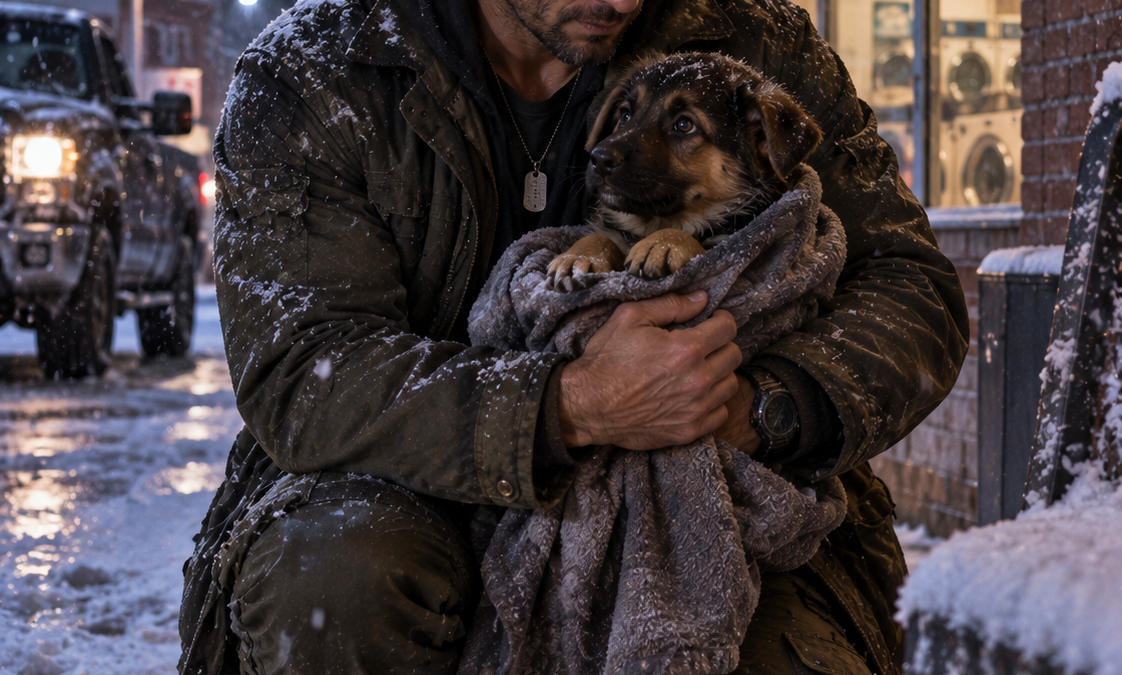
Caleb stood behind him, hands in his jacket pockets, dog tags resting beneath his shirt. He remembered the night clearly, the headlights, the note, the trembling body in his arms.
He remembered thinking only one night. He remembered believing the house could remain unchanged if he kept every feeling temporary enough. Rook finished sniffing, then turned and looked up at him.
There was no miracle in the look, no human wisdom disguised as a dog’s eyes.
Just trust, simple and astonishing. Caleb crouched and scratched behind the uneven ear that still leaned slightly when Rook was tired.
“Yeah,” he said softly.
“Let’s go home.
” That evening, the house at the end of the drive held warm light in its windows.
Caleb fed Rook in the kitchen. The off-white bowl sat beside the food bowl.
Elena’s blue mug watched from the shelf beside the living plant.
Outside, Harrow Lake darkened under a violet sky, keeping its old secrets without demanding Caleb join them. Rook lowered his head and ate. All of it.
When he finished, he stepped back and looked at the empty bowl. Caleb waited, breath held, though he told himself he was not waiting. Rook gripped the rim gently in his teeth.
For one sharp second, Caleb’s heart tightened, expecting the old ritual, the retreat, the shadow, the guarding of absence.
But Rook did not carry the bowl to the corner. He brought it to Caleb.
The puppy crossed the kitchen, bowl clinking softly against the floor whenever it bumped his paws, and set it at Caleb’s boot.
Then he sat, tail sweeping once, cream gray chest a little fuller than it had been the night of the storm. Caleb looked down at the empty bowl, not hidden, offered.
The meaning arrived quietly. Rook was not afraid the empty bowl meant the end anymore. Maybe tomorrow would have another meal.
Maybe people could leave a room and come back. Maybe love, once lost, did not have to become a locked cabinet, a silent chair, a life reduced to not hurting.
Caleb bent and picked up the bowl. He rinsed it, dried it, and set it back in its place beside the off-white one. Then he filled the blue mug with coffee, not water this time.
Coffee, black, bitter, and probably still tasting like tactical mud with emotional damage. He sat at the table in his chair beside the empty one that no longer felt like a wound demanding he bleed forever. Rook curled at his feet with the toy fox under one paw and the moose under his chin, a small guardian of ridiculous treasures.
Caleb lifted the mug. To you, he said quietly.
He did not need to say Elena’s name for the room to know.
The first sip hurt. The second warmed him.
Outside, the northern night lowered itself gently over North Haven. Pines stood dark against the snow. The lake shone faintly under the first stars.
Somewhere next door, Amos’ wind chime rang, bright and uneven, like laughter, learning its way through cold air.
Caleb listened. Rook slept.
The house was not what it had been before loss. It would never be that house again. But it was not a tomb.
It was a place with pawsteps, coffee, old love, new trust, and a light left on for whoever was still finding the way back. Caleb had thought he rescued Rook from the snow.
In the end, Rook had found the corner where Caleb had been waiting too. And together, neither of them had to guard the dark alone.
In the end, Caleb and Rook did not erase each other’s pain.
They simply stayed close enough for healing to begin. Sometimes, grace does not arrive as thunder from the sky. Sometimes it comes as a trembling dog in the snow, an old mug taken from a cabinet, an empty bowl placed at your feet, or a quiet reason to open the door again.
—END—








