“I need you.””I’m not your wife in this room, and I’m not your employee. I’m the actuary investigating a fraudulent claim. We’re equals in this. Or I walk.”
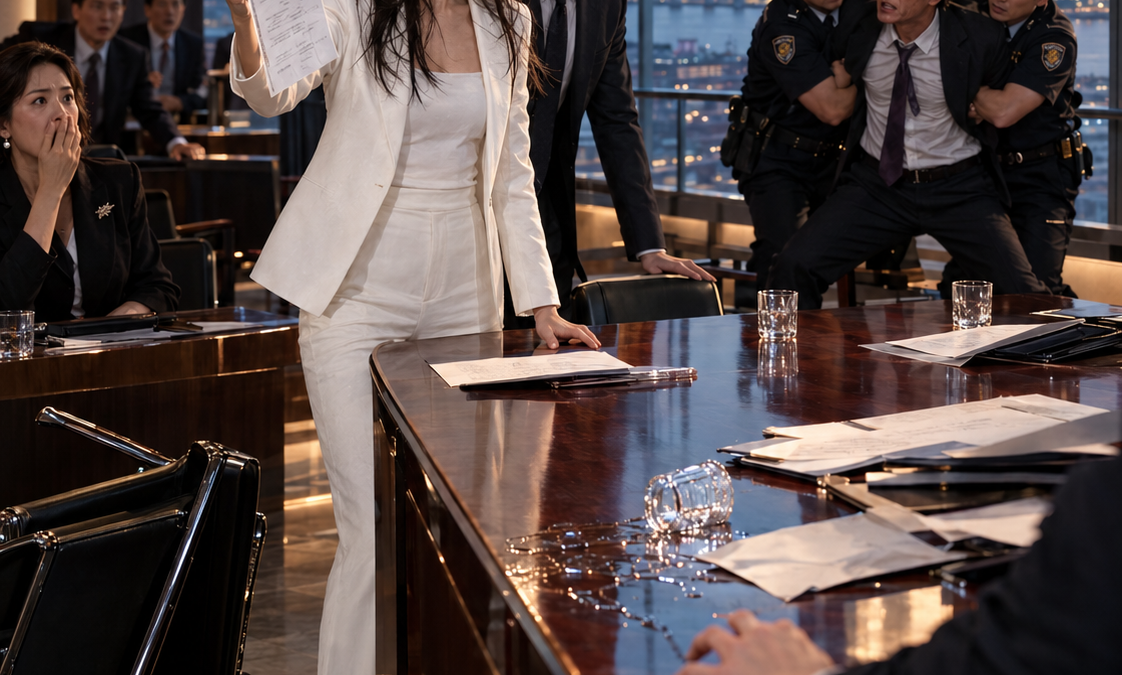
“I need you.”
“I’m not your wife in this room, and I’m not your employee. I’m the actuary investigating a fraudulent claim. We’re equals in this. Or I walk.”
She came to expose a fake death. She stayed to reclaim her own life.
The claim file hit the mahogany conference table with enough force to send a pen rolling.
“Explain this to me again,” Seo Tae-joon said, his voice a low blade, “because I must be misunderstanding something.”
Three people sat across from him in the executive boardroom of Hanjin Group’s headquarters—a glass-and-steel tower in Seoul’s Gwanghwamun district that his grandfather had built from a shipping company and his father had expanded into an empire. Insurance. Construction. Hospitality. Eighty thousand employees. Twelve trillion won in annual revenue. A family name that opened doors from Seoul to Singapore to Silicon Valley.
And right now, all Tae-joon could see was his brother-in-law’s signature on a death claim for a man who wasn’t dead.
“It’s a routine payout,” Park Joon-ho said, spreading his hands with the practiced calm of a man who’d never been punched in the face. He was handsome in the way of expensive suits and whitened teeth, his hair swept back from a high forehead, his manicured fingers laced together on the table. “Uncle Byung-ho passed away in Busan. The documentation is complete. The policy was his—a standard life insurance instrument he took out years ago through our own Hanjin Life division. The beneficiary is the family trust. This is not controversial.”
“Except my signature is on the approval line.” Tae-joon slid the document across the table toward his sister, who sat beside her husband. “And I never signed it.”
Seo Min-ji—his younger sister, thirty-four, elegant in a cream Chanel suit—didn’t look at the paper. She looked at her husband instead. That was the first wrong thing, and Tae-joon catalogued it with the cold precision that had made him the youngest CEO in Hanjin Group’s history.
“Oppa,” she said, using the familial address in that placating tone she’d perfected since childhood, “you’ve been traveling. You sign dozens of documents a week. Maybe you forgot—”
“I don’t forget signatures.” Tae-joon leaned back in his chair. Behind him, through floor-to-ceiling windows, Seoul sprawled under a gray February sky, the Han River a dull silver ribbon cutting through the city. “I especially don’t forget signing off on a three-point-two billion won life insurance payout for an uncle who refused to speak to any of us for the past eleven years. An uncle, I might add, who was supposedly healthy as of his last medical exam six months ago.”
The third person in the room finally spoke.
“He wasn’t healthy.”
Tae-joon’s gaze shifted to the woman sitting at the far end of the table, and something in his chest pulled tight—a sensation he immediately suppressed. Dr. Han Soo-yeon. His wife. Estranged wife. The woman he hadn’t spoken to in nine months, except through lawyers.
She looked different. Thinner. Her black hair was shorter, cut to her jaw in a style that made her look sharper, more severe. She wore a plain navy blouse and gray slacks, no jewelry except the thin gold wedding band she still hadn’t removed. Her hands—the hands of a pianist, he remembered—rested flat on a medical file.
“Uncle Byung-ho had congestive heart failure,” Soo-yeon continued, her voice level, professional. “His cardiologist in Busan documented it. The medical documentation, while thin, meets the policy’s minimum requirements. On paper, this claim is valid.”
“On paper.” Tae-joon repeated the phrase like it tasted bad. “And your professional opinion, Dr. Han?”
Her dark eyes met his. Once, those eyes had looked at him with warmth. Now they held only the flat neutrality of a stranger—or a witness.
“My professional opinion is that this file crossed my desk three weeks ago,” she said. “I flagged it for review because the timing was suspicious. I was told to approve it or find a new job. I chose neither. I called your office.”
“You called my office,” he repeated slowly. “Nine months after you stopped taking my calls. To report a suspicious insurance claim.”
“It wasn’t personal.”
“Everything between us is personal.”
The words landed harder than he intended. Min-ji’s eyes widened. Joon-ho’s expression flickered—something quick and calculating that Tae-joon didn’t miss. Soo-yeon’s jaw tightened, but she didn’t look away.
“The claim is on your desk because I wouldn’t approve it,” she said. “The signature is in question because someone forged it. And the uncle—” She paused, pulling a second document from the file. “—was seen alive in Sokcho six weeks ago.”
The room went very quiet.
Tae-joon took the paper. It was a grainy photograph, printed from what looked like a gas station security camera. A man in a fisherman’s coat, hunched against the wind, walking along a pier. The face was partially obscured, but the posture—the slight stoop of the left shoulder, the way he favored his right leg—was unmistakable.
Byung-ho. His uncle. Alive.
“Where did you get this?” Tae-joon asked.
“It came in my mail last week. No return address. No note.” Soo-yeon’s voice was steady, but her fingers had curled slightly against the table. “That’s the fourth piece of evidence I’ve received in the past month that suggests Uncle Byung-ho is not dead. The first was a hospital intake form from a clinic in Gangneung. The second was a receipt for a ferry ticket to Ulleungdo. The third was a handwritten note—”
“What did the note say?”
She hesitated. For the first time since he’d walked into the room, something flickered in her expression—uncertainty, maybe, or the ghost of an old wound.
“It said: Ask Tae-joon what happened at the Sapphire.”
The words hit him like a physical blow. The Sapphire. A nightclub in Gangnam. A night he’d spent trying to forget for fifteen years.
“What happened at the Sapphire?” Joon-ho asked, his tone casual, but his eyes had gone sharp.
“Nothing relevant to this claim,” Tae-joon said flatly. “Soo-yeon, I need to speak with you privately.”
“Anything you have to say to me—”
“Now.”
Min-ji stood up, her chair scraping against the floor. “Oppa, this is ridiculous. Uncle Byung-ho is dead. We had a funeral. I saw the body—”
“Did you?” Tae-joon turned on his sister, and for a moment, the mask slipped—the cold, controlled CEO giving way to something older, rawer. “Because I didn’t. I was in New York when the funeral happened. Convenient, isn’t it? My own uncle dies, and I’m on the other side of the world, and my signature appears on a payout to the family trust without my knowledge.”
Min-ji’s face went pale. “What are you implying?”
“I’m not implying anything. Yet.” He gathered the documents, tucking them into his briefcase. “Joon-ho, the claim is denied. Effective immediately. If you have a problem with that, file a formal appeal. Soo-yeon—” He gestured toward the door. “My office. Five minutes.”
He didn’t wait for her to follow. He walked out of the boardroom, past the stunned faces of the executive assistants, through the glass-walled corridor that connected the boardroom to the CEO’s suite. His secretary, a taciturn woman named Mrs. Ahn who had been with him for seven years, took one look at his face and stood up from her desk.
“Cancel my meetings for the rest of the day,” he said.
“All of them?”
“All of them.”
He pushed through the double doors into his office—a corner suite with a view of the Han River and the sprawling city beyond—and stood at the window, his back to the door, his hands gripping the windowsill.
He heard her footsteps. The soft click of the door closing.
“You told them,” he said, not turning around. “About the Sapphire.”
“I told them what the note said.” Her voice was behind him, near the door. She hadn’t moved further into the room. “I didn’t tell them what happened. I don’t actually know what happened. You never told me.”
No. He hadn’t. He’d carried that night for fifteen years—the blood on his hands, the body in the alley, the promise he’d made to a dying man. He’d never told anyone. Not even her. Especially not her.
“The claim is fraudulent,” he said, turning to face her. “Joon-ho forged my signature. The question is why. The payout would go to the family trust, which means—”
“Which means whoever controls the trust controls the shares.” Soo-yeon’s eyes met his, and he saw it—the actuary’s brain working behind the still surface of her face. “Uncle Byung-ho’s shares. Twenty-two percent of Hanjin Group. If he’s dead, the shares transfer to the trust. If the trust is administered by—”
“My father. And if my father is incapacitated, which he has been since his stroke—”
“Then you control the trust. Or you would, if you signed the claim.” She paused. “But you didn’t sign it. Joon-ho forged your signature. Which means he was trying to—”
“Steal the shares. Or frame me for fraud. Or both.” Tae-joon moved toward her, and she didn’t flinch—she held her ground, her chin lifted, her eyes steady. “The restructuring vote is in three weeks. If Uncle Byung-ho’s shares are in play, the vote could go either way. Joon-ho wants a seat on the board. Min-ji wants control of the hospitality division. And my mother—”
“Your mother wants you out.”
He stopped. “Yes.”
The silence stretched between them, thick with everything unsaid. Nine months of separation. Fifteen years of secrets. A marriage that had started as a business arrangement and ended—or paused, or fractured, or whatever this was—in a lawyer’s office in Gangnam.
“Why did you come to me?” he asked. “You could have taken this to the police. The insurance board. Anyone. Why bring it here?”
Soo-yeon looked at him for a long moment. Then she reached into her bag and pulled out an envelope—plain white, no return address, the same kind of envelope the other documents had come in.
“Because this came this morning,” she said. “And it’s addressed to you.”
He took the envelope. Inside was a single sheet of paper, handwritten in a shaky, familiar script. His uncle’s handwriting. He’d know it anywhere—the same handwriting that had signed his recommendation letters for university, his admission to the executive training program, the same handwriting that had written him a letter on his wedding day telling him he was making a mistake.
Tae-joon-ah,
If you’re reading this, you’ve finally stopped being an idiot and started asking questions. Good. It’s about time.
I’m not dead. But if I stay in Korea, I will be. Your brother-in-law has been very busy. Your mother has been even busier. And the man who controls the trust controls the company. You know this. You’ve always known this.
I’m sending you clues. One at a time. Not because I don’t trust you, but because I need to know if you’re still the boy I raised or if you’ve become your father’s son.
The first clue: ask your wife why she really left you.
The second clue: the Sapphire wasn’t an accident.
The third clue: I’m closer than you think.
Find me before the restructuring vote. Or don’t. But know this—if Joon-ho gets those shares, everything your grandfather built will burn. And he’ll be the one holding the match.
—Uncle Byung-ho
Tae-joon read the letter twice. Then a third time. Then he looked up at Soo-yeon, who was watching him with an expression he couldn’t read.
“Ask your wife why she really left you,” he said slowly. “What does that mean?”
She didn’t answer.
“Soo-yeon.”
“Maybe you should ask yourself,” she said quietly, “why you never came after me.”
The words hung in the air between them. Outside, Seoul hummed with the sound of traffic, of millions of lives moving through the city. Inside, the silence was absolute.
“I need your help,” he said finally. The words cost him something—he could feel it, a tightness in his chest, a bruise on his pride. “I need someone on the inside of Hanjin Life who can trace the medical documents. Someone who knows the actuarial tables, the approval process, the—”
“You need an actuary.”
“I need you.”
Another silence. Longer this time. Soo-yeon looked at him, and he saw something shift in her eyes—not warmth, not forgiveness, but something harder. A calculation. A decision being made.
“I’ll help you,” she said. “On one condition.”
“Name it.”
“I don’t work for you. I don’t answer to you. I’m not your wife in this room, and I’m not your employee. I’m the actuary investigating a fraudulent claim, and you’re the CEO whose signature was forged. We’re equals in this. Or I walk.”
He wanted to argue. He wanted to remind her that he was the CEO of a twelve-trillion-won conglomerate and she was an actuary who’d been pushed out of her job six months ago, that she needed him as much as he needed her. But he looked at her—at the set of her jaw, the steadiness of her gaze—and he remembered something she’d said to him once, years ago, when they were still pretending their marriage could work.
I will never be someone’s possession. Not yours. Not anyone’s.
“Equals,” he said.
She nodded once. “Then we start now. I need access to the Hanjin Life claims database. Full access, no restrictions. And I need to know everything about the Sapphire.”
“No.”
“The note mentioned it. The letter mentioned it. Whatever happened that night is connected to this.”
“The Sapphire is not connected to this.”
“You don’t know that.”
“I do.” He moved closer to her, close enough to smell her perfume—the same one she’d always worn, jasmine and something else, something clean and sharp. “The Sapphire happened fifteen years ago. Uncle Byung-ho wasn’t there. Joon-ho wasn’t there. It has nothing to do with—”
“Then why did Uncle Byung-ho mention it in his letter?”
He didn’t have an answer for that.
“Fine,” he said. “But you don’t get to ask about the Sapphire until I trust you.”
“You don’t trust me?”
“I haven’t trusted anyone in fifteen years.” He turned back to the window. “You of all people should know that.”
She was quiet for a moment. Then: “I’ll need a workspace. And access to the files by tomorrow morning.”
“You’ll have it.”
“And Tae-joon?”
He turned. She was standing in the doorway now, her hand on the frame, her face half in shadow.
“I didn’t leave because I stopped loving you,” she said. “I left because I couldn’t breathe.”
She walked out before he could respond. The door clicked shut behind her, and Tae-joon stood alone in his office, the letter from his uncle still in his hand, the words ask your wife why she really left you burning in his mind.
He didn’t know what she meant. He didn’t know what his uncle was playing at. But he knew one thing for certain: whoever was trying to take control of Hanjin Group had made a mistake.
They’d brought Soo-yeon back into his life.
And he wasn’t going to let her go again.
Chapter 2: The Claim
The apartment was cold when Soo-yeon got home.
She’d rented it six months ago, after the separation, after she’d moved out of the penthouse in Hannam-dong with its sweeping views and its silent rooms and its husband who was never there. It was a two-bedroom in Mapo-gu, on the third floor of a building that had been new in the nineties and had never quite recovered. The heating was unreliable. The walls were thin. The kitchen had a gas stove that clicked three times before it lit.
She liked it. It was hers.
She hung her coat on the hook by the door, toed off her heels, and walked into the kitchen to put the kettle on. While the water heated, she spread the documents across her small dining table—the medical file, the security photograph, the handwritten notes, the letter she’d stolen a glance at before handing it to Tae-joon.
Ask your wife why she really left you.
She hadn’t told him the truth. Not all of it. She’d told him she couldn’t breathe, which was true, but it wasn’t the whole truth. The whole truth was more complicated—more dangerous—and she wasn’t sure he was ready to hear it.
She poured the tea and sat down, pulling the medical file toward her.
Park Byung-ho. Sixty-seven years old. Brother of the late Hanjin Group chairman. Estranged from the family for eleven years, ever since a dispute over shares had turned into a cold war. Lived alone in a house in Busan, on the coast, where he kept a boat and a garden and, according to the last neighbor interview, “a grudge he watered every day.”
The medical documentation listed congestive heart failure, diagnosed eighteen months ago. A cardiologist in Busan—Dr. Kim Hyun-woo, licensed, board-certified—had signed the death certificate. The cause of death: cardiac arrest. The date: January 17th. The body: cremated, per Byung-ho’s written wishes, three days later.
It all looked legitimate. That was the problem.
Soo-yeon had been an actuary for twelve years. She’d reviewed thousands of claims, and she’d learned to spot the ones that were too clean, the ones where every box was ticked and every form was filled and nothing was out of place. Fraud, in her experience, didn’t usually announce itself with errors. It announced itself with perfection.
She opened her laptop and pulled up the Hanjin Life claims database. Tae-joon had come through—her access had been restored, full permissions, no restrictions. She could see everything: the original policy application, the premium payments, the beneficiary designations, the medical examiner’s report.
The policy had been taken out eight years ago. The premium: three million won a year. The beneficiary: the Byung-ho Family Trust, administered by Hanjin Group’s legal department. The death benefit: three point two billion won.
Soo-yeon scrolled through the application. Byung-ho’s signature was there, on the bottom, along with the date. She compared it to the signature on the death certificate. They matched.
She compared it to the letter Tae-joon had shown her. They didn’t.
Not exactly. The letter’s handwriting was shakier, the strokes less controlled, the spacing uneven. That could be age, or illness, or stress. But there was something else—a small difference in the way the letter *g* was formed, a loop that the policy application didn’t have.
Soo-yeon pulled up a handwriting analysis program she’d used before, when she’d worked fraud cases for a previous employer. She fed in the letter, the policy application, and the death certificate. Then she waited.
The results came back in three minutes.
The letter and the policy application had a 94% match. The letter and the death certificate had a 71% match. The death certificate’s signature was a forgery.
She sat back in her chair, her heart beating faster than it should. This wasn’t just a suspicious claim anymore. This was fraud. Someone had forged Uncle Byung-ho’s signature on a death certificate, which meant someone had either killed him or was pretending he was dead. Either way, they were willing to commit a felony to get their hands on twenty-two percent of Hanjin Group.
Her phone buzzed. A text message from an unknown number.
Check the doctor. Kim Hyun-woo. Busan. He has a gambling problem.
Soo-yeon stared at the message. Then she typed back: Who is this?
No response.
She tried again: Uncle Byung-ho?
The reply came a moment later: Don’t tell Tae-joon. Not yet. He needs to figure it out on his own.
Soo-yeon’s hand trembled. She set the phone down on the table, face-up, and stared at the words on the screen. It was him. It had to be him. The estranged uncle, the man everyone thought was dead, was sending her text messages.
She thought about calling Tae-joon. She thought about forwarding the message, telling him everything, letting him take over. It would be the smart thing to do. The safe thing.
But something stopped her. Some instinct, some memory, some ghost of the woman she’d been before the separation. The woman who’d believed she could trust her husband. The woman who’d been wrong.
He needs to figure it out on his own.
Fine. She’d let him figure it out. But she wasn’t going to sit around waiting for him to catch up.
She opened her laptop and started digging into Dr. Kim Hyun-woo.
Chapter 3: The Mother
The next morning, Soo-yeon arrived at Hanjin Group headquarters at 7:45 AM. The lobby was already busy—employees in dark suits and heels, security guards at the metal detectors, a coffee kiosk doing brisk business. She swiped her new access card at the turnstile and took the elevator to the seventeenth floor, where the actuarial department was located.
Her new workspace was a small office at the end of the hall, with a window that looked out onto a gray concrete building. A desk, a chair, a computer, a filing cabinet. It was exactly what she’d asked for: functional, private, and far from the executive suite.
She’d just sat down when the door opened.
“Dr. Han.”
Soo-yeon looked up. The woman in the doorway was tall, elegant, and terrifying—even at sixty-four, even with the silver hair and the soft smile, there was something about Seo Hye-ryun that made you want to check your pockets. She was Tae-joon’s mother, the widow of the late chairman, the matriarch of the Seo family. She was also, according to rumor, the reason Soo-yeon had been pushed out of her job six months ago.
“Mrs. Seo,” Soo-yeon said, standing. “What a surprise.”
“Not a surprise, surely. You’re working for my son now. I wanted to see how you were settling in.” Hye-ryun walked into the office, her eyes moving across the space with the cool assessment of a woman who’d spent forty years judging people and finding them wanting. “Small. But then, you’ve always preferred small, haven’t you? Small apartment. Small job. Small ambitions.”
Soo-yeon kept her expression neutral. “I like to think of it as focused.”
“Yes. Focused.” Hye-ryun sat down in the chair across from the desk, crossing her legs at the ankle. She was wearing a Chanel suit in deep navy, pearls at her throat, her hair perfectly coiffed. She looked like a magazine spread come to life. “I heard about the claim you flagged. The one for my dear brother-in-law. Such a tragedy, his passing. Though I must admit, I was surprised to hear you were the one who found the irregularities.”
“I’m an actuary. Finding irregularities is what I do.”
“Mmm. And finding your way back into my son’s life—is that also what you do?”
The words were polite. The tone was not. Soo-yeon felt her jaw tighten.
“I’m here to do a job, Mrs. Seo. Nothing more.”
“I’m sure.” Hye-ryun smiled, but her eyes were cold. “You know, when you left Tae-joon, I was relieved. He needed a wife who could support him, not a wife who brought scandal and gossip and—how shall I put this—complications. But he wouldn’t divorce you. He wouldn’t even discuss it. Do you know why?”
Soo-yeon didn’t answer.
“Because he’s stubborn. And because he’s sentimental, in a way he’d never admit. He thinks he owes you something.” Hye-ryun leaned forward slightly. “But I want you to understand something, Soo-yeon. My son is the CEO of Hanjin Group. He is the heir to a legacy that took three generations to build. And I will not allow anyone—anyone—to threaten that legacy. Not a brother-in-law with delusions of grandeur. Not a dead uncle with a grudge. And not an estranged wife who suddenly reappears with accusations and forged signatures.”
Soo-yeon’s hands had gone very still on the desk. “Are you threatening me, Mrs. Seo?”
“I’m warning you.” Hye-ryun stood, smoothing her skirt. “If you hurt my son again, I will destroy you. I don’t care about the claim. I don’t care about the shares. I care about my family. And you, Dr. Han, are not part of my family. Not anymore.”
She walked to the door, then paused, looking back over her shoulder.
“One more thing. The restructuring vote is in three weeks. If you’re smart, you’ll stay out of it. Let the men handle the business. That’s what women like you are best at, isn’t it? Staying quiet. Staying out of the way.”
She left, closing the door softly behind her.
Soo-yeon sat frozen for a long moment. Her heart was pounding—not with fear, but with anger, the hot, helpless anger of a woman who’d been told her entire life to stay quiet, stay small, stay out of the way.
She reached for her phone and texted the unknown number.
Your sister-in-law just threatened me. Did you know she was involved?
The reply came almost instantly: She’s more involved than you think. Check the trust documents. Find out who the successor trustee is.
Soo-yeon frowned. The successor trustee—the person who would take over the trust if the current trustee became incapacitated or died. Tae-joon’s father was the current trustee, but he’d been in a coma since his stroke three years ago. The successor trustee would be…
She opened the Hanjin Group legal database and pulled up the trust documents.
There it was, on page fourteen, in black and white.
In the event of the incapacity or death of the primary trustee, the successor trustee shall be Park Joon-ho, son-in-law of the late chairman.
Soo-yeon stared at the screen. Joon-ho. The brother-in-law. The man who’d forged Tae-joon’s signature. The man who was pushing for the restructuring vote.
If Byung-ho’s shares went into the trust, and Joon-ho became the successor trustee, then Joon-ho would control twenty-two percent of Hanjin Group. Combined with his wife’s shares—Min-ji owned eight percent—he’d have enough voting power to challenge Tae-joon’s control of the company.
And if Tae-joon was implicated in the fraudulent claim—if it came out that his signature was on the payout document, even a forged signature—then he’d be removed as CEO. Disgraced. Possibly arrested.
Joon-ho wasn’t just trying to steal the shares. He was trying to destroy Tae-joon.
Soo-yeon’s phone buzzed again.
Now you understand. The question is: what are you going to do about it?
She typed back: Who are you? Really?
The reply took longer this time. Almost a full minute.
I’m the man who raised Tae-joon. The man who taught him to run this company. The man your mother-in-law tried to erase. And I’m not going to let her destroy everything I built. Find me, Soo-yeon. Before it’s too late.
She set the phone down, her mind racing.
The door opened again. This time, it was Tae-joon.
He looked tired—the kind of tired that came from sleepless nights and too much caffeine and the weight of a twelve-trillion-won company on your shoulders. His tie was loosened, his collar unbuttoned, his hair slightly disheveled.
“We need to talk,” he said.
“About what?”
“About the fact that you’ve been receiving text messages from my uncle.”
Soo-yeon’s blood went cold. “How do you know that?”
“Because I’ve been receiving them too.” He held up his phone. “And he told me to ask you why you really left me. So I’m asking. What aren’t you telling me?”
She looked at him—at the man she’d married, the man she’d loved, the man she’d left—and she felt the words rise up in her throat. The truth. The real truth. The thing she’d never told anyone.
“I left because your mother threatened to have me killed,” she said.
The silence that followed was deafening.
Tae-joon didn’t move. Didn’t blink. His face went very still, the way it did when he was processing something too big to react to.
“What?”
“Six months before I left. Your mother invited me to tea at the house in Pyeongchang-dong. She told me she knew about the deal my father made with your uncle—the deal that brought us together in the first place. She said if I didn’t leave you, she’d make sure my father spent the rest of his life in prison for fraud. And then she said—” Soo-yeon’s voice cracked. She stopped, swallowed, forced herself to continue. “She said accidents happen. People fall down stairs. Cars crash on rainy roads. She said if I stayed, I’d regret it.”
Tae-joon’s hands had curled into fists at his sides. “Why didn’t you tell me?”
“Because I didn’t think you’d believe me. Because she’s your mother. Because—” She broke off, shaking her head. “Because I was scared. I was scared and I was alone and I didn’t know what to do. So I left. I told myself it was for the best. That you’d be better off without me.”
He took a step toward her. Then another. Then he was standing in front of her, close enough that she could see the pulse beating in his throat.
“My mother threatened you,” he said, his voice low and rough. “And you believed her.”
“She’s a powerful woman.”
“So am I.” He reached out, hesitated, then took her hand. His grip was warm, firm, careful. “I’m not my father. I’m not going to let her control my life. Or yours.”
“You can’t promise that.”
“I can promise I’ll try.” He looked at her—really looked at her, the way he hadn’t in months, maybe years—and something in his expression shifted. Softened. “I’m sorry I didn’t fight for you. I should have. I should have come after you. I should have—”
“Tae-joon.”
“—I should have believed you when you said you couldn’t breathe. I should have asked why. I should have—”
“Tae-joon.” She pulled her hand away. “We can’t do this. Not now. Not while there’s a fraud investigation and a restructuring vote and your uncle sending cryptic text messages. We need to focus.”
He looked at her for a long moment. Then he nodded.
“Fine. We focus.” He stepped back, putting distance between them. “But after this is over—after we’ve found Uncle Byung-ho and stopped Joon-ho and figured out what the hell is going on—we’re going to talk. Really talk. About us.”
“There is no us.”
“There could be.” He held her gaze. “If you want there to be.”
She didn’t answer. She didn’t know how.
“Meet me in my office at six,” he said. “We’ll go over what we have so far. And Soo-yeon?”
“What?”
“I’m glad you’re here.”
He left before she could respond. Soo-yeon stood alone in her small office, her heart racing, her mind spinning, and wondered what she’d gotten herself into.
Chapter 4: The Sapphire
Six o’clock came faster than Soo-yeon expected. She’d spent the afternoon digging into Dr. Kim Hyun-woo—and what she’d found made her skin crawl.
The cardiologist who’d signed Uncle Byung-ho’s death certificate had a gambling problem, just as the text message had said. He owed money to several illegal lending operations in Busan, and he’d been seen at a high-stakes poker game in Seoul three days before the death certificate was issued. The game was hosted by a company called Blue Star Holdings—a shell corporation that traced back, through three intermediaries, to Park Joon-ho’s personal investment fund.
Soo-yeon gathered the documents and headed to the executive suite.
Tae-joon’s office was empty when she arrived, but the door was open. She walked in, set her files on the conference table, and stood at the window, looking out at the city. The sun had set, and Seoul was a sprawl of lights—headlights and streetlamps and the glowing windows of a thousand buildings.
“Sorry I’m late.”
She turned. Tae-joon stood in the doorway, still in his suit but with his jacket off, his sleeves rolled up to the elbow. He looked tired, but there was something different about him tonight—a tension, a readiness, like a man preparing for a fight.
“What did you find?” he asked, closing the door.
“Dr. Kim Hyun-woo. The cardiologist who signed the death certificate. He’s in debt to a gambling ring that connects to Joon-ho’s investment fund.” She handed him the file. “The death certificate is forged. I ran handwriting analysis. The signature doesn’t match Uncle Byung-ho’s other documents.”
Tae-joon studied the file, his jaw tightening. “So Joon-ho paid off the doctor to fake the death certificate.”
“It looks that way.”
“But why? If Uncle Byung-ho is alive, the death certificate is meaningless. The only way this works is if—”
“If the family believes he’s dead. If no one asks questions. If the claim goes through and the shares transfer to the trust.” Soo-yeon met his eyes. “Joon-ho didn’t know Uncle Byung-ho would send us evidence. He thought he had it all under control.”
“But he doesn’t.” Tae-joon set the file down. “Because Uncle Byung-ho is alive, and he’s sending us clues, and he’s—” He paused, a strange look crossing his face. “He’s testing us. Both of us.”
“Testing us how?”
“Testing whether we’re still the people he raised. Whether we’re still worth saving.” Tae-joon moved to the window, standing beside her. “Uncle Byung-ho was the one who taught me how to run this company. He was the one who taught me to ask questions, to dig deeper, to never trust anyone who wanted power too badly. When my father had his stroke, Uncle Byung-ho was supposed to take over as chairman. But my mother—” He shook his head. “She orchestrated a vote. She turned the board against him. She accused him of embezzlement, of mismanagement, of conspiring with rival families. It was all lies, but it worked. He was pushed out. Exiled to Busan.”
“And your father? What did he do?”
“He was in a coma. He couldn’t defend his brother. And by the time he woke up—” Tae-joon’s voice hardened. “He wasn’t the same man. The stroke had damaged his brain. He couldn’t remember anything. He couldn’t remember that his own wife had betrayed his brother.”
Soo-yeon was quiet for a moment. “Your mother is dangerous.”
“My mother is a survivor. She came from nothing, married into this family, and spent forty years making sure no one could ever take it away from her. She’s not evil—she’s just willing to do whatever it takes.” He looked at Soo-yeon. “Including threatening my wife.”
“Ex-wife.”
“Legally, no.” He turned to face her. “We’re still married, Soo-yeon. You never filed. I never filed. As far as the law is concerned, we’re husband and wife.”
She stared at him. “You never told me you wanted a divorce.”
“I never told you I didn’t.” He moved closer. “I didn’t file because I didn’t want to. I didn’t want to let you go. I thought if I just gave you space, if I waited long enough, you’d come back. And then months passed, and I convinced myself you were better off without me, and I—” He stopped. Swallowed. “I was wrong.”
Soo-yeon felt something crack open in her chest—something she’d locked away nine months ago, something she’d told herself she didn’t feel anymore.
“Tae-joon—”
“I’m not asking you to forgive me. I’m not asking you to be my wife again. I’m just asking you to stay. Long enough to figure this out. Long enough to find Uncle Byung-ho. Long enough to—”
“I’m not going anywhere.” She said it before she could stop herself. “Not until this is over.”
He looked at her, and for a moment, the mask slipped—the cold, controlled CEO gave way to something younger, more vulnerable. Something that looked almost like hope.
“Good,” he said. “Then let’s get to work.”
They sat at the conference table, files spread around them, and started piecing together the puzzle. The forged signature. The compromised doctor. The trust documents. The restructuring vote. The Sapphire.
“We need to talk about the Sapphire,” Soo-yeon said.
Tae-joon’s expression shuttered. “I told you—”
“I don’t care what you told me. Uncle Byung-ho mentioned it in his letter. It’s connected. You need to tell me what happened.”
He was silent for a long moment. Then he got up, walked to the window, and stood with his back to her.
“Fifteen years ago,” he said, “when I was twenty-three, I made a mistake. I was young, I was stupid, and I was trying to prove something to my father. He’d sent me to negotiate a deal with a group of investors from Shanghai—the kind of deal that involved more than just money. There was a fight. A man died. My uncle—Uncle Byung-ho—he was the one who cleaned it up. He paid off the witnesses. He bribed the police. He made sure no one connected the death to me.”
Soo-yeon’s blood ran cold. “You killed someone?”
“No.” He turned to face her. “I didn’t kill him. But I was there. I was responsible. And Uncle Byung-ho covered it up. He saved me. He saved the company. And my mother—she knew. She’s known for fifteen years. She’s been holding it over my head, using it to control me, reminding me that she could destroy me anytime she wanted.”
“And Joon-ho? Does he know?”
“I don’t know. But if he did—if he found out—he could use it. He could go to the police. He could destroy everything.” Tae-joon’s voice was raw. “That’s what the Sapphire is. That’s my secret. The thing I’ve been hiding for fifteen years.”
Soo-yeon stood up and walked toward him. She stopped a few feet away, close enough to see the tension in his shoulders, the way his hands were clenched at his sides.
“Everyone has secrets,” she said. “Everyone has things they’d do anything to hide. That doesn’t make you a bad person. It makes you human.”
“It makes me a liability. To you, to the company, to everyone who depends on me.”
“No.” She took another step. “It makes you someone who needs help. And I’m here. I’m not going anywhere. So stop pushing me away.”
He looked at her—really looked at her—and something in his expression broke. For a moment, he wasn’t the CEO of Hanjin Group. He wasn’t the heir to a billion-dollar empire. He was just a man, tired and scared and desperately alone.
“I don’t know how to stop,” he said.
Soo-yeon reached out and took his hand. “Then let me teach you.”
 [Tap here for the Next Part ]