Part 2: “I need you.””I’m not your wife in this room, and I’m not your employee. I’m the actuary investigating a fraudulent claim. We’re equals in this. Or I walk.”
Chapter 5: The Vote
The next two weeks passed in a blur of investigation and preparation.
Soo-yeon worked from her small office on the seventeenth floor, combing through years of Hanjin Life records, tracing payments, following leads. She found more evidence of Joon-ho’s scheme—shell companies in the Cayman Islands, wire transfers to Swiss bank accounts, a network of bribes and payoffs that stretched from Busan to Seoul to Shanghai.
Tae-joon worked from the executive suite, meeting with lawyers, preparing his defense, trying to figure out who on the board was loyal and who had been bought.
They met every night at six o’clock. Sometimes in his office. Sometimes in hers. Sometimes in a small café near the building, where they could talk without being overheard.
They didn’t touch. They didn’t talk about their marriage. They didn’t talk about the future. They just worked—two people with a common goal, united by a common enemy.
But slowly, gradually, the walls between them began to crumble.
It started with small things. Tae-joon brought her coffee in the morning, remembering how she took it—black, no sugar, a splash of cold water to cool it down. Soo-yeon brought him dinner when he forgot to eat, setting it on his desk without a word, watching from the corner of her eye as he picked at it.
Then came the jokes—dry, sarcastic, the kind of humor they’d shared in the early days of their marriage. Tae-joon made a comment about Joon-ho’s hair transplant, and Soo-yeon laughed so hard she nearly choked. Soo-yeon made a comment about the board’s fashion sense, and Tae-joon smiled—a real smile, the first she’d seen in months.
Then came the late-night conversations—the quiet moments when the files were closed and the computers were off and they just talked. About their childhoods. About their dreams. About the things they’d never told anyone.
“I used to think I’d be a pianist,” Soo-yeon said one night, sitting on the floor of Tae-joon’s office, her back against the sofa. “My mother taught me. She said I had the hands for it. But then she died, and my father couldn’t afford the lessons, and—” She shrugged. “I became an actuary instead. Numbers instead of music.”
“Do you regret it?”
“Sometimes. But then I think about the lives I’ve saved—the fraudulent claims I’ve caught, the families who would have lost everything if I hadn’t been paying attention. And I think maybe this is what I was supposed to do.”
Tae-joon was sitting at his desk, watching her. “You never told me that.”
“You never asked.”
The silence that followed was different—heavier, charged with something unspoken.
“I’m sorry I didn’t ask,” he said. “I’m sorry I didn’t ask about a lot of things.”
Soo-yeon looked at him. “You’re asking now.”
The night before the restructuring vote, they met in his office one last time. The evidence was gathered. The lawyers were prepared. Everything was in place.
“If this works,” Tae-joon said, “Joon-ho will be arrested. My mother will be implicated. The board will have to choose sides.”
“If this fails,” Soo-yeon said, “you’ll be removed as CEO. You might be arrested. The company could go to Joon-ho.”
“Then we can’t fail.”
She looked at him—at the man she’d married, the man she’d left, the man she was starting to believe in again—and felt something shift in her chest.
“We won’t,” she said.
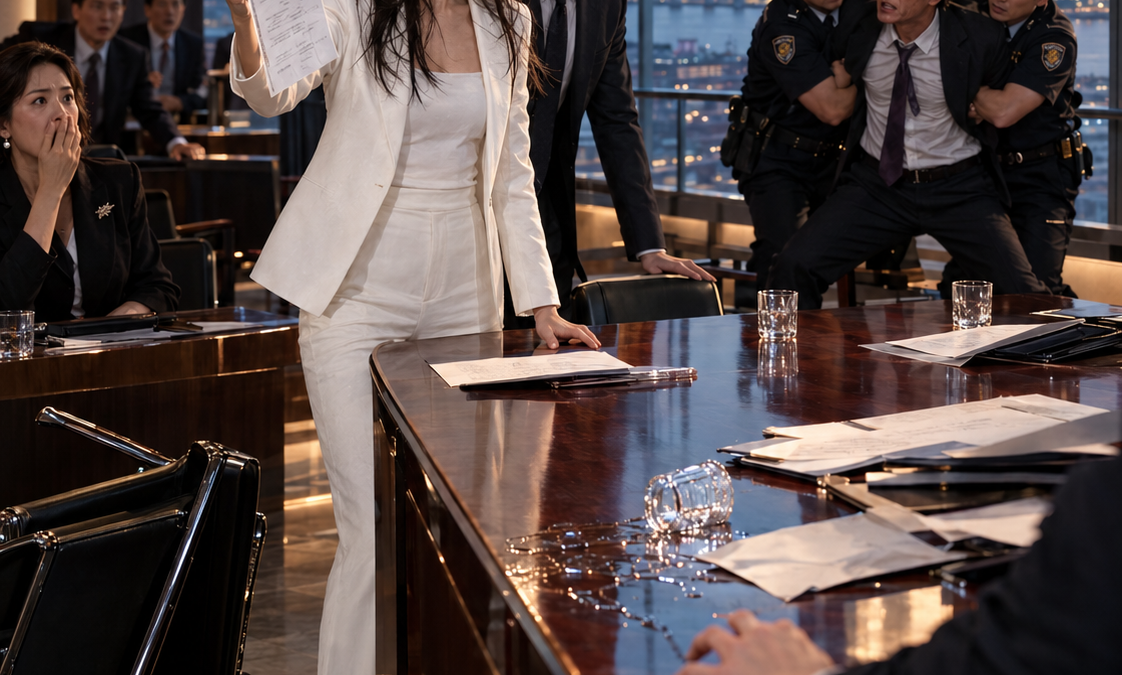
The restructuring vote was held in the grand boardroom on the twentieth floor. The entire board was present—twelve men and women in dark suits, seated around a long mahogany table, with Tae-joon at the head. Soo-yeon stood in the back, near the door, watching.
Joon-ho arrived last, as if making an entrance. He was wearing a new suit, a new watch, a new confidence. Min-ji was at his side, her hand on his arm, her expression nervous.
“Shall we begin?” Joon-ho asked, settling into his chair.
Tae-joon didn’t answer. He simply slid a document across the table.
“What’s this?” Joon-ho picked it up, scanned it, and went pale.
“It’s the proof that you forged my signature on a fraudulent insurance claim,” Tae-joon said, his voice calm. “It’s also proof that you paid Dr. Kim Hyun-woo to falsify a death certificate. And it’s proof that you’ve been planning to take control of this company by any means necessary.”
Joon-ho’s face twisted. “This is absurd. These are lies—”
“The police are waiting outside,” Tae-joon said. “They have warrants for your arrest. For fraud. For forgery. For conspiracy to commit murder.”
“Murder?” Min-ji’s voice was shrill. “What are you talking about?”
Tae-joon looked at his sister, and for a moment, his expression softened. “Uncle Byung-ho isn’t dead. He’s been in hiding for months, trying to gather evidence against your husband. Joon-ho tried to have him killed when he refused to sign over his shares.”
Min-ji’s face crumpled. She turned to Joon-ho. “Is this true?”
Joon-ho was on his feet now, his eyes wild. “Don’t listen to him. He’s lying. He’s trying to destroy us—”
The doors at the back of the room opened, and two police officers walked in.
“Park Joon-ho,” one of them said. “You’re under arrest.”
Joon-ho ran.
He shoved past Min-ji, knocked over a chair, and bolted for the side door. But Tae-joon was faster. He caught Joon-ho by the arm, spun him around, and slammed him against the wall.
“It’s over,” Tae-joon said, his voice low and dangerous. “You’re done.”
The police officers took Joon-ho away. Min-ji collapsed into a chair, sobbing. The board sat in stunned silence.
And from the doorway, a voice spoke.
“Well. That was dramatic.”
Everyone turned.
A man stood in the entrance—thin, weathered, with a fisherman’s coat and a walking stick and a smile that didn’t quite reach his eyes.
Uncle Byung-ho.
“I believe I have a vote to cast,” he said.
Chapter 6: The Man Who Came Back
The boardroom erupted.
Twelve board members were on their feet at once, shouting over each other—questions, accusations, demands for order. Min-ji’s sobbing cut through it all, a high, keening sound that made the hairs on Soo-yeon’s arms stand up. Tae-joon stood frozen by the side door, his hand still raised from where he’d slammed Joon-ho against the wall, his face a mask of controlled fury.
But Soo-yeon was watching the man in the doorway.
Byung-ho looked older than his photograph. The fisherman’s coat hung off his frame, too big for shoulders that had once filled a chairman’s suit. His left hand gripped a walking stick; his right hand hung at his side, fingers slightly curled, as if they’d forgotten how to unclench. The stoop she’d seen in the security camera was more pronounced now, a permanent question mark in the shape of his spine.
But his eyes—his eyes were sharp. They swept the room once, taking in the chaos, the arrests, the open mouths of the board members, and then they landed on Soo-yeon.
He smiled. A real smile this time. It crinkled the corners of his eyes and made him look, for a moment, like the man Tae-joon had described—the uncle who’d taught him to ask questions, to dig deeper, to never trust anyone who wanted power too badly.
“Dr. Han,” Byung-ho said, his voice gravelly but clear. “I believe I owe you a debt.”
“You owe me an explanation,” Soo-yeon said.
“Several. But first—” He turned to the board. “I’m not dead. I apologize for the inconvenience. And I’d like my seat back.”
The board chairman—a silver-haired man named Hwang In-soo who had been with Hanjin Group for thirty years—cleared his throat. “Mr. Park, this is highly irregular—”
“So is attempting to steal my shares through a forged death certificate. So is conspiring with my brother’s widow to remove my nephew from his rightful position. So is—” Byung-ho’s voice hardened. “—trying to have me killed. Which is what happened when I refused to sign the transfer documents Joon-ho put in front of me.”
A murmur ran through the room.
“I have evidence,” Byung-ho continued. “Recordings. Documents. Witness statements. I’ve been gathering them for months, waiting for the right moment to return. And now—” He gestured toward the door where the police had taken Joon-ho. “—the right moment has arrived.”
Hwang In-soo looked at Tae-joon. “Mr. Seo? Do you corroborate this?”
“I do,” Tae-joon said. “My uncle has been in contact with me and with Dr. Han for several weeks. He’s been providing evidence of the conspiracy against him. Against the company. Against me.”
“And your mother? Mrs. Seo Hye-ryun?”
The room went quiet again. Soo-yeon saw Tae-joon’s jaw tighten. She saw the flicker of something—pain, anger, grief—pass through his eyes.
“My mother,” he said slowly, “will be investigated. If she’s found to be involved in the conspiracy, she will be held accountable. No one is above the law. Not even family.”
Hwang In-soo nodded slowly. “Then I propose we table the restructuring vote until the investigation is complete. All in favor?”
Every hand in the room went up.
The aftermath took hours.
Statements were given. Evidence was logged. Lawyers arrived, then more lawyers, then the police again. Byung-ho was taken to a private room to give his formal testimony, his walking stick clicking against the marble floors of the executive corridor. Min-ji was escorted out by her assistant, her face blotchy and swollen, her cream Chanel suit rumpled. She didn’t look at Tae-joon. She didn’t look at anyone.
Soo-yeon stayed in the background, answering questions when asked, watching the machinery of a conglomerate in crisis grind into motion. She saw Tae-joon in the corridor once, surrounded by men in suits, his face pale but composed. He caught her eye across the crowd and held her gaze for a moment—just a moment—before he was pulled away.
It was nearly midnight when the building finally emptied.
Soo-yeon was gathering her files in the small office on the seventeenth floor when the door opened. She didn’t have to turn around to know who it was.
“You should go home,” Tae-joon said.
“So should you.”
“I can’t.” He walked into the office and sank into the chair across from her desk—not the CEO’s chair, not the heir’s chair, just a chair. He looked exhausted. “The investigators want to meet again tomorrow. The board wants a full report by Friday. And my mother—” He stopped. Pressed his fingers to his eyes.
“Have you spoken to her?”
“She left the building before the police arrived. Her assistant says she’s at the house in Pyeongchang-dong. She’s not answering her phone.” He lowered his hands. “She knows what’s coming.”
Soo-yeon sat down across from him. “What is coming?”
“Arrest. Disgrace. The end of everything she spent forty years building.” He met her eyes. “And I don’t know how to feel about it.”
“She threatened to have me killed. She threatened your uncle. She manipulated the board, the trust, the company—”
“I know.”
“She’s a criminal, Tae-joon.”
“I know.” His voice cracked. “She’s also my mother.”
Soo-yeon was quiet for a moment. Then she reached across the desk and took his hand.
“You don’t have to know how to feel,” she said. “You just have to feel it.”
He looked at her hand on his. Then at her face. And something in his expression—something hard and guarded that he’d been carrying for years—cracked open.
“I missed you,” he said.
“I know.”
“I missed your voice. Your laugh. The way you hum when you’re concentrating. The way you—”
“Tae-joon.”
“—the way you always knew when I was lying. Even when I was lying to myself.”
She squeezed his hand. “We can’t do this. Not tonight. Not while everything is still—”
“I know.” He squeezed back. “But I want you to know. Whatever happens—whatever comes next—I’m not going to let you go again. Not without a fight.”
She pulled her hand away. “You didn’t fight before.”
The words landed like a slap. He flinched.
“No,” he said. “I didn’t. I was a coward. I was afraid of my mother, afraid of the company, afraid of—” He shook his head. “I was afraid of you. Of how much I needed you. It was easier to let you go than to admit that.”
“And now?”
“Now I’ve lost everything else. The only thing I’m afraid of losing is you.”
Soo-yeon stood up. She walked to the window and looked out at the city—the lights, the river, the sprawl of a metropolis that never slept. She could feel him watching her. She could feel the weight of his words, the truth in them, the years of silence and distance and longing.
“I need time,” she said.
“I know.”
“I need to figure out who I am now. Not who I was when we met. Not who I was when I left. Not who my mother-in-law tried to make me into.”
“I know.”
“And I need to know that you’re not going to turn back into the man who let me walk away.”
“I won’t.”
“You can’t promise that.”
“I can promise to try.” He stood up and walked toward her. “I can promise to be better. I can promise to fight for you every day. I can promise that if you give me another chance, I’ll spend the rest of my life proving that I deserve it.”
She turned to face him. He was close now—close enough to touch, close enough to kiss. She could see the lines around his eyes, the fatigue in his face, the desperate hope he was trying so hard to hide.
“I’m not ready,” she said. “Not yet.”
“Then I’ll wait.”
“How long?”
“As long as it takes.” He smiled—a tired, crooked smile that made her chest ache. “I’ve waited nine months. I can wait longer.”
Chapter 7: The House in Pyeongchang-dong
Three days later, Soo-yeon drove to the Seo family estate.
It was a long drive—north of the city, into the hills, past the gates of other houses that were just as grand and just as hidden. The estate had been in the family for three generations, a sprawling compound of traditional hanok buildings and modern additions, surrounded by gardens and walls that kept the world out.
The gates opened when she gave her name. The security guard didn’t smile. He just waved her through, and she drove up the long gravel drive, her hands tight on the wheel.
She’d been here before—dozens of times, as a daughter-in-law, as a guest, as a woman who’d tried and failed to belong. She remembered the formal dinners, the endless small talk, the way Hye-ryun had watched her across the table like a cat watching a mouse. She remembered the night she’d told Tae-joon she was leaving, and he’d just stood there, silent, while his mother smiled.
She parked and got out. The door opened before she could knock.
Hye-ryun stood in the entrance, wearing a silk robe and house slippers, her silver hair down, her face bare. Soo-yeon had never seen her without makeup. It made her look old—older than sixty-four, older than her years.
“I expected my son,” Hye-ryun said.
“He’s in Seoul. Meeting with the prosecutors.”
“And he sent you. His wife. His estranged wife. To do his dirty work.” Hye-ryun’s lips curved. “How predictable.”
“He didn’t send me. I came on my own.”
Hye-ryun studied her for a long moment. Then she stepped aside. “Come in. I’ll make tea.”
The house was quiet. The servants had been dismissed—Hye-ryun had given them the week off, according to the news reports, to “avoid unnecessary questions.” Soo-yeon followed her through the entry hall, past the formal reception rooms, into a small kitchen that smelled of jasmine and old wood.
Hye-ryun moved slowly, deliberately, filling the kettle, setting out cups. Her hands weren’t steady. Soo-yeon noticed that—the slight tremor, the way she had to concentrate to pour the water.
“Why did you come?” Hye-ryun asked, not turning around.
“To understand.”
“To gloat, you mean.”
“No.” Soo-yeon sat down at the kitchen table. “To understand why you did it. Why you threatened me. Why you tried to destroy your husband’s brother. Why you’d risk everything—your family, your company, your son—for power.”
Hye-ryun turned. Her face was unreadable. “You think it was about power?”
“I think you spent forty years climbing. I think you married into a family that treated you like an outsider. I think you fought for every scrap of respect you ever got. And I think when you finally had control, you couldn’t let it go.”
Hye-ryun set the teapot on the table and sat down across from Soo-yeon. For a moment, she just looked at her—really looked, the way she never had before.
“You’re smarter than I gave you credit for,” she said.
“I’m an actuary. I read people.”
“No. You read numbers. People are harder.” Hye-ryun picked up her cup. “I never wanted to hurt you, Soo-yeon. I wanted you to leave. There’s a difference.”
“You threatened to have me killed.”
“I threatened to make you disappear. I never meant it literally.” She took a sip of tea. “I knew you were too smart to stay. Too proud. I was right.”
“You were wrong.” Soo-yeon’s voice was steady. “I left because I was scared. But I came back because I’m not scared anymore.”
Hye-ryun’s eyes flickered. “And my son? Does he know you’re here?”
“He knows.”
“Does he know what I’m going to tell you?”
Soo-yeon frowned. “What are you going to tell me?”
Hye-ryun set down her cup. She looked older now—tired, defeated, the mask finally gone. “The Sapphire. The nightclub. The night my son’s life changed forever.”
“What about it?”
“It wasn’t an accident.” Hye-ryun met her eyes. “The man who died that night—his name was Kang Min-seok. He was a rival. A threat to the family. And my husband, Tae-joon’s father, sent him there to provoke a confrontation. He knew Tae-joon would be there. He knew what would happen.”
Soo-yeon felt the blood drain from her face. “Tae-joon’s father set it up?”
“My husband wanted Tae-joon to have blood on his hands. He wanted leverage. He wanted a son who could never betray him because he’d always be complicit.” Hye-ryun’s voice was flat. “I found out afterward. I used it. I held it over Tae-joon’s head for fifteen years—not because I wanted to hurt him, but because I wanted to protect him. If the truth came out, he’d be destroyed. The company would be destroyed.”
“So you blackmailed your own son.”
“I controlled him. There’s a difference.” Hye-ryun stood up. “I’m not asking for forgiveness. I’m not asking for sympathy. I’m just telling you the truth. The truth my son doesn’t know. The truth that’s been eating him alive for fifteen years.”
Soo-yeon stood up too. “Why are you telling me?”
“Because he won’t listen to me. He never has. But he listens to you.” Hye-ryun walked toward the door. “Whatever happens to me—whatever punishment I face—I want him to know. I want him to know that I was trying to protect him. In my own way.”
“It was a terrible way.”
“I know.” Hye-ryun opened the door. “But it was the only way I knew.”
Chapter 8: Found Family
Soo-yeon told Tae-joon everything.
They were sitting in her apartment—the small one in Mapo-gu, with the unreliable heating and the thin walls—because she couldn’t bear to have this conversation in the executive suite, surrounded by the trappings of power. Tae-joon listened without speaking. He didn’t interrupt. He didn’t argue. He just sat there, his hands clasped between his knees, his face pale, as she told him about his father’s setup, his mother’s blackmail, the fifteen years of secrets and lies that had shaped his entire life.
When she finished, he was silent for a long moment.
“My father,” he said finally, “sent a man to die. To trap me. To make sure I could never leave.”
“Yes.”
“And my mother—” He stopped. Swallowed. “She used it to control me. To keep me close. To make sure I never became the man my father wanted me to be.”
“I think she believed she was protecting you.”
“I know.” He looked at her. “That’s what makes it so hard. She was trying to protect me. But she was also trying to control me. And I don’t know how to separate the two.”
Soo-yeon reached for his hand. “You don’t have to figure it out tonight.”
“I know.” He squeezed her hand. “But I need to figure out something. I need to know—I need to know what I want. Not what my parents wanted. Not what the company needs. What I want.”
“And what do you want?”
He looked at her—really looked, the way he had in his office the night everything changed, the way he had in the boardroom when he’d caught Joon-ho, the way he had in a hundred moments over the past three weeks.
“You,” he said. “I want you.”
Soo-yeon felt something catch in her throat. “Tae-joon—”
“I’m not asking for an answer. I’m not asking for a promise. I’m just telling you what I want.” He lifted her hand to his lips and kissed her knuckles. “You’re the only thing that’s ever felt real to me. The only thing I’ve ever wanted that wasn’t about the company, or my parents, or proving something to someone else.”
She pulled her hand away. “I can’t—”
“I know.”
“I’m not ready.”
“I know.”
“But I—” She stopped. Took a breath. “I want you too.”
The words hung in the air between them. Tae-joon didn’t move. He didn’t reach for her. He just sat there, looking at her, with an expression that was equal parts hope and fear.
“What does that mean?” he asked.
“It means I’m not saying no.” She met his eyes. “It means I’m not saying yes. It means I need time. I need to trust you. I need to trust myself. And I need to know that whatever happens next, we’re not going to fall apart again.”
“Then we won’t.”
“You can’t promise that.”
“I can promise to try.” He leaned forward. “I can promise to be honest with you. To tell you the truth, even when it’s hard. To fight for you, even when you push me away. To love you, even when you don’t believe me.”
“Tae-joon—”
“I love you, Soo-yeon. I’ve loved you since the first day I saw you, standing in the lobby of Hanjin Life with a stack of actuarial tables and a look on your face like you were already calculating how long it would take to escape.” He smiled. “I’ve loved you for six years. I’ve loved you through the marriage and the separation and the silence. I’ve loved you every day, even when I couldn’t say it.”
Soo-yeon felt tears prick her eyes. She blinked them back.
“I love you too,” she said. “That’s why it hurt so much.”
He reached for her then—slowly, carefully, giving her every chance to pull away. When she didn’t, he cupped her face in his hands and kissed her.
It was a gentle kiss. A careful kiss. The kiss of a man who was terrified of breaking something fragile. But underneath the gentleness was something else—a hunger, a need, a desperate longing that had been building for months, maybe years.
When they finally pulled apart, both of them were breathing hard.
“That was—” Soo-yeon started.
“Yeah,” Tae-joon said. “It was.”
“I’m still not ready.”
“I know.”
“But I want to be.”
He smiled. “Then we’ll work on it. Together.”
Chapter 9: The Boardroom War
The next week was a war.
Not the kind with guns and bombs, but the kind with lawyers and reporters and board meetings that went on for hours. Hye-ryun was arrested on charges of conspiracy and blackmail. She didn’t resist. She walked out of the house in Pyeongchang-dong in a tailored suit, her hands in cuffs, her head held high. The news played the footage on a loop.
Joon-ho was denied bail. Min-ji filed for divorce, then withdrew the filing, then filed again. The tabloids had a field day. Hanjin Group’s stock price fluctuated wildly—down, then up, then down again—as investors tried to figure out whether the company was imploding or purging itself of corruption.
Through it all, Tae-joon fought.
He met with investigators. He testified before the board. He gave interviews to the press, carefully worded statements that acknowledged the fraud without admitting the company’s guilt. He was calm, controlled, professional—the CEO of a twelve-trillion-won conglomerate, managing a crisis with the precision of a surgeon.
But Soo-yeon saw the cracks.
She saw the way his hands shook when he thought no one was looking. She saw the nights he didn’t sleep, the meals he didn’t eat, the moments when he’d just stop in the middle of a sentence and stare at the wall, lost in thought. She saw the weight of everything—his parents’ betrayals, his uncle’s return, the company’s future—pressing down on him.
And she did what she could.
She brought him dinner when he forgot to eat. She made him sit down when he’d been standing for hours. She held his hand in the elevator, when no one else could see. She didn’t push. She didn’t demand. She just stayed.
One night, after a particularly brutal board meeting, they sat in his office—the corner suite, the one with the view of the Han River—and didn’t talk. They just sat there, side by side on the sofa, watching the lights of the city flicker in the darkness.
“Byung-ho wants to come back to the board,” Tae-joon said finally.
“He should.”
“I know. But it complicates things. He’s been gone for eleven years. The board doesn’t trust him. The investors are nervous. And my mother—” He stopped.
“Your mother is in jail.”
“I know.” He shook his head. “It’s strange. I spent my whole life afraid of her. And now she’s gone, and I don’t feel free. I just feel—”
“Empty?”
“Yes.” He looked at her. “Is that terrible?”
“No.” She reached for his hand. “It’s human.”
They sat in silence for a while longer. Then Tae-joon said, “My uncle wants to meet you. Officially. He says he owes you a debt.”
“He doesn’t owe me anything.”
“He disagrees.” Tae-joon smiled. “He says you’re the reason he’s alive. The reason the company is still in one piece. He wants to thank you.”
Soo-yeon was quiet for a moment. “I didn’t do it for him.”
“I know.”
“I did it for you.”
Tae-joon’s grip tightened on her hand. “I know.”
Chapter 10: The Uncle’s Confession
Byung-ho was staying at a small hotel in Insadong—not a luxury property, not a corporate suite, just a modest room with a view of the rooftops and the mountains beyond. He was sitting by the window when Soo-yeon arrived, a cup of tea in his hand, his walking stick propped against the wall.
“You came,” he said.
“You asked.”
He gestured to the chair across from him. “Sit. Please.”
Soo-yeon sat. The room was small, but warm—a kettle on the counter, a blanket on the bed, a stack of newspapers on the table. It felt like a place where someone had been living for a while, not just passing through.
“I owe you an apology,” Byung-ho said.
“For what?”
“For putting you in danger. For sending you those clues without explaining. For dragging you into a family war that should never have touched you.” He set down his tea. “I was a coward. I ran away instead of fighting. And when I finally decided to fight back, I used you to do it.”
“You didn’t use me. You trusted me.”
“I trusted you because I had no one else.” He met her eyes. “Tae-joon’s father was my brother. My own brother. And he tried to destroy me. He turned the board against me. He accused me of crimes I didn’t commit. He let his wife—that woman—orchestrate my exile.” His voice trembled. “I lost everything. My home. My position. My family. And I spent eleven years in Busan, alone, telling myself I didn’t care.”
“But you did care.”
“I cared more than I could bear.” He picked up his tea again, but didn’t drink. “When Joon-ho came to me last year, asking me to sign over my shares, I refused. I knew what he was doing. I knew he was working with Hye-ryun. But I didn’t know they’d try to kill me.”
Soo-yeon leaned forward. “What happened?”
“They sent men to my house. Two of them. They said if I didn’t sign the papers, they’d make sure I never signed anything again.” He smiled grimly. “I escaped. Through a back window. Down to the harbor. A fisherman I knew took me out on his boat, and I stayed out at sea for three days until I could find a way to disappear.”
“And the death certificate?”
“Joon-ho hired a forger. He had the documents filed. He told the family I’d had a heart attack. He organized the funeral—a closed casket, supposedly per my wishes. No one questioned it. No one except you.”
“I didn’t know it was you. I just knew something was wrong.”
“That’s why I chose you.” Byung-ho set down his tea and looked at her. “I’d been watching the family for months. I knew Tae-joon was struggling. I knew he’d separated from you. I knew Hye-ryun was moving against him. But I didn’t know who to trust. So I sent you one clue. Then another. To see if you’d follow them. To see if you’d believe me.”
“And if I hadn’t?”
“Then I would have stayed dead. And Joon-ho would have won.” He reached across the table and took her hand. “You saved my life, Soo-yeon. You saved the company. You saved my nephew. And I will never forget it.”
Soo-yeon felt tears prick her eyes. She blinked them back.
“I didn’t do it for you,” she said. “I did it because it was right.”
“I know.” Byung-ho released her hand. “And that’s why you’re the only one I trust.”
Chapter 11: The Almost
The weeks passed. The investigation continued. The company slowly, painfully, began to stabilize.
Tae-joon and Soo-yeon fell into a rhythm. They worked together during the day—she in her small office on the seventeenth floor, he in his corner suite on the twentieth—and met in the evenings, sometimes in his office, sometimes in hers, sometimes in a café or a restaurant or a walk along the Han River.
They didn’t touch much. They didn’t talk about the future. They just—were. Together. Present. Learning each other again.
But the tension was there. Beneath every conversation, every glance, every accidental brush of hands. The tension of two people who wanted each other and were terrified of wanting each other.
One night, after a late meeting with the board, Tae-joon walked Soo-yeon to her apartment. They stood on the doorstep, the city quiet around them, the streetlights casting long shadows on the pavement.
“Do you want to come in?” Soo-yeon asked.
Tae-joon hesitated. “I don’t know if I should.”
“Why not?”
“Because I don’t know if I can control myself.” He met her eyes. “I want you, Soo-yeon. I’ve wanted you for months. And if I come in—if I’m alone with you in that apartment—I don’t know if I’ll be able to stop.”
Soo-yeon felt her heart pound. “What if I don’t want you to stop?”
He stared at her. “Are you sure?”
“No.” She took a step closer. “But I’m tired of being afraid. I’m tired of waiting. I’m tired of pretending I don’t feel what I feel.”
“Then don’t pretend.”
He kissed her.
It was different from the first kiss. Harder. Hungrier. The kiss of a man who’d been holding back for weeks and finally couldn’t anymore. Soo-yeon kissed him back, her hands in his hair, her body pressed against his.
They stumbled into the apartment. Tae-joon kicked the door shut behind them. His hands were on her waist, her back, her face. Her hands were on his chest, his shoulders, his neck.
“I love you,” he murmured against her lips. “I love you so much it terrifies me.”
“I love you too.”
“Tell me to stop. Tell me if you’re not ready. I’ll stop. I’ll—”
“Don’t stop.”
He lifted her onto the kitchen counter. She wrapped her legs around his waist. The apartment was cold, but neither of them noticed.
And then his phone rang.
Tae-joon froze. Soo-yeon froze. They looked at each other, breathless, disheveled, inches apart.
“I should get that,” Tae-joon said.
“No.”
“It might be important.”
“It’s always important.” Soo-yeon pressed her forehead to his. “You’re the CEO of Hanjin Group. Everything is important.”
He laughed—a low, rueful laugh that vibrated through her chest. “You’re right.”
He pulled out his phone. Looked at the screen. His expression changed.
“What is it?” Soo-yeon asked.
“It’s my uncle.” He held up the phone. “The prosecutors want to meet tomorrow. They have new evidence. About the Sapphire.”
Soo-yeon felt the blood drain from her face. “What kind of evidence?”
“I don’t know.” He looked at her. “But I have to go.”
She nodded. “I know.”
He kissed her one last time—soft, quick, a promise. Then he stepped back, straightened his tie, and walked to the door.
“Tomorrow,” he said. “After the meeting. We’ll talk.”
“Okay.”
“I love you.”
“I love you too.”
He left. Soo-yeon sat on the kitchen counter, alone in the cold apartment, and wondered what new catastrophe was waiting for them.
 [Tap here for the Next Part ]