They Fired the Nurse He Assaulted—Then Her Secret Combat Medic Identity Silenced the Room
They Fired the Nurse He Assaulted—Then Her Secret Combat Medic Identity Silenced the Room
A chief surgeon grabbed a nurse by her ponytail and dragged her across the emergency room floor in front of patients, interns, and security cameras. Nobody stopped him.
Nobody said a word. The hospital administrator arrived, reviewed the situation, and fired her. Not him, her.
Within the hour, she was escorted out of the building she had worked in for 3 years.
But here is what that surgeon didn’t know.
What nobody in that hospital knew. the quiet woman in blue scrubs who had once crawled through enemy fire to pull dying soldiers out of the dark.
And the man she treated that morning, he remembered exactly who she was.
The fluorescent lights at Harrove Memorial Hospital had been flickering for 6 days. Maintenance had submitted the work order twice. Nobody followed up.
That was the kind of place. It was a mid-sized regional hospital in Bmar, Oregon, operating on deferred repairs and optimistic budget projections where the people who did the most work had the least authority to demand anything get fixed. Mara Sutton noticed the flickering the way she noticed most things quietly, cataloged it, moved on.
She had worked the emergency department for 3 years and had long since learned which battles were worth picking. Burned out light bulbs in a hallway that administration used twice a day were not on that list. She checked the wall clock.
6:14 a.m.46 minutes left in her shift. The ER at that hour had the particular exhausted quality of a night that had almost ended.
The overnight surge, two car accidents, a pediatric fever that turned out to be serious, a diabetic crisis that almost wasn’t caught in time, had burned through most of the staff.
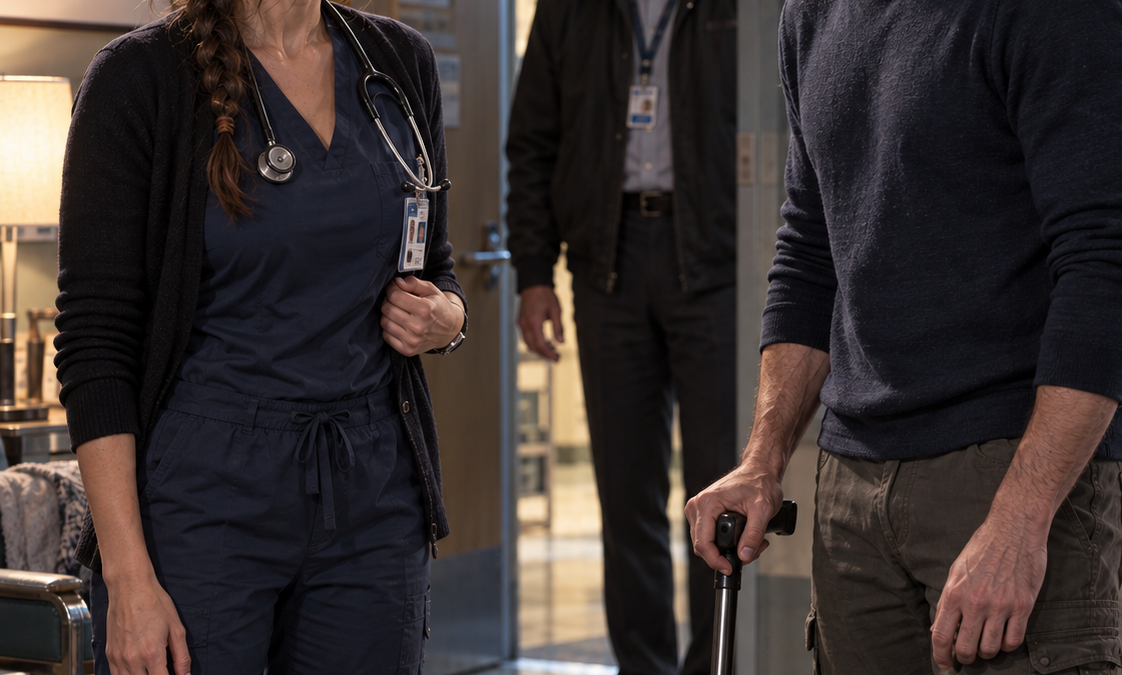
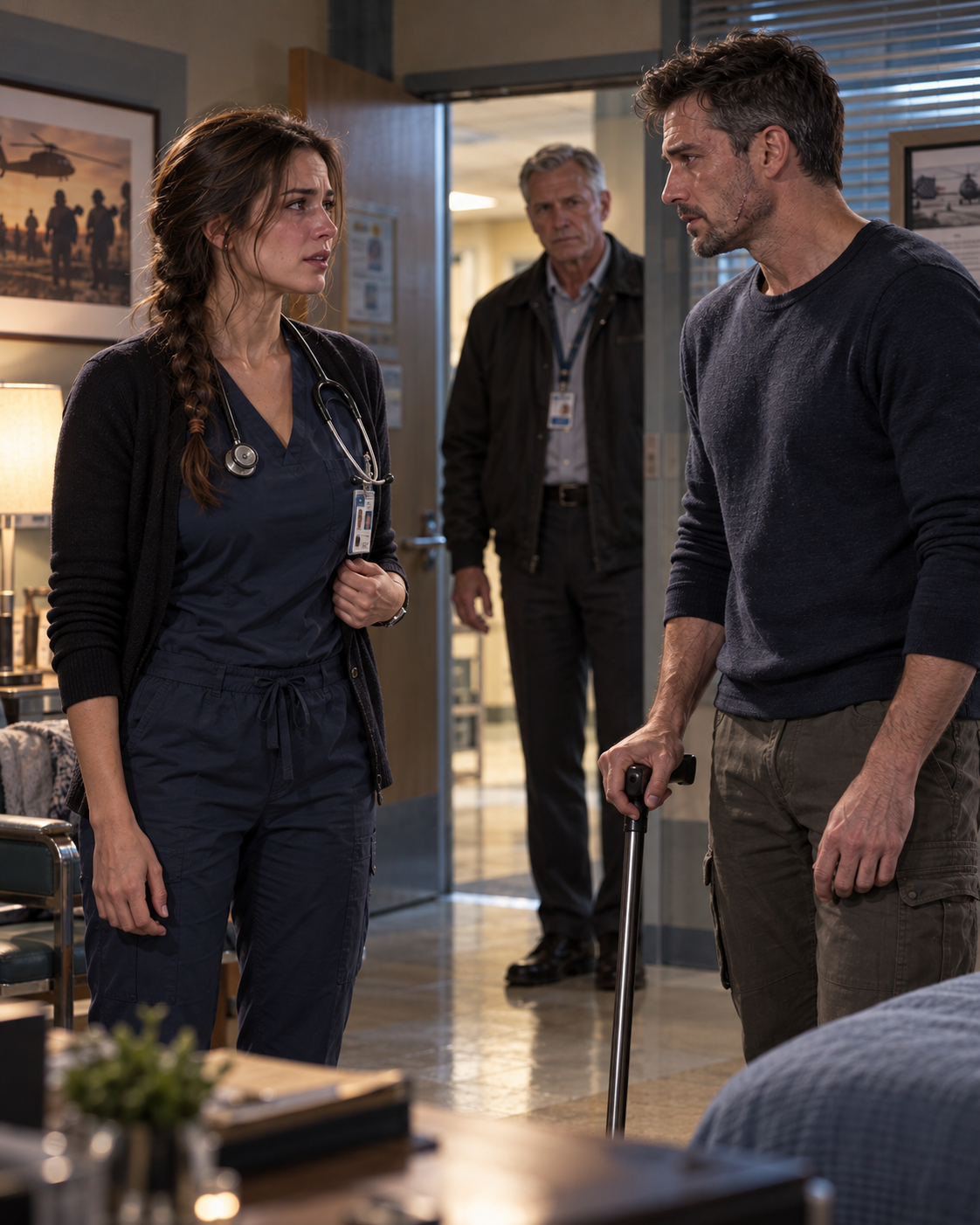
Nurses moved with that specific postad adrenaline slowness, deliberate and careful because the body had already spent everything it had and was now running on something thinner. Mara was 31 years old, medium height, brown hair pulled back in a tight braid that she refreshed every morning before walking through the ambulance bay doors.
She had calm, dark eyes that people consistently misread as passivity.
She wasn’t passive.
She was economical. There was a difference, and most people never learned it until it mattered. She was charting at the secondary station when she saw him.
He was sitting in one of the hard plastic chairs along the east wall of the waiting area.
The section that technically wasn’t triage, but where people sometimes ended up when the department was overwhelmed and intake couldn’t process fast enough.
He looked to be in his mid-50s, wearing a canvas jacket that had been washed too many times, tetics, cargo pants with a split seam along the left knee. He had his forearms resting on his thighs and his head slightly down, not sleeping, just enduring. There was a dark stain along his left temple, dried.
He had been bleeding at some point, and either nobody had noticed or nobody had acted on it. Mara looked at the board.
His name wasn’t on it.
She walked over. Sir.
She crouched to his level rather than standing over him, a habit so ingrained, she didn’t think about it anymore.
How long have you been here? He looked up slowly.
His eyes were clear, but tired.
The kind of tired that wasn’t about one bad night.
Couple hours maybe. They said someone would come. Did anyone take your information at intake?
Lady at the desk said, “Wait.”
Mara looked back at the intake window. The overnight intake coordinator had been pulled to assist with the pediatric case around 3A.
M. Nobody had covered.
This man had been sitting here bleeding unregistered for God knows how long. And the system had simply forgotten him. Okay.
She said, “I’m going to take a look at that.
Can you tell me your name?”
Decker. Roy Decker. Mr.Decker.
I’m Mara.
I’m going to get a kit and clean that up for you and then we’ll get you registered properly.
Is there anywhere else you’re hurting?
He thought about it honestly, which she appreciated. ribs.
Left side fell two nights ago.
We’ll get x-rays.
She stood, retrieved a wound care kit from the supply closet, and returned.
Roy Decker didn’t flinch when she cleaned the laceration above.
Just watch the middle distance with patient eyes. The cut was about 4 4 cm, deep enough to have needed stitches hours ago, but had partially closed on its own. She examined it carefully.
This is going to need a few sutures. How did it happen? Sidewalk, he said simply.
She didn’t push.
She had worked emergency medicine long enough to know that sometimes sidewalk was the whole story, and sometimes it was a door that opened onto something much darker. And and the right time to find out was not in the first 2 minutes.
She was applying a temporary closure strip when she heard the double doors swing open behind her. She knew the footsteps before she turned. Everyone in the ER knew them.
Dr.Callum Ror, chief of emergency surgery at Hardgrove Memorial, moved through the department the way a pressure system moved through weather, loud, displacing, certain of its own authority. He was 53, broad-shouldered with silver streked hair and the kind of face that had probably been considered handsome 20 years ago, and had since hardened into something that was some merely commanding. He wore his confidence the way some men wore an expensive watch constantly, visibly, as a statement.
He had a way of walking into a room and immediately recalibrating everyone in it toward his orbit. Residents straightened.
Nurses pre-apologized with their posture. Even the attending physicians had a habit of checking themselves when Ror was near.
A self-editing reflex that Mara had observed and found instructive. She did not share it. Sudden she turned.
Roy Decker was still in her peripheral vision. Dr.Ror, what are you doing? Wound care and intake for a patient who was missed in the overnight queue.
Ror looked at Roy Decker, the way a person looks at furniture that’s been placed in inconveniently.
A brief assessment, a conclusion. Then his gaze came back to Mara with the particular expression that meant he had already decided the outcome of this conversation and was simply running through the procedural steps to get there.
He’s not on the board.
No, he was left in the waiting area after intake was pulled for the fever case.
I’m addressing that.
There’s a protocol for unregistered patients.
The protocol is that someone addresses them.
I’m doing that.
Something moved across Ror’s face.
Not anger, not yet, but the immediate predecessor to it.
The moment when a person in authority realizes that the person they’re speaking to isn’t going to quietly defer and recalibrates accordingly.
We have three posttop patients to review this morning.
two on call escalations and a chest pain in bay four that your attending hasn’t seen yet.
He said it with the cadence of someone who has rehearsed authority so long it comes out as simple fact. He can wait for registered intake.
Mara looked at Roy Decker. The dried blood along his temple. The way he was holding his left side without seeming to notice he was doing it.
He’s been waiting for 2 hours.
Dr.The laceration required closure. The rib pain suggests possible fracture.
Leaving him unexamined wasn’t an option I was comfortable with.
You’re a nurse.
Yes.
Which means the options you’re comfortable with are not the deciding factor.
He said it calmly. That was the thing about Ror.
He didn’t need to raise his voice to make it clear that the conversation was over.
He had a way of delivering the final word that sounded almost reasonable, almost administrative, which made it harder to argue with and harder to name for what it was. Mara held his gaze for a beat. He needed care.
I provided it.
I’ll complete the registration paperwork now and flag him for physician assessment.
You’re pulling staff time and department resources for a vagrant who wandered in off the street.
Roy Decker didn’t react to the word.
He’d heard worse.
That somehow made it more offensive, not less.
“He’s a patient,” Mara said.
Three interns near the supply cart had gone very still.
She could feel their attention without looking at them that collective held breath quality of witnesses who understand they’re watching something that could go several directions and aren’t sure which direction is safe.
Ror took two steps closer. Not aggressive, not technically, just close enough to change the geometry of the conversation. You have a remarkable talent, he said quietly, for forgetting your place.
I know exactly where I am, Dr.Ror.
I’m in an emergency department.
That man is is in my care. What happened next took less than 2 seconds.
Ror reached out and closed his hand around her braid. Not a grabcontrolled, deliberate, like a man accustomed to having his corrections go unchallenged.
He pulled, not enough to knock her down, but enough to turn her head, enough to physically reorient her toward him the way you might redirect a dog that wasn’t paying attention.
Two steps backward. Her sneakers squeaked on the polished floor. The department went silent.
Not gradually, instantly. Every person in the visible range of that hallway, interns, nurses, the registration clerk visible through the intake window, a patient in bay, lifted the curtain to complain about the weight.
Every single one of them stopped. Mara did not fall. She caught her footing immediately, absorbed the movement, and went still.
There were several things she could have done in the following. Second, her body had been trained a long time ago and in circumstances that had nothing to do with fluorescent lights in hospital floors to respond to physical threat with speed and precision.
The training was still there. It would always be there. It lived in muscle and reflex below the level of thought, and it would have taken almost nothing to access it.
She did not access it.
She simply stood very still with Ror’s hand in her hair and looked at him with an expression that one of the interns would later describe in a statement to the hospital board as completely unafraid.
Ror released her. For a moment, nobody moved.
Then hospital administrator Bernard Hol appeared at the far end of the hallway, drawn by the silence, the way administrators are always drawn by silence. Because silence in an er means something has stopped and things stopping costs money.
He was a compact man in his late 40s, perpetually slightly rumpled with the measured from expressions of someone who had navigated enough institutional conflict to develop a a constitutional aversion to choosing sides. He read the room in about 4 seconds.
What’s happening here?
Nobody answered immediately.
Then one of the interns, a young woman named Priya, who would later turn out to be the most important witness in the entire investigation, said, “Carefully, doctor.”
Ror grabbed nurse Sutton. Holt looked at Ror, then at Mara, then at the small assembled audience that had formed with the instinctive precision of people who understand, who understand they are watching something that will be talked about later.
Nurse Sutton Holt said, “Step into my office, please.”
She looked at him.
“I have a patient I’m treating.
I’ll have someone cover.
Please come with me.”
She understood what was happening. She could see it in the specific careful neutrality of his face.
The way he was already managing the situation toward the outcome that created the least institutional friction, which was never in in Mara’s experience, the outcome that was correct.
She looked at Roy Decker, who was watching all of this with the quiet attention of a man who has seen many versions of this exact moment and knows exactly how they usually end. She set down the wound kit.
I’ll finish this when I return.
Roy Decker said nothing. He just watched her go.
The walk to Holt’s office took 90 seconds.
Mara counted. It was the kind of thing she did automatically. Time and distance cataloged without decision.
Holt closed the door behind them and gestured to the chair across from his desk with the mechanical hospitality of someone who needed the physical choreography to buy himself a moment to buy himself the moment to think. I want to say first, he began that I understand this morning has been stressful. He grabbed my hair.
I understand that’s your perspective.
It’s also what happened.
There are seven witnesses and a security camera. Holt folded his hands on the desk.
Dr.Ror is under significant pressure.
The department has had a difficult quarter and I’m not interested in contextualizing an assault.
The word landed in the room and stayed there.
Holt’s jaw tightened slightly.
I’m going to ask you to take a breath, Mara.
I’m completely calm.
And she was. That was the part that seemed to be making him more uncomfortable, not less. He had clearly expected tears or anger or at minimum the brittle controlled quality of someone working hard to hold themselves together.
She wasn’t any of those things.
She was sitting in the chair across from his desk with her hands in her lap and her expression and attentive and neutral and it was clearly throwing off the entire script he’d prepared.
There are going to need to be some conversations, he said carefully, between HR, between Dr.Ror’s office.
Will there be a formal report? A beat of course filed with the state board. These things take time to determine the appropriate the appropriate channel for a physician assisting staff member is the state medical board.
Bernard, that’s not a determination that requires time.
His hands tightened on each other.
I’m going to need to ask you to surrender your badge while we conduct the review.
The room tilted slightly, not visibly, Mara’s face didn’t change, but something in her chest registered the specific wrongness of what he just said, the way it always does when an institution chooses its machinery over the human being standing in front of it.
You’re suspending me.
I’m asking you to step back while I’m the one he grabbed.
I I understand that and I want you to know this process is designed to protect.
I’m not going to be managed, Bernard.
She said it without heat. I know what this conversation is.
You want me out of the building so there’s no visible conflict.
And while you figure out how to protect Ror’s position, I’m telling you now for the record that I am documenting everything the incident, this meeting, the request for my badge, and if a formal complaint doesn’t exist in the HR system by end of business today.
I’ll file it directly with the Oregon Health Authority.
Holt looked at her for a long moment.
Then he said, “Your badge, please.”
She unclipped it, set it on his desk. The plastic clicked against the wood surface.
She stood. He still needs sutures.
Someone will need to complete the wound closure. She walked out. The hallway felt different on the way back.
Or maybe she was different in it. She moved through the ER in the specific way of someone who has just had something taken from them and is still deciding how they feel about that.
the deliberate forward motion of a person who will not give anyone the satisfaction of watching them react.
She stopped at Roy Decker’s chair.
He was still there. Of course he was.
The world had not rearranged itself for him while she was in Hol’s office.
Someone will come for the sutures, she said.
Don’t let them skip the rib x-ray.
Roy Decker looked at her for a moment. He had the kind of eyes that had seen enough of the world to stop being surprised by most of it. But something moved in them now, a recognition, a specific knowing attention.
They don’t know what they just did, he said quietly.
Not angry, just factual.
Mara picked up her bag from behind the nurse’s station.
Her personal bag, the one she’d brought in at the start of her shift 12 hours ago.
She clipped her personal phone into her jacket pocket.
She had 13 texts from the night she hadn’t looked at any of them.
Security arrived to escort her out. Two of them, which was either protocol or theater, and she had long since learned not to care about the distinction.
She was walking through the ambulance bay doors when Roy Decker’s voice reached her one more time.
Sudden she turned. He was standing now.
one hand on the wall for balance, looking at her with that same measuring, knowing, “Look, tell them your name,” he said when they asked.
“Tell them your full name.”
She didn’t understand what he meant.
She nodded anyway, a single contained acknowledgement, and walked out into the gray Oregon morning. The sky was low and white, the way it gets in Bell Marsh in March, the kind of light that makes everything look equally and temporarily paused.
She stood in the ambulance bay for a moment, keys in her hand, and breathed the cold air, and tried to locate exactly what she was feeling.
It wasn’t quite anger.
It was something more durable than anger, something that had settled into the bones and was going to take longer to work through. She had been grabbed in front of witnesses by a man with the title that was supposed to mean he understood the weight of harm. And then the institution had asked her for her badge.
She walked to her car, a 2019 Civic with a cracked passenger mirror she hadn’t gotten around to replacing parked in the back row where nurses parked because the closer spots were designated for physicians.
She got in, started the engine, and sat there for a moment with the heat running.
Her phone buzzed, a number she didn’t recognize.
She almost didn’t answer.
She wasn’t in the right frame of mind for a wrong number or a collection call, and she had a drive home and a lot of thinking to do.
She answered anyway. Sutton, a pause on the other end.
Then a voice she hadn’t heard in years.
A voice with the particular quality of command authority. Calm the way deep water is calm.
Wait underneath the surface.
I’m looking for a medic, the voice said.
She goes by a name I haven’t used out loud in a very long time.
Is this still the right number for her?
Mara’s hand tightened on the phone.
Outside the ambulance bay, a dark governmentplated SUV had just pulled into the Harrove Memorial Hospital parking lot and Roy Decker, who had been watching the doors from his chair for the past 3 years of a life uh that hadn’t turned out the way anyone planned, finally released a breath.
he had been holding metaphorically speaking since the moment he had walked through those doors and seen the name on her badge.
She didn’t answer the voice on the phone right away.
Not because she didn’t recognize it.
She recognized it the way you recognize a sound from a specific room in a specific year of your life.
Something that your nervous system cataloges separately from ordinary memory stored at a depth that doesn’t require effort to access.
It simply surfaces whole and immediate when the right trigger arrives. She recognized it.
She just needed 4 seconds to decide what to do with that recognition. You have the right number, she said.
Another pause. Shorter this time.
Where are you? Parking lot.
I just got escorted out of the building. A beat that felt longer than it was.
Stay there. The call ended.
Mara lowered the phone slowly and looked through the windshield at the ambulance bay entrance.
The dark SUV she’d noticed on the way to her car had not moved.
It was parked at an angle that suggested the driver had been in a hurry and had not particularly cared about the lines. Government plates, Oregon registration sticker, but the vehicle had the particular nondescript quality of something that belonged to a fleet rather than a person. She got out of her car.
The cold hit her again.
March in Bmar, carrying that particular damp insistence that didn’t feel like winter anymore, but wasn’t anything else yet either.
She stood beside the Civic and watched the SUV and waited.
The driver’s side door opened first.
A man in civilian clothes, dark jacket, no insignia, the kind of physically composed stillness that tends to come from either discipline or danger or both. He glanced at her once, cataloged her location, and opened the rear passenger door. The man who stepped out was Rear Admiral James Voss.
He was 61 years old with the kind of face that had been weathered by enough years and enough decisions that it had stopped telling you what he was feeling and started just being a face. He wore civilian clothes, two gray jacket, collared shirt, but the military bearing was not something that civilian clothes removed. It was structural.
It was the way he occupied space, the way his eyes moved through a new environment with immediate tactical assessment, the way he crossed a parking lot like a man who had crossed a great many environments and had learned that speed was less important than presence. He stopped 2 feet from her.
For a moment, neither of them said anything. Voss looked at her the way people look at something they were told no longer existed.
Not shock he was past the age and experience level that allowed for shock, but a specific reccalibration. The slight adjustment of a man revising a longheld understanding in real time.
You look different, he said finally.
It’s been 9 years.
You cut your hair. I grew it back out. She paused.
Then I put it in a braid and someone used it against me this morning, so I’m reconsidering the whole thing.
Voss’s expression didn’t change exactly, but something in it compressed slightly.
Tell me what happened. So she did. Standing in the parking lot of Hard Grove Memorial, with the gray Oregon sky overhead and the distant sound of an ambulance somewhere on the other side of the building, she told him in the direct sequenced way that her particular training had made
permanent what happened, in what order, involving whom, with what immediate outcome.
She didn’t editorialize.
She didn’t need to.
The facts were sufficient. When she finished, Voss was quiet for a moment.
The man you treated, he said. Roy Decker. Laceration above the left temple.
Probable rib fracture hadn’t been registered after sitting in the waiting area for two plus hours.
He called me. Boss said last night from a pay phone. Mara looked at him.
He knew who you were. Roy Decker served under my command for 11 years before he was medically separated.
He has my personal number because I gave it to him 6 years ago when he needed somewhere to go and couldn’t find one.
He paused. He told me there was a nurse here who treated him while everyone walked past.
He told me her name.
Something in Mara’s chest went still.
He recognized me, she said. Not a question, not at first.
He said she had dark eyes and a braid and the kind of stillness he’d only ever seen on one other person.
He wasn’t sure.
Then he looked at the name on your badge. Voss met her eyes directly. He called me at 2:00 in the morning.
He said, “Admiral, I think Wraith is alive and working in an ER in Bellarsh.”
The word landed between them in the parking lot cold. Wraith.
She hadn’t heard it spoken aloud in 9 years.
She certain she had at certain points halfconvinced herself that the name belonged to a different person, a version of herself that had existed in a different geography under different physics, and that the ordinary woman with the nursing badge and the
cracked passenger mirror was someone else entirely, was someone who had asked her, someone who had arrived after.
She hadn’t fully convinced herself.
But she’d made progress.
“Why are you here, Admiral?”
she asked. Not for me.
You couldn’t have known what would happen this morning.
Just No, he said.
He said, “I came because Roy called me and because the last time someone told me Roy needed help and I sent someone else, it didn’t go well for Roy.”
He let that sit for a second.
But now I’m here and you’ve been escorted out of a hospital by an administrator who chose the surgeon over you and I’d like very much to go inside and understand that situation a little better.
That’s not your jurisdiction.
My jurisdiction, Voss said mildly, is currently broader than it was the last time we spoke. She looked at him for a moment. He had aged, but the authority had only concentrated.
He He had the look of a man who had spent the intervening years moving upward through structures that had given him more weight and less patience for certain kinds of institutional behavior. There are cameras in that department, she said. Everything that happened is on footage.
Good. He turned to the man in the dark jacket who had been standing at a respectful distance with the practiced invisibility of someone very good at their job.
Peterson, let’s go inside.
Peterson nodded once and fell in slightly behind and to the right. Mara looked at the hospital entrance.
At the ambulance bay doors, she just walked through in the wrong direction. She had her bag on her shoulder and no badge on her jacket. And every institutional signal institutional signal was pointing her car in her apartment and the long grinding process of filing complaints through a proper channels and waiting.
She fell in step beside Voss. They walked through the ambulance bay together and the automatic doors opened and the fluorescent lights still flickering welcomed them back in. The ER was not expecting them.
That was apparent within the first 10 seconds. The intake coordinator, a different one from the overnight, a middle-aged man named Gary, who had the expression of someone who arrived for the day shift and had already sensed that something had gone wrong before he could determine exactly what looked up from his desk and
performed a rapid assessment of the group that had just entered. One woman I recognized as the nurse who had been escorted out 40 minutes ago.
Two men in civilian clothes carrying the particular quality of authority that people who work in hospitals learn to recognize almost by instinct because hospitals have a specific relationship with power structures and everyone in them develops a finely tuned sensor for them. Gary reached for his phone.
Please don’t make that call yet, Voss said pleasantly.
and Gary put the phone down. The ER had not returned to normal.
It had achieved the surface appearance of normal peop of abnormal people moving equipment operating the background rhythm of a functioning department. But underneath that in the particular way that institutional crises exist, everything was slightly pressurized. Mara could feel it.
The interns who had witnessed the incident that morning were not making eye contact with each other, which meant they were making the specific effort of not making eye contact, which was its own kind of communication. The nurses moved with a fraction more deliberateness than usual.
Even the patients in the visible bays had the slightly alert quality of people who sense that something in the environment had shifted. Roy Decker was still in his chair. He had a temporary closure strip on his temple.
Someone had continued the wound care at least.
Though Mara could see from across the room that the sutures still hadn’t been done, he was sitting with his arms on his knees and his eyes on the door with the patience of a man who had learned to wait in environments far less comfortable than a hospital waiting room.
When he saw Voss, something moved across his face that Mara could only describe as relief. Not the surface kind.
Not the social performance of relief, but the real thing, the way a breath releases when you’ve been holding it for a long time.
And finally, don’t have to anymore.
He started to stand. Voss crossed the room in six steps and put a hand on his shoulder. Stay down, Roy.
Sir, his voice was rough at the edges.
I didn’t know if you’d I got your call.
Voss crouched to his level, which was exactly what Mara had done an hour earlier, and she noticed it, but said nothing. You doing all right?
Better than I was at 3:00 in the morning.
We’re going to get you properly taken care of.
Those ribs looked at everything. He stood.
You can let go of the wall now. Roy Decker looked at Mara. You came back.
I wasn’t given a choice, she said.
Someone I used to know showed up in the parking lot. Is that bad? She considered it, still determining.
Bernard Hol appeared at the hallway entrance with the expression of a man who has just been informed that his morning has taken a turn he was not prepared for.
He was moving quickly without quite running, which was its own kind of tell, and he had the look of someone rapidly revising whatever plan he’d assembled.
After Mara left his office, he stopped when he saw Voss. The two men looked at each other across the ER floor.
Hol did his rapid institutional assessment civilian close, but that didn’t matter because the bearing said everything, and the two men flanking him said the rest.
And whatever Hol had been hoping the next hour would look like, it wasn’t this.
“Can I help you?”
Hol said.
Voss’s expression didn’t change.
Rear Admiral James Voss, United States Navy.
I’m here in regard to a veteran who was in your care and a staff member, I understand, was terminated this morning.
I’d like to review your security footage from the ER between 5 and 7A.
M a very specific silence. Our security footage is a hospital privacy matter.
I’m not requesting it as an order, Voss said.
I’m requesting it as a courtesy, but I’d like it in the next 20 minutes, please.
Hol looked at Mara. The look had a particular quality to it.
The specific expression of a man realizing that the situation he thought he’d contained this morning is no longer the shape he thought it was.
I’ll need to contact legal.
That’s completely your right, Voss said.
Peterson. Peterson produced a card and held it out to halt with the calm efficiency of someone who has done this exact thing in exactly this kind of moment before. That number, Voss said, will connect you with my office.
They can discuss the appropriate channels for cooperation.
While you’re making that call, I’ll be sitting with Mr.Decker and Nurse Sutton.
He walked away from Hol, which was itself a specific kind of message.
Holt stood with the card in his hand, and the particular look of a man watching a situation escape the shape he’d put it in.
Mara followed Voss to a row of chairs near the east wall, slightly separate from the waiting area. Roy Decker moved carefully from his chair to join them, one hand on the wall, and Mara automatically calculated the distance and the angle and positioned herself to provide a brace if he needed one without making it obvious she was doing it.
Old instinct. How long has he been like this? Voss asked her quietly, nodding toward Roy.
I don’t know his full history.
I met him 2 hours ago. The rib pain has been there for 2 days at least and the laceration is from before that.
He’s been managing on his own.
Voss looked at Roy directly.
Why didn’t you go to the VA?
Roy was quiet for a moment. The VA in Belmarsh has a 6 week wait for primary care.
I know, you know, and it’s still 6 weeks.
Voss absorbed that without flinching. Yeah. So, I came here.
He paused. I recognized her from across the room. Not right away, but there was something the way she moved.
The way she came down to my level instead of standing over me and then I saw her badge. He looked at Mara.
You’re going by Sutton, my mother’s name.
I changed it after after Kandahar, he said. The word moved through the air between the three of them differently than ordinary words do. It carried specific weight, the weight of a specific place, a specific operation, specific things that had happened inside it.
After Kandahar, she confirmed. Voss turned to her. His voice dropped, not for privacy.
There was nobody close enough to hear, but because the subject seemed to require it. Tell me what you remember.
You know what I remember. Tell me again.
She looked at her hands for a moment. They were steady.
They were always steady.
That hadn’t been trained into her so much as selected for, identified as a quality that already existed and then systematically reinforced.
The extraction was compromised. We came in on the wrong timing. Someone had given coordinates that were 12 hours stale.
By the time we realized the site had been moved, we were already inside the perimeter. She paused. I made a decision to get the uh wounded out first and rejoined the team at the alternate extraction point.
I got three people to the helicopter. When I went back for the fourth, she stopped. Roy was already gone, boss said quietly.
He wasn’t there.
The site was gone. Everything was gone.
She looked at him. I was listed say IA.
You were listed SEIA because the team that processed the site found blood evidence and gear that matched your kit. They made a reasonable conclusion with the information they had. He held her eyes.
You know what happened to the unit? I know what I was told.
Years later. What were you told?
That most of them didn’t make it out.
She said it flat.
The way you say a thing that you’ve carried for long enough that the edges have worn smooth.
That there was one survivor, a communication specialist, who was recovered 4 days later. Nobody told me who.
Voss was quiet for a moment.
In the middle distance, Bernard Holt was on his phone, the posture of a man having a conversation he hadn’t planned for.
Near the charge nurse’s station, Dr.Callumor had appeared from wherever he’d retreated to after the incident, and he was watching the group near the east wall with the specific tight tight-eyed attention of a man trying to determine whether the situation that seemed to be developing was actually as significant as it appeared.
It was the communication specialist, Voss said, is why I drove 6 hours from Portland instead of making a phone call. Mar went still. Not on the outside.
Aside on the outside, she was exactly what she’d been for the past 3 years.
A woman sitting in a chair, composed, attentive, giving nothing away. But something internal shifted the way. Something shifts when a piece of information arrives that reorganizes everything around it.
He’s alive, she said.
He’s alive.
You said the unit. Her voice was careful.
You said most of them didn’t make it.
Most of them didn’t.
He met her eyes directly. He did. She needed a moment.
She took it around her.
The ER continued being an er the sounds and rhythms of a place that doesn’t pause for personal reckonings, which she had always found in a strange way grounding.
Where is he?
That’s a longer conversation, Voss said.
And I’d like to have it somewhere that isn’t a hospital waiting room.
He glanced toward Hol, who is now moving toward the security office with his phone still at his ear. First, I want to see what happened this morning. The security footage took 18 minutes to produce.
Holtz legal council, reached by phone, had apparently reached the rapid and pragmatic conclusion that refusing a rear admiral’s informal request for ER security footage in the context of what was already a documented incident was a significantly worse position than simply showing it.
The footage appeared on a monitor in a small room off the administrative corridor reviewed by Voss Peterson and at Voss’s specific insistence, Mara.
They watched it in silence. The footage was clear. It was the kind of clear that makes things simple and terrible.
Simultaneously, the wide-angle camera in the northeast corner of the ER captured the entire exchange without gaps or obstructions. Mara treating Roy Decker. Ror crossing the floor.
The exchange between them, the body language visible even without audio. The specific moment Ror reached out and took hold of her braid and pulled. Voss watched that part without expression.
Then he watched Hol arrive. watched the conversation, watched Mara uncip her badge and set it on an invisible desk just off camera, walking out of the frame with her bag on her shoulder and her posture exactly the same as it had been at the beginning of the footage,
which was its own kind of extraordinary thing. When it ended, the room was quiet for a moment.
“Where is doctor Ror right now?”
Voss asked.
Holt, who had been standing near the door, said in the surgical attending lounge, “I’d like to speak with him.”
Holt’s expression moved through several phases in approximately 2 seconds.
Reluctance calculation. The specific look of a man, determining that the cost of saying no has exceeded the cost of saying yes.
“I’ll have someone bring him down.
I’d rather walk there,” Voss said.
They walked.
The surgical attending lounge was on the third floor, accessible by a back stairwell that most visitors didn’t use.
Mara had used it hundreds of times for the same reason nurses use back stairwells because the main elevator spent too much time on floors nobody was actually calling from. And time was a resource that the people who did the most work in a hospital had the least of.
She walked up the stairs behind Voss with the specific physical awareness of of returning to to a place where something had been taken from her which was an experience she was not entirely unfamiliar with and which she managed the same way she managed most things by deciding. The emotion was
noted processing was available later and forward motion was what was was needed now. Ror was in the lounge.
He was sitting at the small table near the window with a cup of coffee and his phone. And when the door opened, he looked up with the automatic expression of someone expecting a colleague. What he got was Voss, which took a moment to register because Ror did not know Voss, had no context for who this man was.
And the reading of Strangers in Authority is a skill that requires practice to develop, and Ror had never had much reason to develop it.
Dr.for Ror,” Holt said from behind them.
“This is Rear Admiral James Voss.”
The coffee cup paused halfway to Ror’s mouth.
To his credit, he recovered quickly. He had a native confidence that Mara had observed was not particularly tied to circumstances.
It was more like a default state, a constitutive certainty about his own position and standing that persisted somewhat independent of what the situation actually warranted. He set the coffee down and stood.
Admiral, he extended his hand. What can I do for you?
Vos shook it. You can help me understand what happened in your emergency department this morning.
I’d be happy to.
The fluency of it, immediate, well-c calibrated, the voice of a man who has navigated institutional conversations his entire career and knows that the first 30 seconds are about controlling the frame. There was an incident with a staff member who overstepped her role during a tense moment.
I’ve been discussing with Bernard how we move forward appropriately.
She was treating a patient. She was causing a disruption at a critical time. She was treating Roy Decker.
The name landed differently than Ror expected.
He didn’t show it much, but the slight recalibration was visible to anyone who was paying attention.
And Mara was always paying attention.
He hadn’t known Roy Decker’s name.
Roy Decker had been to him an abstraction, an obstacle, a category, a test case for a boundary he was establishing. The unregistered individual in the waiting area, Ror said.
The combat veteran, who served under my direct command for 11 years, Voss said with exactly the same pleasant tone he’d used since walking into the building, which was somehow more effective than any other register he could have chosen.
who was left bleeding and unregistered in your department for 2 hours. Who was being treated by a staff member you then physically assaulted and whose tr and whose termination you apparently facilitated?
A pause.
I didn’t assault anyone, Rork said.
I made contact during a correction of I watched the footage. The sentence was three words and it stopped Ror completely. The room had a particular quality now.
The kind of particular quality that a room acquires when everyone in it understands that something has shifted permanently and that the concert hissing planned is not the conversation that is going to happen. Holt near the door had the expression of a man who is watching a situation that he was as recently as 2 hours ago confident he could manage and who is realizing that his confidence was significantly misplaced.
Ror looked at Mara.
It was the first time he had looked directly at her since they’d entered the room, which said something.
He looked at her with a complex expression, not quite the dominance of that morning, not quite anything she’d seen from him before.
There was something searching in it, something slightly unsettled, as if he was revising a calculation in real time, and the numbers were not cooperating.
She’s a nurse, he said.
It came out differently than it had that morning, like less like a declaration, more like something he was saying because the alternative was saying nothing and saying nothing felt worse.
Yes, Voss said, “She is.”
He let it sit there. Then very quietly in the way of a person who has decided to offer information not because it will change what happens next, but because it is the truth and the truth is relevant.
Boss said she is also Staff Sergeant Mara Sutton, United States Army Special Operations Combat Medic, Classified Joint Task Force, Kandahar, 2015. She was listed killed in action. She was not killed.
She spent approximately 19 months in medical recovery and reintegration before she transitioned out of service, changed her name, earned her civilian nursing credentials, and spent the last 3 years providing emergency care in your department.”
He paused. She grabbed nothing this morning.
She pulled no one’s hair.
She raised no voice. She treated a patient who was being ignored. She defended that decision when challenged.
and she absorbed a physical assault without responding in kind. He looked directly at Ror.
I’ve seen people with her training and her history respond to physical threat in ways that do not end well for the person who initiated it.
She chose not to because she was at work in a hospital and she is a professional. The lounge was silent.
Outside the window, Bell Marsh continued in its gray marchway traffic on the street below. a crow on the parking garage ledge.
The world operating at its usual indifferent scale. Ror said nothing. Mara watched him sees a nothing.
She watched the particular quality of his silence. Not quite the silence of a man who has been rendered speechless by revelation, more the silence of a man who is doing rapid and somewhat desperate internal accounting.
Running through the possible outcomes of the next several conversations he was about to have. the calls to legal, the potential board review, the footage that now existed in the hands of people who had no institutional incentive to be careful with it.
Holt cleared his throat. Perhaps we should continue this in minus. I want the formal assault complaint filed with the state medical board by end of business today, Voss said, still looking at ROR.
Not started. Filed.
I want nurse Sutton’s termination voided and her badge returned.
And I would like both of those things to happen because this hospital made the correct institutional decision, not because I’m standing in this room.
He let that breathe for exactly one second. Are we clear on that? Holt said yes.
Ror said nothing.
Dr.Ror Voss said, “Are we clear?”
and Callum Ror who had navigated 26 years of institutional medicine with the combination of of ability and authority and the kind of comprehensive personal certainty that had very rarely been genuinely challenged. Looked at the quiet man in the civilian jacket and said nothing for a long enough moment that the silence silence became its own kind of answer. Then he sat down, not defeated exactly, but something had gone out of the room that had been there before, something that had organized itself around the fixed point of his certainty, and without that fixed point, the room was different.
Voss turned away from him, which was the most dismissive thing he could have done, and he did it naturally without theater.
“I’d like my badge back,” Mara said.
Holt produced it from his jacket pocket.
He’d apparently been carrying it since the office, which she filed away as a detail she would think about later.
She took it and clipped it back onto her scrubs. It was a small physical thing.
The badge was plastic and cheap, and her photograph on it was from 3 years ago and slightly unflattering, but there was something about clipping it back into place in that room with those witnesses that felt like a different kind of statement than the one she’d been making
all morning.
She looked at Roy Decker’s situation in her mind, the sutures still undone, the rib x-rays still pending.
She looked at Voss. The conversation you mentioned about Kandahar about the survivor tonight.
He said, “I’m not going anywhere.
I have a patient to finish treating first.”
I know. She walked out of the lounge and down the back stairs and into the ER.
And as I went directly to Roy Decker’s chair, and she said, “Let’s get those sutures done, and then I’m ordering your X-rays.”
Roy Decker looked at her for a moment with that same specific knowing expression the look of a man who knew exactly what had just happened upstairs, not because he’d been told, but because he had known, with the particular confidence of someone who had served under two people who were both in their own ways entirely capable of making things happen.
They gave you the badge back, he observed. They did, thought so. She pulled up the stool and opened a fresh suture kit.
Her hands were steady, the way they had always been, the way they had been, actually in conditions that made steady hands genuinely difficult, and she threaded the needle with the automatic precision of long practice. What she was not prepared for was what Vos said when he appeared in the doorway sements later, after what must have been a very short additional conversation upstairs.
He waited until she finished the first suture.
Then he said quietly, “The survivor<unk’s name is Theo Vargas.”
Her hand stopped just for one beat. one fractional pause that she immediately corrected, returning to the work with the same steadiness. But Roy Decker saw it, and Voss saw it, and the name hung in the air of the ER under the flickering fluorescent light.
Theo Vargas, like the name of someone she’d been told was dead for 9 years, which was exactly what he was, except apparently he wasn’t Theo Vargas.
She finished the second suture before she let herself think the name again. third suture.
Fourth, the needle moved through Roy Decker’s skin with the small, precise pulls that the work required, and her hands did what her hands had always done, which was exactly what she asked of them, no more and no less.
Roy didn’t say anything.
He understood something had shifted in the room. He was a man who had spent enough time in operational environments to read atmospheric pressure without needing it explained.
Voss in the doorway. Voss waited in the doorway. When she tied off the final sutures and applied the dressing, she stripped her gloves and dropped them in the waist recepticle and turned to face him.
Where is he? Portland VA Medical Center. Inpatient rehabilitation.
He paused.
He’s been there for 14 months.
14 months? She absorbed that.
What happened to him? Not a quick answer.
He’s It’s complicated.
Admiral. Her voice was level. What happened to Theo Vargas?
Voss looked at her for a long moment with the expression of a man determining how much of the truth the next five minutes could hold. It was an expression she recognized.
She’d seen it on his face before years ago in different rooms when the information available exceeded what the circumstances allowed.
He was recovered from the Kandahar site 4 days after the operation. significant injury spinal both lower extremities traumatic brain injury.
He was in surgical care in Germany for 3 months then stateside for the long work. He let a beat pass. He was told you were KIA.
He carried that for 9 years.
Something in her chest moved in a way she didn’t particularly want to examine right now in an ER with Roy Decker’s X-ray order still pending and half a shift’s worth of unfinished work on her conscience.
He’s recovering, she said.
Not a question she needed it to be a statement she could hold on to.
He’s walking again mostly.
The TBI left some things that aren’t coming back all the way, but his mind is intact.
Voss said it plainly, not gently, which she appreciated.
He’s been asking about you.
Not by name.
He didn’t know your current name.
But he’s been asking about Wraith since he was conscious enough to ask about anything.
She nodded once, turned back to Roy. X-ray order is in. Bay 3 is open.
Someone will come get you. Roy Decker looked at her with those patient knowing eyes.
You should go. I have work, Mara.
It was the first time he’d used her name.
You’ve had 9 years of work.
Go. She stood there for exactly 2 seconds longer than necessary.
Then she looked at Voss and said, “Where exactly in Portland?”
She didn’t go that day.
That was the part nobody would have predicted.
Maybe if they didn’t know her that having just learned Theo Vargas was alive and 45 minutes away by the most optimistic traffic estimate, she finished her shift.
or what remained of it, 4 hours. She handled a pediatric laceration, assisted on a cardiac workup, and helped manage a bad fall from a ladder that turned out to be worse than the patient wanted to admit, which was always how ladder falls went. Voss did not press her.
He arranged for Royy’s care to be properly documented and overseen, spent 2 hours in meetings with Hol and eventually the hospital’s general counsel, and was still somewhere in the building when she finished charting at 2P M, and finally sat in the breakroom with a cup of coffee that had
gone cold and a phone showing his number on the screen.
She called.
I’m done, she said.
I’ll drive.
I have a car. I know you have a car.
A pause. Let me drive.
She thought about it.
Driving alone to Portland to see a man she’d believed was dead to be seen by a man who’d believed she was dead was the kind of thing that probably deserved a witness.
Not for support. Exactly.
More like a verifier, someone to confirm that what happened actually happened. Give me 10 minutes, she said.
The drive to Portland took 53 minutes. Peterson drove. Voss sat in front.
Mara sat in the back and looked out the window at the wet Oregon landscape moving past and didn’t talk, which Voss seemed to understand required no management.
She had questions.
She was aware of having many questions and was deliberately not asking them yet on because the answers to most of them would arrive in in a context that was better than a moving vehicle and the answers to the rest she wasn’t sure she was ready for yet.
9 years is a long time. long enough that the version of Theo Vargas she she carried in her memory was largely constructed of specific moments and specific qualities.
The way he moved under fire, the economy of it, the way he communicated on a damaged radio, finding signal through interference with what seemed like sheer stubbornness, the particular sound of his voice when he was giving coordinates under pressure, which was flat and precise and betrayed nothing, which was the voice she’d heard in her head for years afterward under circumstances she’d chosen not to examine too closely.
The man in the rehabilitation center in Portland had been through 14 months of inpatient care. He walked mostly. His mind was intact.
He had asked about Wraith. These were the facts.
She held them carefully and waited. Portland VA Medical Center occupied several buildings on a campus that had the particular institutional landscape of places that serve a specific and long-term population functional, unglamorous, permanent. The rehab wing was on the third floor of the main building with wide corridors designed for mobility equipment and nurses stations positioned for sightelines and the smell of a long-term care environment that Mara recognized professionally and experienced now slightly differently than usual.
Voss spoke to someone at the wing’s desk, a woman in her 40s, clinical and efficient, who looked at Mara once with a practiced assessment, and then picked up the phone.
They waited in a small family consultation room. Beige walls, four chairs, a fake plant in the corner.
That was not quite convincing. Mara stood near the window rather than sitting, which Voss also did not comment on. The door opened after 8 minutes.
The man in the doorway was using a cane. He was 44 years old, or would be in March, which was now. He was thinner than she remembered the muscular weight of operational fitness redistributed and partially diminished by the particular physics of long injury and long recovery.
The way the body reclaims its own architecture when the demands on it change, his hair was shorter than she’d known it.
There was a scar along his left jaw that hadn’t been there before.
And he moved with a careful economy that was partly the discipline she remembered and partly now the adaptation of a man who had learned to inhabit a body with different parameters than the one he’d started with.
The Vargas stopped in the doorway. He looked at Mara.
For a long moment, neither of them moved or spoke.
Then he said very quietly, “Wraith.”
Her throat did something she wasn’t expecting.
She managed it.