Little Girl Signed “HELP” to a Biker in a Blizzard — What 163 Hells Angels Did Next Shocked Everyone (part 2)
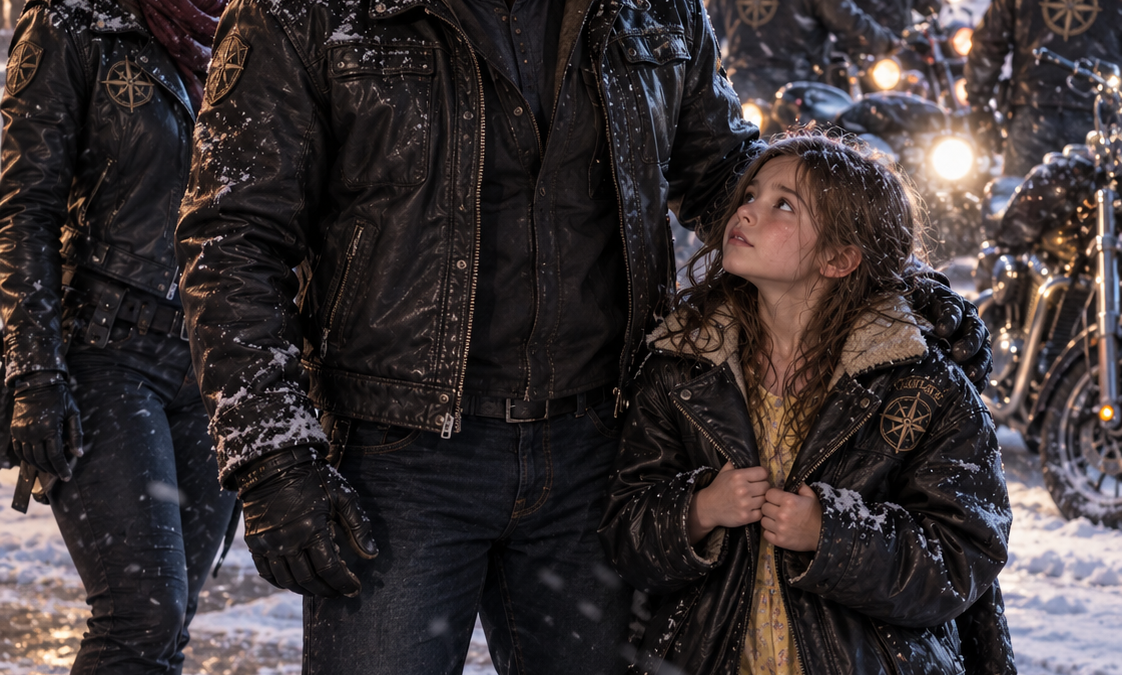
Part 2
Rowan stood up, and walked back toward the office. And in the hallway, he stopped because Shepherd was coming toward him with a specific expression on his face.
Not alarm.
Shepherd’s face didn’t do alarm, but a particular tightness around the eyes that meant he’d received information and was calculating what had changed.
Got a call from Darcy, Shephard said. And the Subaru is not the only thing registered to that plate cluster.
Darcy dug into the VIN history. The car was part of a fleet, five vehicles, all reported stolen in the last 6 months, all from Montana.
All recovered or not, in connection with cases that got quietly closed. Closed by who? Shepherd looked at him.
That’s the thing.
Darcy says two of the cases had federal holds put on them. Information sealed.
Under what authority.
He couldn’t get that far.
A beat. Rowan. He says one of the case numbers associated with the vehicle fleet matches what the girl memorized.
Shephard stopped. You already knew.
She’s 8 years old.
Rowan said she memorized a federal case number off a document she saw for 15 seconds in the back of a car while the man was watching her. He looked down the hallway toward the al cove.
She knew it was important before she knew why. A silence between them.
The heating unit in the wall groaned.
This isn’t a straight abduction.
Shepherd said, “No.
” “How deep does it go?”
Rowan said nothing for a moment. He thought about the woman in the back office who had smiled instead of panicking and who had said the people who sent me with the casual certainty of someone who believed those people were real and present and capable. He thought about five vehicles, Montana plates, federal cases with sealed information.
He thought about the word Hrix and the number 2611 and a second parking lot and a house with too many cars.
Don’t know yet, he said, but deep.
Yeah, deep. They stood there in the humming hallway of a Wyoming rest stop while the blizzard dismantled the world outside.
And Rowan Creed felt something he hadn’t felt since Kandahar.
Not fear, not exactly, but the specific clarifying sensation of stepping off a ledge and knowing the ledge was behind you now. Knowing the decision was made, knowing that the next part was just execution, he went back into the office. The woman was sitting in the same position.
M had moved to the corner, which meant he’d heard something in the last few minutes worth moving for.
And when Rowan looked at him, M gave him the smallest of nods.
She’d made a move, subtle, tested the room.
Rowan sat on the edge of the desk again.
“Tell me about Hrix,” he said.
The woman’s stillness cracked, not into fear, into something faster, something more calibrated.
And she said, “Who told you that name?”
“Doesn’t matter.
It matters.”
She leaned forward slightly. If the girl told you that name, if she heard that name, then you need to understand something. The name means you are no longer in a situation that ends with a county sheriff and a report and everyone going home.
Her voice was very precise.
That name means this doesn’t end tonight for any of us, including you.
She looked at him for a long moment.
especially me,” she said.
And for the first time since he’d seen her in the parking lot, the calculation in her eyes was gone, and what was underneath it was something that surprised him.
It looked almost like relief, as if saying the name out loud was the first honest thing she’d done in a very long time.
Rowan’s phone rang.
He looked at the screen, blocked number. He answered it.
Silence on the line.
Then a voice, male, measured, the kind of voice that lived in expensive rooms, said, “Put the woman on the phone.”
“She’s busy,” Rowan said.
Another silence.
“Mr.Creed,” he went very still.
“You don’t know me,” the voice said.
“But I know quite a bit about you.”
Sergeant Rowan Creed, Iron Compass MC, Chapter President, Laramie, Wyoming, discharged 2011. two purple hearts, one of which involved significant compromise of your hearing.
Your chapter currently has 14 full patch members and is operating without a criminal record, which is frankly an impressive feat of discipline and one I’ve admired from a distance.
A pause.
What you’ve walked into tonight is considerably larger than what you can see right now.
I’m not threatening you.
I’m informing you.
There’s a difference.
There’s always a difference.
Rowan said, “The woman you’re holding is not the problem.
She’s a contractor, a low-level one.
Whatever the child told you, whatever you think it means, I want you to understand that the infrastructure behind this operation is not something that a motorcycle club in Wyoming, however disciplined, is equipped to address. What operation? Rowan said.
It was not a question, a pause that told him the voice had not expected that answer. Let the woman go, the voice said. Take the child to the nearest hospital.
Tell the state police you found her wandering. The case will be handled quietly.
The child will be returned to her family. You will never hear from us again. What happens to the people she told me about?
That’s not your concern.
Rowan looked at the woman in the chair.
She was watching him now with an expression he hadn’t seen on her before.
Attention. Real attention.
The attention of someone who was listening to a conversation she didn’t know was happening and was recalculating something important based on what she could read from one side of it.
She has a good memory, Rowan said into the phone.
The kid, we’re aware and she already told me everything.
A longer silence this time. Then you understand, the voice said that nothing about tonight is going to be simple.
Rowan said, “No, it’s real simple.”
“Explain that to me.”
“She’s 8 years old,” Rowan said.
She signed to me in a blizzard because I was the first person who looked at her in 19 hours who actually saw her.
That’s the whole thing.
That’s all of it.
He paused. You can tell me about infrastructure all you want.
Doesn’t change what it is.
He ended the call. The room was very quiet.
Max said from the corner in his low, even way. How bad?
Rowan said. How bad is bad? Rowan put his phone in his jacket pocket and looked at the woman in the chair who was watching him with that new expression, the one that looked like recalibration.
Who is Hrix? He said one more time.
And this time the woman said, “The name isn’t a person.”
Rowan waited.
“It’s a network,” she said.
“And you just made a phone call that told everyone in it that you know it exists.”
She said it quietly, matterof factly, with the flat effect of someone delivering a damage report. And in the hum of the space heater and the groan of the wind against the walls, Rowan Creed understood that the 40-minute wait for a Wyoming state trooper to reach this rest stop in a blizzard was no longer the most dangerous clock running in this building.
The most dangerous clock was the one that had started the moment he answered that phone. And somewhere in the storm, on roads that should have been empty, headlights that had not been there 20 minutes ago were moving toward the Elkridge Station rest stop from the north.
Shepherd saw them first. He came in from the entrance in a controlled walk that was faster than a walk without being a run.
And he found Rowan in the hallway and said three words. Low.
We have company. Two headlights. Coming north on the access road.
Not state trooper lights. No bar. No flash.
Just two clean beams cutting through the horizontal snow at the kind of steady, unhurried speed. That meant whoever was driving was not worried about the conditions or the visibility or anything else that worried normal people in a blizzard on a closed road.
Rowan said, “How many vehicles?”
“One right now,” Shephard said.
“Access road single lane.
If there are more, they’re staged behind.”
Distance 90 seconds, maybe less. Rowan turned and walked back into the office in three strides.
The woman was still in the chair. She had heard shepherd come in and she had heard the word company and something had shifted in her posture. Not relief, not fear, but the particular bracing quality of someone who knows that the next 60 seconds are going to define a very long stretch of time.
Who’s coming?
Rowan said. She looked at the wall.
Ma’am.
His voice was not loud. It was the kind of quiet that was worse than loud.
I need to know if what’s coming through that door is here for you or here for the girl.
She looked at him.
Then “Both,” she said.
“They’ll take her back.
They’ll take her and they’ll clean this up and nobody will remember this rest stop or this night or your club’s name by the time the weather clears.”
“Clean it up,” Mac said from the corner.
The two words landed flat and heavy. She looked at Mac.
Something moved in her face.
“I didn’t choose this assignment,” she said, and it was the first thing she’d said that sounded like something other than strategy.
Rowan said, “Mack, get the girl and Nora into the bathroom block.
The brick one, not the annex.
Lock it from inside.”
He was already moving. Shepherd bikes now.
We’re not riding out in this.
We’re not riding out.
We’re moving the bikes in front of the building entrance.
All of them. Nothing gets in or out of that lot without going through 1400 lb of American steel.
Shephard went. Rowan stopped in the doorway and looked at the woman one last time.
Stay in this room.
Don’t make noise.
Don’t touch anything.
You’re going to stand between them and the girl.
She said, “Yes, you understand what that means.”
I’ve understood it since the parking lot.
He looked at her for one beat.
“You said you didn’t choose this assignment.
Then help me.”
She was quiet for a long moment. The space heater ticked outside, muffled by walls and wind, the sound of Harley engines turning over. One, then two, then four.
the iron compass bikes coming to life in the cold with the low irregular thunder that Rowan had always thought sounded less like machines and more like something breathing.
“There’s a man named Garrett Voss,” she said.
“He runs logistics for Hendricks in the Northern Corridor.
If the vehicle coming in is one of his, you cannot let them talk to the girl.
Not because she knows too much.”
She stopped because she knows something specific.
Something Voss doesn’t know she knows.
And if he finds out she has it, he won’t take her back.
He’ll eliminate the liability.
What does she know?
I don’t know.
I don’t know what she heard or what she saw at the second stop.
I wasn’t there.
You weren’t there, Rowan said.
I was told to collect her and Casper and deliver her to the station roadhouse outside Dubois.
That’s all.
I’m a driver.
I’m a contractor.
Something in her face tightened and released.
I’m someone who made a very bad series of decisions over a very long time and ended up in a room I can’t find the door to.
Rowan looked at her. He was not a man who trusted easily or quickly.
And what he’d learned in four years of intelligence work and 11 years of running a motorcycle chapter, was that people told you the truth most readily when the alternative had gotten worse than the truth.
And right now, for this woman, the alternative was walking through the building entrance in about 30 seconds.
“Stay here,” he said, and went.
The parking lot had transformed.
The Iron Compass bikes, 11 of them, a mix of Roadkings and Street Glides, and one battered Dina that belonged to a member named Cork, who was 61 years old and had been riding since before some of the chapter’s younger members were born, were arranged across the building entrance in a loose ark, engines running, headlights facing out into the lot.
In the blizzard and the orange sodium light, they looked like something from a different era. Something that had no business being gentle leatherjack jacketed figures standing beside their machines in the driving snow with the patience of people who had waited out worse. Rowan counted his people.
11 bikes, nine riders visible, Shepherd and two others were somewhere in the dark at the lot’s perimeter, which was where he wanted them.
The vehicle coming down the access road was a black Ford Expedition with tinted windows and Wyoming plates that Rowan clocked as the vehicle rolled into the lot entrance and stopped. Held there by the sight of 11 running motorcycles and nine people who had arranged themselves to be impossible to ignore.
The expedition idled for a moment, then the driver’s door opened.
The man who stepped out was not what Rowan had assembled in his mind from the voice on the phone. That voice had been controlled, expensive, the voice of a man behind a desk. This man was different.
Mid-40s, heavy through the shoulders, wearing a dark coat that fit too well to be casual and moved wrong at the left hip, in the way coats moved when they were covering something holstered. His face was broad and reddish from the cold, and he had the kind of eyes that did their work without advertising it. He stood beside his door and looked at the ark of bikes and riders.
And he looked at Rowan, who had come to the front, and he did not look surprised. He looked inconvenienced.
“Quite a setup,” he said.
His voice carried over the wind without effort.
“Blizzard,” Rowan said.
“We parked close.”
“Smart.”
The man came forward two steps. His hands were in his coat pockets, which was a choice that said several things simultaneously.
I’m looking for a woman who works for my company.
She was supposed to check in 2 hours ago. We tracked her vehicle to this location. Company, Rowan said.
Transportation logistics. What do you transport?
A pause. Goods.
What kind of goods? The man smiled. It was a functional smile, the kind that occupied the lower half of a face while the eyes stayed somewhere else entirely.
I’m not here for trouble with your club.
I have no issue with your club.
I just need to locate my employee and I’ll be out of your way.
She’s not here.
Rowan said her vehicle is. People leave their vehicles in a blizzard.
Sometimes they looked at each other across 20 ft of snow-covered asphalt. The Harley engines rumbled and ticked. Wind drove ice crystals horizontally between them.
Somewhere behind the expedition, Rowan could not see what he suspected was behind the expedition. another vehicle or two staged on the access road in the dark.
The man said, “There’s also a child, young girl.
She was in my employees care.”
“Don’t know anything about a child,” “Mister,” a pause.
“I don’t know your name.”
“No,” Rowan agreed.
“You don’t.
I’d like to resolve this quietly and professionally.
I have no interest in escalation, but the child is a ward of the organization I represent, and she needs to be returned to proper care.
Ward, Cork said from two bikes to Rowan’s left.
He said the single word in the flat, uninflected tone of a man who has been in enough rooms with enough liars to know exactly what a word is doing when it’s doing something other than meaning itself.
The man’s eyes moved to Cork and came back to Rowan.
I’d like to speak with your employee, he said again.
She left, Rowan said. On foot. People make different choices in a crisis.
Another silence.
The snow came down between them and the expedition’s headlights were very bright.
And Rowan was aware, had been aware for the last 30 seconds that those headlights were positioned in a way that put his riders in a lit zone and left the vehicle and whatever was behind it in relative dark.
He was also aware that his hearing aid was picking up something that his natural hearing wouldn’t have caught.
A low, irregular sound from somewhere behind the building, not wind, not a machine already present. A second vehicle moving around the perimeter.
He didn’t change his face.
He said, “I’m going to ask you to leave.
” The man tilted his head.
“You don’t have the authority to I know, but I’m asking anyway.”
As one professional to another, he paused. Get back in your vehicle and drive back the way you came.
The road south is still open.
Something changed in the man’s expression, not anger.
The switch from functional courtesy to something underneath it, something harder and more geometric. He looked at the ark of bikes and riders one more time, doing a count that Rowan could see him doing, and then he looked at Rowan with an expression that was not quite a threat and not quite a farewell, but occupied the space between them.
“Garrett Voss,” he said.
Rowan said nothing.
In case you need a name to put with the face, Voss said, “For your records.
” He got back in the expedition, and Rowan turned to Cork and said very quietly, “South side of the building now.”
And Cork moved without hesitation because Cork had been in places, too, and he recognized the specific quality of a man who gives you his real name when he doesn’t have to.
It meant he wasn’t planning to leave witnesses.
The expedition backed out of the lot entrance and its headlights swung away and were swallowed by the snow. And for approximately 45 seconds, the parking lot was just wind and orange light and 11 running bikes.
And then Shephard came around the northeast corner of the building at a controlled run and said, “Black Tahoe.”
Came around the back. They were looking for another entrance.
Find one annex door, but Deb locked it when she left and it’s a solid door.
A beat Rowan. There were two people in the Tahoe. Neither of them was Voss.
He staged them before he came in.
Rowan said he wasn’t negotiating.
No, he was counting us. Rowan looked at his phone.
Darcy had sent a message 3 minutes ago that he hadn’t read yet.
He read it now. He read it twice.
He put the phone in his pocket and stood in the snow for a moment with his hand flat against the side of his Roadk, feeling the engine’s heat through the metal.
What? Norah said. She had come from the bathroom block, moving fast, appearing at his shoulder with the particular quality of someone who has left someone behind and needs to know it was worth it.
He told her what Darcy’s message said.
She was quiet for a moment. Say that again, she said. Garrett Voss, 44 years old.
Cheyenne address, three business registrations, clean record. But Darcy ran the deeper search, the one that takes longer.
Voss’s name appears in a sealed federal case, not as a suspect.
Rowan paused. As a protected asset, the wind drove between them.
He’s an informant.
Norah said was. Darcy says the protection order was filed 8 years ago and renewed twice, which means for 8 years, someone inside the federal system has been running interference for whatever Voss is involved in.
Norah looked at him.
So when Cali gives us the case number, it’s not just a trafficking investigation.
It’s a case that someone in the federal structure is keeping alive but not closing.
Keeping it open means they control what gets found, what gets filed, who gets charged, and who doesn’t.
Someone is protecting the network from inside. From inside, Rowan said a long silence.
The voice on the phone, Norah said.
When you answered the blocked call, that wasn’t Voss.
No, Voss is logistics. The voice on the phone was something else. How do you know?
Rowan thought about the voice, its specific register, the quality of its patience, the way it had said your chapter currently has 14 full patch members with the casual ease of someone reading a file. Because Voss just drove 6 miles in a blizzard to count how many of us there are.
The man on the phone already knew. Norah said nothing for a moment. Then how long do we have before they try again?
However long it takes them to reposition.
We can’t ride out.
No, we can’t stay.
No. Rowan looked at the bathroom block across the lot. Brick building, solid door, no windows on the near side.
Get Callie and bring her to the main building. We need everything she has. All of it in one place before this gets worse.
Norah went. Rowan turned to Shephard. Get Darcy on the phone.
Tell him we need a trooper here regardless of road conditions. tell him whatever he has to tell them.
Accident, medical emergency, whatever opens the radio channel.
And if they’re 40 minutes out, then we have 40 minutes.
He went back inside. The hallway was the same humming fluorescent corridor it had been 20 minutes ago, but it felt different now.
Smaller, more specific, the way spaces feel when they’ve become the only space that matters.
He went to the office door and opened it. The woman was standing, not moving, not making for the door, just standing, which was itself a change. The chair abandoned, her arms crossed over her chest in the posture of someone who has been thinking hard about something and has arrived somewhere uncomfortable.
Boss was out there, Rowan said. I know. I heard the engines.
He gave me his name. She closed her eyes for one second.
Then he’s not leaving.
No, he gave you his name because he doesn’t intend for you to use it.
She opened her eyes. Rowan, I need to tell you something that I should have told you 20 minutes ago. He waited.
The reason I was assigned to collect the girl in Casper, it wasn’t random.
I was chosen specifically because of my background. She stopped, reorganized. I spent 11 years as a licensed social worker in the state of Montana.
I have credentials. I know the language. I know how to present as a legitimate authority figure in a child welfare context.
Her voice was steady, but the steadiness was costing her something. When Hrix needs to move a child through a system, school, hospital, custody, checkpoint, they use people like me.
People who can smile at the right people and sign the right forms and walk out with a child without anyone asking the hard question.
Rowan said, “How long?”
“3 years.”
She said it without looking away. I needed money.
That’s the honest version.
My daughter had It doesn’t matter what my daughter had.
It cost money I didn’t have.
And someone offered me a way to get it.
And I told myself the first time was the last time and then it wasn’t.
Her jaw moved.
That’s the story.
That’s the whole story.
I know it isn’t good enough.
No, Rowan said.
It’s not.
I know. How many children? She looked at the wall.
Six, she said. over 3 years.
I drove them.
I didn’t I never She stopped.
I drove them. The space heater ticked.
Somewhere in the building, a door opened and closed, and he heard Norah’s voice and the lighter sound of a child’s footsteps on lenolium.
Rowan looked at the woman for a long time. He looked at what 3 years of a specific kind of decision had done to a face that had probably once been something softer. He looked at the place where the calculation had been and at what lived underneath it.
And he didn’t forgive her.
And he didn’t condemn her because neither of those things was his job right now.
What’s your name?
He said. She said it. Dana
Kelch.
Dana. I need everything you have on the network. Names, locations, how they communicate, how they move, all of it right now.
If I give you that, I know what it means for you after tonight. I know. She looked at him.
Do you? You help me protect this girl tonight.
I will personally make sure that what you tell me gets to people who will use it correctly. Not sealed, not filed away.
Used. He held her gaze.
That’s what I can offer you.
It’s not immunity.
It’s not protection.
It’s the chance to make one of the six matter.
She looked at the floor for a long moment. Then she started talking. She talked for 11 minutes.
Rowan stood in the office doorway and listened without interrupting. She gave him three names above Voss in the Hendricks structure. She gave him four locations, two in Montana, one in northern Wyoming near the Idaho border.
One she only knew as a set of GPS coordinates she’d memorized because she memorized things the way she’d been trained to memorize things.
She described the communication protocol, burner phones replaced on a 48-hour cycle, coded language and logistics software, a dispatch system that ran underneath a legitimate freight company’s infrastructure like a parasite that had learned to look like the host.
She described the checkpoint system for moving children across state lines. The paperwork, the cover stories, the contacts at two specific facilities she named. She described the second stop on her route from Casper, the house outside Dubois with the cars around it.
and she described who she’d spoken to inside and the name she gave was not Hrix and it was not Voss.
It was a name Rowan recognized.
He recognized it because 3 months ago he had stood in a county commissioner’s meeting in Laramie and heard it spoken from a podium in the context of a child welfare initiative and a grant announcement and a ribbon cutting photograph that had been in the newspaper.
He stood very still. Say that name again, he said.
Dana said it again. He put his back against the door frame and looked at the ceiling and breathed for a moment. And in that moment, the shape of everything rearranged itself into something much colder and much larger than a kidnapping in a Wyoming blizzard.
The person Dana had met at the house outside Dubois. The person who had given her the final instructions and the route and the delivery address was a county level child services administrator who had 3 months ago received a state commenation for her work in foster care reform.
She had access to children, legitimate, documented, state sanctioned access to the most vulnerable children in the system, the ones with no parents watching, no advocates fighting, no permanent address to be reported missing from. She was the door Hendrickx used, and she had been standing in broad daylight behind a podium, in a photograph in a newspaper for years.
Rowan looked at Dana Kelchip. Does Voss know you know her name?
No, I wasn’t supposed to be at that meeting.
There was a scheduling change.
She didn’t know I was there.
Dana’s voice was tight.
When I realized what I’d heard, who she was, I started making plans.
I was trying to get out. How long ago? 6 weeks.
And then they assigned you to collect Callie.
I couldn’t refuse without raising flags.
I thought she stopped. I thought I could do this last job and then disappear with Callie. She looked at him.
I wasn’t going to deliver her.
I want you to know that. Where were you going to take her?
I don’t know.
Away from the route.
I didn’t have a plan past that.
Her voice cracked, the first crack in it, and she pressed it back down immediately. I know how that sounds.
It sounds like someone who ran out of road before they ran out of time, Rowan said. It was not absolution.
It was just accurate. His phone vibrated.
Sheepard Tahoe is back. East side of the lot.
Rowan read it and put the phone away and said, “Dana, is there anything else?”
“One more thing.”
She reached into her coat pocket.
Rowan’s hand moved before he thought about it.
She saw it and held her hand up, fingers spread, showing him, and then slowly reached in and pulled out a small USB drive on a keychain.
I’ve been documenting for 6 weeks.
Names, dates, what I witnessed, what I drove. Encrypted.
The password is my daughter’s birthday, month, day, year.
She held it out. He took it.
Whatever happens to me tonight, she said.
That doesn’t get buried.
It won’t, he said.
He went into the hallway and Callie was there, Norah’s jacket still around her shoulders, the hot chocolate cup gone, her hands at her sides.
She looked at him with those clear brown eyes and he crouched down to her level in the fluorescent hallway of a Wyoming rest stop at 11:30 on a January night and he said very quietly. Callie, the case number you memorized. I need to know where you saw it.
The paper on the seat.
She said, “I told you.
Was there a name on the paper above the number?”
She thought for exactly 2 seconds. Yes.
What name? She told him it was the same name Dana had given him.
And in the specific silence that followed, while the wind hit the building and the Harley’s idled outside, and somewhere on the roof of the annex, a man Garrett Voss had put.
There was looking down at a parking lot full of bikers, Rowan Creed felt something crystallize in him. Not rage, not fear, something past both of those, something that lived in the place where a soldier goes when the mission changes and the rules of engagement change.
and the only thing that stays constant is the single non-negotiable fact of who you are choosing to protect. He stood up, looked at Norah.
Shepherd says they’ve got the roof, Norah said.
I know we’re contained.
I know, Rowan.
We’re 14 bikers with no weapons beyond what’s personal carry in a rest stop in a blizzard with no trooper response for she checked her phone.
31 minutes minimum against a man who kills loose ends for a network with federal protection. I know all of that.
Then what’s the play?
He looked at the USB drive in his hand.
He looked at the door to the office where Dana Kelch sat with six children’s worth of guilt pressing her into a chair.
He looked at Callie, who was watching him with that specific quality she had. Not the dependency of a frightened child, but the focused attention of someone who has decided you are the most important variable in the current equation and is waiting to see what you do with that.
We don’t wait for the trooper, he said.
Then what do we do? We give Voss something he wants more than the girl. He closed his hand around the USB drive.
We give him the thing that makes his asset valuable, the thing he doesn’t know we have.
Norah stared at him. You want to trade the drive?
No. He looked at her.
I want him to think I’m going to trade the drive.
There’s a difference.
He paused. And I I need 2 minutes alone with Cork. Why Cork?
Because Cork, Rowan said, spent 8 years in federal corrections before he found the club. And he knows three people currently serving who owe him a debt that has never been called in.
Norah’s expression shifted.
You’re going to try to get this up the chain tonight in the middle of if that drive disappears into local law enforcement, it gets sealed.
It gets lost.
It gets handled by the same system that’s been protecting Voss for 8 years.
He looked at the drive. We bypass all of it.
We go over the top and we go tonight while Voss is standing in our parking lot and doesn’t know we’re doing it.
And if Cork’s contacts don’t answer, Rowan said, “Then we hold this rest stop until the roads open and we ride out 14 strong with an 8-year-old on the back of my bike and a woman who just turned states evidence sitting behind Mac.
And we don’t stop until we reach somewhere that Garrett Voss’s name means something to the right people.
Norah looked at him for a long moment. Outside through the walls, the Harley engines rumbled in the cold.
Somewhere above them on a roof, a man was watching. Okay, she said.
Okay. Yeah, okay. She put her hand on his arm for one second, brief and firm.
What do you need me to do? Keep Callie away from W. Keep Dana in that room.
And when Voss comes back to the lot entrance in the next 5 minutes, because he will, I need everyone on those bikes to look like we’re exactly as calm as we were 20 minutes ago.
Are we? Rowan thought about the name Callie had given him.
The name on the paper on the seat of a car in a second parking lot outside Dubois, Wyoming. The name in the newspaper photograph.
The name that had been standing in daylight for years while children disappeared from files she controlled.
No, he said, but Voss doesn’t need to know that yet.
He went to find Cork.
And behind him, in the fluorescent hallway, Cali Mercer picked up the paper cup she’d set on the floor and held it in both hands and watched the door close and did not make a sound because she had learned 19 hours ago that silence was its own kind of strength.
And the biker, who had signed safe to her across a blizzard struck waiting room, had not lied to her yet.
She intended to make sure he didn’t have to.
Cork was 61 years old and he moved like someone who had learned a long time ago that speed was less important than direction. He was in the vending al cove when Rowan found him standing with a cup of bad coffee and his phone already in his hand.
And when Rowan told him what he needed, Cork looked at him for exactly 1 second and then looked at his phone and said, “Give me 10 minutes.
You have five.
Then I’ll need them to count.”
Rowan left him there and went back through the building and out the front door into the cold.
And the cold received him the way Wyoming cold always did, without ceremony, without gradation, just the immediate and total fact of it pressing through every layer he had on, and reminding him that the planet’s default setting was not comfort.
The Ark of Iron Compass bikes
was exactly where he’d left it.
Nine riders, 11 machines, engines running, headlights throwing orange white cones into the blowing snow. They looked like what they were, a chapter of outlaw writers who had decided collectively and without a vote that this particular patch of Wyoming asphalt was theirs tonight.
Nobody had asked them to make that decision. Nobody had to.
Rowan walked to the front of the ark and stood beside his Roadk and put his hand on the tank and felt the engine’s heat work up through his palm and into his wrist.
And he looked out at the parking lot where Voss’s expedition had been and where it was not now.
That bothered him more than if it had still been there. A vehicle you could see was a threat with a location.
A vehicle you couldn’t see was a threat with options.
Shepherd appeared from the dark at his right shoulder. To moved, I lost it at the east tree line.
They’re repositioning for what?
They’re deciding whether to wait us out or push through.
Rowan looked at the tree line. 50 ft of snowcovered scrub and fence line between the parking lot and the I80 service road.
If they wait, they’re betting on us running out of reasons to stay.
If they push, they’re betting on speed.
Which does Voss bet on? Rowan thought about the man who had driven into a parking lot full of bikers and given his name.
Speed, he said.
He’s not a patient man.
He gave me his name because he’s used to the name ending conversations.
And it didn’t.
And it didn’t.
Shepherd was quiet for a moment. His breath made a small cloud and the wind took it.
How’s Cork doing?
Counting on what? People who owe him.
Rowan looked at his watch.
3 minutes since he’d left Cork.
He spent 8 years inside before the club federal system. Made friends the hard way.
There are two men he knows who are currently working for agencies that don’t have their names on buildings, and Cork has never asked them for anything.
Shepherd absorbed this.
He’s calling in 8 years of patience tonight.
It’s currency.
A sound from the treeine. Not a voice, not an engine, a crunch.
The specific compressive sound of a boot on crusted snow. Weight shifting.
The kind of sound that doesn’t carry far in wind unless you’re listening for it.
And your hearing aid is picking up the frequencies your surviving ear misses on its own.
Rowan’s hand went to Shepherd’s arm.
One squeeze. Shepherd went still. They stood there for 4 seconds.
The wind came in a gust and then pulled back. And in the gap between gusts, the sound came again. Two distinct contacts, east tree line, roughly 30 ft apart, moving in a line parallel to the lot perimeter.
Flanking, Rowan turned his head slowly and found Max’s eyes across the ark of bikes.
He raised two fingers and pointed east. Max shifted his weight almost imperceptibly and touched the shoulder of the rider beside him, a compact, watchful woman named Beex, who had done six years in the Navy and who did not startle easily.
And something passed between them that wasn’t words.
They started moving.
Not fast, just adjusting position the way people adjust position when they’re cold and restless, which was the only way to move in a parking lot when you didn’t want the treeine to know you’d heard it.
Rowan’s phone buzzed.
Cork text. First call answered. Sending the package.
Second contact is talking.
He read it twice, let out a breath he hadn’t cataloged.

