Little Girl Signed “HELP” to a Biker in a Blizzard — What 163 Hells Angels Did Next Shocked Everyone (part 3)
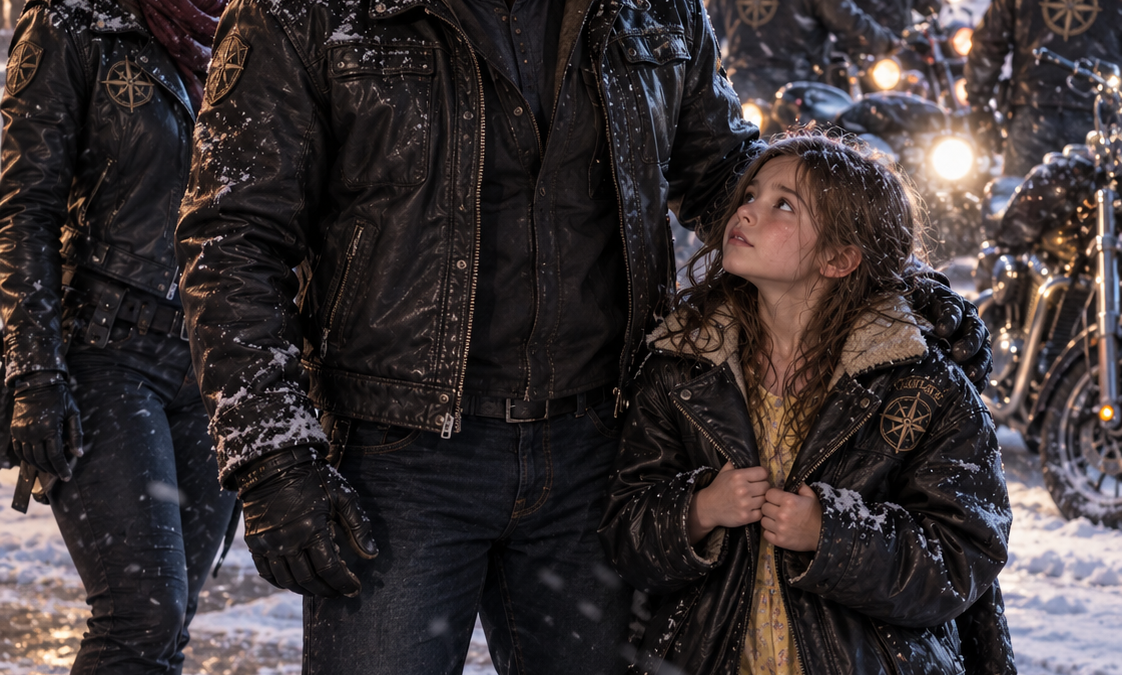
Part 3
The drive was in the air, encrypted, fragmented, split across two channels, the way Cork’s contact had specified in 30 seconds of very quiet, very deliberate phone conversation.
The kind of conversation conducted by people who had spent careers assuming their calls were monitored and had adjusted their language accordingly. It was not enough.
Not yet. Getting the drive to the right people was the first step. The second step was making sure those people understood what they were receiving before Voss could trigger whatever mechanism he had in place to make things disappear.
But it was moving, which meant Rowan had bought something.
He just wasn’t sure yet what he’d spent to get it.
The expedition came back into the lot entrance from the west at 11:47 p.m.And this time, it didn’t stop at the perimeter.
It came in slow and it came in straight. Headlights flooding the ark of bikes. And behind it came the Tahoe.
And behind the Tahoe came a third vehicle, a white panel van with no markings that Rowan had not seen before and that told him Voss had been on the phone in the 20 minutes he’d been invisible.
Three vehicles.
The Expedition in Tahoe he’d accounted for.
The van was new inventory.
He heard Norah’s voice in his earpiece.
A simple setup, short range. The club used them for ride coordination and tonight they were using them for this.
I see the van, she said. Rowan, I see it.
That’s not logistics.
That’s capacity.
I know. He looked at the van.
It had stopped behind the Tahoe angled and no one had gotten out of it, which meant it was waiting for something to get into it. Stay with Callie.
Don’t open that bathroom door for anything except my voice.
Understood. Voss got out of the expedition again. Same coat, same hands and pockets.
But something had changed in his posture. The slight incline forward, the set of the shoulders, the way he walked across the snow-covered asphalt with the deliberate pace of a man who has stopped calibrating for the possibility that this ends without contact.
He stopped 10 ft from the bike ark, closer than before. Close enough that Rowan could see his face clearly in the headlight wash.
I’m going to make this simple, Voss said.
Good, Rowan said. I like simple.
You have something that belongs to the organization I represent. A girl and a drive.
I want both of them.
I’m prepared to leave every person in this parking lot in the same condition I found them if you make the exchange now.
And if I don’t, Voss looked at the van.
That becomes a different kind of conversation. Rowan looked at the van too, then back at Voss.
How many are in the van? Enough.
I’ve got 14 riders, Voss.
Some of them have done things for the government that the government still doesn’t like to write down.
You want to have that conversation? We can have it.
But I want you to think about what it costs before you open that door. Voss smiled.
The same functional smile from before.
The one that didn’t reach anywhere useful.
You’re not killers.
No, Rowan said.
We’re not.
Then you’re going to lose.
Probably.
Rowan said, “But you’re going to know you were in a fight.”
A silence. The engines ran.
The snow came down.
Somewhere in the treeine, the two contacts he’d heard earlier had gone still.
They were listening, too, waiting for the signal that would or wouldn’t come.
Then something happened that Rowan had not calculated.
The expedition’s passenger door opened, and a man got out who was not one of Voss’s logistics people, not a driver, not security.
He was wearing a suit under an open overcoat, which was the wrong clothing for a Wyoming blizzard, which meant he had not planned to be outside. He was 60, maybe older, with white hair and the kind of face that appeared in annual reports and press releases and county commissioner meetings.
He walked around the front of the expedition and stood beside Voss, and he looked at Rowan with an expression that was not Voss’s calculated patience, but something older and more frightened, trying to look like something else.
Rowan recognized him,
not from the newspaper photograph Dana had described. He recognized him because 6 months ago, this man had ridden in a July 4th parade through Laramie in the back of a convertible, waving, and the Iron Compass had been providing crowd perimeter security as a favor to the city, and Rowan had stood on a street corner and watched him go by.
State Senator Douglas Puit. Rowan kept his face exactly where it was, let nothing move.
Puit said, “Son, I think we’ve gotten off on the wrong foot here.”
Nobody responded to that.
I’m Douglas Puit.
I represent the 31st District and I’ve worked with law enforcement in this state for 22 years.
And I want you to know that whatever you think is happening here, I can help you understand the full context.
Rowan said, “The full context?
This is a child welfare situation.
The girl in that building has been removed from a dangerous home environment by legitimate stop.”
Rowan said. Puit stopped.
Don’t.
Rowan’s voice was still even, but something had moved into it.
Not anger, the thing that lives past anger, the thing that has been compressed by years of specific experience into a very small, very dense space.
And that when it surfaces doesn’t announce itself.
I’ve got a woman in that building who spent 3 years driving children for your network.
I’ve got a drive with 6 years of documentation.
and I’ve got an 8-year-old girl who memorized your name off a paper she saw for 15 seconds in the back of a car.
He paused.
So, don’t stand in a parking lot in a blizzard and tell me about child welfare.
Puit’s face had gone through several colors.
He looked at Voss. Voss was looking at Rowan with an expression that had shed the last layer of functional courtesy and arrived at something underneath that was very simple and very cold. The drive, Voss said.
It’s gone.
Rowan said, “You’re lying.
I’m really not.”
A silence that lasted exactly long enough for Voss to run the calculation. The specific calculation of a man who has built a career on controlling information and who is now being told that control has been broken.
That somewhere in the last 40 minutes, something has moved beyond his ability to stop it. Rowan watched him run it.
Watch the point where the calculation arrived somewhere Voss didn’t like.
“Who did you send it to?”
Voss said.
someone who isn’t you.
Voss’s right hand came out of his coat pocket.
What happened in the next 8 seconds was not choreographed, and it was not graceful, and it was not the way fights look in the version of the world that gets edited for screens.
It was fast and ugly and driven entirely by the decision that Mack had already made before Voss’s hand cleared his pocket.
The decision that had been made the moment the van arrived, the moment the treeine made sounds, the moment the senator got out of the expedition in a suit in a blizzard. Mack went through the gap between two bikes at a dead run.
He was 6’4 and 240 lb and he had been a Marine in Fallujah and his right knee was fine, unlike Rowan’s.
and he crossed 20 ft of snowed over asphalt in the time it took Voss’s hand to complete its arc.
And he hit Voss in the shoulder. Not a punch, a redirect.
The kind of controlled collision that takes a weapon off its line without requiring a decision about what comes after.
Voss’s arm went wide.
Whatever was in his hand discharged into the snow 6 ft to the left. Cork from somewhere behind Rowan.
Taser. Not a firearm.
A taser. which meant Voss had come prepared to incapacitate, not to kill. In the parking lot, in front of 14 witnesses, which meant Puit was still in enough of a political framework to not want bodies.
That was the only good news in the parking lot. Everything else happened at once.
The van’s side door opened and three men came out moving fast.
And from the treeine, the two contacts came through the fence line. And Beex went left and Shephardd went right. And Cork put himself directly between the building entrance and everything else and stood there like a man who had spent eight years in federal corrections, learning exactly how much space a single determined person could hold.
Rowan did not run. He walked fast toward the point where Mack had Voss on the ground.
Not restrained, M was not sitting on him. He was standing over him with one boot on the wrist that had held the taser, which was the minimum necessary to communicate that the situation had changed.
Boss looked up at him from the asphalt. His coat was open. His face was bleeding slightly from where it had met the ground.
His expression was not fear, and it was not defeat. It was the expression of a man who is making a recalculation in real time, adjusting variables, looking for the angle that still exists.
You have no authority here, Voss said. No, Rowan agreed.
You’re a motorcycle club with no legal standing and no, Voss.
Rowan crouched down to his level.
Same thing he’d done with Cali in the hallway.
The same geometry of attention. The drive went to two people.
One of them works for an agency that has been trying to build a case against Hrix for 3 years and kept hitting sealed walls. They have the case number now.
They have the network map. They have names. He paused.
Including Puits. From somewhere behind him, Puit made a sound.
The other person, Rowan said, is a journalist.
I won’t tell you which one.
This was not entirely accurate.
Cork’s contact was not technically a journalist, but accuracy was not the point of this particular statement.
So, whatever you do in the next 10 minutes, I need you to understand that it doesn’t change what’s already moving.
Voss looked at him. His jaw was tight, and his breath was coming in visible clouds, and there was snow in his hair, and none of it had made him look small, which was itself a piece of information.
You don’t understand what you’ve started.
Voss said, I hear that a lot tonight.
Hendrickx doesn’t end with the drive.
Hendrickx doesn’t end with whatever you think you’ve sent to whoever you think you’ve sent it to.
The people at the top of this are He stopped, looked at Max’s boot on his wrist, looked back at Rowan.
You’ve created a problem that outlives tonight.
Good, Rowan said.
I’m counting on it.
He stood up. Mac, he said.
Max stepped back. Voss sat up slowly, did not stand, sat in the snow of the parking lot with his coat open and his hair blown sideways by the wind and looked at Rowan Creed standing above him in the headlight wash of 11 Harley-Davidson motorcycles and said nothing.
Puit from the front of the expedition said, “This is going to be managed.
Whatever you think, this will be managed and no one will.”
Senator Rowan looked at him. Get back in the car.
You cannot speak to me. Get back in the car and call your lawyer.
That’s the most useful thing you can do right now.
He held Puit’s gaze until Puit’s eyes went somewhere else.
And then Puit did something that confirmed everything Rowan had read in him from the first moment he’d stepped out of the expedition in a suit in a blizzard.
He got back in the car. Not because Rowan had authority, because Puit was a man whose entire life had been structured around knowing when a room had turned against him and the room had turned.
The three men from the van had stopped advancing. They were standing in the snow 20 ft from the bike ark, and they were looking at each other and at Voss on the ground and at the iron compass members who were not moving, just present.
14 people distributed across a parking lot in a way that occupied every angle of approach without appearing to the way soldiers occupy terrain.
One of the three put his hands up slightly, not surrender, but the gesture of a man who is working a job and who has just recalculated whether the job is worth what it’s paying.
He stepped back one step. The man beside him stepped back too.
Rowan’s earpiece.
Nora.
Rowan, we’ve got lights on the access road.
He looked at the access road, blue and red strobing through the snow. Not one set.
Three, Shepard said from his left. Trooper response.
Three units. Darcy came through.
22 minutes early, Shepard said, and there was something in his voice that was not quite wonder, but occupied the space next to it. Voss heard it, too. He was still on the ground, and he turned his head toward the access road lights, and something moved in his face.
The first genuine thing Rowan had seen there all night. Not fear, not panic, something smaller and more specific.
The look of a man watching the last variable go outside his control. Rowan turned and walked toward the building entrance. Cork was still at the door, standing with his coffee cup and his phone.
And when Rowan reached him, Cork said without looking up from his screen, “Second contact confirmed receipt.
They’re verifying the encryption now.
Says 20 minutes for authentication.
We’ve got troopers incoming.
I heard. Cork looked up.
His face was seamed and weathered, and his eyes were the particular dark gray of someone who had made peace with most of what he’d done and was still working on the rest.
You okay? Rowan thought about the question.
Callie Norah hasn’t opened the door.
Good Rowan. Yeah. Voss is right about one thing.
Cork said this doesn’t end tonight.
Whatever’s on that drive, whoever receives it, the structure is too large to come down in one night.
I know we’re going to be in this for a while.
I know that, too. Rowan looked at the access road where the first trooper unit was pulling into the lot entrance. Light bar turning the snow blue and red and blue again in slow sweeping arcs that made the whole parking lot look like something from a nightmare someone had lit wrong.
But Callie goes home tonight. Whatever else, that part ends tonight. Cork looked at him for a moment.
Then he nodded once and stepped aside from the door. Rowan went inside.
He walked through the fluorescent hallway and past the office where Dana Kelch sat with six children’s worth of history and a future that was going to be determined by people in rooms he would never enter.
And past the vending al cove where a paper cup sat on the floor with a ring of dried hot chocolate at the bottom. and he stopped at the bathroom block door and he knocked twice. Pause.
Once the signal he’d told Nora and the lock turned and the door opened.
Cali Mercer stood in the doorway in the yellow sundress and the oversized jacket and her feet in the wet canvas sneakers and she looked up at him and the practice stillness was still there, but something underneath it had shifted. Something had loosened the way ground loosens after a long freeze when the temperature finally makes its move.
behind her through the small window near the ceiling. The blue and red light strobed in and swept the walls and swept away.
“Wait, are they here?”
Callie said.
“They’re here.
Police.”
“Three units.”
She looked at him for a long moment. The light swept.
Her face went blue and then red and then back to the flat fluorescent white.
“Are you in trouble?”
she said. This question landed in him somewhere unexpected.
eight years old, yellow sundress, 19 hours of captivity and a parking lot confrontation and a blizzard and the cold that had gone into her bones. And her first question was whether he was in trouble.
Not the kind that matters, he said. She looked at him for one more beat.
Then she nodded the same way Cork had nodded once direct, the nod of someone who has heard an answer and has decided it’s enough.
She stepped out of the bathroom.
She stood in the hallway and looked at the front door where through the glass the parking lot lights had been joined by the trooper unit’s bars and the whole lot was a slow turning conversation in blue and red.
And she looked at Rowan and she said, “I want to go home.”
“I know,” he said.
“Can I go home?”
And Rowan Creed, who had not cried since a specific night in 2009 that he never named, felt something move in his chest that was not a feeling he had words for in any language he’d been taught.
and he said, “Yeah, Callie, you can go home.”
He put his hand out. She took it. And they walked toward the door, the 53-year-old biker with the hearing aid and the bad knee and the tonitis that sounded like distant static.
And the 8-year-old girl in the yellow sundress, who had memorized a federal case number off a document she’d seen for 15 seconds, and had raised her frozen fingers in a blizzard, and trusted that someone on the other side of that gesture would be worth trusting.
The door opened and the cold came in and the light strobed and through the noise and the wind.
Rowan could hear the troopers voices and Voss saying something tight and controlled and Max’s voice answering it.
And he could hear the Harley engine still running, still breathing, still there. And he could hear Norah coming up behind him and Cork and Shephard and all of it was loud and cold and blinding.
But Callie didn’t flinch.
She walked out into the blue and red light with her chin up and her hand in his.
And the first trooper who reached them stopped short when he saw the child, stopped and looked, and the professional distance in his face cracked for just one second, just enough, and he said, “Is this Cali Mercer?”
And Rowan said, “Yes.
” And the trooper crouched down and said her name, and Callie looked at him with those clear brown eyes and said, “I have information.
I need to tell someone.
I need to tell someone everything.”
The trooper looked up at Rowan. Rowan looked back and somewhere behind them in the parking lot, Garrett Voss was speaking to the second trooper in the careful, controlled voice of a man who had done this before, who had navigated situations before, who had an answer for everything before, but who was doing it with a dead taser in the snow and a
state senator in his car and a USB drive that was already three states away in two encrypted pieces heading toward people who were not in his rolodex. And the third trooper had her hand on her radio and the radio was live.
And what was about to come out of it was going to be the beginning of the kind of night that does not end until morning. The kind of morning that does not arrive without cost.
The kind of cost that 14 bikers in a Wyoming parking lot had agreed to pay without being asked, without being thanked, without knowing yet how long the pain would last.
Rowan felt Callie’s hand tighten in his.
He tightened back, and from the treeine, invisible in the dark in the snow, something moved. A vehicle, no lights, pulling away from the fence line with the slow, deliberate patience of a man who had learned long ago when to disappear and when to wait, and who understood that tonight was not the end of anything but a different kind of beginning.
Voss’s third car, the one Rowan hadn’t seen.
And in it, in the dark, a phone was already dialing. The third car never came back.
Rowan knew it wouldn’t.
Not tonight. The kind of man who keeps a third vehicle staged in the dark and pulls away clean when the blue lights arrive is not the kind of man who reverses course on the same night.
He cuts the loss. He recalibrates. He makes a phone call to someone above him and reports that the operation has experienced a complication and waits for instructions.
And the instructions take time because the people giving them are in warm rooms far from Wyoming. And they have to think carefully about what they want to cost themselves before they decide what to do next. It bought time, not safety.
Time. Rowan understood the difference.
He stood in the parking lot for 20 minutes while the troopers worked the scene. Voss and his two visible associates separated and questioned.
The van’s three occupants detained on a probable cause hold that the senior trooper, a lean woman named Casy, who moved with the particular efficiency of someone who had been doing this job in all weather for 15 years, established with a professionalism that suggested she had heard enough of what Darcy communicated through the emergency channel to
understand that this was not a standard call.
Puit had not gotten out of the expedition again. His window was down 2 in and his voice came through it in the controlled modulated tones of a man reciting his rights to himself like a mantra. He did not look at Rowan.
Rowan did not look at him.
Dana Kelch came out of the building at Trooper Caskey’s request escorted by Mac and she walked across the parking lot in the strobing light with her head up and her hands visible and she gave her name and she said clearly and without hesitation, “I want to cooperate fully.
I have information regarding a multi-state trafficking network operating under the name HRIS. I want to speak to a federal agent.
She paused. I understand what that means for me.
I want to do it anyway. Casy looked at her for a long moment. Then she looked at Rowan.
Rowan said nothing, just nodded once. Casy got on her radio.
It took 4 hours for the first federal presence to arrive. a two agent team that came down from Casper in an SUV that had driven carefully through the clearing roads, arriving at the Elk Ridge Station rest stop at 3:52 a.m.to find 11 Harley-Davidson motorcycles still parked in a loose ark across the building entrance, nine riders who had not left, a state senator sitting in the back of a trooper unit, a logistics contractor in federal hold, and a woman named Dana Kelch who had been talking steadily into a recorder for 2 hours and showed no signs of stopping. Cali Mercer was asleep.
She had fallen asleep at 1:15 a.m.on a folded pile of iron compass leather jackets in the building’s back office.
the same office where Dana had sat in the chair which Norah had dragged against the wall and filled with jackets until it was something approaching a bed. Callie had sat down to wait and had been asleep within minutes, the way children sleep when the body finally overrules the mind and demands its debt, sudden and complete and without negotiation. Norah had stayed in the room.
She sat on the floor with her back against the wall and her knees up and she did not sleep and she did not leave.
When the federal agents arrived, Rowan briefed them in the hallway in 10 minutes, structured, sequential, the way he’d been trained to brief people who needed information fast.
He told them about the drive, the two recipients, the encrypted split.
He gave them Cork’s contacts acknowledgement codes, which Cork had saved as screenshots.
He told them about Puit, and about the name Cali had given him, and about the county child services administrator, whose name was on a paper in a car outside Dubois. He told them about the second stop location, the house with the GPS coordinates Dana had memorized.
He told them about the case number and what it meant and what it had been protecting. The younger of the two agents, a woman, late30s, who had not introduced herself by name and whose jacket said nothing, wrote in a small notebook without looking up.
The older agent, a man with a gray beard, who had the quality of someone who had been doing this work long enough to have stopped being surprised by it, and had replaced surprise with a very specific kind of tired patience, looked at Rowan when he finished and said, “How long did you hold this location?”
“About 4
hours.”
With 14 riders, 14, yes, against Voss and his people and the senator. The older agent looked at the hallway for a moment, at the fluorescent lights, at the space heater visible through the office door, at the pile of leather jackets with a child sleeping in them.
He said, “That drive reaches the right people.
It could break this thing open.
Cases we’ve been trying to close for 3 years.”
“That’s what I was told.”
Rowan said, “You understand there will be a process.
Federal involvement, state jurisdictions, the Puit situation alone is he stopped.
It’s going to take time.
It’s not going to look like it happened in a night.
I know how these things work. The agent looked at him. Do you?
I did four years of intel work before I ended up where I ended up. Rowan held his gaze.
I know it doesn’t end tonight.
I know Voss has people above him and they have people above them.
And that structure doesn’t come down because we sent a drive and made a statement in a parking lot.
He paused.
But Puit’s in a trooper unit right now having a very specific kind of evening.
And the administrator in Dubois doesn’t know yet that her name is on a recorder.
And 12 children Darcy cross-referenced from the sealed case files are going to have someone looking for them who wasn’t looking before tonight.
He let that sit.
It’s a start.
The older agent said nothing for a moment.
Then he said, “You took a significant risk.
I have a significant hearing aid and a bad knee and I’m 53 years old.”
Rowan said, “My risk calculus is different from what it used to be.”
The agent almost smiled.
It didn’t quite make it.
We’ll need statements from your people.
They know. And you.
I’ll be here.
He went outside. The storm had broken sometime in the last hour without anyone inside noticing.
The wind had dropped to nothing, and the snow had stopped, and the sky above the Wyoming highway was doing what it did after a hard storm, clearing fast and going black, and filling with stars that look too close and too many. the way stars look when all the atmospheric interference has been scoured away.
And what’s left is just the raw distance between here and everything else.
The parking lot was quiet. The trooper units were still there, their light bars off now, just vehicles. The expedition and the Tahoe and the van were there, surrounded by evidence tape that Casy had run in a precise perimeter with the focused energy of someone who understood that tonight was going to generate paperwork for months and wanted to get the scene right from the start.
The 11 iron
compass bikes were still running, not because anyone had forgotten to turn them off, because nobody had turned them off, because in the hours since the confrontation and the arrest and the federal arrival, the nine riders had stayed beside their machines. And the machines had stayed alive, idling in the cold with the low, patient rumble of engines that did not understand the concept of giving up. And nobody had said anything about it.
And that was the kind of thing about the Iron Compass that Rowan had never been able to explain to anyone who wasn’t in it.
Cork was sitting on his diner with a cigarette and his phone and the expression of a man who had spent 8 years in a cell learning how to wait and had never fully stopped. Rowan walked over and stood beside him.
“Second contact confirmed authentication,” Cork said without looking up.
“About an hour ago.
They’re working it.”
“Good, good.
You should know.”
Cork took a pull on the cigarette, exhaled slow.
My first contact, the one I’ve known since Bowmont.
He said this particular network has been on their radar for 4 years, said they kept losing traction because every time they got close, something in the access chain closed up.
Puit Rowan said, “Or someone like him, more than one probably.”
Cork looked at his cigarette. He said the case number being on that paper in the car, a document that specific being that accessible, might mean someone inside the network was already trying to create exposure.
Rowan thought about Dana Kelch, about 6 weeks of documentation on a USB drive, about a scheduling change that had put her in a room where she wasn’t supposed to be and had put a name in her memory or someone inside was already trying to get out, he said.
Cork considered this
same destination, different road. They stood in the quiet of the posttorm parking lot, and the stars were very bright, and the Harley engines idled.
And after a while, Cork finished his cigarette and field stripped it the way he’d learned in corrections, and held the filter in his hand because there was no ashtray, and said, “She going to be okay, the kid.
” Rowan looked at the building entrance.
Through the glass, he could see the back hallway, and through that, the edge of the office doorway and Norah’s boots on the floor where she was sitting against the wall.
She’s going to carry it, he said.
But yeah, she’s going to be okay.
How do you know? Because she memorized a federal case number off a document she saw for 15 seconds.
He paused.
Kids who do that don’t break.
They bend for a while and then they find their shape. Cork nodded slowly.
What about us? Rowan looked at him.
Voss wasn’t lying.
Cork said what he said about this not ending tonight.
The network’s not gone.
We put a dent in it. We got one man in a trooper unit and we gave some people a drive they might be able to use, but the thing itself is still there.
I know. So, what do we do?
Rowan looked at the highway at the I80 corridor running east and west through the Wyoming dark, empty now, the blizzard’s aftermath still visible in the drifts along the shoulders and the ice glaze on the asphalt catching the starlight.
I thought about the truck stops and the rest areas and the lonely back roads that spread out from this highway in every direction. the spaces between towns where things happen that towns pretended not to know about.
“We do what we’ve been doing,” he said.
“We ride.
We watch.
We don’t interfere unless interfering is the only option,” he paused.
“And we answer when someone signs to us.”
Cork looked at him for a moment, then he picked up his helmet from his handlebars and turned it in his hands and said, “You know she’s going to remember you.
She doesn’t need to.
Doesn’t matter what she needs to, she will.”
Rowan didn’t answer that.
At 5:30 a.m., the federal agents released the Iron Compass members from the scene pending formal statements, which Trooper Casy scheduled for 48 hours out to give everyone time to reach a location with a federal field office. The sun was not up, but the sky to the east had begun its pre-dawn work.
That particular grade of dark that is not quite black anymore, that has started the long negotiation toward gray.
Callie’s mother arrived at 5:47 a.m.She came in a trooper’s vehicle from Casper, having been reached by phone at 2:00 a.m.and having spent the next 3 hours and 47 minutes in the passenger seat of a trooper’s SUV traveling roads that were technically still under advisory, talking to no one, looking at the road through the windshield with the expression of a woman who has dismantled every minute of the last day and a half and rebuilt it around a single fact she is not yet sure is real.
Her name was Ellen Mercer and she was 34 years old and she came through the building entrance at a pace just below running and Norah met her in the hallway and Norah said, “She’s in here.
She’s okay.
She’s been asleep.”
And Ellen made a sound that was not a word and went through the office doorway. Rowan did not follow. He stood in the hallway and listened to the specific quality of silence that came from the office.
Not absence of sound, but the presence of something too concentrated for noise. The sound of a reunion that had no language adequate to it, that resolved itself into breathing, and the small involuntary sounds that humans make when something they had started to believe was lost, is suddenly and impossibly not lost.
After a while, the sounds changed, and he heard Callie’s voice, still small, still steady, the same voice that had said, “I remember everything in a parking lot,” saying something he couldn’t make out.
And then Ellen’s voice broken and reconstructing itself, answering.
Norah came back into the hallway and stood beside him. Her face was doing something careful. She woke up the second her mother came in the door, Norah said before Ellen even made a sound.
Kids know, Rowan said. Norah looked at the office doorway.
Dana federal custody.
She’ll be processed through Casper.
She gave them everything. What happens to her?
I don’t know.
She cooperated fully. She documented for 6 weeks. She had the drive ready.
He paused.
I told the agent she’d tried to get out.
That’s on the record.
Does it matter?
I don’t know that either.
He looked at the doorway. She drove children for 3 years. Norah said nothing.
She also just helped take down a state senator and a logistics network and gave federal investigators the access they needed to reopen cases they’ve been losing for 4 years.
He rubbed his eyes. He was very tired. Both of those things are true at the same time.
I’m not the one who decides what that adds up to.
Norah leaned against the wall. You okay?
Ask me when I’ve slept.
I’m asking now.
He thought about it about the parking lot and the taser in the snow and Voss’s face doing its calculation and Puit in the back of a trooper unit and the third vehicle pulling away in the dark with a phone already dialing.
About all of it still out there, the structure still standing. The people above Voss still in their warm room, still making decisions.
“I’m functional,” he said.
“That’s not what I asked.”
He looked at her.
Norah Vance, who had come into this club because her life had been made too small, and who had spent 9 years making it larger one mile at a time, who had sat on the floor of a resttop bathroom for 3 hours keeping one hand in reach of an 8-year-old girl’s shoulder so she would know in her sleep that someone was there.
“No,” he said honestly.
Not entirely. Norah nodded. Good.
Entirely okay in a situation like this means you’re not paying attention.
He almost smiled at that. Not quite.
The office door opened and Ellen Mercer came out with Callie’s hand in hers.
Not the grip that the other woman had used. Nothing like that.
The easy unconscious connection of a mother who has not yet let go and is not planning to for some time. and she stopped in the hallway and looked at Rowan and opened her mouth and then closed it again because there was no sentence available. Rowan said she did everything right, everything.
Ellen’s jaw worked.
Her eyes were red and there was nothing composed about her face and she was the most honest looking person he’d seen in 24 hours.
How?
She said, “How did you sign to me?”
Rowan said in the parking lot. I saw it. Ellen looked down at Calie.
Callie looked up at her mother, then at Rowan.
She was wearing Norah’s jacket, still, the sleeves hanging past her hands, her yellow sundress visible below it, her wet sneakers beginning to dry out at the edges.
She had the look of a child who has slept hard and woken into a world she’d been afraid might not be there, and is spending these first minutes confirming the inventory.
“You know, sign language,” Callie said to Rowan.
“Some of it, not much.
My grandma taught me.”
“I know.
You told Nora. Callie considered this.
Then she raised her right hand, small fingers moving with the practiced ease of someone for whom the language was native, not learned, and she signed something brief and clean. He read it.
Thank you. He raised his hand, signed back.
You’re the one who did this.
She looked at his hands and then at his face, and something moved in her expression. Not a smile exactly, more the thing that precedes a smile. the internal shift that happens before the face catches up.
Then she turned back to her mother and leaned into her side, and Ellen’s arm came around her, and they stood like that in the hallway while the pre-dawn light came weakly through the service building small, high windows, and the heating unit ticked, and the coffee smell from
the machine.
Deb had eventually turned back on, drifted through the building like the most ordinary thing in the world. Trooper Casy appeared at the end of the hallway.
Mrs.Mercer, whenever you’re ready, we’ll take you to Casper.
Medical evaluation for Cali, then a federal interview team will want to speak with her in the morning with you present. She paused.
There’s no rush.
Take your time. Ellen nodded. She looked at Rowan one more time.
I don’t know your name, she said.
Rowan, I don’t know how to.
She stopped, started again. Thank you. Seems like the wrong size.
It’s the right size, he said.
She got herself through 19 hours and she signed to a stranger in a parking lot and that took more courage than anything I did tonight. He looked at Callie. Tell your grandmother her teaching saved a life.
Callie looked up at her mother and something passed between them. The telegraphic communication of people who know each other completely.
And then Ellen guided her daughter down the hallway and through the front door and out into the Wyoming pre-dawn, and the door closed behind them. The hallway was quiet.
Norah exhaled.
“Come on,” she said.
Cork found a diner 20 minutes south that’s open.
“Duh.”
The diner was called Maxines, and it had been open since 1987, and it did not appear to have changed significantly since then, which was the best thing about it. The booths were green vinyl, and the counter was yellow laminate, and the coffee came in white mugs that were heavier than they looked. And the woman behind the counter, not Maxine, Maxine had died in 2019.
This was her daughter-in-law, Patricia, looked at 14 bikers coming through her door at 6:00 in the morning without surprise, which was the second best thing about the diner. They took three boos and two counter stools, and they ordered coffee and eggs and whatever Patricia recommended, which turned out to be biscuits with a gravy that had clearly been thought about seriously. and they sat in the yellow diner light and the smell of coffee and butter and the particular warmth of a building that has had its heat running all night and they did not talk much.
That was fine. Some things did not require immediate language. The language would come later in the weeks ahead in conversations on the road and in the chapter house and in the long hours of rides that worked things through without words better than words could.
But right now they were 14 people on the other side of something. And on the other side of something, you eat and you drink coffee and you let the warmth back in and you take inventory of what you still have. What they had 14 people, no serious injuries, two bruised ribs for Mac from the engagement in the lot, which he reported with the detachment of a man for whom bruised ribs ranked somewhere between an annoyance and a minor inconvenience.
a gash on Shepherd’s left hand from the fence line that Patricia cleaned and bandaged without being asked, appearing from the back with a first aid kit with the matter-of-act efficiency of a woman who had tended to traveler’s wounds before.
Shephard said, “Thank you.”
Patricia said, “Eat your eggs.”
And went back to the counter.
Court got his phone out and checked it one more time and then put it away and picked up his coffee mug and held it in both hands and said to Rowan, “Lo, across the booth, first contact says the authentication is complete and the material is with three people now, not two.”
The third is someone at DOJ he trusts.
He says it’s past the point where it can be quietly buried.
Rowan absorbed this. Good.
He says there’s going to be a process, grand jury, probably before anything visible.
Could be 6 months before anything public happens. I know Puit will have lawyers.
I know the administrator in Dubois. I know, Cork. Cork looked at his coffee.
But it moves. But it moves.
Rowan agreed. They drank their coffee.
Beex at the counter stool was talking to Patricia in a low voice about something unrelated to anything that had happened in the last eight hours. something about the road conditions south of Rollins, something about whether the elk migration had come through early this year. And Patricia was answering with the authority of someone who had lived in this corridor long enough to have opinions about the elk.
And Beex was listening with genuine attention because Beex was someone who had been trained to take in information from any source and had never fully turned that off. Shepherd sat with his bandaged hand around his own mug and looked at the table.
After a while, he said to nobody in particular, “She memorized a federal case number.”
Nobody answered immediately. Then Max said from the seat beside him.
8 years old.
“8 years old,” Shephard said.
Another silence.
“Her grandmother taught her to pay attention,” Norah said.
“Because she was deaf.
She said you miss things when you only listen.”
Shepherd looked at his mug.
“We spend a lot of money training people to observe under pressure,” he said.
programs, courses, weeks in classrooms. He paused.
8 years old, yellow sundress, 19 hours, and she built herself a weapon out of everything she could see and hear, and she waited for someone to hand it to. No, nobody said anything to that because there was nothing that improved on it.
The sun came up somewhere east of Rollins, and the light came through Maxine’s front windows at a low winter morning angle that turned the yellow laminate counter gold and made the coffee steam visible and touched the chrome of the coffee machine and the vinyl of the boos and the faces of 14 people sitting in a diner in Wyoming.
And it was not beautiful in any arranged way, not the kind of beautiful that gets described, just the specific quality of light, arriving after a long dark and finding things still where it left them. Rowan sat in his booth and drank his second coffee and looked at his hands on the table.
The right one, the one he’d used to sign to Cali across the waiting room.
The left one with the scar that he didn’t explain.
He thought about what it costs to be the person who looks, to be the person in a parking lot who sees something in a child’s eyes and doesn’t walk past it.
He had walked past things before in his life, in years he didn’t revisit in daylight.
He had been the person who didn’t look because looking costs too much, because he’d already spent himself too completely in too many places on too many things, and there was nothing left for other people’s emergencies.
That had been a long time ago. It had also in certain ways been last night because the person who had stood at the vending machine in the Elk Ridge station rest stop and calculated whether to get involved, who had felt the weight of 14 riders and a chapter he was responsible for in a network he was now understanding was larger than any of
them had known. That person had also had to decide.
He had decided because of a pair of frozen fingers making a single word in the air. That was the whole of it. You could dress it up in whatever language you wanted.
Duty, instinct, conscience, whatever word fit the frame you were holding, but at the bottom it was just a pair of frozen fingers and a word and a man who happened to know what the word meant. Patricia refilled his coffee without asking.
He said, “Thank you.”
She said, “You looked like you needed it.”
He thought about that.
“Yeah,” he said.
“We all did.”
She looked at the three booths and the two counter stools and the 14 people in varying stages of coffee and eggs and posttorm quiet and she looked back at him with the expression of a woman who had been watching travelers come through her door for long enough to have developed a taxonomy.
“You do something good last night,” she said.
Rowan considered the question with the honesty it deserved.
“We tried,” he said.
“Good enough,” Patricia said and went back to the counter to They rode out at 8:15.
The roads were clear enough. A trooper had come through at 7:30 and posted the I80 corridor as open with caution, which in Wyoming meant the pavement was visible and the ice was manageable.
If you weren’t going stupid speeds, and the Iron Compass did not go stupid speeds in winter, they went deliberate.
They went in formation to a breast the way the club always rode long stretches. A moving shape that the road understood that other drivers learned to read and give space to.
Rowan led as he always did.
The Road King’s engine was warm and the road was white shouldered, and the sky above the Wyoming corridor was the specific clear blue that only exists after a storm has emptied itself completely.
A blue that had no ambiguity in it, no weather left to threaten, just altitude and light and the wide specific fact of the American West going in every direction to the edge of what you could see. His hearing aid picked up the formation behind him.
11 other engines. The particular overlapping rhythm of a group of machines that had been tuned by different hands over different years and had arrived at their own collective sound. Not synchronized, not matching, just together in the way that things that have been through the same weather together become together.
He thought about what Cork had said.
She’s going to remember you.
He thought about Callie in the yellow sundress, Norah’s jacket over her shoulders, hot chocolate in her hands, telling her story in a methodical sequence to a biker who was writing it down on a phone in a vending al cove at 11:30 at night.
He thought about her, saying, “I know.”
When he told her she’d done good with the matter-of-act confidence of a child who had already run the assessment herself and reached the same conclusion and did not need external confirmation, just acknowledgement.
He thought about Dana Kelch saying, “I didn’t choose this assignment,” and meaning something underneath it that was not an excuse.
He thought about a USB drive moving through encrypted channels toward people who would use it, and a federal agent with a gray beard and tired patients who had looked at the pile of iron compass leather jackets with a child sleeping in them, and had not said anything, but whose face had said something. He thought about Garrett Voss in a trooper unit, phone confiscated, and the third vehicle pulling away in the dark with a call already being made.
He thought about the structure still standing, still running, the machinery of something that did not end in a single night, and would require months or years of the slow, unglamorous procedural work of federal cases and grand juries and jurisdictional negotiations to dismantle if it could be dismantled, which was not guaranteed, which was the honest answer. None of it was finished.
He knew that. But Cali Mercer was going home.
She was in a trooper’s vehicle going south toward Casper with her mother’s arm around her.
And she was going to sleep in her own bed and see her grandmother and tell her what the sign language had done. And that was a specific and non-negotiable fact that no part of the unfinished machinery could take back.
That was the thing worth carrying. The rest you held differently.
Not close, not like a wound. You held it the way you held a mission that was ongoing with attention, with intention, with the understanding that it required you to keep showing up. The formation crossed into open country south of Rollins, and the road straightened and the sky went enormous.
The way Wyoming sky goes enormous when the land drops away flat, and there is nothing between you and the horizon. And Rowan let the road king breathe into the straight, felt it settle into its cruising rhythm, and the wind came at him clean and very cold, and he did not lean away from it. Behind him, the iron compass rode.
No sirens, no pursuit, no third vehicle in any mirror, just the road and the morning and the engines and the specific sound of 14 people going home, knowing that they had not solved anything clean and had not fixed anything permanently, and had not come away without cost.
Max Ribs, Shepherd’s Hand, Cork’s eight years of patience cashed in one night, and all of them now known to a network that did not forget, but had done the thing that needed doing in the place where it needed doing, in the way that it needed to be done, which was enough,
which had to be enough, which was in the end the only accounting that had ever made sense to Rowan Creed in 53 years of being the kind of person who looked when looking was hard.
7 months later, a federal indictment was unsealed in the District Court of Wyoming, naming 11 individuals across three states in connection with a child trafficking operation. The indictment included one current state senator, two former child welfare administrators, and a logistics contractor named Garrett Voss.
The case number cited in the indictment was a 9-digit number that an 8-year-old girl had memorized off a document she’d seen for 15 seconds in the back of a car.
The Iron Compass MC was not mentioned anywhere in the indictment. That was how they wanted it.
Cali Mercer went back to school in February. Her grandmother flew in from Albuquerque and stayed for 3 weeks.
In the evenings, they sat at the kitchen table and practiced sign language. And her grandmother taught her new words.
And Callie taught her grandmother the sign she had made in a blizzard that had started everything. And her grandmother held her hands and looked at her for a long moment and then signed back in the careful way of someone who wants to make sure each word lands exactly right.
You were very brave. And Calie, who had been told this many times in many ways by many people in the months since January, signed back with the matter-of-act certainty of a child who has run the assessment herself and trust the result. I know.
Somewhere in Wyoming, on a road that had no name on any map worth buying, a road king moved through country that looked like it had been there since before the idea of roads. The writer was 53 years old, and he had a hearing aid and a bad knee and tonitis that sounded like distant static, and he was not going anywhere in particular, and he was not in any hurry. and the engine beneath him breathed with the low, irregular, patient rhythm of something that had been through a great deal of weather and had decided to keep running anyway.
The sky above him was the after storm blue. The road went forward. He rode.
This is a work of cinematic fiction created solely for artistic and entertainment purposes. All characters, locations, organizations, and events depicted are entirely fictional and bear no resemblance to real persons, living or deceased, or actual events.
—END—