Single Dad Broke Into the CEO’s Office to Save Her—She Screamed, “Arrest Him!” (Part 1)
Single Dad Broke Into the CEO’s Office to Save Her—She Screamed, “Arrest Him!” (Part 1)
PART 1
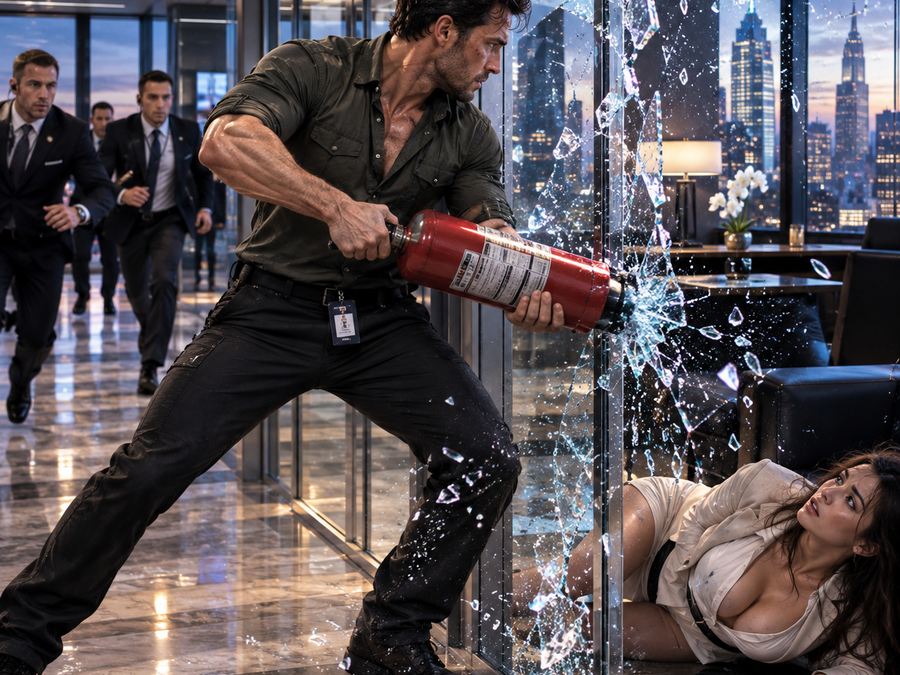
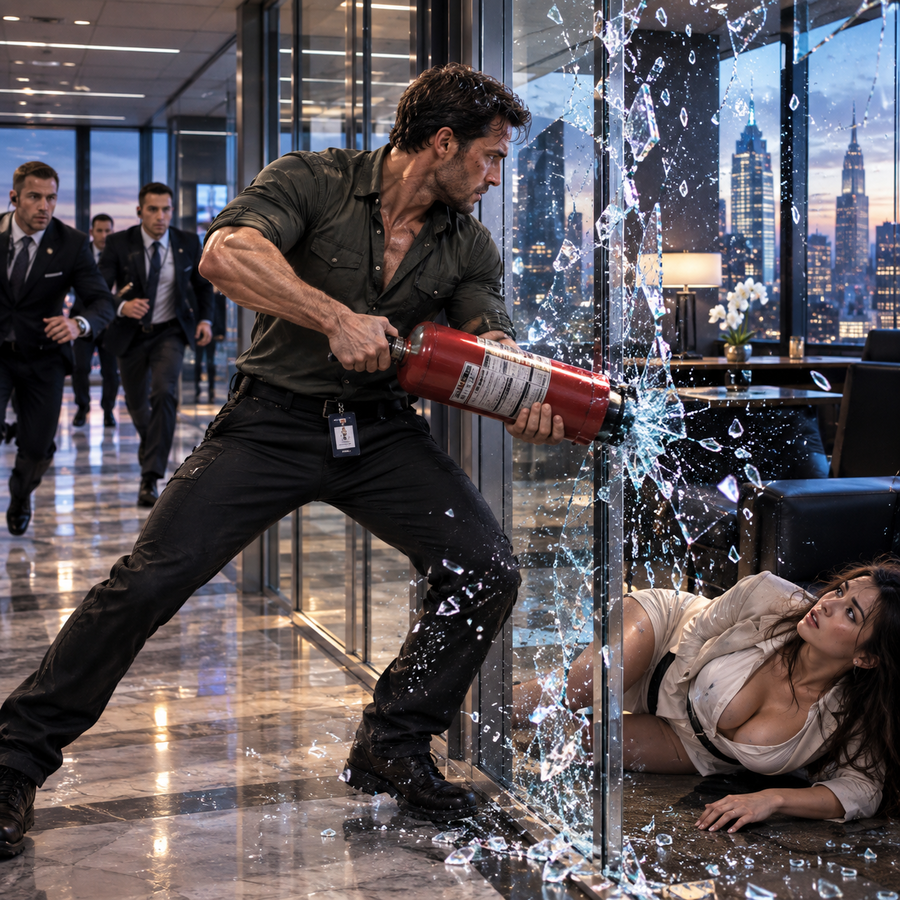
Nathan Cole swung a 30-pound steel breaker bar straight into reinforced glass and didn’t stop swinging until the wall screamed open. Security alarms tore through the 38th floor like a gunshot at a funeral. Inside that locked executive office, the most powerful woman in the building was already on the floor.
And the man kneeling over her—hands bleeding, uniform dirty, chest heaving—looked like every kind of guilty you could imagine. She opened her eyes, looked straight at him, and said two words that would change both their lives forever. “Arrest him.”
But here’s what nobody in that hallway knew yet. Nathan Cole had been awake since four in the morning. That wasn’t unusual. He’d been running on broken sleep for three years, ever since the accident. And somewhere along the way, his body had simply stopped expecting more. Six hours was a good night. Four was normal.
Tonight, it had been three and a half, and he’d given up fighting it at 3:48 a.m. and gone downstairs to make coffee and pack his daughter’s lunch before she even stirred. Lily was sixteen now. She’d gotten her mother’s eyes—that particular shade of dark amber that looked almost gold in certain light.
And her mother’s habit of going completely silent when something was bothering her, which meant Nathan spent a fair amount of his parenting energy reading silences instead of words. This morning’s silence was a different kind. The easy kind.
She’d come downstairs in her volleyball sweatshirt and sat across from him at the kitchen table with a bowl of cereal and her earbuds in, and they’d existed in the same space the way that people who truly know each other can—comfortably, without performance.
Nathan had watched her scrolling through something on her phone and thought she’s okay today the way he always checked first thing. The way he’d been checking first thing every single morning for three years. “You got that history thing due today?” he asked.
She pulled one earbud out. “Turned it in yesterday.” “Early?” She gave him a look that said obviously. “Extra credit.” He pointed at her. “That’s my kid.” She almost smiled. Put the earbud back in.
He drove her to school at 7:15, watched her walk through the front doors without looking back. Sixteen-year-olds don’t look back. And that’s exactly how it’s supposed to be.
And then he drove across Denver toward the Astron Medical Technologies Tower with his thermos of coffee going cold in the cup holder. The Astron building was thirty-eight floors of glass and steel in the heart of downtown. The kind of building that caught the morning light and threw it back at you like a challenge.
Nathan had been maintaining its mechanical systems for two years. HVAC, building automation, electrical distribution, fire suppression—the invisible skeleton that kept thirty-eight floors of offices and laboratories and executive suites alive and comfortable without anyone ever having to think about it.
That was the job. Keep everything running so smoothly that nobody ever noticed it was running at all. He’d been an industrial automation engineer once, for a company out of Houston, designing control systems for manufacturing facilities across three states. Complex work. Problem-solving at a level that required the kind of abstract thinking most people couldn’t sustain. He’d been good at it. More than good.
But Karen got sick in the fall of his thirty-third year, and by the following spring, she was gone. And what was left was Nathan and Lily and the understanding—clear and permanent as anything he’d ever calculated—that his daughter needed a father who came home at the same time every night. Who was present and stable and there.
And that was worth more than any career trajectory he’d spent a decade building. He’d taken the technician job two months after the funeral. His former colleagues had called it a step backward. His mother-in-law had cried when he told her, though she tried to hide it. His own father had asked very carefully whether Nathan was doing all right.
Nathan was fine. He knew exactly what he was doing and why. Some men defined themselves by how high they climbed. Nathan had decided to define himself by what he refused to abandon.
So every morning he drove to the Astron tower in his truck, clocked in, pulled on his uniform, and spent his days inside the parts of the building that executives never saw—the mechanical rooms and crawl spaces and equipment floors where the actual work of keeping a modern high-rise alive got done. He was good at the invisible work, too.
He got to the building at 7:52 a.m. and was in the mechanical room by eight. The morning started normally enough. Two minor temperature complaints from the fourteenth floor, a faulty pressure switch on the twenty-second that he diagnosed and tagged for replacement, and a sensor calibration on the thirty-first that had been drifting for a week and finally needed to be zeroed. Standard work.
He moved through it methodically, documenting everything in the building management system the way he always did, because documentation was the discipline that separated professional technicians from people who just hoped things kept working.
It was 11:43 when the first strange reading appeared. He was reviewing the automated system logs on his tablet in the basement mechanical room when he caught it—a pressure differential in the exhaust network serving floors thirty-five through thirty-eight that didn’t match the morning’s line by a margin he could write off as instrumentation drift.
He looked at the number again. “That’s not drift.” He pulled up the equipment status for the exhaust fan serving the executive level and went completely still. Fan EX38B was running in reverse. Not slowly, not partially. Full reverse.
The fan motor was spinning opposite to its programmed direction, which meant instead of pulling stale air out of the executive suite, it was pushing whatever air was already in the exhaust plenum back toward the space. Nathan set his tablet down on the equipment table and checked the program logic directly.
The fan was commanded to run forward by the building automation system. The controller said it was running forward. The actual motor was running backward. He’d seen that kind of mismatch once before in a paper plant in New Mexico—caused by a failed control relay that had inverted the motor’s phase sequence.
It was rare. The kind of failure that built-in diagnostics almost never caught because the system thought everything was fine. But this wasn’t a paper plant. This was an occupied executive floor with real people in it.
He checked the air quality sensors next. Two of them, AQ384 and AQ386, which monitored the corridor serving the executive suite, showed a status code that made his jaw tighten. Maintenance bypass. Both sensors had been placed in bypass mode, which meant they weren’t reading and weren’t alarming.
In a legitimate maintenance scenario, that was normal. You bypass sensors when you’re calibrating or replacing them to prevent false alarms during the work. But there was no work order for those sensors. He’d seen every open work order in the system that morning. Neither one was on the list.
He pulled the bypass record. The override had been entered at 9:00 a.m. using an executive-level access credential. Nathan sat very still for a moment. The way he did when a problem was trying to tell him something he didn’t quite understand yet.
Executive-level credentials could access the building management system’s override functions. That was a design decision he’d never agreed with. Executive overrides made sense for things like after-hours access and HVAC scheduling, but bypassing life safety sensors was a different order of authority. And giving that power to non-technical personnel was a gap that made professional building operators nervous.
He checked one more thing before he reached for his radio. The supply dampers for zone 38—the air delivery to Audrey Whitmore’s office—were locked closed. Manually locked. Not by the automation system. By a direct hardware override. Her office wasn’t getting fresh air supply. The exhaust was running backward. And the sensors that would normally scream about it had been silenced.
Nathan picked up his radio. “Dispatch, this is Cole. I’m in the basement mechanical. I need to flag a condition on the executive level, thirty-eight. I’m seeing abnormal equipment status that needs to be looked at before end of business today.”
A pause. “Copy, Cole. Can you submit a work request through the portal and we’ll schedule—” “I’m not talking about a work request. I’m talking about a safety flag. The ventilation configuration serving the executive suite is abnormal and I need a supervisor to review it with me today.”
Another pause. “I’ll pass that to your supervisor.” His supervisor, Frank Dinger, called back fourteen minutes later and listened to Nathan explain the readings with the patient sigh of a man who already knew the answer.
“It’s probably an automation glitch,” Frank said. “The system updated over the weekend. Remember we had that phase sequence thing on twelve—” “Frank, that’s exactly my point. If the controller is reporting the fan is forward when it’s actually running in reverse, we have an inversion failure. And if that’s happening at the same time those sensors are in bypass—” “The sensors are in bypass because somebody over there probably requested a quiet day. You know how they get when they have investors in the building.” “Who authorized the bypass?” “I’d have to check.” “I checked. It was an executive credential.”
“Okay, so someone upstairs wanted a quiet morning without false alarms. Nathan, I have six open tickets from this morning and the chiller on twenty is throwing codes again. Can we handle the executive level on Monday?”
“Frank, I’m telling you, I’m looking at a ventilation configuration that cannot be the result of normal operation. Something is wrong.” Silence on the line. Then Frank said carefully, “Are you telling me there’s an active life safety emergency?”
Nathan paused. “I’m telling you the conditions exist that could create one.” “Okay, look, put it in writing. Send it to me. I’ll review it Monday and we’ll inspect the executive level when the investors are gone and Whitmore isn’t going to have us removed from the floor for interrupting her week.”
The line went dead. Nathan stared at the phone for a moment. Then he took out his company phone and started photographing his screen. Every abnormal reading. Every bypass record. Every equipment status that didn’t match what it was supposed to say. He sent them all to Frank in a single message. Frank did not respond.
At 1:15 p.m., Nathan decided he was going up to the executive floor regardless. He had legitimate reasons. There were two HVAC supply units serving floors thirty-six through thirty-eight that required monthly filter checks—checks that were genuinely on the maintenance calendar for this week.
He could access the mechanical space adjacent to the executive level without entering the suite itself. And from there, he could pull physical equipment readings that would either confirm his concern or show him he was wrong. He’d been wrong before. He was willing to be wrong.
He took the service elevator to thirty-seven, entered the mechanical room through the locked equipment door on the north side, and began pulling filter housings on the first of the two supply units. He was ten minutes into the inspection when the door opened behind him.
“Mr. Cole.” He turned. Rebecca Sloan stood in the equipment room doorway in a charcoal jacket and heels that had absolutely no business being in a mechanical room. She was the chief strategy officer. He’d seen her name on org charts and her face in company announcements, but he’d never spoken directly to her before today.
She had the kind of steady, controlled composure that Nathan associated with people who had spent years learning to manage rooms. “Miss Sloan,” he said. “I got a message from facilities that you were flagging an issue on the executive level.” Her voice was calm. Professionally calm. The kind of calm that was also a warning.
“I raised a safety concern about the ventilation system serving thirty-eight. I’m doing a filter inspection on thirty-seven while I wait for my supervisor to review the data.” “I appreciate your diligence.” She smiled, and the smile was perfect and it communicated almost nothing. “The company has investor meetings running through this afternoon and an executive working session this evening. We need the executive level to be calm and undisturbed. Is there any reason your inspection couldn’t wait until next week?”
“Miss Sloan, with respect, the readings I flagged this morning are abnormal in a way that I think warrants a same-day look. I’m not asking to enter the executive suite. I just need access to the mechanical spaces.” “You have access to the thirty-seventh floor mechanical room. That’s where you are.” “I also need to check the equipment room on thirty-eight.”
Something moved behind her eyes. So small he might have imagined it. “The thirty-eighth mechanical room is adjacent to the executive suite. During investor meetings, that space is considered a sensitive area.” “It’s a mechanical room, Mr. Cole.” The warmth in her voice dropped exactly one degree. “I’m sure you’re very good at your job, and I’m sure whatever you’ve identified will turn out to be a routine glitch. But today is not the day, and I need to ask you to leave the executive level until the business day concludes.”
“Understood.” Nathan looked at her for a moment. “I’d like to speak to Miss Whitmore directly.” Rebecca didn’t blink. “Excuse me?” “If there’s a life safety question about conditions in the CEO’s office, I think the CEO should hear it.” “That is not how this building operates.” “Mr. Cole, my concern is about equipment serving her specific office. I think she has a right to know that I’ve flagged it.”
Rebecca’s expression shifted into something that was technically still a smile. “I’ll mention it to her. Thank you for your thoroughness.” She held the door open. “I do need you to head back downstairs now.”
Nathan gathered his tools slowly. Not defiantly. Just at his own pace. “I’m going to document this conversation,” he said. “And my request to inspect the executive mechanical room so there’s a record of it.” “Document whatever you like,” Rebecca said pleasantly. “Have a good afternoon.”
He ran into Audrey Whitmore forty minutes later. Entirely by accident.
He’d come back to the thirty-eighth floor through a different route—the north elevator that served the mechanical levels. Technically within his access permissions, intending to check one external sensor mounted on the parapet wall near the executive mechanical room that he could reach without entering the restricted zone.
He was walking down the service corridor when a door opened and three people stepped out of what he recognized as the executive conference room. Two of them he didn’t know. The third was Audrey Whitmore.
She was taller than he’d expected from her company photos. Forty. Maybe not much younger than he was, with the kind of posture that came from a lifetime of being watched and deciding not to apologize for the space she occupied. She wore a dark suit and carried a leather notebook and was saying something clipped and definitive to the man beside her when she saw Nathan in the hallway.
She stopped. The two men with her stopped. Nathan stopped. For a moment, nobody said anything. Then Audrey looked at his badge, then at his face, and said, “Who are you?”
“Nathan Cole. Building systems.” “Why are you on this floor?” “I have an access concern. I’ve been trying to escalate all day about the ventilation system serving your office. I’ve been blocked from reaching facilities supervision, so I was attempting to access the external sensor on the parapet to pull a physical reading.”
Audrey’s expression didn’t change, but her attention sharpened in a way Nathan recognized—the look of someone who was actually listening, not just waiting for him to finish. “Rebecca told me a technician had flagged something. She said it was a routine glitch.”
“I don’t think it’s routine. The fan serving your office exhaust is running in inverted phase—backward—and two air quality sensors on this level are in maintenance bypass without an active work order. Your supply damper is also locked closed, which means fresh air delivery to your office has been interrupted.” He paused. “Taken together, those three conditions are not a glitch. They’re a pattern.”
Audrey stared at him. One of the men with her—mid-fifties, investor type, with the comfortable impatience of someone who had not come to Denver to discuss HVAC—made a small sound that communicated clearly that this conversation was beneath the dignity of everyone present.
“Miss Whitmore,” Nathan said, “I’d like five minutes to inspect the mechanical room adjacent to your office. Just five minutes, with whoever you want standing right behind me. If I’m wrong, I’ll apologize and go away. If I’m right, you need to know tonight.”
Something passed across her face. He couldn’t read exactly what it was. Then she said, “I hired you to maintain the building, Mr. Cole. Not to manage my schedule.”
Nathan held her gaze for one beat. “Then let me maintain the building.” The silence stretched. Then Audrey looked at the two men beside her, looked back at Nathan, and said, “My facilities team will review it. Thank you.” She walked past him down the corridor without another word.
Nathan stood in the hallway watching her go. He thought she almost listened. He thought, “Almost isn’t good enough.” He took out his phone and kept documenting.
By 6:00 p.m., the executive level had mostly emptied. The investor meetings had concluded. The visiting executives had been escorted down to a company dinner at a restaurant six blocks away. Rebecca Sloan had walked through the thirty-eighth floor herself—Nathan later learned—checking that everything was in order before the building settled into its evening quiet.
From the basement mechanical room, Nathan watched the building automation system. The readings hadn’t improved. If anything, they were worse. He was now tracking a third anomaly he hadn’t caught in his morning review. The temperature in the electrical equipment room on the thirty-seventh floor—directly below Audrey’s office—was rising dramatically.
Not yet triggering an alarm, but steadily. In a slow climb that the automation system logged as within normal variance, but that Nathan read differently. He pulled the maintenance history for the equipment on that level and found something that made his stomach drop.
Three weeks earlier, a bank of backup battery systems had been replaced as part of a capital improvement project. The contractor had installed them, tested basic functionality, and closed out the work order. Standard practice. But battery systems generated heat during charging cycles. And if the insulation surrounding the charging infrastructure was old or improperly seated, that heat could build up inside the assembly slowly without triggering the fire detection system that monitored for rapid temperature increases.
Because the temperature wasn’t rising rapidly. It was creeping. And the ventilation configuration currently running on the executive level—exhaust running backward, no fresh air supply—was pulling air from exactly the direction of that overheating equipment room. Straight up. Straight toward Audrey’s office.
Nathan called security. At 6:22 p.m., Thomas Reed, the security director, answered on the second ring and listened to Nathan go through the whole sequence without interrupting. When Nathan finished, Reed was quiet for a moment.
“I’m not going to dismiss this,” Reed said. “But what you’re describing, if it’s accurate, is a building systems problem, and my authority to act on it unilaterally has limits. I can’t evacuate the CEO’s office based on one technician’s read of sensor data she hasn’t confirmed.”
“What if I could show you the data directly?” “Send it to me.” Nathan sent everything. All eleven photographs, the equipment logs, the timeline of override events. Reed called back eight minutes later.
“Okay, some of this looks concerning. But here’s my problem, Cole. If I go up there and tell Miss Whitmore I’m evacuating her based on your interpretation of the ventilation data, and she’s in the middle of reviewing a billion-dollar acquisition document, and it turns out there’s no actual emergency—that’s a serious professional and legal exposure for me. And if there is an actual emergency, then the building’s life safety systems should be alarming.”
“The sensors are in bypass, which you say is unauthorized. I don’t have the authority to verify that from here.” “Then let me up. Five minutes in the executive mechanical room. I’ll have an answer for you in five minutes.”
A pause. “I can’t authorize unilateral access to the restricted executive level without a work order or a direct request from Miss Whitmore’s office.” “Can you call her?”
“I can try. But Cole, you need to understand—if I call the CEO at 6:30 in the evening and interrupt her preparation for a board vote because a night-shift technician thinks the HVAC is misconfigured, and she disagrees with that assessment, this becomes a problem for you. Not just for me.”
“I understand,” Nathan said. “Call her.” Reed called him back at 6:51. “She says to address any maintenance concerns through the normal work order system.”
Nathan stared at the wall. The temperature in the thirty-seventh floor equipment room was at 94 degrees. The baseline had been 71. He called Audrey’s direct line. No answer. He called the executive reception desk. No answer. The receptionist had gone home.
He called security again. Reed was starting to sound like a man who was trying to be helpful and running out of road to run it on. “There’s nothing else I can do tonight, Cole. I’m sorry. If you want, put everything in writing and we’ll escalate first thing Monday.”
“Thomas.” Nathan’s voice was flat and quiet. “I need you to hear me. That temperature reading is at 94 and climbing. The air from that room is being pulled directly toward Audrey Whitmore’s office. She is the only executive still in the building, and every sensor that would normally flag this condition has been deliberately disabled.”
Silence. “Deliberately,” Reed said carefully. “The bypass records show an executive credential. There is no work order. Someone with executive access put those sensors in bypass this morning and has not taken them out.”
The silence was longer this time. “I’m going to go up there,” Reed said. “I’m going to knock on her door and tell her I have a concern I need her to physically acknowledge. That’s the most I can do without triggering a full security response.”
“Thank you, Cole. You better be right.” “I know.”
Nathan watched the building automation system for the next eighteen minutes. At 7:09, the temperature in the equipment room hit 101 degrees. At 7:14, he tried Audrey’s line again. Nothing.
At 7:19, Thomas Reed called back, and his voice had changed. “She’s not answering the door. I can see light under it. I knocked three times. No response.”
Nathan was already moving. “Thomas, I need you to override the lock on her office right now.” “I can’t. The executive lockdown protocol requires—” “Thomas. She’s not answering, and she should be in there. Override the lock.”
“The protocol requires sign-off from a senior executive or the building facilities director, and I can’t reach either of them.” Nathan had reached the stairwell door. He hit it hard with his shoulder and took the stairs two at a time. “Then get someone on the phone right now. Thirty-eighth floor. Do it.”
He came off the stairs on thirty-seven and ran to the equipment room, swiped his badge, went inside. The heat hit him like a door. Not fire heat. Not that kind of emergency. But dense. Close. Chemical-tasting air.
He looked at the battery charging assembly in the corner of the room and saw exactly what he’d feared. The insulation around the charging housing was discolored, darkened in irregular patches. The kind of thermal damage that happened slowly and silently and made the air around it toxic before it ever burst into flame.
He grabbed his radio. “Thomas, that equipment room is actively producing contaminated air. The ventilation is pulling it straight up to thirty-eight. You need to get her out of that office right now.”
“I still can’t override the lock.” Nathan was already back in the stairwell. “Then open the door or get out of my way.” He hit the thirty-eighth floor running and nearly collided with Thomas Reed, who was standing in the executive corridor outside Audrey’s office with his radio in one hand and a key card in the other, and his face had the particular look of a man who was watching two protocols collide and didn’t know which one to obey.
Nathan looked through the frosted glass panel beside Audrey’s office door. She was on her feet. Barely. Behind her desk, one hand gripping the edge of it. As he watched, she let go. Her legs went. She went down in slow motion. The way people go down when they’re not falling but collapsing. When the body is simply done holding itself up.
“Open it,” Nathan said. “I can’t open it. The protocol—” Nathan had already turned away. He looked at the reinforced glass panel beside the door. Not the door itself. The fixed panel. And picked up the only thing in reach that had the weight and hardness to do what needed doing. A steel access key box mounted to the wall, about the size of a brick, meant to hold emergency key cards.
He ripped it from its bracket and drove it into the glass. The first strike cracked it. The second sent fractures spiderwebbing from the impact point. The third punched through. The alarm was instantaneous. A raw, flat screaming that filled the corridor like a physical force.
Nathan hit the glass twice more, clearing enough of the panel to get his arm through, reached in, and turned the interior handle. The door swung open. The smell came out at him hard. Subtle and chemical and wrong in the way that the air around dissolving insulation is wrong. Not smoke. Not burning. But corrupted. The air of a space that had been quietly filling with decomposition byproducts for hours without anyone noticing.
He was dizzy before he crossed the threshold. He got to Audrey in four steps, grabbed her under the arms, and pulled. She was heavier than she looked. Dead weight. Her body offering him nothing to work with.
He moved backward, pulling her one foot and then the other until they were in the doorway and then across it and into the hallway. And by the time he got her fully clear of the office, his vision was narrowing at the edges from whatever he’d inhaled on the way in.
He set her down on the hallway floor as carefully as he could. She was breathing. He could see it. The rise and fall. Shallow and fast. But there. He put his hand on the floor and stayed on his knees for a moment, head down, breathing corridor air and trying to let the dizziness pass.
Then the stairwell doors burst open. Two security officers came through at a run, followed by a third. They saw the shattered glass. They saw the scattered papers. They saw the cabinet that had been rattled open when Audrey had grabbed it on her way down. They saw the maintenance worker on his knees beside the unconscious CEO.
Nathan looked up. The security officer leading the group had his hand on his radio and his eyes on Nathan with an expression that required no translation. “Don’t move,” the officer said.
“She needs medical—” “Don’t move.” Nathan held his hands out to the sides. Palms open. The universal signal. I’m not a threat. He had learned long ago that you didn’t argue with security when they had that look on their face. You gave them the visual they needed, and you waited.
Audrey stirred. Her hand moved first. Fingers pulling against the carpet. Then her head turned. She blinked. Once. Twice. Nathan watched her eyes come back into focus. The slow, effortful return of consciousness. The look of someone surfacing from somewhere dark and trying to understand where the light was coming from.
She looked at the ceiling. She looked at the shattered glass. She looked at Nathan. Her eyes went to his uniform, his badge, his face. And somewhere behind her eyes, memory was assembling itself out of scattered pieces. The afternoon. The corridor. The technician who wouldn’t stop insisting that something was wrong with her ventilation system.
Rebecca Sloan appeared from the far end of the hallway. Composed. Unhurried. Reading the situation with the practiced calm of someone who had spent a career managing crisis by staying two steps ahead of everyone else’s reaction. She moved to Audrey’s side and crouched down, one hand on Audrey’s shoulder, her voice low and controlled.
“Audrey, I’m here. You’re all right.” Audrey’s eyes hadn’t left Nathan. “He broke into your office,” Rebecca said quietly. Not loudly. Not for the room. Just clearly enough. Just warm enough that it was the only thing Audrey could hear. “He broke into your office, and the documents are scattered everywhere.”
Nathan watched Audrey’s face. He saw the confusion. He saw the fear underneath it. He saw the way her mind—still foggy, still working to reassemble a coherent picture of the last thirty seconds—grabbed onto the clearest and most familiar version of the story available to it. Strange man. Broken glass. Her office. Her documents.
“Audrey,” Rebecca said softly. “Tell them.” Audrey Whitmore looked directly at Nathan Cole and said it. “Arrest him.”
The security officers moved. Nathan didn’t resist. He put his hands behind his back and let them put the cuffs on. And he knelt on the floor of the thirty-eighth corridor, beside the shattered glass he had broken to save her life, and he stared at the carpet and thought about his daughter. Who was home right now, probably asleep, waiting for the sound of his truck in the driveway.
He thought about all the calls he’d made that afternoon. All the documentation. All the photographs still sitting on his company phone. Timestamped. Inarguable. And he thought about the woman who had just ordered his arrest. And he thought, “She doesn’t know yet what she doesn’t know. But she will.”
The medics arrived six minutes later. Audrey was placed on a gurney and taken toward the elevator, and as she passed Nathan—still kneeling, still cuffed, a security officer’s hand on each shoulder—she didn’t look at him. But Rebecca Sloan did. And what Nathan saw in Rebecca Sloan’s eyes in that one unguarded moment was not triumph. It was calculation. The rapid, precise calculation of someone who was checking a spreadsheet in their head and determining whether the numbers still added up.
Nathan filed that away. He had eleven photographs on his phone. He had an hour’s worth of radio logs and call records. And he had the one thing that Rebecca Sloan had apparently not considered when she built her plan. Nathan Cole was not a man who gave up when people told him he was wrong.
He was a man who documented everything. And the paperwork had only just begun.
The security officers pulled Nathan to his feet. The handcuffs were cold against his wrists. The alarm was still sounding. And somewhere in the building below, the slow, silent clock of the investigation was already ticking. Whether anyone knew it yet or not.
They walked Nathan down the hall in handcuffs at 9:31 p.m. And the worst part wasn’t the cold metal around his wrists. The worst part was the silence. The alarm had cut off two minutes after the medics arrived. And what replaced it was that particular corporate quiet. The kind that meant everyone who mattered had already formed an opinion and nobody was interested in revising it.
The security office on the second floor was a small room with a desk, two chairs, a monitor showing a grid of camera feeds, and the particular institutional smell of carpet that had absorbed too many difficult conversations.
Officer Daniel Marsh—young, mid-twenties, the kind of careful that hadn’t yet become confidence—sat Nathan in the chair across from the desk and uncuffed one wrist, refastening it to the arm of the chair with a longer restraint cable. “You want water?” Marsh asked.
“I want my phone,” Nathan said. “That’s evidence right now.” “Then I want to know who’s making that determination. Because there are photographs on that phone that were taken before anything happened tonight. And if they get deleted or overwritten, that’s obstruction.”
Marsh looked at him. He was too young to be comfortable with the word obstruction coming from someone sitting in restraints. “I’ll pass that along.” “Write it down,” Nathan said. “Right now. I want it documented that I requested the preservation of photographic evidence on my company-issued device.” And he looked at the clock on the wall. 9:34 p.m. on a Friday night.
Marsh wrote it down. Nathan sat back and breathed slowly and thought about Lily. She went to bed around 10:00 on weekends, sometimes later if she was texting her friends, and she wouldn’t panic until morning if he didn’t come home tonight. She knew his shifts sometimes ran long and he always texted if he was going to be genuinely late. He hadn’t texted. His phone was in an evidence bag somewhere down the hall.
He needed to make a call. “I need to contact my daughter,” he said. “She’s sixteen. She’s home alone and she doesn’t know where I am.”
Marsh hesitated. “She’s a minor,” Nathan said quietly. “I’m not asking for a favor. I’m telling you that a sixteen-year-old girl is going to wake up tomorrow morning and her father won’t be home. That’s the situation.”
Marsh left the room. He came back three minutes later with a desk phone and dialed a number Nathan gave him. Lily picked up in the third ring. “Dad.”
“Hey, sweetheart.” “Why are you calling from a weird number? It’s almost ten.” “I’m going to be held up tonight at work. Something happened at the building and I’m dealing with it.” “Are you okay?”
A pause. “What kind of something?” “The kind I’ll explain tomorrow. I need you to lock the front door.” “Okay.” “Make sure both locks.” “And don’t worry.”
Another pause. Longer. He could feel her reading the gap between what he was saying and what he wasn’t. She’d always been able to do that. Even when she was small. Karen used to say Lily got that from him. The habit of listening for the thing underneath the words.
“Dad, are you in trouble?” “I’m okay,” he said. “Lock the door. Get some sleep.” “I’m not going to sleep.” “I know,” he said. “But try. Love you.” “I love you, too,” she said very quietly. And he could hear in those four words exactly how frightened she was and exactly how hard she was working not to show it.
He handed the phone back to Marsh. He stared at the camera grid on the monitor and waited.
At 10:02 p.m., the door opened and Thomas Reed walked in. Reed was fifty-three, built like someone who had once been an athlete and had gradually traded muscle for the kind of physical density that comes from spending twenty years making decisions under pressure. He was the security director. He’d been the one on the phone with Nathan all evening. He’d been the one who couldn’t open the door.
He sat down across from Nathan and put a folder on the desk and didn’t open it. “How’s Whitmore?” Nathan asked.
“Denver General. Treated and conscious. They’re saying mild chemical exposure. Probably from decomposing electrical insulation.” Reed paused. “The firefighters who went into her office confirmed the air quality in there was well outside safe limits.”
Nathan felt something release in his chest. A tension he’d been holding since the moment she hit the floor. “Okay,” he said. “Good.”
Reed looked at him carefully. “You don’t seem surprised by that.” “I’m not. I told you what was in that room three hours before she collapsed.” “I know you did.” Reed opened the folder. He laid out a printed sheet—a report summary. Nathan could see, though he couldn’t read it from where he sat. “Walk me through it again. From the beginning.”
Nathan walked him through it. Everything. In order. With timestamps, because he’d been documenting in his head as a backup to the documentation on his phone. And the timestamps were precise because Nathan had always been precise.
The 11:43 fan reading. The bypass records. The damper lock. The call to Frank. Rebecca’s appearance in the mechanical room. Audrey in the hallway. The temperature climb on thirty-seven. The call to Reed at 6:22. The call back at 6:51. The equipment room. The frosted glass.
Reed listened to all of it without interrupting. When Nathan finished, Reed said, “You mentioned an executive credential on the bypass record. Do you know whose?”
“I photographed the screen. The credential ID is in the image. Your system should be able to match it to a user account.” “We’re working on that.” “Work faster,” Nathan said. Not rudely. Just directly. “Because whoever bypassed those sensors did it before 9:00 a.m. this morning. That’s at least twelve hours of intentional safety suppression. And that’s not a glitch, Thomas. That’s a decision.”
Reed studied him. “You’re saying someone did this deliberately.” “I’m saying the evidence says so. I’m not drawing conclusions. I’m giving you the sequence.”
A silence settled between them. The kind that meant Reed was taking it seriously enough to be careful about what he said next. “There’s a complication,” Reed said finally.
“Tell me.” “Miss Whitmore’s office. The acquisition documents.” Reed’s voice was measured. “Some of them were found scattered. The cabinet was open.”
Nathan understood immediately where this was going. “I didn’t touch the documents. I touched Audrey Whitmore with both hands to drag her out of a room that was trying to kill her.” “I know that’s what you’re saying.” “What is somebody else saying?”
Reed didn’t answer that directly. He closed the folder. “We’re going to need you to stay here while we complete the preliminary review. You haven’t been charged with anything. You’re being held as a material witness. Pending—”
“Thomas.” Nathan kept his voice level. “Who’s telling a different story?” Reed stood up. “Someone with more standing than you have right now. That’s all I can tell you tonight.”
He moved toward the door. Then he stopped. “The photographs on your phone. You said they were timestamped.” “Eleven images. All taken before 7:00 p.m. The metadata will show the exact time and the device ID. They match the building automation system’s logs.” “If that holds up,” Reed said carefully, “it changes the picture significantly.”
“It’ll hold up,” Nathan said. “Because I didn’t stage a crisis. I documented one. There’s a difference. And the timestamps prove which one this was.”
Reed left. The door closed. Nathan sat alone in the security office and stared at the camera feeds and thought about the expression on Rebecca Sloan’s face in the hallway. That one unguarded second of calculation. The rapid internal accounting of someone checking whether the numbers still added up.
He thought, “She didn’t expect me to get her out.” He thought, “She thought Audrey would be sick. Manageable sick. Twenty-four hours in a hospital sick.” He thought, “She didn’t know about the insulation.” And that gap—the distance between what Rebecca had planned and what had almost happened—was the crack in the architecture of the whole scheme.
The question was whether anyone would look into it hard enough to find the crack before they filed Nathan Cole’s case as a disgruntled maintenance worker who had engineered a crisis to make himself look heroic. He knew how that story would sound. He’d been in enough rooms to know how stories competed with each other. And he knew that the story with the better-dressed narrator usually won.
He had eleven photographs. He had timestamps. And he had the truth. He just needed somebody with authority to sit still long enough to look at all three.
At 11:17 p.m., the door opened again. This time, it was a woman he didn’t recognize. Fifties, business casual, reading glasses pushed up on her head, with the brisk efficiency of someone who had been pulled away from something else and was making the best of it. She introduced herself as Patricia Holt from Astron’s internal legal and compliance office.
“Mr. Cole, I’ve been asked to advise you that you’re free to leave. You’re not being charged tonight.” Nathan looked at her carefully. “Under what conditions?”
“No conditions.” “That’s not how this works. Why am I being released?” Holt sat down where Reed had been sitting. She folded her hands on the desk with the precision of someone choosing their words before speaking them.
“The preliminary review of the building automation system logs has confirmed certain aspects of your account. The equipment malfunction in the thirty-seventh floor battery room has been verified by the fire department’s investigation team. You are not currently a suspect in a criminal matter.”
“Currently,” Nathan said. “Correct. What about my employment status?” A pause that lasted exactly one second too long. “You’ve been placed on administrative suspension with pay pending a full internal investigation. Your badge access has been temporarily restricted.”
Nathan breathed through his nose. “I’ve been suspended with pay.” “Holt said, pending—” “I know what pending means.” He leaned forward slightly. “Miss Holt, I need you to tell me something honestly. Is there an active effort inside this company tonight to construct a narrative in which I’m responsible for what happened in that office?”
Holt held very still. “Because if there is,” Nathan continued, “then the eleven photographs on my phone and the hours’ worth of radio call records documenting my attempts to warn people are going to become very important very quickly. And I would hate for those records to somehow get lost in the administrative shuffle between now and Monday morning.”
“Your device has been secured,” Holt said carefully. “The contents will be reviewed as part of the investigation.” “Reviewed by whom?” “Internal IT and the relevant security personnel.”
“Is that the same security personnel who reported to the executive team—specifically to Rebecca Sloan—until 9:00 tonight?” Another pause. Longer this time.
“I’d like an independent copy of those photographs sent to an external party before I leave this building,” Nathan said. “Tonight. My personal email address. That’s my condition for leaving quietly.”
Holt looked at him for a long moment. Then she said, “That’s not something I can authorize.” “Then I’d like to speak to someone who can.”
They stared at each other across the desk. Holt left the room. She came back twenty-two minutes later with a different answer. “We’ll send the images to your personal email before you leave the building. You’ll sign an acknowledgement that they’re company property and cannot be shared publicly or used outside of legal proceedings.”
“That’s fine,” Nathan said. “As long as they exist somewhere that isn’t under Astron’s control tonight.”
Holt slid a paper across the desk. Nathan read it carefully. He read everything carefully. Always. And signed it.
He walked out of the Astron tower at 11:52 p.m. with his personal belongings in a plastic bag, his phone gone, his badge deactivated, and eleven photographs in his personal email inbox. The night air hit him like something he’d forgotten to be grateful for. Cold, thin Denver air. Perfectly clean.
He stood on the sidewalk for a moment and breathed it. Then he called a car and went home. Lily was awake, sitting at the kitchen table with a cup of tea and her phone face-down in front of her. She looked at him the way she’d looked at him the night they got the call from the hospital three years ago. That braced, careful look of someone who is trying to be ready for whatever comes through the door.
He sat down across from her. “I’m okay,” he said. “I know,” she said. But she kept looking at him. “I’m suspended,” he said. “From work. With pay. For now. There’s going to be an investigation.”
Lily absorbed this without moving. “What happened?” Nathan told her. Not everything. She didn’t need everything. But enough. The readings. The warnings. The woman on the floor. The handcuffs.
When he finished, Lily was quiet for a moment. Then she said, “You saved her life.” “Yeah.” “And they arrested you.” “Cuffed me. They didn’t formally arrest me, Dad.”
Her voice was flat in a way that meant she was angry and had decided to manage it carefully. “That’s the same thing.” He didn’t argue with her because she wasn’t wrong.
“What are you going to do?” she asked. “I’m going to make sure the evidence stays intact. And then I’m going to wait for someone with enough authority to look at it.” Honestly, Lily looked at him for a long time. “And if nobody does?”
Nathan thought about Rebecca Sloan’s face in the hallway. The calculation in those eyes. The competence of someone who had built a very careful plan and was watching it bend but not yet break. “Somebody will,” he said. Not because he was certain. Because the alternative was not something he was willing to consider.
“Go to bed, Lil.” She didn’t argue. She got up, and on her way past him, she put her hand briefly on his shoulder. A gesture that was entirely her mother’s. And then she went upstairs.