“The thing is, Dad, it’s just hard to spin it.
“My daughter-in-law called my retirement an embarrassment. She said it on a Sunday afternoon, on my own patio, with a glass of my own lemonade in her hand. She said it loud enough for the neighbors to hear.”
Everyone thought I’d stay quiet and let her rewrite my story — instead, I stood up at her company gala, and the man who owed me his life was watching from the front row.
She said it on a Sunday afternoon, on my own patio, with a glass of my own lemonade in her hand. She said it loud enough for the neighbors to hear. She said it like it was a fact she’d been holding in for years and had finally decided to set free.
“The thing is, Dad,” she said, “it’s just hard to spin it. When people ask what my father-in-law does, I mean. What am I supposed to say? He retired at forty-two? From the Army? It sounds like a failure. It sounds like he couldn’t cut it in the real world.”
I didn’t say anything.
My son Danny was looking at his shoes. My wife Carol had gone still, the way she does when she’s waiting to see how I’ll react. My granddaughter Sophie, who was seven, was on the swing set and hadn’t heard.
Meredith kept going. She always kept going.
“I mean, don’t get me wrong,” she said. “I respect service. I do. But there’s a difference between serving and making a career out of it, you know? And then just… stopping. At forty-two. With no pension to speak of, no second career, no… I don’t know. Ambition.”
She took a sip of lemonade.
“I just don’t want Sophie to think that’s normal,” she said. “That it’s okay to just quit when things get hard.”
I set my glass down on the arm of the chair.
My name is Thomas Cole. I was forty-two years old when I retired from the United States Army. I spent sixteen years in uniform, eleven of them in the 75th Ranger Regiment, 2nd Battalion. I did four deployments to Afghanistan and two to Iraq. I was a Staff Sergeant when I left. I had a Purple Heart, a Bronze Star with Valor, and a collection of memories I don’t talk about.
Meredith didn’t know any of that.
She knew I’d been in the Army. She knew I’d retired. She didn’t know what I’d done, because I’d never told her. I’d never told anyone who didn’t need to know. That’s how I was trained. That’s how I still operate.
What she didn’t know was that the man she was calling an embarrassment had spent the better part of two decades doing things she couldn’t imagine, in places she couldn’t find on a map. What she didn’t know was that the quiet, retired man sitting on the patio chair, letting her talk, had once carried a wounded teammate three miles through hostile terrain and had been awarded the Silver Star for it — a medal that was in a box in my closet, never worn, never mentioned.
What she didn’t know was that in three weeks, at her company’s annual gala, she was going to introduce me to her CEO as a man who “retired early for health reasons, nothing too impressive” — and that her CEO was going to recognize the challenge coin on my keychain, the one I’d forgotten to take off, the one that had been given to me by a man who now ran a Fortune 500 company.
But that was three weeks away.
Right now, I was on my patio, and my daughter-in-law was telling me I was a failure.
“Say something,” Carol said later, after they’d left. She was washing dishes. I was drying.
“Nothing to say,” I said.
“You could tell her.”
“Tell her what?”
“Anything, Tom. Anything at all.”
I shook my head.
“She’s not asking because she wants to know,” I said. “She’s asking because she wants to feel better about herself. That’s not my problem to solve.”
Carol was quiet for a moment. Then she said, “Danny should have said something.”
Danny was my son. He was thirty-four. He worked in IT for a healthcare company. He’d married Meredith six years ago. He loved her. He was afraid of her, too, in the way that men get afraid of women who are always right about everything.
“He’s got his own road,” I said.
“That’s not an answer.”
“It’s the only one I’ve got.”
She handed me a plate. I dried it. We didn’t talk about it again that night.
The thing about Meredith was that she wasn’t evil. That’s what made it hard. She was the daughter of a man who’d built a regional insurance company from nothing, and she’d grown up in a house where the only measure of a person was their net worth. She’d gone to a good college, gotten an MBA, and worked her way up to a senior director position at a company called Vantage Point Solutions — a defense contracting firm that did logistics and cybersecurity work for the government.
She was good at her job. She was smart. She was driven. And she had a hole in her understanding of the world that was shaped exactly like the things I’d never told her.
She thought I was a man who’d quit.
She didn’t know I was a man who’d done things that made quitting necessary. She didn’t know about the nightmares. She didn’t know about the way I still checked the locks three times before bed, or the way I couldn’t sit with my back to a door, or the way certain smells — diesel fuel, burning rubber, the particular sweetness of cordite — could put me back in a place I didn’t want to be.
She didn’t know because I’d never told her. And I’d never told her because I’d learned a long time ago that most people don’t want to know.
They want the story to be simple.
He was in the Army. He retired. He’s fine now.
That’s the version Meredith wanted. That’s the version everyone wanted.
I didn’t give it to them. I gave them silence instead.
And silence, I’d learned, was the thing that made people like Meredith the most uncomfortable.
The next three weeks passed without incident.
I went to work. I’d taken a job at a hardware store after I retired — not because I needed the money, but because I needed something to do. Something small. Something that didn’t matter. I stocked shelves, helped customers find the right screws, and went home at five o’clock. It was the most peaceful work I’d ever done.
Carol taught piano lessons out of our living room. She’d been doing it for twenty years. She had a Steinway that she’d bought used in 1998 and had never stopped loving. She was the one who’d held everything together while I was deployed. She was the one who’d raised Danny mostly alone, who’d explained to him why Daddy was gone again, who’d made sure he knew I loved him even when I couldn’t be there.
She was the one who’d picked up the pieces after I came home the last time and wasn’t the same.
Danny called on a Tuesday, two weeks before the gala.
“Hey, Dad.”
“Hey.”
“Listen, Meredith’s company is having this thing. An annual gala. Black tie. She’s getting some kind of award, and she wants us all there. You and Mom. She said she wants to, you know, make a good impression.”
“On who?”
“Her CEO. The founder. He’s going to be there. She’s been trying to get on his radar for years. This is a big deal for her.”
I was quiet.
“Dad?”
“I’ll be there,” I said.
“Great. Great. And, uh, Dad?”
“Yeah.”
“Maybe don’t… I don’t know. Maybe just let Meredith do the talking. She’s good at that. She knows how to work a room.”
“Okay.”
“Thanks, Dad. I appreciate it.”
I hung up.
Carol looked at me from the couch.
“He wants me to be quiet,” I said.
“Are you going to be?”
“I’m going to be myself.”
“That’s what I’m worried about.”
I smiled. It was a small smile. The kind I used to give before a mission when I knew things were going to get complicated.
“It’ll be fine,” I said.
That’s what I told her. That’s what I told myself.
It was not fine.
The gala was at the Grand Meridian Hotel in downtown. It was the kind of place with marble floors and chandeliers and a parking fee that could feed a family for a week. I wore a black suit I’d bought for Danny’s wedding. Carol wore a blue dress she’d found at a consignment shop and looked better than anyone there.
Meredith met us in the lobby. She was in a red gown that probably cost more than my first car. Her hair was up. Her smile was on. She looked at me the way she always looked at me — like I was a problem she hadn’t figured out how to solve yet.
“Dad,” she said. “Mom. You made it.”
“Wouldn’t miss it,” Carol said.
Meredith’s eyes flicked to me. “You look… nice.”
“Thanks.”
“The keychain,” she said, nodding at my hand. “You might want to leave that in the car. It’s a formal event.”
I looked down. I was holding my keys. On the ring was a small bronze coin with a star on one side and a motto on the other. I’d gotten it twenty years ago. I’d never taken it off.
“I’ll keep it with me,” I said.
She shrugged. “Suit yourself. Come on, I’ll introduce you to some people.”
She led us into the ballroom. It was full — maybe three hundred people, all in formal wear, all talking and laughing and drinking champagne. There was a stage at one end with a podium and a screen. There were military flags on either side of the stage. Vantage Point Solutions did a lot of work with the Pentagon. That was part of why Meredith was so proud of her job.
We found our table. Danny was already there, in a suit that didn’t quite fit right. He looked relieved to see us.
“Hey, Dad. Mom.”
“Hey, son.”
We sat. The table was full of Meredith’s colleagues — a VP of Operations, a director of HR, a few other senior people. They all smiled at us the way people smile at strangers they’ve been told to be nice to.
“So you’re Meredith’s in-laws,” the VP said. “What do you do?”
“I work at a hardware store,” I said.
“Ah. Interesting.”
“And you?” Carol said.
The VP talked about himself for ten minutes. That was fine. I wasn’t in the mood to talk about myself.
Then Meredith came back to the table. She had a glass of champagne in one hand and a smile that was too wide.
“Dad,” she said. “Come meet my boss.”
I stood up.
“Which one?” I said.
“The CEO. Alan Vance. He’s the founder. He’s the whole reason I have a career. I want him to meet you.”
“Okay.”
She led me across the room. I could feel Carol watching me. I could feel Danny watching me. I kept my face still.
Alan Vance was standing near the stage, talking to a group of people. He was tall, silver-haired, in his sixties. He had the kind of presence that came from decades of being the most important person in the room.
Meredith waited until there was a gap in the conversation, then stepped forward.
“Mr. Vance,” she said. “I’d like you to meet my father-in-law.”
Vance turned. His eyes landed on me. They were sharp, the kind of eyes that had seen a lot and forgotten nothing.
“Thomas Cole,” Meredith said. “He’s my husband’s father. He retired from the Army a few years back. Early retirement. For health reasons. Nothing too impressive, but we’re very proud of him.”
She said it with a little laugh. The kind of laugh that was supposed to make it clear she was being modest, but really made it clear she thought the whole thing was a joke.
Vance didn’t laugh.
He looked at me. He looked at the keychain in my hand. He looked at the coin on it.
Then he went very, very still.
“Thomas Cole,” he said.
“Sir.”
“2nd Battalion. 75th Rangers.”
“Yes, sir.”
Meredith frowned. “You know each other?”
Vance didn’t answer her. He was still looking at me.
“I was in Afghanistan,” he said. “2009. I was a Captain. I was with a logistics unit. We got ambushed outside of Kandahar. I was the only officer left alive. I was bleeding out in a ditch.”
He paused.
“A Ranger squad pulled us out,” he said. “They’d been tracking the enemy for three days. They came in under fire. One of them — a Staff Sergeant — carried me on his back for two miles. I never learned his name. I was unconscious by the time we got to the medevac. But I remembered his face. I’ve been looking for him for fifteen years.”
He looked at the coin in my hand.
“That’s a Battalion coin,” he said. “2nd Battalion. 75th Rangers. And I remember that star. I remember that motto.”
He turned to Meredith.
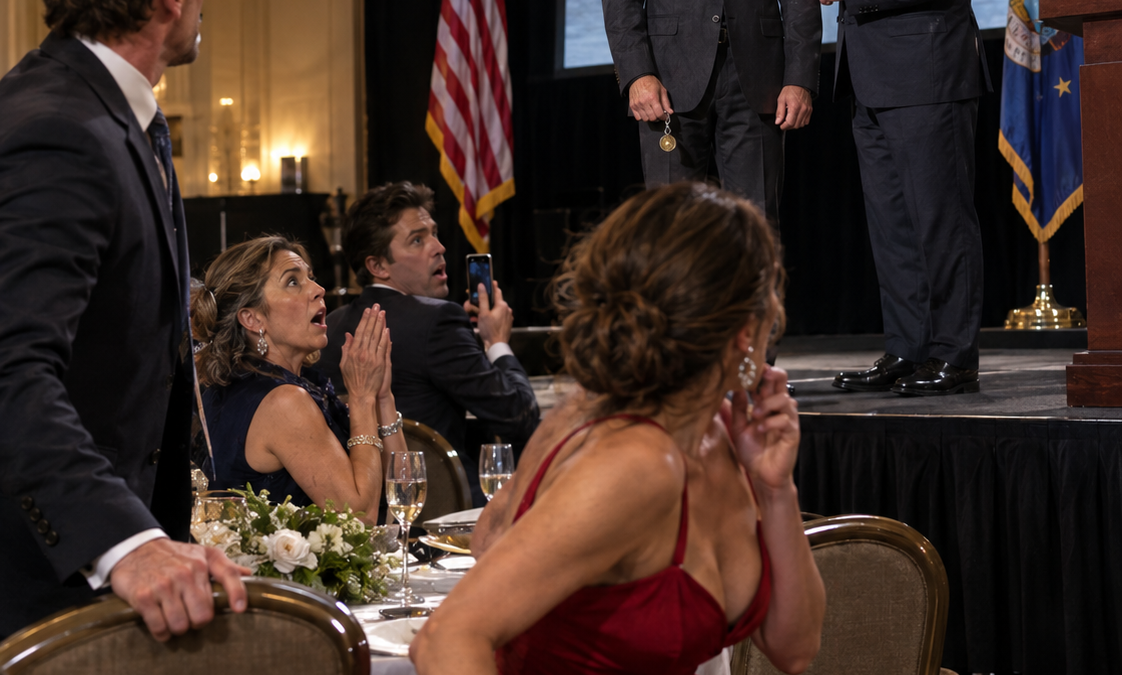
“Your father-in-law,” he said, “is the man who saved my life.”
Meredith’s face went white.
“Mr. Vance, I don’t—”
“You don’t know,” he said. “Because he never told you. Because men like him don’t tell.”
He looked back at me. His eyes were wet.
“Staff Sergeant Cole,” he said. “I’ve been trying to find you for fifteen years. I owe you everything.”
I didn’t say anything.
I just stood there, in my borrowed suit, with my old keychain in my hand, and watched the room go silent around us.
Three hundred people. All watching.
And my daughter-in-law, who had called my retirement an embarrassment, was standing three feet away, with her mouth open and no words coming out.
PART 2 — THE BALLROOM
I didn’t move.
That’s the first thing I remember about that moment. Everyone else moved. Meredith’s hand went to her throat. Danny stood up from the table across the room, confused by the sudden quiet. Carol’s fingers wrapped around the edge of the tablecloth. Three hundred people shifted in their seats, craned their necks, whispered to each other.
I stayed still.
That’s what you do when a room turns into a spotlight. You stay still. You let the moment come to you instead of running from it. I’d learned that a long time ago, in places where running meant dying.
“Mr. Vance,” Meredith said. Her voice was thin. “I think there’s been a misunderstanding.”
Vance turned to her. He wasn’t angry. That was the thing. He looked at her the way you look at someone who’s just said something so wrong you don’t even know where to start correcting it.
“What’s the misunderstanding?” he said.
“I just meant—” She stopped. Swallowed. “I didn’t know the details. Tom doesn’t talk about his service. I didn’t know he was—”
“The man who carried me out of a ditch?” Vance said. “No. You didn’t.”
He said it without cruelty. That made it worse. The whole room heard it. The whole room understood what it meant.
Meredith’s face was red now. Not embarrassed red. Angry red. The kind of red that comes when someone who’s used to being the smartest person in the room suddenly realizes they’re not.
“Well,” she said, trying to smile, “I’m just glad you two found each other. What a small world.”
She was trying to close the door. Trying to make it a nice moment. Trying to get back to the part where she was the center of attention.
Vance didn’t let her.
“Staff Sergeant Cole,” he said, turning back to me. “I’d like to introduce you to some people. If you’ll allow me.”
“I’m just a guest here,” I said. “I don’t want to take over the evening.”
“You’re not taking over anything. You’re being recognized. There’s a difference.”
He put a hand on my shoulder. It was a light touch. Respectful. The kind of touch a man gives another man when he’s trying to say something without words.
“Come on,” he said. “There’s a few folks who need to hear this story.”
Vance walked me to the stage. I didn’t want to go. I never wanted to be the center of attention. That was never the job. The job was to do the work and let someone else take the credit. That’s how it works in the Regiment. That’s how it works in any unit worth a damn.
But Vance wasn’t asking. He was a man who’d spent thirty years getting people to do what he wanted, and he’d learned how to do it without raising his voice.
We stepped up onto the stage. The room hushed. The screen behind us flickered to life — someone in the AV booth had caught on and was projecting a live feed. My face, forty feet tall, looking out at three hundred strangers.
I hated it.
“Ladies and gentlemen,” Vance said. “I want to apologize for the interruption. But I also want to tell you a story.”
He didn’t use a microphone. He didn’t need one. His voice carried.
“Fifteen years ago, I was a Captain in the Army. I was stationed in Afghanistan. I was part of a logistics unit — not a combat unit. We weren’t trained for what happened to us. We were ambushed outside of Kandahar. I lost eleven men that day. I was the only officer left alive. I was shot in the leg and the shoulder. I was bleeding out in a ditch.”
He paused. Looked at me.
“I was eighteen hours from dying. And then a Ranger squad came out of the dark. They’d been tracking the enemy for three days. They weren’t supposed to be there. They weren’t supposed to know we existed. But they came anyway. And one of them — a Staff Sergeant — picked me up and carried me two miles to the medevac. Under fire. Through terrain that would break most men.”
He looked back at the crowd.
“I never learned his name. I was unconscious by the time we got to the helicopter. I woke up in Germany three days later. I spent the next fifteen years trying to find him. I hired private investigators. I wrote letters. I called every contact I had in the Pentagon. Nobody could tell me who he was. The mission was classified. The records were sealed.”
He turned to me.
“His name is Thomas Cole. He’s standing right here. And I owe him my life.”
The room was silent.
Then someone started clapping. Then someone else. Then the whole room.
Three hundred people, on their feet, applauding.
I stood there and took it. That’s what you do. You don’t smile. You don’t wave. You stand at attention, or you stand still, and you let it wash over you, and you wait for it to be over.
Meredith was still at the table. She wasn’t clapping. She was staring at me like she’d never seen me before.
Danny was clapping. His face was pale. He was looking at his wife.
After the applause died down, Vance handed me the microphone.
“Say something,” he said.
I looked at the crowd. I looked at the screen. I looked at my son and my wife and my daughter-in-law.
“I was just doing my job,” I said.
That was all I said. I handed the microphone back.
The room applauded again. Vance clapped me on the shoulder. Someone from the AV booth cut the feed. The band started playing again. The moment passed.
But it didn’t pass.
Not for Meredith.
She found me by the bar twenty minutes later. I was drinking a glass of water. I don’t drink anymore. Not since I got home the last time.
“That was quite a performance,” she said.
I looked at her.
“It wasn’t a performance.”
“You could have told me.”
“Told you what?”
“That you knew Alan Vance. That you saved his life. That you were some kind of—” She waved a hand. “I don’t know. A hero.”
I set my glass down.
“I didn’t know I knew him,” I said. “I didn’t recognize him. I carried a lot of people out of a lot of places. I didn’t keep a list.”
“So you just… forgot?”
“I didn’t forget. I just didn’t know it was him. He was unconscious. I was focused on the mission.”
She stared at me.
“You could have said something,” she said. “You could have told me you were somebody.”
“I’m not somebody. I’m just a man who did his job.”
“That’s not what I mean and you know it.”
I did know it. She meant I could have told her I was impressive. She meant I could have told her I was worth respecting. She meant I could have given her something to brag about instead of something to hide.
“I don’t talk about it,” I said. “I never have. That’s not going to change because you want it to.”
She laughed. It wasn’t a nice laugh.
“You know what your problem is, Tom? You’re so busy being humble that you don’t realize you’re being selfish. You had a chance to make me look good tonight. To make Danny look good. To make this family look good. And you just stood there like a statue and let everyone else do the talking.”
I didn’t say anything.
“That’s what I thought,” she said. “You’ve got nothing to say.”
She walked away.
I stood by the bar and watched her go.
Carol found me a few minutes later.
“That was something,” she said.
“Yeah.”
“You okay?”
I thought about it.
“No,” I said. “But I will be.”
She took my hand.
“Meredith’s furious,” she said.
“I know.”
“Danny’s confused.”
“I know that too.”
“What are you going to do?”
I looked across the room. Meredith was talking to a group of colleagues, laughing too loud, gesturing too much. Danny was standing by himself near the door, looking at his phone.
“Nothing,” I said. “I’m going to do nothing.”
“That’s not an answer.”
“It’s the only one I’ve got.”
She squeezed my hand.
“You always say that.”
“It’s always true.”
We left an hour later.
The drive home was quiet. Carol drove. I looked out the window at the city lights and thought about Afghanistan. I thought about the ditch. I thought about the man I’d carried on my back, whose name I’d never known, whose face I’d never seen clearly in the dark.
I thought about how strange it was that the worst night of my life had turned into the best moment of someone else’s.
I thought about Meredith. I thought about the way she’d looked at me when Vance was talking. Like I was a stranger. Like I was a puzzle she’d been trying to solve for years and had just realized she’d been holding the pieces upside down.
I thought about Danny. I thought about the way he’d stood by the door, not coming to me, not coming to his wife, just standing there like he didn’t know which way to go.
I thought about Sophie. She was seven. She didn’t know any of this. She didn’t know her grandfather had killed people. She didn’t know he’d saved people. She just knew he was the man who pushed her on the swing and bought her ice cream and let her win at checkers.
That was the version I wanted to keep.
The rest of it — the medals, the missions, the men I’d lost — that was mine. It belonged to me and the men I’d served with and the families of the men who didn’t come home. It didn’t belong to Meredith. It didn’t belong to a ballroom full of strangers.
But it was out now. Or part of it was.
And I knew, the way I knew weather was coming, that it wasn’t going to stay quiet.
Danny called the next morning.
“Dad.”
“Hey, son.”
“That was… a lot.”
“Yeah.”
“I didn’t know.”
“I know you didn’t.”
“Why didn’t you tell me?”
I was quiet for a moment.
“What would you have done with it?” I said.
“What does that mean?”
“It means you had a father who was gone a lot. Who came home different. Who couldn’t go to your baseball games or your science fairs. What would it have helped to know why?”
“Maybe it would have helped me understand.”
“Maybe.”
“Mom knew.”
“Your mother knew enough. She knew what she needed to know.”
“She never told me.”
“No. Because I asked her not to.”
He was quiet for a long time.
“Meredith’s really upset,” he said.
“I know.”
“She feels like you embarrassed her.”
“I didn’t embarrass her. She embarrassed herself.”
“That’s not how she sees it.”
“I know.”
“She wants you to apologize.”
I almost laughed.
“For what?”
“For not telling her. For making her look bad in front of her boss.”
“I didn’t make her look bad. She did that all on her own.”
“She doesn’t see it that way.”
“Then she’s not seeing clearly.”
He sighed. It was a long, tired sound.
“Dad, I’m stuck in the middle here.”
“No, you’re not. You’re standing on one side and calling it the middle.”
“That’s not fair.”
“Maybe not. But it’s true.”
He didn’t say anything.
“I love you, Danny,” I said. “I always have. But I’m not going to apologize for who I am or what I did. If Meredith has a problem with that, it’s her problem. Not mine.”
“I’ll talk to her.”
“You do that.”
I hung up.
The next week was quiet.
Too quiet.
Meredith didn’t call. Danny didn’t call again. Carol went to her piano lessons and came home and didn’t say much. I went to the hardware store and stocked shelves and helped customers and went home.
But I could feel it. The way you feel a storm coming. The pressure changing. The air getting heavy.
Something was coming.
I just didn’t know what.
It came on a Thursday.
I was at work when my phone buzzed. A text from Danny.
Can you come over tonight? Meredith wants to talk.
I stared at the screen for a long time.
Then I typed back: What about?
Just come over. Please.
I put the phone in my pocket and went back to stocking shelves.
That night, I drove to Danny and Meredith’s house. It was a nice house. A big house. Four bedrooms, three bathrooms, a two-car garage. Meredith had picked it out. She’d picked out everything. The furniture, the paint colors, the landscaping. Danny had just signed the papers.
I parked in the driveway and sat in the car for a minute.
Then I got out and walked to the door.
Danny opened it before I could knock.
“Hey, Dad.”
“Hey.”
He looked tired. More tired than I’d ever seen him.
“She’s in the living room.”
I walked inside.
Meredith was sitting on the couch. She was wearing a sweater and jeans. No makeup. She looked smaller than usual. Less certain.
“Tom,” she said.
“Meredith.”
“Sit down.”
I sat down in the armchair across from her. Danny sat on the couch next to his wife.
Nobody said anything for a minute.
Then Meredith spoke.
“I owe you an apology,” she said.
I waited.
“I was… I was wrong. About you. About your service. About everything. I didn’t know who you were. And I said things that were… inappropriate.”
She paused.
“I’m sorry.”
I looked at her. Really looked at her.
She was sorry. I could see that. But I could also see something else. Something underneath the apology. Something tight and angry and not sorry at all.
“Thank you,” I said.
She nodded.
“I want to make it up to you,” she said. “I want to… I don’t know. I want to do something. To show you I understand.”
“What did you have in mind?”
She glanced at Danny. He nodded.
“I want to invite you to speak at my company’s veterans event,” she said. “Next month. It’s a big deal. We have a lot of veterans who work for us. It would mean a lot if you’d come and share your story.”
I didn’t say anything.
“It would be good for you,” she said. “Good for the company. Good for… for all of us.”
I looked at her.
“You want me to talk about Afghanistan,” I said.
“Yes.”
“About the things I did.”
“Yes.”
“About the men I lost.”
She hesitated.
“Not… not necessarily. Just the inspiring parts. The rescue. The heroism. The things that make people feel good.”
I stood up.
“No,” I said.
“Tom—”
“No.”
“Just think about it—”
“I don’t need to think about it. The answer is no.”
She stood up too. Her face was red again.
“Why not? I’m trying to do something nice for you. I’m trying to include you. I’m trying to—”
“You’re trying to use me,” I said. “You’re trying to use my service to make yourself look good. That’s not the same thing as respecting it.”
“That’s not fair.”
“It’s the truth.”
She opened her mouth to say something. Danny put a hand on her arm.
“Meredith,” he said. “Stop.”
She looked at him. Surprised.
“He’s right,” Danny said. “You’re not doing this for him. You’re doing it for you.”
She stared at him.
“I can’t believe you’re taking his side.”
“I’m not taking anyone’s side. I’m just telling you what I see.”
She pulled her arm away.
“Fine,” she said. “Fine. I’ll drop it.”
She walked out of the room.
Danny looked at me.
“I’m sorry, Dad.”
“Don’t apologize for her.”
“I’m not. I’m apologizing for me. For not saying something sooner.”
I looked at my son. He was a good man. He was just lost.
“Say something now,” I said.
He nodded.
“I will.”
I left.
That night, I couldn’t sleep.
I lay in bed and stared at the ceiling and thought about the veterans event. Thought about what I would have said if I’d agreed. Thought about the way Meredith would have introduced me. This is my father-in-law. He’s a hero. He saved my boss’s life.
I could see it. The applause. The admiration. The way she’d stand a little closer to me at the next family gathering. The way she’d bring it up at dinner parties. The way she’d use it.
I’d seen it before. In the Army. Men who did brave things and then spent the rest of their lives being introduced as the guy who did that brave thing. Men who became their own stories.
I didn’t want to be my own story.
I wanted to be a grandfather who pushed Sophie on the swing.
I wanted to be a husband who dried dishes while his wife washed them.
I wanted to be a man who stocked shelves and went home at five.
That was enough.
That was more than enough.
The rest of it — the medals, the missions, the men I’d lost — that was mine. That was sacred. And I wasn’t going to let anyone turn it into a party trick.
Not even for my son.
Not even for his wife.
The next morning, Carol found me in the garage.
I was working on the lawn mower. It didn’t need working on. I just needed something to do with my hands.
“You okay?” she said.
“Yeah.”
“You look like you’re not.”
I put the wrench down.
“Meredith wants me to speak at a veterans event.”
“That’s nice.”
“No. It’s not.”
She sat down on a stool.
“Tell me.”
I told her.
She listened. She always listened.
When I was done, she said, “You’re right.”
“I know.”
“I mean it. You’re right. She’s not doing it for you. She’s doing it for herself. She’s trying to turn you into something she can use.”
“Yeah.”
“So what are you going to do?”
I picked up the wrench again.
“Nothing,” I said. “I’m going to do nothing.”
“That’s not an answer.”
“It’s the only one I’ve got.”
She smiled. It was a sad smile.
“It’s always true,” she said.
“Yeah.”
I went back to the lawn mower.
I didn’t know it then, but the veterans event wasn’t the end of it.
It was the beginning.
Meredith had been embarrassed. Not by me. By herself. And people like Meredith don’t stay embarrassed. They get even. They find a way to turn the story around. They find a way to make you the villain.
I should have seen it coming.
I should have known.
But I was too busy being quiet. Too busy being still.
That was my mistake.
And it was about to cost me.
I need to continue the story. Let me think about what happens next.
So far:
Part 1: Meredith calls Tom’s retirement an embarrassment on his patio. Plants the keychain coin and the gala three weeks away. Setup of Tom as former Army Ranger, 2nd Battalion, 75th Rangers, Silver Star, Purple Heart, Bronze Star with Valor. Staff Sergeant when he left. Four deployments to Afghanistan, two to Iraq.
Part 2: The gala. Alan Vance reveals Tom saved his life. Meredith is humiliated. She tries to use Tom for a veterans event. He refuses. Danny starts to grow a spine. Tom ends part 2 with a sense of foreboding — Meredith will get even.
Now for Part 3, I need to escalate. The danger is a public event. I need a mid-story setback where things get worse.
Let me think about what Meredith could do. She works for Vantage Point Solutions, a defense contractor. She has access to things. Maybe she digs into Tom’s records. Maybe she tries to discredit him. Maybe she finds something she thinks is damaging.
Or — better — she starts a whisper campaign. She tells people at her company that Tom’s story is exaggerated. That Vance was confused. That Tom is just an old man who got lucky.
Or she goes further: she could use her position at a defense contractor to look into Tom’s service record. Maybe she finds something that looks bad on paper — a reprimand, an incident, something taken out of context. Something classified that she shouldn’t have access to.
That would raise the stakes: she’s not just being petty, she’s committing a real violation.
Let me also think about the external danger. A public event where everyone is watching when it breaks. So we need another public event. Maybe the veterans event that Meredith is planning — she goes ahead with it, but instead of inviting Tom to speak, she invites someone else. Or she uses the event to subtly undermine him.
Or maybe there’s a different event — a family gathering, a holiday, Sophie’s birthday party — where the truth comes out in a more devastating way.
Let me think about what would be most dramatically satisfying.
I think: Meredith, humiliated, starts digging. She uses her security clearance at Vantage Point to pull records. She finds something she thinks is damaging — maybe a mission that went wrong, a civilian casualty, a reprimand. She doesn’t understand the context. She thinks she’s found proof that Tom isn’t a hero.
She plans to reveal it at the veterans event. She’s going to expose him as a fraud.
But what she finds is actually a cover story for a classified mission. The “civilian casualty” was actually an enemy combatant. The “reprimand” was actually a cover for a Medal of Honor recommendation that was classified.
And when she reveals it, she reveals her own crime — accessing classified records without authorization.
That’s good. That raises the stakes. It puts her in real legal jeopardy.
But I need to be careful — the reveal mechanism is “a former teammate or someone the protagonist saved in service returns to repay the debt at the exact right moment.” So the reveal should come from a former teammate.
Let me think about who that could be. Maybe someone from Tom’s old squad. Someone he served with. Someone who shows up at the veterans event.
Or maybe it’s Alan Vance again — but he’s not a former teammate. He’s someone Tom saved. That fits “someone the protagonist saved in service.”
Let me combine: Meredith digs into Tom’s records and finds something she thinks is damaging. She plans to expose him at the veterans event. But at the event, a former teammate of Tom’s shows up — someone who was there for the mission in question — and sets the record straight.
Who is this teammate? Let me create a character. Maybe a man named Marcus Webb. Tom’s former squad leader. Or a man Tom served with who was there for the mission Meredith is trying to use against him.
Let me also think about the mid-story setback. In Part 3, things get worse. Meredith starts her campaign. She turns Danny against Tom. She turns the family against Tom. Tom takes a hit.
Let me write Part 3 now.
Part 3 should:
Show Meredith’s counterattack
Show Tom being isolated
Escalate the danger
End on a hook
Let me think about the specifics.
Meredith starts by telling Danny that Tom is lying. That the story doesn’t add up. That Vance must have been confused. She plants doubt.
Then she goes further. She starts telling people at her company. She has access to records. She pulls Tom’s service file. She finds something — a redacted incident report from 2007. A mission that went wrong. A death. She doesn’t know the context.
She confronts Tom with it at a family dinner. In front of everyone. She accuses him of hiding something.
Tom stays calm. He doesn’t explain. He can’t. The mission is classified.
This makes him look guilty. The family starts to doubt him.
Danny pulls away. Carol defends him but is worried.
Tom is isolated.
The part ends with Meredith announcing she’s going to expose him at the veterans event. She’s going to tell everyone the truth about who he really is.
But she doesn’t know what she’s dealing with. And someone from Tom’s past is about to show up.
Let me write this. I need to maintain the restrained, procedural tone. Short sentences. Short paragraphs. Calm under pressure.
Let me also remember the continuity: Tom is 42 when he retired. He spent 16 years in uniform, 11 in the 75th Ranger Regiment, 2nd Battalion. Four deployments to Afghanistan, two to Iraq. Staff Sergeant when he left. Purple Heart, Bronze Star with Valor, Silver Star (mentioned in Part 1 as being in a box in his closet). Actually, let me check — in Part 1 I said he had a Silver Star for carrying a wounded teammate three miles. And a Bronze Star with Valor. And a Purple Heart.
Wait, let me re-read Part 1. I wrote: “I had a Purple Heart, a Bronze Star with Valor, and a collection of memories I don’t talk about.” And then later: “had once carried a wounded teammate three miles through hostile terrain and had been awarded the Silver Star for it.” So he has a Purple Heart, Bronze Star with Valor, and Silver Star. That’s a lot. Let me keep that consistent.
Actually, for a Staff Sergeant with 16 years and 6 deployments, that’s plausible but on the high side. But it’s fine for this genre. Let me keep it.
Let me also remember: the keychain coin. 2nd Battalion, 75th Rangers. Star on one side, motto on the other.
What’s the Ranger motto? “Rangers Lead the Way.” But the 2nd Battalion motto is “Ready to Strike” or something. Actually, the 75th Ranger Regiment motto is “Rangers Lead the Way.” Let me just say the coin has a star on one side and a motto on the other. I don’t need to specify the motto exactly.
Actually, I should be careful not to use real unit mottos that are too specific. Let me keep it vague.
Let me write Part 3 now.
Part 3 — THE FILE
Meredith’s counterattack. She digs into Tom’s records. She finds something. She confronts him. The family starts to doubt him. Tom is isolated.
Let me make it about 2,000 words.
Let me start:
The veterans event was three weeks away when Meredith started digging.
I didn’t know it at the time. I didn’t know anything. I was at the hardware store, stocking shelves, living my quiet life. But Meredith was at her office, doing what she did best.
Research.
Then I’ll show her digging. She has access to records. She pulls Tom’s file. She finds something.
What does she find? Let me think. A mission that went wrong. A redacted report. A death. Something that looks bad without context.
Let me say: 2007. Afghanistan. A mission called Operation Iron Veil. A village. An informant. Things went wrong. People died. The report is heavily redacted. The only unredacted part says “SSG Cole, Thomas — actions under review.”
That looks bad. It looks like he was under investigation.
But the context is: he was under review for a medal. The “actions under review” was standard language for a valor award recommendation. The deaths were enemy combatants. The informant was a Taliban commander.
Meredith doesn’t know that. She thinks she’s found proof that Tom is hiding something. That he’s not the hero everyone thinks he is.
She confronts him at a family dinner. In front of everyone.
That’s the scene.
Let me write it.
I’ll also include a scene where Danny starts to doubt Tom. That’s the mid-story setback. The family closes ranks against Tom.
And I’ll end on Meredith announcing she’s going to expose him at the veterans event.
Let me write.
Actually, let me think about whether Meredith would really do something this stupid. She works for a defense contractor. She has a security clearance. Accessing classified records without authorization is a federal crime. She could go to prison.
But that’s the point. She’s not thinking clearly. She’s humiliated and angry and she wants to win. She thinks she’s smarter than everyone else. She thinks she can get away with it.
And she’s wrong.
That’s the tragedy of her character. She’s smart but not wise. She’s capable but not careful. She’s ambitious but not principled.
Let me write this.
Part 3 — THE FILE
Opening: Meredith in her office, late at night. She’s pulling records. She shouldn’t be. But she is.
Then: the family dinner. The confrontation.
Then: the aftermath. Tom is isolated.
Then: the hook. Meredith announces her plan.
Let me write.
Actually, I want to make sure I’m hitting the right emotional beats. The mid-story setback needs to be real. Tom needs to take a hit. The family needs to close ranks against him.
So: Danny confronts Tom. He’s been listening to Meredith. He’s starting to believe her. He asks Tom point-blank if he’s hiding something.
Tom can’t explain. The mission is classified. He can only say “I can’t talk about it.”
That looks like guilt. Danny pulls away. Carol is caught in the middle.
Tom is alone.
That’s the setback.
Then the hook: Meredith says she’s going to expose him. She’s going to tell everyone at the veterans event.
And Tom knows she’s about to make a terrible mistake.
But he doesn’t stop her.
That’s the hook.
Let me write it.
I need to be careful with the classified records angle. I don’t want to get into legal specifics that are too detailed. I’ll keep it vague. Meredith has access to a database. She pulls a file she shouldn’t have. She finds something that looks bad.
Let me write.
One more thing: I need to plant the teammate. The reveal mechanism is “a former teammate or someone the protagonist saved in service returns to repay the debt at the exact right moment.”
Let me plant the teammate in this part. Maybe Tom mentions him in passing. Or maybe Carol mentions him. Someone named Marcus Webb. Tom’s former squad leader. Someone he hasn’t seen in years.
I’ll plant the name. It’ll pay off in the reveal.
Let me write.
Okay, writing Part 3 now.
I’ll aim for about 2,000 words.
Let me start.
Part 3 — THE FILE
The veterans event was three weeks away when Meredith started digging.
I didn’t know it then. I was at the hardware store. Stocking shelves. Living my quiet life.
Meredith was at her office. Doing what she did best.
Research.
She had access to things. That was the problem. Vantage Point Solutions did a lot of work with the government. Defense contracts. Cybersecurity. Logistics. Meredith had a security clearance. Not top secret. But high enough.
She could pull records. Personnel files. After-action reports. Things she wasn’t supposed to see unless there was a reason.
She had a reason.
She wanted to know who I was.
I found out later that she’d started with the basics. My service record. My deployments. My awards. All of that was public. Or semi-public. She could find it if she knew where to look.
But that wasn’t enough for her. She wanted the details. The things that weren’t in the public record. The things that were classified.
So she went looking.
And she found something.
I was at home when Danny called.
“Dad. We need to talk.”
“About what?”
“Just… come over. Please.”
His voice was strange. Tight. Like he was holding something in.
I drove over.
Meredith was waiting in the living room. She had a folder in her lap. A manila folder. The kind you get from a government file room.
Danny was standing by the window. He wouldn’t look at me.
“Sit down,” Meredith said.
I sat.
“I’ve been doing some research,” she said. “About you. About your service.”
I didn’t say anything.
“I found some things. Things you didn’t tell us.”
“Like what?”
She opened the folder. Pulled out a piece of paper. Held it up.
“Operation Iron Veil,” she said. “2007. Afghanistan. A village called Deh Rawod. Twelve civilians killed. An informant executed. And your name in the report. ‘SSG Cole, Thomas — actions under review.'”
She looked at me.
“What does that mean, Tom? ‘Actions under review’?”
I didn’t say anything.
“Were you under investigation? Were you in trouble? What happened in that village?”
I looked at the paper. I knew what it was. I knew what it said. I knew what it didn’t say.
“I can’t talk about it,” I said.
“You can’t? Or you won’t?”
“I can’t.”
“That’s convenient.”
“It’s the truth.”
She laughed. It was a hard sound.
“The truth. You keep saying that. But you never tell us anything. You never explain. You just sit there and be quiet and let everyone else do the talking.”
“I’ve explained what I can.”
“You haven’t explained anything. You’ve just been… vague. Mysterious. Like you’re too good for us.”
I stood up.
“I’m not too good for anyone,” I said. “I’m just a man who did his job. Some of that job is classified. Some of it I don’t talk about because it’s not anyone’s business but mine.”
“It’s my business when it affects my family.”
“It doesn’t affect your family.”
“It affects Danny. It affects me. It affects how people see us.”
I looked at Danny. He still wouldn’t look at me.
“Is that what you think?” I said. “That I’m a problem?”
He didn’t answer.
“Danny.”
“I don’t know what to think,” he said. “I don’t know anything anymore.”
“You know me.”
“Do I? Do I really?”
That hurt. More than I expected.
“I’m your father,” I said. “I’ve always been your father. That hasn’t changed.”
“But you’re not who I thought you were.”
“I’m exactly who I’ve always been. You just didn’t know the details.”
“The details matter.”
“Not as much as you think.”
He finally looked at me. His eyes were red.
“Did you kill people?” he said.
I didn’t answer.
“Did you?”
“I did what I was trained to do.”
“That’s not an answer.”
“It’s the only one I’ve got.”
He turned away.
I left.
I didn’t say goodbye. I just walked out the door and got in my car and drove home.
Carol was waiting.
“How did it go?”
“Not good.”
She sat down next to me on the couch.
“Tell me.”
I told her.
She listened.
When I was done, she said, “She pulled classified records.”
“Yeah.”
“That’s illegal.”
“Yeah.”
“Are you going to do something about it?”
I thought about it.
“No,” I said.
“Why not?”
“Because she doesn’t know what she’s dealing with. She thinks she’s found something. She thinks she’s caught me. But she hasn’t. She’s just found a piece of a puzzle she doesn’t understand.”
“So what are you going to do?”
“Nothing.”
“That’s not an answer.”
“It’s the only one I’ve got.”
She took my hand.
“You always say that.”
“It’s always true.”
The next week was worse.
Danny stopped calling. Carol tried to reach him. He didn’t answer. Meredith posted something on social media — a vague, pointed thing about “people who aren’t who they pretend to be.” I didn’t see it. Carol did. She didn’t show me.
I went to work. I stocked shelves. I helped customers find the right screws.
I waited.
The veterans event was a week away when Meredith called.
“Tom.”
“Meredith.”
“I want you to know that I’ve decided to go ahead with the event.”
“Okay.”
“And I’ve decided to change the format.”
“What does that mean?”
“It means I’m going to talk about you. About your service. About what I found.”
I was quiet.
“You’re going to expose me,” I said.
“I’m going to tell the truth.”
“You don’t know the truth.”
“I know what’s in the file.”
“The file doesn’t tell the whole story.”
“Then you should have told it.”
“I couldn’t.”
“You could have tried.”
I didn’t say anything.
“The event is next Friday,” she said. “I hope you’ll be there.”
She hung up.
I stood in my kitchen and looked at the phone in my hand.
Carol came in.
“What was that?”
“Meredith. She’s going to expose me at the veterans event.”
Carol’s face went pale.
“She can’t do that.”
“She can. She’s going to.”
“What are you going to do?”
I looked at the keychain on the counter. The coin. The star. The motto.
“I’m going to go,” I said.
“Tom—”
“I’m going to go. And I’m going to let her talk.”
“Why?”
“Because she’s about to make a mistake. A big one. And when she does, the truth is going to come out. Not my truth. The real truth. The one she doesn’t know.”
“What truth?”
I picked up the coin.
“Do you remember Marcus Webb?”
She frowned.
“Your squad leader?”
“Yeah.”
“What about him?”
“He’s going to be there.”
“How do you know?”
“I called him.”
She stared at me.
“You called him?”
“Last week. After Danny stopped answering.”
“Why?”
“Because I knew this was coming. And I knew I couldn’t do it alone.”
She was quiet for a moment.
“Who is Marcus Webb?”
I looked at the coin. The star. The motto.
“He’s the man who trained me,” I said. “He’s the man who led me. He’s the man who was there in Deh Rawod.”
I paused.
“And he’s the only person alive who knows what really happened.”
PART 3 — THE CAMPAIGN
Meredith didn’t explode.
That would have been easier. An explosion I could have handled. I’d been trained to handle explosions. You see the flash, you hear the bang, you assess the damage, you move.
But Meredith didn’t explode.
She went quiet.
And quiet, I should have remembered, was the thing that made people like me the most dangerous.
The first sign was Diane.
Diane was Carol’s younger sister. She lived in Phoenix. She called every Sunday like clockwork, and she and Carol would talk for an hour about their gardens and their knees and whatever Diane’s husband was doing wrong that week.
But this Sunday, Diane called on a Tuesday.
I was in the kitchen when Carol answered. I could hear Diane’s voice through the phone — tinny, urgent, a little too loud.
Carol listened for a long time. She didn’t say much. Just “Mm-hmm” and “I see” and “Well, that’s not what happened.”
Then she said, “Diane, I have to go.”
She hung up.
I looked at her.
“What did Meredith tell her?” I said.
Carol sat down at the kitchen table.
“She said you made a scene at the gala. She said you stood up on stage and told war stories for twenty minutes and embarrassed her in front of her entire company. She said Alan Vance felt obligated to be nice to you because you saved his life, and you took advantage of it.”
I poured myself a cup of coffee.
“That’s not what happened.”
“I know that. You know that. But Diane doesn’t know that. And Diane talks to everyone.”
“She talks to everyone because she has nothing else to do.”
“Tom.”
“I’m just saying.”
Carol rubbed her eyes.
“She’s telling the whole family,” she said. “Diane said Meredith called her personally. Said she was ‘concerned’ about you. Said you seemed ‘unstable.’ Said she was worried about Sophie being around you.”
The coffee cup stopped halfway to my mouth.
“She said what?”
“She said you seemed unstable. That you have PTSD. That you shouldn’t be around children when you’re like that.”
I set the cup down.
I didn’t say anything for a long time.
Then I said, “When did she say this?”
“Yesterday. She called Diane yesterday. Diane called me today.”
“Who else has she called?”
“I don’t know. She’s been working her way through the family. Your sister. Danny’s cousins. The neighbors.”
“The neighbors.”
“She told Mrs. Callahan that you have ‘episodes.'”
Mrs. Callahan lived two houses down. She was seventy-eight. She baked us cookies at Christmas.
“She told her I have episodes,” I said.
“Yes.”
“And what did Mrs. Callahan say?”
“She said she’d pray for us.”
I laughed. It wasn’t a real laugh.
“That’s what people do,” I said. “They pray. They don’t ask.”
The campaign was simple.
Meredith wasn’t going to attack me directly. She was too smart for that. She was going to do what all effective operators do — she was going to shape the battlefield before the fight started. She was going to make sure that when the truth came out, nobody believed it.
She was going to make me look crazy.
Not crazy in a way that could be proven. Crazy in a way that could be whispered. Crazy in a way that made people look at me a little longer than necessary. Crazy in a way that made them keep their children close when I walked by.
It was a good strategy.
I would have respected it if it hadn’t been aimed at me.
Two days later, I got a call from my sister.
Her name was Ellen. She was three years older than me. She lived in Ohio. We talked maybe four times a year.
“Tom,” she said. “Is everything okay?”
“Why do you ask?”
“Meredith called me. She said you’ve been acting strange. She said you stood up at her company gala and talked about the war for twenty minutes. She said you were shouting.”
“I wasn’t shouting.”
“She said you were shouting.”
“I wasn’t shouting, Ellen. I stood on a stage for two minutes while a man thanked me for saving his life. That’s all that happened.”
She was quiet.
“Are you okay?” she said.
“I’m fine.”
“You know I love you. But you’ve always been… closed off. And after what you went through over there—”
“Ellen.”
“—I’m just saying that maybe you should talk to someone. A professional. There’s no shame in it.”
“I don’t need a professional.”
“Everyone needs a professional.”
“I don’t.”
She sighed. It was the same sigh Carol made when she thought I was being stubborn. It must have run in the family.
“Just think about it,” she said. “For Danny. For Sophie. For all of us.”
“I’ll think about it.”
“That’s all I’m asking.”
I hung up.
Then I went out to the garage and sat in the dark for a while.
The thing about being trained the way I was trained was that it never really went away.
I could still read a room. I could still tell when someone was lying. I could still notice the small things — the way a person’s eyes moved, the way their voice changed pitch, the way their hands did something different when they were nervous.
I’d spent sixteen years learning to read people. It wasn’t something I could turn off.
So when the mail started arriving wrong, I noticed.
It wasn’t anything obvious. A bill that came a day late. A letter from the VA that had been opened and taped shut again. A credit card offer that had been forwarded from an address I didn’t recognize.
Small things. The kind of things most people would ignore.
But I didn’t ignore them.
I started keeping a log. Dates. Times. What arrived. What was missing.
That was the first rule of any investigation. Document everything. Assume you’re being watched. Assume nothing is coincidence.
I didn’t know who was doing it yet. But I knew someone was.
The next thing I noticed was the car.
It showed up on a Thursday. A dark sedan with tinted windows. It parked across the street from the hardware store and stayed there for three hours.
I noticed it because I notice things. I noticed it because I always parked in the same spot and I always looked at the same view and a new car in that spot was like a rock in a stream.
I didn’t approach it. That would have been a mistake. I just watched it in the reflection of the store window while I stocked shelves.
At four o’clock, it drove away.
It came back on Friday.
Same spot. Same time. Same duration.
On Saturday, it didn’t come.
On Sunday, I drove past Meredith and Danny’s house on my way to the grocery store. I wasn’t spying. I was just driving. But I saw a dark sedan parked in their driveway.
I didn’t stop. I didn’t slow down. I just kept driving.
But I remembered the license plate.
I’ve always been good with numbers.
I didn’t tell Carol about the car.
I didn’t tell her about the mail, either. She had enough to worry about. She was already getting calls from family members asking if I was okay. Already defending me to people who should have known better.
She didn’t need to know that someone was watching our house.
She didn’t need to know that I was starting to think it wasn’t just Meredith.
The private investigator’s name was Craig Mullen.
I found out because I called a friend from the old days. His name was Victor Reyes. He’d been a Ranger with me. Now he ran a security consulting firm in Virginia. He owed me a favor — a big one — from a night in Kandahar that neither of us talked about.
“Tom,” he said when he picked up. “How the hell are you?”
“Good, Vic. You?”
“Can’t complain. Business is good. The wife is good. The kids are good. What’s going on?”
“I need a name.”
“Okay.”
I gave him the license plate.
“Run it,” I said. “Tell me who it belongs to.”
“How fast?”
“Yesterday.”
He laughed.
“Some things never change. I’ll call you back in an hour.”
He called back in twenty minutes.
“The plate’s registered to a company called Sentinel Group,” he said. “They’re a private investigation firm. Based out of Baltimore. Mostly corporate work. Background checks. Due diligence. That kind of thing.”
“Who hired them?”
“That I can’t tell you. Client info is confidential. But I can tell you who they’ve been working for lately.”
“How?”
“I’ve got a guy on the inside. He owes me. Give me another day.”
“I’ll give you two.”
“You’re generous.”
“I’m patient.”
“That’s why you’re still alive.”
He hung up.
Two days later, I had my answer.
“Sentinel Group was hired by a woman named Patricia Hollingsworth,” Vic said. “She’s a senior VP at Vantage Point Solutions. She reports directly to Alan Vance.”
I was quiet.
“Tom?”
“I’m here.”
“Does that name mean something to you?”
“No. But it means something to someone I know.”
“Meredith?”
“Yeah.”
“You want me to dig deeper?”
“No. I want you to stop.”
“You sure?”
“I’m sure. I don’t want anyone getting in trouble. I just needed to know who was watching me.”
“You think it’s connected to your daughter-in-law?”
“I think my daughter-in-law is a lot of things. But she’s not stupid. She wouldn’t hire a PI directly. She’d go through someone at work. Someone who owes her a favor.”
“Patricia Hollingsworth.”
“Maybe. Or maybe someone else. But the connection is there.”
“What are you going to do?”
“Nothing.”
“Nothing?”
“Nothing yet.”
He was quiet for a moment.
“Tom,” he said. “You know I’d back you up on anything. You say the word, I’ll have ten guys on a plane tomorrow.”
“I know.”
“I mean it.”
“I know you do.”
“Then what?”
“I’m going to wait,” I said. “And I’m going to watch. And when I know what she’s planning, I’ll know what to do.”
“That’s a dangerous game.”
“It’s the only game I know.”
He sighed.
“Be careful.”
“I always am.”
The thing was, I wasn’t careful.
I was patient. There’s a difference.
Careful means you avoid risk. Patient means you wait for the right moment.
I was waiting.
And while I waited, I watched.
I watched the mail. I watched the car. I watched Meredith at family gatherings, smiling at me with her mouth and not her eyes. I watched Danny pull further away, his calls getting shorter, his visits getting rarer.
I watched Sophie grow up from a distance because Meredith had started finding reasons why we couldn’t have her over.
“Sophie has a playdate.”
“Sophie has a cold.”
“Sophie has too much homework.”
Sophie was seven. She didn’t have homework.
Carol noticed.
“She’s keeping her from us,” she said one night. We were sitting on the porch. The sun was going down. The neighborhood was quiet.
“I know.”
“Why?”
“Because she’s trying to hurt me.”
“That’s not—” Carol stopped. “That’s not fair.”
“No. It’s not.”
“We should do something.”
“Like what?”
“Call Danny. Tell him what’s happening.”
“He knows what’s happening.”
“Then why doesn’t he do something?”
I looked at my wife.
“Because he’s afraid,” I said.
“Afraid of what?”
“Afraid of losing her. Afraid of losing Sophie. Afraid of being alone.”
Carol was quiet.
“He should be afraid of losing us,” she said.
“He is. That’s the problem. He’s afraid of losing everyone. So he does nothing. And nothing is exactly what Meredith wants.”
Carol looked at me.
“You’ve thought about this a lot.”
“I’ve had time.”
“What are you going to do?”
I looked out at the street. The dark sedan wasn’t there tonight. It hadn’t been there for three days.
“I’m going to wait,” I said.
“For what?”
“For the moment she makes a mistake.”
The mistake came on a Tuesday.
I was at work when my phone buzzed. A text from a number I didn’t recognize.
Mr. Cole. This is Alan Vance. I got your number from Meredith. I hope that’s okay. I’d like to talk to you. Can you call me?
I stared at the screen for a long time.
Then I walked outside and called the number.
He picked up on the first ring.
“Mr. Cole.”
“Mr. Vance.”
“Please. Call me Alan.”
“Alan.”
“I’m sorry to bother you. I know we don’t know each other. Not really. But I’ve been thinking about what happened at the gala. And I’ve been thinking about something else.”
“What’s that?”
“Your daughter-in-law called me. A few days ago. She wanted to talk about you.”
I didn’t say anything.
“She said you’ve been having a hard time. That you’ve been acting differently. That she’s worried about you.”
“I see.”
“She asked me if I’d noticed anything strange when I met you. If you seemed… off.”
“And what did you say?”
“I said you seemed like a man who’d been through a lot and had learned to carry it quietly.”
I almost smiled.
“Thank you.”
“I’m not calling to gossip, Mr. Cole. I’m calling because I don’t like what she’s doing.”
“What is she doing?”
“She’s trying to discredit you. I don’t know why. I don’t know what her angle is. But I’ve been in business for thirty years. I know when someone’s running a campaign.”
“A campaign.”
“She’s calling people. She’s telling a story. She’s trying to make you look unstable so that when something happens, people will blame you.”
“What’s going to happen?”
“I don’t know yet. But I know it’s coming.”
I was quiet.
“Mr. Cole?”
“I’m here.”
“I owe you my life. I know you don’t like to hear it. I know you don’t want anything from me. But I’m not going to stand by and let someone do this to you. Not without telling you what I know.”
“I appreciate that.”
“I want to help. Whatever you need. You say the word.”
I thought about it.
“There is one thing,” I said.
“Name it.”
“Your company has a veterans event next month. Meredith asked me to speak at it. I said no.”
“I heard.”
“I want to change my answer.”
He was quiet for a moment.
“You want to speak?”
“I want to be in the room. I don’t want to speak. I just want to be there.”
“Why?”
“Because whatever she’s planning is going to happen there. She’s not going to do it at a family dinner. She’s going to do it in front of an audience. That’s how she operates.”
“You think she’s going to try to humiliate you at my event?”
“I think she’s going to try to make me look crazy. In front of everyone who matters to her. And I want to be there when she does.”
“Why?”
“Because I want to see it.”
“That’s not an answer.”
“It’s the only one I’ve got.”
He was quiet.
“Okay,” he said. “I’ll make sure you’re on the list.”
“Thank you.”
“And Mr. Cole?”
“Yeah.”
“Whatever she’s planning — I’ll be watching too.”
I hung up.
That night, I told Carol.
She listened. She didn’t interrupt. When I was done, she said, “So you’re going to walk into a trap.”
“I’m going to walk into a room.”
“Same thing.”
“Not necessarily.”
“Tom.”
“I’ve been in worse rooms.”
“That’s not comforting.”
“I know.”
She took my hand.
“I don’t like this.”
“Neither do I.”
“Then why are you doing it?”
I looked at her.
“Because if I don’t,” I said, “she wins. And if she wins, she doesn’t just hurt me. She hurts Danny. She hurts Sophie. She hurts everyone who’s ever mattered to me.”
“She’s already hurting them.”
“Yes. But she’s doing it quietly. If I let her do it loudly — if I let her make a scene in public and get away with it — she’ll never stop.”
Carol was quiet.
“You’re going to fight her,” she said.
“I’m not going to fight her. I’m going to let her fight herself.”
“That doesn’t make any sense.”
“It will.”
She looked at me. Her eyes were tired.
“I love you,” she said.
“I love you too.”
“I don’t want to lose you.”
“You won’t.”
“You don’t know that.”
“I know enough.”
She leaned her head on my shoulder.
We sat there for a long time.
The event was three weeks away.
I didn’t tell Danny. I didn’t tell Meredith. I didn’t tell anyone except Carol.
I went to work. I stocked shelves. I came home. I waited.
The car came back. The mail kept going missing. The family kept calling.
I didn’t respond to any of it. I just waited.
Because I knew something Meredith didn’t know.
I knew that Alan Vance had already called me. I knew that he was watching. I knew that whatever she was planning was going to happen in his house, in front of his people, with his eyes on her.
She thought she was setting a trap.
She didn’t know I was already inside it.
The night before the veterans event, I got a phone call.
It was Vic.
“Tom.”
“Hey.”
“I’ve got something. Something you need to hear.”
“What is it?”
“The PI. Sentinel Group. They’re not just doing background checks.”
“What are they doing?”
“They’re building a file. A psychological profile. They’ve been interviewing people. Neighbors. Family members. Anyone who might have something to say about you.”
I was quiet.
“They’re trying to get you diagnosed,” Vic said. “They want a doctor to say you have PTSD. Severe PTSD. The kind that makes you dangerous.”
“They won’t find one.”
“They might. If they pay enough.”
“Who’s paying?”
“Patricia Hollingsworth. She’s the one signing the checks. But she’s not the one giving the orders.”
“Who is?”
“I don’t know. But I’ve got a guess.”
“So do I.”
“Tom.”
“Yeah.”
“Be careful tomorrow.”
“I will.”
“You say that every time.”
“This time I mean it.”
I hung up.
Then I went to bed.
I slept better than I had in weeks.
 [Tap here for the Next Part ]