Part 2: “The thing is, Dad, it’s just hard to spin it.
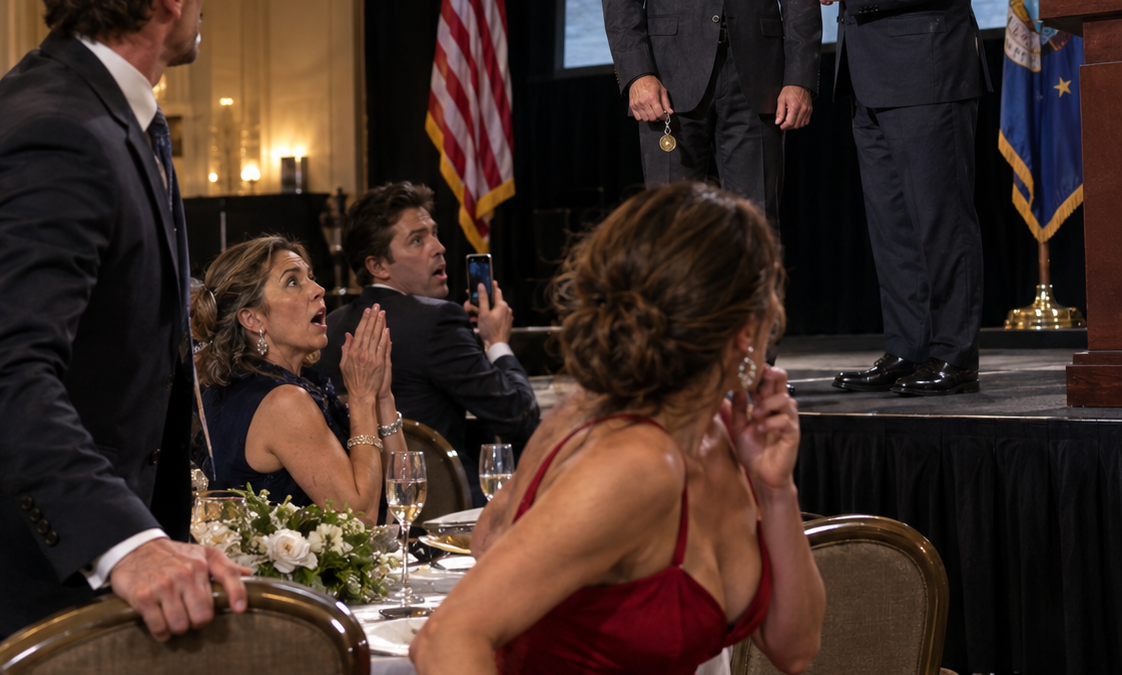
PART 4 — THE VETERANS EVENT
The veterans event was at Vantage Point Solutions headquarters.
It was a modern building. Glass and steel. A flagpole out front with the American flag and the company flag. A security desk in the lobby with two guards who checked IDs and made you sign in.
I signed in at 8:45. The event started at 9:00.
Carol couldn’t come. She’d caught a cold the day before. She’d wanted to come anyway. I’d told her no.
“You need to rest,” I said.
“I need to be there.”
“You need to trust me.”
She looked at me for a long time.
“I do trust you,” she said. “I just don’t trust her.”
“Neither do I.”
“So why are you going?”
I kissed her forehead.
“Because it’s time.”
The auditorium was on the second floor. It held about two hundred people. There was a stage with a podium and a screen. There were rows of chairs. There was a banner that said HONORING THOSE WHO SERVED.
I found a seat in the back. I didn’t want to be noticed. Not yet.
Meredith was up front. She was in a navy blue suit, talking to a man in a gray suit. She was smiling. She was always smiling when she was nervous.
Danny was with her. He looked uncomfortable. He always looked uncomfortable at these things.
I watched them for a while. Then I looked at the program in my hand.
Vantage Point Solutions Annual Veterans Appreciation Breakfast.
Welcome: Patricia Hollingsworth, Senior Vice President.
Remarks: Alan Vance, Founder and CEO.
Guest Speaker: Meredith Cole, Senior Director.
Closing: A moment of recognition for our veterans.
I read it twice.
Guest Speaker: Meredith Cole.
She was going to speak. She was going to stand up in front of her company and talk about veterans. And I was going to be in the audience.
I knew what she was going to do.
I’d known since the moment Alan Vance called me.
The event started at 9:00.
Patricia Hollingsworth opened it. She was a tall woman with short gray hair and a voice that carried. She talked about the importance of service. About the values that veterans bring to the workplace. About how Vantage Point Solutions was proud to employ so many men and women who had worn the uniform.
It was a good speech. I’d heard a lot of good speeches.
Then Alan Vance spoke. He talked about his own service — briefly, modestly. He talked about the men he’d served with. He talked about the ones who hadn’t come home.
He didn’t mention me. I appreciated that.
Then it was Meredith’s turn.
She walked to the podium. She adjusted the microphone. She smiled at the crowd.
“Good morning,” she said. “Thank you all for being here. This is an important day for our company. It’s a day when we recognize the men and women who have served our country. It’s a day when we honor their sacrifice.”
She paused.
“I want to tell you a story,” she said. “About a man I know. A veteran. Someone in my own family.”
I didn’t move.
“He served his country for many years. He was in the Army. He did things that most of us can’t imagine. He was a hero.”
The word hung in the air.
“But there’s another side to his story,” she said. “A side that doesn’t get talked about. The side that comes home and doesn’t know how to fit in. The side that struggles with things that the rest of us don’t understand.”
She paused again. She looked at the crowd. She looked at me.
“I’m talking about my father-in-law,” she said. “Tom Cole. He’s here today. And I want to share his story with you — because I think it’s important. I think it’s important for all of us to understand what our veterans go through. Not just the heroism. Not just the medals. But the pain. The difficulty. The way it changes them.”
She smiled at me. It was a sad smile. A caring smile.
“The way it makes them… different.”
The room was quiet.
I sat in my seat and watched her.
She was good. She was very good.
She was making me into a case study. A cautionary tale. The veteran who came home broken. The veteran who couldn’t adjust. The veteran who needed to be pitied.
She was doing it in front of her entire company. In front of her boss. In front of the man who owed me his life.
She was making herself the expert. The caring daughter-in-law. The one who understood.
And she was making me the problem.
I didn’t move. I didn’t speak. I just watched.
“The thing is,” Meredith continued, “Tom doesn’t talk about it. He doesn’t ask for help. He just… sits there. Quiet. Keeping everything inside. And that’s what worries me. That’s what worries his whole family.”
She paused.
“We’ve tried to help him. We’ve tried to get him to talk to someone. A professional. But he refuses. He says he doesn’t need it. He says he’s fine.”
She shook her head.
“He’s not fine. I know he’s not fine. And I’m afraid that if something doesn’t change — if he doesn’t get the help he needs — something bad is going to happen.”
She let that sink in.
“I’m not saying this to embarrass him,” she said. “I’m saying this because I care. Because I love him. Because I want him to get better.”
She looked at me again.
“I hope you understand, Tom,” she said. “I’m only doing this because I love you.”
The room turned to look at me.
Two hundred faces. All staring.
I sat still.
I didn’t smile. I didn’t frown. I just looked at Meredith.
And then I stood up.
I didn’t stand up fast. I didn’t stand up angry. I stood up the way I’d been trained to stand up when entering a room that might be hostile. Slowly. Deliberately. Hands visible. No sudden movements.
I walked down the aisle toward the stage.
Meredith’s face changed. Just a little. Just enough for me to see.
“What are you doing?” she said.
I didn’t answer.
I walked up the steps to the stage. I walked past her. I stood at the podium.
I looked out at the crowd.
“I’m Tom Cole,” I said. “I’m the man she’s talking about.”
The room was silent.
“I want to thank my daughter-in-law for her concern,” I said. “It’s good to know she cares.”
I paused.
“I want to tell you a little about myself,” I said. “Not everything. Just a little.”
I looked at the crowd.
“I served sixteen years in the United States Army. Eleven of those years were in the 75th Ranger Regiment. I did four deployments to Afghanistan. Two to Iraq. I was a Staff Sergeant when I retired.”
I paused.
“I did things I’m not proud of. I did things I am. I lost friends. I lost parts of myself. I came home different.”
I looked at Meredith.
“But I didn’t come home broken,” I said. “I came home changed. There’s a difference.”
The room was still.
“I don’t talk about what I did because it’s not my story to tell. It belongs to the men I served with. It belongs to the families of the men who didn’t come home. It doesn’t belong to me. It doesn’t belong to a company event. It doesn’t belong to a speech.”
I paused.
“It belongs to the dead. And I won’t use it to make anyone feel better about themselves.”
Meredith’s face was white.
“I’m not crazy,” I said. “I’m not unstable. I’m not a danger to anyone. I’m a man who did his job and came home and tried to live a quiet life.”
I looked at her.
“And I’m tired of being called an embarrassment by someone who never asked me a single question about what I actually did.”
I stepped back from the podium.
The room was silent.
And then Alan Vance stood up.
He walked to the stage. He stood next to me. He looked out at the crowd.
“I want to add something,” he said.
He looked at Meredith.
“Ms. Cole,” he said. “You just gave a speech about your father-in-law. You talked about his struggles. His pain. You talked about how he needs help.”
He paused.
“Did you ever ask him if he wanted you to share that?”
Meredith opened her mouth. Nothing came out.
“Did you ever ask him if he wanted to be your case study?”
She shook her head.
“No,” she said. “But I was just trying to—”
“Help?” Vance said. “You were trying to help him by telling two hundred people he’s broken? You were trying to help him by making him a cautionary tale?”
He looked at the crowd.
“I’ve known a lot of veterans in my life,” he said. “I’ve known men who served in Vietnam. Men who served in the Gulf. Men who served in Iraq and Afghanistan. And I’ve learned something about them.”
He paused.
“They don’t need our pity. They don’t need our sympathy. They don’t need us to talk about them like they’re not in the room.”
He looked at me.
“They need us to listen. To respect. To understand that what they did matters — even if they don’t want to talk about it.”
He looked at Meredith.
“And they need us to stop using their service as a prop for our own speeches.”
The room was silent.
Meredith was crying. Not loudly. Just tears running down her face.
I didn’t feel sorry for her.
I left the stage.
I walked down the aisle. I walked past Danny. He was staring at me. His face was a mix of shock and something else. Something that looked almost like relief.
I didn’t stop.
I walked out of the auditorium. I walked down the stairs. I walked past the security desk. I walked out the front door.
I stood on the sidewalk and breathed.
The sun was out. The sky was blue. It was a beautiful morning.
I heard footsteps behind me.
I turned.
Danny was there.
“Dad.”
“Danny.”
He stopped a few feet away.
“I didn’t know,” he said.
“You didn’t know what?”
“Any of it. I didn’t know she was going to do that. I didn’t know she’d been calling people. I didn’t know she hired someone to follow you.”
I looked at him.
“How did you know about that?”
He swallowed.
“She told me. Last night. She said she was just trying to help. She said she was worried about you. She said she wanted to make sure you were okay.”
“And you believed her?”
He didn’t answer.
“Danny.”
“I didn’t know what to believe. She’s my wife.”
“She’s your wife. I’m your father.”
“I know.”
“You’ve known me for thirty-four years. You’ve known her for eight.”
“I know.”
“So?”
He looked at the ground.
“I’m sorry,” he said.
“Sorry for what?”
“For not saying something. For not standing up for you. For letting her do this.”
I looked at my son.
He was crying.
I walked over to him. I put my hand on his shoulder.
“I love you,” I said. “I always have. But you need to figure out what kind of man you want to be.”
He looked at me.
“I don’t know,” he said.
“Then figure it out.”
I walked away.
I drove home.
Carol was on the couch with a blanket and a box of tissues.
“How did it go?” she said.
“It went.”
“What happened?”
I sat down next to her.
“Meredith gave a speech about me. She called me broken. She called me unstable. She said I needed help.”
Carol’s face hardened.
“And?”
“And I stood up. I said my piece. Alan Vance backed me up.”
“What did he say?”
“He said veterans don’t need pity. They need respect.”
Carol was quiet.
“Good,” she said. “That’s good.”
“Yeah.”
“So what happens now?”
I looked at her.
“I don’t know,” I said. “But I think it’s going to get worse before it gets better.”
“Why?”
“Because Meredith doesn’t lose gracefully. She’s going to find a way to make this my fault. She’s going to tell everyone I humiliated her. She’s going to play the victim.”
“And what are you going to do?”
I looked out the window.
“I’m going to wait,” I said. “And I’m going to watch. And when she makes her next move, I’ll be ready.”
Carol took my hand.
“I’m proud of you,” she said.
“For what?”
“For not fighting back the way she wanted you to. For staying calm. For being you.”
I squeezed her hand.
“I’m tired,” I said.
“I know.”
“I’m tired of being quiet. I’m tired of being patient. I’m tired of letting people say things about me that aren’t true.”
“Then don’t.”
I looked at her.
“I can’t fight her,” I said. “Not the way she wants. She’s better at that than I am. She’s been doing it her whole life.”
“So what are you going to do?”
I was quiet for a long time.
“I’m going to tell the truth,” I said. “All of it. Not just the parts she wants to hear. Not just the parts that make people comfortable. All of it.”
“What does that mean?”
“It means I’m going to stop protecting her. I’m going to stop protecting Danny. I’m going to stop protecting the family from the truth.”
Carol looked at me.
“That’s a big change,” she said.
“I know.”
“Are you ready for it?”
I thought about it.
“No,” I said. “But I’m going to do it anyway.”
The next day, I got a call from Alan Vance.
“Mr. Cole.”
“Alan.”
“I wanted to check on you. After yesterday.”
“I’m fine.”
“I also wanted to tell you something. Something I probably should have told you before the event.”
“What’s that?”
“Patricia Hollingsworth was fired this morning.”
I was quiet.
“Why?”
“Because I found out she was the one who hired the private investigator. She was the one building the file on you. She was doing it at Meredith’s request.”
“For how long?”
“Six weeks. Maybe longer. They started before the gala. Before she knew who you were.”
I let that sink in.
“She was building a file on me before she even met me.”
“Yes.”
“Why?”
“Because you were a problem. You were a retired veteran who didn’t fit her narrative. She wanted to make sure that if you ever became a problem, she’d have something to use against you.”
“And Patricia Hollingsworth helped her.”
“She did it as a favor. Meredith promised her something. A promotion. A bigger role. Something.”
I shook my head.
“I’m sorry,” Vance said. “I should have caught it sooner.”
“It’s not your fault.”
“It feels like it is.”
“Don’t. You did more than enough. You stood up for me when you didn’t have to.”
“I owed you.”
“You didn’t owe me anything.”
“I owed you my life. And I’m going to spend the rest of it trying to pay that back.”
I was quiet.
“There’s something else,” Vance said.
“What?”
“The board wants to meet you. The executive board. They heard what happened yesterday. They want to thank you. Personally.”
“Thank me for what?”
“For your service. For your dignity. For the way you handled yourself.”
“I didn’t do anything.”
“You did. You stood up for yourself. You didn’t take the bait. You didn’t let her win.”
“I’m not trying to win.”
“I know. That’s why they want to meet you.”
I thought about it.
“Okay,” I said. “Tell them I’ll come.”
“Good. I’ll set it up.”
He paused.
“Mr. Cole?”
“Yeah.”
“I’m sorry about your daughter-in-law. I’m sorry about what she did.”
“Don’t be sorry. She showed me who she is. That’s a gift.”
“Is it?”
“It’s better than not knowing.”
I hung up.
That night, I told Carol about the board meeting.
She was surprised.
“The board wants to meet you?”
“That’s what he said.”
“That’s… that’s big, Tom.”
“I guess.”
“What are you going to say?”
“I don’t know. I’ll figure it out.”
She looked at me.
“You’re different,” she said.
“What do you mean?”
“Since the gala. Since everything started. You’re different.”
“Different how?”
“You’re… I don’t know. More present. More… here.”
I thought about it.
“I spent a lot of years being invisible,” I said. “Being quiet. Being the guy in the background. I thought that’s what I was supposed to do.”
“And now?”
“Now I think maybe I was wrong.”
She took my hand.
“I’m glad,” she said.
“About what?”
“That you’re not invisible anymore.”
I smiled.
“Me too.”
The board meeting was on a Friday.
I wore my suit again. The same one from the gala. I didn’t have another one. Carol had offered to buy me a new one, but I told her no. I didn’t need a new suit. I just needed to be myself.
The boardroom was on the top floor. It had a view of the city. There was a long table with leather chairs. There were eight people sitting around it. Alan Vance was at the head.
“Mr. Cole,” he said. “Thank you for coming.”
“Thank you for having me.”
I sat down.
The board members introduced themselves. I didn’t remember their names. I was never good with names.
They asked me questions. About my service. About my deployments. About what I did after I retired.
I answered them honestly. I didn’t give them more than they asked for. I didn’t give them less.
After an hour, the chairman of the board — a man named Harold Finch — leaned forward.
“Mr. Cole,” he said. “I want to ask you something. And I want you to be honest with me.”
“Okay.”
“Why didn’t you tell anyone? About what you did? About who you were?”
I thought about it.
“Because it wasn’t anyone’s business,” I said. “Because I didn’t want to be defined by it. Because I wanted to be just a man. Not a hero. Not a victim. Just a man.”
He nodded.
“I understand that,” he said. “But I want you to know something. What you did — not just in the Army, but here, in this building, standing up to your daughter-in-law — that mattered. It mattered to a lot of people.”
I didn’t say anything.
“You showed us what dignity looks like,” he said. “You showed us what restraint looks like. You showed us what it means to be a man of honor.”
He paused.
“I’d like to offer you something.”
“What’s that?”
“A position. On our advisory board. We have a veterans outreach program. It’s new. We need someone to lead it. Someone who understands what it means to serve. Someone like you.”
I was quiet.
“I’m retired,” I said. “I work at a hardware store.”
“I know. But this isn’t a full-time job. It’s a few hours a month. You’d be helping us connect with veterans. Helping us understand what they need. Helping us do better.”
I looked at him.
“Why me?”
“Because you’re the kind of man we want representing us. Because you’re honest. Because you’re humble. Because you don’t want the spotlight.”
I thought about it.
“I’ll think about it,” I said.
“That’s all I ask.”
I drove home.
Carol was waiting.
“How did it go?”
“They offered me a job.”
“What kind of job?”
“Advisory board. Veterans outreach. A few hours a month.”
She smiled.
“Are you going to take it?”
“I don’t know.”
“Why not?”
I looked at her.
“Because I don’t want to be a symbol,” I said. “I don’t want to be the guy who stands up and talks about being a veteran. I just want to be me.”
“You can be both.”
“Can I?”
She took my hand.
“You’ve been hiding for twenty years,” she said. “Maybe it’s time to stop hiding.”
I thought about it.
“Maybe,” I said.
“Maybe is enough.”
The next day, Danny called.
“Dad.”
“Hey.”
“I left her.”
I was quiet.
“What?”
“I left Meredith. I packed my bags last night. I’m at a hotel.”
I didn’t say anything.
“I should have done it a long time ago,” he said. “I should have stood up for you. I should have stood up for myself. I should have seen what she was doing.”
“Danny.”
“I know. I know it took me too long. I know I should have been better. But I’m trying to be better now.”
I closed my eyes.
“Where are you staying?” I said.
“The Marriott. Downtown.”
“I’ll be there in an hour.”
“You don’t have to—”
“I’ll be there in an hour.”
I hung up.
I found him in the hotel lobby. He looked like hell. He hadn’t slept. His eyes were red.
“Dad.”
I sat down next to him.
“You okay?”
“No.”
“That’s fair.”
He looked at me.
“I’m sorry,” he said.
“I know.”
“I’m sorry for everything. For not standing up for you. For letting her treat you that way. For being a coward.”
“You’re not a coward.”
“I am.”
“No. You’re a man who got lost. There’s a difference.”
He looked at me.
“How do you always know what to say?”
“I don’t. I just say what I feel.”
He laughed. It was a sad laugh.
“I don’t know what to do now,” he said.
“Yes, you do.”
“What?”
“You go home. You figure out what you want. You talk to Sophie. You tell her the truth. You be the father she deserves.”
He was quiet.
“And Meredith?”
“That’s up to you. Not me.”
He nodded.
“Okay.”
“Okay.”
We sat there for a long time.
That night, I went home and told Carol everything.
She listened. She didn’t interrupt.
When I was done, she said, “What happens now?”
“I don’t know,” I said. “But I think it’s going to be okay.”
“Why?”
“Because Danny’s finally standing up for himself. Because Meredith can’t hurt us anymore. Because we’re still here.”
She took my hand.
“We’re still here,” she said.
“Yeah.”
“We’re still here.”
PART 5 — THE HOTEL
Danny stayed at the Marriott for a week.
I went to see him every day. Sometimes we talked. Sometimes we just sat there and watched whatever was on the TV. He didn’t want to talk about Meredith. He didn’t want to talk about Sophie. He just wanted to sit.
I understood. I’d done a lot of sitting after I came home. It took me a long time to figure out that sitting wasn’t healing. It was just hiding.
On the fourth day, he finally talked.
“I don’t know how it got this bad,” he said.
We were in his hotel room. It smelled like cleaning products and old coffee. The curtains were drawn. He hadn’t opened them since he got there.
“It didn’t get bad,” I said. “It was always bad. You just didn’t see it.”
“That’s harsh.”
“Maybe.”
He looked at me.
“How long did you know?”
“About what?”
“About her. About what she was doing. About the way she treated you.”
I thought about it.
“Since the beginning,” I said.
“Since the beginning?”
“Since the first time she called me an embarrassment. That was four years ago. At Thanksgiving. You weren’t in the room.”
He stared at me.
“She called you an embarrassment at Thanksgiving?”
“She said I was ‘a tough story to tell at parties.’ I didn’t take it personally. I just noticed it.”
“Why didn’t you say something?”
“To who? To you? You would have taken her side. You always did.”
He was quiet.
“I didn’t always—”
“Yes, you did. You don’t remember it that way because you didn’t want to. But you did.”
He put his head in his hands.
“I’m sorry.”
“I know.”
“I’m really sorry.”
“I know that too.”
He looked up.
“What do I do now?”
“About what?”
“About Sophie. About Meredith. About everything.”
I leaned back in my chair.
“You start by telling Sophie the truth,” I said. “Not everything. She’s seven. But enough. You tell her that you and her mother are having problems. That it’s not her fault. That you love her no matter what happens.”
“And Meredith?”
“You tell her the truth too. You tell her that you know what she did. You tell her that you’re not going to let her use Sophie as a weapon. You tell her that you’re going to fight for your daughter.”
“Fight how?”
“With everything you’ve got. The way I should have fought for you.”
He looked at me.
“What do you mean?”
I took a breath.
“When you were growing up,” I said, “I was gone. A lot. I missed things. Birthday parties. Baseball games. School plays. I told myself it was for a good reason. I told myself I was serving my country. But that didn’t help you. It didn’t help your mother. It just meant you grew up without a father.”
“That’s not true.”
“It’s true enough.”
He shook his head.
“You were there when it mattered.”
“Was I?”
He didn’t answer.
“I’m not saying this to make you feel guilty,” I said. “I’m saying it because I want you to do better than I did. I want you to fight for Sophie. Not just for custody. Not just for visits. But for her. For her whole life. Don’t let Meredith turn her into something she’s not.”
He nodded.
“Okay.”
“Okay.”
We sat there for a while.
Then he said, “Did you ever think about leaving Mom?”
I looked at him.
“No.”
“Never?”
“Never.”
“Why not?”
I thought about it.
“Because your mother was the only thing that made sense,” I said. “When I came home, everything was different. The world was different. I was different. But she was the same. She was always the same. She was the one thing I could hold onto.”
He was quiet.
“I want that,” he said. “I wanted that with Meredith.”
“I know.”
“But I didn’t get it.”
“No. You didn’t.”
He looked at me.
“Will I ever get it?”
I thought about it.
“Maybe,” I said. “But not with her.”
Meredith called me the next day.
She didn’t text. She didn’t email. She called. I saw her name on my phone and I let it ring three times before I picked it up.
“Hello.”
“You did this.”
I didn’t say anything.
“You turned him against me. You turned my husband against me.”
“I didn’t turn anyone against anyone. He made his own choice.”
“He’s my husband.”
“He’s my son.”
She was quiet.
“I’m going to fight this,” she said.
“I know.”
“I’m going to fight you. I’m going to fight him. I’m going to fight everyone who tries to take my daughter away from me.”
“Sophie isn’t a prize, Meredith. She’s a child.”
“She’s my child.”
“She’s both of yours.”
“You don’t get to tell me how to raise my daughter.”
“I’m not telling you anything. I’m just telling you what I see.”
“And what do you see?”
I thought about it.
“I see a woman who’s spent her whole life trying to be the smartest person in the room. I see a woman who can’t stand being wrong. I see a woman who’s about to lose everything because she can’t stop fighting.”
She was quiet for a long time.
“I hate you,” she said.
“I know.”
“You ruined my life.”
“No. You did that.”
She hung up.
The next week was quiet.
Too quiet.
I went to work. I came home. I waited for the next shoe to drop.
It dropped on a Tuesday.
I was at the hardware store when my phone buzzed. A text from Danny.
She filed for custody. Full custody. She’s saying I’m unfit.
I stared at the screen.
Then I typed back: Come over tonight. We’ll figure it out.
He came over. He looked worse than he had at the hotel. His eyes were red. He hadn’t shaved in days.
“She’s saying I abandoned them,” he said. “She’s saying I left her and Sophie with no warning. She’s saying I’m unstable. She’s saying I have anger issues.”
“Do you?”
“No.”
“Then it’s a lie.”
“She’s going to say you’re unstable too. She’s going to say you’re a bad influence. She’s going to say Sophie shouldn’t be around you.”
I sat down at the kitchen table.
“She’s been planning this,” I said.
“What?”
“The whole time. Since the gala. Since before the gala. She’s been building a case. Not just against you. Against me.”
“Why?”
“Because she knows I’m the one thing she can’t control. She knows that if I’m in Sophie’s life, Sophie will learn the truth about her. And she can’t have that.”
Danny stared at me.
“That’s insane.”
“No. It’s strategic.”
“She’s not strategic. She’s just angry.”
“Angry people can be strategic. Especially smart angry people.”
He sat down across from me.
“What do we do?”
“We fight.”
“How?”
I thought about it.
“We get a lawyer. A good one. We document everything. Every call. Every text. Every time she tries to use Sophie as a weapon. We build our own case.”
“And the file?”
“What file?”
“The one she made. The one the private investigator made. Alan Vance told me about it. She’s been building a psychological profile of you for months.”
I paused.
“She can’t use it,” I said.
“Why not?”
“Because it was obtained illegally. Patricia Hollingsworth was fired for it. If Meredith tries to use that file in court, she’ll be admitting to hiring someone to stalk a veteran. That won’t go well for her.”
Danny looked at me.
“You’ve thought about this.”
“I’ve had time.”
“Dad.”
“Yeah.”
“I’m sorry I didn’t believe you.”
I looked at my son.
“You believe me now?”
“Yeah.”
“Then that’s enough.”
The lawyer’s name was Sarah Chen.
She was a family law attorney. She’d been recommended by Alan Vance’s personal lawyer. She was in her forties, sharp, and didn’t smile much.
“I’ve read the filing,” she said. We were in her office. Danny was next to me. Carol was on speakerphone.
“It’s aggressive,” Sarah said. “She’s claiming emotional abuse, instability, abandonment. She’s asking for full custody with supervised visitation for Danny.”
“Supervised?” Danny said.
“She’s saying you’re a danger to your daughter.”
“That’s ridiculous.”
“I know it’s ridiculous. But it’s what she’s claiming. And we need to take it seriously.”
“What do we do?”
“We build a counter-narrative. We show that Danny is a stable, loving father. We show that Meredith has been using Sophie as a pawn. We show that she’s been running a campaign against Tom that has nothing to do with Sophie’s well-being.”
“How do we show that?”
“We have evidence. The private investigator. The phone calls to family members. The lies she told Alan Vance. We have witnesses. Mr. Vance himself has offered to testify.”
Danny looked at me.
“He offered?”
“He did,” I said.
“Why?”
“Because he’s a good man. And because he owes me.”
Sarah continued. “We also have Tom’s service record. We can use that to show that the ‘instability’ claim is false. A man who served sixteen years in the Rangers, who was awarded a Silver Star, who saved a man’s life under fire — that’s not an unstable man. That’s a hero.”
I shifted in my chair.
“I don’t want to be a hero in a courtroom,” I said.
“I understand that,” Sarah said. “But this isn’t about you. It’s about Sophie. And if Meredith is going to use your service against you, we need to use it for you.”
I was quiet.
“Tom,” Carol said through the speaker. “She’s right.”
“I know.”
“So let her do her job.”
I nodded.
“Okay,” I said. “Okay.”
The hearing was set for the end of the month.
Three weeks.
Three weeks to build a case. Three weeks to prepare. Three weeks to figure out how to tell a judge that my son was a good father and my daughter-in-law was a liar.
I didn’t sleep much.
I kept thinking about Sophie. She was seven. She didn’t understand what was happening. She just knew that Daddy didn’t live at home anymore. She just knew that Mommy was sad and angry all the time. She just knew that something was wrong and no one would tell her what.
I wanted to protect her. I wanted to keep her out of it. But I couldn’t. Not anymore.
The best I could do was make sure she knew she was loved. By both of us.
I saw Sophie the week before the hearing.
Meredith had been keeping her away from us. But Danny had negotiated a visit. Supervised. At a park. With Meredith’s mother present.
I went with him.
Sophie was on the swings when we got there. She saw us and ran over.
“Grandpa!”
She hugged me. I picked her up. She was getting heavy.
“Hey, sweetheart.”
“Where have you been?”
“I’ve been around. I’ve been thinking about you.”
“I missed you.”
“I missed you too.”
She looked at Danny.
“Hi, Daddy.”
“Hi, baby.”
She hugged him too.
Meredith’s mother was sitting on a bench nearby. She was watching us. She didn’t look happy.
We played with Sophie for an hour. We pushed her on the swings. We chased her around the playground. We sat on the grass and talked about her school and her friends and her favorite colors.
For an hour, everything was normal.
Then it was time to go.
Sophie hugged me again.
“Are you coming back?” she said.
“Of course I am.”
“Promise?”
“I promise.”
She looked at me.
“Mommy says you’re sick,” she said. “She says you have something wrong with your head.”
I felt my chest tighten.
“I’m not sick, sweetheart. I’m just tired.”
“Are you going to get better?”
“I’m already better. I’m here with you.”
She nodded.
“Okay.”
She ran back to her grandmother. We watched her go.
Danny was crying.
I put my hand on his shoulder.
“Come on,” I said. “We’ve got work to do.”
The day before the hearing, I got a call from Vic.
“Tom.”
“Hey.”
“I’ve got something for you.”
“What is it?”
“I found the guy.”
“What guy?”
“The guy who built the file. The private investigator. His name is Craig Mullen. He’s the one who was following you.”
“I know that.”
“Yeah, but I found something else. He kept a copy of everything. Every report. Every interview. Every note. He’s got it all on a flash drive.”
“How do you know?”
“Because I talked to him.”
“You talked to him?”
“I paid him a visit.”
“Vic.”
“Don’t worry. I was polite.”
I shook my head.
“What did he say?”
“He said he felt bad about it. He said he didn’t know who you were when he started. He said once he found out, he wanted to stop. But Meredith kept pushing. She kept paying. She kept demanding more.”
“So he kept going.”
“He kept going. But he kept copies. Just in case.”
“Just in case what?”
“Just in case he needed leverage. Just in case things went south.”
“And now?”
“And now he’s willing to give them to you. For free. He said he doesn’t want to be part of this anymore.”
I was quiet.
“Tom?”
“I’m here.”
“You want me to get the drive?”
“Yeah. Get the drive.”
“I’ll have it to you by tomorrow morning.”
“Thanks, Vic.”
“Don’t thank me. Just win.”
I hung up.
The hearing was at the county courthouse.
It was a small room. Wood paneling. Fluorescent lights. A judge’s bench at the front. Two tables. One for each side.
I sat in the back. Carol was next to me. Danny was at the table with Sarah Chen. Meredith was at the other table with her lawyer. She didn’t look at me. She didn’t look at Danny. She just stared at the judge.
The judge was a woman in her fifties. Her name was Judge Alvarez. She had a reputation for being fair and no-nonsense.
“Are we ready to proceed?” she said.
“We are, Your Honor,” Sarah said.
“We are,” Meredith’s lawyer said.
The hearing started.
Meredith’s lawyer went first. He painted Danny as an absent father. A man who couldn’t hold down a job. A man who had anger issues. A man who had abandoned his family.
He brought up the hotel. He brought up the week Danny spent away. He brought up the fact that Danny had left without telling Meredith where he was going.
It wasn’t true. Danny had told her. She just didn’t want to hear it.
Then he brought up me.
“Your Honor,” he said, “I’d like to call attention to the respondent’s father. Thomas Cole. Mr. Cole is a veteran with a history of psychological issues. He’s been the subject of a private investigation. He’s been described by family members as unstable and potentially dangerous.”
I didn’t move.
“Objection,” Sarah said.
“On what grounds?”
“Relevance. Mr. Cole is not the respondent. His mental state has no bearing on Danny Cole’s fitness as a father.”
“Your Honor,” Meredith’s lawyer said, “we’re arguing that Mr. Cole is a bad influence on the child. That his presence in her life is detrimental to her well-being.”
The judge looked at Sarah.
“Overruled. I’ll allow it. But I want to see evidence.”
Meredith’s lawyer smiled.
“I have a file,” he said. “A psychological profile compiled by a licensed investigator.”
He handed a folder to the bailiff. The bailiff handed it to the judge.
The judge opened it. She read for a moment.
Then she looked at Meredith.
“Mrs. Cole,” she said. “Did you commission this file?”
Meredith nodded.
“Yes, Your Honor.”
“You hired a private investigator to compile a psychological profile of your father-in-law?”
“Yes.”
“Why?”
“Because I was concerned about him. Because I was worried about his mental state. Because I wanted to make sure my daughter was safe.”
“Was your daughter ever in danger?”
“No. But she could have been.”
The judge looked at the file again.
“This file contains interviews with family members. Neighbors. It contains allegations of PTSD. It contains a recommendation that Mr. Cole undergo a psychiatric evaluation.”
“Yes, Your Honor.”
“Who paid for this file?”
“I did.”
“How much?”
“I don’t remember exactly.”
“Try.”
Meredith hesitated.
“Twelve thousand dollars.”
The judge set the file down.
“Mrs. Cole,” she said. “Do you understand that hiring a private investigator to compile a psychological profile of a family member without their knowledge or consent is a serious invasion of privacy?”
“I was just trying to protect my daughter.”
“You were trying to build a case against your father-in-law. A case that has nothing to do with your daughter’s safety and everything to do with your relationship with him.”
“That’s not true.”
“It is true. And I don’t appreciate having my court used as a venue for a personal vendetta.”
Meredith’s face went white.
“Your Honor—”
“Sit down, Mrs. Cole.”
She sat down.
The judge looked at Sarah.
“Does the respondent have anything to add?”
Sarah stood up.
“Yes, Your Honor. I’d like to call a witness.”
“Who?”
“Alan Vance. CEO of Vantage Point Solutions.”
Meredith’s head snapped up.
“He’s here,” Sarah said. “He’s waiting outside.”
The judge nodded.
“Call him in.”
Alan Vance walked into the courtroom.
He was wearing a suit. He looked calm. He looked like a man who’d been in a lot of courtrooms.
He sat down in the witness box.
Sarah approached him.
“Mr. Vance,” she said. “Can you tell the court how you know Thomas Cole?”
“He saved my life,” Vance said.
“In what context?”
“I was a Captain in the Army. I was stationed in Afghanistan. My unit was ambushed. I was the only officer left alive. I was bleeding out in a ditch. Staff Sergeant Cole carried me two miles to a medevac. He saved my life.”
“Did he ever ask you for anything in return?”
“Never.”
“Did he ever mention what he’d done?”
“Never. I had to track him down. I found him at a company event. His daughter-in-law introduced him as a man who ‘retired early for health reasons.’ She didn’t know who he was.”
Sarah paused.
“Mr. Vance, you’ve heard the allegations in this courtroom today. That Mr. Cole is unstable. That he’s dangerous. That he’s a bad influence on his granddaughter. Based on your knowledge of him, are those allegations true?”
“Absolutely not.”
“Can you elaborate?”
“Thomas Cole is one of the most disciplined, controlled, and honorable men I’ve ever met. He served his country with distinction. He saved my life. He’s spent the last twenty years living quietly and asking for nothing. If he were unstable, he would have broken a long time ago. He didn’t. He’s the most stable man I know.”
The judge looked at Meredith.
“Mrs. Cole,” she said. “Do you have anything to say about this?”
Meredith was crying.
“No,” she said. “No, Your Honor.”
The judge ruled in Danny’s favor.
Joint custody. No supervised visitation. No restrictions on my time with Sophie.
Meredith was ordered to pay Danny’s legal fees.
She was also ordered to undergo a psychological evaluation of her own.
The judge said it was “in the best interest of the child.”
Meredith didn’t say anything. She just sat there.
After the hearing, I walked outside. The sun was bright. The air was warm.
Danny came up to me.
“We won,” he said.
“We won.”
He hugged me. He hadn’t hugged me in years.
“Thank you,” he said.
“For what?”
“For being you.”
I didn’t say anything.
I just held my son.
That night, we went out to dinner.
Danny. Carol. Me. Sarah Chen. Alan Vance. Even Vic drove up from Virginia.
We sat at a big table in a restaurant downtown. We ate steak and potatoes and talked about nothing important.
At one point, Vic leaned over to me.
“You know,” he said, “you could have told me what was going on.”
“I didn’t want to bother you.”
“Bother me? Tom, you saved my life. I owe you.”
“You don’t owe me anything.”
“I owe you everything.”
I looked at him.
“Then let’s call it even.”
He laughed.
“Deal.”
We clinked glasses.
The next day, I called Meredith.
I didn’t want to. But I did.
“Hello.”
“It’s Tom.”
“What do you want?”
“I want to talk.”
“We have nothing to talk about.”
“We have Sophie to talk about.”
She was quiet.
“What about her?”
“She’s going to grow up. She’s going to ask questions. She’s going to want to know what happened.”
“So?”
“So I want to make sure she gets the truth. Not your version. Not my version. The truth.”
“And what is the truth?”
“The truth is that her parents loved her. Both of them. The truth is that they couldn’t make it work. The truth is that it wasn’t her fault.”
She was quiet for a long time.
“Why are you telling me this?”
“Because I don’t want to fight you anymore. I don’t want to be your enemy. I just want to be Sophie’s grandfather.”
She was quiet.
“I don’t know if I can do that,” she said.
“I know. But I’m willing to try if you are.”
She didn’t say anything.
“I’ll think about it,” she said.
She hung up.
I went home.
Carol was on the porch. The sun was going down. The neighborhood was quiet.
“How’d it go?” she said.
“She said she’d think about it.”
“That’s something.”
“Yeah.”
I sat down next to her.
“Are you okay?” she said.
“I don’t know. I think so.”
“You think so?”
“I’m tired. But I’m okay.”
She took my hand.
“We’re still here,” she said.
“Yeah.”
“We’re still here.”
 [Tap here for the Next Part ]

