“I asked you to wear long sleeves.
“My grandmother uninvited me from Thanksgiving three weeks before the dinner. She did it over the phone. Calm voice. Steady. Like she was reading a grocery list.”
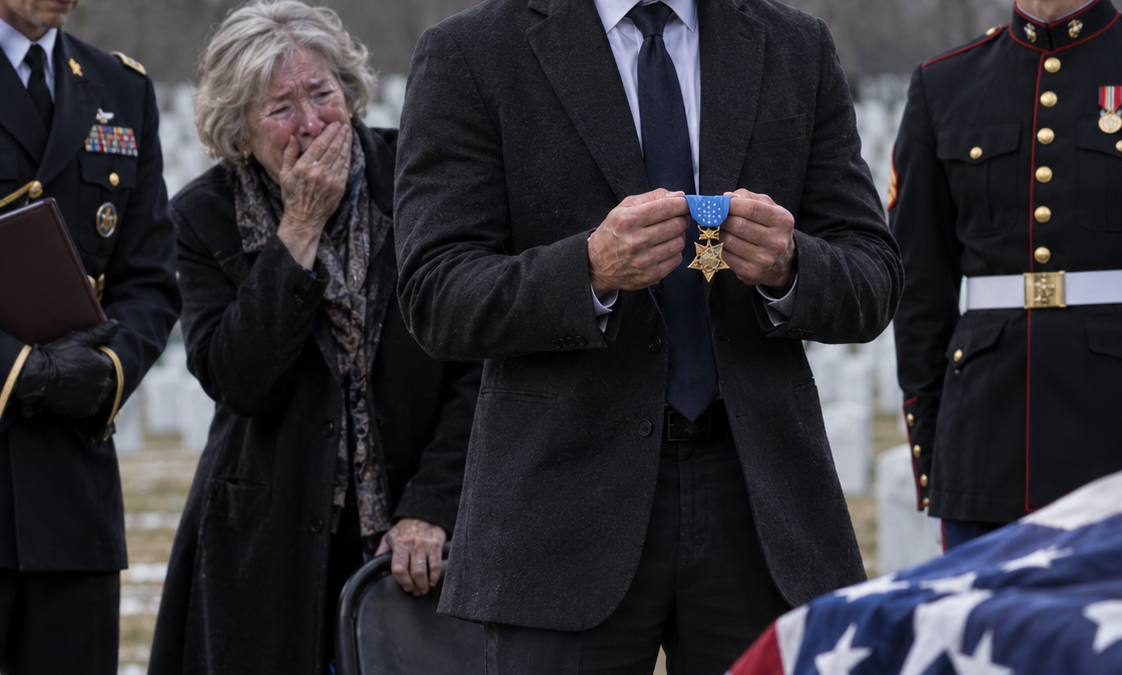
They thought hiding the tattoo would protect the family’s image → they ended up on the front page of the Roanoke Times honoring a Medal of Honor hero they’d buried for fifty years.
She did it over the phone. Calm voice. Steady. Like she was reading a grocery list.
“Daniel, I need to ask you something, and I need you to hear me.”
“I’m listening.”
“Don’t wear short sleeves to Thanksgiving. The tattoo. It’s not appropriate for the family photos.”
I was standing in my kitchen when she said it. Coffee in my hand. Rain hitting the window. My jaw tightened but I didn’t say anything for a moment.
“Did you hear me?” she asked.
“I heard you.”
“Good. I’m not trying to be cruel. You know I’m not cruel. But the whole family will be there. Both sides. Your cousin Brenda is bringing her new husband’s parents. They’re very nice people. Very traditional. And that arm of yours — it looks like something from a motorcycle gang.”
I set the coffee down.
“It’s not a motorcycle gang, Grandma.”
“I know it’s Navy something. I know. But it doesn’t matter what it is. It matters what it looks like. And it looks…”
She paused. Looking for the word.
“…rough.”
There it was.
What she didn’t know — what none of them knew — was that the ink on my right arm wasn’t decoration.
My name is Daniel Kessler. I’m forty-seven years old. I spent twenty-two years in the United States Navy, sixteen of them as a SEAL. Three deployments to Afghanistan. Two to Iraq. One to places I still can’t name.
The tattoo on my right forearm is a trident. The SEAL insignia. Below it, in small block letters, the names of four men who didn’t come home. Above it, a date. One date. The worst day of my life.
I got it in a parlor in Virginia Beach two weeks after I got back from my last deployment. The tattoo artist asked me if I wanted something more detailed. More artistic. I told him no. I wanted it simple. Readable. So that every time I looked down, I’d remember.
My grandmother had seen it once. At a Fourth of July barbecue three years ago. She’d made a face. A small one. A quick one. But I saw it.
She never mentioned it again until that phone call.
“Grandma,” I said. “I’m not going to cover it.”
Silence on the line.
“Daniel—”
“I’m not going to cover it. I’ll wear a short-sleeve shirt. If that’s a problem, I’ll stay home.”
“You’re being dramatic.”
“I’m being honest.”
Another silence. Longer this time.
“You know,” she said, “your cousin Michael is coming. He just made partner at his law firm. And your Uncle Robert — he’s been asking about you. Wondering what you’ve been doing with yourself. I told him you work at a gym now. He seemed confused.”
“I do work at a gym now.”
“Yes. But you know what I mean. He expected more.”
That was the thing about my family. They measured people in titles and salaries and the kind of car you drove. My grandfather had been a banker. My uncle was a surgeon. My cousin was a lawyer. Everyone had a business card with something impressive on it.
I had a gym membership and a pickup truck and a mortgage I’d paid off early.
They didn’t know why I’d bought that house. They didn’t know what I’d done to afford it. They didn’t know anything.
“I’ll see you at Thanksgiving, Grandma,” I said.
“Wear long sleeves.”
“I’ll see you at Thanksgiving.”
I hung up before she could say anything else.
The thing about my family is that they’d never asked.
Not once. Not in twenty-two years.
When I enlisted after high school, my mother cried. My father — who’d done four years in the Army himself, supply corps, never saw combat — told me I was wasting my potential. I could have gone to college. I could have gotten a degree. I could have made something of myself.
I told him I wanted to serve. He told me that was a nice sentiment but sentiment doesn’t pay the bills.
I shipped out to Great Lakes for basic training two weeks later.
My grandmother sent me a card. A nice one. A picture of the family on the front. Inside, in her neat handwriting: “We’re proud of you. Stay safe.” Twenty words. Maybe fewer. I still have it somewhere.
For the first few years, they asked questions. Where are you stationed? What are you doing? Are you safe?
I gave them the standard answers. San Diego. Training. Yes, I’m safe.
I didn’t tell them about BUD/S. The cold water. The sand. The instructors screaming in my face for six months straight. The men who quit. The men who didn’t.
I didn’t tell them about my first deployment. The mountains. The night raids. The first time I watched a man die.
I didn’t tell them about my second. The one that changed everything.
They stopped asking after a while. I think they sensed I didn’t want to talk about it. Or maybe they just got tired of the silence.
Either way, by the time I came home for good — twenty-two years in, my body held together with scar tissue and stubbornness — they didn’t know who I was.
They knew I’d been in the Navy. They knew I was a SEAL, technically. My mother had told people that much. “My son is a Navy SEAL,” she’d say at parties, and people would nod and make impressed sounds, and she’d move on to talking about my cousin the lawyer.
But they didn’t know what it meant. Not really.
They didn’t know about the men I’d lost. The men I’d saved. The things I’d done.
They didn’t know about Mike.
I’ll get to Mike.
Thanksgiving was at my grandmother’s house. The big house. The one my grandfather had built in 1972, back when he was still running the bank and the family still had money.
It sat on six acres outside of Roanoke. White columns. Wraparound porch. A lawn that took three days to mow. My grandmother had lived there alone for fifteen years, ever since my grandfather died, and she kept it spotless.
My mother met me at the door.
“Daniel.” She hugged me. Quick. Light. The way she always did. “You look thin.”
“I look the same.”
“You look thin.” She stepped back. Looked at me. “You’re wearing short sleeves.”
“I am.”
“Your grandmother said—”
“I know what she said.”
My mother’s face tightened. She was fifty-eight years old, dyed blonde, and perpetually anxious about how things looked. Her whole life was about how things looked.
“Just… be careful,” she said.
“I’m always careful.”
She didn’t catch the irony.
I walked into the living room. It was already crowded.
My Uncle Robert was there, holding court by the fireplace. He was a surgeon. Orthopedic. Made a lot of money. Talked about it constantly, but never directly. Always with a story that happened to mention his boat or his new car or the vacation house in Florida.
His wife, Aunt Patricia, was on the couch with my mother. They were talking about someone’s daughter who’d gotten into Yale.
My cousin Michael was at the bar, mixing himself a drink. He was thirty-two, three years out of law school, and already convinced he was the smartest person in every room. He saw me and raised his glass.
“Hey, Danny. Still pumping iron?”
I nodded.
“Good for you. Good for you.” He took a sip of his drink. “Gotta stay in shape. I’m at the gym five days a week now. Got a trainer. Expensive, but worth it.”
“That’s good, Mike.”
“I mean, you work at a gym, right? So you know. You know what I’m talking about.”
“I know.”
He smiled. A little too wide. The way people smile when they’re not really smiling.
“Hey, I heard you were in the military or something. What was that about?”
I looked at him. He knew. He knew exactly what I’d done. My mother had told the whole family.
But he wanted me to say it. He wanted to hear me say “I was a Navy SEAL” so he could make a joke about it. So he could put me in a box.
“Navy,” I said. “For a while.”
“A while? How long?”
“Twenty-two years.”
His eyebrows went up. “Twenty-two years? Man. That’s a long time to be… doing whatever it is you were doing.”
“It was.”
“What’d you do, exactly? Like, were you on a ship? I always pictured you on a ship.”
I didn’t answer.
“Hey, no judgment,” he said, holding up his hands. “Some people join the military, some people go to law school. Different paths. Different paths.”
He laughed. I didn’t.
The dining room was set for twenty-two people.
White tablecloths. China. Silver. A centerpiece of dried flowers that my grandmother had arranged herself. She was eighty-one years old and still insisted on doing everything herself.
The extended family had arrived by five. Aunts and uncles and cousins I saw once a year. The new in-laws. Brenda’s husband’s parents, who were, as promised, very nice people. Very traditional. The father shook my hand and asked what I did.
“I work at a gym,” I said.
“Fitness. Good industry. Good industry.”
His wife looked at my arm. At the trident. At the names. She didn’t say anything, but I saw her eyes linger.
I sat at the far end of the table. The kids’ end, traditionally, though the kids were all adults now. It was where the family put the people they didn’t quite know what to do with.
My grandmother sat at the head of the table. She gave a short speech before dinner. The usual. Gratitude. Family. The importance of being together.
Then she said, “Before we eat, I want to propose a toast.”
Everyone raised their glasses.
“To family,” she said. “To the people we love. To the people who make us proud.”
She looked at my cousin Michael.
“To Michael, who just made partner. We’re so proud of you, sweetheart.”
Michael beamed.
“And to all of you. Every one of you. You make this family what it is.”
She didn’t look at me.
Dinner was loud. It always was.
My Uncle Robert told a story about a surgery he’d performed. A tricky one. A famous patient — he couldn’t say who, but someone important. He described it in detail. The tension. The stakes. How he’d saved the day.
Everyone listened. Nodded. Made impressed sounds.
I ate my turkey and thought about a night in Afghanistan when I’d held a man’s intestines in my hands and tried to keep him alive until the medevac came. He’d died anyway. His name was Marcus. He was twenty-four years old.
After dinner, we moved to the living room. Coffee. Pie. More stories.
I was standing by the window when my grandmother approached me.
“Daniel.”
“Grandma.”
She looked at my arm. The tattoo was visible. Short sleeves. Just like I said.
“I asked you to wear long sleeves.”
“I know.”
“You didn’t listen.”
“I know.”
She sighed. A long, slow sigh. The kind that said she was disappointed but not surprised.
“You’ve always been stubborn,” she said. “Even as a boy. You never did what you were told.”
“I did what I was told for twenty-two years, Grandma. I just don’t do it anymore.”
Her eyes narrowed. “What’s that supposed to mean?”
I didn’t answer.
“Daniel, I don’t understand you. I never have. You had so much potential. You could have been anything. A doctor. A lawyer. A businessman. Instead you went off and… and did whatever it was you did. And now you work at a gym and you have that… that thing on your arm and you won’t even cover it up for one family dinner.”
“Grandma—”
“I’m not finished.”
She wasn’t. She never was.
“Do you know how embarrassing it is? To have to explain to people? ‘Oh, Daniel? He was in the Navy.’ And they ask what you did, and I don’t know what to say. I don’t know what you did. You never told me. You never told anyone.”
“You never asked.”
“I’m asking now.”
I looked at her. Eighty-one years old. Standing there in her pearls and her cardigan, her hair perfectly set, her face tight with frustration.
I could have told her.
I could have told her about BUD/S. About the cold water. About the men who quit. About the ones who didn’t.
I could have told her about the mountains of Afghanistan. The nights. The silence. The way your heart pounds before a breach.
I could have told her about the four names on my arm. About Marcus. About the others. About the day they died.
I could have told her about Mike.
But I didn’t.
“You want to know what I did, Grandma?”
“Yes.”
“I did my job. And I came home. That’s more than some people get.”
She stared at me. I stared back.
“That’s not an answer.”
“It’s the only answer I have.”
She shook her head. Turned away.
“Your cousin Michael is a partner at his law firm,” she said. “He’s twenty-nine years old. He’s accomplished more in seven years than you have in twenty-two.”
“Maybe.”
“Maybe? It’s not a maybe. It’s a fact.”
“Okay.”
She looked at me like I was a stranger. Like she’d never seen me before.
“I don’t know what happened to you, Daniel. You used to be such a sweet boy. Now you’re… I don’t know what you are.”
I didn’t say anything.
“I want you to leave,” she said.
“Grandma—”
“I want you to leave. Now. Before dessert. I don’t want you in the family photos with that thing on your arm. I don’t want people asking questions. I don’t want to have to explain.”
“Explain what?”
“Explain you.”
The room went quiet.
I don’t know when it happened. When everyone stopped talking. But they did. All twenty-two of them. Staring at us.
My grandmother’s face was red. Her hands were shaking.
“Go,” she said. “Please.”
I looked around the room. At my mother, who wouldn’t meet my eyes. At my Uncle Robert, who was studying his shoes. At my cousin Michael, who was smirking.
At all of them. My family.
“Okay,” I said.
I walked to the door. Grabbed my jacket. Opened it.
“Daniel.”
I turned.
It was my grandmother. Her voice was softer now. Almost pleading.
“I’m not trying to hurt you. You know that, don’t you? I’m just trying to protect the family. The family’s reputation. It’s all we have.”
I looked at her for a long moment.
“You had more than that,” I said. “You just didn’t want it.”
I walked out.
I sat in my truck for ten minutes before I drove away.
The rain had stopped. The sky was clear. Cold. I could see my breath in the air.
I thought about going back inside. Apologizing. Covering my arm. Sitting quietly through dessert and letting them pretend nothing had happened.
I thought about driving home and never coming back.
Then my phone buzzed.
A text. From a number I didn’t recognize.
“Danny. It’s Mike. I’m in town. I need to see you. It’s important.”
Mike.
The name hit me like a punch to the chest.
Mike Callahan. My teammate. My friend. The man I’d carried on my shoulders for three miles through the mountains of Afghanistan after he’d been shot in the leg.
The man whose name wasn’t on my arm because he’d survived.
I hadn’t seen him in five years.
I typed back: “Where are you?”
The reply came fast.
“Your grandmother’s house. I’m at the gate. They won’t let me in.”
I looked at the house. The lights in the windows. The family inside.
Then I looked at the gate. At the end of the driveway. Where a tall man in a dark coat was standing, phone in hand.
Mike.
What the hell was he doing here?
I put the truck in gear and drove down the driveway.
I didn’t know it yet, but everything was about to change.
PART 2 — THE GATE
I pulled up to the gate and rolled down my window.
Mike stood there in a dark coat, hands in his pockets. He looked older than I remembered. Grayer. Thinner. But his eyes were the same. Sharp. Alert.
“Danny.”
“Mike.”
Neither of us smiled.
Five years. That’s how long it had been. Five years since I’d visited him in the hospital at Landstuhl. Since I’d watched him learn to walk again on a leg that almost didn’t make it.
“You look good,” he said.
“You look like hell.”
He laughed. Short. Dry. “Yeah. Been a rough stretch.”
“What are you doing here?”
He glanced at the house. At the lights in the windows. At the shapes moving behind the curtains.
“Can we talk somewhere else?”
I nodded. Unlocked the passenger door.
He got in. Buckled his seatbelt. Stared straight ahead.
“Drive,” he said. “I’ll tell you on the way.”
I drove.
We ended up at a diner off the highway. Open twenty-four hours. Coffee that tasted like it had been on the burner since noon. A waitress who didn’t ask questions.
I liked it immediately.
We took a booth in the back. Mike ordered coffee. I ordered coffee. Neither of us ordered food.
“You want to tell me what’s going on?” I asked.
He wrapped both hands around his mug. Looked at me. Looked away.
“I’ve been looking for you for three months,” he said.
“Why?”
“Because I found something. Something you need to see.”
He reached into his coat and pulled out a manila envelope. Laid it on the table between us.
“Open it.”
I opened it.
Inside was a photograph. Old. Black and white. Faded at the edges. The kind of photograph that had been sitting in a drawer for fifty years.
It showed a group of men in Navy uniforms. Frogmen. The ones who came before the SEALs. They were standing on a beach somewhere. Young. Smiling. Cocky.
I looked at the faces. One of them caught my eye.
Not because I knew him. I didn’t. But because he looked familiar. Something about the eyes. The jaw. The way he stood.
“Who is this?”
Mike pointed at the man. “That’s Thomas Kessler. Your grandfather’s brother.”
I stared at him.
“My what?”
“Your great-uncle. Thomas Kessler. He was a frogman in Vietnam. UDT. Underwater Demolition Team. He died in 1968.”
I didn’t say anything.
“Your family never talked about him, did they?”
“No.”
“Of course not. They erased him.”
I looked at the photograph again. At Thomas Kessler. At his face. At his arm.
His right arm.
There was a tattoo on it.
A trident.
“The same tattoo,” I said.
Mike nodded.
“The same tattoo.”
I sat there for a long time. Staring at the photograph. At the man who shared my blood. At the ink on his arm.
“Where did you get this?” I asked.
“Unit archives. I’ve been doing research. For a book. About the teams. The ones who came before us.”
“And you found him.”
“I found him.” Mike took a sip of his coffee. “He was a legend. From what I read. Three tours. Two Purple Hearts. Navy Cross. He died pulling three men out of a river under fire. They gave him the Medal of Honor posthumously.”
I didn’t say anything.
“His body was never recovered. They listed him as killed in action. And then—” He paused. “And then your family buried him.”
“What?”
“Figuratively. They buried him. In the family records. In the history. They never talked about him. Never mentioned his name.”
“Why?”
“Because it was messy. Because it was controversial. Because your grandfather was a banker and he wanted the family to look respectable. A dead war hero with a Medal of Honor? That’s a liability. That’s questions. That’s attention.”
I looked at the photograph.
“So they just erased him.”
“From everything. From the records. From the family tree. From the stories. For fifty years.”
My hands were shaking. I set the photograph down.
“Why didn’t anyone tell me?”
“Because no one knew. Your grandfather kept it secret. He told your grandmother it was a family shame. Something to be buried. And she went along with it.”
My grandmother.
“You’re telling me my grandmother knows about Thomas?”
“She knows. She just doesn’t talk about him.”
I thought about the family tree in her living room. The framed genealogy that went back to the 1800s. Every name. Every date. Every branch.
Except one.
I’d never noticed. I’d looked at that tree a hundred times. Never noticed there was a missing branch.
Mike pulled out another photograph.
“This is him,” he said. “Thomas. In Vietnam.”
I looked at it. A young man in fatigues. Standing in a jungle clearing. Holding a rifle. Smiling.
The same smile.
“He was twenty-three,” Mike said. “When he died.”
I was forty-seven. Twenty-four years older than Thomas had ever been.
“Mike,” I said. “Why are you doing this?”
He looked at me. His eyes were wet.
“Because you saved my life, Danny. You carried me three miles through the mountains. You kept me alive. And I never thanked you. Not really.”
“You didn’t have to.”
“I know. But this—” He tapped the photograph. “This is my way of thanking you. By giving you back your family.”
I didn’t know what to say.
“There’s more,” he said.
“More?”
“A ceremony. In Arlington. Next month. They’re finally giving Thomas his Medal of Honor. It’s been sitting in a drawer for fifty years. Someone found it. Someone pushed it through.”
“Who?”
“I don’t know. But it’s happening. And you should be there.”
“I should be there.”
“You’re his blood. You’re the only one left.”
I thought about the family. About my grandmother. About my mother. About my cousins and uncles and aunts.
They wouldn’t come. They didn’t even know.
Or they did. And they didn’t care.
We sat in the diner for another hour. Mike told me everything he’d found. About Thomas. About his service. About his death. About the men he’d saved.
Three men. He’d pulled three men out of a river under fire. One of them had gone on to become a Navy captain. Another had become a congressman. The third had died in a car accident in 1980.
“They’re giving the Medal to you,” Mike said. “At the ceremony. They want a family member to receive it.”
“I don’t want it.”
“You don’t have to want it. You just have to show up.”
I looked at the photographs. At Thomas. At the trident on his arm.
“The same tattoo,” I said.
“Same one.”
“Did you know? When you got yours?”
Mike shook his head. “I didn’t know. I didn’t know until I found the photograph. But I think—I think you knew. Subconsciously. When you got that tattoo. You were honoring something. You just didn’t know what.”
I looked at my arm. At the trident. At the names.
“I thought I was honoring my men,” I said. “The ones I lost.”
“You were. And you were honoring him too. You just didn’t know it yet.”
I drove Mike back to his hotel. He was staying in Roanoke. Near the airport. He had a flight out the next morning.
“Stay in touch,” he said.
“I will.”
“You’d better. I’m not carrying your ass again.”
That was a joke. The only one I’d heard from him all night.
“Mike.”
“Yeah?”
“Why now? Why after five years?”
He looked at me. His face was hard to read.
“Because I got a call,” he said. “From a woman. She said she was your grandmother.”
I stared at him.
“She called me?”
“She called the VA. Asked about you. Said she was trying to reach someone who knew you. Someone who knew what you did.”
“When?”
“Last week. She was trying to find someone to talk to. About you. About what you did in the service.”
I didn’t know what to say.
“She didn’t know anything,” Mike said. “She didn’t know what you did. She didn’t know what you went through. She just knew you were a SEAL and she wanted to understand.”
“Why?”
“I don’t know. But I told her I’d talk to her. After I talked to you.”
I sat there for a long moment.
“She doesn’t know about Thomas,” I said.
“She does. She just doesn’t talk about him.”
“She knew him?”
“She met him. Once. When she was young. Before she married your grandfather.”
“How do you know that?”
“She told me. She told me she remembered him. She remembered him coming home from the war. The first time. Before the second deployment. She said he was the kindest man she’d ever met.”
I looked at my hands.
“And then he died.”
“And then he died. And your grandfather told her to forget him.”
“Did she?”
Mike shook his head. “No. She said she never forgot him. She said she named your mother after him.”
I looked at him.
“Your mother’s name is Danielle,” he said. “She named her after Thomas. And she named you after him too.”
I sat there. In the truck. Outside the hotel. And I thought about my name.
Daniel.
I’d always thought it was just a name. Just a random choice. My mother had never told me why she picked it.
Now I knew.
I didn’t go home that night.
I drove back to my grandmother’s house. It was late. The lights were off. Everyone was asleep.
I parked on the road. Walked up the driveway. Stood in front of the house.
The family tree was in the window. I could see it. Dimly lit by the streetlamp.
I thought about Thomas. About his name. About the fact that it wasn’t there.
I thought about my grandmother. About the phone call. About the way she’d looked at me when she told me to leave.
I thought about all the years of silence. All the years of not asking. All the years of pretending we were something we weren’t.
Then I saw a light come on inside. A figure in the window.
My grandmother.
She was standing there. Looking out at me. Not moving. Just looking.
I looked back.
For a long moment, neither of us moved.
Then she raised her hand. Pressed it against the glass.
I didn’t move.
She lowered her hand. Turned away. The light went off.
I stood there for another minute. Then I got back in my truck and drove home.
I didn’t know what it meant. I didn’t know if it meant anything at all.
But I knew one thing.
The truth was coming.
And there was nothing anyone could do to stop it.
PART 3 — THE FAMILY TREE
The next morning, my phone rang.
I looked at the screen. Unknown number.
I answered.
“Daniel?”
It was my mother.
“Mom?”
“Daniel, I need to talk to you. About last night. About your grandmother.”
“Is she okay?”
“She’s fine. She’s—she’s not fine. She’s upset. She’s been up all night.”
“Why?”
Silence.
“Mom?”
“She told me something. Something I didn’t know. Something about your name.”
I closed my eyes.
“What did she tell you?”
“She told me about Thomas. About her brother-in-law. About what he did.”
I didn’t say anything.
“She told me she named you after him. Did you know that?”
“No.”
“I didn’t know either. She never told me. She never told anyone.”
“Why is she telling you now?”
Silence.
“Mom?”
“She wants you to come back. She wants to talk to you. Before Thanksgiving. Before everyone gets there.”
“She wants me to come back?”
“She said she made a mistake. She said she was wrong.”
I looked out the window. The sun was coming up. The sky was gray and pink.
“When?”
“Tomorrow. She wants you to come tomorrow. Just you. No one else.”
I thought about it.
“Okay,” I said. “I’ll be there.”
I hung up.
I didn’t know what she wanted. I didn’t know what she was going to say.
But I knew one thing.
The story wasn’t over.
I got to my grandmother’s house at ten the next morning.
She was waiting on the porch. Sitting in a wicker chair. A blanket over her lap. She looked smaller than I remembered. Older.
“Daniel.”
“Grandma.”
She didn’t get up. Didn’t offer a hug. Just looked at me.
“Sit down.”
I sat in the chair next to her. The same chair I’d sat in as a boy, when I’d come to visit and she’d tell me stories about the old days.
“I owe you an apology,” she said.
I didn’t say anything.
“I was wrong. About the tattoo. About what I said. About the way I treated you.”
She paused. Looked at her hands.
“I was scared.”
“Scared of what?”
“Of what people would think. Of what they’d say. Of the questions.”
“What questions?”
She didn’t answer right away.
“Your grandfather was a proud man,” she said. “He built this family. He built everything we have. And he had rules. Rules about how we were supposed to be. How we were supposed to look. What we were supposed to say.”
“And Thomas broke those rules.”
She looked at me. Her eyes were wet.
“Yes.”
“He was a war hero. He died saving three men. And your husband erased him because it was messy.”
“He didn’t erase him. He just—he didn’t talk about him. He said it was better that way. Better for the family.”
“Better for who?”
She didn’t answer.
“Grandma, he was a Medal of Honor recipient. He gave his life for his country. And you just—you just pretended he didn’t exist.”
“I know.”
“You named my mother after him. You named me after him. But you never told us. You never told us who he was.”
“I know.”
“Why?”
She looked at me. The tears were falling now. She didn’t wipe them away.
“Because I was afraid. Your grandfather was a powerful man. He controlled everything. The money. The house. The family. And I was young. I was scared. I didn’t know any better.”
“And now?”
“Now I’m eighty-one years old. And I’ve spent fifty years pretending. And I’m tired, Daniel. I’m so tired.”
She reached out. Took my hand.
“I’m sorry. I’m sorry for what I said. I’m sorry for what I did. I’m sorry for all of it.”
I looked at her. At the woman who’d raised my mother. Who’d been the matriarch of this family for half a century.
“I’m not the one you should apologize to,” I said.
She nodded. Slowly.
“I know. I know. But he’s gone. And you’re here.”
I sat there for a long time. Holding her hand.
“I’m going to Arlington,” I said. “Next month. They’re giving him his Medal of Honor. Finally.”
Her eyes widened.
“They found it?”
“Someone did. I don’t know who. But it’s happening.”
She was quiet for a moment.
“I want to come,” she said.
I looked at her.
“You want to come?”
“I want to be there. For him. I want to—I want to make it right.”
“Grandma, the whole family is going to be at Thanksgiving. If you go to Arlington—”
“I don’t care about Thanksgiving. I care about Thomas. I care about doing the right thing.”
I looked at her. At the determination in her eyes.
“Okay,” I said. “I’ll take you.”
She nodded. Squeezed my hand.
“Thank you.”
I didn’t say anything.
“Daniel.”
“Yeah?”
“What you did. In the service. What you did for your country. I never understood it. I never asked. And I’m sorry for that too.”
“It’s okay.”
“It’s not okay. But thank you.”
I looked at her. At the old woman in the wicker chair. At the tears on her face.
“Grandma,” I said. “There’s something else.”
“What?”
“The tattoo. The names. The four men I lost. I want to tell you about them.”
She looked at me. Nervous. Scared.
“Are you sure?”
“I’m sure.”
So I told her.
I told her about Marcus. About the night he died. About holding his hand while he bled out in the back of a Humvee.
I told her about Tommy. About the ambush. About the way he’d thrown himself on a grenade to save his squad.
I told her about David. About the helicopter crash. About the way he’d pushed me out of the way before it went down.
I told her about Chris. About the suicide. About the way I’d found him in his apartment three days after he got back from his last deployment.
I told her everything.
When I was done, she was crying. Not soft tears. Real ones. The kind that shake your whole body.
“I didn’t know,” she said. “I didn’t know.”
“No one did.”
“I’m so sorry, Daniel. I’m so sorry.”
“It’s okay, Grandma.”
“It’s not okay. None of it is okay.”
I looked at her. At the grief on her face. At the guilt.
“No,” I said. “It’s not.”
We sat there for a long time. Neither of us said anything.
Then she asked, “What are you going to do? About Thanksgiving?”
“I don’t know.”
“Are you going to come?”
“I don’t know.”
She nodded. Slowly.
“I understand. But I hope you do. I hope you come. I want to make this right. In front of everyone.”
I looked at her.
“You want to make it right in front of everyone?”
“Yes. I want them to know. About Thomas. About you. About all of it.”
“Grandma, that’s a lot. That’s—”
“I know it’s a lot. But I’m tired of secrets. I’m tired of pretending. I’m eighty-one years old and I don’t want to die with this on my conscience.”
I looked at her. At the determination in her eyes.
“Okay,” I said. “I’ll come.”
She smiled. A real smile. The first one I’d seen from her in years.
“Thank you.”
I nodded.
“But Grandma.”
“Yes?”
“There’s something you need to know. About who’s coming to Thanksgiving.”
“Who?”
“A man named Mike Callahan. He’s a friend of mine. A former teammate. He’s the one who found Thomas’s records. He’s the one who’s been pushing for the ceremony.”
She looked at me.
“He’s coming?”
“He’s coming. And he’s bringing something.”
“What?”
“A photograph. Of Thomas. In Vietnam. With the tattoo.”
She closed her eyes.
“I want to see it,” she said.
“You will.”
She opened her eyes. Looked at me.
“Daniel.”
“Yeah?”
“I’m proud of you. I don’t know if I’ve ever said that. But I am.”
I looked at her. At the old woman who’d spent fifty years hiding the truth.
“Thank you, Grandma.”
She nodded.
And for the first time in a long time, I felt like maybe—just maybe—things were going to be okay.
I was wrong.
 [Tap here for the Next Part ]

