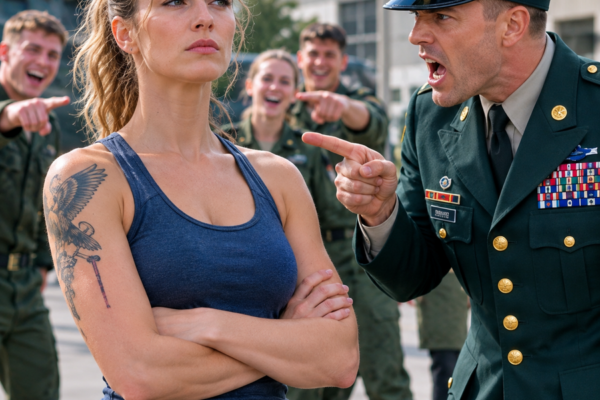
Part 2: “I asked you to wear long sleeves.
PART 4 — THE STORM
I drove home that night with a weight in my chest.
Not the bad kind. The kind that comes when something heavy finally gets set down. My grandmother knew. About Thomas. About me. About the men I’d lost.
She’d listened. She’d cried. She’d said she was proud.
It should have felt like enough.
It didn’t.
Because I knew what was coming. Thanksgiving. The whole family. Both sides. The cousins and uncles and aunts and the new in-laws who’d looked at my tattoo like it was a stain.
My grandmother wanted to make it right. In front of everyone.
I didn’t know if she could.
I didn’t know if they’d let her.
The week before Thanksgiving, my mother called again.
“Daniel, I need to talk to you.”
“About what?”
“About your grandmother. About what she’s planning.”
“Planning?”
“She wants to make a speech. At Thanksgiving. About Thomas. About you. About—” She paused. “About everything.”
“And?”
“And I don’t think it’s a good idea.”
“Why not?”
“Because it’s Thanksgiving. It’s a family dinner. It’s not the time or the place—”
“For the truth?”
“For drama.”
I leaned back in my chair. Looked at the ceiling.
“Mom, do you know who Thomas Kessler was?”
Silence.
“Do you know what he did?”
More silence.
“He was your uncle. He was a war hero. He died saving three men. And your father—your father—erased him from the family. Your mother went along with it. For fifty years.”
“I know.”
“You know?”
“I found out. When your grandmother told me. About a week ago.”
“And you’re okay with it?”
“I’m not okay with it. But I don’t think Thanksgiving is the time—”
“When is the time, Mom? When is the right time to tell the truth about a man who died for his country?”
Silence.
“Daniel, I’m just trying to keep the peace.”
“The peace. Right. The peace where no one talks about anything and everyone pretends everything is fine.”
“That’s not fair.”
“None of this is fair.”
She was quiet for a moment.
“Are you coming?”
“Yes.”
“And your friend? The one your grandmother mentioned?”
“Mike. Yes. He’s coming.”
“This is going to be a disaster.”
“Maybe. But it’s going to be the truth.”
I hung up.
I sat in the dark for a long time.
Then I called Mike.
“Hey.”
“Danny. What’s up?”
“Thanksgiving. It’s at my grandmother’s house. You’re still coming?”
“I’ll be there.”
“Good.”
“You okay?”
“No.”
“You want to talk about it?”
“No.”
“Okay.”
I paused.
“Mike.”
“Yeah?”
“Thank you. For finding him. For finding Thomas.”
“You don’t have to thank me.”
“I do.”
“You’d have done the same for me.”
“I would have.”
“Then we’re even.”
I laughed. A short one.
“Yeah. We’re even.”
I hung up.
I looked at my arm. At the trident. At the names.
Four names. And now a fifth. Thomas.
I thought about what Mike had said. That I’d been honoring him without knowing it. That the tattoo on my arm was a connection to a man I’d never met.
I wondered what Thomas would think. If he could see me now. If he could see his great-nephew carrying his memory without knowing it.
I hoped he’d be proud.
I hoped he’d understand.
The day before Thanksgiving, I got a package.
I didn’t recognize the return address. Some government office in Virginia.
I opened it.
Inside was a letter. Official. Stamped.
Dear Mr. Kessler,
We are writing to inform you that the Medal of Honor awarded posthumously to Thomas J. Kessler, UDT-12, United States Navy, has been recovered and will be presented at a ceremony at Arlington National Cemetery on December 15th.
As his closest surviving relative, you are invited to receive the medal on his behalf.
Please contact our office to confirm your attendance.
Sincerely,
Captain James Morrison
U.S. Navy (Ret.)
I read the letter three times.
December 15th. Three weeks after Thanksgiving.
Three weeks to prepare.
Three weeks to decide what to say.
Three weeks to figure out how to tell my family that the man they’d erased was about to be honored by the President.
I folded the letter. Put it in my pocket.
I wasn’t ready.
But I was going to have to be.
Thanksgiving morning.
I woke up early. Shaved. Put on a dress shirt. Dark blue. Rolled the sleeves up.
No suit. No jacket. Just the shirt. And the ink.
I looked at myself in the mirror.
The trident. The names. Thomas’s name wasn’t there yet. But it would be. I’d already decided. After the ceremony, I’d go back to the same parlor in Virginia Beach. I’d add his name. Below the others.
I grabbed my keys.
Time to go.
The drive to my grandmother’s house was quiet. The roads were empty. The sky was gray.
I pulled into the driveway and parked.
I could see the cars. Uncle Robert’s BMW. Cousin Michael’s Mercedes. A few others I didn’t recognize.
The whole family was here.
I got out of the truck and walked to the door.
My grandmother was standing in the doorway.
“Daniel.”
“Grandma.”
She looked at my arm. At the trident. At the names.
“Are you ready?”
“No.”
“Neither am I.”
She smiled. A nervous smile.
“Come in.”
I walked inside.
PART 5 — THE TABLE
The house smelled like turkey and cinnamon and something burning in the kitchen.
The living room was already crowded. My mother was on the couch, talking to Aunt Patricia. Uncle Robert was by the fire, holding court. Cousin Michael was at the bar, mixing drinks.
Everyone stopped talking when I walked in.
“Daniel,” my mother said. Her voice was tight.
“Mom.”
“You’re—you’re here.”
“I’m here.”
I looked around the room. At the faces. At the people who’d watched my grandmother tell me to leave. At the people who’d said nothing.
“Nice shirt,” cousin Michael said. “Very… casual.”
I looked at him. He was wearing a blazer. A tie. A watch that cost more than my first car.
“It’s a family dinner,” I said. “Not a board meeting.”
He laughed. A little too loud.
“Right. Right. Just saying.”
I didn’t respond.
My grandmother appeared at my side.
“Everyone, sit down. Dinner’s ready.”
We moved to the dining room. The same white tablecloths. The same china. The same centerpiece of dried flowers.
I sat at the far end again. The kids’ table.
But this time, I wasn’t alone.
Mike was already there. Sitting at the end, next to me. He’d arrived early. He’d been waiting.
“Hey,” he said.
“Hey.”
“You ready?”
“No.”
“Me neither.”
We sat in silence while the others took their seats.
My grandmother stood at the head of the table. She looked at everyone. At the faces. At the family she’d spent fifty years protecting.
Then she spoke.
“Before we eat, I have something I need to say.”
The room went quiet.
“I’ve been keeping a secret for fifty years. And I’m tired of keeping it.”
My uncle shifted in his seat. “Mother, maybe this isn’t—”
“It’s exactly the time.”
She looked at me. Then at Mike. Then at everyone else.
“Fifty years ago, my husband’s brother died in Vietnam. His name was Thomas. He was a frogman. UDT. He died saving three men.”
Silence.
“After he died, my husband decided to erase him. From the family. From the records. From everything. He said it was for the best. He said it was for the family’s reputation.”
She paused.
“And I let him. I was young. I was scared. And I let him.”
My uncle was staring at his plate. My mother was staring at the tablecloth. Cousin Michael was looking around the room, confused.
“Thomas was a hero,” my grandmother said. “He was awarded the Medal of Honor. Posthumously. And we—we buried it. We buried him.”
She looked at me.
“But Daniel didn’t. Daniel served this country for twenty-two years. He was a SEAL. He fought in Afghanistan. Iraq. Places we’ll never know about. And he lost men. Four of them. Their names are on his arm.”
Everyone looked at me. At my arm. At the trident. At the names.
“He didn’t cover them up. He didn’t hide them. He honored them. And he honored Thomas. Without even knowing it.”
She looked at the table.
“I’m ashamed. Of what I did. Of what we did. And I’m sorry.”
Silence.
Then my Uncle Robert spoke.
“Mother, this is—this is a lot. This is a family dinner. Maybe we should—”
“No.”
He looked at her.
“I said no. I’m not done.”
She looked at me.
“Daniel, stand up.”
I stood.
“Show them.”
I looked at her. Then at the room. At the faces.
I pulled up my sleeve.
The trident. The names. The date.
“This,” I said, “is the SEAL insignia. I got it after my last deployment. The names below it are the men I served with. The men I lost.”
I looked at my cousin Michael.
“The date above them is the day they died.”
No one said anything.
“Thomas had the same tattoo. On the same arm. I didn’t know that until a week ago. Neither did my grandmother.”
I looked at Mike.
“Mike found his records. He found the photograph. He found everything.”
Mike stood up. He pulled out the manila envelope. Opened it. Pulled out the first photograph.
“This is Thomas Kessler,” he said. “In Vietnam. 1967.”
He passed the photograph to my uncle. Then to my mother. Then to cousin Michael.
“And this,” Mike said, pulling out the second photograph, “is Daniel. Two years ago. After his last deployment.”
He passed it around.
The two photographs sat side by side on the table. Two men. Two generations. The same tattoo. The same eyes.
“The ceremony is next month,” Mike said. “Arlington. They’re giving Thomas his Medal of Honor. Finally.”
He looked at my grandmother.
“And she’s going to be there. And so am I. And so is Daniel.”
My uncle looked at the photographs. At Thomas. At me.
“I didn’t know,” he said.
“Neither did I,” my mother said.
“No one did,” my grandmother said. “That was the point.”
The room was quiet for a long time.
Then my cousin Michael spoke.
“So what? We’re supposed to feel bad? We’re supposed to—”
My grandmother cut him off.
“You’re supposed to listen. For once in your life, Michael, you’re supposed to listen.”
He shut up.
My grandmother looked at me.
“I’m sorry, Daniel. For what I said. For what I did. For all of it.”
I looked at her. At the old woman who’d spent fifty years hiding the truth.
“I know,” I said.
She nodded.
“Now sit down. Everyone. Dinner’s getting cold.”
We sat.
We ate.
No one said much.
But something had changed.
PART 6 — THE GRAVEYARD
The weeks between Thanksgiving and the ceremony passed slowly.
I went back to work. I trained. I ran. I did the things I always did.
But something was different.
I called my mother. We talked. Really talked. For the first time in years.
She told me about her childhood. About the way my grandfather had controlled everything. About the way she’d learned to keep her head down. To not ask questions.
“I was scared of him,” she said. “He was my father. And I was scared of him.”
“He was your father. He should have protected you.”
“He didn’t. He protected the family. The image. The reputation.”
“And you?”
“I learned to do the same.”
I didn’t say anything.
“I’m sorry, Daniel. For not standing up for you. For not asking. For not—for not being there.”
“You’re here now.”
“I know. But I should have been there then.”
I let it go.
I called my grandmother. Every few days. We talked. About Thomas. About the ceremony. About what she was going to wear.
She told me stories. About Thomas. About the way he’d laughed. The way he’d danced. The way he’d promised her he’d come home.
“He was so young,” she said. “They all were. But he was—he was special. He had this light in him.”
“He was a hero.”
“He was. But he was also just a boy. A boy who wanted to come home and marry his girl and have a family.”
“He never got that.”
“No. He never did.”
She was quiet for a moment.
“I’m glad you’re here, Daniel. I’m glad you came back.”
“Me too.”
The night before the ceremony, I couldn’t sleep.
I lay in bed. Staring at the ceiling. Thinking about Thomas. About the three men he’d saved. About the life he never got to live.
I thought about my own men. The four names on my arm. The four men who’d never come home.
I thought about Marcus. About the way he’d laughed. The way he’d always been the first one to volunteer. The way he’d died in my arms.
I thought about what he’d said to me once. On a rooftop in Kabul. We were watching the sunrise. Smoking cigarettes we weren’t supposed to have.
“You know what I want?” he’d asked.
“What?”
“I want to go home. I want to have a family. I want to watch my kids grow up.”
“You will.”
“You think so?”
“I know so.”
He’d smiled. Stubbed out his cigarette.
“Thanks, Danny.”
“For what?”
“For lying to me.”
He’d laughed. I’d laughed.
That was three weeks before he died.
I got up. Walked to the kitchen. Poured a glass of water.
I looked at my arm. At the names.
Marcus. Tommy. David. Chris.
And now Thomas.
I thought about what Mike had said. About honoring something without knowing it.
I thought about the ceremony tomorrow. About the Medal. About the President.
I thought about my family. About my grandmother. About my mother. About the ones who’d shown up and the ones who hadn’t.
My uncle had called. The day after Thanksgiving. He’d said he was sorry. He said he wanted to come to the ceremony. He said he wanted to be there.
I told him he could.
My cousin Michael hadn’t called.
I wasn’t surprised.
The morning of the ceremony was cold. Gray. The kind of day that makes you want to stay in bed.
I put on my suit. Dark blue. The one I’d bought for my grandmother’s birthday five years ago. I hadn’t worn it since.
I looked in the mirror.
The trident was hidden. The names were hidden. But they were there. They were always there.
I got in my truck and drove to my grandmother’s house.
She was waiting on the porch. Wearing a black dress. A pearl necklace. Her hair perfectly set.
“You look nice,” I said.
“You look nice too.”
I helped her into the truck. She was slower than she used to be. Frailer.
“Nervous?” I asked.
“Yes.”
“Me too.”
She looked at me.
“He’d be proud of you, Daniel.”
I didn’t say anything.
“I mean it. Thomas. He’d be proud.”
“Thanks, Grandma.”
We drove to Arlington.
The ceremony was at noon. At the gravesite. There wasn’t a body. Just a marker. A stone with Thomas’s name.
Mike was already there. In his dress blues. Standing at attention.
He nodded when he saw us.
“Mrs. Kessler.”
“Mike.”
They shook hands.
“Thank you,” she said. “For finding him. For not letting him be forgotten.”
Mike nodded.
“It was an honor.”
We stood there. Waiting.
Then the cars arrived. Black SUVs. Official plates.
A man in a Navy uniform stepped out. Captain Morrison. The one who’d sent me the letter.
“Mr. Kessler?”
“Yes.”
“I’m Captain Morrison. We spoke on the phone.”
“Yes. Thank you for coming.”
He nodded. Looked at my grandmother.
“Mrs. Kessler. It’s an honor.”
She nodded.
Then the ceremony began.
The captain spoke. About Thomas. About his service. About his sacrifice.
“Thomas Kessler was a man of extraordinary courage. He gave his life so that others might live. He is a hero. And today, we finally honor him as such.”
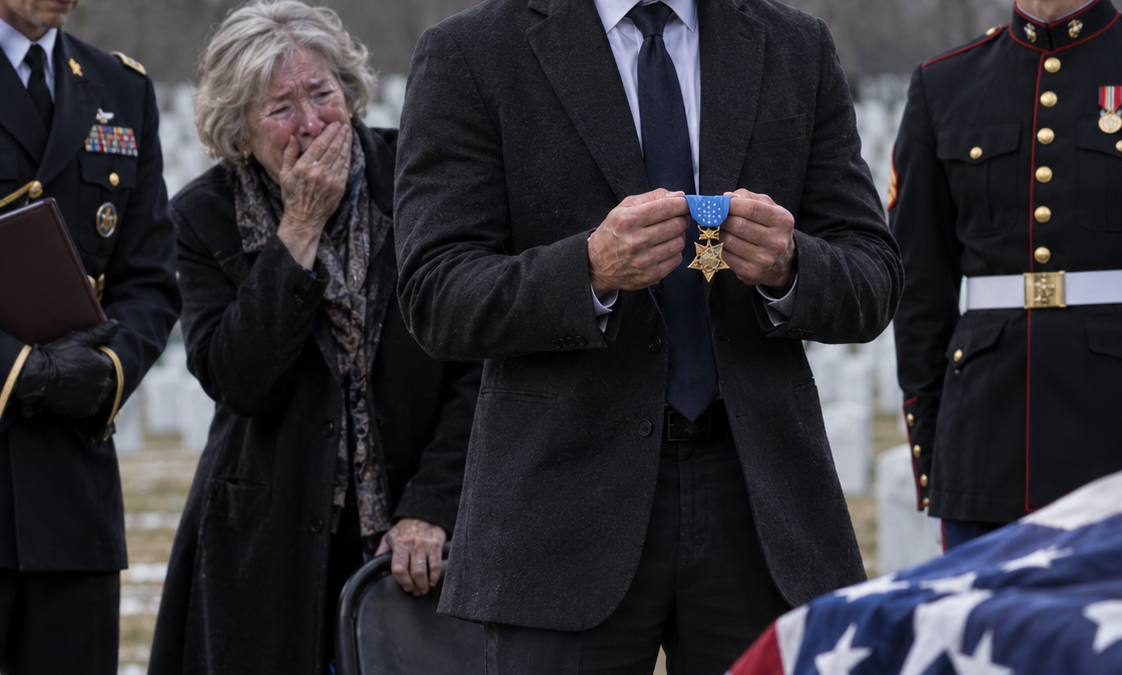
The Medal of Honor was presented. A blue ribbon. A gold star. A symbol of everything Thomas had done and everything he’d given.
I accepted it on his behalf.
I held it in my hands. Felt the weight of it.
This was what my grandfather had buried. This was what my family had ignored. This was what Thomas had died for.
I looked at my grandmother. She was crying. Silent tears running down her face.
I looked at Mike. He was standing at attention. Tears in his eyes.
I looked at the small crowd. The Navy officers. The veterans. The ones who’d come to honor a man they’d never met.
And then I looked at the edge of the crowd.
A man was standing there. Alone. Old. Gray hair. A cane.
He was watching me. Watching the ceremony.
I didn’t recognize him.
But he was crying.
After the ceremony, the man approached me.
“Mr. Kessler?”
“Yes?”
“Daniel Kessler?”
“Yes.”
He held out his hand.
“My name is William Hayes. I served with Thomas. In Vietnam.”
I shook his hand.
“You were one of the men he saved.”
He nodded. His eyes were wet.
“He pulled me out of the river. I was bleeding. I couldn’t walk. He carried me. All the way to the extraction point.”
He paused.
“He died because of me.”
I didn’t say anything.
“I’ve been looking for his family for fifty years. I didn’t know if you existed. I didn’t know if anyone cared.”
“We care,” I said. “We’re here.”
He nodded. Tears falling.
“Thank you. Thank you for honoring him.”
“He was my great-uncle. I never met him. But I—I carry him with me.”
I showed him my arm. The trident. The names.
He looked at it. At the ink. At the date.
“He had the same one,” he said.
“I know.”
He touched my arm. Gently.
“He was the bravest man I ever knew. And I’ve never forgotten him. Not for one day.”
“Neither will I.”
He nodded. Shook my hand again.
“Thank you, Daniel.”
“Thank you, Mr. Hayes.”
He walked away.
My grandmother was standing behind me.
“Who was that?”
“One of the men Thomas saved.”
She closed her eyes.
“Fifty years,” she said. “Fifty years and I never knew.”
“Now you do.”
She nodded. Opened her eyes.
“Now I do.”
PART 7 — THE UNEXPECTED GUEST
The ceremony ended. The crowd dispersed. The Navy officers got back in their SUVs. Captain Morrison shook my hand one more time.
“If you ever need anything, Mr. Kessler. Anything at all.”
“Thank you, Captain.”
He nodded. Got in his car. Drove away.
Mike walked over.
“You okay?”
“Yeah.”
“You sure?”
I looked at the grave. At the marker. At the Medal in my hand.
“I’m sure.”
He nodded.
“You did good, Danny.”
“We did good.”
He put his hand on my shoulder. Squeezed.
“Call me if you need anything.”
“I will.”
He walked away.
I stood there with my grandmother. At the grave of a man I’d never met. A man who shared my blood. A man who’d died saving three others.
“I want to tell you something,” my grandmother said.
“What?”
“When your grandfather told me to forget Thomas, I said okay. I said okay because I was scared. Because I didn’t know what else to do.”
She paused.
“But I never forgot him. Not for one day.”
“I know.”
“I named your mother after him. I named you after him. I did that because I wanted a piece of him to live on. Even if no one knew.”
“And now everyone knows.”
She nodded.
“Now everyone knows.”
We stood there for a long time.
Then we walked back to the truck.
I drove her home.
We didn’t say much on the way.
But it was a comfortable silence.
The kind you earn.
The family gathered at my grandmother’s house that night.
Not everyone. Uncle Robert and Aunt Patricia. My mother. My uncle’s kids. A few others.
But not cousin Michael.
He’d sent a text. Said he was busy. Said he had a work thing.
No one believed him.
We sat in the living room. My grandmother in her chair. Me on the couch. My mother next to me.
My uncle spoke first.
“Daniel, I want to say something.”
“Okay.”
“I’m sorry. For Thanksgiving. For what I said. For what I didn’t say.”
I looked at him.
“I didn’t know about Thomas. I didn’t know about any of it. But I should have. I should have asked. I should have—I should have been better.”
“You’re here now.”
He nodded.
“I’m here now.”
My mother spoke next.
“Daniel, I—I don’t know what to say. I’m proud of you. I’ve always been proud of you. I just—I didn’t know how to show it.”
“You’re showing it now.”
She nodded. Tears in her eyes.
We sat there. Talking. About Thomas. About the ceremony. About the men I’d served with.
I told them about Marcus. About Tommy. About David. About Chris.
I told them about Mike. About the day I’d carried him three miles through the mountains.
I told them about the men I’d lost. And the men I’d saved.
They listened.
For the first time in my life, they listened.
And when I was done, my grandmother spoke.
“Daniel, I want to ask you something.”
“What?”
“Will you tell me about the tattoo? The whole story? I want to know. I want to understand.”
I looked at her.
“It’s a long story.”
“I have time.”
So I told her.
I told her about BUD/S. About the cold water. About the men who quit. About the ones who didn’t.
I told her about my first deployment. The mountains. The night raids. The first time I watched a man die.
I told her about the tattoo parlor in Virginia Beach. About the artist who’d asked me if I wanted something more artistic.
I told her about the names. About what they meant.
When I was done, she was quiet.
“Thank you,” she said. “For telling me.”
“You asked.”
“I know. And I’m glad I did.”
She reached out. Took my hand.
“I’m proud of you, Daniel. I don’t know if I’ve ever said that. But I am.”
I looked at her. At the old woman who’d spent fifty years hiding the truth.
“I know, Grandma.”
She smiled.
And for the first time in a long time, I believed her.
The next morning, I got a call.
Unknown number.
I answered.
“Daniel Kessler?”
“Yes.”
“This is Captain Morrison. I’m calling about the ceremony.”
“What about it?”
“There’s something I didn’t tell you. About the Medal. About the ceremony.”
“What?”
“It was requested. By someone. Someone who knew Thomas. Someone who wanted to make sure he was honored.”
“Who?”
“Your grandmother.”
I froze.
“She called us. About six months ago. She said she wanted to make it right. She said she’d been carrying the guilt for fifty years and she couldn’t do it anymore.”
I didn’t say anything.
“She’s the one who pushed for the ceremony. She’s the one who found the records. She’s the one who made it happen.”
I sat there. In my kitchen. Staring at the wall.
“She didn’t want you to know,” Captain Morrison said. “She said she didn’t want to take credit. She said she just wanted it to happen.”
“Why are you telling me this?”
“Because you should know. Because you should know who really fought for him.”
I didn’t say anything.
“Mr. Kessler?”
“I’m here.”
“I’ll let you go. But I thought you should know.”
“Thank you, Captain.”
I hung up.
I sat there for a long time.
My grandmother had done this. She’d made it happen.
She’d spent fifty years silent. And then she’d finally spoken.
I picked up the phone. Called her.
“Daniel? Is everything okay?”
“Grandma, I need to ask you something.”
“What?”
“The ceremony. Why did you do it?”
Silence.
“Grandma?”
“I don’t know what you’re talking about.”
“Captain Morrison told me. About the call. About you.”
More silence.
“Grandma, why didn’t you tell me?”
“I didn’t want you to think—I didn’t want you to think I was trying to make up for it. For what I did. I wasn’t. I just—I just wanted him to be honored. I wanted the world to know.”
“Why?”
“Because I loved him. He was my brother-in-law. He was family. And I let my husband erase him. And I’ve spent fifty years regretting it.”
She paused.
“I’m not a good person, Daniel. But I’m trying to be. For what it’s worth.”
I closed my eyes.
“It’s worth a lot, Grandma.”
“It is?”
“Yeah. It is.”
She was quiet for a moment.
“Thank you, Daniel.”
“Thank you, Grandma.”
I hung up.
I looked out the window. The sun was coming up. The sky was pink and gold.
For the first time in a long time, I felt like things were going to be okay.
 [Tap here for the Next Part ]