“It felt like being shot. But worse. Because the bullet came from someone I trusted.”
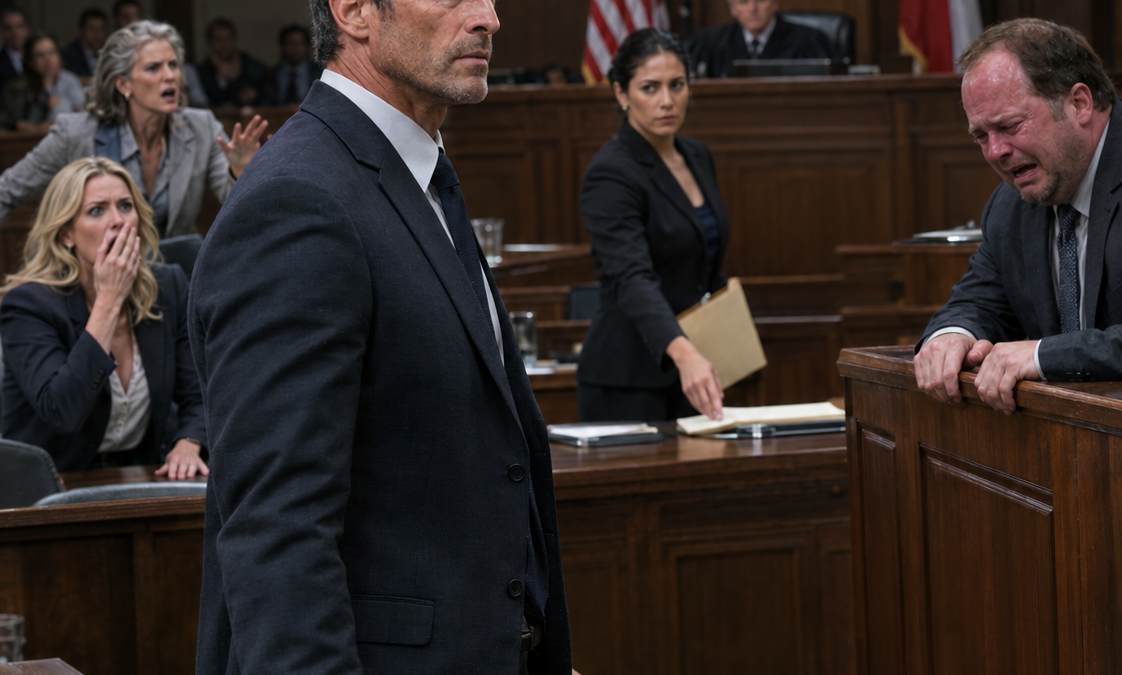
“The gavel came down and my brother smiled. I saw it from the third row of the gallery. A small, satisfied twitch at the corner of his mouth.”
They thought paying my brother $40,000 would cost me my house and my reputation → they didn’t know I was a former Army Ranger with a Silver Star and a brother who would eventually testify against them.
I saw it from the third row of the gallery. A small, satisfied twitch at the corner of his mouth. The kind of smile you learn to read in a firefight, when the man across from you thinks he’s won.
He hadn’t won. Not yet.
What he didn’t know was that my attorney had a folder on her desk with a bank transfer receipt in it. Forty thousand dollars. Dated twenty-three days ago. From my ex-wife’s personal account to his.
I hadn’t seen it yet either. But I would.
My name is Ethan Cross. I was forty-six years old when my brother Caleb stood up in a courtroom in Travis County, Texas, and told a judge that I was a violent man who had abandoned his family.
I was a former U.S. Army Ranger. 2nd Battalion, 75th Ranger Regiment. Three deployments to Afghanistan, one to Iraq. I had a Bronze Star with a “V” device that I never talked about and a purple heart I kept in a shoebox in my closet.
None of that mattered in that courtroom.
What mattered was that my ex-wife, Danielle, wanted the house in Lakeway. The house I had bought with my own money before we were married. The house I had paid off in full two years before the divorce. The house she had never once set foot in during our entire marriage because she said it was “too rustic” and “too far from civilization.”
Now she wanted it.
And my brother, my only surviving sibling, was helping her take it.
The trial had started three days earlier. A civil matter. Property dispute. The kind of thing that should have been settled over coffee and a mediator’s conference table.
But Danielle had hired a bulldog. A Dallas attorney named Priscilla Vandermeer who wore four-inch heels and smiled like a shark. She had filed for a partition of the property, claiming that the Lakeway house was “marital property” because I had “maintained it” during our marriage.
It was a lie. A clean, well-drafted lie.
I had bought the house in 2009, five years before I met Danielle. It was a small stone cabin on three acres of hill country, with a screened porch and a view of the Pedernales River valley. I had paid two hundred and forty thousand dollars for it, cash, using money I had saved from my deployments and a small inheritance from my grandmother.
I had never told Danielle about the inheritance. She didn’t need to know.
What she needed to know—what she had learned within six months of our wedding—was that I had a house. A paid-off house. A house that was worth considerably more now than when I bought it.
And she wanted it.
The divorce had been final two years ago. No children. No joint assets worth fighting over. She had walked away with the house in Austin, the car, and half our savings. I had walked away with the Lakeway cabin and a quiet sense of relief that I never said out loud.
I thought it was over.
Then the partition suit arrived.
Her attorney argued that I had “commingled” the property by paying for renovations during the marriage. That I had “used marital funds” to install a new septic system and a metal roof. That Danielle was therefore entitled to a share of the property’s current value.
It was legal gymnastics. But it was working.
Judge Harmon was a small, precise man with wire-rimmed glasses and a reputation for being fair. He had listened to three days of testimony. He had watched Danielle cry on the stand about how I had “changed” during our marriage, how I had become “distant” and “cold,” how I had “refused to talk about my feelings.”
I had refused to talk about a lot of things. The things I had seen overseas. The things I had done. The friends I had lost.
She knew that. She just didn’t care.
And on the fourth day, she called my brother to the stand.
Caleb and I had been close once. Growing up in Odessa, Texas, we had shared a bedroom until I was fifteen and he was twelve. We had hunted rabbits together with a pellet gun our father had given us. We had built forts in the vacant lot behind our house and defended them from the neighborhood kids with sticks and dirt clods.
Then I had joined the Army. And Caleb had stayed home.
Our father had been proud of me. A career military man himself—twenty-two years in the Air Force—he had understood what I was choosing. Our mother had cried at my first deployment, but she had understood too. In her way.
Caleb had not understood.
He had gone to community college for a year, then dropped out. He had worked a series of jobs—car salesman, insurance adjuster, real estate agent—none of which had lasted more than two years. He had married a woman named Beth who came from money and who looked at me the way you look at a stray dog that’s wandered into your yard.
When our father died of a heart attack in 2016, Caleb had been the one to handle the estate. He had been the one to sell the family home. He had been the one to distribute the proceeds.
I had been in Afghanistan. I hadn’t been able to come home for the funeral.
That had been the beginning of the end. Caleb had never forgiven me for missing our father’s funeral. He had never understood that I couldn’t just leave. That I was in the middle of an operation. That men were counting on me.
He had taken the inheritance that should have been split between us and used it to pay off his own debts. He had told me it was “what Dad would have wanted.” He had told me I had “made my choice” when I went overseas.
I had let it go. What else could I do?
But now he was on the stand. And he was telling a different story.
“Ethan was always aggressive,” he said. His voice was smooth. Practiced. “Even as a kid. He had a temper. He used to get into fights at school. Our parents were worried about him.”
That was a lie. I had been a quiet kid. I had kept my head down. I had gotten into exactly one fight in high school, when a senior had called my mother a name, and I had been suspended for three days.
“After he joined the Army,” Caleb continued, “he changed. He became more distant. More controlling. When he got married to Danielle, I saw the same pattern. He wanted things his way. He didn’t want to compromise.”
I sat in my chair and kept my face still. I had learned that in Ranger School. When you’re hurting, when you’re exhausted, when everything in your body is screaming at you to quit—you keep your face still. You keep your eyes forward. You wait.
“Did you ever see him be physically violent toward Danielle?” Priscilla Vandermeer asked.
My brother paused. He looked at the judge. He looked at the jury—six people who had been pulled from their lives to sit in this courtroom and decide my fate.
“I saw him grab her arm once,” Caleb said. “At a Christmas party. She had made a joke about something, and he grabbed her arm and pulled her into another room. She looked scared.”
The room was silent.
I had never grabbed Danielle’s arm. Not once. Not ever. The Christmas party he was referring to had been at his own house, three years ago. Danielle had made a joke about my “PTSD” in front of thirty people—a joke about how I still checked the locks three times before going to bed, how I still flinched at loud noises, how she had “trained” me out of most of my “weird habits.”
I had pulled her aside to ask her to stop. I had not grabbed her. I had not hurt her. I had just asked her to stop.
But Caleb was telling a different story.
And the jury was listening.
My attorney, Diana Reyes, was a small woman with a bulldog’s heart. She had been a JAG officer in the Navy before going into private practice. She had represented veterans in VA claims, landlords in eviction disputes, and a few divorce cases that had made the local news.
I had hired her because she was thorough. Because she didn’t promise me anything she couldn’t deliver. Because when I sat in her office and told her the truth—the whole truth, including the parts I had never told anyone—she had nodded once and said, “Okay. Let’s get to work.”
She had spent the last three weeks digging. She had filed subpoenas. She had requested financial records. She had deposed Danielle twice and had caught her in at least three inconsistencies.
But she hadn’t found the bank transfer yet. That would come later. That would come on the last day.
Right now, she was cross-examining my brother.
“Caleb,” she said, standing up from the plaintiff’s table. “You testified that you saw Ethan grab Danielle’s arm at a Christmas party. Is that correct?”
“That’s correct.”
“Which Christmas party?”
“Three years ago. At my house.”
“And how many people were there?”
“I don’t know. Twenty, thirty.”
“And you’re telling this court that in a room full of twenty or thirty people, the only person who saw Ethan grab Danielle’s arm was you?”
Caleb’s jaw tightened. “I didn’t say I was the only one. I said I saw it.”
“Did anyone else testify that they saw it?”
“I don’t know. I’m not—”
“Did you file a police report?”
“No.”
“Did you tell anyone at the time?”
“I—I told Danielle. Later.”
“You told Danielle later. The woman who is now suing my client for his house. You told her later.”
“It wasn’t like that.”
“Wasn’t like what, Mr. Cross?”
Caleb shifted in his seat. He was a large man, soft around the middle, with a receding hairline and the kind of face that had once been handsome and was now just tired. He had never had the discipline to stay in shape. He had never had the discipline for anything.
“It wasn’t like I was trying to help her in the lawsuit,” he said. “I was just telling the truth.”
“The truth. You’re telling the truth now, three years later, in a courtroom, when it matters.”
“Yes.”
“And you never mentioned this before. Not to the police. Not to your family. Not to anyone.”
“I told Danielle.”
“You told Danielle. The woman who is paying your legal fees.”
Caleb’s face went red. “That’s not—”
“Objection,” Priscilla Vandermeer said, rising from her chair. “Counsel is badgering the witness.”
“Sustained,” Judge Harmon said. “Ms. Reyes, please limit yourself to the facts.”
Diana smiled. “Of course, Your Honor. I have no further questions for this witness.”
But she did have further questions. She just wasn’t ready to ask them yet.
I had met Danielle in a bar in Austin in 2014.
I had been home from my fourth deployment for six months. I had been working as a security contractor for a private firm, training local police departments in active-shooter response. It was good work. It kept me busy. It kept me from thinking too much about the things I had seen overseas.
She had been sitting at the end of the bar with two friends. She had been laughing at something on her phone. She had looked up when I walked in, and our eyes had met, and I had felt something I hadn’t felt in a long time.
Hope. Stupid, naive hope.
We had talked for three hours that night. She had told me about her job—she worked in marketing for a tech startup—and about her family—her parents were divorced, her mother lived in Dallas, her father was somewhere in Florida—and about her dreams—she wanted to travel, she wanted to see the world, she wanted to “make a difference.”
I had told her about my military service. The parts I could tell. The parts that wouldn’t make her look at me differently.
She had been impressed. She had told me she had always admired soldiers. She had told me she had a cousin who had served in the Marines. She had told me I was “brave” and “noble” and “selfless.”
I should have known then. I should have known that people who talk like that have never actually seen what war does to a person. They have never watched a friend die. They have never held a dying man in their arms and listened to him ask for his mother.
But I was lonely. And she was beautiful. And I wanted to believe that I could have a normal life.
We had gotten married eighteen months later. A small ceremony in a vineyard outside of Austin. My brother hadn’t come. My mother had come, but she had spent most of the evening talking to Danielle’s mother about “how hard it must be” to have a son in the military.
Danielle had been happy that day. She had smiled for the camera. She had held my hand. She had whispered that she loved me.
It had lasted two years.
The cracks had started small. She had complained about my schedule—I was still doing contract work, still traveling frequently. She had complained about my “mood swings”—the days when I would come home and sit in silence, staring at the wall, unable to talk about what I was feeling. She had complained about my “secrecy”—the fact that I wouldn’t tell her everything about my past.
Then the cracks had widened. She had started going out with her friends more often. She had started coming home late. She had started sleeping in the guest room.
I had asked her if something was wrong. She had told me she was “just stressed.” She had told me she needed “space.” She had told me she “still loved me” but she “needed to figure things out.”
She had figured things out six months later, when I came home early from a training exercise and found her in bed with a man I had never met.
I had not yelled. I had not fought. I had simply packed a bag, walked out the door, and filed for divorce the next day.
She had been surprised. She had expected me to beg. She had expected me to fight. She had not expected me to walk away.
But that’s what Rangers do. We assess the situation. We make a plan. We execute.
And we don’t look back.
The trial had been going for four days. Four days of testimony. Four days of lies.
Danielle had cried on the stand. She had talked about how I had “changed” after we got married. How I had become “controlling” and “possessive.” How I had “isolated” her from her friends and family.
None of that was true. She had isolated herself. She had stopped talking to her friends because they had started asking questions about the man she was seeing behind my back. She had stopped talking to her family because her mother had told her she was making a mistake.
But she was good at crying. She was good at playing the victim.
And the jury was watching.
My mother had been in the gallery every day. She sat in the back row, next to Caleb’s wife Beth, and she watched. She watched her older son sit in silence while her younger son lied. She watched her ex-daughter-in-law cry about a marriage she had destroyed.
She had called me after the first day. She had asked me if I was “okay.”
I had told her I was fine.
She had told me she was “praying for me.”
I had told her I appreciated that.
We had not talked about Caleb. We had not talked about the lies. We had not talked about the fact that her younger son was trying to take her older son’s house.
Some things you don’t talk about. Some things you just carry.
On the fourth day, after Caleb’s testimony, I went back to my hotel room and sat on the bed.
The room was small. Beige walls. A generic painting of a sunset over a lake. A television that I hadn’t turned on.
I had been in worse places. Much worse places. A cave in the mountains of Afghanistan. A sandbag bunker in Ramadi. A hospital bed in Landstuhl, Germany, with a tube in my chest and a nurse telling me I was lucky to be alive.
This was just a hotel room. This was just a trial. This was just my brother lying about me in front of a judge.
I had survived worse.
But it still hurt.
I thought about my father. He had been a quiet man, like me. He had served his country, come home, raised his family, and died too young. He had never talked about his time in the Air Force. He had never talked about the things he had seen.
But I had seen the way he carried himself. The way he stood a little straighter when the national anthem played. The way he kept his medals in a drawer in his study, wrapped in a soft cloth, never displayed.
He had understood. He had understood what it meant to serve. He had understood what it cost.
And he had understood what it meant to be betrayed by the people you loved.
I thought about my mother. She had always favored Caleb. He was the baby. He was the one who had stayed close to home. He was the one who had given her grandchildren.
I had been the one who left. The one who went overseas. The one who missed birthdays and holidays and family dinners.
She loved me. I knew that. But she loved him more.
She had always loved him more.
I was still sitting on the bed when my phone rang.
I looked at the screen. Diana Reyes.
I answered.
“Ethan,” she said. Her voice was tight. Controlled. “I need you to come to my office. Now.”
“What’s going on?”
“I found something. Something that changes everything.”
I stood up. My legs felt steady. My hands were calm.
“On my way,” I said.
I grabbed my keys and walked out the door.
What I didn’t know was that Diana had found the bank transfer. The forty thousand dollars. The proof that my brother had been paid to lie.
And when I found out, everything would change.
PART 2 — THE FOLDER
Diana’s office was on the third floor of a small building in downtown Austin. It had a view of the Capitol and a couch that had seen better days.
She was standing behind her desk when I walked in. Her face was pale. Her hands were shaking slightly.
“Sit down,” she said.
I sat.
She slid a folder across the desk. Manila. Unmarked. The kind of folder that holds secrets.
“I subpoenaed Danielle’s financial records three weeks ago,” she said. “Standard procedure. I was looking for evidence of commingling. Something I could use to show that she had contributed to the Lakeway property.”
I nodded.
“I found something else.”
She opened the folder. Inside were two pages. A bank statement. A wire transfer receipt.
I looked at the numbers. I looked at the names.
Caleb Cross. Forty thousand dollars. From an account I didn’t recognize.
“Whose account is this?” I asked.
“Danielle’s mother,” Diana said. “Margaret Halloran. She transferred the money to your brother twenty-three days ago. Three weeks before the trial started.”
I stared at the paper. The numbers swam in front of my eyes.
“Why?”
“That’s the question, isn’t it?” Diana sat down across from me. “I have a theory. But I need you to tell me if I’m right.”
“Go ahead.”
“Your brother has been having financial problems. I did some digging. He filed for bankruptcy two years ago. He lost his house in a foreclosure last year. He’s been living in a rental in Round Rock, and his wife has been supporting them both.”
I nodded. I had known some of that. Caleb had never told me directly, but I had heard it from our mother.
“The forty thousand dollars is enough to pay off his debts. Or at least most of them. And it came from Danielle’s mother, three weeks before he testified against you.”
I looked up. “You think he was paid to lie.”
“I think the timing is suspicious. I think the amount is suspicious. And I think the fact that he never told anyone about this alleged ‘assault’ until now is suspicious.”
I sat back in my chair. The room was quiet. The only sound was the hum of the air conditioning.
“What do we do?” I asked.
“We can’t prove intent. Not yet. But we can introduce this evidence. We can show the jury that your brother had a financial motive to lie.”
“Will it be enough?”
Diana hesitated. “I don’t know. Judge Harmon is a stickler for procedure. If I introduce this evidence, Vandermeer will object. She’ll say it’s irrelevant. She’ll say it’s a smear campaign.”
“Is it?”
Diana looked at me. Her eyes were steady.
“No,” she said. “It’s the truth. And the truth is always relevant.”
I nodded.
“When do we present it?”
“Tomorrow. After Vandermeer rests her case. I’ll call your brother back to the stand. I’ll ask him about the money. And then I’ll ask him why he lied.”
I thought about Caleb. I thought about the Christmas party. I thought about the way he had looked at me when he testified. The satisfaction in his eyes. The confidence.
He thought he had won.
He was wrong.
I didn’t sleep that night.
I lay in my hotel bed and stared at the ceiling and thought about my brother.
We had been close once. Before the Army. Before the deployments. Before everything.
I remembered a summer when we were kids. We had gone camping in the Davis Mountains with our father. Just the three of us. Our mother had stayed home with a cold.
We had hiked to the top of a ridge and looked out over the desert. The sun was setting. The sky was orange and purple and red.
Our father had put his hand on my shoulder and said, “Look at that, boys. That’s God’s country.”
Caleb had been eight years old. He had been scared of the dark. He had held my hand as we walked back to the campsite.
I had protected him. I had always protected him.
And now he was trying to take my house.
I thought about the money. Forty thousand dollars. Enough to pay off his debts. Enough to buy his loyalty.
Danielle’s mother had paid him. Danielle had orchestrated it. They had conspired to lie in a court of law.
And I had the proof.
I thought about what I would say when I saw him again. When Diana called him back to the stand. When I looked into his eyes and asked him why.
I didn’t know. I didn’t know if I would be angry. I didn’t know if I would be sad. I didn’t know if I would feel anything at all.
I had learned to compartmentalize. I had learned to push my emotions down and focus on the mission. That was what Rangers did. We didn’t feel. We acted.
But this was different. This was my brother.
I closed my eyes and tried to sleep.
I couldn’t.
The next morning, I arrived at the courthouse early.
I stood outside the doors and watched the sun rise over the Capitol. The sky was pink and gold. The air was cool.
I thought about my father. He would have known what to do. He had always known what to do.
But he was gone. And I was alone.
Diana arrived at eight o’clock. She was wearing a dark suit and a white blouse. Her hair was pulled back. She looked like she was ready for war.
“Are you ready?” she asked.
I nodded.
“Good. Because Vandermeer is going to fight this. She’s going to say the evidence is inadmissible. She’s going to say it’s a distraction.”
“Will the judge agree?”
“I don’t think so. Harmon is fair. He’ll want to hear the evidence. He’ll want to know why your brother received forty thousand dollars from Danielle’s mother three weeks before he testified.”
We walked into the courthouse together. The doors were heavy. The marble floors were cold.
The gallery was full. My mother was in the back row. Beth was next to her. Danielle was at the plaintiff’s table, whispering to her attorney.
Caleb was sitting in the witness section. He looked up when I walked in. His eyes met mine.
I didn’t look away.
Judge Harmon entered the courtroom. Everyone stood.
“Please be seated,” he said. “Ms. Reyes, you may call your next witness.”
Diana stood up. She smoothed her jacket.
“The defense calls Caleb Cross.”
Caleb stood. He walked to the witness stand. He looked confused. He had already testified. He didn’t understand why he was being called back.
He sat down. He raised his right hand. He swore to tell the truth.
“Mr. Cross,” Diana said. “You testified yesterday that you saw my client grab his ex-wife’s arm at a Christmas party three years ago. Is that correct?”
“Yes.”
“And you testified that you told Danielle about this incident later. Is that correct?”
“Yes.”
“When exactly did you tell her?”
“I don’t remember. A few weeks later. Maybe a month.”
“So you waited a month to tell your sister-in-law that her husband had been violent toward her?”
“I—I didn’t know what to do. I didn’t want to cause problems.”
“But you’re causing problems now. You’re testifying in a lawsuit that could cost my client his home.”
“I’m just telling the truth.”
“Are you?”
Caleb’s jaw tightened. “Yes.”
Diana reached into her folder. She pulled out the bank statement. The wire transfer receipt.
“Mr. Cross, do you recognize this document?”
Caleb looked at it. His face went pale.
“I—I don’t—”
“It’s a wire transfer receipt. Forty thousand dollars. From Margaret Halloran—Danielle’s mother—to your personal bank account. Dated twenty-three days before this trial began.”
Caleb’s mouth opened. Closed. Opened again.
“I—that’s—”
“Did you receive forty thousand dollars from Danielle’s mother three weeks before you testified against your brother?”
Caleb looked at Danielle. Danielle looked at her attorney. Her attorney looked at the judge.
“Objection,” Vandermeer said. “Relevance.”
“Overruled,” Judge Harmon said. “The witness will answer the question.”
Caleb’s hands were shaking. “I—it was a loan. She was helping me out. I had some debts.”
“A loan. From your brother’s ex-wife’s mother. A woman you barely know.”
“She’s—she’s family.”
“She’s not your family. She’s your brother’s ex-wife’s mother. And she gave you forty thousand dollars three weeks before you testified against him.”
“It was a loan.”
“Did you sign a promissory note?”
“I—”
“Did you agree to repay it?”
“I—yes. Eventually.”
“When?”
“I don’t—I don’t know.”
“Did you tell anyone about this loan?”
“No.”
“Did you tell your brother?”
“No.”
“Why not?”
Caleb was silent.
“Why didn’t you tell your brother that his ex-wife’s mother had given you forty thousand dollars?”
“I—I didn’t think it was relevant.”
“Not relevant. You received forty thousand dollars from the woman who is currently suing my client for his house. You received it three weeks before you testified that my client was violent. And you didn’t think it was relevant.”
“I—I was just trying to help.”
“Help who?”
“Danielle. She—she was scared of him.”
“She was scared of him. So you took her mother’s money and lied on the stand.”
“I didn’t lie!”
“You didn’t lie. You just forgot to mention the money. You just forgot to mention that you had a financial incentive to testify against your brother.”
“I—”
“Mr. Cross, did Danielle or her mother ask you to testify?”
“I—Danielle asked me to tell the truth.”
“Did she ask you to say that you saw my client grab her arm?”
“I—”
“Did she?”
“I don’t—I don’t remember.”
“You don’t remember whether your sister-in-law asked you to lie on the stand?”
“I didn’t lie!”
“But you took the money.”
“I—it was a loan.”
“A loan you never told anyone about. A loan you never signed a document for. A loan from a woman you barely know, three weeks before you testified against your brother.”
Caleb was crying now. Tears were running down his cheeks. He was a big man, soft and weak, and he was falling apart on the witness stand.
“I’m sorry,” he said. “I’m sorry. I didn’t—I didn’t want to—”
“Did Danielle ask you to lie?”
“I—she said—she said she needed help. She said Ethan was trying to take everything from her. She said she just needed someone to—to corroborate her story.”
“To corroborate her story. So she asked you to lie.”
“I—I didn’t think of it that way.”
“How did you think of it?”
“I thought—I thought I was helping. I thought she was telling the truth.”
“But she wasn’t. You know she wasn’t. You were there at the Christmas party. You saw what actually happened.”
“I—”
“You saw my client pull his wife aside and ask her to stop making jokes about his PTSD. You saw him be calm and controlled. You did not see him grab her. You did not see him be violent.”
“I—I don’t—”
“You lied, Mr. Cross. You lied on the stand. You lied to this court. You lied to your brother.”
Caleb broke down. He put his face in his hands and sobbed.
“I’m sorry,” he said. “I’m sorry. I’m sorry.”
Judge Harmon banged his gavel. “Order. Order in the court.”
Diana turned to the judge. “Your Honor, I have no further questions.”
Vandermeer stood up. “Your Honor, I move to strike this testimony. The witness is clearly distressed and—”
“Denied,” Judge Harmon said. “The testimony stands. The jury will consider it.”
He looked at Caleb. His eyes were cold.
“You may step down, Mr. Cross.”
Caleb stood up. He stumbled. He almost fell.
He looked at me. His eyes were red. His face was wet.
“I’m sorry,” he whispered.
I looked at him.
I didn’t say anything.
The trial ended the next day.
The jury deliberated for six hours. They came back with a verdict.
No partition. The Lakeway house was mine.
Danielle’s attorney had tried to argue that the commingling claim was still valid. She had tried to argue that the renovations I had made during the marriage had increased the property’s value. She had tried to argue that Danielle was entitled to compensation.
But the jury didn’t buy it. The evidence of the forty thousand dollars had poisoned everything. If Danielle was willing to pay my brother to lie, what else was she willing to do?
Judge Harmon ruled in my favor. He awarded me the house and dismissed the partition claim.
Danielle left the courtroom in tears. Her mother followed her, glaring at me as she passed.
Caleb didn’t look at me. He walked out with Beth, his head down, his shoulders slumped.
My mother stayed in the back row. She watched me as I gathered my things. She didn’t say anything.
I walked out of the courthouse into the bright Texas sun.
I had won.
But it didn’t feel like winning.
PART 3 — THE PHONE CALL
Three days after the verdict, my mother called me.
I was at the Lakeway house. I had driven out there the day after the trial ended, needing to be somewhere quiet, somewhere away from the noise of the city. The cabin was dusty and smelled like cedar and old wood. I had opened all the windows and let the hill country air blow through.
My phone rang while I was sitting on the screened porch, watching the sun set over the valley.
I looked at the screen. Mom.
I answered.
“Ethan,” she said. Her voice was soft. Hesitant.
“Hey, Mom.”
“I—I wanted to check on you. After everything.”
“I’m fine.”
“You don’t sound fine.”
I didn’t say anything.
“Ethan, I—I didn’t know. About the money. About Caleb. I didn’t know he was lying.”
“I know.”
“I would have—I would have said something. If I had known.”
“I know.”
She was quiet for a moment. I could hear her breathing. I could hear the television in the background. She was probably sitting in her recliner, the one with the worn armrests, watching the news.
“I talked to him,” she said. “After the trial. I asked him why he did it.”
“What did he say?”
“He said he was scared. He said Danielle threatened him. She told him that if he didn’t help her, she would tell everyone about—about the bankruptcy. About the foreclosure. She said she would ruin him.”
I closed my eyes. The sun was warm on my face. The breeze was cool.
“She blackmailed him,” I said.
“He said she didn’t give him a choice.”
“Everyone has a choice.”
“I know. I know. But he’s—he’s not like you, Ethan. He’s not strong.”
I didn’t say anything. I didn’t want to say what I was thinking. I didn’t want to say that strength wasn’t something you were born with. It was something you built. Something you chose.
“He’s my son,” my mother said. “He’s your brother.”
“He was my brother.”
“Ethan—”
“He lied about me, Mom. He stood up in a courtroom and told everyone I was a violent man. He told them I hurt Danielle. He told them I was controlling and aggressive.”
“He said he was sorry.”
“Did he?”
“He cried. When I talked to him. He cried.”
I thought about Caleb on the witness stand. The way he had broken down. The way he had said he was sorry.
He had been sorry. Sorry that he got caught. Sorry that the money had been exposed. Sorry that he had to face the consequences of what he had done.
But was he sorry for what he had done? Was he sorry for the lies? Was he sorry for trying to take my house?
I didn’t know. I didn’t know if he was capable of that kind of self-reflection. I didn’t know if he had ever been.
“Mom,” I said, “I need to go.”
“Wait—Ethan—”
“I’ll call you later. Okay?”
“Okay. I love you.”
“I love you too.”
I hung up.
I sat on the porch and watched the sun disappear behind the hills. The sky turned orange and purple and red. The stars came out.
I thought about my father. He would have known what to do. He had always known what to do.
But he was gone. And I was alone.
I sat there for a long time. The night got colder. The stars got brighter.
I didn’t move.
The next morning, I got another call. This one was from Diana.
“Ethan,” she said. “I have news.”
“What kind of news?”
“Good news. Or at least interesting news. Depends on how you look at it.”
“I’m listening.”
“I did some more digging. After the trial. I wanted to know why Danielle was so desperate to get the Lakeway house. It didn’t make sense. She has the house in Austin. She has a good job. She has money.”
“Okay.”
“She’s broke.”
I paused. “What?”
“She’s broke. She lost her job six months ago. She’s been living off savings and credit cards. She owes over a hundred thousand dollars to various creditors.”
I sat down on the edge of the bed. The cabin was still. The only sound was the wind outside.
“How did that happen?”
“She made some bad investments. She got involved with a guy who was running a Ponzi scheme. She put most of her savings into it. When it collapsed, she lost everything.”
I thought about Danielle. The woman I had married. The woman who had cheated on me. The woman who had tried to take my house.
She had always been obsessed with money. With status. With appearances. She had always wanted more than she had.
And now she had nothing.
“Is she going to be okay?” I asked.
Diana paused. “I don’t know. Probably not. She’s facing bankruptcy. She might lose the Austin house. She’s already lost most of her friends. The only person who’s still supporting her is her mother.”
“And Caleb.”
“And Caleb. But he doesn’t have any money. He spent the forty thousand dollars already. Paid off his debts and bought a new truck.”
I shook my head. “So Danielle was desperate. She needed money. She saw the Lakeway house as a way to get it.”
“That’s my theory. She knew the property had appreciated. She knew it was worth four or five hundred thousand now. If she could force a partition, she could get half. That would have been enough to pay off her debts and start over.”
“So she bribed my brother to lie.”
“Exactly. She knew Caleb was desperate too. She knew he was in financial trouble. She offered him a way out. And he took it.”
I thought about Caleb on the witness stand. The way he had cried. The way he had said he was sorry.
He had taken the money. He had lied. He had tried to take my house.
And now he was driving a new truck.
“Does my mother know?” I asked.
“About Danielle’s finances? I don’t know. Probably not. Danielle has been hiding it from everyone.”
I nodded. I thought about my mother. She had always loved Danielle. She had always thought Danielle was “good for me.” She had always thought I was lucky to have her.
She had been wrong.
“What happens now?” I asked.
“Nothing. The trial is over. You won. The house is yours. Danielle has to figure out her own problems.”
“And Caleb?”
“Caleb is a different story. He accepted money in exchange for false testimony. That’s a crime. It’s called subornation of perjury.”
I was quiet for a moment.
“You could press charges,” Diana said. “If you wanted to.”
I thought about it. I thought about Caleb standing in a different courtroom, facing a different judge. I thought about him in an orange jumpsuit. I thought about him in a prison cell.
I thought about our father. What would he have wanted?
“I don’t know,” I said.
“You don’t have to decide now. But you should think about it. What he did was serious. It wasn’t just a lie. It was a crime.”
“I know.”
“I’ll leave it with you. Let me know what you want to do.”
She hung up.
I sat on the edge of the bed and stared at the wall.
The sun was rising outside. The light was coming through the windows. The cabin was warm.
I thought about my brother. I thought about the lies. I thought about the money.
I thought about what I was going to do.
PART 4 — THE RECORD
I didn’t press charges.
Not because I forgave him. Not because I wasn’t angry. But because I knew that pressing charges wouldn’t fix anything. It wouldn’t give me back my brother. It wouldn’t undo the lies. It wouldn’t make the past three years disappear.
And I had learned, in the years since I left the Army, that sometimes the best thing you can do is walk away.
I had walked away from Danielle. I had walked away from my marriage. I had walked away from the life I had tried to build with her.
I could walk away from Caleb too.
But I didn’t want to. Not yet. Not without giving him a chance to explain.
So I called him.
He didn’t answer. I left a message.
“Hey. It’s me. I want to talk. Call me back.”
He didn’t call back that day. Or the next.
I waited a week. Then I called again.
“Caleb. It’s Ethan. I’m not angry. I just want to talk. Please call me.”
He didn’t call.
I waited another week. Then I called my mother.
“He won’t talk to me,” she said. “I’ve tried. I’ve gone to his house. Beth says he’s not feeling well. She says he’s been in bed for days.”
“Depressed?”
“I don’t know. Maybe. He won’t talk to me either.”
I thought about Caleb. Lying in bed. Staring at the ceiling. Thinking about what he had done.
He had always been the weak one. The one who couldn’t handle pressure. The one who crumbled when things got hard.
I had protected him when we were kids. I had stood up for him when our father was too hard on him. I had covered for him when he made mistakes.
And now he had betrayed me. And he couldn’t even face me.
“Caleb,” I said, to the empty air. “You should have just told me. You should have just asked for help.”
But he hadn’t. He had taken the money instead. He had lied instead.
And now he was hiding.
A month passed. Then two.
I moved back into the Lakeway house. I fixed the things that needed fixing. I cleaned out the closets. I painted the walls.
I started running again. Every morning, I would run the hill country roads, past the cedar trees and the limestone outcroppings, past the deer and the wild turkeys. I would run until my lungs burned and my legs ached. I would run until I couldn’t think anymore.
I had learned to run in the Army. It was a way to clear my head. A way to process the things I couldn’t talk about.
It still worked.
I also started going to the VA. I had avoided it for years. I had told myself I didn’t need help. I had told myself I was fine.
But I wasn’t fine. I hadn’t been fine for a long time.
I started seeing a therapist. A woman named Dr. Karen Foster. She had worked with veterans for twenty years. She had seen it all.
“What brings you here?” she asked, our first session.
“I don’t know,” I said. “My brother lied about me in a court. My ex-wife tried to take my house. I’ve been having trouble sleeping.”
“Trouble sleeping how?”
“Nightmares. Flashbacks. The usual.”
“The usual.”
“I was a Ranger. I did four deployments. I saw things. I did things. It doesn’t go away.”
She nodded. She didn’t try to fix me. She didn’t tell me to “move on” or “let it go.” She just listened.
That was what I needed. Someone who would listen.
We talked about my childhood. About my father. About the Army. About Danielle. About Caleb.
We talked about the trial. About the lies. About the money.
We talked about the anger. The sadness. The betrayal.
It helped. Not all at once. But slowly.
I started sleeping better. Not every night, but most nights. I started feeling more like myself.
I started to think that maybe things were going to be okay.
Then I got the letter.
It came in a plain white envelope with no return address. I opened it on the porch, sipping coffee, watching the sun rise over the valley.
Inside was a single sheet of paper. Handwritten. The handwriting was messy, almost illegible.
It was from Caleb.
“Ethan,” it said. “I’m sorry. I know that doesn’t mean anything. I know it doesn’t undo what I did. But I’m sorry.
“I was scared. I was broke. Danielle offered me money and I took it. I told myself it was just a loan. I told myself it was just helping her out. I told myself you wouldn’t care.
“But I knew it was wrong. I knew I was lying. I knew I was hurting you.
“I was jealous. I’ve always been jealous. You were the one who joined the Army. You were the one who got the medals. You were the one who got to be a hero.
“I stayed home. I failed. I got divorced. I lost my house. I lost everything.
“And then Danielle came to me with this money. And she told me I could get back at you. She told me I could finally win.
“I was weak. I know that. I’ve always been weak.
“I don’t expect you to forgive me. I don’t expect you to talk to me. But I wanted you to know that I’m sorry. I’m sorry for the lies. I’m sorry for the trial. I’m sorry for everything.
“I’m going to try to be better. I’m going to try to be the man you thought I was.
“I hope someday you can forgive me.
“Caleb.”
I read the letter twice. Then I folded it and put it back in the envelope.
I sat on the porch and watched the sun rise.
I thought about Caleb. I thought about the money. I thought about the lies.
I thought about the jealousy. The resentment. The years of living in my shadow.
He had been weak. He had always been weak. But he was also my brother.
I had protected him when we were kids. I had stood up for him when our father was too hard on him. I had covered for him when he made mistakes.
I could do it one more time.
I picked up my phone and called him.
He answered on the second ring.
“Ethan?” His voice was hoarse. He sounded like he hadn’t slept in days.
“I got your letter.”
“I—I didn’t know if you would read it.”
“I read it.”
“I meant every word.”
“I know.”
We were both quiet. I could hear him breathing. I could hear the television in the background.
“Caleb,” I said. “I’m not going to press charges.”
He let out a breath. “Thank you.”
“But I’m not going to forgive you either. Not yet.”
“I understand.”
“You took money to lie about me. You tried to take my house. You told a courtroom that I was a violent man.”
“I know. I’m sorry.”
“I know you’re sorry. But sorry doesn’t fix it. Sorry doesn’t undo it.”
“I know.”
I paused. I thought about what to say next. I thought about all the things I wanted to tell him. All the anger. All the hurt.
But I didn’t say any of it. I just said what I had been thinking for weeks.
“I’m going to give you a chance to make it right. Not with words. With actions.”
“What do you mean?”
“I want you to go to therapy. I want you to deal with your issues. The jealousy. The resentment. The feeling that you’re not good enough.”
“I—”
“I’m not asking you to be perfect. I’m asking you to try. To actually try.”
He was quiet for a moment. Then he said, “Okay.”
“I’m going to hold you to that.”
“I know.”
“I love you, Caleb. You’re my brother. But I don’t trust you anymore. And that’s going to take a long time to fix.”
“I know.”
“Okay.”
“Okay.”
We hung up.
I sat on the porch and watched the sun rise. The sky was pink and gold. The air was cool.
I thought about my father. He would have known what to do. He had always known what to do.
But he was gone. And I was alone.
But maybe that was okay.
Maybe being alone was better than being betrayed.
Maybe being alone was the first step toward being whole again.
PART 5 — THE VA HALLWAY
The VA hospital in Austin was a sprawling complex of beige buildings and faded parking lots. I had been there a dozen times over the years, but I had always kept my head down, always moved quickly, always avoided eye contact.
This time was different. This time I was there for therapy. This time I was there to talk.
Dr. Foster’s office was on the third floor. It was small and quiet, with a window that looked out over a courtyard. There was a couch and a chair and a box of tissues on the table.
“Tell me about your brother,” she said, our third session.
“I called him. A few weeks ago. He sent me a letter.”
“What did it say?”
“He said he was sorry. He said he was jealous. He said he was weak.”
“And what did you say back?”
“I told him I would give him a chance. To make it right.”
“How did that feel?”
I thought about it. I thought about the phone call. The silence. The awkwardness.
“Strange,” I said. “I’ve spent so long being angry. And now I’m not. Not really.”
“What changed?”
“I don’t know. I just realized that being angry wasn’t helping me. It wasn’t hurting him. It was just hurting me.”
Dr. Foster nodded. “That’s a good insight.”
“I guess.”
“It sounds like you’re starting to process what happened. The betrayal. The trial. The lies.”
“I’m trying.”
“That’s all anyone can do.”
We talked for the rest of the session. About my father. About the Army. About the things I had seen overseas. About the things I had done.
I told her about a mission in Afghanistan. A night raid on a compound in Helmand Province. We had been ambushed. Two of my men had been killed. I had carried one of them out, bleeding, his body limp in my arms.
He had died on the helicopter. He had been twenty-two years old.
I had never told anyone that story. Not Danielle. Not my mother. Not anyone.
But I told Dr. Foster.
And when I was done, I felt something I hadn’t felt in a long time.
Relief.
After the session, I walked down the hallway toward the exit. The corridor was crowded with veterans in wheelchairs, veterans on crutches, veterans with service dogs. The walls were covered with posters about PTSD and depression and suicide prevention.
I passed a bulletin board covered with flyers. One of them caught my eye.
“AUSTIN RANGER REUNION — SEPTEMBER 15 — FORT HOOD”
I stopped. I looked at the flyer. I looked at the date.
It had been ten years since I had seen any of my old Ranger buddies. Ten years since I had left the Army. Ten years since I had tried to forget.
I thought about the men I had served with. The men I had trained with. The men I had fought with.
I thought about Specialist Marcus Webb. He had been in my squad. He had been a kid, barely nineteen, from a small town in Mississippi. He had been killed in Iraq during my third deployment. I had been the one to write the letter to his mother.
I thought about Sergeant First Class Diego Ramirez. He had been my team leader. He had taught me everything I knew. He had retired a few years ago and moved to Arizona.
I thought about Captain Sarah Chen. She had been our company commander. She had been the best leader I had ever served under. She had left the Army to work for the State Department.
I hadn’t talked to any of them in years. I had let those connections fade. I had told myself I didn’t need them. I had told myself I was fine on my own.
But I wasn’t fine. I had never been fine.
I pulled out my phone and took a picture of the flyer. Then I walked out of the hospital and into the bright Texas sun.
That night, I sat on the porch of the Lakeway house and thought about the reunion.
I thought about what it would be like to see those men again. The ones who had survived. The ones who had moved on. The ones who had built lives outside the Army.
I thought about what I would say to them. How I would explain the last ten years. The divorce. The trial. The lies.
I thought about whether they would understand.
And then I thought about something else. Something I hadn’t thought about in a long time.
My service record.
I had been awarded the Bronze Star with “V” device for valor during my second deployment. I had been recommended for the Silver Star during my fourth. I had been given a Purple Heart after being wounded in Iraq.
I had never talked about any of it. I had never displayed my medals. I had never told anyone what I had done.
But maybe it was time.
Maybe it was time to stop hiding.
Maybe it was time to be proud of what I had accomplished.
I thought about Danielle. How she had dismissed my service as “just a job.” How she had called my PTSD “weird habits.” How she had told her friends that I was “damaged” and “difficult.”
I thought about Caleb. How he had called me “aggressive” and “controlling.” How he had lied about me being violent.
I thought about the jury. The people who had looked at me and seen a man who had failed his wife and his family.
They didn’t know. They didn’t know who I really was. They didn’t know what I had done.
But maybe it was time they found out.
The next day, I called the number on the flyer.
A gruff voice answered. “Ranger reunion, this is Mike.”
“Hi. I’m calling about the reunion. September 15.”
“You a Ranger?”
“Yes. 2nd Battalion. 2005 to 2014.”
“Welcome home, brother. What’s your name?”
“Ethan Cross.”
“Ethan Cross. Why do I know that name?”
“I don’t know. Maybe you don’t.”
“No. No, I do. Were you in Afghanistan? 2010? Operation—”
“Operation Sledgehammer.”
“Yeah. Yeah, I remember. You were the one who went back for Webb.”
I paused. “Webb was killed.”
“No. Not Webb. The other one. The kid from Ohio. He was pinned down. You went back and pulled him out.”
I remembered. I remembered the smoke. The gunfire. The kid’s face, covered in blood, screaming for his mother.
I had gone back. I had pulled him out. I had carried him to the helicopter.
He had lived. He had lost his leg. But he had lived.
“I remember,” I said.
“Man, I remember hearing about that. You got the Bronze Star for it, didn’t you?”
“I don’t like to talk about it.”
“You should. That was a hell of a thing.”
I didn’t say anything.
“You coming to the reunion?”
“I think so.”
“Good. We need more guys like you. The ones who actually did something.”
I laughed. It was a dry laugh. “I don’t know about that.”
“I do. See you in September, brother.”
“See you then.”
I hung up.
I sat on the porch and watched the sun set.
I thought about the kid from Ohio. I hadn’t thought about him in years. I didn’t even remember his name.
But I remembered the weight of him. The way he had hung in my arms. The way he had screamed.
I had saved him. I had saved a life.
And no one knew. No one knew what I had done. No one knew what I had sacrificed.
But maybe that was okay. Maybe I didn’t need anyone to know.
Maybe I just needed to remember.
 [Tap here for the Next Part ]


