“Other families have sons who serve. They don’t come home early. They don’t quit.”
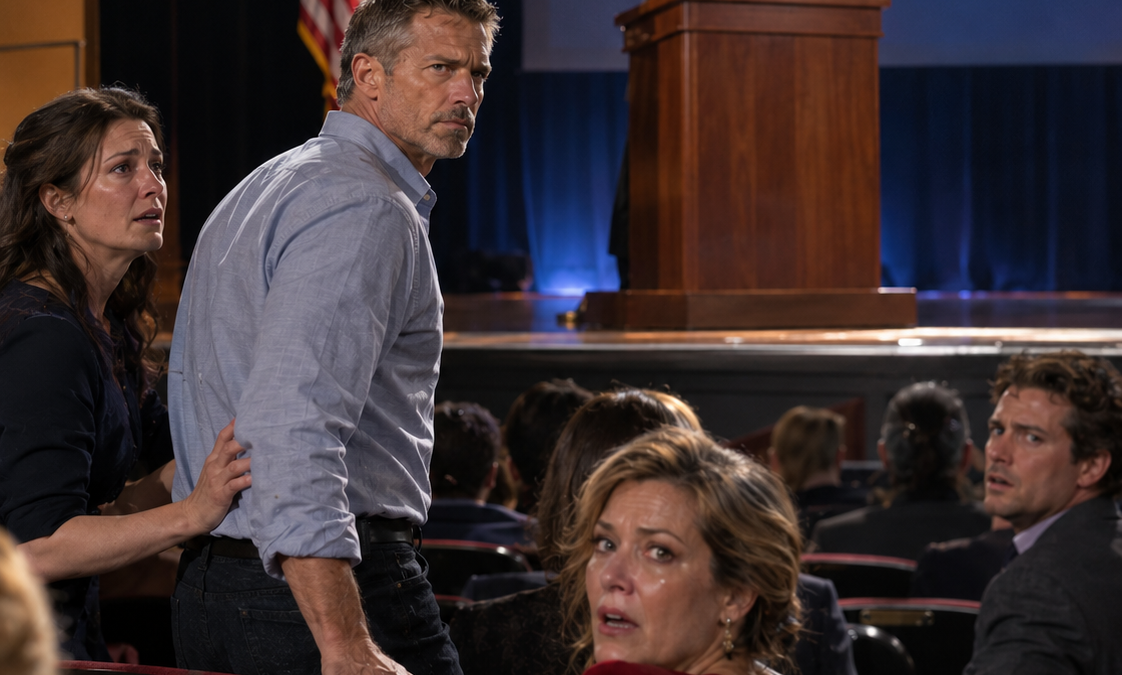
“My mother told four hundred strangers I was a coward. She said it loud enough for the next table to hear. Loud enough for the whole dining room to hear.”
She thought she was exposing her son’s shame at a family dinner → she ended up sitting in the front row while a retired general called him a hero, and the only thing left to do was write a letter she could barely sign her name to.
She said it loud enough for the next table to hear. Loud enough for the whole dining room to hear. She said it with a smile, like it was a funny story, like it was something we could all laugh about together.
I was sitting two feet from her, eating my salmon.
My name is Daniel Cross. I am thirty-eight years old. I served twelve years in the United States Army, eleven of them in Special Forces. I was a Green Beret, 7th Special Forces Group, and I did things and went places I will never be allowed to talk about. I was medically retired at thirty-four after an injury I cannot fully explain. That is all I am permitted to say about the reason I left.
What my mother told the entire Royal Caribbean dining room was different.
She told them I quit.
She told them I ran.
She told them I came home early because I couldn’t handle it.
What she didn’t know was that the woman at the next table was listening. And that woman knew exactly who I was. She had a photograph of me in her cabin, folded into the pocket of her suitcase, because I was the last person to see her husband alive.
I didn’t know any of that yet.
The cruise was my mother’s idea. Her seventieth birthday. She wanted the whole family together, no excuses, no cancellations. Three generations on a ship in the Caribbean for seven days. My sister Bethany paid for most of it — her husband owns a chain of car dealerships in Ohio and money is not a thing they worry about. My mother likes to remind people about that.
My wife Sarah came with me. She is a high school biology teacher and the only person in my family who has ever looked at me like I was worth something. She held my hand under the table that first night and squeezed it when my mother started talking.
I stayed calm.
That is what I was trained to do.
I said nothing.
We boarded the ship in Fort Lauderdale on a Saturday afternoon. The Serenade of the Seas. White hull, blue water, Florida sun beating down like it had something to prove. The line to get on was long and slow and everyone was already annoyed.
My mother had already started drinking.
She had a prosecco in her hand by the time we got through security. She was wearing a gold necklace that Bethany bought her for Christmas and a caftan she ordered online for the trip. She was in a good mood. That should have been a warning.
The family came from all over. My mother and my father flew in from Arizona. Bethany and her husband Marcus and their two kids came from Columbus. My uncle Ray — my mother’s brother — drove down from Tampa with his third wife. There were eighteen of us total, all assigned to the same dinner table, two long tables pushed together in the main dining room.
I would have rather been anywhere else.
That is not a thing you are allowed to say about your own family. But it is the truth.
I grew up in a house where my father worked and my mother managed appearances. That was her job. She managed what people thought of us. She wanted the neighbors to think we were a certain kind of family — successful, comfortable, the kind of people who didn’t have problems. We had plenty of problems. She just made sure nobody knew.
My father drank. Not in a dramatic way. Not in a way that showed up in public. But every night at home, he had four or five glasses of whiskey and then he fell asleep in front of the television and my mother cleaned up around him like it was normal. I think it was normal, to her.
I was the oldest. Bethany came four years later. By then I had learned to stay out of the way, to not make noise, to not be a problem. I read books and I ran track and I kept my head down. That was my strategy. It worked.
I joined the Army at eighteen. I told my parents over dinner.
My mother put her fork down and looked at me like I had said I was going to join the circus.
“You’re going to what?” she said.
“Enlist,” I said. “I already talked to the recruiter.”
“The Army,” she said. “The actual Army.”
“Yes.”
She looked at my father. He was already on his second glass and he just shrugged.
“Let him do it,” he said. “It’ll straighten him out.”
That was the entire conversation.
I shipped out three weeks later.
Special Forces was not something I stumbled into. I chose it. I wanted the hardest thing I could find, the thing that would make me into someone different than the boy who sat quiet at the family dinner table and let his mother do all the talking.
The training was fourteen months at that time. I went through Basic and Airborne and then the Special Forces Assessment and Selection, which is the gate you have to pass just to be considered. I passed it.
Then came the Q Course. Small unit tactics. Language school. Surviving, evading, resisting, escaping. Weapons. Demolitions. Communications. Medical. The kind of training that kills people who are not paying attention.
I made it through.
I got my Green Beret.
The first time I put it on, I felt like I had finally done something that mattered. Like I had become a person worth being.
My mother sent me a card. It had a flag on the front. Inside it said “Proud of you! Love, Mom.”
That card was the most she ever acknowledged my service.
I served in Afghanistan. I served in Iraq. I served in places I cannot tell you the names of, doing things I cannot describe. I was part of an Operational Detachment Alpha — an A-Team — and my job was to work with local forces, train them, fight alongside them, and do whatever else needed to be done.
I was good at it. I am not bragging. I am just telling you the truth.
I was good at it because I had spent my whole childhood learning how to be quiet and watch and wait. That is the skill. That is the skill nobody teaches you in a classroom. You learn it in a house where saying the wrong thing at the wrong time causes problems.
The Army gave me a place to use it.
The Army gave me a place where being quiet and watchful and patient was not a defect. It was a weapon.
I was promoted to Sergeant First Class. I was given teams to lead. I led men in places where the wrong decision meant somebody’s son was not coming home.
Some of them didn’t come home.
I carry those names with me. I carry them every day. There is a weight that does not go away.
I met Sarah in 2015. She was a teacher at a school near Fort Bragg and a friend of mine from my unit knew her roommate. We met at a cookout and she asked me what I did and I told her I was in the Army.
“What kind?” she said.
“Special Forces,” I said.
She nodded. She didn’t ask what that meant. She didn’t ask if I had killed anyone. She didn’t ask anything stupid. She just nodded and said, “That must be hard.”
That was the first time anyone in my life had said that to me.
We got married two years later. My mother came to the wedding. She was polite. She was cordial. She asked Sarah about her job and Sarah told her she was a teacher and my mother said, “Oh, that’s nice.”
Sarah is not “nice.” Sarah is a biology teacher at a public high school and she spends her days teaching kids who don’t have much and she is one of the smartest people I have ever met. But to my mother, “teacher” is a job you do until you find a real career. That was the tone.
I noticed it.
I didn’t say anything.
I was injured in 2021.
I cannot tell you how. I cannot tell you where. I cannot tell you what the mission was or who I was with. I can tell you that I was hit by something that should have killed me and that I spent seven months in a hospital and that when I came out, I was not the same person I was when I went in.
I was medically retired. Honorable discharge. Full benefits. A retired ID card that says I served and that I am broken now.
That is the thing my mother does not understand.
She thinks I quit. She thinks I gave up. She thinks I came home early because I didn’t want to do the work anymore.
She has never asked me what happened.
Not once.
The cruise was in July.
We flew into Fort Lauderdale two days before. Sarah and I stayed in a hotel near the beach. It was the first time we had been away together in almost a year. We walked on the sand and ate at a Cuban restaurant and for a couple of days, I felt like a normal person living a normal life.
Then we got on the ship and my family showed up.
My mother arrived with four bottles of wine in her luggage. She hugged me and told me I looked thin. She hugged Sarah and told her she looked tired.
Bethany arrived with a full face of makeup and a designer bag and immediately started complaining about the flight, the hotel, the line for security, the price of parking.
Marcus, her husband, arrived behind her with their two kids, who are eight and eleven, and a look on his face like he was already calculating how many days until he could go back to work.
My father arrived last. He looked older than I remembered. He moved slower. He still had a drink in his hand by the time he got to the room.
The whole family was together. On a ship. In the middle of the ocean.
Nowhere to go.
That first dinner was on the second night.
Our table was in the back of the main dining room, near the windows. White tablecloths. Real silverware. A menu with four courses. The ship was moving gently and the water outside the windows was deep blue.
I was seated between Sarah and my uncle Ray. My mother was across from me. Bethany was next to her. The kids were at the end of the table, already bored.
The first hour was fine.
Small talk. Travel stories. Complaints about the weather. Marcus told a long story about a customer at one of his dealerships and everyone laughed except me and Sarah. My mother told a story about her neighbor’s dog and everyone laughed except me and Sarah.
Then my mother asked me a question.
“So, Daniel,” she said. “How is retirement treating you?”
The way she said “retirement.” Like it was a punchline.
“Fine,” I said.
“Fine,” she repeated. “Just fine. Not good. Not great. Fine.”
“I’m doing okay,” I said.
“Sarah, how is he really doing?” my mother said. “Is he getting out of the house? Is he doing anything?”
“He’s doing well,” Sarah said. “He stays busy.”
“Busy with what?” my mother said.
“Projects,” Sarah said.
She didn’t elaborate. She knew better. My mother was not asking because she cared. She was asking because she wanted material.
I could see it building. I had seen it before. At Thanksgiving. At Christmas. At every family gathering where she needed to make herself feel better by making someone else feel smaller.
I kept eating.
“Did I tell you about the Hendersons?” my mother said to the table.
Nobody asked who the Hendersons were. She was going to tell us anyway.
“Their son is in the Navy,” she said. “He’s a pilot. He just got promoted. He’s stationed in Hawaii. They put it in the church newsletter.”
“That’s nice,” Bethany said.
“It is nice,” my mother said. “It’s wonderful. It’s the kind of thing you can be proud of.”
She took a sip of wine.
She looked at me.
I kept eating.
“Daniel’s friend from the Army,” my mother said. “The one he used to work with. What happened to him?”
“He’s still active,” I said.
“Still active,” she repeated. “Still serving. Still doing his job.”
“Yes,” I said.
“And you’re not,” she said.
“No,” I said. “I’m not.”
“Why?”
That was the question.
I looked at her. She was smiling. It was a small smile, the kind that says “I already know the answer and I want everyone else to hear it.”
I could have said something. I could have said “I was injured on a mission that is classified and I almost died and I can’t tell you more than that.” I could have said “It’s not something I discuss at dinner.”
I said nothing.
I was trained to do nothing.
“Did you know,” my mother said, turning to face the rest of the table, “that Daniel came home early? From his deployment. Before it was over.”
“He was medically retired,” Sarah said.
“He came home,” my mother said. “That’s the point. He came home before his time was up. The Army didn’t send him home. He came home.”
She said the last three words slowly. “He came home.” Like it meant something shameful.
“He was injured,” Sarah said.
“Injured how?” my mother said. “He doesn’t talk about it. We don’t know. We just know he came home.”
“You should ask him,” Sarah said. Her voice was calm but I could hear the edge in it.
“I have asked him,” my mother said. “He doesn’t answer.”
“Maybe he can’t,” Sarah said.
My mother turned back to the table. She had the wine glass in her hand and she was smiling that smile again.
“So that’s the story,” she said. “He was gone, and then he was back, and none of us know why. But I have my suspicions.”
“Mom,” Bethany said. It was not a warning. It was an encouragement.
“I’m just saying,” my mother said. “I’m just saying what everyone is thinking.”
She looked at me.
“Other families have sons who serve,” she said. “They serve their full time. They don’t come home early. They don’t quit.”
I set my fork down.
I didn’t say anything.
My mother turned to the table and laughed.
“I’m just kidding,” she said. “I’m just giving him a hard time. You know how he is.”
Everyone laughed. Not all of them. My uncle Ray didn’t. Sarah didn’t. But most of the table did.
My father laughed.
Bethany laughed.
Marcus laughed.
Even the kids laughed, because everyone else was laughing and they didn’t know why.
I didn’t laugh.
I picked up my fork and I kept eating.
What my mother didn’t know — what nobody at that table knew — was that the family at the next table had heard everything.
It was a woman and her teenage son. They were sitting by themselves, facing our table. The woman was in her fifties. She had short gray hair and reading glasses hanging from a chain around her neck. She was eating slowly. She wasn’t talking. Her son was on his phone.
When my mother said “quit,” the woman looked up.
She looked at me.
She looked at me for a long time.
I noticed her noticing. I didn’t know why.
I thought maybe she just felt bad for me. Some stranger who heard a mean joke and felt awkward about it.
I was wrong.
I didn’t find out until the next day.
The next morning I was sitting on the deck, reading. Sarah was at the gym. The sun was out and the water was calm and for a few minutes I felt like I was on vacation.
A woman sat down in the chair next to me.
“Mr. Cross,” she said.
I looked up.
It was the woman from the dining room. The one who had been watching.
“Hi,” I said.
“My name is Vivian Harper,” she said. “My son is Tyler. We’re on the cruise.”
“Okay,” I said.
“I heard what your mother said last night,” she said.
I didn’t say anything.
“I want to talk to you about it,” she said. “But not about that.”
She reached into her bag.
She pulled out a photograph.
She handed it to me.
I looked at it.
It was a picture of a soldier in uniform. Young. Maybe twenty-five. Smiling. Standing in front of a wall I recognized. I had stood in front of that wall.
“His name was Michael Harper,” she said. “My husband.”
I looked at her.
“I think you knew him,” she said.
I did.
I knew him.
I had carried him out of a place I cannot name on a day I have tried to forget.
PART 2 — THE PHOTOGRAPH
I didn’t answer her right away.
I couldn’t.
The photograph was in my hand and I was looking at Michael Harper’s face and I was back there. Not in the dining room. Not on the deck. In the place I don’t talk about, with the sounds I don’t talk about, carrying a man who weighed maybe one hundred and eighty pounds with all his gear and who was bleeding out through a wound in his side.
I carried him for two hundred yards. It took sixteen minutes. I know because I counted. Counting was the only thing that kept me on my feet.
He talked the whole way. He talked about his wife and his son. He told me their names. He told me about his wedding and the first time he held his son and the fishing trip they had planned for the summer.
He told me he was going to make it.
He didn’t.
Vivian was watching me.
“You don’t have to say anything,” she said. “I know what you did for him.”
“I don’t know what you know,” I said.
“I know you carried him,” she said. “I know you got him out of there. I know he lived long enough to say goodbye to me on the radio.”
That last part.
I had not known that.
I had handed Michael off to the medics and then I had gone back into the fight and I had not known what happened after. I had assumed he died before they could reach the base. I had assumed he never got to talk to anyone.
“You talked to him?” I said.
“I talked to him,” she said. “Fourteen minutes. He told me he loved me. He told me to tell Tyler he loved him. He told me the man who carried him was named Cross and that I should find him someday and thank him.”
She paused.
“I have been looking for you for eight years,” she said.
I didn’t cry.
I wanted to. But I didn’t.
I sat there on the deck of that ship with a photograph in my hand and a woman I had never met telling me about a conversation I had made possible and I didn’t cry. I just held the picture and looked at Michael’s face and said the only thing I could think of.
“I’m sorry,” I said.
She looked at me.
“Why are you sorry?” she said.
“I didn’t get him there fast enough,” I said.
“Daniel,” she said. “He lived because of you. He died because of the wound. You didn’t cause it. You carried him out. You gave me those fourteen minutes. You gave my son a father who told him he loved him before he died.”
I didn’t say anything.
“I’ve been trying to find you,” she said again. “I checked the records. I asked around. Nobody would tell me anything. Then I saw you on this ship and I heard your mother say your name and I knew.”
“You knew what?”
“I knew it was you,” she said. “Michael told me about you. He told me you were from North Carolina and that you were the best medic on the team and that you never talked about yourself. He told me you were the kind of man who would carry somebody up a hill under fire and then never mention it again.”
She paused.
“He was right,” she said.
I sat with Vivian for an hour.
She told me about Michael. She told me about the years after he died — raising Tyler alone, going back to work, learning how to be a single mother. Tyler was seventeen now. He was a good kid. He played soccer and he was thinking about enlisting after high school.
I told her what I could.
I told her Michael was brave. I told her he was good at his job. I told her he was the first person to make me laugh in a bad place and that I would never forget the joke he told me a week before he died.
I didn’t tell her the details of the day. I couldn’t. Those details are classified and they will always be classified. But I told her the things I could tell her.
She told me she had never heard them before.
“He was my husband,” she said. “And nobody ever told me anything.”
“That’s how it works,” I said.
“I know,” she said. “That doesn’t mean it isn’t hard.”
We finished talking and she gave me her number and said she was on the ship for another five days and that she wanted me to meet Tyler.
“He doesn’t know about you,” she said. “Not really. He knows what I’ve told him. He knows somebody carried his father out. He doesn’t know who.”
“He doesn’t need to know,” I said.
“He deserves to know,” she said. “You don’t have to be a hero. You just have to be a person. He’s never met anybody who served with his father.”
I told her I would think about it.
She nodded and got up and walked away.
I sat on the deck for a long time.
What I didn’t know then was that my mother had been watching.
She had seen me sitting with Vivian. She had seen the photograph. She had seen the way I was looking at it.
At lunch that afternoon, she asked me about it.
“Who was that woman?” she said.
“A passenger,” I said.
“You looked very friendly,” she said.
“She’s just someone I met,” I said.
“What were you talking about?”
“Things,” I said.
“What things?”
“Her husband,” I said. “He served.”
My mother nodded.
“Served in what?” she said.
“The Army,” I said.
“The Army,” my mother repeated. She had that smile again. “Like you.”
“Like me,” I said.
“What did he do?”
I looked at her.
“He died,” I said.
The smile went away.
“Thank you for your service,” she said.
She said it the way you say it to a stranger at an airport. Like a line from a script. Like something you have to say because someone will notice if you don’t.
“Thank you,” I said.
And that was the end of the conversation.
I sat with Sarah that afternoon and told her what had happened.
I told her about Michael. I told her about the day. I told her about Vivian and the photograph and the conversation on the deck.
She listened. She didn’t interrupt. When I was finished, she reached over and took my hand.
“You should talk to her son,” she said.
“I don’t know if I can,” I said.
“Why not?”
“Because I don’t know what to say,” I said. “What do you say to somebody who lost their father? What do you say to somebody who knows you were there and you came home and their father didn’t?”
“You tell them the truth,” she said. “You tell them what you told me. You tell them their father was brave and that he loved them and that you did what you could.”
“It won’t be enough,” I said.
“It doesn’t have to be enough,” she said. “It just has to be true.”
I didn’t sleep well that night.
I lay in the bed in that small cabin and I listened to the ship moving and I thought about Michael Harper and all the other men I had served with who did not come home. I thought about the ones whose names I carry. I thought about the ones whose families never knew what happened.
I thought about my mother.
I thought about the way she had said “he came home.” Like coming home was a thing to be ashamed of. Like surviving was a weakness. Like the fact that I had been hurt and had not been able to keep going was a moral failing.
I thought about the way she had said “other families have sons who serve” like I was not one of those sons. Like I was something else. Something lesser.
I thought about Michael Harper and the fourteen minutes he had with his wife before he died.
I thought about Tyler, who was seventeen and had lost his father when he was nine and had never met anybody who was there.
I thought about the fact that I was on a ship with my mother, who had told four hundred strangers I was a coward, and a woman I had never met, who had been looking for me for eight years to tell me I had done something good.
I didn’t know what to do with any of it.
So I lay there and I listened to the ship and eventually I fell asleep.
The next day was a port day.
We docked in Nassau. Everybody got off the ship. My mother wanted to go shopping. Bethany wanted to go to the beach. My father wanted to find a bar.
I told them I wasn’t feeling well.
I stayed on the ship.
I sat on the deck with a book and I read and I didn’t see anybody from my family for six hours. It was the best day of the trip so far.
In the afternoon, I saw Tyler.
He was sitting by the pool with his phone. He was wearing a t-shirt with a soccer logo and he looked bored. He looked like every seventeen-year-old I had ever seen.
I walked over.
“Hey,” I said.
He looked up.
“You’re the guy my mom was talking to,” he said.
“Yeah,” I said.
“She said you served with my dad.”
“I did,” I said.
He looked at me for a second.
“Sit down,” he said.
I sat down.
We talked for two hours.
He asked me questions. I answered the ones I could. He wanted to know what his father was like. I told him he was funny. I told him he was good at his job. I told him he talked about his wife and his son all the time and that everyone on the team knew he was the one with the happy marriage.
“He talked about us?” he said.
“All the time,” I said. “He was proud of you. He told me you were playing soccer. He told me you were good at it.”
“He did?”
“He did.”
Tyler didn’t say anything for a minute.
Then he said, “My mom told me you carried him.”
“I did.”
“She said you carried him for a long way and that you got shot at the whole time.”
“She said that?”
“She did.”
I didn’t say anything.
“I just want to say thank you,” Tyler said. “For what you did.”
“You don’t have to thank me,” I said.
“I know I don’t have to,” he said. “I want to.”
I told him about the fourteen minutes.
I told him his father got on the radio and talked to his mother. I told him his father told her to tell Tyler he loved him. I told him his father’s last words were about him.
Tyler started crying.
I didn’t know what to do. I have been in firefights. I have been shot at. I have held dying men in my arms. I have never known what to do when someone cries.
I put my hand on his shoulder.
“That’s all I know,” I said. “That’s all I can tell you.”
He nodded.
“Thank you,” he said again.
“You don’t have to thank me,” I said again.
He looked at me.
“My dad would have wanted me to,” he said.
That night at dinner, my mother was in a mood.
She had been shopping. She had bought a new bracelet and a hat and she was showing them off. She was talking about the people she had met on shore and the restaurant she had eaten at and the wine she had ordered.
I was quiet. I was thinking about Tyler.
“You’re quiet tonight,” my mother said.
“Tired,” I said.
“Tired from what?” she said. “You didn’t do anything today. You stayed on the ship.”
“I was reading,” I said.
“Reading,” she repeated. “That’s what you do now, I guess.”
She said it like “reading” was a diagnosis.
“I saw you talking to that woman again,” she said. “The one from the other night.”
“She’s a friend,” I said.
“A friend,” my mother said. “You just met her. That’s not a friend. That’s a stranger.”
“She’s not a stranger,” I said.
“She was a stranger two days ago,” my mother said.
I didn’t say anything.
“What’s her name?” my mother said.
“Vivian,” I said.
“Vivian what?”
“Harper,” I said.
My mother laughed.
“Harper,” she said. “That’s a nice name. Very nice. Very normal. So what does Vivian Harper want with you?”
“She wanted to talk,” I said.
“About what?”
“About her husband,” I said. “He served.”
“You said that,” my mother said. “You said he served and he died. So what does that have to do with you?”
I looked at her.
“He served with me,” I said.
The table got quiet.
“Wait,” Bethany said. “She was on the ship? The widow of somebody you served with?”
“Yes,” I said.
“And she just happened to be on this cruise?” Bethany said.
“Yes.”
“And she just happened to find you?” Bethany said.
“She wasn’t looking for me,” I said. “She recognized me from the dining room.”
“The dining room,” Bethany repeated.
“Yes.”
“When Mom was talking,” Bethany said.
“Yes.”
Bethany looked at my mother. My mother looked at me.
“So she heard what I said,” my mother said.
“She did,” I said.
“And she came up to you,” my mother said.
“She did.”
“And she told you about her husband.”
“She told me about her husband.”
“The one who died.”
“The one who died,” I said.
My mother was quiet for a moment.
“Well,” she said. “I’m sure she was very moved.”
She took a sip of wine.
“People love a sad story,” she said.
I put my fork down.
“Mom,” I said.
“What?”
“That’s not what this is,” I said.
“Then what is it?” she said.
“It’s not a sad story,” I said. “It’s the truth. It happened. Her husband died. I was there.”
“So you were there,” my mother said. “And he died. And you came home.”
The way she said “you came home.” Like it was still a crime.
I looked at her.
I looked at my father. He was drinking and not looking at me.
I looked at Bethany. She was looking at her plate.
I looked at Marcus. He was looking at his phone.
I looked at Sarah. She was looking at me. Her eyes said: you don’t have to do this.
I looked back at my mother.
“You’re right,” I said.
“I’m right?” she said.
“You’re right,” I said. “I came home. He didn’t. That’s the truth.”
I picked up my fork.
I went back to eating.
My mother didn’t say anything else for the rest of dinner.
She tried. She started a few sentences. She talked about the shopping and the bracelet and the hat. But the energy had gone out of her. She was performing to an audience that had stopped watching.
When dinner was over, she got up and left.
Bethany followed her.
Marcus followed Bethany.
My father stayed at the table and ordered another drink.
Sarah reached under the table and squeezed my hand.
“You okay?” she said.
“I’m okay,” I said.
“You don’t have to be okay,” she said.
“I know,” I said. “I’m okay.”
I wasn’t okay.
But I was calm.
I was trained to be calm.
PART 3 — WHAT SHE DIDN’T KNOW
The next morning I was up early.
I walked the deck before sunrise. The ship was quiet. The sky was gray and the water was gray and everything was still. This is the best time of day. No people. No noise. No questions.
I thought about Michael Harper.
I thought about Tyler.
I thought about my mother.
I thought about the fact that she had said “people love a sad story” like the truth was a performance. Like Vivian’s grief was an act. Like the fourteen minutes Michael had with his wife before he died was something that could be reduced to entertainment.
I thought about all the things my mother didn’t know.
She didn’t know that I had been awarded the Silver Star.
She didn’t know that I had been awarded the Bronze Star with Valor.
She didn’t know that I had been awarded the Purple Heart.
She didn’t know that the injury that ended my career was a shrapnel wound that had severed a nerve in my leg and that I walked with a slight limp I had never mentioned because mentioning it would invite questions.
She didn’t know that I had spent seven months in a hospital in Germany and then a rehab facility in Texas.
She didn’t know that I had learned to walk again.
She didn’t know that I had held four men in my arms while they died.
She didn’t know that I had written letters to their families.
She didn’t know that I had gone to three funerals.
She didn’t know that I had spent the first two years after my retirement sitting in a room in my house staring at the wall because I could not stop thinking about the people I had not been able to save.
She didn’t know that Sarah had saved me.
She didn’t know that Sarah had found me a therapist and gone with me to every appointment and sat in the waiting room while I talked about things I couldn’t talk about.
She didn’t know any of it.
Because she had never asked.
I got back to the cabin at seven. Sarah was awake.
“You were up early,” she said.
“Couldn’t sleep,” I said.
“Thinking about the dinner?”
“Thinking about everything,” I said.
She sat up in bed.
“What do you want to do?” she said.
“About what?”
“About your mother,” she said. “About the way she talks to you. About the way she talks about you.”
I sat down on the edge of the bed.
“I don’t know,” I said.
“I’m serious,” she said. “She called you a coward in front of four hundred people. She’s been doing this for years. It’s not okay.”
“It’s not okay,” I said. “But it’s not new.”
“That doesn’t make it better,” she said.
“I know,” I said.
“So what are you going to do?”
I thought about it.
“Nothing,” I said.
She looked at me.
“That’s your answer?”
“That’s my answer,” I said. “I’m not going to fight her. I’m not going to argue. I’m not going to tell her about the Silver Star and the Bronze Star and the Purple Heart. I’m not going to make her understand.”
“Why not?” she said.
“Because she won’t,” I said. “She doesn’t want to understand. She wants to be right. She wants to be the person in the room who knows better. If I tell her the truth, she’ll find a way to make it about her.”
“You don’t know that,” Sarah said.
“I do know that,” I said. “I’ve known her my whole life.”
Sarah didn’t argue. She knew I was right.
But she also knew something else.
“You’re not doing nothing,” she said.
“What do you mean?”
“You’re going to talk to Vivian again,” she said. “And Tyler. You’re going to do whatever you can for them. That’s what you do.”
I looked at her.
“That’s not nothing,” she said. “That’s something.”
Later that morning I saw Vivian at the pool.
She was sitting in a lounge chair with a book. Tyler was in the pool. She saw me and waved.
I walked over.
“How are you doing?” she said.
“I’m okay,” I said.
“Did you talk to Tyler?”
“I did.”
“How was it?”
“It was good,” I said. “It was hard. But it was good.”
She nodded.
“He came back to the room and told me you were the guy,” she said. “He said you were exactly what he expected.”
“What did he expect?”
“Somebody who didn’t want to talk about themselves,” she said. “Somebody who listened more than he talked. Somebody who was quiet.”
“Quiet is my specialty,” I said.
“Michael was the same way,” she said. “He never wanted to talk about himself either. It took me a year of marriage to get him to tell me the details of his job.”
“He told you eventually?”
“He told me some of it,” she said. “Not all of it. Never all of it.”
“Nobody tells all of it,” I said.
“I know,” she said.
I sat with Vivian for a while.
We talked about Michael. We talked about Tyler. We talked about the years after he died. She told me about the day the notification officers came to her door. She told me about the funeral. She told me about the letter she got from the Army and the flag they gave her.
She told me something else.
“I heard what your mother said the other night,” she said.
I didn’t say anything.
“I heard all of it,” she said. “The part about you running. The part about you quitting. The part about you coming home early.”
I looked at the water.
“I’m sorry,” she said.
“You don’t have to apologize,” I said. “You didn’t say it.”
“I know I didn’t say it,” she said. “But I’m sorry that she did.”
I didn’t say anything.
“I want to tell you something,” she said. “Something Michael told me.”
“What?”
“He said you were the bravest person he had ever met,” she said. “He said you had a way of staying calm when everything was falling apart. He said you never raised your voice and you never panicked and you never left anybody behind.”
I looked at her.
“He said that?”
“He said that,” she said. “I kept it in my journal. I wrote it down the night after he told me.”
She paused.
“I’ve been reading it a lot these past few days,” she said.
I didn’t know what to say.
I had spent the last several years thinking of myself as a person who was broken. I had spent the last several years thinking that the things I had done were in the past and that they didn’t matter anymore. I had spent the last several years living a quiet life with Sarah and trying not to think about the day I got hurt.
Vivian was telling me that Michael had seen something in me that I had forgotten.
“He talked about you like you were a big brother,” she said. “He said you looked out for the team. He said you were the one who made sure everybody got home.”
“I didn’t get everybody home,” I said.
“You got him home,” she said. “For fourteen minutes. That’s more than anybody else could do.”
I sat there.
I didn’t cry.
But I wanted to.
That afternoon I went to the gym.
I do this when I need to think. I lift weights. I run on the treadmill. I do the same exercises I have been doing since I was eighteen. The routine helps.
I was in the middle of a set when Bethany walked in.
She was wearing workout clothes that looked like they had never been worn. She saw me and walked over.
“Hey,” she said.
“Hey,” I said.
She stood there awkwardly.
“Can I talk to you?” she said.
“I’m kind of in the middle of something,” I said.
“It’ll just take a minute,” she said.
I set the weights down.
“Okay,” I said.
“I wanted to apologize,” Bethany said.
“For what?”
“For the other night,” she said. “At dinner. When Mom was talking about you. I should have said something.”
“You didn’t have to,” I said.
“I know I didn’t have to,” she said. “But I should have. You’re my brother.”
I looked at her.
“What do you want me to say?” I said.
“I don’t want you to say anything,” she said. “I just wanted to apologize.”
“Okay,” I said. “Apology accepted.”
She stood there.
“Can I ask you something?” she said.
“Sure,” I said.
“Is it true?” she said. “What Mom said? Did you come home early?”
I looked at her.
“That’s what she said,” I said.
“I know that’s what she said,” Bethany said. “I’m asking if it’s true.”
I picked up the weights.
“You should ask Mom,” I said.
“She’s not going to tell me anything,” Bethany said. “She never tells me anything. She just tells me what she wants me to believe.”
“Then you have your answer,” I said.
I started my next set.
Bethany watched me for a minute.
Then she left.
I finished my workout and went back to the cabin.
Sarah was reading on the balcony. She looked up when I came in.
“Bethany came to see me,” I said.
“What did she want?”
“She wanted to apologize.”
“For what?”
“For the dinner,” I said. “For not saying anything.”
“Did you believe her?”
I thought about it.
“I don’t know,” I said. “Maybe she meant it. Maybe she didn’t. It doesn’t really matter.”
“Why not?”
“Because she’s not the problem,” I said. “Mom is the problem. Bethany just follows along.”
“That’s not an excuse,” Sarah said.
“No,” I said. “It’s not. But it’s the truth.”
That night was the captain’s dinner.
Everybody on the ship got dressed up. There was a formal dinner in the main dining room and a reception in the lounge beforehand. My mother had been talking about it for days.
She wanted everyone to look good.
She wanted everyone to make the right impression.
She wanted everyone to be the kind of family she could be proud of.
I put on a suit. Sarah put on a dress. We walked to the lounge together.
The lounge was full. There were people everywhere. The captain was there — a tall man in a white uniform with gold stripes on his sleeves. He was shaking hands and posing for photos.
My mother found us immediately.
“There you are,” she said. “I’ve been looking for you.”
“Here we are,” I said.
“Don’t slouch,” she said. “Stand up straight. People are watching.”
I stood up straight.
She looked at Sarah.
“You look nice,” she said.
“Thank you,” Sarah said.
My mother turned and walked away.
Sarah looked at me.
“People are watching,” she said quietly.
“Always,” I said.
The dinner was long.
Six courses. Speeches. A toast from the captain. My mother drank and talked and performed and I sat there and ate and said as little as possible.
At one point, my mother leaned over to me.
“I heard your friend is still on the ship,” she said.
“Vivian?” I said.
“Yes,” she said. “Vivian. The widow.”
“She’s here,” I said.
“Is she coming to the ceremony?”
“What ceremony?”
“The one tomorrow,” my mother said. “In the theater. The veterans’ tribute. They’re doing it for all the veterans on the ship.”
I didn’t know about it.
“I didn’t know about it,” I said.
“It’s in the daily schedule,” my mother said. “You should go.”
“Why?”
“Because you’re a veteran,” she said. “And people should see you there.”
She smiled.
“It would look good,” she said.
I looked at her.
“You want me to go to a veterans’ tribute so it looks good,” I said.
“I want you to go because you should,” she said. “You served. You should be recognized.”
“You didn’t want me recognized two nights ago,” I said.
My mother’s smile faltered.
“What does that mean?” she said.
“Nothing,” I said.
“It doesn’t mean nothing,” she said.
“It means nothing,” I said.
I picked up my fork.
I went back to eating.
After dinner, Sarah and I walked on the deck.
“What was that about?” she said.
“She wants me to go to the veterans’ tribute,” I said.
“Are you going to go?”
“I don’t know.”
“Why not?”
“Because it’s not about me,” I said. “It’s about her. She wants me to stand up so she can point at me and say, ‘That’s my son, the veteran.’ She wants the credit without the cost.”
Sarah was quiet.
“You should go,” she said.
“Why?”
“Because you earned it,” she said. “Not for her. For you. You served. You did things. You deserve to be recognized.”
“I don’t need to be recognized,” I said.
“I know you don’t,” she said. “But you deserve it anyway.”
I looked at the water.
“I’ll think about it,” I said.
I didn’t sleep that night either.
I lay in bed and I thought about the tribute. I thought about standing up in front of a crowd of strangers and being acknowledged for my service. I thought about my mother watching from the audience. I thought about what she would say afterwards.
She would say something about how she had raised a hero. She would say something about how proud she was. She would make it about her.
That was always the pattern.
I did something. She took the credit. If I failed, it was my fault. If I succeeded, it was because of her.
I had spent my whole life living with that pattern.
I was tired of it.
 [Tap here for the Next Part ]


