Part 2: “Other families have sons who serve. They don’t come home early. They don’t quit.”
PART 4 — THE TRIBUTE
The veterans’ tribute was at two in the afternoon.
I didn’t decide to go until the last minute. Sarah and I were sitting in the cabin and she looked at me and said, “You’re going.”
“How do you know?” I said.
“Because I know you,” she said. “And you’re not going to let her win.”
I put on a button-down shirt and a pair of slacks. I didn’t wear a uniform. I hadn’t worn a uniform since the day I was medically retired.
Sarah walked with me to the theater.
“You don’t have to stay,” I said.
“I’m staying,” she said.
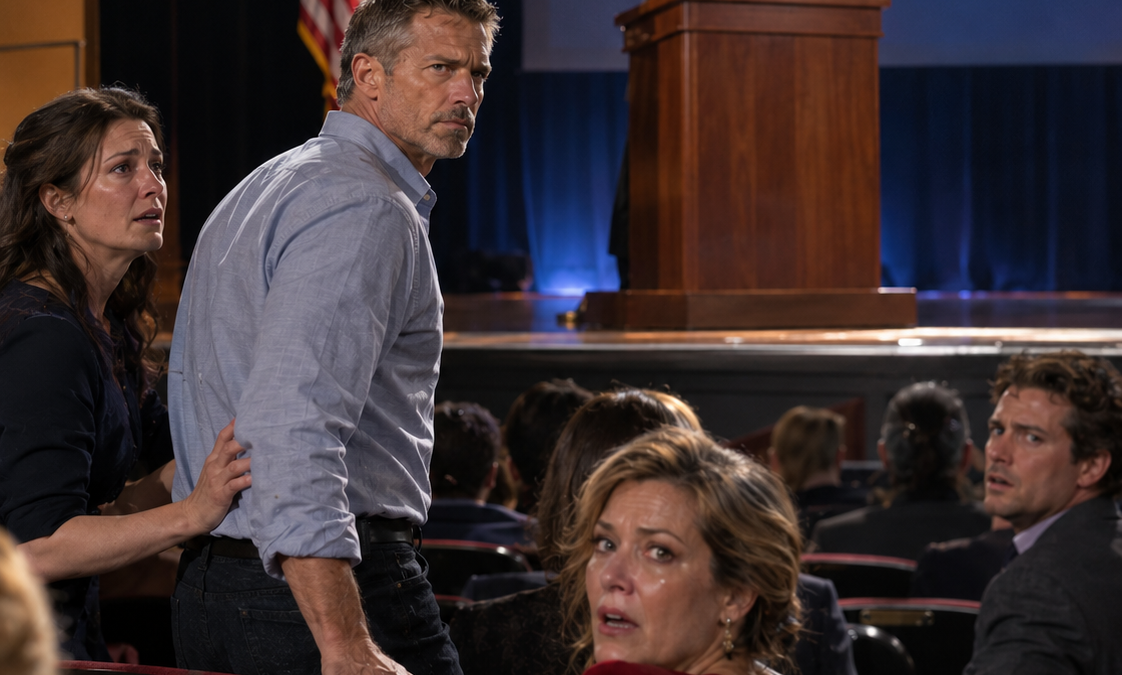
The theater was almost full.
There were maybe three hundred people in the seats. The stage had a podium and a row of chairs and a big screen behind it with a logo on it. The logo said “Honoring Our Veterans.”
I found a seat in the back.
Sarah sat next to me.
My mother was in the front row. She had saved seats for Bethany and Marcus and their kids. She was wearing a red dress and she was talking to the woman next to her like they had known each other for years.
She didn’t see me.
The tribute started at two.
The cruise director came out and gave a speech about how important it was to honor veterans and how much we owed them and how the ship was proud to have so many veterans on board.
Then he introduced the captain.
The captain came out and gave a speech about service and sacrifice and duty. He talked about his own family members who had served. He talked about the importance of remembering.
Then he introduced the guest speaker.
A retired Army general.
I recognized the name before I saw the face. General Mark Caldwell. Retired four-star. Former commander of Special Operations Command.
I had met him once. Years ago. At a briefing I was not supposed to talk about.
He walked out onto the stage.
He was in his late sixties. Gray hair. Tall. He moved like a man who had spent his whole life in uniform.
He stood at the podium.
“Good afternoon,” he said.
The crowd clapped.
He gave a speech about service.
He talked about what it meant to serve. He talked about the men and women who had given their lives. He talked about the families who had lost them. He talked about the debt we owed and the debt we could never repay.
Then he did something unexpected.
“I want to recognize some people in this room,” he said.
He looked at a list on the podium.
“We have a lot of veterans here today,” he said. “I want to ask all of you to stand when I call your branch.”
He called the Army. He called the Navy. He called the Marines. He called the Air Force. He called the Coast Guard.
People stood. People clapped.
I stood for the Army.
My mother turned around and saw me. She smiled and waved.
I sat back down.
Then General Caldwell did something else.
“Before I finish,” he said, “I want to tell you a story.”
He paused.
“A few years ago, I was in a briefing in a place I can’t name,” he said. “And I was briefed on an operation that had gone wrong. An operational detachment had been ambushed. They were outnumbered. They were taking heavy fire. One man was wounded so badly he couldn’t walk.”
The room got very quiet.
“I want to tell you about the man who carried him out,” General Caldwell said.
I felt my chest tighten.
I looked at Sarah.
She looked at me.
“We don’t have to stay,” she whispered.
I didn’t move.
“The man who carried that soldier was a Special Forces medic,” General Caldwell said. “He carried a man who weighed almost two hundred pounds with all his gear, under fire, for two hundred yards up a hill. He took fire the entire way. He was wounded himself during the carry. He didn’t stop. He didn’t leave the man behind. He got him to the evacuation point and handed him off to the medics.”
He paused.
“Then he went back into the fight,” he said. “He rejoined his team and he kept fighting for another six hours. He did not mention the carry to anyone. He did not ask for recognition. He did not ask for a medal.”
The room was silent.
“He was awarded the Silver Star for that action,” General Caldwell said. “He was also awarded the Bronze Star with Valor for a separate action. He was awarded the Purple Heart for wounds received in combat. He was medically retired two years later after an injury that ended his career.”
He looked out at the audience.
“His name is Daniel Cross,” he said. “And he is in this room.”
I didn’t move.
I didn’t stand.
I sat there and I stared at the stage and I felt three hundred people turn around and look at me.
My mother turned around and looked at me.
Her face was white.
General Caldwell stepped out from behind the podium.
“Sergeant First Class Cross,” he said. “Would you stand up, please?”
I stood up.
The room clapped.
I didn’t hear it.
I was looking at my mother.
She was looking at me like she had never seen me before.
General Caldwell asked me to come to the stage.
I walked down the aisle. Three hundred people were watching. Sarah was watching. My mother was watching. Bethany was watching. My father was watching.
I got to the stage and General Caldwell shook my hand.
“Thank you for your service,” he said.
“Thank you, sir,” I said.
“I’ve wanted to meet you for a long time,” he said. “I was briefed on your actions. I read the citation. I don’t know many men who would do what you did.”
“I was just doing my job, sir,” I said.
“That’s what the good ones always say,” he said.
He turned to the audience.
“This man,” he said, “is a hero. Not because of what he did. Because of who he is. Because he came home and he didn’t talk about it. Because he carried a man out of the fire and then went back in. Because he served his country for twelve years and asked for nothing.”
He paused.
“I want this room to know who he is,” he said. “I want this room to know what he did. Not because he needs the recognition. He doesn’t. He’s been living without it for years. But because you should know.”
He looked at me.
“Men like this don’t come around often,” he said. “I’m honored to have met him.”
I didn’t know what to say.
I stood on that stage in front of three hundred strangers and a retired four-star general and I thought about all the things I had never told anyone. I thought about Michael. I thought about the day I got hurt. I thought about the years I had spent in silence.
I thought about my mother.
She was still sitting in the front row.
She was looking at me with an expression I had never seen on her face before.
It looked like shame.
I didn’t give a speech.
I just said thank you. I shook the general’s hand. I walked back to my seat.
Sarah was crying.
I sat down next to her.
“You didn’t tell me,” she whispered.
“About what?”
“About the Silver Star,” she said. “About any of it.”
“You knew I served,” I said.
“I knew you served,” she said. “I didn’t know you were a hero.”
“I’m not a hero,” I said.
“You are,” she said.
I looked at her.
“Okay,” I said.
After the tribute, people came up to me.
They shook my hand. They thanked me for my service. They asked for photos. I stood there and smiled and said thank you and didn’t say anything else.
My mother stood off to the side.
She didn’t come up to me.
She didn’t say anything.
She just stood there with her hands folded and her face pale and her eyes on me like she was seeing me for the first time.
I looked at her.
She looked away.
That night at dinner, nobody talked.
The whole table was quiet. My mother ate and didn’t look at me. Bethany looked at me every few minutes like she wanted to say something but didn’t. My father drank and said nothing. Marcus looked at his phone.
Sarah held my hand under the table.
The silence went on for twenty minutes.
Then my mother broke it.
“I didn’t know,” she said.
She said it quietly. She said it to her plate.
“You didn’t know what?” I said.
“About the medal,” she said. “About the general. About all of it.”
“You never asked,” I said.
She looked up at me.
“I never asked,” she said.
She didn’t say anything else.
I didn’t either.
We finished dinner in silence.
When it was over, my mother got up and left.
Bethany followed her.
Marcus followed Bethany.
My father stayed and ordered another drink.
Sarah and I went back to the cabin.
“What are you thinking?” she said.
“I’m thinking about Michael,” I said.
“About Michael?”
“About the fact that he died and his wife spent eight years trying to find me and my mother spent thirty-eight years trying to make me feel small,” I said.
“What are you going to do?” she said.
“I don’t know,” I said. “I don’t know if there’s anything to do.”
PART 5 — WHAT SHE KNEW
The next morning I woke up to a knock on my cabin door.
I looked at the clock. It was 6:45.
I got up and opened the door.
My mother was standing in the hallway.
She was wearing a robe. Her hair was not done. She looked like she had not slept.
“Can I come in?” she said.
I stepped aside.
She walked in and sat down on the edge of the bed. Sarah was still in bed, awake, watching.
My mother looked at me.
“I need to ask you something,” she said.
“Okay,” I said.
“The general,” she said. “He said you were awarded a Silver Star.”
“He did,” I said.
“You didn’t tell me.”
“I didn’t tell anyone,” I said.
“Your wife didn’t know,” she said. “She said that. She said she didn’t know about the medal.”
“She didn’t,” I said.
“Why not?”
“Because I don’t talk about it,” I said.
“Why not?”
“Because I don’t have to,” I said.
My mother looked at the floor.
“I don’t understand you,” she said.
“I know,” I said.
“I’ve never understood you,” she said. “You were always quiet. You never told me anything. You never let me in.”
“I tried,” I said.
“Did you?”
“When I was eighteen,” I said. “I told you I was going to enlist. You said ‘let him do it, it’ll straighten him out.’ That was the whole conversation.”
“That’s not fair,” she said.
“It’s true,” I said.
She was quiet for a minute.
“I’m sorry,” she said.
“For what?” I said.
“For what I said at dinner,” she said. “The first night. I said things I shouldn’t have said.”
“You said them to four hundred people,” I said.
“I know,” she said.
“You said I ran away from my duty,” I said. “You said I quit. You said I was afraid.”
“I know,” she said.
“You didn’t know any of that,” I said. “You didn’t know why I came home. You didn’t know I was injured. You didn’t know I was in the hospital for seven months. You didn’t know I had to learn how to walk again.”
“I know,” she said.
“You didn’t know,” I said, “because you never asked.”
She didn’t say anything.
She sat there on the edge of the bed with her hands in her lap and she looked at me and I saw something I had never seen on her face before. I saw guilt. Real guilt. The kind that comes from knowing you did something wrong.
“I heard you,” she said.
“Heard what?”
“That night,” she said. “At dinner. I heard you say ‘he died.’ About the woman’s husband. I heard the way you said it. You weren’t being dramatic. You weren’t making a scene. You just said it. You said it like it was true.”
“It was true,” I said.
“I know,” she said. “I’ve been thinking about it since then. I’ve been thinking about how you said it. And then I heard the general say your name and I realized I had been wrong about you my whole life.”
She started crying.
I had never seen my mother cry.
Not once.
She sat there on the edge of my bed on a cruise ship in the Caribbean and she cried.
“I’m sorry,” she said. “I’m sorry I said those things. I’m sorry I didn’t ask. I’m sorry I didn’t know.”
I looked at Sarah.
Sarah looked at me.
I looked back at my mother.
“I accept your apology,” I said.
She looked up.
“You do?”
“I do,” I said. “But it doesn’t fix anything.”
She looked confused.
“What do you mean?”
“I mean,” I said, “that you can’t undo the last thirty-eight years by saying sorry on a cruise ship. You can’t undo the things you said at dinner. You can’t undo the way you treated me my whole life. You can’t undo the fact that you called me a coward in front of four hundred people.”
“I know,” she said.
“Do you?” I said.
She didn’t say anything.
“I accept your apology,” I said again. “But it’s going to take time. It’s going to take more than a conversation at six in the morning.”
She sat there.
“Can I ask you something else?” she said.
“Okay,” I said.
“Why didn’t you tell me?” she said. “About the medal. About the general. About all of it. Why didn’t you tell me?”
“Because you wouldn’t have believed me,” I said.
She looked at me.
“Would you?” I said.
She didn’t say anything.
“That’s why,” I said.
She got up and left.
She walked out of the cabin and closed the door behind her.
I sat down on the bed.
Sarah put her hand on my back.
“You okay?” she said.
“I don’t know,” I said.
“Do you want to talk about it?”
“Not yet,” I said.
She didn’t push.
She just sat there with me.
Later that day I saw Vivian at the pool.
She was with Tyler. They were playing cards at a table.
She saw me and waved me over.
“How are you doing?” she said.
“I’m okay,” I said.
“You don’t look okay,” she said.
“I had a conversation with my mother this morning,” I said.
She nodded.
“How did it go?”
“She apologized,” I said.
“Did you accept?”
“I did,” I said. “But I told her it doesn’t fix anything.”
Vivian looked at me.
“That’s the most honest thing I’ve ever heard,” she said.
We talked for a while.
She told me she and Tyler had been talking about Michael. She told me Tyler had been asking questions about what his father was like and that she had been telling him stories. She told me she had told him about me.
“What did you tell him?” I said.
“I told him what you did,” she said. “I told him you carried his father out. I told him you didn’t have to do that. I told him you chose to.”
“I didn’t choose,” I said. “I just did it.”
“That’s a choice,” she said.
I didn’t say anything.
“Michael would have wanted you to know that,” she said. “He would have wanted you to know that what you did mattered.”
I sat with them for a while.
We played cards. Tyler asked me questions about his father. I answered what I could.
At one point, Tyler asked me something I didn’t expect.
“Do you have kids?” he said.
“No,” I said. “Not yet.”
“Do you want kids?”
I looked at Sarah, who was sitting across the pool reading.
“Yeah,” I said. “I do.”
“Why don’t you have them?”
I didn’t know how to answer.
“Life got in the way,” I said.
“That’s a bad excuse,” Tyler said.
“It is,” I said. “But it’s the truth.”
That night was the last night of the cruise.
We would dock in Fort Lauderdale the next morning. Everybody would go home.
My mother didn’t come to dinner.
Bethany came. Marcus came. The kids came. My father came. But my mother stayed in her cabin.
Bethany asked me about it.
“What did you say to her?” she said.
“I didn’t say anything,” I said. “She came to my cabin this morning. She apologized.”
“She apologized?”
“She said she was sorry for what she said at dinner. She said she didn’t know about the medal. She said she was wrong about me.”
Bethany looked at me.
“She was wrong about you,” she said. “We all were.”
I looked at her.
“What do you mean?” I said.
“I mean we all believed what she told us,” she said. “We believed you quit. We believed you ran. We never asked. We never checked.”
“You didn’t know,” I said.
“That’s not an excuse,” she said.
I looked at Bethany.
She looked different to me. Older. Tired. Like she had been carrying something she didn’t want to carry.
“I’m sorry,” she said.
“For what?”
“For believing her,” she said. “For not asking you. For not knowing.”
“You were a kid,” I said. “You were raised in the same house I was. You learned the same lessons.”
“That doesn’t make it right,” she said.
“No,” I said. “It doesn’t.”
I didn’t sleep that night.
I sat on the balcony and watched the water and I thought about the last seven days.
I thought about the dinner. I thought about the tribute. I thought about my mother on the edge of my bed with tears on her face.
I thought about what she had said.
“I’ve been wrong about you my whole life.”
That was the thing. She had been wrong. Not just about me. About everything. She had spent her whole life believing that status and money and appearances were what mattered. She had spent her whole life trying to be something she wasn’t. She had spent her whole life trying to make her family into something it wasn’t.
And she had missed the one thing that was actually real.
PART 6 — THE LETTER
The cruise ended on a Sunday morning.
We docked in Fort Lauderdale at seven. Everybody was supposed to be off the ship by ten. Sarah and I packed our bags and went to the dining room for one last breakfast.
My mother was there.
She was sitting by herself at a table near the window. She had a cup of coffee in front of her and she wasn’t drinking it.
I walked over.
“Can I sit down?” I said.
She looked up.
“Please,” she said.
I sat down.
We sat there for a minute without talking.
“I want to tell you something,” she said.
“Okay,” I said.
“I’ve been thinking about what you said,” she said. “About how I can’t undo the last thirty-eight years with an apology.”
“I remember,” I said.
“You’re right,” she said. “I can’t. But I want to try.”
I looked at her.
“Try to do what?” I said.
“Try to be better,” she said. “Try to be the kind of mother you deserved.”
“You can’t be the mother I deserved,” I said. “You can only be the mother you are.”
She nodded.
“I know,” she said. “But I can be better than I was.”
She reached into her purse.
She pulled out an envelope.
“I wrote you a letter,” she said. “I want you to read it. Not now. Later. When you’re home.”
I took the envelope.
“Why a letter?” I said.
“Because I can’t say it out loud,” she said. “I’m not good at saying things out loud. I never have been. I’m good at talking. I’m good at performing. I’m not good at saying what I actually mean.”
She paused.
“The letter says what I mean,” she said.
I put the envelope in my jacket pocket.
“Thank you,” I said.
“Don’t thank me yet,” she said. “Read it first.”
“I’ll read it,” I said.
She nodded.
We sat there for a few more minutes without talking.
Then she got up and left.
I didn’t read the letter on the ship.
I waited until we were home. Sarah and I flew back to North Carolina and drove home from the airport and I unpacked my bag and I took the envelope out of my jacket pocket and I sat down at the kitchen table.
I opened it.
It was two pages, handwritten, front and back.
I read it.
“I don’t know how to start this letter. I’ve never been good at writing things down. Your father was the writer. I was the talker.
I want to tell you I’m sorry. I know you’ve heard that already. I know it doesn’t mean much. But I want to say it again, and I want to say it better.
I’m sorry I didn’t ask.
I’m sorry I didn’t ask about your service. I’m sorry I didn’t ask about your injury. I’m sorry I didn’t ask about what happened to you over there.
I’m sorry I believed what I wanted to believe instead of asking you what was true.
I’m sorry I called you a coward.
I’m sorry I said those things in front of strangers.
I’m sorry I spent your whole life trying to make you into something you weren’t instead of seeing what you were.
I don’t know why I’m like this. I’ve been thinking about it for days and I don’t have an answer. I think maybe it’s because I was raised to care about what people think. My mother cared about what people think. Her mother cared about what people think. It goes back generations.
I thought if I could make my family look perfect, then I would be okay. I thought if I could make you and Bethany into the kind of children people admired, then I would be a good mother. I thought appearances were the same as reality.
I was wrong.
You were never the problem. I was.
You did something with your life that mattered. You served your country. You saved lives. You carried a man out of the fire and you never told anyone. You are the kind of man I should have been proud of. I was too busy being proud of things that didn’t matter.
I don’t know if you can forgive me. I don’t know if you should.
But I want you to know that I see you now. I see what you did. I see who you are.
I’m proud of you.
I should have said that a long time ago. I should have said it every day.
I’m saying it now.
I love you.
Mom.”
I read the letter twice.
Then I folded it and put it back in the envelope.
Sarah was standing in the doorway.
“What does it say?” she said.
I handed her the letter.
She read it.
When she was done, she looked at me.
“What are you going to do?” she said.
I didn’t answer right away.
I thought about Michael Harper. I thought about Tyler. I thought about Vivian. I thought about the fourteen minutes Michael had with his wife before he died. I thought about all the things my mother had never said to me.
I thought about the fact that she had finally said them.
“I don’t know,” I said.
I called my mother that night.
She answered on the second ring.
“Hello?”
“Hi, Mom,” I said.
“Daniel,” she said.
“I read your letter,” I said.
“Okay,” she said.
“I don’t have a lot to say,” I said. “I just wanted you to know I read it.”
“Okay,” she said.
“And I wanted you to know that I believe you,” I said.
“You do?”
“I do,” I said. “I believe you meant it. I believe you’re trying.”
“I am,” she said. “I’m trying.”
We talked for an hour.
We didn’t fix everything. We didn’t undo the last thirty-eight years. But we started something.
That was enough for now.
A month later, I got a call from Vivian.
“I wanted to tell you something,” she said.
“What’s that?”
“Tyler enlisted,” she said. “He shipped out to basic training last week.”
I didn’t know what to say.
“He said you inspired him,” she said. “He said he wanted to do something that mattered.”
“He’ll be good at it,” I said.
“I hope so,” she said. “I’m scared. But I’m proud.”
“You should be proud,” I said.
“Thank you,” she said.
“Don’t thank me,” I said.
“I’m not thanking you for anything specific,” she said. “I’m thanking you for existing. For being the kind of person my son could look up to. For being the kind of person his father would have wanted him to be.”
I hung up the phone and sat in the kitchen for a long time.
Sarah came in and sat down next to me.
“What’s wrong?” she said.
“Nothing’s wrong,” I said. “Tyler enlisted.”
“He did?”
“He did.”
She took my hand.
“How do you feel about that?” she said.
“I feel good,” I said. “I feel like maybe something I did made a difference.”
“You saved his father’s life,” she said. “You gave him fourteen minutes with his father before he died. And now his son is going to go out and do something with his life because of you.”
“I didn’t do anything,” I said.
“You did everything,” she said.
I sat there with her and I thought about everything.
I thought about the cruise. I thought about the dinner. I thought about the tribute. I thought about my mother’s letter. I thought about Tyler.
I thought about the fact that I had spent years thinking I was broken.
I thought about the fact that I wasn’t.
I’m not going to say everything turned out perfect.
It didn’t.
My mother still says the wrong thing. She still cares too much about what people think. She still struggles to be honest about her feelings. But she’s trying. She calls me now. She asks how I’m doing. She asked me about the Silver Star once, and when I told her I didn’t want to talk about it, she didn’t push.
That was enough.
She came to visit us last month. She sat on our porch and drank coffee and watched the sunset and at one point she looked at me and said, “I’m glad you’re my son.”
I said, “Thanks, Mom.”
That was all I said.
But I meant it.
I still think about Michael Harper.
I think about him every time I see a flag. I think about him every time I hear a helicopter. I think about him every time I look at his son’s face in the photos Vivian sends me.
I think about the fourteen minutes.
I think about what he said to his wife before he died.
I think about the fact that I was there for that. I was there for the beginning of it. I carried him up that hill and I handed him off and he got to say goodbye to his family.
That was the thing I did.
That was the thing that mattered.
My mother didn’t know about it. Nobody knew about it. But it happened. It was real.
And now I carry it with me.
Not as a weight.
As a gift.
I don’t know what the future looks like.
I don’t know if my mother will ever fully understand who I am. I don’t know if my family will ever be normal. I don’t know if I’ll ever be able to talk about the things I did without feeling like I’m opening a door I can’t close.
But I know this.
I served my country. I did things that mattered. I saved a man’s life and I gave his family fourteen minutes they wouldn’t have had otherwise.
And I came home.
That’s not something to be ashamed of.
That’s something to be proud of.

