Part 2: “I did something,” I said
PART 4 — THE AGENT
Frank Ngo and I met in 2003 at a forward operating base in Kandahar Province.
He was a young Vietnamese-American kid from Falls Church who’d enlisted at nineteen and gone straight into Special Forces and ended up as a junior medic on my team. He was five-foot-six and weighed a hundred and thirty pounds and could carry a grown man on his back for two miles without stopping.
In 2004, on a ridge above a village I won’t name, our vehicle hit an IED and Frank went out the back. He had shrapnel in his hip and his shoulder and his left calf, and a piece of the vehicle frame through his right arm. The medic on the team — Doc Amaya — was pinned in the wreck. Frank was bleeding out and I was the only one on my feet.
I put a tourniquet on his arm with a belt from my own pants and I carried him two thousand meters down a shale slope to the landing zone with his blood running down my chest. He was conscious the whole way. He kept saying my name.
He spent nine months at Walter Reed. He came back with a plate in his arm and a limp and a Purple Heart, and he finished his enlistment and went to Virginia Tech on the GI Bill and got a degree in criminal justice and joined the state police.
He was forty-three years old when I called him on that Thursday night. He’d been with the organized crime division for six years.
We talked for two hours.
“You saved my life,” Frank said. “You don’t call for eleven years and then you call and you say ‘I need to talk to you.’ What the hell, Sergeant.”
“I know.”
“I looked for you. I called Ruby. I called everybody.”
“I know.”
“You went off the grid.”
“I went off the grid.”
“Why?”
I looked at the photograph on the kitchen table. Eight men in beards. A sky the color of a nickel.
“I had my reasons,” I said.
Frank was quiet for a second. I could hear his TV in the background, low. He turned it off.
“Okay,” he said. “You called. What’s going on?”
So I told him.
I told him everything. The fence. The knife. The three vehicles in the driveway Monday night. The heavy man. The cut brake line. Dustin’s visit to the shop. The threat. The voices in the shed. The quitclaim deed from 2009. The eleven feet of dead man’s land. Wanda Pruitt. Marisol Vega’s video. All of it.
I laid it out in order, the way you’d brief a commander. Timelines. Names. Locations. I didn’t editorialize. I didn’t speculate. I told him what I knew, what I inferred, and what I didn’t know, and I let him draw his own conclusions.
Frank didn’t say a word for the first four minutes.
When I finished, he said one thing:
“Where are you right now?”
“In the cottage.”
“Is the kid home?”
“Dustin? Yes. His truck’s in the driveway.”
“Are you armed?”
“No.”
“Why not?”
“Because I’ve never once needed to be.”
Frank breathed out. Long and slow.
“Sergeant,” he said, “I need you to listen to me and I need you to hear me the first time.”
“Go ahead.”
“We’ve had an investigation open on Tulley Marsh since January. We’ve got eight people under indictment. We’ve got two cooperating witnesses. We’ve got wiretap authorization for four numbers, and one of those numbers belongs to your neighbor.”
“Which neighbor.”
“Dustin Pike. We’ve had his phone for six weeks. We’ve got about nine hundred hours of calls.”
I sat very still.
“Frank,” I said.
“Yeah.”
“Why didn’t anybody tell me?”
“Because nobody knew you were there.” He paused. “We ran your name six weeks ago when we pulled the property records. Your name came up as the tenant on the cottage. And I was the one who saw it.”
“And you didn’t call me.”
“I didn’t know it was you. I saw ‘C. Draeger’ and a Route 11 address and I thought, that’s a coincidence. There’s a lot of Draegers. And then last week one of our analysts sent a flag up to my supervisor saying there’s a man in Harlow Bend with an Army service record that came back restricted, and my supervisor asked me if I knew anything about it, and I looked at the file, and I saw the service number.”
He stopped.
“And you knew,” I said.
“And I knew.”
Silence.
“Frank,” I said.
“I’m sorry, Sergeant.”
“I’m not asking you to apologize.”
“I should’ve called you.”
“You should have. But you’re calling me now.”
He laughed. It was the same high, cracked laugh. “Yeah. I’m calling you now. Because you called me.”
“Frank.”
“Yeah.”
“What do you need from me?”
He was quiet for a moment.
“First thing,” he said, “is I need you to not get killed.”
“That’s the plan.”
“Second thing is I need you to do absolutely nothing. No going back over that fence. No photography. No talking to the kid. No talking to the mother. No calling the sheriff. Nothing. You’re a civilian and I’m telling you as an agent of the Commonwealth of Virginia that you need to stand down.”
“Frank.”
“I mean it.”
“I hear you.”
“That’s not the same as agreeing.”
“No,” I said. “It isn’t.”
Another silence.
“Sergeant,” Frank said, “please.”
I looked at the photograph on the table.
“Frank,” I said, “what do you think is in that shed?”
He was quiet for a second.
“We don’t know,” he said. “We think it’s product. Finished product, packaged for transport. Tulley moves everything from the valley down to the Carolina line. If he’s got a stash house in Harlow Bend, that’s a problem for us, because Harlow Bend is forty minutes from the nearest barracks and there’s one deputy in the whole town.”
“Kelty.”
“You know Kelty?”
“I know Kelty. He came out about a stray dog two years ago. He’s a good man. He’s not equipped for this.”
“No,” Frank said. “He’s not.”
“Frank.”
“Yeah.”
“If I told you where the eleven feet are, could you get a warrant?”
He didn’t answer right away.
“Maybe,” he said. “Maybe. We’d need a judge to sign off on a strip of land that’s technically part of an estate that’s been open since 1998. That’s the kind of thing that a defense attorney picks apart in five minutes.”
“What if you had an eyewitness on the strip who could testify to what’s stored on it?”
“The strip, or the shed?”
“The shed. From the strip.”
“Sergeant.”
“I’m asking a hypothetical.”
“I know you’re asking a hypothetical. That’s what scares me.”
“Answer the question.”
Frank was quiet for a moment.
“If the eyewitness were a civilian,” he said, “and if the civilian had a lawful right to stand on that strip, and if the civilian could describe what he saw with specificity, then yes. We could use that.”
“And if the eyewitness happened to be a man with a twenty-four-year Army service record and a Silver Star and a congressional citation—”
“Sergeant.”
“—would that help or hurt?”
Frank laughed. It wasn’t a happy laugh.
“Hurt,” he said. “If you’re trying to be a witness, it hurts. Because the first thing the defense does is say, look at this guy. He’s a trained killer. He’s got a motive. He’s a vigilante. He’s got a personal grudge against the defendant. And the judge looks at your file, and your file says things that make judges nervous, and there you are.”
“Then I won’t be a witness.”
“Then who will?”
I looked out the kitchen window. Across the yard, the light was on in the Pike kitchen. Ruthanne was at the sink with her back to the window. The way she had been Monday night.
“Frank,” I said. “I need you to do something for me.”
“What.”
“I need you to pull the state police records on Ruthanne Pike.”
“Why?”
“Because her son forged her name on a quitclaim deed eight years ago and filed it with the county, and because she’s seventy-one years old, and because there’s a Marine corporal’s flag on her mantel, and because I’ve known her for four years and I don’t think she knows what’s in her own shed.”
Frank was quiet.
“Sergeant,” he said. “Are you asking me to open a case on a seventy-one-year-old woman?”
“I’m asking you to find out if she’s a victim or a participant.”
Another pause.
“And if she’s a participant?”
I looked at the light in the kitchen.
“Then she’s a participant,” I said. “And I’ll deal with that.”
“Sergeant.”
“Frank.”
“Say the word and I’ll have three cars in Harlow Bend by morning.”
“Not yet.”
“Say the word.”
“Not yet.”
Frank breathed out.
“Then tell me what you need me to do,” he said. “Because I’m not going to sit here and wait for you to get killed, and I don’t care if you’re my sergeant, you’re not my sergeant anymore. I’m a state police agent. I don’t take orders from you.”
“You never did.”
“I did. Every day for two years. But not today.”
I almost smiled.
“Then here’s what I need,” I said. “I need you to find out where Tulley Marsh is going to be on Sunday.”
“Why Sunday?”
“Because Dustin said ‘Sunday.’ And because Dustin told me I had until Sunday to leave. And because if there’s a window when something is going to happen, Sunday is the day.”
“Where’d you hear ‘Sunday’?”
“In the shed. This afternoon.”
“You went in the shed?”
“No. I stood on the eleven feet.”
“Sergeant—”
“I stood on the eleven feet, Frank, and I heard two men talking. Dustin and the heavy one. And Dustin said, ‘He’s gone Sunday,’ and the other one said something I couldn’t hear, and Dustin said, ‘No, I’ll do it myself.'”
Frank was quiet.
“Okay,” he said. “I’ll find out. But you have to promise me something.”
“What.”
“You don’t go back over that fence. Not tomorrow. Not Saturday. Not Sunday. You don’t take a single step onto that parcel for any reason. If something happens, you call 911 and then you call me.”
“Frank.”
“Promise me.”
I looked at the photograph.
“Okay,” I said. “I promise.”
“Say it.”
“I won’t go back over the fence.”
“Good.”
“Frank.”
“Yeah.”
“I need one more thing.”
“What.”
I looked at the photograph. Eight men. A mud wall. A sky the color of a nickel.
“Find out if there’s anybody else from the team in the area,” I said. “And if there is, get them a message. Tell them I’m in Harlow Bend and I might need a hand.”
Frank laughed again. The cracked one.
“Sergeant,” he said, “you’ve been out of the Army for twelve years and you’re still running an OPORD.”
“I’m running an OPORD.”
“Who do you want?”
“I want whoever’s closest.”
“I’ll make some calls.”
“Thank you, Frank.”
“Don’t thank me. Just don’t die.”
“I’ll do my best.”
“You said that in 2004.”
“And I did my best.”
“You did. You did better than your best.” He breathed out. “Okay. I’ll call you tomorrow. And Sergeant—”
“Yeah.”
“It’s good to hear your voice.”
I hung up.
Friday morning I went to the shop at six and ran a bead on a trailer frame and thought about nothing for three hours.
That’s a skill. It’s the one I use most. When there’s nothing to do, you do the work in front of you. You don’t think about the thing that’s coming. You think about the bead. The heat. The angle. The wire speed.
At nine-fifteen my phone buzzed on the bench.
A text from an unknown number.
Cal. It’s Ruby. Boudreaux is coming. He’ll be there by four. He’s got a truck and a trailer and he says he’s bringing his dog. Don’t argue.
I looked at it for a while.
Then I typed back:
Tell him to leave the dog at home.
Too late. He’s already on the road. Says the dog is non-negotiable.
What kind of dog.
He wouldn’t say.
I put the phone down and went back to the bead.
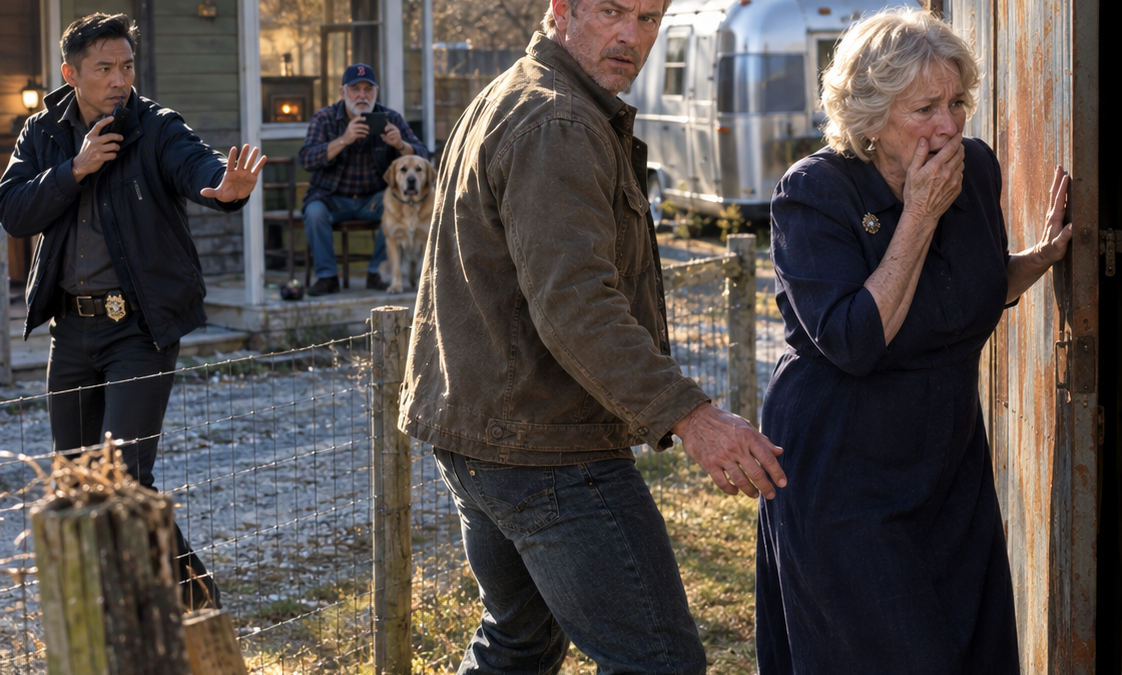
At four o’clock, a beat-up gray Dodge Ram 2500 pulled into my lot with a flatbed trailer and a silver Airstream camper and a man in his mid-sixties with a gray beard and a Red Sox cap and a plastic kennel in the bed of the truck.
He got out and stretched and looked at the shop and looked at me and grinned.
“Sergeant,” he said.
“Boudreaux.”
“We were never formally introduced. I was two teams over. But I heard about you.”
“From who?”
“Everybody.” He jerked his thumb at the truck bed. “I brought the mutt. His name’s Doc Holliday. He doesn’t bite and he doesn’t bark and he’s older than I am, which is saying something.”
“He’s a dog.”
“He’s a dog.”
“You brought a dog.”
“I brought a dog and a camper and a grudge,” Boudreaux said. “Ruby said you got a situation with some local assholes. Where do I park?”
I looked at the driveway. Then I looked at the Pike house. Then I looked at the fence.
“Park on the eleven feet,” I said.
“The what?”
“I’ll explain.”
Boudreaux grinned again.
“Sergeant,” he said, “this is already the most interesting week I’ve had in four years.”
He pulled the trailer around to the back of the cottage and parked it on the strip of land that belonged to a dead Marine, and he let the dog out, and the dog walked three circles and lay down in the grass and went to sleep.
That night, at ten-forty, someone knocked on my kitchen door.
I was sitting at the table with the notebook open. Boudreaux was in the camper. The dog was on the porch.
I got up and looked through the window.
Ruthanne Pike was standing on my step with her coat buttoned up over her nightgown and her reading glasses on and her hands shaking.
I opened the door.
“Ruthanne.”
“Calvin.” She looked past me at the table. At the notebook. At the photograph I hadn’t put away. “Can I come in?”
“Of course.”
She came in and sat down at the kitchen table in the chair Boudreaux had sat in earlier, and she looked at the photograph of the eight men for a long moment.
“That’s you,” she said. “Third from the left.”
“Yes, ma’am.”
“Who’s the boy with the bandage?”
“A friend of mine.”
“Where was this taken?”
“A long way from here.”
She nodded. Then she looked at me and her eyes were wet and her mouth was working and I realized, standing in my own kitchen, that I had never in four years seen Ruthanne Pike look the way she looked right then.
“Calvin,” she said. “I need to tell you something.”
I sat down across from her.
“I’m listening,” I said.
And she started to cry.
PART 5 — THE MARINE’S WIFE
Ruthanne Pike cried for about two minutes and I sat across from her and didn’t say a word.
That’s a thing I learned a long time ago. When someone starts crying, you don’t touch them and you don’t talk. You let them get through it. Touching makes it worse. Talking makes it worse. Silence gives them the room to come back.
She got a tissue out of her coat pocket and wiped her eyes and blew her nose and set the tissue on the table.
“I’m sorry,” she said.
“Don’t be.”
“I shouldn’t have come over here this late.”
“You can come over any time you want.”
She looked at me with her wet eyes and her mouth turned down and she said, “You’re a good man, Calvin. I’ve known that for four years.”
“Thank you, ma’am.”
“My son is going to hurt you.”
I didn’t say anything.
“He’s been telling me for a week that he’s going to run you off. I told him to leave you alone. I told him you never did anything to anybody. And he looked at me the way he looks at me sometimes, and he said, ‘You don’t get to tell me what to do in my own house.'”
“It’s your house,” I said.
“That’s what I said. And he laughed.” She looked at the table. “He said, ‘Not for long.'”
I let that sit.
“Ruthanne,” I said, “what’s in the shed?”
She didn’t answer right away. She looked at the photograph of the eight men.
“Wayne built that shed in 1994,” she said. “It was a workshop. He had a table saw and a lathe and a drill press and he made birdhouses and picture frames and a rocking horse for Dustin when Dustin was six.” She paused. “He died in ’98. And for a while I kept it the way he left it. Dust and all. I couldn’t go in there.”
“Yes, ma’am.”
“And then about eight years ago Dustin started using it. He said he needed storage. He had a hauling business, he said, and he needed someplace to keep his equipment. So I said okay. And he put a lock on it. And he told me not to go in there.”
“When was the last time you were inside?”
She thought about it.
“2016,” she said. “Maybe. I went in to get Wayne’s lathe because a man from the church wanted to buy it. Dustin was at work. I had to break the lock with a crowbar.”
“What did you see?”
She looked at me.
“Boxes,” she said. “Plastic bins. A scale on the workbench. Wayne’s workbench. A scale where Wayne used to keep his chisels.”
“Did you ask him about it?”
“I asked him. And he told me it was for his shipping business. He said he had to weigh packages.”
“Did you believe him?”
She looked at the tissue on the table.
“I wanted to,” she said. “I wanted to so bad.”
“Ruthanne—”
“Calvin, I know what my son is.” She looked up. “I’ve known for years. I’ve known since he was nineteen and he came home with a bloody shirt and told me he’d been in a fight. I’ve known since he was twenty-three and he moved back into the house and started getting phone calls from men I didn’t know. I’ve known since 2013 when the sheriff came out here and asked me if I knew where Dustin was, and I lied to him and said I didn’t.”
She stopped.
“I lied to the sheriff,” she said. “For my son.”
I sat there.
“And Wayne knew,” she said. “Wayne knew before he died. He told me on his deathbed, he said, ‘Ruthanne, you watch that boy. You watch him.’ And I told him, I said, ‘Wayne, he’s our son.’ And Wayne said, ‘I know. That’s why I’m telling you.'”
She wiped her eyes again.
“Wayne was a Marine,” she said. “He was in Korea. He was at Chosin. He came home and he worked at the paper mill for thirty-one years and he never once raised his voice to me and he never once laid a hand on Dustin. And when he died, Dustin didn’t cry. He stood at the funeral and he didn’t cry and he asked me if he could have the truck.”
I looked at the flag on her mantel through the window. It was dark in her house but I could see the shape of it in the light from the street.
“Ruthanne,” I said, “why are you telling me this now?”
She looked at me.
“Because you’re the first man who’s ever fixed something without asking for anything,” she said. “Because you drove me to Brenner when my car wouldn’t start and you sat in the waiting room for three hours and you didn’t complain once. Because when I fell in the yard last summer and I couldn’t get up, you were the one who came running and you picked me up like I was nothing and you carried me inside and you called my doctor and you stayed until she got here.”
“I remember.”
“You stayed until she got here and you never told anybody. You never mentioned it. Not once. Not to Marisol. Not to Wanda. Not to anybody.”
“No, ma’am.”
“That’s the kind of man you are,” she said. “And my son is going to hurt you. And it’s my fault. Because I made him. Because I let him be what he is. Because I let him put that lock on my husband’s shed and I never took it off.”
I looked at her for a long moment.
“Ruthanne,” I said, “I need to ask you something. And I need you to tell me the truth, even if it’s hard.”
She nodded.
“Did you sign a quitclaim deed in 2009?” I said. “Transferring the back parcel to Dustin?”
She looked at me.
“What’s a quitclaim deed?”
“It’s a paper that says you’re giving away your interest in a piece of land. It doesn’t have to be notarized by a lawyer. It just has to be signed and filed.”
She thought about it.
“Dustin came to me with papers,” she said. “In 2009. He said he needed them for the business. He said it was about insurance. He said if anything ever happened to him, the business would need the back parcel to be in his name, or the insurance wouldn’t pay out.”
“And you signed?”
“I signed.”
“Did you read them?”
“I don’t read things like that, Calvin.” She looked at her hands. “I don’t understand that kind of paper. I trust my son. I trusted my son.”
I nodded.
“Ruthanne,” I said, “I want you to do something for me.”
“What.”
“I want you to go home and I want you to go to bed and I want you to not say anything to Dustin. Not one word. Not about me. Not about the fence. Not about tonight. Can you do that?”
She looked at me.
“He’s going to hurt you,” she said again.
“No, ma’am,” I said. “He’s not.”
“You don’t know him.”
“I know him better than you think.”
She stood up. She put the tissue in her pocket and buttoned her coat and looked at the photograph on the table one more time.
“You were in the Army,” she said.
“I was.”
“For a long time.”
“Yes, ma’am.”
“Were you a soldier like Wayne?”
I looked at the photograph. Eight men. A mud wall. A sky the color of a nickel.
“Something like that,” I said.
She nodded. She walked to the door and I opened it for her and she stepped out onto the porch and the dog lifted his head and looked at her and went back to sleep.
“Ruthanne,” I said.
She turned.
“Thank you for telling me.”
She didn’t say anything. She walked across the yard toward her kitchen light and went inside and shut the door.
I stood on the porch for a minute.
Then Boudreaux’s voice came from the camper.
“Sergeant.”
“Yeah.”
“That was a Marine’s wife.”
“Yeah.”
“I heard every word.”
“I figured.”
“Her husband was at Chosin. That means something.”
“I know it does.”
Boudreaux was quiet for a second.
“Sergeant,” he said, “what are we doing?”
I looked at the shed.
“Tomorrow,” I said, “we’re going to see Frank Ngo.”
Saturday morning at eight-thirty, Frank Ngo pulled into my lot in an unmarked dark gray Impala with a laptop bag on the passenger seat.
He got out and looked at the shop and looked at the cottage and looked at the Airstream and looked at Boudreaux, who was sitting on the porch with a coffee and the dog.
“Sergeant Draeger,” Frank said.
“Frank.”
He walked up onto the porch and looked at Boudreaux and stuck out his hand.
“You must be Boudreaux.”
“That’s me.”
“Frank Ngo.”
“State police.”
“That’s right.”
“Ruby told me about you.”
“Ruby tells everybody about everybody.”
“He said you were a medic.”
“I was a team guy who got cross-trained as a medic. Same as half the team.”
“Ruby said you carried three people out of a burning truck outside of Khost.”
Boudreaux looked at Frank for a long moment. Then he looked at me.
“Sergeant,” he said, “you got a real talker here.”
“He’s a friend.”
“He’s a state cop.”
“He’s both.”
Boudreaux nodded slowly. Then he looked at Frank.
“What do you need from me?” he said.
“Nothing yet,” Frank said. “Right now I need to talk to the sergeant.”
We sat at the kitchen table. Frank had his laptop open and a file folder with maybe forty pages in it.
“I pulled the records on Ruthanne Pike,” he said. “I also pulled everything on Tulley Marsh and Dustin Pike, which I already had, but I went through it again with your name in mind.”
“And?”
“And there are three things I think you should know.”
He opened the folder.
“One. Ruthanne Pike has no criminal record. Not a single ticket. She’s paid her property taxes every year since 1971. She’s a member of the First Baptist Church of Harlow Bend and she’s been on the altar guild since 1984. And she has one son, Dustin, born 1990, father Wayne Pike, deceased 1998.”
“Okay.”
“Two. Dustin Pike has eleven arrests since 2008. Nine of them were nolle prossed — dismissed. Two were misdemeanor convictions. One for assault, one for destruction of property. He served forty-five days in the county jail in 2014 and he’s been on unsupervised probation since.”
“Who’s his lawyer?”
Frank looked up.
“How’d you know he had a lawyer?”
“Because eleven arrests and two convictions isn’t bad luck. Somebody’s been making calls.”
Frank nodded.
“His lawyer is a man named Howard Pryor. Out of Roanoke. He’s not a public defender. He’s a private attorney who specializes in drug cases and he charges about five hundred dollars an hour.”
“Who’s paying?”
“That’s what I wanted to know. So I pulled the financials.” He tapped the laptop. “Between 2015 and 2023, Howard Pryor received forty-seven thousand dollars in payments from a business account at First Piedmont Bank in the name of Marsh Logging & Land Clearing.”
I sat back.
“So Tulley Marsh paid for Dustin’s lawyer,” I said.
“Forty-seven thousand dollars’ worth.”
“For eleven arrests.”
“For eleven arrests.”
Boudreaux, who was standing in the doorway with his arms crossed, said, “That’s not an uncle helping a nephew. That’s an employer protecting an asset.”
Frank looked at him.
“That’s what I said to my supervisor,” he said.
“Frank,” I said, “what’s the third thing?”
Frank was quiet for a second.
“The third thing is the shed,” he said. “I pulled the property records myself. I ran the deed history. And there’s something in that quitclaim from 2009 that I want you to see.”
He turned the laptop around.
On the screen was a scanned image of the quitclaim deed. I could see Ruthanne’s signature at the bottom, shaky and uncertain, the way an old woman signs something she doesn’t understand.
“Look at the notary block,” Frank said.
I looked at it.
The notary’s name was listed as Howard Pryor. The same Howard Pryor who’d defended Dustin Pike eleven times.
“His own lawyer notarized the deed,” I said.
“His own lawyer notarized the deed. Which means Howard Pryor witnessed Ruthanne Pike signing over four acres of land to his client, eight years before his client got arrested for the first time on a drug charge. And there’s no record of any payment for that land. No money changed hands.”
“That’s legal malpractice at minimum,” I said.
“That’s fraud,” Frank said. “That’s fraud and possibly exploitation of an elderly person. And I’ve got a call in to the commonwealth’s attorney in Brenner County.”
“Frank.”
“Yeah.”
“Does Pryor know you’re looking?”
Frank was quiet.
“I don’t know,” he said. “I hope not. But I can’t guarantee it. Lawyers talk. And if Pryor knows we’re looking at the deed, he might call Tulley, and if Tulley knows, then Dustin knows, and if Dustin knows—”
“Then Sunday happens sooner,” I said.
“Sunday happens sooner.”
I looked at the laptop. I looked at the deed. I looked at the signature.
“Frank,” I said, “how much time do we have?”
“I don’t know. Maybe a day. Maybe less.”
“Then here’s what I want to do.”
“Go ahead.”
“I want you to get a warrant for the shed.”
Frank shook his head.
“I can’t.”
“Why not?”
“Because I need probable cause, and probable cause needs a witness, and the only witness I’ve got is a fifty-eight-year-old welder who went for a walk on a strip of land that may or may not legally belong to a dead man.”
“Then let me get you a witness.”
Frank looked at me.
“Sergeant.”
“Ruthanne Pike owns that land. Or she owned it, before her son forged her signature on a quitclaim. And she lived in that house with that shed in her backyard for thirty years. If she walked out her back door and stood on the property line and looked through the gap in the shed door, and if she saw what was inside, and if she told you about it — would that be probable cause?”
Frank was very still.
“Sergeant,” he said, “you’re talking about putting a seventy-one-year-old woman in the middle of a drug investigation.”
“I’m talking about asking her to tell the truth about her own property.”
“Tulley Marsh has killed people.”
“I know.”
“Dustin Pike has put two men in the hospital.”
“I know.”
“If they find out she talked to us—”
“Frank,” I said, “she’s already in the middle of it. She’s been in the middle of it for eight years. She’s the one who told me tonight that she’s known what her son is since he was nineteen years old.”
Frank looked at me for a long moment.
“You talked to her,” he said.
“She came over last night.”
“What’d she say?”
“She said her son is going to hurt me. She said it’s her fault. She said she signed the deed because Dustin told her it was for insurance and she doesn’t read things like that.”
Frank closed his eyes.
“Jesus,” he said.
“Frank.”
“Yeah.”
“Get the warrant.”
“Sergeant.”
“Get the warrant. And tell me what time Sunday.”
Frank opened his eyes and looked at the laptop.
“I don’t know what time Sunday,” he said. “But I know where Tulley Marsh is going to be.”
“Where?”
“He’s got a meeting at a farm supply store in Lexington at ten in the morning. He’s got a guy who works there who’s on our wiretap. He’s going to be there at ten and he’s going to be there for about an hour. That’s the window.”
“Sunday at ten.”
“Sunday at ten.”
I looked at Boudreaux.
Boudreaux looked at me.
“Sergeant,” he said, “what are we doing Sunday at ten?”
I looked at the shed through the kitchen window.
“We’re going to stand on the eleven feet,” I said. “And we’re going to get a witness.”
PART 6 — THE ELEVEN FEET
Sunday morning came in cold and clear.
I was up at four. That’s not a habit I chose. That’s a habit that chose me. Twenty-four years of standing watch before dawn and the body doesn’t forget.
I made coffee. I sat at the kitchen table with the notebook open and I read through everything I’d written over the past six days. Names. Dates. Times. The quitclaim. The lien. The nine hundred hours of wiretap. The forty-seven thousand dollars. The brake line. The knife. The three vehicles. The eleven feet.
I closed the notebook and put it in my jacket pocket.
Boudreaux was up at five. He came in with the dog and poured himself a cup of coffee and sat down across from me and didn’t say anything for a while.
“Sergeant,” he said finally.
“Yeah.”
“How many times have you done this?”
“Done what.”
“Walked into something you knew was going to go bad.”
I thought about it.
“I don’t know,” I said. “A lot.”
“Does it get easier?”
“No.”
“Didn’t think so.”
He drank his coffee. The dog lay down by the wood stove and sighed.
“What time’s the agent getting here?” Boudreaux said.
“Eight.”
“And the woman?”
“I’m going to go talk to her at seven.”
“You think she’ll do it?”
I looked at the Pike house through the kitchen window. The kitchen light was on.
“I think she’s been waiting eight years for somebody to ask her,” I said.
I knocked on Ruthanne’s door at seven-fifteen.
She opened it in her church dress — navy blue, with a brooch on the collar — and she had her purse over her arm and her reading glasses on and she looked at me and said, “I’m ready.”
“Ruthanne—”
“I know what you’re going to ask me, Calvin. I’ve been up since four thinking about it.” She stepped out onto the porch and closed the door behind her. “I’m going to walk out to that shed with you and I’m going to look through the door and I’m going to tell the truth about what’s in it.”
“Ruthanne, I need you to understand what you’re doing.”
“I understand.”
“If Dustin finds out—”
“Dustin is my son,” she said. “And I love him. And I have spent thirty-four years loving him and covering for him and lying for him and I am done.” Her chin came up. “Wayne would be ashamed of me. He’d be ashamed of what I let happen in his shed. And I’m not going to stand in front of my husband’s flag one more Sunday and pretend I don’t know what’s in my own backyard.”
I looked at her for a long moment.
“Okay,” I said.
“Okay.”
“Frank Ngo is a state police agent. He’s coming at eight. He’s going to have a warrant by noon, but we need you to look through the door first so he can get probable cause.”
“I understand.”
“And I need you to stay behind me the whole time. If anything happens — anything — you turn around and you go back inside and you lock the door.”
“I understand.”
“Ruthanne.”
“Calvin.” She looked at me. “You’re the one who’s going to be standing in front of that door. Not me.”
I didn’t have an answer for that.
Frank pulled in at eight with a second car behind him — a dark blue sedan with two plainclothes agents inside. He got out and shook my hand and looked at Ruthanne and introduced himself.
“Mrs. Pike,” he said. “I’m Special Agent Frank Ngo. I understand you’re willing to assist us.”
“I am.”
“Ma’am, I need to be very clear with you about what this means. If you identify items in that shed that are consistent with a narcotics operation, you’ll be a witness in a criminal proceeding. That may require you to testify in court. And the people involved in that operation are dangerous.”
“I know,” Ruthanne said. “My son is one of them.”
Frank looked at me. I looked at him.
“Okay,” he said.
At eight-forty, we walked out the back door of the cottage.
Boudreaux stayed on the porch with the dog. He had his phone out and he was recording. That was the arrangement. If anything happened, we wanted it on video.
Frank and the two agents stayed at the edge of the yard, on the cottage side of the fence. The legal reasoning was simple: if the eleven feet belonged to Wayne Pike’s estate, and if the estate had never been closed, then Ruthanne Pike, as the surviving spouse and the presumptive heir, had a lawful right to stand on it. Frank couldn’t cross onto the parcel himself without a warrant. Ruthanne could.
I walked ahead of her. I stepped through the gap in the fence and onto the grass and stopped on the strip and turned around and held out my hand.
Ruthanne took it. She stepped through the gap and stood next to me.
We were ten feet from the shed door.
“Okay,” I said. “I need you to walk up to the door and look through the gap. Don’t touch anything. Don’t open anything. Just look.”
She nodded.
She walked up to the door.
She stopped.
She looked through the two-inch gap between the door and the frame.
She stood there for a long time. Ten seconds. Twenty. Thirty.
Then she turned around.
“There’s bins,” she said. Her voice was steady. “Plastic bins. Nine or ten of them. And there’s a scale on Wayne’s workbench. And there’s a duffel bag on the floor with money in it. Banded. I can see it through the gap.”
Frank was already on his phone.
“Get the warrant,” he said. “I’ve got probable cause.”
The warrant came through at eleven-forty. Judge Ellerbee in Brenner County signed it. Frank called me from the car.
“We’re a go,” he said. “I’ve got a team coming from Roanoke. ETA thirty minutes. Do not — do not — go near that shed until we get there.”
“I hear you.”
“Sergeant.”
“I hear you, Frank.”
I hung up and sat down at the kitchen table.
Ruthanne was in her house. She’d gone back inside after the door and she hadn’t come out. Boudreaux was on the porch. The dog was asleep.
At twelve-fifteen, Dustin’s Silverado came down Beech Street and turned into the driveway.
I was at the kitchen window. I saw it happen.
Dustin got out of the truck. He was alone. He was sober. He walked toward the house and then he stopped and turned around and looked at the Airstream parked on the back parcel.
He stood there for a long moment.
Then he walked to the back of the lot. He walked past the cottage. He walked past the fence. He walked right up to the shed.
He looked at the door.
Then he looked at my kitchen window.
He couldn’t see me. But he knew.
I saw him take his phone out. I saw him make a call. I saw him put the phone back in his pocket and stand there with his hands on his hips, looking at the shed, looking at the house, looking at the cottage, looking at the sky.
Then he walked back to his truck and got in and drove off.
I called Frank.
“He knows,” I said.
“What happened?”
“He came home. He looked at the shed. He made a call. He left.”
“Shit.”
“Frank, where’s your team?”
“Ten minutes out.”
“He knows, Frank.”
“I heard you.”
“Frank—”
“Sergeant. Get Mrs. Pike out of that house.”
I ran across the yard.
I knocked on Ruthanne’s door and she opened it and I said, “Ruthanne, I need you to come with me.”
“Why?”
“Because Dustin knows. And I need you somewhere safe.”
She looked at me. Then she looked past me at the street. Then she nodded and grabbed her purse and came out and I walked her across the yard to the cottage and Boudreaux met us at the door.
“Take her inside,” I said. “Lock the door. Don’t open it for anybody but me or Frank.”
“Where are you going?”
“I’m going to stand on the eleven feet.”
“Sergeant—”
“Boudreaux. Take her inside.”
He looked at me. Then he took Ruthanne’s arm and led her into the cottage and shut the door.
I walked out to the back of the lot.
I stood on the eleven feet.
And I waited.
Frank’s team arrived at twelve-forty.
Four cars. Eight agents. Frank came around the corner of the cottage with a vest on and a radio in his hand and he looked at me standing on the strip and he said, “Sergeant, get behind the line.”
“Frank—”
“Get behind the line. That’s an order.”
I stepped back onto the cottage side of the fence.
Frank and two agents walked up to the shed. Frank cut the lock with a bolt cutter. He slid the door open.
I couldn’t see inside from where I was standing. But I could hear.
I heard Frank whistle. I heard one of the agents say, “Jesus Christ.” I heard the sound of a camera shutter, over and over. I heard Frank say, “Bag it. Bag all of it.”
At one-fifteen, Frank came back around the corner. He had his phone out and he was typing.
“Nine bins of finished product,” he said. “About forty pounds. Plus a scale, plus thirty-one thousand dollars in cash, plus a ledger with names and amounts going back four years.”
I looked at him.
“Frank,” I said, “that ledger is the case.”
“That ledger is the whole case,” he said. “It’s Tulley’s handwriting. It’s got dates and quantities and initials. It ties every one of the eight people we’ve already indicted to the product in that shed.”
“And Dustin?”
“Dustin’s initials are in the ledger forty-two times.”
I looked at the shed.
“Frank,” I said, “where’s Dustin now?”
Frank looked at his phone.
“We don’t know. He’s not answering his phone. His truck was last seen heading east on Route 11 about forty minutes ago.”
“East.”
“East.”
I looked at the road.
“Frank,” I said, “Tulley’s in Lexington.”
“Tulley’s in Lexington until noon. He should be on his way back by now.”
“Which way does he come back?”
“Route 11 to 608.”
“Route 11.”
“Route 11.”
I looked at the road again.
“Frank,” I said, “if Dustin’s heading east on Route 11, he’s heading toward his uncle.”
Frank looked at me.
“Sergeant,” he said, “what are you saying?”
“I’m saying Dustin knows we found the shed. And he knows the only person who could have let us in is his mother. And he knows his uncle is going to want to know why.”
Frank stared at me.
“Call the Lexington barracks,” I said. “Tell them to stop Tulley Marsh before he gets to Harlow Bend. And tell them to look for Dustin Pike on Route 11 heading east.”
Frank was already on the radio.
They caught Dustin at two-forty.
He was pulled over on Route 11 about six miles east of Harlow Bend, doing eighty-one in a fifty-five, with a loaded pistol on the passenger seat and a duffel bag in the back with nine thousand dollars in it and a change of clothes.
He didn’t resist. That’s what the state trooper wrote in his report. He just sat in the truck and looked straight ahead and said, “Is my mother okay.”
The trooper said, “What?”
Dustin said, “Is my mother okay. Did he hurt her.”
The trooper said, “Who?”
And Dustin said, “The old man. The welder.”
They took him to the Brenner County jail and booked him on possession with intent to distribute, conspiracy, and a firearms charge.
Tulley Marsh was stopped at two-fifty-five on Route 11 about four miles west of Harlow Bend. He had a lawyer in the car with him. He was released on his own recognizance at four-fifteen and his case is still pending.
Howard Pryor was indicted by a grand jury in Brenner County eleven weeks later on two counts of fraud and one count of exploitation of an elderly person. His law license was suspended by the Virginia State Bar in March. His case is still pending.
And on a Tuesday afternoon in April, in a small courtroom in Brenner County, Ruthanne Pike sat in the witness box and told a judge and a jury and a room full of people exactly what she had told me in my kitchen on that Friday night.
She testified for two hours and forty minutes.
She never once looked at her son.
And when it was over and the bailiff called a recess, she walked out of the courtroom and down the steps and across the parking lot and got into my truck, and I drove her home, and neither of us said a word the whole way.
 [Tap here for the Next Part ]


