Part 3: “I did something,” I said
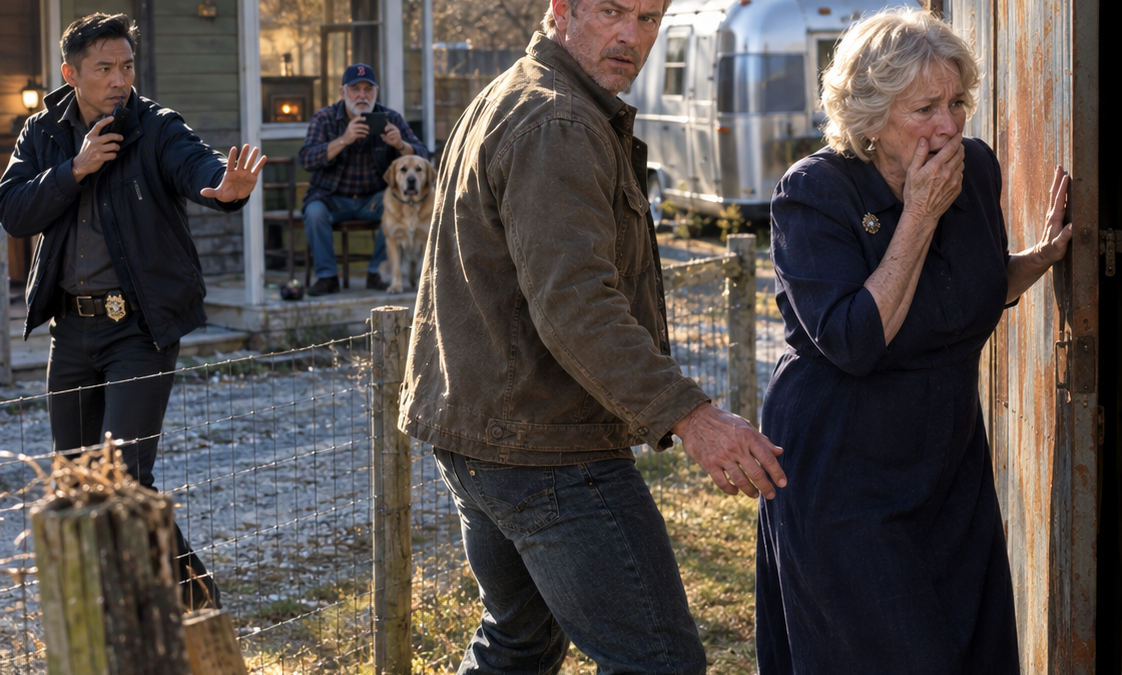
PART 7 — THE TOWN
Dustin Pike’s trial started on a Tuesday in April and ended on a Thursday.
He was charged with possession with intent to distribute, conspiracy to distribute, felon in possession of a firearm, and two counts of witness intimidation. The last one was for the brake line. The state police crime lab matched the cut to a pair of tin snips they found in the toolbox of his truck, and the tin snips had his prints on them, and the truck had my brake fluid on the undercarriage.
That last detail came from a forensic technician in Roanoke who spent three days underneath my truck with a UV light.
I didn’t know they could do that. I learned a lot that spring.
The trial lasted three days. I was a witness on the second day. I sat in the witness box and answered questions for forty-five minutes and told the truth about the fence and the knife and the brake line and the conversation in my shop.
The defense attorney — a young woman from Roanoke named Danielle Whitfield who was not Howard Pryor and who did her job with a kind of grim competence I respected — asked me one question I didn’t expect.
“Mr. Draeger,” she said, “is it true that on the day in question you disarmed my client with your bare hands?”
I looked at her.
“Yes, ma’am,” I said.
“And is it true that you served in the United States Army for twenty-four years?”
“Yes, ma’am.”
“In what capacity?”
“Special Forces,” I said.
The courtroom went very quiet.
“Special Forces,” she repeated. “As in, the Green Berets?”
“Yes, ma’am.”
“And what was your specialty?”
“Weapons sergeant,” I said. “Later, team sergeant.”
She looked at her notes for a moment. Then she looked at me.
“Mr. Draeger,” she said, “did you ever deploy to a combat zone?”
“Six times, ma’am.”
“And did you receive any decorations?”
I didn’t answer right away.
“Objection, Your Honor,” Frank said from the prosecution table. “Relevance.”
“Sustained,” the judge said.
The defense attorney nodded and moved on.
But it was already out. The bailiff looked at me differently after that. The court reporter looked at me differently. Two women in the gallery whispered to each other. And Dustin Pike, sitting at the defense table in an orange jumpsuit with his hands cuffed in front of him, turned his head and looked at me for the first time in three days.
He didn’t look angry.
He looked like a man who had just understood something.
Ruthanne testified on the third day.
She walked into that courtroom in the same navy blue dress she’d worn on the Sunday we stood on the eleven feet. She carried a small black purse in both hands. She sat down in the witness box and she put her purse in her lap and she looked straight ahead at the prosecutor and she answered every question they asked her.
They asked her about the quitclaim deed. She told them about the insurance papers Dustin brought her in 2009.
They asked her about the shed. She told them about Wayne’s lathe and the crowbar and the scale she saw on his workbench in 2016.
They asked her about the lock. She told them she never had a key.
They asked her about Dustin. She told them he was her son.
And then the prosecutor asked her one more question.
“Mrs. Pike,” he said, “why are you here today?”
She looked at him for a long moment. Then she looked down at her purse.
“Because my husband was a Marine,” she said. “He was at Chosin. He came home and he worked at the paper mill for thirty-one years and he never asked anybody for anything. And I have spent twenty years telling myself that his son was going to turn out like him. And I have spent the last eight years knowing he wasn’t.” She looked up. “And I am done lying about it.”
The prosecutor nodded.
“No further questions,” he said.
Dustin was convicted on all counts.
He was sentenced to fourteen years in the Virginia Department of Corrections. The judge, a man named Rufus Bell who had been on the bench since 1994, said something at sentencing that the local paper quoted for weeks.
“Mr. Pike,” he said, “you spent thirty-four years being told by your uncle and your lawyer and your mother that the rules didn’t apply to you. And then you met a man who has spent thirty-four years doing exactly what the rules required, and it did not end well for you.”
He banged the gavel.
The town found out about me in pieces.
Marisol Vega posted her video to Facebook on a Wednesday night in March. It was eleven seconds long and it showed Dustin coming at me with the knife and then the knife hitting the grass. She captioned it “My neighbor, for four years. He is a welder.” That was all.
It got four hundred likes in three days.
Diego Vega told everybody at school. Diego Vega was eleven years old and he had been my Saturday welding student for two years, and he had watched me fix a hay spear and a trailer hitch and his mother’s mailbox, and now he told every kid at Brenner Middle School that Mr. Draeger was a Green Beret who had fought in six wars and disarmed a man with one hand.
None of that was exactly true. I fixed the hay spear with two hands.
But Diego believed it, and Diego’s version spread, and by the end of March I couldn’t walk into the Food Lion without somebody stopping me in the cereal aisle to shake my hand.
Wanda Pruitt called me on a Thursday afternoon.
“Calvin,” she said, “I want you to know I’ve had four people in this office this week asking about you.”
“About what?”
“About your service record. About whether you were really Green Beret. About whether you ever got any medals.”
“What did you tell them?”
“That I know how to look up property records and nothing else.”
“Thank you, Wanda.”
“You’re welcome. But I’ll tell you the truth, Calvin. Everybody in this county already knows. It’s a small place. And you’ve been here four years and you never once told anybody, and now everybody’s finding out, and people are talking.”
“Talking about what?”
“About how the quiet old man in the cottage turned out to be somebody.”
I didn’t say anything.
“Calvin,” Wanda said, “are you mad?”
“No, ma’am.”
“Are you okay?”
“I’m okay.”
“Good. Because I need you to fix my back gate. The hinge is rusted through.”
“I’ll come by Saturday.”
“Good.”
She hung up.
Kelty — Deputy Kelty, the man from the sheriff’s office who had come out about the stray dog two years earlier — came by the shop on the last Friday in April.
He walked in and stood in the doorway and looked at the shop and looked at me and looked at Boudreaux, who was still parked on the eleven feet in his Airstream and who was still calling himself “just visiting.”
“Mr. Draeger,” Kelty said.
“Deputy.”
“I want to apologize to you.”
“For what?”
“For four years.” He took his hat off. “I’ve driven past this shop a hundred times. I never once stopped to say hello. I assumed — well. I assumed you were just some old man who rented Ruthanne’s cottage.”
I looked at him.
“I am an old man who rents Ruthanne’s cottage,” I said.
“You know what I mean.”
“I do.”
He stood there for a second.
“I’ve been doing this job for thirty-one years,” he said. “And in thirty-one years, I’ve never had a case that made me feel the way this one did.”
“Because of Dustin?”
“Because of Dustin.” He turned his hat over in his hands. “And because of what I didn’t know. And because if I’d done my job right eight years ago, when Ruthanne called me about the lock on the shed—”
“She called you?”
“2016. She called the office and said she was worried about what her son was keeping in her husband’s workshop. And I told her I’d look into it. And I didn’t. I got busy. There was a car accident on 11 and a domestic over on Elm and a burglary at the co-op, and I never got around to it.” He looked at me. “And if I had, you wouldn’t have had to do any of this.”
I set down the angle grinder.
“Deputy,” I said, “you’ve got a whole county and one car.”
“That’s not an excuse.”
“No. It’s not. But it’s the truth.”
He looked at me for a long moment.
“You’re not mad at me,” he said.
“No, sir.”
“Why not?”
I picked up the grinder again.
“Because I’ve spent twenty-four years learning that when things go wrong, you can either find somebody to blame or you can find something to fix. Blaming Kelty doesn’t put Dustin in prison. Fixing the shed door does.”
Kelty looked at me for a long moment.
“Mr. Draeger,” he said, “if you ever want a job.”
“I’ve got one.”
“I know. I just wanted to say it.”
He put his hat back on and walked out.
Boudreaux left on the first Sunday in May.
He pulled the Airstream off the eleven feet and hitched it to the Dodge and stood in the driveway with the dog on a leash and looked at me.
“Sergeant,” he said.
“Boudreaux.”
“You going to be okay?”
“I’m going to be okay.”
“You going to answer your phone when Ruby calls?”
“I’ll answer it.”
“You going to come visit?”
“I’ll come visit.”
“You’ve been saying that for four years.”
“I know.”
He looked at the cottage. He looked at the fence. He looked at Ruthanne’s kitchen window, where she was standing at the sink with her back to the glass.
“Take care of her,” he said.
“I will.”
“And take care of yourself.”
“I will.”
He loaded the dog and got in the truck and pulled out and I watched the Airstream go down Beech Street and turn onto Route 11 and disappear.
I stood in the driveway for a while after.
Then I walked back to the cottage and sat down at the kitchen table and opened the notebook to the last page I’d written on.
The page had names and dates and addresses and the phone number for Frank Ngo.
Underneath, on the last line, I’d written four words.
Call Erin. Tell her.
I looked at those words for a long time.
Then I picked up my phone and I called my daughter.
She answered on the second ring.
“Dad?”
“Erin.”
“It’s not Sunday.”
“I know.”
“Is everything okay?”
I looked at the notebook.
“No,” I said. “I don’t think it is. I think it’s been not-okay for about twenty-two years. And I think I owe you a conversation.”
Silence on the line.
“Okay,” she said. “I’m listening.”
“I know you are,” I said. “That’s the problem.”
PART 8 — SUNDAY
The conversation with Erin took four hours.
I called her on a Sunday afternoon and I sat on the porch with the phone against my ear and I told her everything. Not the operation. Not the names of the villages. Not the men I’d lost. But the rest of it.
I told her about the twenty-four years. I told her about the six deployments. I told her about the Silver Star and the drawer it sat in and the fact that I had never once shown it to anybody. I told her about Frank Ngo and the ridge above the village and the two thousand meters with his blood running down my chest. I told her about Doc Amaya, who was pinned in the wreck that day and who never walked right again, and who now runs a hardware store in Charlottesville and calls me every Christmas. I told her about Boudreaux and the dog and the Airstream on the eleven feet.
I told her about the fence and the knife and the brake line and the shed.
I told her about Ruthanne Pike and the Marine corporal’s flag and the navy blue dress.
And then I told her about Ash Grove.
I told her about her grandmother’s will and the forty acres and the barn and the fact that Nolan and Patricia had handled the estate and that somehow by the time the dust settled the only thing I got was a phone call from Patricia telling me not to bother coming to the funeral.
“I didn’t fight it,” I said. “I didn’t call a lawyer. I didn’t ask for anything.”
“Why not?”
“Because I didn’t want it. I didn’t want the house. I didn’t want the land. I didn’t want to be in that room with those people. I just wanted to be left alone.”
“Dad.”
“Mm.”
“That’s not the same as being okay.”
I looked out at the fence. The new post I’d set two weeks ago with a bag of Quikrete and a level.
“No,” I said. “It isn’t.”
Erin was quiet for a second.
“Did you ever tell Grandma what you did?”
“No.”
“Why not?”
“Because I didn’t think it would matter.”
“Dad.”
“I know.”
“You’re allowed to be proud of it. You’re allowed to tell people. You’re allowed to say, ‘I served my country and I was good at it.’ That’s not bragging. That’s just the truth.”
“I know.”
“Do you?”
I sat there for a while.
“No,” I said. “But I’m learning.”
Erin came to Harlow Bend two weeks later.
She flew into Roanoke on a Friday night and I picked her up at the airport and she stood in the arrivals hall with a duffel bag over her shoulder and her hair pulled back and she looked at me for a long moment.
Then she walked over and hugged me.
She hadn’t hugged me in nine years.
We drove back to Harlow Bend in the dark and I showed her the cottage and the shop and the fence. She met Ruthanne the next morning. She met Marisol and Diego. She met Wanda Pruitt at the diner on Tuesday.
On Sunday, she sat on the porch with me and we watched the sun go down over Route 11.
“Dad,” she said.
“Yeah.”
“Why did you come here?”
I thought about it.
“Because I wanted to be nobody,” I said.
“And did it work?”
I looked at the fence. The new post. The beaded tomatoes. The light in Ruthanne’s kitchen window, where she was standing at the sink with her back to the glass, the way she did every night.
“No,” I said. “It didn’t.”
“Are you glad?”
I looked at my daughter.
“Yes,” I said. “I am.”
In June, I got a letter from a man named Colonel James Halloran.
He was the commander of the 5th Special Forces Group at Fort Campbell, Kentucky, and he had gotten my name and address from a database that I didn’t know still had me in it. The letter was one page long and typed on official letterhead.
Sergeant Draeger,
It has come to my attention that you have never been formally recognized at the unit level for your service. I understand from your records that this was at your request. I am writing to ask you to reconsider.
On the 18th of September this year, the Group will hold its annual reunion at Fort Campbell. This year’s ceremony will include a formal recognition of the operators who were awarded the Silver Star in the years 2001 through 2006. Your name is on that list.
I have been told you will refuse. I am told this by men who have known you for thirty years.
I am writing anyway.
You don’t have to speak. You don’t have to stay for the dinner. You don’t have to do anything but stand up when your name is called.
I hope you’ll consider it.
Colonel James Halloran
5th Special Forces Group (Airborne)
I read the letter three times.
Then I folded it and put it in the drawer in the sideboard, on top of the little green canvas bag.
I thought about it for six weeks.
I didn’t tell anybody. Not Ruthanne. Not Erin. Not Frank. Not Ruby. I thought about it in the shop, in the mornings, while I ran beads on trailer frames. I thought about it at the diner on Tuesday mornings, reading the paper with Wanda behind the register. I thought about it on the porch at night.
The thing is, I’d spent twenty-two years not telling anybody because I didn’t want to be looked at differently. I didn’t want to be the man who did that thing, or the man who lost those men, or the man who came home with something in his chest that he couldn’t put down. I wanted to be a welder. I wanted to be a tenant. I wanted to be nobody.
And then a fence post rotted and a man pulled a knife and I stood on eleven feet of dead man’s land and a seventy-one-year-old woman in a navy blue dress told a courtroom what she had spent eight years not saying.
And I realized I had been asking the wrong question.
I’d been asking how to be nobody.
The question was how to be somebody without it costing anybody else.
I called Erin on the last Sunday in August.
“Dad. Hey. It’s not Sunday.”
“It is Sunday.”
“It’s not the right Sunday.”
“Erin.”
“Okay, okay. What’s up?”
“I got a letter from Fort Campbell.”
Silence.
“What kind of letter?”
“A colonel named Halloran. He wants me to come to the reunion in September. They’re doing a recognition ceremony for Silver Star recipients. He wants me to stand up when my name is called.”
The line went very quiet.
“Dad,” Erin said.
“Yeah.”
“You have a Silver Star?”
“Yes.”
“You have a Silver Star.”
“Yes.”
“For how long?”
“Since 2006.”
“Dad.”
“Erin.”
“You’ve had a Silver Star for nineteen years and you never told me?”
“I never told anybody.”
She was quiet for a long moment.
“Are you going to go?” she said.
“I don’t know.”
“Are you going to go.”
“I’m asking you what you think.”
“I think you should go.” Her voice broke a little. “I think you should go and I think you should stand up when your name is called and I think you should let people see who you are. Because I spent twenty-two years thinking my father was a man who gave up. And I spent the last four months finding out he was the bravest man I’ve ever known. And I want other people to know that too.”
I looked at the fence.
“Okay,” I said.
“Okay?”
“Okay. I’ll go. And I want you to come with me.”
“I’ll be there.”
“And Erin.”
“Yeah.”
“I want you to bring your aunt and uncle.”
Silence.
“Dad.”
“Erin.”
“You haven’t spoken to them in twenty-two years.”
“I know.”
“Why do you want them there?”
I looked out at the yard. The tomatoes. The new fence post. The light in Ruthanne’s kitchen.
“Because they’ve spent twenty-two years telling each other I’m nobody,” I said. “And I’m done letting them be right.”
I called Nolan two days later.
He answered on the fourth ring. He sounded like an old man, which he was. He was sixty-three and he’d had a hip replacement and he hadn’t worked the farm in three years.
“Hello?”
“Nolan. It’s Calvin.”
A long silence on the line.
“Calvin,” he said.
“Hello, Nolan.”
“What do you want.”
“Nothing. I want to invite you to something.”
“I don’t want anything to do with you.”
“That’s fine. I’m not asking you to want anything. I’m asking you to come to Fort Campbell, Kentucky on the eighteenth of September.”
Another silence.
“Why would I do that?”
“Because I’m being recognized at a ceremony. The 5th Special Forces Group is holding a Silver Star recognition at the annual reunion. My name is on the list. And I want you there.”
Silence.
“Silver Star,” Nolan said.
“Yes.”
“You have a Silver Star.”
“Yes.”
“Since when.”
“2006.”
“You’ve had a Silver Star for nineteen years and you never told anybody.”
“That’s what your niece said.”
Nolan was quiet for a long time.
“Calvin,” he said.
“Yeah.”
“Why didn’t you ever tell us?”
I looked at the fence.
“Because you never asked,” I said. “And because I didn’t think you’d want to know. And because I spent a long time not wanting to be the person who did the things I did. But I’m done with that now. And I’m inviting you because you’re my brother. And you can come or you can not come. Either way, I’m going.”
Silence.
“I’ll think about it,” Nolan said.
“Okay.”
“Calvin.”
“Yeah.”
“I’m sorry about the funeral.”
“I know.”
“You weren’t supposed to hear about it from Patricia.”
“I know.”
“I was going to call you.”
“I know, Nolan.”
“Calvin.”
“Yeah.”
“I’m sorry.”
I looked at the light in the kitchen window.
“I know,” I said. “Come to Kentucky. Bring Patricia. And we’ll have the conversation we should have had twenty-two years ago.”
“I’ll think about it.”
“Okay.”
I hung up.
The morning of September eighteenth was cold and clear.
Erin flew into Nashville the night before and drove down to Fort Campbell with me in a rental car. She wore a dark green dress and her hair down and she sat in the passenger seat with her hands folded in her lap.
“Dad,” she said.
“Yeah.”
“Are you nervous?”
I looked at the road.
“No,” I said.
“Are you lying?”
“Yes.”
She laughed.
We drove onto the post at nine-forty. A young sergeant at the gate looked at my ID and looked at the guest list and looked at me and said, “Welcome home, Sergeant Draeger.”
I didn’t say anything.
We parked and walked into the assembly hall. It was a big room with military flags and white tablecloths and large screens showing a rotating slideshow of photographs from deployments going back to 2001. There were maybe four hundred people in the room. Active duty soldiers in dress uniforms. Retired operators in suits and boots and beards. Wives and children and grandchildren.
Ruby was standing by the door.
He was in a suit with a Purple Heart pin on his lapel and his cane in his hand and when he saw me he dropped the cane against the wall and crossed the room and hugged me for a long time.
“You came,” he said.
“I came.”
“You miserable son of a bitch.”
“I know.”
“This is your daughter?”
“This is Erin.”
Ruby looked at Erin and stuck out his hand.
“Your father,” he said, “is the best man I have ever known.”
Erin looked at me.
I looked at the floor.
We found our seats. There were four seats in the third row — one for me, one for Erin, and two more at the end that stayed empty until 9:58, when Nolan and Patricia walked in.
Nolan was thinner than I remembered. He had a cane and a gray suit that didn’t quite fit and he looked around the room the way a man looks around a room he never expected to be in.
Patricia was behind him in a dark blue dress with her purse in both hands.
They sat down next to Erin without saying anything.
The ceremony started at ten.
There were fourteen names on the list.
They were called in order of the year. The first was a man named Estrada who had been awarded in 2001 and who walked up to the podium with a walker and stood at attention anyway while the room applauded.
The second was a man named Kettering who had been awarded in 2002 and who had died in 2018 and whose widow accepted on his behalf.
The third was a man named Delacroix.
The fourth was a man named Whitaker.
And then they called the fifth name.
“Sergeant First Class Calvin Draeger. Fifth Special Forces Group. Awarded for actions in support of Operation Enduring Freedom, 2006.”
I stood up.
The room applauded.
I looked at Erin. She was crying and smiling at the same time.
I looked at Ruby. He was standing at the edge of the aisle with his hand over his heart.
I looked at Nolan. He was sitting with his hands in his lap and his mouth open and his eyes wet.
I looked at Patricia. She was looking at me the way a person looks at something they’d been wrong about their whole life.
I walked to the podium.
Colonel Halloran shook my hand and gave me a small framed certificate and stepped back.
I stood at the podium and looked out at four hundred people.
I didn’t have a speech. I hadn’t written one. I’d told the colonel I wasn’t going to speak and he’d said that was fine.
But I stood there for a moment. And I thought about the photograph in the drawer. Eight men in beards and no uniforms standing in front of a mud wall somewhere in the mountains, with a sky behind them the color of a nickel.
And I thought about Frank Ngo, thirty-nine years old in a state police office in Roanoke, who had spent eleven years looking for me.
And I thought about Ruthanne Pike, seventy-one years old, in a navy blue dress, telling a courtroom what she had spent eight years not saying.
And I thought about a fence post that rotted through at the ground line and leaned over into my tomato beds.
I leaned into the microphone.
“Thank you,” I said. “I’m not going to make a speech. I’m just going to say one thing.”
The room was quiet.
“For twenty-two years I told myself I didn’t want anybody to know who I was. And I told myself that because I was afraid. Not of what people would think. But of what I would have to remember.”
I looked at Erin.
“And then somebody asked me a question I couldn’t answer, and I had to tell the truth. And the truth was that I wasn’t nobody. I was just somebody who’d never let anybody see it.”
I looked at Nolan.
“And I want to say, to my brother and my sister-in-law, who are sitting in the third row — I’m sorry I never told you. I should have. A long time ago.”
Nolan put his hand over his mouth.
Patricia started to cry.
I looked at Erin one more time.
“That’s all,” I said. “Thank you.”
The room applauded.
I walked back to my seat and sat down and Erin took my hand and didn’t let go for the rest of the ceremony.
Nolan and Patricia came to the cottage the following weekend.
They drove up from Ash Grove on Saturday morning and they parked in the driveway behind my truck and they got out and stood in the yard and looked at the cottage and the fence and the shop and the light in Ruthanne’s kitchen window.
Nolan walked up onto the porch and sat down in the chair next to mine.
“Calvin,” he said.
“Nolan.”
“I don’t know what to say.”
“Then don’t say anything.”
He looked out at the yard.
“It’s a nice place,” he said.
“It is.”
“You’ve been happy here.”
“I have.”
He looked at his hands.
“I was wrong,” he said. “About all of it. About the estate. About the funeral. About you.”
“I know.”
“I don’t expect you to forgive me.”
“I already have.”
He looked at me.
“You have?”
“I have.”
“How?”
I looked at the fence. The new post. The tomatoes.
“Because I spent twenty-two years being angry at you,” I said. “And it didn’t make me a better man. It just made me a smaller one. And a man came at me with a knife nine months ago and I realized that all that anger had been sitting in me the whole time. And I don’t want to carry it anymore.”
Nolan was quiet for a long moment.
Then he said, “Thank you.”
“For what?”
“For being better than us.”
“I’m not better than you, Nolan.”
“You are.”
“I’m not.” I picked up my coffee. “I’m just somebody who got asked a question.”
PART 9 — THE FENCE
Ruthanne Pike died on a Tuesday in February, seventeen months after Dustin was sentenced.
She had a heart attack in her kitchen. She was standing at the sink, the way she always stood at the sink, with her back to the window.
I was the one who found her. She’d been dead about an hour when I got home from the shop. I called 911 and I called Frank and I sat with her until the ambulance came.
Her funeral was at the First Baptist Church of Harlow Bend on the following Saturday. There were about eighty people there. The altar guild sat in the front two rows in their white dresses. Marisol Vega sang “Amazing Grace” and cried through the second verse. Diego Vega, thirteen years old by then, sat next to his mother with his hands folded.
Dustin was not allowed to attend. He was in a state facility in Greensville County and the warden denied his request.
At the graveside, after the burial, a Marine honor guard from Roanoke folded the flag that had been on Ruthanne’s mantel for twenty-seven years and presented it to me.
I didn’t know they were going to do that. I stood there in the cold with the folded flag in my hands and the bugler playing taps, and I didn’t know what to do with it, and Marisol Vega came up and put her hand on my arm and said, “You keep it. She would have wanted you to keep it.”
So I did.
It sits on my mantel now. Triangular case. A Marine corporal’s flag from a war that ended before I was born.
I look at it every morning when I make coffee.
The house went to Ruthanne’s cousin in Ohio. The cottage went with it. The cousin is a retired schoolteacher named Mary who lives in Columbus and who has no interest in Virginia and who told me on the phone, in a flat Ohio accent, “Just keep paying the rent and we’ll be fine.”
So I kept paying the rent.
I fixed the gutters again. I rebuilt the front steps. I planted tomatoes in the beds by the fence and they came up every summer for three summers running.
The shed is gone. Mary had it torn down. She hired a crew out of Roanoke and they took the whole thing down to the slab and hauled the debris away, and the four acres behind the cottage are just grass now, mowed once a month by a kid from Brenner.
Sometimes I stand on the eleven feet. Just to stand there.
Erin comes out twice a year now. Once in the summer and once at Christmas. She sleeps on the pull-out couch and she drinks coffee with me on the porch in the mornings and she’s stopped asking me questions about the Army because she’s realized I’ll answer them now.
She asked me once, last July, sitting on the porch with a beer, why I never told her about any of it.
I thought about it for a long time.
“Because I didn’t want you to be proud of me,” I said.
She looked at me.
“That doesn’t make any sense.”
“I know.”
“Dad.”
“I know it doesn’t make sense, Erin. But it’s the truth.”
She shook her head.
“Grandma was proud of Uncle Nolan,” she said. “Because he stayed. Because he worked the farm. Because he did what the family was supposed to do. And you left. And you did something else. And I think for a long time you thought that meant you weren’t allowed to be proud of what you did.”
I looked at the fence.
“That’s close enough,” I said.
“Well, that’s stupid.”
“Yes, ma’am.”
“So you’re done with it, right? You’re done thinking that?”
I looked at her.
“I’m working on it,” I said.
Frank Ngo calls me every couple of months.
He got promoted twice. He’s a lieutenant now. He runs the organized crime unit out of Roanoke.
Tulley Marsh’s case went to trial in 2024. He was convicted on eleven counts and sentenced to twenty-eight years. He’s in a federal facility in West Virginia now and he’s not coming back.
Howard Pryor took a plea deal. He got four years and lost his law license for good. He’s out now. He lives in Florida.
And Dustin Pike is still in Greensville. He’ll be eligible for parole in 2032. He sends me letters sometimes. I don’t open them. I put them in a shoebox on the shelf in the closet.
I don’t know why I keep them. Maybe because he’s Ruthanne’s son. Maybe because I don’t want to forget that a man can be a son and a monster at the same time.
Maybe because I don’t want to become the kind of man who throws things away.
Ruby Alcazar called me last month.
“Cal,” he said.
“Ruby.”
“How’s the fence?”
I looked out the kitchen window.
“Fixed,” I said.
“The post?”
“Replaced it myself. Set it in Quikrete. It’ll be there a hundred years.”
“Good.”
“You’re calling about something else.”
“I’m calling about the outreach center.”
“What about it?”
“We’re growing. We need a second location. Down your way.”
I looked at the fence.
“Ruby,” I said.
“Yeah.”
“What do you need?”
“A building. A man who knows how to fix things. Somebody who’s been there and come out the other side and doesn’t talk about it.”
I stood at the kitchen window for a long moment.
“Where would it be?”
“Roanoke. Maybe. Or Brenner. Or somewhere in between.”
“Ruby.”
“Say the word, Cal.”
I looked at the fence. The new post. The tomatoes coming up in the beds. The light in Ruthanne’s kitchen window, where a different person stood now, and where the light didn’t seem the same.
“Ruby,” I said, “I’ll call you back.”
“You always say that.”
“I know.”
“You’ve been saying it for twenty-six years.”
“I know.”
“Cal.”
“Yeah.”
“Say the word.”
I looked at the fence.
“Okay,” I said.
Silence.
“What?” Ruby said.
“Okay.”
“You’re saying okay?”
“I’m saying okay.”
Ruby laughed. The cracked, high laugh. The one he laughed the day I called him at four in the morning, twelve years ago, with a knife on my porch rail and three trucks in the driveway.
“Cal,” he said, “you son of a bitch.”
“I know,” I said.
“I’ll be down next week.”
“I’ll be here.”
“You’ll be here.”
“I’ll be here.”
I hung up and sat down at the kitchen table and opened the notebook to a fresh page.
At the top of the page I wrote four words.
Draeger Veterans Outreach. Brenner.
Then I sat there for a long time and looked at the fence through the window.
It’s a good fence. Eighty feet of four-by-four cedar with wire mesh running along the property line. The post at the corner is pressure-treated and set in Quikrete and it’ll outlive me.
I built it myself, last spring, on the eleven feet that technically belonged to a dead Marine.
I set the post on the strip. I measured the line with a string and a level. I drove the stakes. I poured the Quikrete. I ran the wire mesh from post to post and I tensioned it with a come-along and it’s straight and true and it doesn’t lean.
Ruthanne Pike would have liked it.
I know this because she told me once, standing on my porch, before any of it happened, before the knife and the shed and the eleven feet.
“Calvin,” she said. “You fix things.”
“Yes, ma’am,” I said.
“That’s a good thing to be.”
“Yes, ma’am.”
And I didn’t know it then, but she was right.
It’s a Tuesday morning and I’m sitting on the porch.
The coffee is hot. The paper is on my lap. Wanda’s shift at the diner starts in an hour and she’ll wave when I walk in.
The fence is standing. The tomatoes are in. The light is on in Ruthanne’s kitchen window and a new person is standing at the sink with her back to the glass, and I don’t know her name yet, and I will.
My daughter calls every other Sunday. Ruby calls every three months. Frank calls every couple of months. Nolan came up in the spring and helped me rebuild the steps and we didn’t talk about the funeral and we didn’t have to.
And somewhere in Greensville, a man is sitting in a cell and writing letters I don’t open.
And somewhere in a drawer in the sideboard, underneath a black notebook and a stack of papers, there’s a photograph of eight men in beards standing in front of a mud wall somewhere in the mountains, with a sky behind them the color of a nickel.
Third from the left. Me. Twenty-nine years old. Arm around a thin young man with a bandage on his head and a smile that takes up half his face.
On the back, in ballpoint, a date and three letters.
F.N.
I don’t keep it in the drawer anymore. I keep it on the mantel next to the flag.
Some mornings I look at it. Most mornings I don’t.
But I know it’s there. And for the first time in twenty-two years, that’s enough.

