Part 3: “She’ll be hurt. You know how she gets.”
PART 7 — THE CALLS
I called Maria Ramirez from the airport.
Eleanor sat next to me in the terminal. She didn’t say anything. She just held my hand.
The phone rang three times.
“Hello?”
“Maria Ramirez?”
“This is she.”
“My name is Robert Hale. I served with your husband.”
Silence.
“I’ve been waiting for this call for fifteen years.”
“I know. I should have called sooner.”
“Yes. You should have.”
I closed my eyes.
“I’m sorry.”
“I don’t want an apology,” she said. “I want to know what happened.”
So I told her.
I told her about the compound. About the firefight. About the three men I couldn’t save. I told her about Ramirez. About the way he’d fought. About the way he’d covered my six while I pulled Webb out. About the way he’d stayed behind to hold a position when he didn’t have to.
“He died a hero,” I said. “He died saving other men. He died doing exactly what he was trained to do.”
She was quiet for a long time.
“He always said he wanted to make a difference.”
“He did.”
“Did you know him well?”
“Not well enough. But I knew he was good. I knew he was brave. I knew he was the kind of man you’d want next to you when things went bad.”
She started crying.
“Thank you,” she said. “Thank you for telling me.”
“I should have told you years ago.”
“Yes. But you told me now.”
She paused.
“Master Chief?”
“Yes.”
“His son is in the Marines now. He’s stationed in Okinawa. He’s a good boy. He looks just like his father.”
“I’d like to meet him someday.”
“He’d like that.”
“I’ll call him. I’ll tell him what I told you.”
“Good. He needs to hear it.”
I called Emily Porter while we were waiting to board.
She answered on the first ring.
“Hello?”
“Emily Porter?”
“This is she.”
“My name is Robert Hale. I served with your father.”
Silence.
“I was wondering when you’d call.”
“I should have called sooner.”
“Yes. But you called now.”
I told her what I told Maria. I told her about her father. About the way he’d held a position with a broken arm and a punctured lung. About the way he’d kept firing until he couldn’t.
“He saved lives that day,” I said. “He saved my life. He saved the lives of men you’ll never meet. He was a hero.”
“I know,” she said. “I’ve always known.”
“Then why did you write to me?”
“Because I wanted you to know that I don’t blame you. I never blamed you. My father believed in what he was doing. He believed in the mission. He believed in his brothers. And I believe he would have done the same thing again.”
I didn’t say anything.
“Master Chief?”
“Yes.”
“You saved David Chen. You saved seventeen men. My father would be proud to have served with you.”
I gripped the phone.
“Thank you.”
“You’re welcome. And Master Chief?”
“Yes.”
“Take care of yourself. My father would want that.”
I called Tommy Gibbs from the rental car.
He was waiting.
“Master Chief.”
“Tommy.”
“When can I see you?”
“I’m flying back to Virginia tomorrow. But I’ll come to you. Where are you?”
“Fort Bragg. I’m stationed at Fort Bragg.”
“Army?”
“Yes. Like my dad.”
I closed my eyes.
“I’ll come in two weeks. Is that okay?”
“Yes. I’ll take leave.”
“Good.”
I paused.
“Tommy.”
“Yeah.”
“Your dad died with my hand on his chest. He died looking at me. He died knowing he wasn’t alone.”
Silence.
“Thank you,” he said. “That’s all I needed to know.”
We flew home that night.
Marcy was waiting at the door when we got there. She ran up and hugged me.
“Dad! You’re back!”
“I’m back.”
“How was San Diego?”
“It was good. I met some people.”
“Did you meet the man you saved?”
“I did.”
“What was he like?”
“He was a doctor. He delivered babies. He had a wife and two kids. He was happy.”
She smiled.
“That’s good, Dad.”
“It is.”
The next week was quiet.
I went back to work. Frank asked me how San Diego was. I told him it was good. He didn’t ask for details. He was good at that.
Eleanor and I talked more. Not about the big things. About the small things. What we wanted for dinner. What Marcy was doing in school. What we were going to do for Thanksgiving.
It was normal. It was good.
Lorraine called on Wednesday.
“Robert.”
“Lorraine.”
“I’ve been thinking about what you said. About the party. About me wanting to fix things.”
“Okay.”
“You were right. I wanted to throw another party so I could feel better about the first one. So I could tell myself I’d done right by you.”
I didn’t say anything.
“But that’s not what you need. You don’t need another party. You need something else.”
“What do you think I need?”
She paused.
“I don’t know. That’s the problem. I don’t know what you need. But I want to learn.”
I sat down at the kitchen table.
“Then learn.”
“How?”
“By asking. By listening. By not assuming.”
She was quiet.
“Okay.”
“Okay?”
“I’ll ask. I’ll listen. I’ll stop assuming.”
“Good.”
She paused.
“Robert.”
“Yeah.”
“I’m proud of you. I don’t think I’ve ever said that. But I am.”
I didn’t say anything.
“I know it doesn’t mean much. I know I’m late. But I am.”
“Thank you.”
She hung up.
The story kept spreading.
A reporter from the Virginian-Pilot called again. This time I agreed to talk.
I met her at a coffee shop in Virginia Beach. Her name was Karen Liu. She was young. Maybe thirty. She had a notebook and a recorder.
“Why now?” she asked.
“Why now what?”
“Why did you agree to talk now?”
I thought about it.
“Because I spent twenty years hiding. And I’m tired of hiding.”
“What changed?”
“My daughter. She asked me why I never told her. And I didn’t have a good answer.”
She wrote something down.
“Tell me about the ceremony.”
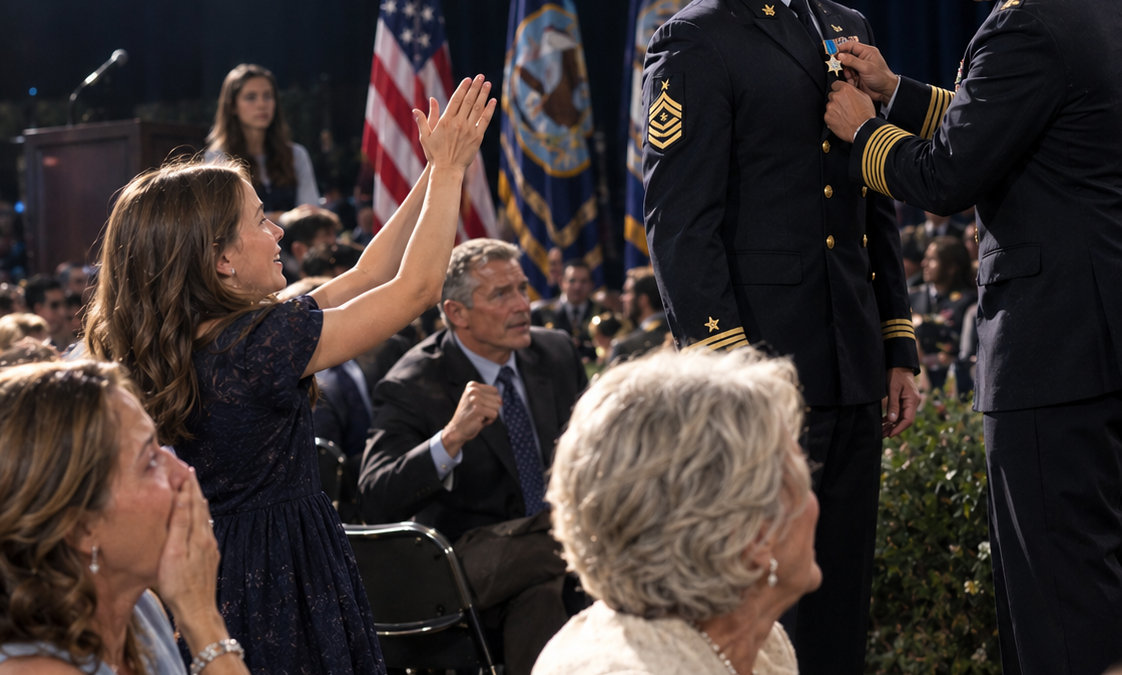
I told her about the ceremony. About the medal. About the men I’d served with.
“Tell me about the recital.”
I looked at her.
“How do you know about the recital?”
“Someone mentioned it. Someone who was at the party.”
I didn’t say anything.
“Is it true that you skipped your own retirement party to go to your daughter’s piano recital?”
“I didn’t skip it. I went to the recital first. Then I went to the party.”
“But your family scheduled the party on the same day as the recital.”
“Yes.”
“Did they know about the recital?”
“Yes.”
“And they scheduled the party anyway?”
“Yes.”
She stopped writing.
“Why?”
“You’d have to ask them.”
She looked at me.
“Master Chief, I’m going to write this story. And I’m going to be honest. Your family comes off… not great.”
I didn’t say anything.
“Do you want me to soften it?”
“No.”
She looked surprised.
“Really?”
“Really. They earned it.”
She wrote something else down.
“Can I quote you on that?”
“You can.”
The article came out on a Sunday.
The headline was: “The SEAL Who Chose His Daughter Over His Own Retirement Party.”
I read it twice.
It was fair. It was honest. It told the story of a man who’d spent twenty years in the shadows and come home to a family that didn’t know him.
It told the story of the recital. Of Lorraine’s email. Of the party at the country club.
It told the story of the ceremony. Of the medal. Of the men I’d served with.
It told the story of David Chen and Tommy Gibbs and Maria Ramirez and Emily Porter.
It ended with a quote from me.
“I don’t want to be a hero. I just want to be seen.”
Eleanor read it first. She cried.
Michael called. He’d read it. He said he was proud.
Marcy read it. She didn’t understand all of it. But she understood enough.
“Dad, you’re famous now.”
“I’m not famous.”
“You’re in the newspaper. That’s famous.”
I laughed.
“Okay, maybe a little famous.”
Lorraine read it. She called Eleanor.
“I didn’t realize,” she said. “I didn’t realize how bad it was. The way the article describes it. I look like a monster.”
Eleanor didn’t say anything.
“I was a monster.”
“Mother—”
“I was. I spent forty years treating him like he wasn’t good enough. And I never once asked why. I never once asked who he was.”
She started crying.
“I don’t know how to fix it.”
“You can’t fix it. But you can change.”
“How?”
“By being different. By being better. By showing up.”
Lorraine was quiet.
“I can do that.”
The article went viral.
Not internet-famous viral. But viral enough. It was picked up by a military blog. Then a bigger blog. Then a local TV station. Then a national news site.
I did one interview. Then I stopped.
I didn’t want to be famous. I just wanted to be seen.
The attention died down after a few weeks. But something had changed.
People in town knew who I was now. Not just the guy who worked at the hardware store. The SEAL. The hero.
Frank put a sign in the window: “We’re proud of our own. Robert Hale, Navy SEAL.”
I told him to take it down.
He didn’t.
Two weeks later, I flew to Fort Bragg.
Tommy Gibbs met me at the airport. He was twenty-six. Tall. Built like his father. He had the same eyes.
“Master Chief.”
“Tommy.”
He shook my hand. Then he hugged me.
We drove to a diner near the base. We ordered coffee. We sat in a booth in the corner.
“Tell me about my dad,” he said.
So I told him.
I told him about Robert Gibbs. About the way he’d laughed at bad jokes. About the way he’d always shared his cigarettes. About the way he’d talk about his son.
“He talked about you all the time,” I said. “He said you were going to be a soldier. He said you were going to be better than him.”
Tommy smiled.
“He said that?”
“All the time.”
“He never told me.”
“He didn’t have to. I could see it.”
Tommy looked down at his coffee.
“I never met him. Not really. I was two when he deployed. He died when I was three.”
“I know.”
“I’ve spent my whole life trying to know him. Reading letters. Talking to guys who served with him. Trying to figure out who he was.”
“He was a good man. He was a brave man. He was a man who loved his son.”
Tommy nodded.
“Thank you.”
“For what?”
“For telling me. For coming here. For not ignoring my letter.”
I looked at him.
“I should have come sooner.”
“Yeah. But you came now.”
He smiled.
“That’s what everyone says.”
“Because it’s true.”
I flew home the next day.
Marcy was waiting at the door again.
“Dad!”
“Hey, sweetheart.”
“How was Fort Bragg?”
“It was good. I met a man whose father I served with.”
“Did you tell him about his dad?”
“I did.”
“Was he happy?”
“He was. I think.”
She nodded.
“Good.”
She took my hand.
“Dad.”
“Yeah.”
“I’m glad you’re home.”
“Me too.”
That night, I sat on the back porch.
The air was cool. The leaves were changing. Fall had arrived.
Eleanor came out with two cups of coffee. She sat next to me.
“What are you thinking about?”
“The article.”
“What about it?”
“I don’t know. I feel… lighter.”
She looked at me.
“Lighter how?”
“Like I’ve been carrying something for twenty years and I finally put it down.”
She nodded.
“That’s good.”
“I think so.”
We sat there in silence.
“Robert.”
“Yeah.”
“I’m proud of you. I know I’ve said it before. But I want to say it again. I’m proud of you.”
I took her hand.
“Thanks, Ellie.”
“You’re welcome.”
We sat there and watched the stars.
I thought about Tommy. About David. About Maria and Emily.
I thought about Ramirez and Porter and Gibbs.
I thought about the seventeen men I’d saved and the three I couldn’t.
I thought about Marcy. About the recital. About the cake.
And I thought about what came next.
PART 8 — THE RECITAL
Thanksgiving came three weeks later.
Lorraine hosted. She’d always hosted. For forty years, Thanksgiving had been at her house. Turkey. Stuffing. Cranberry sauce from a can because she refused to make it fresh.
This year was different.
She called Eleanor the week before.
“I want to do something different this year.”
“Different how?”
“I want to invite everyone. Not just the family. Everyone.”
Eleanor paused.
“Mother, what are you talking about?”
“Robert’s friends. The men he served with. The ones who came to the ceremony. I want to invite them.”
Eleanor didn’t say anything.
“I know it’s late notice. But I want to try. I want to do something right.”
“Mother—”
“I know. I know I’ve been terrible. I know I have a lot to make up for. But I want to try. Please let me try.”
Eleanor called me that night.
“What do you think?”
I thought about it.
“I think it’s a start.”
“So you’ll come?”
“I’ll come.”
“And your friends?”
“I’ll call them.”
Tom Delgado answered on the first ring.
“Robert.”
“Tom.”
“What’s up?”
“My mother-in-law wants to invite you to Thanksgiving.”
Silence.
“Your mother-in-law. The one who scheduled your retirement party on top of your daughter’s recital.”
“That’s the one.”
“The one who treated you like a handyman for forty years.”
“That’s the one.”
Tom laughed.
“What changed?”
“Everything. Nothing. I don’t know. She’s trying.”
“Trying how?”
“She wants to meet you. She wants to know that part of my life. She wants to do better.”
Tom was quiet for a moment.
“Robert, are you sure about this?”
“No. But I’m willing to try.”
“Then I’ll be there.”
Marcus Webb answered on the second ring.
“Master Chief.”
“Marcus.”
“What’s going on?”
“My mother-in-law wants to invite you to Thanksgiving.”
“The one from the party?”
“That’s the one.”
“The one who didn’t know who you were?”
“That’s the one.”
Marcus laughed.
“She wants to meet me?”
“She wants to meet all of you. She wants to know who I am.”
“And you’re okay with this?”
“I don’t know. But I’m willing to try.”
“Then I’ll be there.”
Danny Kwan answered on the third ring.
“Master Chief.”
“Danny.”
“How are you doing?”
“Good. I have a question for you.”
“Shoot.”
“My mother-in-law wants to invite you to Thanksgiving.”
“The one who—”
“Yes.”
“Wow.”
“Yeah.”
“Are you okay with this?”
“I’m trying to be.”
Danny paused.
“Master Chief, I’ve known you for twenty years. You’ve never asked me for anything. Not once.”
“I’m not asking now. I’m inviting.”
“Same thing.”
I didn’t say anything.
“Of course I’ll be there. Sarah’s been wanting to meet you anyway.”
“Sarah?”
“My wife. She’s heard stories. She wants to know if you’re real.”
I laughed.
“I’m real.”
“We’ll see.”
Thanksgiving was at Lorraine’s house.
I arrived early with Eleanor and Marcy. The house was already full of smells. Turkey. Pies. Bread.
Lorraine was in the kitchen. She was wearing an apron. I’d never seen her in an apron.
“Robert. You’re early.”
“I always am.”
She smiled. It was a small smile. But it was real.
“I made the cranberry sauce fresh this year.”
“I noticed.”
“I looked up a recipe. It has orange zest in it.”
“That sounds good.”
She nodded.
“I hope it is.”
Tom, Marcus, and Danny arrived together at noon.
I met them at the door.
“Gentlemen.”
“Master Chief.”
They came inside. They looked around at the house. At the china. At the crystal. At the fancy furniture.
“This is nice,” Tom said.
“It’s my mother-in-law’s.”
“Right.”
Lorraine came out of the kitchen.
“You must be Tom. Robert’s told me about you.”
Tom shook her hand.
“Ma’am.”
“Please. Call me Lorraine.”
“Lorraine.”
She looked at Marcus.
“And you must be Marcus. The one Robert carried.”
Marcus nodded.
“That’s me.”
“I read about that. In the article. I had no idea.”
“Most people don’t.”
She looked at Danny.
“And you’re Danny. The youngest.”
“Not anymore.”
She smiled.
“No. I suppose not.”
She gestured toward the living room.
“Please. Sit down. Dinner will be ready soon.”
Dinner was loud.
Michael and Priya came with Rosa. Mark and Diane came. Phillip and Carla came. Even Carla’s kids, who were in their twenties now.
The table was long. It seated twenty. It felt like thirty.
Lorraine put me at one end. She put Tom, Marcus, and Danny near me. She sat at the other end.
Before we ate, she stood up.
“I want to say something.”
The table went quiet.
“For forty years, I’ve had a son-in-law. I thought I knew him. I thought he was a man who fixed things and didn’t say much and was… fine. Just fine.”
She paused.
“I was wrong. I didn’t know him. I didn’t ask. I assumed. And I treated him like he was less than he was.”
She looked at me.
“I’m sorry, Robert. I’m sorry for forty years of not asking. I’m sorry for the party. I’m sorry for the recital. I’m sorry for all of it.”
I didn’t say anything.
“I know that doesn’t fix anything. I know I can’t undo the past. But I want to do better. I want to know you. The real you.”
She picked up her glass.
“So I’d like to make a toast. Not to the SEAL. Not to the hero. To my son-in-law, Robert Hale. The man who chose his daughter over his own party. The man who went back three times. The man who’s been sitting at my table for forty years, and I never saw him.”
She raised her glass.
“To Robert.”
The table echoed.
“To Robert.”
After dinner, I found Lorraine in the kitchen.
She was washing dishes. Alone.
“Lorraine.”
She turned around.
“Robert.”
I walked over and stood next to her.
“That was a good toast.”
“Thank you.”
I picked up a dish towel and started drying.
“You don’t have to do that.”
“I know.”
She looked at me.
“Robert, I meant what I said. I want to know you.”
I set the dish down.
“What do you want to know?”
She thought about it.
“What was your favorite mission?”
I blinked.
“What?”
“Your favorite mission. The one you’d do again if you could.”
I thought about it.
“There was one. In 2005. We were extracting a group of villagers from a Taliban-controlled area. Whole families. Kids. Old people. We got them out through a mountain pass.”
“How many?”
“Eighty-seven.”
She stopped washing.
“Eighty-seven people.”
“Yes.”
“And you got them all out?”
“Yes.”
She looked at me.
“That’s incredible.”
“It was just a job.”
“No. It wasn’t.”
She picked up another dish.
“Tell me more.”
So I did.
The men stayed until nine.
Tom, Marcus, and Danny sat in the living room with me. We talked about the old days. The missions. The men we’d served with. The ones who were still alive and the ones who weren’t.
Lorraine sat in the corner. She listened. She didn’t say anything.
At nine, they stood up.
“Master Chief, it was an honor.”
“Tom. Don’t call me that.”
He laughed.
“Old habits.”
He shook my hand.
“Same time next year?”
I looked at Lorraine.
“Maybe.”
She nodded.
“I’d like that.”
Tom looked at her.
“Then I’ll be here.”
They left.
I walked them to the door. I watched them drive away.
When I came back inside, Lorraine was still in the corner.
“Robert.”
“Yeah.”
“Thank you.”
“For what?”
“For coming. For letting me try. For not giving up on this family.”
I looked at her.
“I didn’t give up because of Marcy. And because of Eleanor. Not because of you.”
She nodded.
“That’s fair.”
I started to walk away.
“Robert.”
I stopped.
“Yes?”
“I’m going to do better. I’m going to be better. I don’t know if you’ll ever forgive me. But I’m going to try.”
I looked at her.
“That’s all I can ask.”
Christmas came.
Lorraine hosted again. She invited everyone. Including Tom, Marcus, and Danny.
She sat next to me at dinner. She asked me questions. Real questions. About my childhood. About my parents. About what I wanted to do with the rest of my life.
I answered.
It wasn’t easy. It wasn’t comfortable. But I answered.
In January, I got a call from the Naval Special Warfare Command.
They wanted me to speak at a graduation. BUD/S Class 342. They wanted me to talk about what it meant to be a SEAL.
I said yes.
I stood in front of a hundred and twenty men. Young men. Scared men. Men who didn’t know if they’d make it.
I looked at them.
“I was where you are,” I said. “I was scared. I was tired. I wanted to quit. But I didn’t.”
I paused.
“You won’t remember most of what I say. That’s okay. But remember this: the man next to you is your brother. The man next to him is your brother. You don’t leave your brothers behind. Not ever.”
I looked at them.
“You’re going to do things you can’t talk about. You’re going to see things you can’t forget. You’re going to carry things that no one else will ever understand.”
I paused.
“But you’re not alone. You’re never alone. And when you come home—when you finally come home—you don’t have to hide. You don’t have to disappear. You can let people in.”
I looked at the back of the room. Eleanor was there. Marcy was there. Lorraine was there.
“You can let people see you.”
After the graduation, Marcy ran up to me.
“Dad!”
“Hey, sweetheart.”
“That was amazing.”
“It was just a speech.”
“No. It was more than that.”
She hugged me.
“I’m proud of you.”
I hugged her back.
“Thanks, Marcy.”
“You’re welcome.”
She pulled back and looked at me.
“Dad.”
“Yeah.”
“I’m glad you came to my recital.”
I looked at her.
“Me too.”
That night, I sat on the back porch.
The air was cold. Winter had arrived. The stars were bright.
Eleanor came out with two cups of coffee. She sat next to me.
“What are you thinking about?”
“Everything.”
“That’s a lot.”
“It is.”
She took my hand.
“Robert.”
“Yeah.”
“I love you.”
I looked at her.
“I love you too.”
“I know. But I wanted to say it. I wanted to make sure you knew.”
I squeezed her hand.
“I know.”
We sat there and watched the stars.
I thought about the journey. The deployments. The missions. The men I’d lost. The men I’d saved. The family I’d kept at arm’s length.
I thought about the recital. The party. The ceremony. The article.
I thought about Lorraine. About how she’d changed. About how she was still changing.
I thought about Marcy. About the cake. About the way she’d looked at me when I walked into the auditorium.
I thought about David Chen. About Tommy Gibbs. About Maria Ramirez and Emily Porter.
I thought about Ramirez, Porter, and Gibbs. The three men I couldn’t save. The three men I’d carry forever.
I thought about Tom and Marcus and Danny. The brothers who’d never left. The brothers who’d come back.
I thought about what came next.
The answer came to me in the spring.
I was sitting in the hardware store when a young man walked in. He was in his twenties. He looked lost.
He walked up to the counter.
“Are you Robert Hale?”
“I am.”
“I read about you. In the paper. The article about the SEAL who chose his daughter over his party.”
“Okay.”
He looked at me.
“I’m thinking about joining the Navy. I want to be a SEAL.”
I looked at him.
“Why?”
“Because I want to do something that matters. I want to be part of something bigger than myself.”
I nodded.
“That’s a good reason.”
“But I’m scared. I don’t know if I can do it.”
I looked at him.
“Everyone’s scared. That’s not the question.”
“What’s the question?”
“The question is what you do with it.”
He stared at me.
“What did you do with it?”
I thought about it.
“I did my job. I did it even when I was scared. I did it even when I didn’t want to. I did it because the men next to me were counting on me.”
He nodded.
“That’s what I want.”
“Then go. Try. If you make it, you’ll be part of something most people will never understand. If you don’t, you’ll still be better for trying.”
He smiled.
“Thank you, Master Chief.”
“Robert.”
“Robert.”
He left.
I watched him go.
Frank came out of the back room.
“What was that about?”
“Kid wants to be a SEAL.”
“You talked him into it?”
“I talked him into trying.”
Frank nodded.
“That’s all you can do.”
“Yeah.”
He looked at me.
“You know, Robert, you’re different.”
“Different how?”
“Lighter. Happier. Like you’re not carrying something anymore.”
I thought about it.
“I’m not.”
That night, I told Eleanor about the kid.
“What did you say to him?”
“I told him to try.”
“Did he seem like he could do it?”
“I don’t know. Maybe. It’s not about whether he can do it. It’s about whether he’s willing to try.”
She nodded.
“That’s good advice.”
“It’s what I would have wanted to hear when I was his age.”
She looked at me.
“Robert.”
“Yeah.”
“I’m glad you found your way back.”
I looked at her.
“Back?”
“To yourself. To us. To being seen.”
I thought about it.
“I’m glad too.”
The summer came.
Marcy had another recital. Her second.
She was playing a harder piece this time. Chopin. A nocturne. She’d been practicing for three months.
The day of the recital, I woke up early.
I made coffee. I sat on the back porch. The sun was coming up over the trees.
Eleanor came out.
“Ready?”
“Yeah.”
We drove to the community center. The same one as before. The same folding chairs. The same piano.
Lorraine was there. She’d come early. She was sitting in the front row.
I sat next to her.
She looked at me.
“Robert.”
“Lorraine.”
“Thank you for letting me come.”
“Thank you for coming.”
She smiled.
The lights dimmed. The woman in the floral dress walked onto the stage. She welcomed everyone.
Then the children started playing.
Marcy was the tenth performer.
She walked onto the stage in a dress I’d bought her for her birthday. Blue. Her hair was pulled back. She looked small and serious and absolutely confident.
She found me in the crowd. I nodded.
She sat down at the piano. She placed her hands on the keys. She took a breath.
And then she played.
It was beautiful. It was more than beautiful. It was everything I’d ever wanted for her.
When she finished, the room stood up.
I stood up too.
She found me again.
I gave her a thumbs up.
She smiled.
After the recital, we went to ice cream. The same shop. The same booth.
Lorraine came with us. She sat at the end of the table.
Marcy ordered chocolate chip. She ate it slowly.
“Dad.”
“Yeah.”
“Did you like it?”
“I loved it.”
“Really?”
“Really.”
She smiled.
“Good.”
Lorraine leaned forward.
“Marcy, you were wonderful.”
Marcy looked at her.
“Thanks, Grandma.”
“You’re welcome.”
There was a pause.
“Grandma?”
“Yes, sweetheart.”
“I’m glad you came.”
Lorraine’s eyes got wet.
“I’m glad I came too.”
That night, I sat on the back porch.
The air was warm. Summer had arrived. The fireflies were out.
Eleanor came out with two cups of coffee.
She sat next to me.
“What are you thinking about?”
“The future.”
“What about it?”
“I don’t know. I’m just… thinking.”
She took my hand.
“We have time.”
I looked at her.
“Yeah. We do.”
We sat there and watched the fireflies.
I thought about the journey. The long road. The twenty years of service and the fifteen years of silence and the two years of coming back.
I thought about the recital. The first one. The one that started everything.
I thought about the choice I’d made. The choice to go to my daughter instead of my party.
It had cost me something. It had cost me the illusion of a family that understood me.
But it had given me something else. Something better.
It had given me the truth.
I looked at Eleanor.
“Ellie.”
“Yeah.”
“Thank you.”
“For what?”
“For staying. For trying. For not giving up.”
She squeezed my hand.
“I wasn’t going to give up on you, Robert. I just didn’t know how to reach you.”
“And now?”
“Now I do.”
I looked out at the fireflies.
“Good.”
We sat there in silence.
The stars were bright. The air was warm. The future was open.
I was fifty-nine years old. I was a former Navy SEAL. I was a husband and a father and a grandfather.
And for the first time in a long time, I was seen.