“Nobody Calls D.C. From Here.” Cop Took a Black Woman’s Phone—Then Washington Shut Down His Precinct
“Nobody Calls D.C. From Here.” Cop Took a Black Woman’s Phone—Then Washington Shut Down His Precinct
Put that phone away.
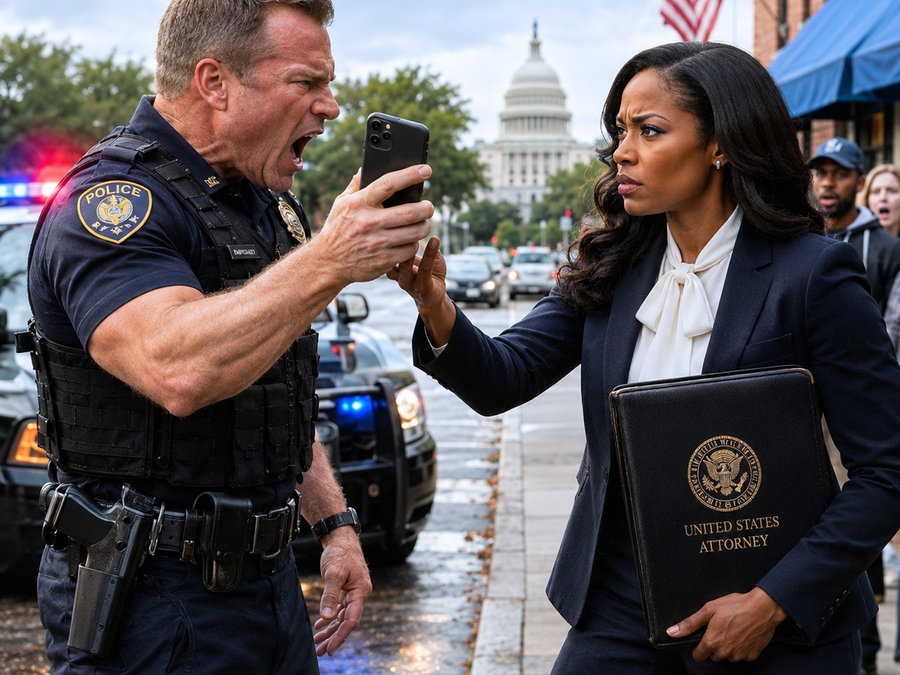
A black woman like you isn’ calling anybody important from my town, Sergeant Daniel Mercer his sneered as he snatched the cell phone from Avery Brooks’s hand before she could finish dialing.
He pressed the power button, sealed the phone inside an evidence bag, then deliberately tossed it onto the hood of his patrol car with a mocking grin. A few passing drivers slowed to watch.
Mercer folded his arms. Nobody calls DC from here.
Around here, this badge decides who gets heard. The deputies behind him laughed.
One of them kicked Avery’s worn leather briefcase across the roadside, spilling neatly organized legal files into the dirt.
Mercer glanced at the scattered papers and laughed again.
Look at that. A black woman carrying law books like they make you untouchable.
Around here, those papers are worth less than my parking tickets.
The laughter grew louder. He took one slow step closer until they were face to face.
And here’s your first lesson about this town, Mercer said coldly.
People with power don’t answer calls from women they expect us to arrest.
Avery, a black woman dressed in a simple navy blazer, never raised her voice. She simply looked into his eyes.
No, she said quietly.
Washington already heard enough.
The smiles around Mercer began to fade as distant sirens rolled across the Georgia highway, growing louder every second. Without realizing it, Mercer had just turned an ordinary traffic stop into the investigation that would change his career forever.
The heavy steel door slammed shut behind Avery Brooks with a metallic echo that seemed to linger through the small booking area.
She didn’t flinch.
Her wrists weren’t cuffed yet, but Sergeant Daniel Mercer walked beside her as though she were already guilty of something dangerous.
Get her name in the system, Mercer barked, resisting an investigation.
Obstruction.
We’ll figure out the rest.
The young desk officer hesitated.
Sir, we don’t actually have probable Mercer cut him off with a glare.
Did I ask for legal advice, Officer Collins? No, sir.
Then type.
The keyboard clacked nervously.
Avery quietly watched every movement inside the station.
The faded walls, the malfunctioning security monitor near the booking desk, the cracked American flag plaque hanging beside the mission statement that promised integrity, honor, service.
She almost smiled at the irony. Mercer noticed.
You think something’s funny?
No.
You’ve been awfully calm.
I’ve learned panic usually helps the wrong people.
His jaw tightened.
I’ve dealt with people like you for 25 years.
I imagine you have. Her answer sounded harmless.
It somehow irritated him even more.
Another deputy walked in carrying Avery’s leather briefcase.
What do you want me to do with this?
Mercer snatched it away himself.
Oh, let’s see what our little lawyer thinks is so important.
He dumped everything onto the evidence table.
Legal folders, a notebook, several business cards, pens, case files tied neatly with blue bands.
Mercer flipped through them without permission. Civil rights?
He laughed loudly enough for everyone nearby to hear. Figure.
One deputy leaned over. Another activist looking for a lawsuit?
Mercer grinned.
They’re all the same.
He picked up one document, barely glanced at it, then crumpled it into a ball and tossed it toward the trash can.
It bounced off the rim and landed on the floor. Nobody bothered picking it up.
Officer Ethan Collins shifted uncomfortably. Sir, those are personal legal documents.
Mercer looked back at him. So?
They might be protected.
Mercer slowly walked closer.
You planning to defend her? No, sir.
Then stop talking. The room fell silent.
Avery bent down, picked up the crumpled paper, and carefully smoothed each fold with her fingertips.
Mercer watched with amusement.
You know what your problem is? She remained silent.
You actually think rules protect people?
He leaned closer. Out here, I decide which rules matter.
Avery looked at him calmly.
That’s exactly worries me.
For a brief second, Mercer felt something he couldn’t explain.
Not fear, not yet, something closer to discomfort.
He buried it beneath another sneer.
Take her phone.
It’s already in evidence.
Another deputy answered.
No.
Mercer shook his head. Bring it here.
The clear evidence bag was placed into his hand. The screen remained black after he powered it off on the roadside.
He rotated it slowly. No password?
Officer Collins spoke quietly.
It probably has biometric security.
Mercer smirked.
Then it won’t be needing this.
Before anyone could react, he pulled open a desk drawer, dropped the phone inside, and slammed it shut.
If Washington wants to talk to her, he shrugged dramatically.
They can wait.
The deputies laughed. Only Collins remained silent, 40 miles away.
Inside a federal office building in Atlanta, an encrypted communications console emitted a soft warning tone.
Connection lost.
An analyst looked at the screen.
That’s odd.
Another employee rolled over in his chair. What happened?
The secure callback disappeared. Equipment failure?
The analyst frowned.
No. He enlarged the call log.
The connection was terminated manually. By her?
I don’t think so.
He picked up the phone.
We need to notify headquarters.
Back inside the station, Mercer continued searching Avery’s belongings.
He found a folded road map, receipts, a fountain pen, nothing that satisfied his growing curiosity. What exactly are you doing in Hollow Creek?
I’m traveling.
For what?
Personal business.
He laughed. You expect me to believe that?
It doesn’t matter what you believe.
The room went quiet again. Mercer hated that answer.
People usually argued, they shouted, they pleaded.
Avery did none of those things. She simply waited as though she already knew how this day would end.
That confidence unsettled him more than he wanted to admit. Officer Collins quietly approached the evidence desk.
Sergeant? What?
The traffic camera.
What about it? It never showed a traffic violation.
Mercer stared at him. So?
So, there’s no recorded reason for the stop.
Mercer’s expression hardened.
It malfunctioned.
It didn’t.
It did now. Collins swallowed.
Yes, sir.
The young officer stepped away.
Avery noticed.
She also noticed Collins discreetly memorizing the evidence locker number before returning to his desk. Interesting.
Not everyone inside this building had surrendered their conscience.
Mercer suddenly held up a small notebook.
What’s this?
My journal.
He flipped through several pages.
Most contained handwritten observations, dates, locations, conversation. Nothing seemed unusual until one page stopped him.
Only four words were written across the top. Pattern of constitutional violations.
Mercer’s smile disappeared.
He continued reading.
Traffic stops, unlawful searches, property seizures, citizen complaints, officer names, badge numbers, including his own.
His eyes narrowed. What exactly is this?
My notes.
You’ve been documenting us?
I document everything. Mercer slammed the notebook shut.
You came here looking for trouble. No.
Avery answered softly. I came here because trouble was already here.
Before Mercer could respond, the station phone rang.
The dispatcher answered.
After only a few seconds, she looked toward Mercer. Sergeant.
What? Someone from Washington has been trying to reach this station.
Mercer laughed dismissively.
Tell them I’m busy.
It’s marked federal.
His smile faded only slightly.
Take a message. They refused.
What did they say? The dispatcher hesitated.
They said they’ll be arriving instead.
For the first time that afternoon, the room became completely silent.
Mercer forced out a laugh that sounded far less confident than before.
Good.
He tossed Avery’s notebook back onto the table.
Let them come. He had no idea that those would become the last arrogant words he would speak before his entire world began to collapse.
The silence inside Hollow Creek Police Department lasted only a few seconds after the dispatcher repeated the message.
They said they’re coming here.
Sergeant Daniel Mercer let out another laugh, louder this time, as if volume alone could erase the uneasiness creeping into the room. Everybody claims they someone in Washington.
He pointed toward Avery Brooks.
She’s just trying to scare us.
No one answered. Officer Ethan Collins kept his eyes on his computer screen, pretending to finish paperwork while discreetly watching Mercer through the reflection in the monitor.
Mercer walked over to Avery’s chair and leaned against the desk.
You’ve got one more chance.
Avery remained calm.
To do what?
Tell me who you’re really trying to call.
I already told you.
No. His smile faded.
You told me where. He leaned closer until only inches separated them.
I asked who. Avery met his eyes.
The people who answer when local authority forgets what the Constitution says.
The room fell silent again. One deputy rolled his eyes.
Mercer chuckled.
That’s a fancy answer.
It happens to be the truthful one.
Mercer’s patience finally cracked.
Booker, officer Collins froze.
Sir? You heard me.
We still don’t have a charge.
Mercer slammed both palms onto the counter.
I don’t need you explaining probable cause every 5 minutes.
But booking requires I said Booker. Collins slowly looked toward Avery.
For the first time since she arrived, their eyes met. She gave him a nearly invisible nod.
Not a plea for help, not fear, simply acknowledgment as if she understood the impossible position he had been placed in. Collins quietly lowered his head.
I can’t.
Mercer blinked. What did you just say?
I said I can’t enter false charges.
Every conversation inside the station stop.
Another deputy whispered, he’s lost his mind.
Mercer’s voice became dangerously quiet.
Officer Collins. Yes, sir.
You’ve been here 18 months.
Yes, sir.
You know who signs your evaluations?
I do.
And you’re choosing her over your career?
Collins swallowed hard.
I’m choosing department policy.
Mercer stared at him for several long seconds. Then he smiled.
It was the kind of smile everyone inside the building feared. Fine.
He pulled a clipboard from the counter.
I’ll do it myself.
Within minutes, he began typing. Reason for detention, failure to comply, interference, suspicious behavior.
Collins couldn’t believe what he was reading.
None of it had happened.
Every word was fiction.
Avery quietly watched Mercer manufacture an official record in real time. You know, she finally said, false reports become permanent evidence.
Mercer didn’t even look up.
So do convictions. They also become federal exhibits.
His fingers paused above the keyboard only for a second. Then he continued typing harder than before.
Across the hall, the dispatch center received another incoming call.
Dispatcher Linda Harris answered. Hollow Creek Police Department.
A calm male voice spoke. This is Special Agent Michael Donovan with the Department of Justice.
We need to speak with Sergeant Daniel Mercer immediately.
Linda looked through the glass. Mercer was still typing.
May I ask what this concerns?
I’m afraid I can’t discuss that over an unsecured line.
She hesitated.
I’ll transfer you.
No, the agent interrupted.
Don’t transfer me.
Her eyebrows lifted. Is Sergeant Mercer currently detaining a woman named Avery Brooks?
Linda slowly looked toward the booking room.
Yes. Is she safe?
Linda didn’t answer immediately.
E ma’am.
His voice became firmer. This answer is extremely important.
Linda looked through the window once more.
Mercer had just taken Avery’s notebook again.
She’s physically unharmed.
A short silence followed.
Thank you. The line disconnected.
Linda’s heartbeat quickened.
She had worked dispatch for 19 years. Federal agents rarely asked questions that directly.
Mercer tossed the notebook onto the table.
What are all these names?
Citizens. And these dates?
Traffic stops.
You’ve been collecting complaints.
I’ve been documenting facts.
Mercer laughed. No jury believes notebooks.
Maybe, Avery answered, but juries tend to believe patterns.
He slammed the cover shut again.
What makes you think you’ll ever see a courtroom?
Several deputies laughed. Avery never did.
Instead, she slowly looked toward the surveillance camera mounted high in the corner.
The tiny red recording light wasn’t blinking anymore.
Mercer noticed. You looking for that?
He smiled proudly.
Funny thing about cameras. He motioned toward the ceiling.
They break.
Collins immediately looked up.
The camera had been working less than 5 minutes earlier. Mercer followed his gaze.
Me not my problem.
Collins knew better.
Everyone did. Without recording, there would be no video of anything that happened inside booking.
Mercer folded his arms.
Now we’re finally having a private conversation.
Avery spoke quietly.
You’ve turned it off before.
The sentence landed like a hammer.
Mercer’s expression hardened.
What did you say? You heard me.
You accusing me?
I’m observing you.
He stepped closer.
You don’t know anything about me.
No.
She answered calmly.
I know your habits.
A flicker of uncertainty crossed his face. Only a flicker.
Outside, rain clouds gathered over Hollow Creek. An elderly couple stood across the street watching the station.
The husband shook his head.
They’ve got another one.
His wife quietly replied. No.
She kept watching Avery through the window.
I think this one’s different.
Inside, Collins quietly opened the station’s digital evidence system.
He entered the locker number assigned to Avery’s property.
Status.
Recently accessed.
Twice. His forehead tightened.
The phone should have been secured only once. Why had Mercer reopened the locker?
He clicked further.
Access log unavailable. Deleted.
His stomach dropped. Someone had manually erased the electronic record.
That was impossible without supervisor credentials, unless Mercer himself had done it. Collins glanced toward Avery.
She sat quietly, hands folded in her lap, almost as if she expected every single violation before it happened.
He suddenly realized something.
She hadn’t once asked for her phone back.
Not once.
Why?
Most innocent people demanded it immediately. She never did.
It was almost as though the phone itself no longer mattered.
That thought stayed with him.
Meanwhile, more than 600 miles away in Washington D. C.
, a secure conference room had filled far more quickly than usual.
A large screen displayed a single message in bold red letters. Field contact lost.
Assistant Attorney General Rebecca Lang stood at the head of the table.
When was the last confirmed transmission?
14 minutes ago.
What do we have? Audio.
Only audio?
Yes, ma’am.
Play it.
The room filled with Mercer’s voice.
Nobody calls DC from here.
Then a black woman like you isn’t calling anybody important from my town.
The recording ended with the sound of a phone being ripped away and distant shouting. No one spoke.
Rebecca slowly closed the folder in front of her.
Prepare an emergency deployment.
B. Yes.
US Attorney? Notify them.
Civil Rights Division already activated.
She looked once more at the frozen image on the screen.
Nobody cuts off one of our investigators. The room erupted into motion.
Back in Hollow Creek, Sergeant Daniel Mercer still believed he controlled every second inside his station. He had no idea that Washington had already begun moving toward him.
And this time, Washington wasn’t making another phone call.
The holding cell was barely large enough for a narrow bench and a stainless steel sink bolted to the wall. A single fluorescent light buzzed overhead, casting a cold glow across the concrete floor.
Avery Brooks sat quietly with her hands folded in her lap. She had been inside for nearly 3 hours.
No formal charge, no attorney, no phone call.
Every minute that passed added another violation to a growing list she never bothered to recite aloud.
Outside the cell, Sergeant Daniel Mercer walked through the hallway with the confidence of a man who had spent decades believing no one would ever question his authority. Still waiting for Washington?
He asked through the bars.
Avery looked up.
I’m waiting for the truth.
Mercer smirked.
The truth is whatever ends up in my report.
He walked away before she could answer.
Officer Ethan Collins remained standing near the booking desk. Every instinct told him something had gone terribly wrong.
Mercer had ignored department policy at every step, and now he was preparing to file paperwork that Collins knew contained statements that were simply untrue. Dispatcher Linda Harris quietly approached him.
You heard that call, too? Collins nodded.
They didn’t sound like ordinary federal agents.
They weren’t.
Linda lowered her voice.
I’ve worked dispatch for 19 years.
I’ve never heard someone from Washington sound that certain.
Collins glanced toward Mercer’s office.
What are you thinking?
I’m thinking they already know than we do.
Mercer shut his office door and spread Avery’s belongings across his desk again.
Her notebook, her business cards, a leather portfolio.
Nothing explained why she remained so calm.
He searched every compartment one more time.
Hidden beneath a folder, he found a plain white envelope.
There was no official seal, no government logo, only a handwritten note.
Open only if necessary.
Mercer laughed.
Let’s see your little secret.
Inside was nothing more than a blank sheet of paper.
He frowned. He turned it over.
Still blank.
Seriously?
He crumpled it in frustration and threw it into the wastebasket. He never realized the paper had been intentionally left there to reveal whether anyone had illegally searched privileged materials.
Across town, rain began falling over Hollow Creek. At a small diner near the courthouse, retired school principal Martha Green watched the local news while sipping coffee.
Breaking news had not yet reached television, but word traveled quickly in a town this size. They stopped another lawyer, someone whispered.
No, another customer replied.
I heard she’s from Atlanta.
An elderly veteran sitting by the window slowly shook his head.
Doesn’t matter where she’s from.
He stared toward the police station.
Every time they think nobody’s watching, they push too far.
Back inside the station, Mercer gathered his supervisors.
We’re finishing this today.
One deputy looked uneasy. What if Washington actually shows up?
Mercer scoffed.
They won’t.
And if they do, they’ll read my report.
Officer Collins finally spoke. Unless they read every report.
The room became silent.
Mercer turned slowly.
You’ve had a lot to say today.
I am trying to protect the department. No.
Mercer’s eyes narrowed.
You’re questioning me in front of my officers.
I’m questioning decisions that could hurt every honest officer here.
Those words lingered in the room. Several deputies looked away.
For the first time, Mercer noticed something unsettling. No one laughed.
No one backed him up.
The confidence that had surrounded him all afternoon had begun to crack. Avery closed her eyes for a moment.
She wasn’t thinking about herself.
She was thinking about the families whose names filled her notebook.
The mechanic who had lost his job after an unlawful arrest, the nurse whose vehicle had been searched without consent. The college student who abandoned a scholarship because a fabricated charge followed him for years.
She had promised each of them only one thing.
If the evidence is real, I’ll bring the truth into the light.
Promises like that required patience, not anger.
A loud crash echoed through the hallway.
A deputy hurried toward Mercer.
PART 2
Sir, we’ve got people gathering outside.
How many?
Maybe 30. Mercer shrugged.
They’ll leave.
They’re recording.
So?
They’re streaming.
Mercer’s expression changed.
Outside the station, more residents had begun standing along the sidewalk.
No shouting, no violence, just silent observation.
Some held umbrellas against the rain. Others simply watched the front entrance.
Word had spread that another questionable detention was taking place inside.
Linda’s computer chimed again.
A new message appeared across the secure communications terminal.
Priority federal contact request.
She opened it. The message contained only one sentence.
Maintain all existing records. Do not alter, delete, or destroy evidence.
Her heartbeat quickened.
Before she could say anything, Mercer stepped behind her. What is that?
She instinctively minimized the screen.
Routine system notification.
Mercer stared for several seconds before walking away.
Linda waited until he disappeared down the hallway.
Then she printed the message.
Instead of leaving it on her desk, she quietly slipped it into a locked drawer. Officer Collins entered the evidence room under the pretense of checking inventory.
Locker E17 remained sealed. He compared it with the electronic log.
The access history was still missing. Someone had erased it completely.
He reached into his pocket and wrote the current time on a small notepad.
If investigators arrived, they would need to know exactly when he discovered the missing records.
He wasn’t trying to build a case.
He was trying to preserve the truth.
Mercer returned to Avery’s cell one final time before sunset.
You’ve made this much harder than it needed to be.
Avery stood.
No. She spoke with the same quiet confidence she had shown all day.
You did.
He folded his arms. Do you know what happens when people challenge this department?
I know what happens when departments stop respecting the law.
He leaned closer to the bars. I can keep you here until tomorrow.
Avery never looked away. You can delay accountability.
She paused.
But you can’t prevent it.
Before Mercer could answer, headlights reflected across the rain-soaked windows at the front of the station. One vehicle, then another, then three more.
Large black SUVs rolled slowly into the parking lot without flashing lights or sirens.
Every conversation inside the building stopped. Deputies drifted toward the lobby windows.
No county marking, no state police insignia, only dark government plates. Mercer forced a smile.
They’re probably lost.
But deep inside, for the first time that day, he wasn’t sure.
And somewhere beyond the rain, a convoy from Washington had finally arrived in Hollow Creek. Rain drummed steadily against the station windows as every deputy in the lobby stared at the convoy of black SUVs parked outside.
No emergency lights, no sirens, just silent engines idling beneath the gray Georgia sky. Sergeant Daniel Mercer forced a laugh.
Probably some federal training exercise.
No one joined him.
Officer Ethan Collins noticed something Mercer didn’t.
Every SUV had government plates.
The drivers remained inside waiting instead of rushing the building.
They’re here for a reason, Collins murmured.
Mercer shot him a cold look. They can wait.
He turned toward the evidence room.
First, we’re cleaning up today’s paperwork.
Inside his office, Mercer pulled Avery Brooks’s file onto the desk.
He reread the incident report he had written only minutes earlier. Failure to comply, suspicious behavior, officer safety concerns.
Each sentence sounded convincing on paper.
Each sentence was false. Deputy Rick Saunders stepped into the office.
Sergeant, are we really filing that?
Mercer didn’t look up.
Do you have a better idea? Rick hesitated.
If federal investigators ask for body camera footage, Mercer finally raised his eyes.
They won’t find anything.
Rick frowned.
What do you mean?
Mercer walked to a locked cabinet and removed several body cameras that had already been docked for upload.
The recordings haven’t reached the server yet.
Rick immediately understood.
You can’t be serious.
I am. Mercer connected one camera to his computer.
The progress bar appeared. Delete files?
He clicked without hesitation. Rick took an uneasy step backward.
That’s evidence.
It’s my evidence.
No.
Rick shook his head.
It belongs to the department.
Mercer’s expression hardened.
It belongs to whoever keeps this badge on. Across the hallway, Linda Harris quietly watched through the partially open office door.
She couldn’t hear every word, but she saw enough.
The body cameras, the computer, the deletion screen. Her stomach tightened.
Without drawing attention, she picked up the station’s internal incident log and noted the exact time.
If anyone ever questioned today’s events, she wanted a record that could not be erased from memory.
Meanwhile, Avery remained alone in the holding cell. She listened carefully.
Footsteps, doors opening, voices growing more anxious. Something had changed.
Mercer ‘s confidence was beginning to unravel, and everyone inside the building could feel it.
Officer Collins approached the cell carrying a bottle of water. He slid it through the opening.
I’m sorry.
Avery accepted it with a grateful nod.
You don’t owe me an apology.
I should have stopped this.
You tried.
It wasn’t enough.
It rarely is the first time.
Collins looked at the floor.
I became a police officer because I believed this badge meant protecting people.
Avery spoke gently.
The badge still can.
He looked back at her. But only if good officers protect its meaning.
Those words stayed with him long after he walked away. Outside, more residents gathered despite the rain.
Some recognized Avery from earlier that afternoon. Others came because rumors spread quickly through Hollow Creek whenever Mercer was involved.
An elderly pastor stood quietly beneath a black umbrella.
Beside him, a former army medic folded his arms.
Neither shouted, neither protested. They simply watched.
Across the street, several people began recording the building with their phones.
One whispered, something’s different today.
Another answered, I think somebody finally pushed too far. Inside the evidence room, Mercer reached locker E 17.
He removed Avery’s cell phone from the evidence bag.
The screen remained locked.
He tried pressing the power button.
Nothing. The battery had died.
He exhaled sharply.
Useless. Searching for anything valuable, he examined the phone case.
Nothing.
He checked the charging port. Nothing.
Frustrated, he tossed the phone back into the locker. What Mercer never realized was that the phone itself was no longer the most important piece of evidence.
The secure call Avery had attempted to make had automatically synchronized its connection data to a protected federal server before the phone ever reached his hands. Destroying the device would never erase the record.
Several hundred miles away in Washington, Assistant Attorney General Rebecca Lang stood inside the Justice Department’s Operations Center.
A large digital map displayed Hollow Creek with a flashing marker. An analyst approached her.
We’ve confirmed signal interruption.
What about vehicle telemetry? It matches her assigned route.
And the audio? We enhanced it.
Rebecca listened once more.
Mercer voice echoed through the speakers. Nobody calls DC from here.
She remained expressionless. Has the deployment team landed?
10 minutes ago.
They’re approaching the station now.
What are your instructions? Rebecca closed the case file.
No announcements, no warnings, no advanced notice. She looked around the room.
If local evidence is being destroyed, every additional minute matters.
Back in Hollow Creek, Rick Saunders found Mercer shredding handwritten notes from earlier interviews.
Sergeant, Mercer didn’t stop feeding papers into the shredder.
What?
This keeps getting worse.
No, Mercer replied. It gets worse if people panic.
Rick lowered his voice. People are already panicking.
For the first time all day, Mercer noticed the station itself had changed.
Deputies avoided eye contact.
Dispatch had gone unusually quiet. No one joked anymore.
No one seemed eager to follow his orders.
The atmosphere that had once revolved around absolute confidence had been replaced by something far more dangerous, doubt.
Then came a sharp knock at the front entrance.
Every conversation stopped.
A second knock followed.
Slow, deliberate.
Professional. Officer Collins looked through the glass doors.
His breathing caught. Men and women in dark suits stood outside beside the black SUVs.
Each displayed a federal credential. At the front of the group stood a silver-haired woman holding a sealed envelope.
She looked directly through the glass and spoke calmly enough for Collins to read her lips. Open the door.
Behind him, Mercer was still walking toward the lobby, convinced he could control whatever came next.
He had no idea the people waiting outside were no longer asking for cooperation. They were arriving with federal authority.
The station lobby fell into complete silence. The knock came again.
Firm, measured, unhurried.
Officer Ethan Collins looked back towards Sergeant Daniel Mercer.
They’re asking to come in.
Mercer straightened his uniform and adjusted the silver badge pinned to his chest. Then let them in.
Collins unlocked the front door. Five men and two women entered without raising their voices.
They wore dark business suits instead of tactical gear. Their expressions revealed nothing.
The silver-haired woman at the front held up a leather credential wallet. Special Agent Karen Whitmore, Department of Justice.
She glanced around the room before continuing.
We’re looking for Sergeant Daniel Mercer.
Mercer stepped forward with a practiced smile.
That would be me.
I’m afraid we need to speak with you.
About what?
Karen handed him a sealed envelope.
Official federal correspondence.
Mercer opened it immediately. His confidence faded ever so slightly as he scanned the first page.
What is this? A preservation notice.
He frowned.
I don’t understand.
You don’t need to.
Karen’s tone remained calm.
You only need to comply.
She looked around the lobby. Effective immediately, no digital records, body camera files, dispatch logs, evidence lockers, or surveillance systems are to be altered, accessed, or destroyed until further notice.
Every deputy heard the instruction.
Rick Saunders instinctively looked toward Mercer’s office, where the computer used to erase body camera files was still powered on.
Karen noticed the movement.
So did I. Mercer forced another smile.
This seems like a misunderstanding.
Does it? We conducted a routine traffic stop.
Karen nodded once.
That’s one version.
And the other?
We’ll determine that after reviewing the evidence.
Mercer folded the letter.
You’re welcome to inspect whatever you need.
I intend to. He gestured toward the hallway.
My officers have nothing to hide.
Across the room, Collins lowered his eyes.
The words echoed painfully. Nothing to hide.
Yet only minutes earlier, Mercer had deleted recordings and rewritten reports. Karen slowly surveyed every face in the lobby.
Years of investigations had taught her one thing.
People rarely lied with words alone.
They lied with silence. She could already see who was nervous, who avoided eye contact, who seemed relieved.
Meanwhile, Avery remained seated inside the holding cell.
She heard unfamiliar voices in the hallway. Professional, controlled, not local.
The corner of her mouth lifted almost imperceptibly. She recognized that tone.
People who had already read the law before walking through the door.
Officer Collins approached Karen quietly.
Ma’am, she turned.
I need to tell you something. Before he could continue, Mercer interrupted.
Officer Collins.
His voice carried across the hallway.
I’ll handle this.
Karen looked back and forth between them. No, she answered calmly.
I’d like to hear what Officer Collins has to say.
Mercer’s jaw tightened.
Collins hesitated only a moment. The incident report was changed.
Karen remained expressionless.
When?
This afternoon. By whom?
Collins looked directly at Mercer. Sergeant Mercer.
No one spoke. Karen simply removed a small notebook from her briefcase and wrote a single sentence.
Mercer watched every word. For the first time that day, he felt the investigation shifting beyond his control.
Dispatcher Linda Harris stepped forward. I have something too.
Mercer stared at her in disbelief. Linda.
She ignored him. There were two calls from Washington.
Karen nodded.
We know.
The second instructed us not to alter evidence.
Karen wrote another note. Did that instruction reach Sergeant Mercer?
Linda answered honestly. Yes.
And afterward, Linda took a slow breath. I observed him accessing evidence.
Mercer’s face hardened.
You’ve worked with me for 12 years.
I know. And this is how you repay loyalty?
Linda met his eyes.
This isn’t about loyalty.
She paused.
It’s about the oath we all took.
The room became painfully quiet.
Karen turned toward Mercer.
I’d like access to the holding area.
Certainly.
He forced another smile.
We’ve treated the detainee professionally.
Karen said nothing. As they walked down the hallway, Mercer continued talking.
She’s been uncooperative.
Karen stopped outside the cell.
Avery slowly stood. For a brief moment, neither woman spoke.
Then Karen smiled politely. Miss Brooks.
Agent Whitmore.
Mercer’s eyes narrowed.
You two know each other?
Karen looked at him.
We’ve met.
Mercer felt a knot tighten in his stomach.
Avery had never claimed to know anyone. She had simply remained silent.
That silence suddenly felt very different.
Karen stepped closer to the cell.
Are you injured? No.
Were you allowed to make a phone call?
No.
Were you informed of any criminal charge? No.
Karen nodded once. Every answer was short, clear, enough.
She turned back toward Mercer. When was she arrested?
She wasn’t arrested.
Karen looked at the locked cell.
Then why is she behind bars?
Mercer searched for an answer. None came quickly enough.
Just then, another federal agent hurried into the hallway carrying a tablet.
Ma’am.
Karen accepted it. What do we have?
The state traffic camera. She reviewed the footage.
Avery gray sedan had remained perfectly within its lane.
No speeding, no unsafe movement, no equipment violation, nothing.
Karen looked up.
Sergeant. Mercer swallowed.
Yes? What was your legal basis for initiating the stop?
He hesitated.
Reasonable suspicion.
Of what? Mercer opened his mouth.
No words came. The silence lasted only seconds, but inside Hollow Creek Police Department, it felt like the first crack in a dam that had held back years of unanswered complaints.
And before the afternoon was over, that crack would become impossible to contain.
For several long seconds, nobody inside Hollow Creek Police Department said a word. Karen Whitmore lowered the tablet displaying the state traffic camera footage and looked directly at Sergeant Daniel Mercer.
What was your legal basis for stopping Ms.Brooks?
Mercer’s mouth opened, but no answer came.
He had spent years talking his way through complaints.
Today, every excuse seemed to disappear before it reached his lips.
Finally, he cleared his throat.
The state camera doesn’t always capture everything.
Karen nodded. I agree.
Mercer’s confidence returned for a moment.
Exactly.
That’s why we’ve already requested every other recording.
His expression froze.
Every recording dash cameras.
She counted calmly. Body cameras, dispatch audio, GPS logs, radio traffic, evidence access records.
She paused.
And server activity.
Mercer’s heartbeat quickened.
Server activity. He glanced instinctively toward his office.
Karen noticed.
So did everyone else.
Special Agent Michael Donovan entered the lobby carrying a sealed evidence case.
Ma’am.
Karen looked over.
The county IT administrator is on the line. What did he find?
He says someone accessed the body camera server approximately 40 minutes ago. Rick Saunders slowly closed his eyes.
Karen asked the obvious question.
Was that scheduled maintenance?
Michael shook his head. No.
Authorized?
No. Logged?
No.
Mercer interrupted before anyone else could speak.
I checked the system myself.
Michael looked down at the report.
Interesting. He opened the folder.
The administrator says your login credentials were used to permanently delete several files.
The room became silent.
Mercer’s face paled.
I didn’t delete anything.
Michael calmly turned another page.
Your username. Another page.
Your password. Another.
Your workstation. Then one final page.
Your fingerprint authentication.
Mercer stared at the evidence. Someone whispered behind him.
Oh god.
Karen’s attention shifted toward officer Collins.
Who else had access to that workstation? No one.
Are you certain?
Yes.
She nodded. Thank you.
There was no accusation in her voice, only confirmation. Mercer suddenly realized what was happening.
Every answer from every witness was forming a single timeline, one that pointed directly at him.
Desperate to regain control, Mercer pointed toward Avery’s holding cell.
This woman isn’t who she claims to be.
Karen looked at him. What does she claim to be?
Mercer hesitated.
She never said. Exactly.
Karen answered quietly.
You’ve made assumptions all afternoon.
Mercer’s frustration boiled over.
She’s hiding something.
Karen remained composed.
So are you. The sentence landed harder than any raised voice could have.
Inside the holding cell, Avery listened without interrupting.
She had spent years learning that truth rarely needed to compete with anger. Outside, panic was beginning to spread through the department.
Deputies whispered among themselves. One quietly removed his duty belt and placed it on a desk before sitting down.
Another called his wife and simply said, I’m going to be late.
No one laughed anymore. Dispatcher Linda Harris hurried from communications carrying another printed message.
Agent Whitmore. Karen accepted it.
What is it?
Another secure transmission.
Karen scanned the page. Her expression changed for the first time that afternoon.
Michael noticed.
Problem? No.
She folded the paper.
The director’s office has authorized expansion.
Expansion?
We’re no longer reviewing one traffic stop.
She slowly looked around the station.
We’re reviewing every complaint filed against this department during the last six years.
Several deputies visibly stiffened. Rick whispered, six years.
Karen heard him.
Yes. The review begins today.
Mercer felt the room slipping away from him. He took one last gamble.
Those complaints were investigated already. Were they?
Karen asked. We closed every one.
Michael handed her another folder. Not exactly.
She opened it. 43 complaints.
Another page.
27 dismissed without witness interviews.
Another nine missing evidence files. Another five reports signed before investigations were completed.
Karen closed the folder.
That isn’t a review.
She looked directly at Mercer.
That’s a pattern.
A loud engine echoed outside.
Another convoy entered the parking lot.
This time the vehicles weren’t SUVs.
They were marked FBI forensic response vans. Officer Collins watched through the window.
They brought crime scene technicians.
Rick looked stunned. For a traffic stop?
Collins slowly shook his head. No.
I don’t think this has been about the traffic stop for a long time.
Karen walked toward Avery’s holding cell.
Without saying a word, she unlocked the door.
The heavy steel door swung open. Avery stepped into the hallway.
Mercer’s eyes widen.
You can’t just release her.
Karen calmly replied, actually I can.
There hasn’t been a hearing.
There hasn’t been a lawful detention either.
Mercer took one step forward. I object.
Karen’s voice remained even.
Your objection is noted.
She paused. It has no legal effect.
Avery walked out of the cell with quiet dignity.
Officer Collins handed her the leather briefcase that deputies had emptied hours earlier.
I’m sorry, he said sincerely.
Avery accepted it.
The apology that matters most is the one you give yourself by doing the right thing from now on.
Those words settled deeply into Collins’s conscience.
As Avery organized the scattered documents inside her briefcase, Karen quietly approached her. Are you ready?
Avery gave a slight nod.
I’ve been ready since before the traffic stop.
Karen smiled faintly.
So has Washington. Mercer heard the exchange.
A chill ran through him.
For the first time all day he understood one terrifying truth.
This investigation had never begun when he stopped Avery’s car.
PART 3
It had begun long before she ever entered Hollow Creek. And without realizing it, he had just provided federal investigators with exactly the evidence they had been waiting to obtain.
A heavy silence settled over Hollow Creek Police Department as Avery Brooks adjusted the strap of her worn leather briefcase.
For hours, Sergeant Daniel Mercer had treated her like an ordinary citizen he believed he could intimidate.
Now she stood outside the holding cell, calm as ever, while federal agents quietly repositioned themselves throughout the building.
No one spoke. No one moved.
Special Agent Karen Whitmore looked toward Michael Donovan. Begin.
The command was soft. Its impact was immediate.
Two FBI forensic specialists rolled large black equipment cases into the lobby. Another team headed directly toward the evidence room.
A fourth agent walked to dispatch.
One by one, every office inside the station was occupied.
Mercer finally stepped forward.
You can’t just take over my department.
Karen calmly handed him another document. This is a federal search warrant signed by the United States District Court.
He stared at the seal. His confidence weakened.
What exactly are you searching for?
Karen answered without emotion. Everything.
The forensic team entered the evidence room first. One technician photographed every shelf before touching a single item.
Another connected a forensic imaging device to the evidence computer.
A third agent examined the chain of custody records. Within minutes, one technician called out, Recovered deletion logs.
Michael looked up.
Can they be restored? They were never completely erased.
Mercer’s heart sank.
The files he believed were gone had left digital traces behind. Every action, every login, every deletion attempt, the system had quietly recorded them all.
Meanwhile, another team entered Mercer’s office.
Desk drawers were photographed.
Computers were sealed.
External hard drives were cataloged. A small portable shredder sat beside the desk.
One investigator pulled the waste container free.
Inside lay hundreds of shredded strips. Bag this.
Another agent nodded.
For reconstruction.
Mercer watched in disbelief.
They’re just scraps.
The investigator looked at him. So are fingerprints.
Across the lobby, Karen approached Avery. You all right?
I’m fine.
You’ve been patient.
I didn’t come here looking for revenge.
Karen smiled faintly. I know.
I came looking for accountability.
Karen nodded.
And I believe you’re about to find it.
Officer Ethan Collins quietly stepped beside Avery. I owe you the truth.
You don’t owe me.
I saw more than I admitted. She waited.
I’ve been here 18 months.
He looked around the station.
This wasn’t the first unlawful stop.
Avery remained silent. I kept telling myself someone higher up would fix it.
And now, Collins looked toward the federal agents collecting evidence. I finally understand.
No one higher up could fix what nobody was willing to report.
Avery gave him a respectful nod. Then today can become your first honest day.
A sudden voice echoed from the evidence room.
Agent Whitmore. Karen walked quickly inside.
What is it?
The technician pointed toward the monitor. We recovered the evidence locker access history.
Karen studied the screen.
Opened at 3:42 p.m.Opened again at 4:16 p.m.Opened again at 5:03 p.m.Each entry carried the same authorization.
Michael compared the timestamps with dispatch records. The second access happened after Washington instructed the station to preserve evidence.
Karen slowly closed the folder.
So he continued accessing evidence after receiving federal notice.
Michael answered quietly.
Yes.
Document everything.
Mercer tried to interrupt. I was checking inventory.
Karen turned toward him.
Three separate times.
E.
You also deleted body camera files.
I didn’t.
Michael held up another report.
The recovery logs disagree. Outside, dozens of residents remained behind the police barriers.
Rain had stopped. News vans had begun arriving from nearby counties.
Camera crews pointed lenses toward the station entrance.
Rumors spread rapidly.
Justice Department.
They’re searching the whole building.
An elderly woman who had once filed a complaint against Mercer quietly wiped away tears. I told them.
Her voice trembled. I told them nobody listened.
Standing beside her, Pastor Raymond Ellis gently replied, Looks like someone finally did. Inside the station, another breakthrough came.
A forensic examiner removed the hard drive from the surveillance server. Interesting.
Karen looked over.
What did you find?
The booking camera wasn’t broken.
Mercer’s face lost all color.
The examiner continued.
It was manually disabled. He enlarged the system log.
14 minutes after Miss Brooks entered the building, Michael looked toward Mercer.
Using administrator credentials again, Mercer’s credentials.
The hallway fell silent. Even the deputies who had defended Mercer all afternoon avoided looking at him.
Karen stepped into the center of the lobby.
Sergeant Mercer. He looked up slowly.
At this point, you’re instructed not to access any department property, computer systems, evidence, or personnel.
He swallowed. Am I being suspended?
Karen answered carefully.
That decision belongs to your department. She paused.
But this investigation now belongs to the United States Department of Justice. Those words echoed through the station.
For years, Mercer had controlled every room he entered. Today, he no longer controlled even his own office.
As agents continued collecting boxes of evidence, Avery quietly reached into her briefcase.
For the first time since entering Hollow Creek, she removed a slim, black leather credential holder.
She didn’t open it.
Not yet, Karen noticed.
So it’s time.
Avery looked toward the lobby where every deputy had unconsciously gathered. Almost.
Outside, more federal vehicles rolled into the parking lot. Inside, every eye turned toward Avery Brooks.
No one knew exactly who she was, but within the next few minutes, the truth would change not only Sergeant Daniel Mercer’s career, it would change the future of Hollow Creek Police Department forever.
No one inside Hollow Creek Police Department spoke. Every deputy, dispatcher, and federal investigator watched Avery Brooks as she calmly held the black leather credential holder in her hand.
Sergeant Daniel Mercer forced himself to laugh.
So what now? His voice sounded hollow.
You flash another business card?
Avery looked at him for a long moment.
Then she slowly opened the credential wallet.
Inside was a gold federal seal beside a dark blue identification card. Karen Whitmore stepped aside, allowing everyone in the lobby a clear view.
Avery held the credential at eye level.
My name is Avery Brooks. She paused.
Special counsel assigned to the Civil Rights Division of the United States Department of Justice.
The room fell completely silent. No one moved.
No one even seemed to breathe.
Mercer’s face drained of color.
No. His voice barely escaped.
No. Karen looked toward the deputies.
You are now looking at the lead federal investigator assigned to an ongoing civil rights investigation involving Hollow Creek Police Department.
Several officers instinctively stepped away from Mercer.
Rick Saunders slowly removed the patrol cap from his head.
He suddenly understood why Avery had never argued. She had never needed to.
Mercer shook his head repeatedly. You never identified yourself.
Avery calmly answered, you never asked. You tricked me.
No. She met his eyes without anger.
You judged me before you ever cared who I was. The words struck harder than any accusation.
Mercer searched desperately for another explanation.
There has to be some mistake.
There isn’t.
Avery opened her briefcase and removed a thin federal case file. Across the front were the words Hollow Creek Civil Rights Review.
She placed it gently on the counter. This investigation began 9 months ago.
Mercer ‘s eyes widened.
9 months? We received repeated complaints involving unlawful traffic stops, illegal searches, fabricated reports, and violations of constitutional rights.
Karen added quietly, we were waiting for direct evidence.
Avery looked at Mercer. You provided it.
Michael Donovan connected a laptop to one of the lobby monitors. The screen illuminated.
We’ve recovered the interrupted secure call.
Mercer swallowed.
Recovered? Michael nodded.
The phone never completed the conversation. He pressed play.
The lobby filled with Mercer’s own voice.
Put that phone away.
A black woman like you isn’t calling anybody important from my town.
A nervous laugh followed. Then, nobody calls DC from here.
The sound of the phone being ripped away echoed through the speakers. The recording ended.
No commentary was necessary. Every deputy had heard it.
Every federal agent had heard it. Mercer slowly lowered his head.
Michael opened another file.
This recording synchronized automatically with a protected federal server before the device was Mercer’s eyes shot upward.
The phone was dead.
The phone wasn’t the only system recording.
Michael displayed another image, a dashboard map, vehicle telemetry, secure satellite transmission, encrypted backup logs.
Avery quietly explained, federal field equipment is designed so evidence can’t disappear just because someone takes a phone.
Mercer finally understood.
Everything he had done to hide the truth had only created more evidence. Karen motioned toward the forensic team.
What about the surveillance server? A technician answered immediately.
We restored the disabled booking camera. He projected the recovered footage.
The video showed Mercer removing Avery’s belongings, searching privileged legal documents, opening her notebook, accessing her evidence locker repeatedly.
No audio was necessary. The images alone told the story.
Another technician spoke.
We also reconstructed several deleted body camera files.
The screen changed again.
Mercer appeared deleting recordings from his workstation.
Time stamps, user credentials, fingerprint authentication.
Every action matched the forensic logs. Rick Saunders closed his eyes.
It’s over.
Outside, local television stations interrupted regular programming. Breaking news.
Federal investigation expands at Hollow Creek Police Department.
Residents watched from restaurants, gas stations, and living rooms throughout the county.
Some recognized Mercer’s face immediately.
Others recognized Avery. A woman standing behind the police barricade whispered through tears.
She believed us.
Another quietly answered, she never stopped. Inside the station, Karen stepped beside Mercer.
Sergeant Daniel Mercer.
He didn’t answer.
You are hereby relieved of all supervisory authority pending federal criminal investigation. Mercer looked around the room.
No one defended him, not one deputy, not one supervisor, not one friend. Officer Ethan Collins took a slow step forward.
He unclipped his patrol keys from his belt and held out his hand.
Sergeant. Mercer stared at him.
The evidence room keys. For several seconds, he refused to move.
Finally, without saying a word, he placed the keys into Collins’s hand.
The gesture was small.
Its meaning was enormous.
Authority had changed hands.
Not through force, through truth. Avery closed her briefcase.
Karen looked at her. Anything else?
Avery nodded once.
There is. She turned toward every officer still standing in the lobby.
I didn’t come here hoping this department would fail.
Her voice remained calm.
I came hoping the honest officers inside it would finally have a chance to succeed.
Her eyes briefly met Collins’s.
The Constitution belongs to every American. She looked around the room once more.
And a badge only has value when the people wearing it protect that promise. No one spoke.
Outside, another convoy arrived.
This time carrying officials from the US Attorney’s Office and state investigators.
The investigation was no longer centered on one unlawful traffic stop. It had become one of the largest civil rights investigations Hollow Creek had ever seen.
And before the sun set, Sergeant Daniel Mercer would learn that losing his badge was only the beginning of what justice had in store. By sunrise the following morning, Hollow Creek looked like a different town.
Yellow federal evidence tape surrounded the police department.
FBI forensic teams continued carrying sealed boxes from the building while state investigators interviewed officers one by one.
News helicopters circled overhead as television crews broadcast live from across the street.
The station that had once made people feel powerless had become the center of an investigation no one could ignore. Sergeant Daniel Mercer sat alone in a conference room that had been converted into an interview space.
The badge he had worn with pride for nearly 26 years rested inside a clear evidence bag on the table. For the first time in his career, someone else controlled the questions.
Across from him, Assistant US Attorney David Monroe calmly closed another folder.
Sergeant Mercer, we’ve completed our preliminary review.
Mercer looked exhausted.
I’ve already answered everything.
David nodded. You answered many questions.
He slid several photographs across the table. The evidence answered the rest.
The photographs showed the deleted body camera logs, the surveillance footage, the evidence locker records, and the recovered audio from Avery’s interrupted call.
There was nothing left to explain away.
Mercer lowered his eyes.
Outside the room, former deputies quietly watched investigators move through offices they once considered untouchable. Several officers voluntarily provided written statements.
Others admitted they had remained silent for years because they feared retaliation. Officer Ethan Collins was among the first to cooperate fully.
He handed investigators every note he had written the previous afternoon. Every time, every observation, every instruction he believed violated department policy.
Karen Whitmore accepted the notebook. You understand this may become part of the federal case.
I do. Why keep these notes?
Collins looked through the window toward the empty patrol cars. I think I always hoped someone honest would eventually ask.
Karen smiled, and yesterday they did.
Within 48 hours, the Department of Justice announced that Hollow Creek Police Department would be placed under independent federal oversight pending the outcome of the investigation. State authorities suspended Mercer without pay.
A grand jury was convened.
The district attorney’s office reopened dozens of complaints that had been dismissed years earlier.
Old evidence boxes were removed from storage. Witnesses who had once given up hope began receiving phone calls asking them to tell their stories again.
For many families, it was the first time anyone in authority had ever said two simple words.
We’re listening.
One week later, the community center overflowed with residents. Some had once been stopped without cause.
Others had lost jobs, scholarships, or opportunities after questionable arrests.
Now they gathered not in anger, but in cautious hope.
Avery Brooks stood quietly near the back of the room, listening rather than speaking.
An elderly man approached her.
I filed a complaint 7 years ago. She shook his hand.
I read it.
They told me nobody would ever believe me.
Avery smiled gently.
Truth doesn’t always arrive quickly.
She paused. But when enough truth stands together, it becomes impossible to ignore.
The The wiped tears from his eyes.
Thank you.
You don’t need to thank me.
She looked around the room. You never stopped telling the truth.
Someone finally decided to hear it. Outside the building, Collins caught up with Avery before she reached her car.
I wanted to ask you something.
She turned.
Go ahead.
After everything Mercer did, weren’t you angry?
Avery thought for a moment. Of course.
So how did you stay calm?
She looked toward the courthouse across the street because anger can expose injustice.
She smiled softly, but discipline is what proves it.
Collins nodded slowly. I almost walked away yesterday.
But you didn’t.
I was afraid.
So was everyone.
She closed the driver’s door halfway.
Courage isn’t the absence of fear, Ethan.
She looked him in the eye.
It’s deciding that integrity matters more.
Those words stayed with him long after she drove away.
3 months later, federal prosecutors announced multiple criminal charges against Mercer, including obstruction of justice, destruction of evidence, deprivation of constitutional rights under color of law, and falsification of official records.
Several additional investigations expanded beyond Hollow Creek.
Other departments voluntarily reviewed their own policies.
Training standards were strengthened. Independent citizen review procedures were established.
The investigation that began with one unlawful traffic stop reached far beyond a single town. As for Avery Brooks, she never held a press conference.
She never celebrated. She quietly accepted another assignment from the Civil Rights Division.
Before leaving Georgia, she stopped once more outside the now renovated Hollow Creek Police Department.
A new plaque had been placed inside the lobby. It read, Justice begins the moment truth is no longer afraid to be heard.
Avery looked at it for only a second before returning to her car.
There would always be another town, another family waiting to be heard, another promise worth keeping.
She started the engine and drove toward the next assignment, leaving behind a community that had finally begun replacing fear with trust.
Some victories are measured in headlines.
Others are measured in the quiet relief of ordinary people who wake up believing that the law belongs to them again. The latter was always the victory Avery had been working for.
Life lesson, real justice is not built by the loudest voice or the highest title.
It is built by ordinary people who choose integrity when it would be easier to stay silent.