Part 2: “Even if it’s in a support role.”
PART 4 — THE ATTICUS GROUP
Atticus Group had been around since the early nineties.
They started as a logistics company. Then they moved into defense contracting. By 2004, they had contracts in Afghanistan, Iraq, and a handful of places that don’t show up on a map.
They were the ones who set up the cover for Nightingale. They handled the front — a fake construction company, a fake payroll, fake local hires who didn’t exist. The whole operation ran through their paperwork.
And when it went wrong, they were the ones who made sure it never happened.
I knew the name. I’d known it for twenty years.
I just hadn’t heard it out loud since 2005.
I called Victor Reyes that night.
“Atticus,” I said.
Silence.
“Victor.”
“I heard you.”
“Elizabeth Whitmore says someone from Atticus approached Kessler’s firm.”
“I heard that too.”
“How?”
“Because I’ve been watching them for three years. Ever since they started bidding on contracts that overlapped with our old work.”
“Why didn’t you tell me?”
“Because you were out. You had a life. I didn’t want to pull you back in.”
“Victor, my life just got subpoenaed.”
He sighed.
“Fair.”
“So what do you know?”
He told me.
Atticus had been acquired in 2018 by a larger holding company. The holding company had government contracts that required security clearances. To keep those clearances, they had to demonstrate that they’d never been involved in any unauthorized disclosures.
Nightingale was a problem.
If the operation was ever declassified, the review would show that Atticus had been complicit in covering it up. That they’d falsified records. That they’d paid off the families of the men we lost with money that never showed up in any audit.
“And if that comes out,” Victor said, “they lose everything.”
“So they want to keep it buried.”
“They want to keep you buried. You’re the last living operational witness who could testify to what actually happened.”
“There are four others.”
“Three. Brian Mackey died two years ago. Heart attack.”
I sat down.
“Three.”
“Three men who don’t talk about it. Just like you. But you’re the only one who just got a federal court order sealing your file. You’re the only one whose name is on a public docket. You’re the one they’re worried about.”
“So Kessler is working for them.”
“Not officially. Kessler’s firm has done contract work for Atticus for a decade. She could be representing a client who happens to be Atticus. Or she could be representing Atticus directly. Either way, she’s doing their work.”
“Can we prove it?”
“Not yet. But there’s something else.”
“What?”
“Atticus sent a letter to the Navy two weeks ago. Formally requesting that your ceremony be cancelled.”
I stopped.
“Why?”
“They cited operational security concerns. They said a public ceremony would draw attention to classified operations and endanger ongoing missions.”
“That’s not true.”
“No. It’s not. But it’s a plausible-sounding reason. And they sent it to three different offices. They’re trying to create a paper trail.”
“To do what?”
“To make the Navy think twice. To make them cancel. To make you disappear without anyone noticing.”
I looked at the letter from the Secretary of the Navy. Still open on my laptop.
“They can’t stop it.”
“They can try.”
The next morning, I called Lieutenant Commander Foster.
“I need to know something.”
“Go ahead.”
“Has the Navy received any correspondence from Atticus Group regarding my ceremony?”
A pause.
“How do you know about that?”
“So it’s true.”
“Mr. Vance, I can’t discuss ongoing—”
“Renee. I know you can’t. But I need to know if the ceremony is still happening.”
“It’s still happening.”
“Will it happen if Atticus keeps pushing?”
Another pause.
“That depends.”
“On what?”
“On whether the Secretary decides the political cost is worth it.”
“Can I do anything?”
“You can show up.”
“That’s it?”
“That’s a lot. Atticus is counting on you to back down. If you show up, they lose.”
I thought about it.
“I’ll be there.”
“Good.”
That afternoon, the story broke.
Julia Pace published it on a Wednesday. The headline was careful. “Classified Records Subpoenaed in Virginia Divorce Case, Sparking Federal Review.”
She didn’t name me. She didn’t name the operation. But she named the court. She named Grable. She named the firm.
And she named Atticus Group.
I read it twice.
The article said that Atticus had declined to comment. It said that a representative from the company had been seen at a federal building in Arlington two weeks earlier. It said that questions had been raised about the company’s connection to the case.
It didn’t say what I knew. But it was enough.
Helen read it over my shoulder.
“How did she find out about Atticus?”
“I don’t know. But someone gave her the name.”
“Who?”
I thought about it.
“Elizabeth.”
Elizabeth Whitmore called me that night.
“I saw the article,” she said.
“I saw it too.”
“I was the one who gave the reporter the name.”
“Why?”
“Because I’m done protecting people who don’t deserve it.”
I didn’t say anything.
“Thomas, when I hired Kessler, I thought she was working for me. When I found out she wasn’t, I looked into her firm. I found the connection to Atticus. And I found out what Atticus has been doing.”
“What have they been doing?”
“Paying off families. For years. The families of men who died in operations they were involved in. They called it ‘humanitarian support.’ It was hush money.”
“How do you know?”
“Because I’ve been getting payments too.”
I stopped.
“What?”
“After Gerald died, I started receiving annual payments from a company called Halvern Holdings. I didn’t think anything of it. I assumed it was part of the estate. Then I looked into it. Halvern is a subsidiary of Atticus.”
I sat down.
“Elizabeth, why would Atticus pay you?”
“Because of my brother.”
“Your brother?”
“David Whitmore. My older brother. He was in the Navy. He died in 2004.”
I didn’t breathe.
“Elizabeth. What was your brother’s name?”
“David Whitmore. He was a SEAL.”
I closed my eyes.
The man we lost in the compound wasn’t named David Reyes.
His name was David Whitmore.
He’d used his mother’s maiden name on his official records. Reyes was his operational alias. Only four people in the world knew his real name.
I was one of them.
“Thomas?”
“I knew your brother.”
The phone was silent.
“You knew David?”
“I served with him. He was on my team.”
“You—” Her voice broke. “You were there?”
“Elizabeth. I carried him out.”
She started to cry.
“I never knew,” she said. “I never knew what he was doing. I never knew who he was with. They told us he died in a training accident. They told us it was a helicopter crash. They gave us a flag and a letter and a check every year.”
“I know.”
“I thought it was blood money. From the Navy. I thought it was—I don’t know what I thought. I just took it. For years.”
“Elizabeth—”
“Now I know it was Atticus. They weren’t paying me because of David. They were paying me because they wanted me to stay quiet.”
“About what?”
“About the fact that David’s death was covered up. The operation. They didn’t want anyone asking questions. They paid every family the same way.”
I thought about Rachel Aronson. Michael’s wife. She’d never mentioned money. She’d never mentioned anything.
“Did they pay Michael’s family?”
“Yes. But she refused it. She’s been fighting them for years.”
“How do you know that?”
“Because I called her. Two days ago. After I found out.”
I sat in silence.
“Thomas, I want you to know something. I never would have subpoenaed your records if I’d known the truth. I thought you were hiding something shameful. I thought you were a coward who never did anything.”
“I know.”
“But you’re not a coward. You’re the man who carried my brother out of a war zone.”
I didn’t answer.
“I’m sorry,” she said. “For all of it.”
“Elizabeth. There’s something you need to know.”
“What?”
“The ceremony isn’t just for me. It’s for David. And Michael. And everyone else we lost.”
She was quiet.
“Can I be there?” she asked.
“Yes.”
“Will you say his name?”
“I’ll say all of their names.”
The next morning, I got a call from a man I didn’t know.
“Mr. Vance. My name is Robert Keene. I’m the CEO of Atticus Group.”
I stood in my kitchen.
“Mr. Keene.”
“I’d like to meet with you. Privately. To discuss the situation.”
“What situation?”
“The ceremony. The article. The records. I think we can come to an agreement that benefits both of us.”
“What kind of agreement?”
“A financial one. I’m authorized to offer you a settlement. In exchange for your cooperation.”
“My cooperation with what?”
“With a public statement. Saying that the records were requested in error. That the operation you were involved in was not connected to Atticus. That you have no knowledge of any wrongdoing.”
I was silent for a long moment.
“Mr. Keene, do you know what I did for a living?”
“I know you were a SEAL.”
“No. Before that. Before the Navy. I grew up in a trailer in West Virginia. My father was a coal miner. My mother worked at a diner. I never had anything handed to me. Not once.”
“I’m not sure what that has to do with—”
“You’re offering me money to lie. I want you to know that I’ve never taken a bribe. Not in sixteen years of service. Not after. Not once.”
“Mr. Vance, this isn’t a bribe. It’s a settlement.”
“It’s a bribe. And the answer is no.”
“Think about your family. Your wife. Her family. This could go very badly for all of them.”
“Is that a threat, Mr. Keene?”
“It’s a fact.”
“Let me tell you something. Twenty years ago, I was in a compound in Afghanistan with seven men. Five of us walked out. I made the call that got two of them killed. I’ve spent every day since then carrying that. You think a lawyer and a phone call scare me?”
Silence.
“I didn’t think so,” I said. “The ceremony is in six days. I’ll see you there. Or I won’t. Either way, the truth is coming out.”
I hung up.
I called Foster.
“Atticus just tried to buy me.”
“I know. We have a tap on Keene’s office.”
“You have a tap?”
“Federal wiretap. Authorized three days ago. The DOJ has been building a case against Atticus for eighteen months. Your subpoena accelerated it.”
I sat down.
“You knew.”
“We suspected. We didn’t have enough to act until the article.”
“So the ceremony—”
“Is going to be watched by more than just the media.”
“What does that mean?”
“It means that on March 15th, there will be federal agents at Naval Special Warfare Command. Not to arrest anyone. To observe. And to document.”
“Document what?”
“Whatever Atticus does next.”
PART 5 — THE SETBACK
The setback came three days before the ceremony.
I was at the gym when I got the call. A small place in Falls Church. Free weights, a couple of treadmills, a heavy bag in the corner. The owner was a former Marine named Carl who didn’t ask questions.
My phone buzzed. Foster.
“Mr. Vance. We have a problem.”
I set the barbell down.
“What kind of problem?”
“The Secretary of the Navy’s office received another letter this morning. From a congressman.”
“Which congressman?”
“Representative Alan Voss. Virginia’s eleventh district.”
I didn’t know the name.
“What does he want?”
“He’s requesting a formal review of your ceremony. He’s citing operational security concerns and asking for a delay pending an investigation.”
“An investigation into what?”
“Into whether your service record was properly declassified.”
I sat on the bench.
“Can he do that?”
“He can request it. The Secretary can ignore it. But if he doesn’t, the ceremony gets postponed.”
“Will he postpone?”
“I don’t know. The Secretary is under pressure. Atticus has friends in Congress. Voss is one of them.”
“Can we fight it?”
“We’re trying. But this is a political fight now. Not a legal one.”
I looked at the heavy bag.
“What do you need from me?”
“Nothing. Just be ready. If the ceremony happens, you need to be there. If it doesn’t, we need to figure out another way.”
“Another way to what?”
“To get the truth out.”
I called Victor.
“Voss.”
“I heard.”
“How did you hear?”
“Foster called me. She’s keeping me in the loop.”
“Victor, what do I do?”
“You do what you always do. You stay calm. You don’t react. You wait.”
“I’ve been waiting for twenty years.”
“I know.”
“Victor, if they cancel this ceremony—”
“Then we do it ourselves.”
“What does that mean?”
“It means we find another way. A press conference. A congressional hearing. A federal lawsuit. There’s more than one road, Tom. You know that.”
I did know. But I was tired.
“Victor, I’m not a young man anymore.”
“Neither am I. But we’re not done yet.”
That night, Helen and I sat on the porch.
It was cold. Late February. The kind of night where you can see your breath and the stars don’t come out because of the city lights.
“Tom, can I ask you something?”
“Anything.”
“Why did you never tell me about David Whitmore?”
I looked at her.
“Because I didn’t know he was your uncle.”
“What?”
“Elizabeth’s maiden name is Halvern. David used his mother’s maiden name — Reyes — for operational reasons. When I knew him, he was David Reyes. I didn’t find out he was a Whitmore until two days ago.”
She stared at me.
“So all these years—”
“I was serving with your uncle and I didn’t know it. And he didn’t know I was marrying his niece. He was already gone by then.”
“Did you like him?”
I thought about it.
“He was the best of us.”
“What do you mean?”
“Every unit has one guy who’s better than everyone else. Not just as an operator. As a person. David was that guy. He never complained. He never asked for anything. He was the first one in and the last one out.”
“How did he die?”
I looked at the stars.
“We were extracting a target from a compound. The intel was wrong. There were more hostiles than we expected. David was covering our exit. He took a round to the chest.”
“Did you—”
“He died in my arms. I carried him two miles to the extraction point. He was already gone.”
Helen was quiet for a long time.
“Tom, why didn’t you ever tell me any of this?”
“Because it’s classified. Because it’s painful. Because I didn’t want you to look at me differently.”
“I wouldn’t have.”
“You would have. Everyone does.”
She reached over and took my hand.
“I’m sorry I never asked,” she said.
“You didn’t have to ask. I should have told you.”
“I understand why you didn’t.”
“Do you?”
“Yes. You were protecting me.”
“I was protecting myself.”
“That too.”
She smiled.
“I love you,” she said. “I loved you before I knew any of this. I’ll love you after.”
I squeezed her hand.
“I love you too.”
The ceremony was postponed.
The Secretary’s office announced it on a Thursday. A brief statement. “Due to ongoing operational security considerations, the ceremony scheduled for March 15th has been postponed pending review.”
No explanation. No timeline.
I read the statement three times.
Helen watched me.
“I’m sorry,” she said.
“It’s not over.”
“It doesn’t feel like it’s not over.”
I called Foster.
“Is it true?”
“It’s true. The Secretary made the call this morning.”
“Why?”
“Voss. And two other congressmen. They sent a joint letter. The Secretary decided the political cost was too high.”
“So that’s it.”
“It’s not it. We’re working on something.”
“What?”
“I can’t tell you yet. But it’s something.”
“Foster—”
“Trust me, Mr. Vance. This isn’t over.”
I didn’t trust anyone for the next four days.
I went to work. I came home. I didn’t answer calls. I sat in the garage and looked at the bag of rock salt.
Helen tried to talk to me. I didn’t have much to say.
On the third day, Daniel called.
“Tom.”
“Daniel.”
“I heard about the ceremony.”
“Everyone heard.”
“I’m sorry.”
“Did you call to tell me that?”
“No. I called to tell you something else.”
“What?”
“Elizabeth is having a family dinner tomorrow night. At the house. She wants you and Helen to come.”
“Why?”
“She didn’t say. But she told me to tell you it was important.”
I thought about it.
“Okay.”
“Tom?”
“Yeah?”
“I’m sorry. For everything.”
“I know.”
The dinner was at the Whitmore house. A large colonial in McLean. The kind of house that had been in the family for three generations.
Helen and I drove over together.
“What do you think this is about?” she asked.
“I don’t know.”
“Are you nervous?”
“No.”
“Liar.”
I smiled.
“A little.”
We walked in. Elizabeth was in the hallway. She hugged Helen. Then she hugged me.
“Thomas.”
“Elizabeth.”
“Thank you for coming.”
“Of course.”
She led us into the dining room.
Katherine was there. Daniel was there. Two of their kids. A cousin I’d met once. A lawyer from the family’s estate firm. And a man I didn’t recognize.
“Thomas, this is Robert Keene.”
I stopped.
Keene stood up. He was in his early sixties, tall, with a silver mustache and a handshake that lasted a second too long.
“Mr. Vance. We spoke on the phone.”
“We did.”
“I want to apologize for that conversation. It was inappropriate.”
“Apology accepted.”
“Please, sit.”
I sat.
Helen sat next to me.
Elizabeth took her place at the head of the table.
“I’ve asked you all here because there’s something I need to say.”
The room was quiet.
“For twenty years, I believed my brother died in a training accident. I received a letter. I received a flag. I received a check every year from a company I didn’t know. I never asked questions.”
She paused.
“Two weeks ago, I found out the truth. My brother died in combat. He died serving his country. And he died alongside men who have been forgotten by the people who should have remembered them.”
She looked at Keene.
“Robert is here because he has something to say.”
Keene stood up.
“I’ve been the CEO of Atticus Group for six years. I’ve known about the payments to the families for three. I’ve known about the cover-up for two.”
He looked at me.
“Mr. Vance, I’ve been trying to keep you quiet because I was afraid of what you might say. I was afraid of what would happen if the truth came out. I was afraid of losing my company. My reputation. My life.”
He paused.
“I was wrong.”
The room was silent.
“Tomorrow morning, I’m going to hold a press conference. I’m going to announce that Atticus Group is cooperating fully with a federal investigation into the misappropriation of funds related to Operation Nightingale. I’m going to announce that the families of the men who died will receive full restitution. And I’m going to announce that I’m resigning as CEO.”
He looked at me.
“I can’t undo what I did. But I can stop doing it.”
I didn’t say anything for a long moment.
Then I stood up.
“Mr. Keene, I don’t accept your apology.”
He looked at me.
“You don’t have to.”
“Not because I don’t believe you. Because apology isn’t the point.”
“Then what is?”
“The truth. You’re going to tell it. That’s all I want.”
He nodded.
“That’s what I’m going to do.”
I sat back down.
Helen put her hand on my knee.
Elizabeth raised her glass.
“To my brother David. To Michael Aronson. To everyone who served.”
We all raised our glasses.
After dinner, Elizabeth pulled me aside.
“Thomas, I have something for you.”
She handed me a box. It was old. Wooden. Worn at the corners.
“What is this?”
“David’s things. His letters. His medals. I never opened the box after his funeral.”
“Why are you giving it to me?”
“Because you knew him better than I did. And because I think he’d want you to have it.”
I opened the box.
On top was a photograph. Seven men in desert gear. Standing in front of a transport plane.
David was in the middle. Smiling.
I was next to him.
I hadn’t seen this picture in twenty years.
“Thank you,” I said.
“You’re welcome.”
She kissed my cheek.
“Thank you for carrying him.”
The press conference was the next morning.
Keene stood at a podium in front of the Atticus Group headquarters. Federal agents stood in the back. Reporters filled the first three rows.
I watched from the back.
He said everything he said he would say. He announced the restitution. He announced the investigation. He announced his resignation.
Then a reporter asked a question.
“Mr. Keene, what about the ceremony that was postponed? The one honoring the men who died?”
Keene looked at the reporter.
“I have no comment on that.”
“Will Atticus support its reinstatement?”
“I have no comment.”
The reporter didn’t let it go.
“Mr. Keene, the Secretary of the Navy postponed that ceremony because of a letter from a congressman. A congressman who received campaign contributions from Atticus Group. Do you have any comment on that?”
Keene’s face went pale.
“No comment.”
The room erupted.
I walked out.
That afternoon, I got a call from Foster.
“Mr. Vance. The Secretary has reversed his decision.”
“What?”
“He’s reinstating the ceremony. For April 5th.”
I sat down.
“Are you serious?”
“The press conference changed things. The congressman who wrote the letter just withdrew his objection. He said he was misinformed.”
“Misformed by who?”
“By Atticus. Keene’s cooperation agreement includes testimony about the letter. He told the DOJ who wrote it and who paid for it.”
“So it’s over?”
“It’s not over. But the ceremony is back on. And this time, it’s going to be open to the public.”
“Open to the public.”
“Media. Family. Anyone who wants to come.”
I looked at the box Elizabeth had given me. The photograph was still on the table.
“Foster, can I ask you something?”
“Sure.”
“Will there be room for the families? The ones who lost someone?”
“There’s room for everyone.”
PART 6 — THE NAMES
The ceremony was set for April 5th.
Naval Special Warfare Command. Coronado, California. Eleven hundred miles from Fairfax County. I’d been there once before, in 2003, when I was still active and the world was simpler.
I booked a flight. Helen booked the same one.
“You didn’t have to come,” I said.
“Try to stop me.”
I didn’t.
The two weeks before the ceremony were the strangest of my life.
The house phone rang constantly. Reporters. Veterans. People I hadn’t spoken to in decades. A man from Ohio who said he’d served with David in BUD/S and wanted to know if he could attend.
I said yes to all of them.
I said no to the reporters.
Foster called every day with logistics. Who was coming. Who was speaking. What the schedule would look like.
“The Secretary will be there,” she said. “The Chief of Naval Operations. A few members of Congress.”
“Anyone from Atticus?”
“No. Keene’s cooperation agreement keeps him away from anything public. But his testimony is already with the DOJ.”
“Will it be enough?”
“It’ll be enough.”
Rachel Aronson flew in on April 3rd.
I picked her up at the airport. She was in her late forties, with gray-streaked hair and a face that had known hard years. She carried a small bag and a folder.
“Mr. Vance.”
“Tom.”
She nodded.
“Tom.”
We drove to the hotel. She didn’t say much. I didn’t either. Some silences don’t need filling.
At the hotel, she handed me the folder.
“What is this?”
“Michael’s letters. From deployment. I never read them after he died. I couldn’t.”
“Why are you giving them to me?”
“Because you were there. And because I want you to know who he was.”
I took the folder.
“Rachel, I knew who he was.”
“Then you know he would have wanted you to have these.”
I didn’t open it right away. I put it in my bag and walked her to her room.
“Thank you,” she said.
“For what?”
“For not forgetting.”
I read the letters that night.
There were twelve of them. Written between 2003 and 2004. Handwritten. Michael had small, careful handwriting.
Most of them were about Rachel. About their daughter, Emily. About the house they were going to buy when he got home.
But the last one was different.
Rachel —
If you’re reading this, something went wrong. I need you to know that it wasn’t anyone’s fault. Not the Lieutenant’s. Not the team’s. Not mine.
We were doing something important. I can’t tell you what. But it mattered. It mattered more than anything I’ve ever done.
The Lieutenant — Tom — he’s the best man I’ve ever served with. If something happens to me, trust him. He’ll do right by you. He always does right by everyone.
I love you. I love Emily. I love the life we built.
Tell Emily her dad was a good man. Tell her he died doing something that mattered.
I’ll see you on the other side.
Michael
I set the letter down.
I sat in the hotel room for a long time.
The morning of April 5th was clear. No clouds. Seventy-two degrees.
I put on my suit. Navy blue. The one I’d worn to Daniel’s wedding.
Helen looked at me.
“You look good.”
“I look old.”
“You look distinguished.”
“That’s what old people say.”
She laughed.
We drove to Coronado.
The base was lined with flags. American flags. Navy flags. State flags. A color guard stood at the entrance.
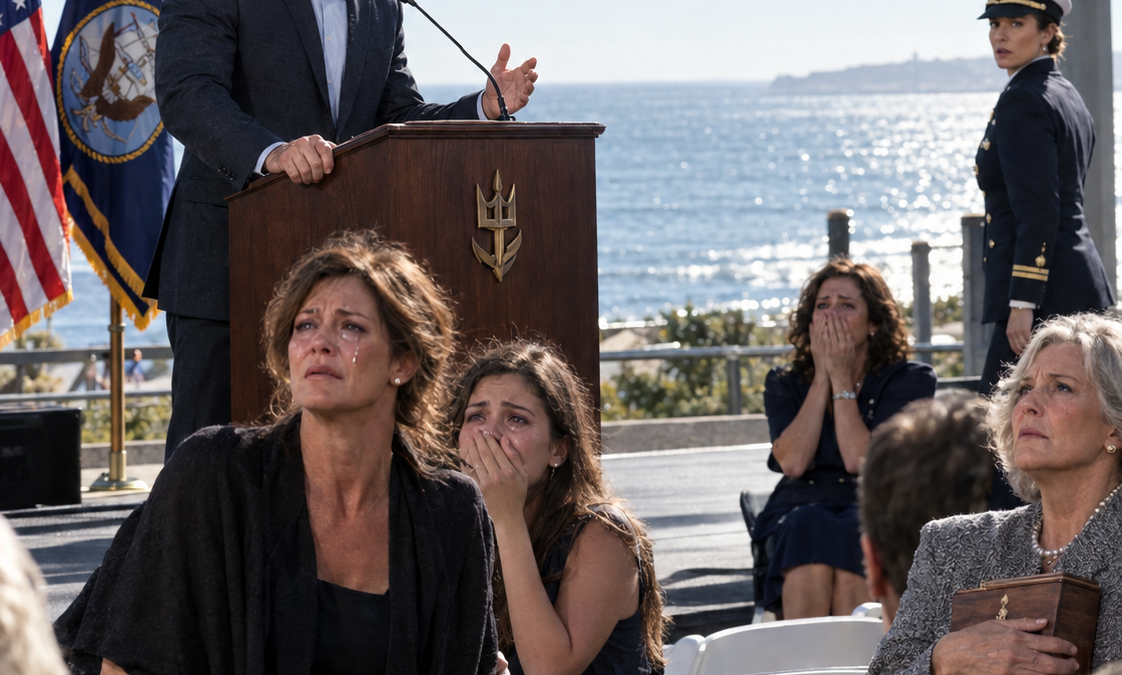
We parked and walked toward the ceremony site. A large outdoor pavilion overlooking the ocean. White chairs. A stage. A podium.
People were already there. Hundreds of them.
I saw Foster first. She was in her dress blues.
“Mr. Vance.”
“Commander.”
“You’re early.”
“I’m always early.”
She smiled.
“The Secretary will arrive in thirty minutes. The ceremony starts at ten.”
“Who’s speaking?”
“The Secretary. The CNO. A representative from the teams. And—” She paused. “You.”
I stopped.
“Me?”
“We didn’t tell you because we didn’t want you to back out.”
“Foster—”
“You don’t have to give a speech. Just say a few words. About the men. About the operation. Whatever you want.”
I looked at the stage.
“I don’t do speeches.”
“You do today.”
I found Rachel in the third row. She was sitting with Emily. Emily was nineteen now. A sophomore at James Madison. She had her father’s eyes.
“Tom,” Rachel said. “This is Emily.”
Emily stood up.
“Mr. Vance.”
“Call me Tom.”
She hugged me. I didn’t expect it.
“Thank you,” she said. “For what you did.”
“I didn’t do anything.”
“You carried my dad out. That’s not nothing.”
I didn’t know what to say.
So I didn’t say anything.
The ceremony started at ten.
The Secretary of the Navy spoke first. He talked about service. About sacrifice. About the men and women who serve in silence.
Then the CNO spoke. He talked about the teams. About the brotherhood.
Then a representative from the SEAL community spoke. He read the names.
Michael Aronson.
David Whitmore.
Brian Mackey.
Allan Ross.
James Chen.
Five names. Five men who died. Four in combat. One years later, from a heart that had carried too much for too long.
I listened.
Then Foster walked to the podium.
“Ladies and gentlemen, it’s my honor to introduce Lieutenant Thomas Vance, United States Navy, retired. Lieutenant Vance served sixteen years as a Navy SEAL, eight of those with Naval Special Warfare Development Group. He was awarded the Bronze Star with Valor, two Purple Hearts, and numerous other citations. He was the team leader on Operation Nightingale.”
She stepped back.
I stood up.
I walked to the podium.
The audience was quiet.
I looked at the crowd. Hundreds of faces. Families. Veterans. Dignitaries.
I looked at Rachel. At Emily.
I looked at Helen.
I looked at the box of David’s letters, sitting on a chair next to Elizabeth Whitmore.
“I didn’t write a speech,” I said.
A few people laughed.
“I was told I should say something. So I’m going to say something.”
I paused.
“Twenty years ago, I led a team into a compound in Afghanistan. We were there to extract a target. We were told the compound was lightly guarded. It wasn’t.”
I looked at the families.
“We got the target. But we lost two men. Michael Aronson. David Whitmore.”
I paused.
“I made the call that day. I ordered the breach. I ordered the exit. I made the decisions that put those men in harm’s way.”
I looked at Rachel.
“Michael Aronson was a father. A husband. A man who loved his family more than anything. He died covering our retreat. He died so the rest of us could get out.”
I looked at Elizabeth.
“David Whitmore was the best of us. He was the first one in and the last one out. He died in my arms.”
I paused.
“I’ve spent twenty years carrying those deaths. Not because I blame myself. Because I remember them. Every day. Every hour.”
I looked at the crowd.
“Today isn’t about me. It’s not about the medals. It’s not about the ceremony. It’s about the men who didn’t come home. It’s about the families who waited for them.”
I looked at Emily.
“Emily, your father was a hero. Not because he died. Because he lived. Because he served. Because he loved you.”
She was crying.
“David, Elizabeth. Your brother was the bravest man I ever knew. He never asked for anything. He never complained. He just did his job.”
I paused.
“I’m not going to tell you that their deaths were worth it. I don’t know if they were. But I know that their lives were. And I know that their service mattered.”
I looked at the crowd one more time.
“That’s all I have to say. Thank you.”
The applause started slowly.
Then it grew.
People stood. The Secretary. The CNO. The families. Everyone.
I stood at the podium.
I didn’t feel like a hero.
I felt like a man who’d finally told the truth.
After the ceremony, people came up to me.
One by one. Veterans. Widows. Children. They shook my hand. They thanked me. They told me stories about men I’d never met.
A woman in her seventies told me her son had served with me in 2002. He’d died the year after. She wanted me to know he’d always talked about me. About how I’d kept him alive.
I didn’t remember her son’s name.
I should have.
I told her I was sorry.
She said I shouldn’t be.
Elizabeth found me near the parking lot.
“Thomas.”
“Elizabeth.”
She handed me the box again.
“I want you to keep this. All of it. The letters. The medals. Everything.”
“I can’t.”
“You can. He would have wanted you to have it.”
I took the box.
“Thank you.”
She kissed my cheek.
“Thank you for bringing him home.”
I walked to the car with Helen.
“How do you feel?” she asked.
“Tired.”
“Anything else?”
I looked at the ocean.
“Light,” I said. “I feel light.”
She took my hand.
“Let’s go home.”
The flight home was quiet.
I slept for most of it. The first real sleep I’d had in weeks.
When we landed, my phone buzzed.
A text from Victor.
You did good, kid.
I smiled.
Then another text. From Foster.
The Secretary wants to meet with you. Tuesday. His office.
I looked at the message.
What about?
He wants to talk about a position. Advisor. Special operations. You don’t have to say yes.
I put the phone down.
Helen looked at me.
“What is it?”
I told her.
She was quiet for a moment.
“Do you want to do it?”
“I don’t know.”
“You’ve been retired for ten years.”
“I know.”
“You’ve built a life.”
“I know.”
“So what do you want?”
I looked out the window. The lights of Virginia. The place I’d called home for fifteen years.
“I want to help,” I said. “That’s all I’ve ever wanted.”
She took my hand.
“Then help.”
 [Tap here for the Next Part ]


