“You should have let him drown.”
“The child had been underwater for one minute and forty seconds.
I counted.
Not because I wanted to. Because I couldn’t stop counting.”
Douglas Ashworth thought a false police report would bury me → his son grew up to become a doctor, named his firstborn after me, and came back to say thank you.
The pool was Olympic-sized, the kind you see in magazines. Heated. Saltwater. Underwater lighting that made the whole thing glow turquoise. Fifty or sixty people stood around it in linen shirts and sundresses, holding mojitos and champagne flutes, laughing at something the host had said. Music pumped through hidden speakers. A catering staff of twelve moved through the crowd with silver trays.
Nobody was watching the water.
I was standing by the gate, the one I’d been asked to leave through ten minutes earlier. I had my hand on the latch when I saw the boy go under.
What they didn’t know was that I’d spent thirty years watching water.
My name is Michael Reyes. I was fifty-four years old when I pulled Douglas Ashworth’s son off the bottom of his pool. I’m a former Air Force Pararescueman. PJ. The ones who jump out of helicopters into the ocean to save people who are already drowning.
I’d done it for twenty-two years. I’d pulled forty-one people out of the water alive. I’d pulled three out dead.
I knew what drowning looked like before it looked like drowning.
The boy’s name was Tyler. He was seven. He had on a blue rash guard and yellow floaties that had slipped off one arm. He’d been playing near the deep end, near the diving board, where the adults had told him not to go. His mother was inside getting another drink. His father was holding court by the grill, telling a story about a business deal, his laugh carrying across the whole yard.
Tyler went under without a sound.
That’s the thing about drowning. It’s quiet. It’s not like the movies. There’s no splashing, no screaming, no arms waving in the air. A child slips under and the water closes over them like nothing happened.
I saw his head dip below the surface. I saw the bubbles. I saw the yellow floatie drift away from his arm.
I dropped my bag and ran.
Earlier that afternoon, Douglas Ashworth had called me a “difficult old man” in front of his wife and three of his neighbors.
We’d been standing in his kitchen. He’d invited me over—well, his wife had invited me, and he’d tolerated it—to discuss the fence line between our properties. The fence was old. It leaned. Some of the posts had rotted through. I’d offered to split the cost of a new one, a simple cedar privacy fence, nothing fancy.
Douglas had laughed at me.
“Michael, I don’t think you understand how things work in this neighborhood,” he’d said. He was a big man, six-two, with the kind of build you get from golf and steak dinners. Silver hair, tanned face, a smile that never reached his eyes. “We don’t do ‘split the cost’ here. If you want a fence, you pay for a fence. On your side of the property line.”
“I’m not asking you to pay for anything,” I’d said. “I’m asking if you want to go in together. It’s cheaper for both of us.”
“I don’t need cheaper.”
His wife, Christine, had looked at the floor. One of the neighbors—a woman named Patricia who lived three houses down—had made a small noise and looked away.
I’d nodded. “Okay. I’ll handle my side.”
“See that you do.”
I’d turned to leave. And that’s when he’d said it.
“You know, Michael, you’ve been here two years now and you still haven’t figured out how this place works. Everyone here has money. Everyone here has connections. And then there’s you. Living in that little house your uncle left you, driving that old truck, doing God knows what all day. You’re a difficult old man. You know that?”
I’d stopped at the door.
I’d learned a long time ago not to react. Not to give people the satisfaction. I’d learned it in places where reacting could get you killed. Where staying calm was the only way to survive.
I’d turned around and looked at him.
“I’m sorry you feel that way,” I’d said.
And I’d walked out.
That was ten minutes before his son almost drowned.
The gate latch was cold under my hand. I remember that. The metal was cold even though it was August, even though the sun had been baking the whole neighborhood all day.
I heard the splash when I hit the water.
I heard someone scream.
I was already under.
The pool was twelve feet deep at the diving board end. Tyler was on the bottom, face down, his arms floating out to the sides. His eyes were open. His mouth was open. He wasn’t moving.
I got to him in four seconds.
I hooked my arm under his chest, rolled him over, and kicked for the surface. My lungs were burning by the time we broke through. I gasped and pulled him against me, his head lolling back against my shoulder.
He wasn’t breathing.
I swam to the edge with one arm, holding him with the other. Someone grabbed my shoulder, tried to help. I shook them off. I needed space. I needed to work.
I laid Tyler on the concrete and checked his airway. Clear. I checked his pulse. Thready. Faint. I tilted his head back, pinched his nose, and started rescue breaths.
One. Two.
I started compressions. Thirty. Hard and fast. The way I’d been trained. The way I’d done it a hundred times before, on beaches and oil rigs and the decks of sinking ships.
“Call 911,” I said. My voice was calm. I don’t know how. “Now.”
Someone was crying. Someone else was yelling. I heard Douglas’s voice, loud and confused, asking what was happening, asking who was touching his son.
I ignored him.
Two more breaths. Thirty more compressions.
Tyler’s chest rose. Fell. Rose. Fell.
I kept going.
I’d been doing this for two minutes when I heard the sirens.
The paramedics took over six minutes later. Tyler was breathing by then. Shallow, irregular, but breathing. His color was coming back. His eyes were moving behind his lids.
I stepped back and let them work.
My hands were shaking. They always did after. The adrenaline leaves and something else takes its place. Something that remembers every other time, every other child, every other face that didn’t come back.
I sat down on the edge of a lounge chair and put my head in my hands.
That’s when Douglas found me.
“What the hell were you doing?” he said.
I looked up.
He was standing over me, his face red, his hands clenched. His wife was behind him, holding Tyler’s hand as the paramedics loaded him onto a gurney. Christine was crying. She kept saying his name, over and over, like a prayer.
“I was saving your son’s life,” I said.
“You were—” He stopped. His mouth opened and closed. “You were supposed to leave. I told you to leave. You had no right to be here.”
I stood up. Slowly. I’m not a big man. Five-ten, one-seventy. But I’ve been told I have a way of standing that makes people step back.
“I was at the gate when I saw him go under,” I said. “If I’d left, he would have been underwater for four minutes. Maybe five. Do you know what happens to a child’s brain after four minutes without oxygen?”
He didn’t answer.
“Neither did anyone else at this party,” I said. “Because nobody was watching the pool.”
Christine made a sound. A sob. She looked at her husband, and there was something in her eyes I couldn’t read. Something between fear and anger and grief.
“The paramedics said he’s going to be okay,” she said. “They said if he’d been under much longer—”
She couldn’t finish.
I nodded. “He’s going to be okay.”
Douglas was still staring at me. His face had gone pale. His hands were still clenched, but they were shaking now.
“You,” he said. “You did this.”
“I did what anyone should have done.”
“No.” He shook his head. “No, you don’t understand. You don’t—”
He stopped.
The paramedics were wheeling Tyler toward the ambulance. Christine went with them. Douglas stood there for a moment, watching them go, and then he turned back to me.
“This isn’t over,” he said.
I didn’t know what he meant. Not then.
I would find out.
I walked home that night.
It was only a quarter mile, down the private road that curved through the neighborhood, past the manicured lawns and the wrought-iron gates and the driveways full of German cars. The sun was setting. The sky was orange and pink and gold.
I thought about Tyler. I thought about his face on the bottom of the pool, his eyes open, his mouth open. I thought about the way his chest had risen when I breathed for him.
I thought about the other children. The ones I hadn’t been able to save.
I unlocked my front door and stepped inside. The house was quiet. It was always quiet. My wife had died six years ago. Cancer. I’d been overseas when she got the diagnosis. I’d come home as fast as I could, but by then it was already too late.
I’d retired a year after she died. Hung up my beret. Moved into my uncle’s old house, the one he’d left me in his will. It was supposed to be a fresh start. A quiet life.
It had been anything but.
I poured myself a glass of water and sat down at the kitchen table. My hands had stopped shaking. My heart rate had returned to normal. I was tired in a way that had nothing to do with physical exhaustion.
The phone rang.
I looked at the screen. Unknown number.
I answered.
“Michael Reyes?”
“Yes.”
“This is Detective Sandra Chen with the county sheriff’s office. I need to ask you a few questions about an incident at the Ashworth residence this evening.”
I closed my eyes.
“I’m listening,” I said.
“Can you tell me what happened?”
I told her. All of it. The fence. The argument. The gate. The boy. The CPR. Douglas’s anger.
She was quiet for a moment when I finished.
“Mr. Reyes, did you enter the Ashworth property after being asked to leave?”
“I was at the gate,” I said. “I hadn’t left yet.”
“But you were asked to leave.”
“Yes.”
“And you stayed.”
“I was leaving. I had my hand on the latch.”
“But you didn’t leave.”
“No.”
“Because you saw the boy go under.”
“Yes.”
“And you went in.”
“Yes.”
She was quiet again. I could hear her breathing on the other end of the line. I could hear the faint sound of a keyboard, someone typing.
“Mr. Reyes, I need you to understand something,” she said. “Mr. Ashworth has filed a complaint against you. He’s claiming you trespassed on his property and assaulted his son.”
The words hit me like a physical blow.
“Assaulted,” I said. “I performed CPR. I saved his life.”
“He’s claiming you were rough with the boy. That you caused additional injuries.”
“That’s not true.”
“I understand. But I need to ask you some more questions. Can you come down to the station tomorrow morning?”
I looked out the window. The sky had gone dark. The streetlights were coming on, one by one, casting pools of yellow light on the sidewalk.
“I’ll be there,” I said.
I hung up and sat in the dark for a long time.
The next morning, I was at the station at eight o’clock.
Detective Chen was younger than I expected. Thirty-five, maybe. Black hair pulled back in a ponytail. Sharp eyes. She didn’t smile when she saw me.
We sat in a small interview room. White walls. Fluorescent lights. A table bolted to the floor. The kind of room I’d seen a hundred times before, in a hundred different countries.
She asked me the same questions she’d asked on the phone. I gave her the same answers.
She asked me about my background.
“I’m a retired Air Force pararescueman,” I said.
Her eyebrows went up.
“Pararescue,” she said. “That’s—”
“Search and rescue. Combat rescue. We jump out of helicopters to save people.”
“How long?”
“Twenty-two years.”
She looked at me for a moment. Then she looked down at her notes.
“Mr. Reyes, I’m going to be honest with you,” she said. “This is a difficult situation. Mr. Ashworth is a well-known figure in this community. He has connections. He’s made a lot of phone calls.”
“I’m sure he has.”
“The district attorney’s office is going to look at this carefully. They’re going to want to know why you were on his property. Why you didn’t leave when you were asked.”
“I was leaving. I saw the boy go under.”
“You could have called 911 from the street.”
“I could have. But he would have been underwater for four minutes by the time anyone got there. That’s brain damage. That’s death.”
She was quiet.
“I’ve seen what happens when you wait,” I said. “I’ve seen it too many times.”
She nodded slowly. “I believe you, Mr. Reyes. But it’s not up to me.”
“What does that mean?”
“It means the DA is going to decide whether to press charges. And given Mr. Ashworth’s influence—”
She didn’t finish the sentence. She didn’t need to.
I understood.
The next week was the longest of my life.
I couldn’t sleep. I couldn’t eat. I sat in my kitchen and stared at the wall and thought about Tyler Ashworth, seven years old, lying on the concrete with water in his lungs.
I thought about his father. About the way Douglas had looked at me, the way he’d said “This isn’t over.”
I thought about the other neighbors. Patricia, who’d looked away when Douglas called me a difficult old man. The others, who’d stood in the kitchen and watched and said nothing.
I thought about my wife. About the way she used to look at me when I came home from a deployment, tired and hollow-eyed and carrying things I couldn’t talk about. She never asked. She just held my hand and let me be quiet.
I missed her.
I missed her so much it was a physical ache in my chest.
On Thursday, a reporter called. A woman from the local paper, wanting to know if I had any comment on the “incident at the Ashworth residence.”
“No comment,” I said.
On Friday, someone spray-painted “TRESPASSER” on my driveway.
I washed it off with a hose and a scrub brush. My hands didn’t shake. They were steady. They were always steady.
On Saturday, I got a letter from the DA’s office. It said they were “reviewing the matter” and would “be in touch.”
On Sunday, I went to church.
I’m not a religious man. Not really. But I go sometimes, when I need to be somewhere quiet. Somewhere with high ceilings and stained glass and the smell of old wood.
The pastor spoke about forgiveness. About turning the other cheek. About loving your enemies.
I sat in the back row and listened.
When the service ended, I walked home. The sun was out. The birds were singing. It was a beautiful day.
I didn’t feel beautiful.
I felt tired. Tired in my bones. Tired in a way that sleep couldn’t fix.
I was walking up my driveway when I saw the car.
A black SUV. Government plates.
A man in a dark suit was standing on my porch.
He turned when he heard me coming.
“Mr. Reyes?”
“Yes.”
“Colonel James Whitfield. I’m with the Air Force. I need to talk to you about Tyler Ashworth.”
I stopped.
The world stopped with me.
“What about him?” I said.
The colonel looked at me. His face was unreadable. But there was something in his eyes. Something that looked like respect.
“He’s alive because of you,” he said. “And there are some people who want to make sure everyone knows it.”
PART 2 — THE COLONEL
I invited him inside.
He stepped into my kitchen and looked around. Small room. Old appliances. A single coffee cup on the counter. The house had been my uncle’s, and I’d never bothered to change much. It still had his curtains, his clock, the picture of his wife on the wall.
“Nice place,” the colonel said.
“It’s quiet.”
“Quiet is good.”
He sat down at the table without being asked. I made coffee. Neither of us spoke until I’d set the cups down and taken the chair across from him.
“Why is the Air Force interested in a pool party?” I said.
Colonel Whitfield wrapped his hands around his mug. He was in his late fifties. Gray at the temples. A thin scar ran along his jaw, the kind of scar that came from a bad landing, not a bar fight.
“Do you remember a mission in the Adriatic? Two thousand twelve. A fishing trawler went down in a storm. Sixteen crew.”
I remembered.
“Seven survivors,” I said. “We pulled them off a life raft in twenty-foot seas.”
“You pulled them off. Specifically.”
“We were a team.”
“You were the one in the water.”
I didn’t answer.
“The pilot of that rescue helicopter was a lieutenant named Marcus Whitfield.”
I looked up.
“He’s my son,” the colonel said. “He’s a colonel now himself, at Ramstein. When I told him about the Ashworth situation, he knew your name immediately.”
I sat back in my chair.
“Why are you telling me this?”
“Because I want you to understand something, Mr. Reyes. You have friends. More than you know. And some of them have been making phone calls.”
“What kind of phone calls?”
Colonel Whitfield took a sip of his coffee.
“The kind that reach people,” he said. “The kind that get results.”
The story came out slowly over the next hour.
Douglas Ashworth had done more than file a complaint. He’d done more than call the DA. He’d called the county supervisor. He’d called the HOA board. He’d called a friend who knew a friend at the state level.
He’d been building a case. A narrative.
Michael Reyes was a strange old man who lived alone in a house he couldn’t afford. Michael Reyes had been “harassing” him about the fence for months. Michael Reyes had “forced his way” onto the property. Michael Reyes had “attacked” his son.
None of it was true. But truth was a fragile thing when a man like Douglas Ashworth had money and connections and a story everyone in the neighborhood was willing to believe.
“The DA is under pressure,” Colonel Whitfield said. “The complaint is flimsy, but Ashworth has been loud. He’s been calling in favors. He’s been telling people you’re dangerous.”
“Am I?”
The colonel smiled. It was a thin smile. Not unfriendly.
“You’re one of the most decorated PJs of your generation. You’ve got a Silver Star and two Purple Hearts and a list of lives saved that would fill a wall. If you were dangerous, Mr. Reyes, everyone in that neighborhood would already know it.”
I looked down at my coffee.
“I don’t talk about that,” I said.
“I know. That’s why your neighbors think you’re nobody.”
“I’m not nobody. I’m just—”
“A man who does his job and comes home and doesn’t make a fuss. I know the type. I was the type.”
I looked up at him.
“You were a PJ?”
“Combat controller. Attached to PJ teams for most of my career. I jumped with you people more times than I can count. Saw you go into water I wouldn’t swim in on a dare.”
He set his mug down.
“Here’s what’s going to happen, Mr. Reyes. I’ve made some calls. People are going to start asking questions. The DA is going to find out exactly who Douglas Ashworth is trying to destroy. And then—”
“And then what?”
“And then we’ll see who’s still standing.”
He left an hour later.
I stood on my porch and watched the black SUV pull away. The sun was high. The street was quiet. Somewhere down the block, a lawnmower started up.
I went back inside and sat at the kitchen table.
I thought about Marcus Whitfield. The lieutenant from the Adriatic mission. I remembered him. Young. Cocky. A good pilot. He’d put his helicopter in the water twice to get us close enough. He’d held it steady while the waves crashed over the rotors.
I remembered the survivors. Seven men, pulled off a life raft in the dark, their faces blue with cold, their eyes wide with shock. One of them had grabbed my arm and wouldn’t let go. He’d kept saying something in Croatian. I never found out what it meant.
I remembered the ones I couldn’t save.
Nine men had gone into the water that night. Seven came out. The other two were found three days later, tangled in the wreckage, still strapped to their bunks.
I’d been the one to find them.
I’d been the one to cut them loose and carry them up.
That was the job. You didn’t always save everyone. You saved who you could.
I hadn’t thought about that mission in years. I’d buried it, the way I’d buried so much else. The way you had to, if you wanted to live with yourself.
But now it was back. Marcus Whitfield. Colonel Whitfield. The whole chain of people I’d served with and saved and never expected to see again.
They hadn’t forgotten me.
I wasn’t sure how to feel about that.
On Monday morning, I got a call from Detective Chen.
“The DA has decided not to press charges,” she said.
I sat down on the edge of my bed.
“Why?”
“Because the evidence doesn’t support them. The 911 call, the paramedics’ reports, the boy’s own medical records—none of it shows any injury consistent with assault. And the trespass claim is weak. You were at the gate. You never went further than the pool deck.”
“That’s it?”
“That’s not all of it.”
She paused.
“Mr. Reyes, I got a call this morning from the Pentagon. Some colonel in the Air Force. He wanted to confirm that you’re a Silver Star recipient. He wanted me to understand exactly what kind of person Douglas Ashworth was accusing.”
The line was quiet.
“Can I ask you something, Detective?”
“Sure.”
“Why are you telling me this?”
Another pause. Longer this time.
“Because I don’t like bullies,” she said. “And I don’t like watching them win.”
I should have felt relieved.
I didn’t.
The charges being dropped was one thing. The neighborhood was another. The stares. The whispers. The way people crossed the street when they saw me coming.
Patricia, the neighbor from the kitchen, came by on Tuesday. She stood on my porch with a covered dish in her hands. Her face was flushed. She looked like she’d been crying.
“I’m sorry,” she said.
“For what?”
“For not saying anything. When Douglas called you that. When he told you to leave. I should have said something.”
I took the dish from her. It was a casserole. Chicken and rice.
“It’s okay,” I said.
“It’s not okay. I’ve lived here for twelve years. I’ve seen how he treats people. I’ve seen how he treats Christine. And I never said anything. Not once.”
She looked at me.
“You saved that boy’s life, and he’s trying to destroy you. And I just—I stood there.”
“You brought me a casserole.”
She laughed. It was a watery laugh. Half tears.
“It’s not enough.”
“No,” I said. “But it’s something.”
She left a few minutes later. I stood on the porch and watched her walk down the driveway. The neighborhood was quiet. The sun was setting.
I went back inside and ate the casserole alone.
The next day, the article ran.
It was in the local paper, the one that came out every Wednesday. Small circulation. Mostly ads and community announcements and the occasional piece about a school play or a charity drive.
But this article was different.
The headline read: “The Quiet Hero Next Door.”
The reporter had done her homework. She’d talked to Detective Chen. She’d talked to the paramedics who’d responded to the call. She’d talked to Colonel Whitfield.
She’d talked to Christine Ashworth.
“I saw him jump into the pool,” Christine was quoted as saying. “He didn’t hesitate. He didn’t ask permission. He just went in. If he hadn’t been there—”
The quote ended there. The reporter had noted that Christine had been unable to finish the sentence.
The article described my military career in careful, respectful terms. Twenty-two years of service. A Silver Star for a mission in the Adriatic that had saved seven lives. Two Purple Hearts. A list of civilian rescue operations that stretched across three continents.
It described the drowning incident in plain, factual terms. The boy, the pool, the CPR.
It described the aftermath.
“Douglas Ashworth, a prominent local businessman, has filed a complaint against Reyes, alleging trespassing and assault. The district attorney’s office has declined to pursue charges, citing lack of evidence.”
The article was short. Maybe eight hundred words. But it was enough.
By Thursday, everyone in the neighborhood had read it.
By Friday, everyone in the county had read it.
By Saturday, the story had been picked up by a regional news station. Then a national one.
By Sunday, Douglas Ashworth’s phone was ringing nonstop.
He showed up at my door that afternoon.
I was in the kitchen, making coffee. I heard the knock. I opened the door and there he was. Douglas Ashworth. Standing on my porch in a polo shirt and khakis, his face red, his eyes wild.
“You did this,” he said.
I didn’t answer.
“You called the papers. You called your military friends. You set this whole thing up.”
“I didn’t call anyone.”
“Bullshit. That article. That reporter. That colonel. You set it up.”
I stepped out onto the porch. I didn’t raise my voice. I didn’t have to.
“Your son almost died,” I said. “And instead of thanking the person who saved him, you tried to have me arrested. You tried to ruin my life. Why?”
He stared at me.
“You know why.”
“No. I don’t.”
“You made me look bad. You made me look like—”
“Like what?”
He didn’t answer.
“Like a man who doesn’t watch his own son at a pool party? Like a man who lets his kid wander near the deep end while he’s drinking and laughing with his friends?”
His face went pale.
“You don’t know anything about me,” he said.
“I know you’re a bully. I’ve seen it before. In different countries, different uniforms. Men who think they’re entitled to everything and can’t stand it when someone doesn’t bow.”
I took a step closer.
“I’m not going to bow to you, Douglas. I’m not going to apologize for saving your son. And I’m not going to leave this neighborhood because you find me inconvenient.”
He stood there for a long moment. His fists were clenched. His jaw was working.
Then he turned and walked away.
I watched him go.
I didn’t feel triumphant. I didn’t feel satisfied.
I felt tired.
The next week was a blur.
The story spread. The article, the TV spots, the viral social media posts. People I hadn’t seen in years reached out. Old teammates. Men I’d served with. Men I’d saved.
A woman in Michigan sent me a letter. Her son was alive because of a PJ rescue in Afghanistan fifteen years ago. She’d never known who pulled him out of the river. She’d spent fifteen years wondering. Now she knew.
I read that letter three times.
I put it in the drawer with the others.
Colonel Whitfield called on Friday.
“Have you seen the news?” he said.
“I’ve seen it.”
“The Air Force is going to give you a commendation. A formal one. There’s a ceremony next month at Joint Base Andrews. They want you there.”
I was quiet for a moment.
“I don’t want a ceremony.”
“I know. But this isn’t for you. It’s for the boy. It’s for everyone who’s going to read about what you did and know that someone like you exists. That’s what this is about.”
I looked out my kitchen window. The sun was setting. The sky was orange and pink and gold.
“I’ll think about it,” I said.
“That’s all I ask.”
That night, I sat on my porch and watched the stars come out.
I thought about my wife. About the life we’d had together. The deployments, the homecomings, the quiet nights in a house that was never quite ours.
I thought about Tyler Ashworth. Seven years old. Alive.
I thought about Douglas Ashworth. The way he’d looked at me. The way he’d turned and walked away.
And then I thought about the ceremony. The medals. The attention.
I didn’t want any of it.
But I knew I was going to go.
Not for me. For the boy. For all the other boys and girls who’d never know the name of the person who’d saved them.
For the ones I couldn’t save.
I was going to stand there in front of everyone and accept a medal I didn’t feel I’d earned, and I was going to do it because Colonel Whitfield was right. Because people needed to know. Because the truth mattered.
I was going to do it.
But first, I was going to do something else.
I pulled out my phone and scrolled through my contacts. It had been years since I’d called any of them. Years since I’d let myself remember.
I found the name I was looking for.
Marcus Whitfield.
I pressed call.
He answered on the second ring.
“Mr. Reyes,” he said. “I was hoping you’d call.”
PART 3 — THE MISSION
Marcus Whitfield had a voice like his father’s. Calm. Measured. The voice of a man who’d spent his life talking to people in crisis.
“I heard what happened,” he said. “The pool. The kid. The bullshit complaint.”
“Your father told you.”
“He didn’t have to. It was on the news. You’re famous now, Mr. Reyes.”
“I don’t want to be famous.”
“Nobody ever does. That’s what makes it work.”
I leaned back in my chair. The kitchen was dark except for the light over the stove. Outside, the crickets had started up. Loud. Persistent.
“Why did you want me to call?” I said.
“Because I owe you.”
“You don’t owe me anything.”
“I owe you my life. Or at least my career. Maybe both.”
I remembered the Adriatic. The trawler going down in twenty-foot seas. The helicopter hovering overhead, its rotors screaming, its searchlight cutting through the rain. Marcus had been a kid then. Twenty-six, maybe. Fresh out of flight school. The youngest pilot in the squadron.
“You were good,” I said. “You held that bird steady.”
“I was terrified. I couldn’t see anything. The waves were higher than the rotor disc. Every time I dropped altitude, I thought I was going to lose it.”
“But you didn’t.”
“Because you were on the radio. You kept telling me where to go. Left, right, up, down. You talked me through it like it was a training exercise.”
I remembered that too. Hanging off the rescue hoist, the water crashing over me, the radio pressed to my ear. I’d been screaming coordinates into the mic, trying to keep Marcus from putting the helicopter into the sea.
“You saved my crew,” he said. “You saved me. And I never got to say thank you.”
“You just did.”
“It’s not enough.”
I was quiet.
“I’m going to be at that ceremony,” Marcus said. “My father told me about it. I’m flying in from Ramstein. I want to be there when they pin that medal on you.”
“You don’t have to do that.”
“I know. But I want to.”
He paused.
“And there’s something else. Something you should know.”
“What?”
“Douglas Ashworth has been making calls. Not just to the DA. He’s been reaching out to people in the defense community. Trying to dig up dirt on you.”
I sat up.
“What kind of dirt?”
“He’s claiming you lied about your record. That you embellished your service. That the Silver Star was for something else, something you don’t want people to know about.”
I felt a cold knot form in my stomach.
“And?”
“And he’s wrong. I know he’s wrong. My father knows he’s wrong. But he’s going to try to make a scene at the ceremony. He’s going to try to embarrass you in front of everyone.”
“How do you know that?”
“Because I know men like him. They can’t stand losing. And right now, he’s losing.”
I stood up and walked to the window.
The street was quiet. The houses were dark. Somewhere in the distance, a dog barked.
“Let him try,” I said.
“That’s what I was hoping you’d say.”
I didn’t sleep that night.
I lay in bed and stared at the ceiling and thought about Douglas Ashworth.
He was a man who’d spent his whole life getting what he wanted. Money. Status. Power. He’d built a business, married a beautiful woman, raised a son. He’d bought a house in the best neighborhood in town. He’d made friends with the right people.
And then a retired PJ had moved in next door. A quiet old man with an old truck and a small house and no obvious source of income. A man who didn’t care about status or connections or the way things worked in this neighborhood.
Douglas had tried to put me in my place. And I hadn’t gone.
That was the problem. That was always the problem with men like him. They couldn’t stand it when someone didn’t play the game.
I’d seen it before. In the military, in foreign countries, in war zones. Men who thought their rank or their money or their connections made them invincible. Men who couldn’t understand why anyone would defy them.
And then they met someone who didn’t care.
The next morning, I went for a run.
I ran every morning. Had for thirty years. It was the one habit I’d never been able to break.
The neighborhood was quiet at six a.m. The streets were empty. The lawns were wet with dew. I ran past the Ashworth house and didn’t look at it. I ran past Patricia’s house and saw her light on in the kitchen. I ran past the gate at the end of the road and turned around.
Four miles. Slow and steady. My knees ached. My back ached. Everything ached. But I kept going.
That was the job. You kept going. You didn’t stop. You didn’t quit.
When I got home, there was a car in my driveway.
A silver BMW. New. Expensive.
I slowed to a walk and approached carefully. The driver’s door opened. A woman stepped out.
Christine Ashworth.
She was wearing a simple dress. No makeup. Her hair was pulled back. She looked tired. Tired in a way that went beyond sleep.
“Mr. Reyes,” she said.
“Mrs. Ashworth.”
“I need to talk to you.”
I nodded. “Come inside.”
She sat at my kitchen table and held a mug of coffee she didn’t drink. I sat across from her and waited.
“I’m sorry,” she said.
“For what?”
“For everything. For Douglas. For the complaint. For the way he’s been treating you.”
I didn’t answer.
“I didn’t know,” she said. “Not at first. When he filed the complaint, I thought—I don’t know what I thought. I thought maybe he was right. Maybe you had done something wrong.”
“And now?”
She looked up at me.
“Now I know he’s lying. He’s been lying to me for years. About everything.”
She set the mug down.
“I’m leaving him.”
I was quiet.
“I know it’s not my place to tell you this,” she said. “But I wanted you to know. I wanted you to know that I see what he is. I see what he’s been doing. And I’m not going to let him do it anymore.”
“Does he know?”
“Not yet. He’ll find out when the papers are served.”
She stood up.
“I’m sorry for what he put you through. I’m sorry for what I let him put you through. You saved my son. You saved Tyler. And I’ll never be able to repay that.”
She walked to the door and stopped.
“There’s going to be a ceremony,” she said. “The Air Force is giving you a commendation.”
“Yes.”
“I’ll be there. Tyler too. If you want us to be.”
I looked at her.
“I’d like that,” I said.
She nodded and left.
I stood in the kitchen for a long time after she was gone.
The ceremony was three weeks away.
I spent those weeks preparing. Not for the ceremony. For what came after.
I called old friends. Men I’d served with. Men I’d saved. Men who owed me nothing and would come anyway.
They came from all over the country. A former PJ in Oregon. A flight nurse in Texas. A rescue swimmer in Florida. A combat controller in Virginia.
They didn’t ask why. They didn’t need to. They just said they’d be there.
That was the thing about the community. The ones who’d been through it. The ones who understood.
You didn’t have to explain. You didn’t have to justify. You just had to ask.
Colonel Whitfield called again on a Tuesday.
“The ceremony’s been moved,” he said.
“Moved where?”
“To the base. Joint Base Andrews. The Air Force wants to make it official. They’re going to give you the commendation in front of a full formation.”
I was quiet.
“That’s a big deal,” he said. “They don’t do that for everyone.”
“I know.”
“There’s going to be press there. National press. The story’s gotten bigger than the neighborhood.”
I closed my eyes.
“I don’t want this.”
“I know you don’t. But it’s happening. And there’s something else you need to know.”
“What?”
“Douglas Ashworth is going to be there. He’s been calling the base. Trying to get himself invited.”
“Why?”
“Because he wants to confront you. In front of everyone. He wants to make you look like a fraud.”
I opened my eyes.
“Let him come,” I said.
“Mr. Reyes—”
“Let him come. I’ll be ready.”
The night before the ceremony, I sat on my porch and watched the sun go down.
I thought about my wife. About the way she used to sit with me on nights like this. Quiet. Patient. Waiting for me to come back from wherever I’d gone in my head.
I thought about the Adriatic. The trawler. The seven survivors. The two bodies.
I thought about Tyler Ashworth. Seven years old. Alive because I’d been at the gate.
I thought about Douglas Ashworth. A man who’d tried to destroy me because I wouldn’t bow.
I thought about all the men and women I’d served with. The ones who’d died. The ones who’d lived. The ones who’d come home to families that didn’t understand them, to neighborhoods that didn’t know them, to lives that never quite fit.
I was one of them. I’d always been one of them.
But tomorrow, that was going to change.
Tomorrow, I was going to stand in front of the world and let them see who I really was.
Not for me. For all of us.
I went inside and went to bed.
I slept better than I had in weeks.
PART 4 — THE FORMATION
Joint Base Andrews was bigger than I remembered.
I’d been there a dozen times over the years. For training. For briefings. For ceremonies I’d mostly skipped. But I’d never been there as the guest of honor. Never as the reason a formation had been called.
I parked my truck in the visitor lot and sat for a moment with my hands on the wheel.
I was wearing my dress blues. The old ones. The ones that still fit because I’d never let myself go. The ribbons were arranged in rows on my chest. The Silver Star. The Purple Hearts. The Air Force Cross. The other ones. The ones that didn’t mean anything to anyone outside the community.
I looked at myself in the rearview mirror.
I looked old. Tired. The lines around my eyes had deepened. The gray in my hair had spread.
But I was still here.
I got out of the truck and walked toward the hangar.
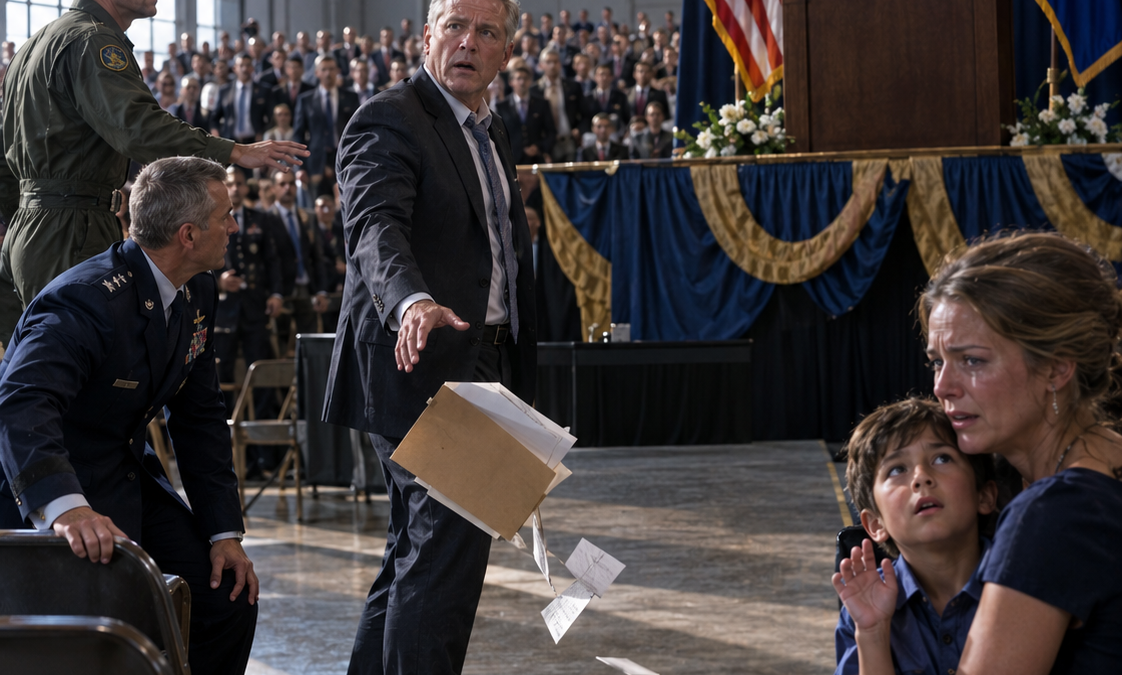
The hangar was massive. Steel beams. Concrete floor. A stage at one end, draped in blue and gold. Rows of folding chairs. A podium with a microphone. Flags everywhere. The American flag. The Air Force flag. Unit colors I didn’t recognize.
There were already people there. A lot of them. More than I’d expected.
I saw Colonel Whitfield first. He was standing near the stage, talking to a group of officers. He saw me and nodded.
Then I saw Marcus.
He was in his flight suit. Tall. Gray at the temples now. He looked like his father. The same calm eyes. The same steady presence.
He walked over to me and extended his hand.
“Mr. Reyes.”
“Colonel.”
“Marcus. Please.”
I shook his hand.
“You look good,” he said.
“I look old.”
“That too.”
I laughed. It surprised me. I hadn’t laughed in weeks.
“Come on,” he said. “There’s someone you should meet.”
He led me across the hangar to a small group of people standing near the back. Two men and a woman. All in civilian clothes. All in their fifties or sixties.
“These are some of the people you saved,” Marcus said.
The first man stepped forward. He was short, stocky, with a thick mustache and a Croatian accent.
“You pulled me off a life raft in the Adriatic,” he said. “I was twenty-three. I thought I was going to die.”
I remembered him. The one who’d grabbed my arm and wouldn’t let go. The one who’d been saying something in Croatian I never understood.
“What were you saying?” I asked. “That night. I never knew.”
He smiled.
“I was saying thank you. Over and over. Thank you.”
I felt something catch in my throat.
“I’m sorry I didn’t understand,” I said.
“You understood. You just didn’t know it.”
The ceremony started at ten.
I sat in the front row. Marcus was on my left. Colonel Whitfield was on my right. Behind me, the hangar was packed. Hundreds of people. Military. Civilian. Press. Cameras.
I didn’t turn around. I didn’t need to.
The base commander gave a speech. He talked about service. About sacrifice. About the men and women who put their lives on the line every day without expecting recognition.
Then he introduced me.
“Master Sergeant Michael Reyes. United States Air Force, Retired. Pararescueman. Silver Star recipient. Twenty-two years of service. Forty-one lives saved in combat and civilian operations.”
I stood up and walked to the podium.
The applause was loud. It went on for a long time. I stood there and waited.
When it died down, I looked out at the crowd.
I saw Patricia. She was sitting in the back, next to a man I assumed was her husband. She was crying.
I saw Christine Ashworth. She was sitting on the aisle, holding Tyler’s hand. The boy was watching me with wide eyes. He looked healthy. He looked alive.
And then I saw Douglas.
He was standing near the back. Arms crossed. Face red. Jaw tight.
He was waiting.
I looked away.
I didn’t give a speech. I’m not a speech guy. I just said thank you. I said the medal wasn’t mine. It belonged to the people I’d served with. The ones who’d died. The ones who’d lived. The ones who’d never gotten the recognition they deserved.
I said I was proud to have served. I said I’d do it again.
Then I stepped back from the podium.
The base commander pinned the commendation to my chest. A new ribbon. A new medal. He shook my hand.
The applause started again.
And that’s when Douglas Ashworth made his move.
He walked down the aisle. Slow. Deliberate. His footsteps echoed in the hangar.
People turned to look. The applause faltered. The cameras shifted.
He stopped in front of the stage.
“Mr. Reyes,” he said. His voice was loud. Loud enough for everyone to hear.
I looked at him.
“Yes?”
“I have a question.”
The base commander stepped forward. “Sir, this is a private ceremony. If you have—”
“It’s okay,” I said.
The commander looked at me. I nodded.
Douglas turned to face the crowd.
“This man,” he said. “This hero. He’s been lying to all of you.”
The hangar went silent.
“He claims he’s a decorated veteran. He claims he saved lives. But I’ve done some digging. I’ve talked to people. And I’ve found out the truth.”
He pulled a folder out of his jacket.
“Michael Reyes didn’t earn that Silver Star. He got it for a mission that went wrong. A mission where people died. He’s not a hero. He’s a fraud.”
The crowd was frozen. Nobody moved. Nobody spoke.
I stood at the podium and looked at Douglas Ashworth.
I’d seen men like him before. In war zones. In bars. In boardrooms. Men who couldn’t stand losing. Men who’d rather burn everything down than admit they were wrong.
I’d learned a long time ago not to react. Not to give them the satisfaction.
But this time was different.
This time, I had backup.
Marcus stood up.
He walked to the edge of the stage and looked down at Douglas.
“Mr. Ashworth,” he said. “I’m Colonel Marcus Whitfield. United States Air Force. I flew the rescue helicopter on the mission you’re talking about.”
Douglas stared at him.
“I was there. I saw what happened. And I can tell you, with absolute certainty, that Michael Reyes is the reason I’m alive. He’s the reason seven men are alive. He’s the reason the mission didn’t end in disaster.”
He paused.
“You’re holding a folder full of lies. I’m holding the truth. And I’m not the only one.”
He turned and gestured to the crowd.
One by one, people stood up.
The Croatian man. The flight nurse from Texas. The rescue swimmer from Florida. The combat controller from Virginia. Men and women I’d served with, saved, bled with.
They stood in silence.
Then Colonel Whitfield stood.
Then the base commander.
Then the entire front row.
Then the row behind them.
Then the row behind that.
Within a minute, the entire hangar was on its feet.
Douglas Ashworth stood alone.
He looked around. His face was white. His hands were shaking. The folder slipped from his fingers and fell to the floor.
“This isn’t—” he started. “You don’t—”
He couldn’t finish.
Two security officers appeared at his side. They didn’t touch him. They didn’t have to. They just stood there, waiting.
Douglas looked at them. Then at me. Then at the crowd.
Then he turned and walked out.
The doors closed behind him with a heavy thud.
The silence lasted a long time.
Then someone started clapping. Then someone else. Then everyone.
The applause was deafening. It filled the hangar. It echoed off the steel beams. It went on and on.
I stood at the podium and let it wash over me.
I didn’t feel triumphant. I didn’t feel vindicated.
I felt tired. And grateful. And sad.
Sad for Douglas Ashworth. A man who’d spent his whole life chasing status and power and had ended up alone, humiliated, in front of everyone who mattered.
Sad for Christine. For Tyler. For the life they’d had and the life they’d lost.
Sad for all the men and women who’d served and come home and been forgotten.
I looked out at the crowd. At the faces. At the people who’d come from all over the country to stand with me.
I thought about my wife. About the way she used to look at me. About the way she’d held my hand and let me be quiet.
I wished she could have been there.
But she wasn’t. She was gone.
And I was still here.
I stepped back from the podium and sat down.
The ceremony was over.
But the story wasn’t.
PART 5 — THE AFTERMATH
The reception was held in a smaller hangar next door.
Tables with white cloths. Trays of food. A makeshift bar. People milling around, talking, laughing, crying. The kind of gathering that happens after funerals and homecomings and ceremonies that mean something.
I stood near the back wall with a cup of coffee I wasn’t drinking.
People came up to me one by one. Strangers. Veterans. Families of people I’d saved. They shook my hand. They told me their stories. They thanked me.
I didn’t know what to say.
I’d spent twenty-two years doing a job. I’d never expected anyone to thank me for it. I’d never expected anyone to remember.
But they did.
Marcus found me an hour in.
He was holding two beers. He handed me one.
“You look like you need this.”
“I don’t drink.”
“I know. But you can hold it.”
I took the beer and held it. He was right. It was something to do with my hands.
“You did good up there,” he said.
“I didn’t do anything.”
“You stood there. You let them see you. That’s more than most people can do.”
I looked at him.
“Your father told me about the calls you made. The people you reached out to. The ones who came.”
Marcus shrugged.
“It wasn’t just me. Word got around. People wanted to be here.”
“Why?”
He looked at me like the answer was obvious.
“Because you’re one of us. Because you spent your whole life saving people and never asked for anything in return. Because when someone tries to tear you down, we’re not going to stand by and watch.”
I didn’t answer.
“You don’t have to say anything,” he said. “I just wanted you to know.”
Christine found me near the end of the reception.
Tyler was with her. He was holding her hand and looking up at me with those wide eyes.
“Mr. Reyes,” she said.
“Mrs. Ashworth.”
“Christine. Please.”
I nodded.
“I wanted to thank you. Again. For everything.”
“You already did.”
“I know. But I wanted to do it in person. In front of Tyler.”
She knelt down next to her son.
“Tyler, this is the man who saved your life.”
Tyler looked at me. He was seven years old. He didn’t understand what had happened. Not really. He just knew he’d been underwater and then he wasn’t.
“Thank you,” he said.
His voice was small. Quiet.
I knelt down so I was at his level.
“You’re welcome,” I said.
“Mommy says you’re a hero.”
“I’m just a man who was in the right place at the right time.”
“That’s what heroes say.”
I smiled. It was the first real smile I’d had in weeks.
“Your mom’s a smart lady.”
He nodded seriously. “She is.”
Christine stood up. She was crying. She didn’t try to hide it.
“I’m filing for divorce,” she said. “I talked to a lawyer yesterday.”
“I’m sorry.”
“Don’t be. It’s the best thing I’ve done in years.”
She looked at me.
“He’s going to try to fight it. He’s going to try to take Tyler. But I’m not going to let him.”
I nodded.
“If you need anything,” I said. “Anything at all.”
“I know. Thank you.”
She took Tyler’s hand and walked away.
I watched them go.
The reception ended at four.
People drifted out in small groups. Handshakes. Hugs. Promises to stay in touch.
I stood by the door and said goodbye to each of them.
The Croatian man. The flight nurse. The rescue swimmer. The combat controller. The dozens of others whose names I’d never known and would never forget.
Colonel Whitfield was one of the last to leave.
He shook my hand.
“You did good, Reyes.”
“I didn’t do anything.”
“You keep saying that. But you did. You showed up. You let people see you. That’s not nothing.”
He paused.
“There’s going to be fallout from this. The press is going to want more. Ashworth is going to try something. He’s not the type to go quietly.”
“I know.”
“Are you ready for that?”
I looked out the hangar door. The sun was setting. The sky was orange and pink and gold.
“I’ve been ready for worse,” I said.
The fallout came faster than I expected.
By Monday morning, the story was everywhere. The ceremony. Douglas’s confrontation. The crowd standing up. The silence.
The local paper ran a follow-up. The regional news stations picked it up. Then the national ones. Then the international ones.
I woke up Tuesday to find a satellite truck parked outside my house.
I didn’t answer the door.
By Wednesday, there were three more trucks.
By Thursday, I’d stopped looking out the window.
The phone rang constantly. Reporters. Producers. People who wanted interviews. People who wanted statements. People who wanted to know what it felt like to be a hero.
I didn’t answer.
I sat in my kitchen and drank coffee and waited for it to pass.
It didn’t pass.
On Friday, a producer from a national morning show showed up at my door. She was persistent. She stood on my porch and knocked for ten minutes.
I opened the door.
“Mr. Reyes,” she said. “I’m—”
“I know who you are.”
“Can I come in?”
“No.”
She blinked.
“I just want to talk to you. Five minutes. That’s all.”
“I don’t do interviews.”
“Why not?”
I looked at her.
“Because I didn’t do anything special. I did my job. I saved a boy’s life. That’s what I was trained to do. It’s not a story. It’s just what happened.”
“But people want to know—”
“People want to know what?”
She hesitated.
“They want to know who you are. What you’ve been through. What it feels like to be a hero.”
“I’m not a hero.”
“You saved seven men in the Adriatic. You saved a child from drowning. You’ve saved dozens of people over twenty-two years. If that’s not a hero, what is?”
I didn’t answer.
“Please, Mr. Reyes. Just five minutes.”
I closed the door.
The next week was worse.
Douglas Ashworth filed a lawsuit. Against me. Against the Air Force. Against the base commander. He claimed defamation. Emotional distress. Interference with his business.
The lawsuit was laughable. Everyone knew it. But it made headlines.
The press loved it. The neighborhood loved it. The whole country loved it.
I hired a lawyer. A woman named Diana Torres. She was in her forties, sharp, no-nonsense. She’d handled cases like this before.
“This is going nowhere,” she told me. “He doesn’t have a case. He’s just trying to stay relevant.”
“He’s trying to hurt me.”
“He’s trying to hurt you. But he’s going to fail. I’ve seen men like him before. They always fail.”
I nodded.
“There’s something else you should know,” she said.
“What?”
“His business is in trouble. The press has been digging. There are allegations of fraud. Tax evasion. Maybe worse.”
I sat back.
“Fraud?”
“His company. Ashworth Development. He’s been under investigation for months. The lawsuit is a distraction. He’s trying to change the narrative.”
I was quiet.
“Mr. Reyes, I know you don’t want to be involved in this. But you are. And the best thing you can do is let it play out. Let the truth come out. It always does.”
I went home and sat on my porch.
The sun was setting. The sky was orange and pink and gold.
I thought about Douglas Ashworth. A man who’d spent his whole life chasing status and power. A man who’d bullied his neighbors and lied to his wife and tried to destroy a stranger because he couldn’t stand being challenged.
And now he was falling apart.
I should have felt satisfied. I should have felt vindicated.
But I didn’t.
I felt tired. Tired in a way that sleep couldn’t fix.
I thought about my wife. About the way she used to sit with me on nights like this. Quiet. Patient. Waiting for me to come back from wherever I’d gone in my head.
I missed her.
I missed her so much it was a physical ache in my chest.
The phone rang.
I looked at the screen. Unknown number.
I almost didn’t answer. I’d stopped answering unknown numbers weeks ago. But something made me pick it up.
“Michael Reyes?”
“Yes.”
“This is Sandra Chen. Detective Chen. From the sheriff’s office.”
I sat up.
“Detective. What can I do for you?”
“It’s not what you can do for me. It’s what I can do for you.”
“What do you mean?”
She paused.
“I’ve been working a case. For the last few months. It’s about Douglas Ashworth. His business. His finances. His connections.”
I was quiet.
“I can’t tell you everything. Not yet. But I can tell you this. The investigation is almost complete. And when it’s done, Douglas Ashworth is going to be facing charges. Serious ones.”
“What kind of charges?”
“Fraud. Embezzlement. Money laundering. Maybe more.”
I closed my eyes.
“Why are you telling me this?”
“Because you deserve to know. Because you’ve been through hell for the last month. Because I don’t like bullies. And because I think you should be prepared.”
“Prepared for what?”
“For what happens next. When the story breaks. When people find out who Douglas Ashworth really is. You’re going to be in the middle of it. Whether you want to be or not.”
I opened my eyes.
“I’m not afraid of him.”
“I know. That’s why I’m calling.”
She paused.
“There’s something else. Something you should know.”
“What?”
“His wife. Christine. She’s been cooperating with us. She’s been giving us information. Documents. Records. Things she found in his office.”
I thought about Christine. About the way she’d looked at me in my kitchen. About the way she’d said she was leaving him.
“She’s been helping you?”
“She’s been helping herself. And her son. She’s trying to protect them. And she’s doing a good job.”
I nodded, even though she couldn’t see me.
“I’m glad,” I said.
“So am I.”
I hung up and sat in the dark for a long time.
The house was quiet. The street was quiet. The whole world seemed to be holding its breath.
I thought about Douglas Ashworth. About the way he’d looked at me in my kitchen. About the way he’d said “This isn’t over.”
He’d been right. It wasn’t over. But not in the way he’d meant.
I thought about Christine. About Tyler. About the life they’d had and the life they were going to have.
I thought about the investigation. The charges. The trial. The press. The whole circus that was coming.
And then I thought about what came after.
When it was all over. When the dust settled. When the cameras left and the reporters moved on and the neighborhood went back to normal.
What then?
I didn’t know.
But I knew I’d be here.
I’d still be here.
The next morning, I went for a run.
Four miles. Slow and steady. My knees ached. My back ached. Everything ached.
But I kept going.
That was the job. You kept going. You didn’t stop. You didn’t quit.
I ran past the Ashworth house and didn’t look at it.
I ran past Patricia’s house and saw her light on in the kitchen.
I ran past the gate at the end of the road and turned around.
When I got home, there was a car in my driveway.
A black SUV. Government plates.
Colonel Whitfield was standing on my porch.
He was holding a folder.
“Mr. Reyes,” he said. “We need to talk.”
 [Tap here for the Next Part ]


