Part 2: “You should have let him drown.”
PART 6 — THE FOLDER
I let him in.
Colonel Whitfield walked to the kitchen table and set the folder down. He didn’t sit. He stood there with his hands on the back of a chair, looking at me.
“You’re not going to like this,” he said.
“I’ve heard that before.”
“This is different.”
I sat down and opened the folder.
The first page was a photograph. A surveillance photo. Grainy. Black and white. It showed Douglas Ashworth standing in a parking garage, talking to a man I didn’t recognize. The man was heavy-set, bald, with a thick neck and a cheap suit.
“Who’s that?” I asked.
“Victor Koval. He runs a construction company in the city. He’s also connected to organized crime. Money laundering. Extortion. The FBI has been watching him for years.”
I turned the page. Another photograph. Douglas and Koval again, this time in a restaurant. They were shaking hands. Koval was smiling.
“Ashworth has been doing business with him for three years,” Whitfield said. “Koval launders money through Ashworth’s development company. Ashworth takes a cut. It’s been going on for a while.”
I looked up at him.
“Why are you telling me this?”
“Because it’s worse than we thought.”
He reached across the table and pulled another page from the folder. A document. A contract. Ashworth Development and Koval Construction. A deal to build a shopping center on the edge of town.
“The shopping center was supposed to be finished two years ago,” Whitfield said. “It’s not. The money’s gone. Millions of dollars. Koval is furious. He’s been threatening Ashworth for months.”
I set the document down.
“Threatening him how?”
“Phone calls. Messages. A few weeks ago, someone threw a brick through Ashworth’s office window. No note. No fingerprints. Just a brick.”
I was quiet.
“Ashworth is scared,” Whitfield said. “He’s been trying to buy time. Trying to find the money. Trying to keep Koval from killing him.”
“Killing him?”
“Koval doesn’t play games. He’s put people in the hospital. He’s put people in the ground. Ashworth knows it. That’s why he’s been so desperate. That’s why he went after you.”
I didn’t understand.
“What does any of this have to do with me?”
Whitfield looked at me.
“Because you’re the one who ruined his plan.”
“What plan?”
“His exit strategy. He was going to sell his house. Use the money to pay Koval. Disappear. Start over somewhere else. But then you saved his son. And the story went national. And now everyone’s watching him. Now he can’t sell the house without people asking questions. Now he can’t disappear.”
I sat back in my chair.
“So he went after me because I saved his son.”
“He went after you because you made him visible. You made him a story. And stories get investigated. Stories get attention. He couldn’t afford attention.”
I looked down at the folder. At the photographs. At the documents. At the whole ugly mess of Douglas Ashworth’s life.
“He was going to let his son die,” I said.
“No. He wasn’t going to let him die. He just wasn’t watching. He was too busy trying to save himself.”
I thought about Tyler. Seven years old. Lying on the bottom of the pool. His father ten feet away, laughing at a story.
“He’s not just a bully,” I said. “He’s a coward.”
“Yes.”
“And now Koval is coming for him.”
“Yes.”
“What happens when Koval finds out about the investigation? When he finds out Christine has been cooperating? When he finds out Douglas can’t pay?”
Whitfield didn’t answer.
I stood up.
“You need to protect them,” I said. “Christine and Tyler. They’re the ones who are going to get hurt.”
“We’re working on it. The FBI is involved now. They’re monitoring Koval. They’re monitoring Ashworth. But it’s complicated.”
“Complicated how?”
Whitfield hesitated.
“Ashworth is still in the house. He’s still with Christine and Tyler. He doesn’t know she’s cooperating. He doesn’t know she’s filing for divorce. If he finds out—”
“He’ll hurt them.”
“Or Koval will. Either way, they’re in danger.”
I walked to the window.
The street was quiet. The sun was high. Somewhere down the block, a lawnmower started up.
“I need to talk to Christine,” I said.
“I know. That’s why I’m here. I want you to come with me.”
We drove to the Ashworth house in the black SUV.
The gates were closed. The driveway was empty. The house looked quiet. Too quiet.
Whitfield pressed the intercom. A moment later, Christine’s voice came through the speaker.
“Yes?”
“Mrs. Ashworth. It’s Colonel Whitfield. I need to talk to you.”
A pause.
“Is Michael with you?”
“Yes.”
Another pause. Then the gate buzzed open.
We walked up the driveway. The front door opened before we reached it.
Christine stood in the doorway. She looked tired. Her hair was pulled back. No makeup. A simple dress. She was holding a cup of coffee she wasn’t drinking.
“Come in,” she said.
We followed her into the kitchen. Tyler was sitting at the table, eating a bowl of cereal. He looked up when he saw me.
“Mr. Reyes!”
“Hey, Tyler.”
“You came back.”
“I did.”
He smiled. It was a good smile. The kind of smile that made you forget about everything else.
“Can I show you my room?”
“Maybe later. I need to talk to your mom first.”
He nodded seriously. “Okay.”
Christine led us into the living room. We sat down on the couch. She sat across from us in an armchair.
“What’s going on?” she said.
Whitfield opened the folder.
“I need to tell you some things about your husband,” he said.
The conversation took an hour.
Whitfield explained everything. The investigation. The fraud. The money laundering. Koval. The threats. The danger.
Christine listened in silence. Her face didn’t change. She’d known some of it. She’d suspected more. But hearing it all laid out was different.
“So he’s a criminal,” she said when Whitfield was done.
“Yes.”
“And he’s been putting my son in danger.”
“Yes.”
“And you want me to help you.”
“We want you to be careful. We want you to be safe. We want you to get out of that house before this blows up.”
She looked at me.
“What do you think?” she said.
I thought for a moment.
“I think you need to leave,” I said. “Tonight. Not tomorrow. Not next week. Tonight. Take Tyler and go somewhere safe.”
“Where?”
“My house. I’ve got an extra room. It’s not much. But it’s safe.”
She looked at me for a long time.
“Why are you doing this?”
“Because I don’t want anything to happen to you or your son.”
“He tried to destroy you.”
“I know.”
“And you’re still willing to help.”
“I’m not doing it for him. I’m doing it for you. And for Tyler.”
She was quiet.
Then she nodded.
“Okay,” she said. “We’ll come.”
They arrived at my house that night.
Christine had two suitcases. Tyler had a backpack full of toys. They stood in my living room and looked around.
“It’s small,” I said.
“It’s perfect,” Christine said.
I showed them to the spare room. It had a bed and a dresser and a window that looked out on the backyard. Nothing fancy. But it was clean. It was safe.
Tyler ran to the window.
“There’s a tree!” he said.
“There is.”
“Can I climb it?”
“Maybe tomorrow.”
He nodded. “Okay.”
Christine put the suitcases down and looked at me.
“Thank you,” she said.
“You’re welcome.”
“I don’t know how to repay you.”
“You don’t have to.”
She nodded. Her eyes were wet.
“I’m going to call my lawyer tomorrow,” she said. “Start the divorce proceedings. Officially.”
“Good.”
“And I’m going to talk to the FBI. Tell them everything I know.”
“Good.”
She looked at me.
“You’re a good man, Michael Reyes.”
“I’m just a man who was in the right place at the right time.”
“That’s what heroes say.”
I smiled. It was the first real smile I’d had in days.
“Your son said the same thing.”
“He’s smart.”
“He is.”
The next week was quiet.
Too quiet.
Douglas didn’t call. Didn’t show up. Didn’t send anyone. The house next door stayed dark. The gates stayed closed.
But I could feel it. Something was building. Something was coming.
I checked the locks every night. I kept my phone charged. I slept with one eye open.
Christine noticed.
“You’re worried,” she said one morning.
“I’m always worried.”
“You think he’s going to do something.”
“I think he’s desperate. And desperate people do desperate things.”
She nodded.
“I know.”
On Thursday, Detective Chen called.
“We’ve got a problem,” she said.
“What kind of problem?”
“Douglas Ashworth is missing.”
I sat up.
“Missing how?”
“He didn’t show up for a meeting with his lawyer yesterday. He didn’t come home last night. His phone is off. His car is gone.”
I was quiet.
“Do you think Koval took him?”
“I don’t know. We’re checking. But there’s something else.”
“What?”
“His financial records. We pulled them this morning. He’s been moving money. Large amounts. Offshore accounts. He’s been planning this for months.”
“Planning what?”
“To disappear. But something went wrong. He didn’t have enough. He was short. And Koval found out.”
I closed my eyes.
“So he ran.”
“Looks like it.”
“And Koval?”
“Koval is looking for him. And Koval is not happy.”
I hung up and sat in the kitchen for a long time.
Christine came in and found me there.
“What’s wrong?” she said.
I told her.
She sat down across from me. Her face was pale.
“He’s gone,” she said.
“He’s gone.”
“And Koval is looking for him.”
“Yes.”
She looked at me.
“What about us? Are we in danger?”
“I don’t know. Maybe. But we’re going to be careful.”
“What does that mean?”
“It means you and Tyler stay here. You don’t leave. You don’t answer the door. You don’t talk to anyone.”
She nodded.
“And you?”
“I’m going to find him.”
“Michael—”
“I’m going to find him before Koval does. Before someone else gets hurt.”
She looked at me.
“You don’t have to do this.”
“I know.”
“You could just let it go. Let the police handle it.”
“I could.”
“But you’re not going to.”
“No.”
She was quiet.
“Why?”
I thought about my wife. About the way she used to look at me. About the way she’d held my hand and let me be quiet.
“Because it’s what I do,” I said. “It’s who I am.”
PART 7 — THE HUNT
I started with the obvious.
Douglas Ashworth had a boat. A forty-foot cabin cruiser he kept at a marina on the bay. He’d mentioned it once, at a neighborhood barbecue, the way men like him mentioned things—loud enough for everyone to hear, casual enough to seem like he didn’t care.
I drove to the marina the next morning.
It was a small place. A dozen slips. A bait shop. A parking lot full of trucks with boat trailers. The kind of place where people knew each other.
I parked my truck and walked to the office.
A man was sitting behind the counter. Sixties. Gray beard. A fishing hat. He looked up when I came in.
“Help you?”
“I’m looking for a boat. Belongs to a friend of mine. Douglas Ashworth.”
The man’s face changed. Not much. Just a flicker. But I saw it.
“Don’t know him.”
“He keeps a cruiser here. Forty-footer. White with blue trim.”
The man shook his head.
“Lots of boats here. Can’t keep track of them all.”
I looked at him. He looked away.
“I’m not a cop,” I said. “I’m not a reporter. I’m just trying to find him before someone else does.”
The man was quiet.
“Someone else?”
“Someone who isn’t as patient as me.”
He looked at me for a long moment. Then he sighed.
“Slip twenty-three. But he’s not there.”
“Where is he?”
“Took the boat out two days ago. Didn’t say where. Didn’t say when he’d be back.”
“Has anyone else been asking about him?”
The man nodded.
“Two guys. Yesterday. Big. Ugly. Didn’t look like boaters.”
“What did you tell them?”
“Same thing I told you. He’s not here.”
“Did they believe you?”
“I don’t know. They left. But they said they’d be back.”
I nodded.
“Thanks.”
“Hey.” The man leaned forward. “Is he in trouble?”
“Yeah.”
“Bad trouble?”
“The worst kind.”
The man was quiet. Then he nodded.
“Good luck.”
I drove to the marina’s edge and parked.
The bay stretched out in front of me. Gray water. Gray sky. A few boats bobbing in the distance. The kind of day that made you want to stay inside.
I sat in my truck and thought.
Douglas had taken his boat. He was running. But he couldn’t run forever. He’d need fuel. Food. Water. He’d need to come back to shore eventually.
Or he’d try to leave the country.
I pulled out my phone and called Colonel Whitfield.
“Ashworth’s gone,” I said. “Took his boat. Been gone two days.”
“I know. We’ve been tracking him.”
“You have?”
“The Coast Guard has been monitoring the marina. They’ve got a boat in the area. But they can’t board him without cause.”
“What about Koval?”
“Koval’s men have been asking around. They’re getting closer.”
“How close?”
“Too close.”
I looked out at the water.
“I need to find him first.”
“I know. That’s why I’m sending you something.”
“What?”
“Coordinates. A place he might be heading. A small island about thirty miles off the coast. He’s got a storage unit there. We found the rental agreement in his financial records.”
I started the truck.
“Send them.”
The island was called Pelican Key.
It was barely an island. A quarter mile of sand and scrub and a few dozen houses. Most of them seasonal. Empty this time of year.
I rented a boat from a marina on the mainland and headed out at dawn.
The water was calm. The sky was clear. The sun was coming up over the horizon, painting everything gold and pink.
I thought about my wife. About the way she used to love the water. About the way she’d stand on the beach and close her eyes and let the wind hit her face.
I missed her.
I missed her every day.
I reached Pelican Key in two hours.
The island had a small harbor. A few docks. A general store. A restaurant that was closed for the season.
I tied up my boat and walked into town.
It didn’t take long to find the storage unit. It was on the edge of the island, a row of metal sheds behind a chain-link fence. Unit fourteen. The lock was new.
I didn’t have a key. But I didn’t need one.
I’d learned a long time ago how to get into places that were locked.
The storage unit was full of boxes.
Clothes. Papers. A safe. A duffel bag full of cash. Passports. A gun.
I didn’t touch the gun.
I sat on a box and looked around.
Douglas had been planning this for months. Maybe years. He’d been moving money. Gathering documents. Preparing to disappear.
But he’d run out of time.
I heard the boat before I saw it.
A low rumble. Getting closer. Then the sound of an engine cutting out. Voices.
I stood up and walked to the door of the storage unit.
Two men were walking up the dock. Big. Ugly. The same two who’d been to the marina.
I stepped out of the unit and closed the door behind me.
They stopped when they saw me.
“Who the hell are you?” one of them said.
“Nobody.”
“Where’s Ashworth?”
“I don’t know.”
“You’re lying.”
“I’m not.”
The bigger one stepped forward. He was six-four, maybe two-fifty. A neck like a fire hydrant. Hands like shovels.
“We’re going to ask you one more time. Where’s Ashworth?”
I looked at him.
“I don’t know.”
He swung.
I ducked.
I’d been out of the game for a long time.
But some things you never forget.
The way to move. The way to breathe. The way to stay calm when someone’s trying to kill you.
I stepped inside his swing and hit him in the throat.
Not hard. Just enough. He gasped and staggered back.
The second man pulled a knife.
I backed up. Hands open. Eyes on the blade.
“Don’t do this,” I said.
He didn’t listen.
He lunged.
I sidestepped and grabbed his wrist. Twisted. The knife clattered to the ground.
I kicked it into the water.
He stared at me.
“Who the hell are you?”
“Someone who doesn’t want to hurt you.”
“Too late for that.”
He swung. I blocked. Hit him in the ribs. He went down.
The first man was getting back to his feet. I turned to face him.
“Stay down,” I said.
He didn’t.
I hit him again. Once. Twice. He went down and stayed down.
I stood there, breathing hard, looking at the two men on the ground.
They were alive. They’d be sore tomorrow. But they’d be alive.
I walked back to the storage unit and sat down on a box.
My hands were shaking.
Not from fear. From something else. Something older.
I’d spent twenty-two years learning how to hurt people. How to stop them. How to survive.
I’d spent the last six years trying to forget.
But it never really goes away.
The men left an hour later.
They crawled back to their boat and motored away. They didn’t look at me. They didn’t say anything.
I sat in the storage unit and waited.
I didn’t know what I was waiting for. Maybe for Douglas to show up. Maybe for someone else.
Maybe for nothing.
The sun went down. The island got dark. The stars came out.
I thought about my wife. About the life we’d had. About the life we’d lost.
I thought about Tyler. Seven years old. Alive because I’d been at the gate.
I thought about Douglas. A coward. A criminal. A man who’d tried to destroy me because I wouldn’t bow.
And then I heard it.
A boat. Coming closer.
I stood up and walked to the door.
A small motorboat was pulling into the dock. One man. Alone.
Douglas Ashworth.
He didn’t see me until he stepped onto the dock.
When he did, he froze.
“You,” he said.
“Me.”
“How did you find me?”
“Doesn’t matter.”
He looked around. Nervous. Scared.
“Are they here?”
“Who?”
“Koval’s men. They’ve been following me for days.”
“They were here. I sent them away.”
He stared at me.
“You sent them away?”
“I discouraged them.”
He looked at me for a long moment. Then he laughed. It was a hollow laugh. A broken laugh.
“You. You’re the one who ruined everything. You saved my son. You made me visible. You brought the whole world down on my head.”
“I didn’t do anything. I just saved a boy’s life.”
“You should have let him drown.”
The words hung in the air.
I didn’t move. I didn’t speak.
“You should have let him drown,” Douglas said again. “Then none of this would have happened. I’d have my money. I’d have my life. I’d be gone.”
I looked at him.
“You’d rather your son be dead than be caught.”
“Yes.”
I felt something cold settle in my chest.
“You’re not a coward,” I said. “You’re something worse.”
“What’s worse than a coward?”
“A man who’d trade his own child for a clean escape.”
He didn’t answer.
“You’re going to turn yourself in,” I said. “You’re going to tell the FBI everything. You’re going to cooperate. And you’re going to spend the rest of your life in prison.”
He laughed again.
“And if I don’t?”
“Then I’ll call Koval. Tell him where you are. Let him deal with you.”
He went pale.
“You wouldn’t.”
“Try me.”
He stared at me. His hands were shaking. His face was twitching.
“You’re bluffing.”
I pulled out my phone.
“Am I?”
He looked at the phone. Then at me. Then at the water.
“I’ll turn myself in,” he said.
I called Detective Chen.
She was there in an hour. With a team. With a boat. With handcuffs.
Douglas didn’t resist. He didn’t say anything. He just stood on the dock and let them take him.
As they led him to the boat, he turned and looked at me.
“Why?” he said.
“Why what?”
“Why did you come looking for me? After everything I did to you. Why didn’t you just let Koval find me?”
I looked at him.
“Because I don’t get to choose who lives and who dies,” I said. “I never did. I just try to save as many as I can.”
He stared at me.
Then they took him away.
I stood on the dock and watched the boat disappear into the dark.
The stars were out. The water was calm. The island was quiet.
I thought about my wife. About the way she used to look at me. About the way she’d held my hand and let me be quiet.
I thought about Tyler. About Christine. About the life they were going to have.
I thought about Douglas. About the way he’d looked at me. About the way he’d said “You should have let him drown.”
I’d met men like him before. In war zones. In bars. In boardrooms. Men who’d trade anything for a clean escape. Men who’d sacrifice anyone for their own survival.
They never won. Not in the end.
I got in my boat and headed back to the mainland.
The sun was coming up. The sky was orange and pink and gold.
It was going to be a beautiful day.
PART 8 — THE RECKONING
The news broke on a Tuesday.
Douglas Ashworth had been arrested. Charged with fraud. Embezzlement. Money laundering. Conspiracy. The list went on for three pages.
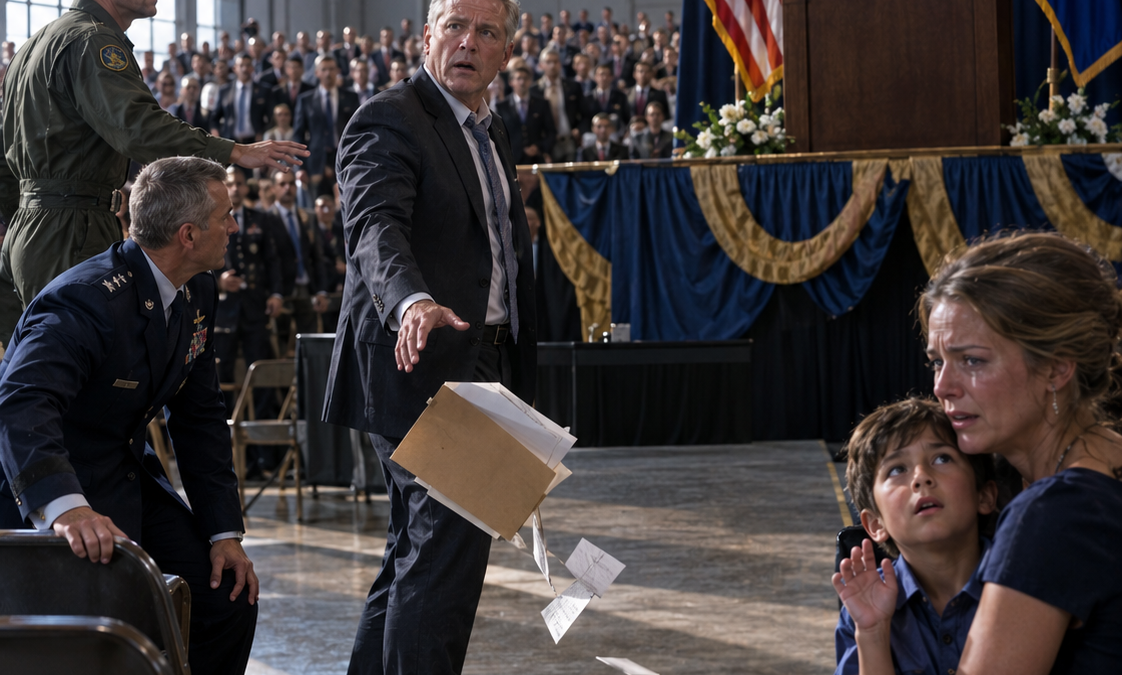
The story ran on every network. Every paper. Every website. The photograph they used was the one from the ceremony—Douglas standing alone in the hangar, his face white, his folder on the floor, the entire crowd on their feet behind him.
The headline was simple. “The Man Who Tried to Destroy a Hero.”
I didn’t read the article. I didn’t need to.
The trial took six months.
I testified. So did Christine. So did Colonel Whitfield. So did Marcus. So did the Croatian man and the flight nurse and the rescue swimmer and the combat controller.
Douglas sat at the defense table and stared at me the whole time. He didn’t blink. He didn’t move. He just stared.
I stared back.
When the verdict came in—guilty on all counts—he didn’t react. He just sat there. Then they led him away.
The judge gave him twelve years.
Koval was arrested two weeks later.
The FBI had been building a case against him for years. Douglas’s testimony—part of his plea deal—gave them what they needed. Koval went down for racketeering. Extortion. Money laundering. Attempted murder.
He got twenty years.
The two men I’d fought on the dock? They were arrested too. Assault. Intimidation. They got five years each.
I didn’t feel anything when I heard the verdicts.
I just felt tired.
Christine finalized her divorce in the spring.
She got the house. She got custody of Tyler. She got a restraining order against Douglas that would last until Tyler turned eighteen.
She sold the house a month later. Bought a smaller place on the other side of town. Close to Tyler’s school. Close to her sister.
She came by to say goodbye before she moved.
“Thank you,” she said. “For everything.”
“You already thanked me.”
“I know. But I wanted to do it again.”
She looked at me.
“You saved my son. You saved me. You gave us a place to stay when we had nowhere else to go. You stood up to Douglas when everyone else was afraid.”
“I just did what anyone would do.”
“No. Not anyone.”
She hugged me. It was the first time anyone had hugged me in months.
“Take care of yourself, Michael Reyes.”
“You too.”
She left. Tyler waved from the car. I waved back.
The neighborhood changed after that.
Patricia started a neighborhood watch. She asked me to be the coordinator. I said yes.
The HOA elected new board members. They asked me to serve. I said no.
The fence between my property and the Ashworth house—now owned by a young couple from the city—finally got replaced. I paid for my half. They paid for theirs. It was cedar. It was simple. It was exactly what I’d wanted three years ago.
Douglas had been wrong about one thing. The neighborhood didn’t run on money and connections. It ran on people. And people, it turned out, remembered.
The ceremony at Joint Base Andrews was followed by another one.
This one was smaller. Quieter. At the local VFW hall. A group of veterans had gotten together and decided to honor me. Not with a medal. With something better.
A plaque. With my name on it. And the names of the forty-one people I’d saved over twenty-two years.
I hung it in my living room. Next to the picture of my wife.
My wife.
I thought about her every day.
I thought about the way she used to sit with me on the porch. The way she’d hold my hand and let me be quiet. The way she’d look at me when I came home from a deployment—tired and hollow-eyed and carrying things I couldn’t talk about.
She never asked. She just held my hand and let me be quiet.
I missed her.
I missed her so much it was a physical ache in my chest.
But it was a good ache. The kind that reminded me I’d loved someone. That I’d been loved back.
That was enough. That was more than enough.
One day, a letter came.
It was from the Croatian man. The one I’d pulled off the life raft. The one who’d grabbed my arm and wouldn’t let go.
He’d gone back to Croatia. He’d gotten married. He’d had children. Grandchildren.
He wrote about his life. About the things he’d done. About the people he’d loved.
He wrote about the night I’d saved him.
“I never forgot you,” he wrote. “I never forgot what you did. You gave me my life back. You gave me everything. I am old now. I am sick. But I am alive. And I am happy. Because of you.”
I read the letter three times.
I put it in the drawer with the others.
The years passed.
Slowly. Quietly. The way years do when you’re not paying attention.
Tyler grew up. He graduated from high school. He went to college. He became a doctor.
He wrote me a letter when he finished medical school.
“I want to save lives,” he wrote. “Like you did. I want to be the person who runs toward the water instead of away from it. I want to be the person who does the right thing even when it’s hard. You showed me what that looks like. Thank you.”
I put the letter in the drawer with the others.
I’m old now.
Seventy-three. Gray hair. Aching knees. A back that hurts every morning.
But I still run. Four miles. Slow and steady. Every day.
I still sit on the porch and watch the sun go down.
I still think about my wife. About the way she used to look at me. About the way she’d hold my hand and let me be quiet.
I still think about the Adriatic. The trawler. The seven survivors. The two bodies.
I still think about Tyler. Seven years old. Lying on the bottom of the pool.
I still think about Douglas Ashworth. A man who tried to destroy me because I wouldn’t bow.
He died in prison. Two years ago. A heart attack. I read about it in the paper.
I didn’t feel anything.
I just felt tired.
The neighborhood has changed.
New families. New houses. New fences. The Ashworth house was torn down a few years ago. A young couple built a new one. Modern. Glass. Bright.
I still live in my uncle’s old house. The one with the old curtains and the old clock and the picture of his wife on the wall.
It’s small. It’s quiet. It’s enough.
People ask me sometimes what I learned from all of it.
I don’t know what to tell them.
I learned that people are complicated. That bullies are often cowards. That heroes are often just people who were in the right place at the right time.
I learned that you can’t control what other people do. You can only control what you do.
I learned that saving a life is the best thing you can do. And that sometimes saving a life means standing up to someone who wants to destroy you.
I learned that the truth always comes out. It always does.
I learned that quiet is not the same as weak. And that calm is not the same as indifferent.
I learned that the people who matter will always find you. And the people who don’t were never worth your time.
I’m sitting on my porch now.
The sun is setting. The sky is orange and pink and gold.
The neighborhood is quiet. The trees are swaying in the breeze. Somewhere down the block, a dog is barking.
I think about my wife. About the way she used to sit with me on nights like this. Quiet. Patient. Waiting for me to come back from wherever I’d gone in my head.
I miss her.
I miss her so much.
But I’m still here.
I’m still here.
And that’s enough.
A car pulls up.
A young man gets out. He’s tall. Dark hair. A white coat over his arm.
He walks up to the porch and stops.
“Mr. Reyes?”
“Yes.”
“My name is Tyler Ashworth. You saved my life.”
I look at him.
He’s grown. He’s a man now. But I’d know those eyes anywhere.
“I know,” I say.
“I wanted to thank you. In person. I never got the chance.”
“You thanked me when you were seven.”
He smiles. It’s a good smile. The kind of smile that makes you forget about everything else.
“I don’t remember that.”
“I do.”
He sits down on the porch next to me.
“I’m a doctor now,” he says. “I work in the ER at the county hospital. I save lives. Like you did.”
“I know. You wrote me a letter.”
He laughs. “I wasn’t sure you got it.”
“I got it. I kept it.”
He looks out at the sunset.
“I never knew my father,” he says. “Not really. My mom told me some things. The trial. The fraud. The things he said about you. About me.”
He pauses.
“He said you should have let me drown.”
I don’t answer.
“I’m sorry he said that.”
“It’s not your fault.”
“I know. But I’m still sorry.”
He looks at me.
“I wanted to tell you something. Something I’ve never told anyone.”
“What?”
“I don’t remember drowning. I don’t remember the pool. I don’t remember anything from that day. My mom told me the story. She told me about you. About how you jumped in. About how you saved me.”
He pauses.
“But I remember something else. I remember being underwater. I remember the quiet. The calm. The way the light looked through the water.”
I look at him.
“I remember feeling safe,” he says. “I remember feeling like someone was coming. Like I wasn’t alone.”
He looks at me.
“That was you. You were coming. I didn’t know it. But I felt it.”
I don’t say anything.
“Thank you, Mr. Reyes. For coming for me.”
I look at him. At his face. At his eyes. At the man he’s become.
“You’re welcome,” I say.
He stands up.
“I should go. I have a shift in two hours.”
“Okay.”
He walks to the edge of the porch and stops.
“One more thing.”
“What?”
“My mother told me something else. She told me what you said to my father. On the dock. Before he turned himself in.”
I look at him.
“She said you told him you don’t get to choose who lives and who dies. That you just try to save as many as you can.”
“That’s right.”
He nods.
“I’m going to remember that. For the rest of my life.”
He walks to his car and gets in. The engine starts. The car pulls away.
I sit on the porch and watch the sun go down.
The sky is orange and pink and gold.
It’s a beautiful night.
PART 9 — THE LETTER
The letter came three weeks after Tyler’s visit.
I found it in the mailbox on a Tuesday morning, sandwiched between a bill and a catalog. A plain white envelope. No return address. Just my name in careful handwriting.
I opened it on the porch.
It was from Christine.
Dear Michael,
I’m writing this because I don’t know how to say it in person. I’ve tried. Every time I see you, the words get stuck. So I’m writing them down instead.
You saved my son’s life. You saved my life. You gave us a place to stay when we had nowhere else to go. You stood up to Douglas when everyone else was afraid. You never asked for anything in return.
I’ve spent a lot of years being ashamed. Ashamed of who I married. Ashamed of what I let happen. Ashamed of the person I became.
You taught me something. You taught me that being quiet doesn’t mean being weak. You taught me that doing the right thing is worth it, even when it costs you everything. You taught me that there are still good people in the world.
Tyler is doing well. He’s in his second year of residency now. He works too hard. He doesn’t sleep enough. But he’s happy. He’s good. He’s the kind of man I always hoped he’d become.
He talks about you all the time. He tells everyone he meets about the man who saved his life. He tells them about the ceremony. About the way you stood there while everyone applauded. About the way you never once bragged or boasted or asked for anything.
He wants to be like you. I want you to know that.
I’m doing well too. I moved to be closer to my sister. I have a small garden. I volunteer at the library. I’m learning to be alone. It’s not easy. But it’s better than what I had.
I don’t know if you’ll write back. I don’t expect you to. I just wanted you to know that you made a difference. Not just in my life. In Tyler’s life. In everyone’s life you touched.
Thank you. For everything.
Christine
I folded the letter and put it in the drawer with the others.
Then I sat on the porch and watched the sun go down.
The summer passed.
The fall came. The leaves turned. The air got cold.
I kept running. Four miles every morning. Slow and steady. My knees ached. My back ached. Everything ached. But I kept going.
I kept sitting on the porch. Watching the sun go down. Thinking about my wife.
I kept thinking about the Adriatic. The trawler. The seven survivors. The two bodies.
I kept thinking about Tyler. Seven years old. Lying on the bottom of the pool.
I kept thinking about Douglas. About the way he’d looked at me on the dock. About the way he’d said “You should have let him drown.”
I’d met men like him before. They never won. Not in the end.
One day, a package came.
A small box. Brown paper. No return address.
I opened it on the porch.
Inside was a medal. A Silver Star. The one I’d been awarded forty years ago. The one I’d lost somewhere along the way.
There was a note inside.
I found this in my father’s things. He took it from your house years ago. I don’t know why. Maybe he wanted to hurt you. Maybe he wanted to have something of yours. Maybe he just wanted to prove he could.
I’m returning it. It belongs to you.
I’m sorry for everything he did. I’m sorry for everything I didn’t do.
Tyler
I held the medal in my hand.
It was heavy. Heavier than I remembered. The ribbon was faded. The metal was scratched. But it was still there.
I pinned it to my chest.
Then I sat on the porch and watched the sun go down.
The years passed.
Tyler became a doctor. A good one. He worked in the ER at the county hospital. He saved lives. He ran toward the water instead of away from it.
I went to his wedding. He married a woman named Sarah. She was kind. She was smart. She laughed at his jokes.
I went to the christening of his first child. A boy. They named him Michael.
I went to his graduation from his residency. He gave a speech. He thanked his mother. He thanked his wife. He thanked his teachers.
Then he said my name.
“Mr. Michael Reyes,” he said. “He saved my life when I was seven years old. He taught me what it means to be brave. He taught me what it means to do the right thing. He taught me what it means to be a man.”
He looked at me. I was sitting in the back row. I hadn’t expected to be mentioned.
“I wouldn’t be here without him,” he said. “None of us would.”
The crowd applauded. I sat there and let it wash over me.
I didn’t feel triumphant. I didn’t feel vindicated.
I felt tired. And grateful. And sad.
Sad for all the men and women who’d served and come home and been forgotten.
Sad for all the children who’d never been saved.
Sad for all the people who’d never had someone run toward the water for them.
I’m old now.
Eighty-one. Gray hair. Aching knees. A back that hurts every morning.
But I still run. Three miles now. Slow and steady. Every day.
I still sit on the porch and watch the sun go down.
I still think about my wife. About the way she used to look at me. About the way she’d hold my hand and let me be quiet.
I still think about the Adriatic. The trawler. The seven survivors. The two bodies.
I still think about Tyler. Seven years old. Lying on the bottom of the pool.
I still think about Douglas Ashworth. A man who tried to destroy me because I wouldn’t bow.
He died in prison. Twelve years ago. A heart attack. I read about it in the paper.
I didn’t feel anything.
I just felt tired.
The neighborhood has changed.
New families. New houses. New fences. The Ashworth house was torn down years ago. A young couple built a new one. Modern. Glass. Bright.
I still live in my uncle’s old house. The one with the old curtains and the old clock and the picture of his wife on the wall.
It’s small. It’s quiet. It’s enough.
People ask me sometimes what I learned from all of it.
I don’t know what to tell them.
I learned that people are complicated. That bullies are often cowards. That heroes are often just people who were in the right place at the right time.
I learned that you can’t control what other people do. You can only control what you do.
I learned that saving a life is the best thing you can do. And that sometimes saving a life means standing up to someone who wants to destroy you.
I learned that the truth always comes out. It always does.
I learned that quiet is not the same as weak. And that calm is not the same as indifferent.
I learned that the people who matter will always find you. And the people who don’t were never worth your time.
I’m sitting on my porch now.
The sun is setting. The sky is orange and pink and gold.
The neighborhood is quiet. The trees are swaying in the breeze. Somewhere down the block, a dog is barking.
I think about my wife. About the way she used to sit with me on nights like this. Quiet. Patient. Waiting for me to come back from wherever I’d gone in my head.
I miss her.
I miss her so much.
But I’m still here.
I’m still here.
And that’s enough.

