Gun to Her Head, the Quiet Nurse Saved Him—Then “Ghostline Six” Was Revealed – Part 2
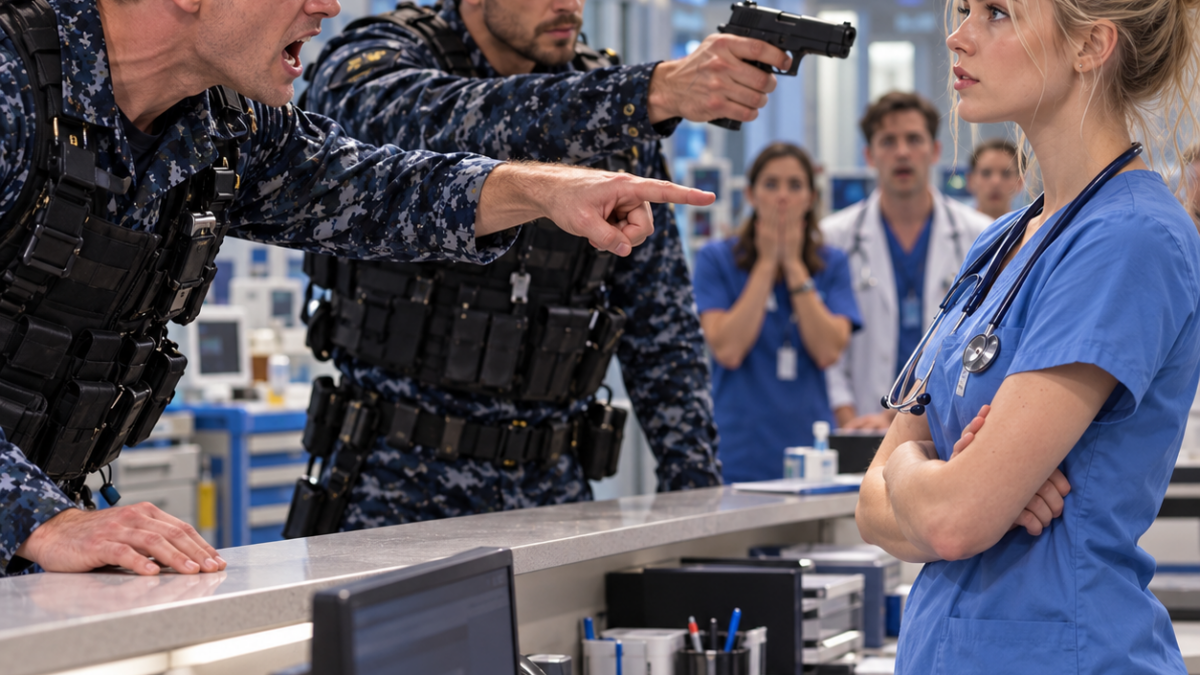
He tells them he was trying to help a panicked young man deescalate.
Mara said, “He tells them he called to calm you down and you misinterpreted his guidance.
He tells them he had no idea you had a weapon.”
She paused. How many people in this room heard that transmission? 3 seconds of silence.
Three, Ortega said. Two of you are trainees whose whose careers depend on a man who just demonstrated that his first priority in this situation is the sample, she said. And one of you is a nurse with no stake in his program.
The cardiac monitor ticked on somewhere outside.
A sound that hadn’t been there before.
the low mechanical thump of a security door being checked, being tested from the other side. Hospital security was working its way through the lockdown protocol, which meant people were getting organized out there, which meant Mara was no longer the only resource trying to solve this room.
But that also meant a clock had started. If security breached before this situation was resolved, before Noah was stable, before the weapon was down, before Ror had made a decision, the dynamics of what happened in the next 60 seconds became much harder to control. She needed Ror to decide.
She needed him to decide the right way. And she needed him to do it before the people outside the door made the decision for him.
Ortega, she said without looking away from Ror. The monitor on your chest. Can you access the buffer memory without the data card?
I he touched the strap. The device has a small display.
You can cycle through the last session readings on the device itself.
I’ve done it during check-ins.
Does it display timestamp data? Yes.
Does it show injection events as a spike in the biometric readings? A pause.
and she could hear him thinking, “If something happened to my blood oxygen or heart rate right after a yes, it would show up a deviation event.”
The device logs anomaly markers automatically.
“So, the device in your chest is currently holding a timestamped physiological record of what happened to your body tonight,” she said, including any point at which your vitals changed in response to a substance.
Yes. She finally looked away from Ror, looked at Ortega.
That’s yours, she said quietly.
That’s your body’s record of what was done to you.
Not Sloan’s record.
Yours, Noah Bell’s monitor alarmed.
Not the arhythmia alarm. Not the blood pressure threshold.
The defibrillation prepar. The one that meant his prep alarm. The one that meant his rhythm crossed arhythmia into the territory of something that could kill him in the next four minutes without intervention.
Mara was moving before the sound finished.
She didn’t ask permission.
She didn’t look at Ror.
She went to Noah and began the intervention sequence with her hands and her training and the particular focused calm of someone who has done this in places and conditions that this fluorescent room did not come close to.
Get out of my way,” she said to the space behind her, to whoever was in it.
There was a pause, one beat, two, and then she heard footsteps stepping back. She worked.
Noah’s rhythm was fighting itself, the electrical signals misfiring in a cascade that her medication adjustment had slowed, but not stopped.
She pushed the next medication through the line and put her hand on his sternum and counted, watching the monitor, watching the pattern, waiting for the signal that said it had worked or hadn’t.
20 seconds, 40. The rhythm broke and settled. Not perfectly, not the clean sinus rhythm of a healthy athlete, but organized, recognizable, something she could work with.
His blood pressure steadied. His oxygen climbed back to 93%.
Mara let out the breath she’d been holding and found that she was gripping the side rail of the gurnie hard enough that her knuckles achd.
She let go, flexed her hand once, turned around. Ror was standing at the back of the bay.
The weapon was still in his hand, but he was looking at Noah, at the monitor above Noah, at the numbers that had just come back from somewhere bad, and his face had lost the calculated quality entirely. What was left was younger, more frightened, more honest. Ortega was already reaching under his shirt.
He unclipped the monitor strap, pulled the device free, and held it in both hands. Ror looked at him. Luis, he said, I know, Ortega said.
You understand what that means? Yes, if you do this. He ran an experiment on us, and Noah is dying, Ortega said.
And his voice cracked on the last word, just fractionally, just enough to show what was underneath all the contained horror he’d been managing since they walked through the doors.
And Sloan told you to destroy evidence while Noah was dying.
And that’s what happened tonight.
That is what actually happened.
The weapon lowered in Ror’s hand.
Not all the way. Not down to his side, just a few inches.
The specific posture of a person who hasn’t surrendered but has stopped being sure.
Mara looked at the monitor device in Ortega’s hands.
Then at the emergency radio mounted to the wall beside the nurse’s station inside the bay, the one that operated on the hospital’s emergency communication band, separate from the regular phone and computer systems, functioning even inside a sealed ward, the one that could reach Dr.
Ren outside, the one that could reach anyone outside. She looked at it for exactly one second.
Then she looked at Ror and she said the only thing left to say, “He’s going to code again.”
She said, “Not in 20 minutes, not in 10.
His rhythm is organizing, but the underlying problem isn’t treated because I don’t know what it is yet, and I won’t know until those labs come back.
I cannot stop what’s coming with what I have in this room.”
She kept her voice level, kept it the same tone she’d used for every sentence she’d spoken in the last 40 minutes.
I need help in here. Medical help. Dr.
Karen is 40 ft away on the other side of a door.
If you let me reach her on that radio, we might be able to keep him alive long enough for the labs to tell us tell us what we’re actually dealing with.
Ror stared at her. The security door at the end of the corridor made the testing sound again, louder this time, the sound of someone who had moved from checking to preparing.
And if those labs, Ror said, show what I think they’re going to show.
Then you get in front of it. She said right now tonight while Noah is still alive, the person who kept him that way instead of the person who kept him that way a pretzen who watched him dieting a program that already threw you away. The silence was the longest one yet.
Ror’s weapon hand dropped to his side.
He didn’t put the weapon down.
He didn’t surrender it.
He just let it hang at the end of his arm like something he’d forgotten.
He was holding the radio.
He said, “Yes, you call Ren.
Only Ren.
You say there’s a medical situation and you need her inside.”
“Yes, nothing else.
” Mara looked at him for a moment, thought psychologically, professionally, thought about everything she was agreeing to and everything she was not, and made a decision about the shape of the next 10 minutes.
“Ortega,” she said.
Yeah.
“When Dr.
Ren comes in,” she said, “I need you to show her the device.”
Ror’s head came up.
Mara crossed to the emergency radio before he could speak.
She was already keying the channel when she heard the first sound from the corridor that she hadn’t heard before.
Not the security door testing, not the hospital PA, not the muffled voices from the organized response outside.
Sloan’s radio crackled to life on Ror’s waistband, and the voice on it was not calm anymore.
Sloan’s voice came through the radio sharp and stripped of everything it had contained before.
The measured authority, the calm logistics, all of it gone, replaced by something tighter and more urgent that Ror clearly recognized because his whole body changed when he heard it.
Ror, I’m getting reports of a security response at the facility.
Whatever you’re doing in there, you need to finish it now.
Leave the patient. Walk out.
I will handle the inquiry from my end, but I cannot protect you if you’re still inside when they breach.
Rors stared at the radio. Mara had her hand on the emergency channel key, and she did not move it.
She watched him absorb what he just heard leave the patient, and she watched his face do the work of dismantling something he’d been holding together for the better part of an hour.
Leave the patient.
Not how’s Noah.
Not is he stable?
Leave him, Evan,” Ortega said.
Ror didn’t answer.
He said, “Leave, Noah,” Ortega said.
And the flatness in his voice was the particular flatness of someone who no longer has the energy to be surprised by the thing that just confirmed what they already knew. The radio crackled again.
“Rork, acknowledge.
” Ror looked at the device on his waistband.
then at Noah, then at the weapon in his own hand, as if he was seeing it from a slight distance, as if some part of him was standing outside the room, looking at the tableau, and arriving at a conclusion about it. He reached down and turned the radio off. The click of it was very small in the sealed bay.
“Call Ren,” he said.
Mara keyed the emergency channel before he could reconsider. The hospital emergency band was a dedicated frequency separate from the main communications network and it had remained functional throughout the lockdown because it ran on an independent power circuit specifically designed for situations where the primary systems were compromised.
She’d known that when she’d looked at the radio.
She’d known it and she’d said nothing because information deployed at the wrong moment was just noise.
Ren, she said into the unit. Bay three, I have a deteriorating cardiac patient and I need you in here. Bring a crash cart and a blood product kit.
3 seconds of silence.
Mara Ren’s voice was controlled, but the relief in it was audible.
The specific relief of a physician who has been standing outside a locked door for 40 minutes doing nothing. Are you all right?
I need the crash cart and the blood product kit. A pause that was not about confusion.
Ren was reading her, reading the deliberate non-answers, understanding what it meant. Copy.
Two minutes. Mara set the radio down and turned back to Noah. His rhythm was holding.
Not well, but holding. His pressure had stabilized at a number that was low enough to worry about, but not low enough to demand immediate aggressive intervention beyond what she was already doing. She adjusted the fluid rate again, noted it in the chart, and checked his temperature, which had dropped slightly since admission.
Another data point that fit a picture she was still assembling.
When Ren comes in, Ror said from behind her, “What do you tell her?”
“The truth,” Mara said.
“All of it.
All of it.”
He was quiet for a moment.
She heard him move, not toward her, just the restless movement of a person in a confined space who doesn’t know what to do with their body.
My career is over, he said, not asking for anything. Just saying it probably, she said.
She didn’t soften it.
Softening it would have been a kind of condescension. That decision was made when you took the weapon out of the locker. Not tonight in this room.
You made it.
I’m guessing somewhere between when Noah went down and when you decided that preventing people from knowing the truth was worth that.
Sloan told us it was the only way to protect the program. Sloan told you a lot of things.
She checked Noah’s line.
How many of them have been accurate? No answer.
The access door at the end of the corridor made a different sound now. Not the test and release of the past 40 minutes, but a sustained deliberate engagement.
the sound of someone working the manual override with purpose and competence. Ren was coming in from the secondary access. Mara knew the layout of this wing well enough to know that the secondary access bypass took 90 seconds to cycle if you knew the procedure and Ren would know the procedure.
She also knew that the security team would be positioned behind Ren and that the moment the door door opened, the configuration of this room was going to change in ways that depended entirely on where Ror’s weapon was when it happened.
She turned around, “Evan.”
She said it the way she’d say a patient’s name during a procedure.
Not commanding, not pleading, just directing attention. When that door opens, you need to have made a decision.
If you have the weapon out when security comes through, this ends one way.
If you don’t, it ends a different way.
I I cannot tell you what to do. But I can tell you that you have about 60 seconds to choose. He looked at the weapon.
She watched him look at it. There was something almost clinical about watching a person decide. The small physical signals, the shift in breathing, the particular way the muscles around the jaw either tightened or released.
She’d read people under pressure for most of her adult life, not as a skill she was proud of, more as a necessity that had developed without her choosing it in environments where reading the room wrong had consequences she didn’t like to dwell on.
Ror’s jaw released.
He bent down and set the weapon on the floor. Then he straightened up and moved to the wall and put his back against it and his hands went to his sides and something in his posture became the posture of someone who has stopped fighting and is now simply waiting for what comes next. Ortega was already at the wall.
The access door opened. Dr.
Mercedes Ren came through first, crash cart ahead of her, moving fast with the specific efficiency of someone who has assessed a situation from incomplete information and decided that speed was more valuable than caution.
She was through the door and into the bay and at Noah’s bedside in under 10 seconds, eyes going immediately to the monitor, to the patient, to the medications already running.
Behind her, two hospital security officers, both broad, both wearing the strained expression of people who had just come through a door they’d been told might have someone armed on the other side of it entered and immediately oriented on Ror and the weapon on the floor.
Hands, one of them said. Ror raised his hands.
They were on him in seconds, professional, controlled, no unnecessary force. The weapon was recovered from the floor.
Ortega complied without being told, hands already up before they reached him. Ren spared one glance at the scene.
Then she was back at Noah. Talk to me, she said to Mara. Mara talked.
She delivered the clinical summary with the same precision she’d have used in any handoff vitals trend, medications administered, interventions and responses, the arhythmia event and resolution, the current status.
And Ren listened and her hands were moving while she listened. The IV assessment, the monitor leads, the blood product kit being opened.
You said blood products, Ren said.
I think we’re going to need them.
The hypoxia pattern doesn’t fit respiratory cause.
His blood pressure drop is progressive rather than acute. And Mara paused because what she was about to say was going to change the shape of the next hour significantly.
I think the substance causing this is affecting his blood’s ability to carry oxygen at the cellular level.
Not the lungs, the blood itself. Ren looked at her.
I’ve seen this once before.
Mara said, “The symptoms, the specific combination of hypoxia with clear lung sounds, the cardiac irregularity pattern, the progressive pressure drop, it’s consistent with a synthetic oxygen carrier gone wrong.
Something that binds to hemoglobin sites and outcome Pete’s natural oxygen transport.
Ren was quiet for exactly 2 seconds. The kind of quiet that meant she was reassembling her clinical framework around a new premise.
If that’s right, Ren said, then standard hypoxia protocol is making him worse.
Yes, Zara said the supplemental oxygen isn’t the problem, but it isn’t solving it either because the problem isn’t oxygen delivery to the lungs.
It’s oxygen transfer from the blood to the tissue.
Treatment exchange transfusion if the labs confirm. remove the compromised blood volume and replace it with normal donor blood that can actually release oxygen to his cells. Ren absorbed this.
That’s a significant intervention based on a hypothesis.
I know what makes you confident in it. The question was clinical, not challenging.
Ren asked it the way she asked every diagnostic question, which was genuinely as part of the process of arriving at the right answer, regardless of its source. Mara thought about what to say and decided that the time for managing information was over.
I’ve seen it in a field context, she said.
Overseas, different setting, but the same presentation. Synthetic compound injection delivered.
Designed to temporarily boost oxygen carrying capacity.
It worked until it didn’t.
And when it failed, it failed this way. Ren looked at her for a moment.
Her expression didn’t change, but something behind it shifted.
A recalibration, a filing of new information next to old information. The quiet process of a smart person updating their picture of who they were talking to. Order the exchange protocol, she said.
I’ll cosign.
If the labs come back and I’m wrong, we stop.
The labs won’t be back for another men.
Order it, Ren said.
We don’t wait.
Mara ordered it.
She was at the supply cabinet getting what she needed when the security officer who wasn’t managing Ror and Ortega approached her.
Ma’am, we need a statement.
You’ll get one, she said, not stopping.
When this patient is stable, there’s a situation commander outside who when this patient is stable, she said again, and something in the way she said it, not loud, not aggressive, just final made him step back.
She brought the supplies to Ren. They worked.
The first phase of the exchange transfusion protocol was about establishing access and confirming blood type, and Ren managed that while Mara maintained Noah’s stabilization and monitored the pressers.
The room had acquired the specific focused quiet of a resuscitation in progress. Everyone moving with purpose, the peripheral noise, the security officers, the low voices from outside the door, Roorf sitting on the floor with his wrists zip tied falling away into irrelevance.
It was in this quiet that the lab results came through.
The terminal at the nurse’s station inside the bay chimed its notification tone.
Mara cross to it brought up the results and read them with the focused speed of someone who has been reading lab values in difficult circumstances for long enough that the numbers organized themselves into meaning before she’d consciously processed each one.
Expanded metabolic panel abnormal. Elevated lactate significant oxygen saturation inconsistent with respiratory parameters as expected.
And in the expanded toxicology under the header she’d ordered specifically because her instinct had told her to, a flagged result for an unidentified synthetic compound with hemoglobin affinity properties detected at concentrations that the lab had marked with the notation.
Consult pharmarmacology compound not in standard reference database, not in the standard database, which meant it wasn’t a known supplement, wasn’t a regulated substance, wasn’t something that had gone through any approval process that would have put it in a database.
It was
something someone had made or sourced from somewhere that didn’t file paperwork.
She printed the results and walked them to Ren. Ren read them without speaking. Her expression was the controlled expression of a physician.
Receiving information that confirms a bad hypothesis, which is a different expression than receiving information that refutes it. The confirmation carries its own weight. Exchange transfusion, Ren said.
Yes. Do we know what the compound is?
Not specifically. The lab flagged it as unidentified.
Ren set the print out on the side table.
I’m calling the chief of staff.
Yes. and toxicology and the military liaison.
Yes, this is going to become a very complicated night. It already is, Mara said and went back to Noah.
The exchange transfusion began at 1:14 a. m.
It was a controlled process removing aloquats of Noah’s blood volume and replacing them with screened donor blood, cycling slowly enough to avoid the hemodynamic swings that could complicate an already compromised cardiovascular system.
Ren drove the protocol.
Mara managed the monitoring and the medication adjustments that kept Noah’s pressure and rhythm within workable parameters.
It was somewhere second cycle of the transfusion at approximately 1:31A m that Mara noticed something she shouldn’t have been the one to notice first.
She was checking the pressure red out when she saw Ror sitting against the far wall with his zip tied wrists resting on his knees do something specific with his jaw.
She’d seen that before in herself, in other people who’d pushed themselves past a particular threshold.
She walked over to the security officer. I need to check him, she said. The officer looked at her.
He’s secure, ma’am.
I know. I need to check him medically.
Mhm. She crouched in front of Ror before the officer could decide whether to object.
Up close, what she’d seen from across the room was clearer.
The color at his lips wasn’t quite right.
His breathing was slightly elevated, and there was a fine tremor in his hands. Not the adrenaline tremor of the last hour, which had come and gone, but something steadier and more organic, something that came from inside rather than from some circumstance.
Ror, she said, when were you injected? He looked at her.
The conditioning protocol, she said, when? 3 hours ago.
same compound as Noah. Sloan said ours was a lower dose, different formulation. She took his pulse from his wrist, still zip tied, but she could get three fingers on the radial artery.
Fast, slightly irregular, she stood up. Ren, she said across the room.
Ren looked up from the transfusion setup. We have a second patient.
The room reconfigured again.
The specific practical reconfiguration of a medical space hatch is to absorb a new critical problem without abandoning the one it’s already managing.
Ren assessed Ror in 90 seconds, ordered a second IV line, called for additional blood products, and began the preliminary workup while Mara split her attention between Noah’s transfusion cycle and Ror’s initial stabilization.
At some point, she wasn’t tracking the exact time, she registered that Ortega was still against the wall, seated on the floor watching, and that he was breathing normally and his color was good.
Different formulation, Ror had said. Or perhaps Ortega had received a different dose. Or perhaps whatever the compound did, it responded differently in different bodies because human physiology was not standardized no matter how much anyone wanted it to be.
She told the second security officer to get Ortega a glass of water. The officer looked at her.
He’s a witness.
She said he stays coherent. The officer got the water at 147a.
M Dr.
Friend’s call to the chief of staff produced results in the form of two additional physicians who came through the secondary access with the specific contained urgency of people who had been woken from sleep and told something that categorically could not wait.
They assessed the situation with the speed of experience, absorbed the clinical picture, and integrated into the treatment without preclaiming, without requiring lengthy explanation because Ren had briefed them efficiently on the radio. At 152 a.
m.
, Noah’s third transfusion cycle showed the first clear sign that the exchange was working.
His oxygen saturation climbed to 97% and held there. Mara watched the number for 20 seconds before she let herself believe it.
Then she noted it in the chart and moved on to the next thing because there was always a next thing. At 28 a. m.
the military liaison officer arrived. She was a Navy commander compact 40s with the specific bearing of someone who dealt in consequences for a living.
She assessed the room with the speed of someone who had been briefed in transit.
Took in Ror in his zip ties, took in Ortega with his glass of water, took in the physiological monitor device that was sitting on the nurse’s station where Ortega had placed it, and then looked at Mara with the particular attention of someone who has been given a name and is verifying that the name fits the person.
“You’re Vance,” she said.
Yes, you were the only medical staff in the room for how long?
Approximately 53 minutes from lockdown initiation to doctor Ren’s entry alone with two armed onearmed.
Mara said Ortega never produced a weapon. The commander noted that literally she wrote it down the device on the station.
She said physiological monitoring device issued to the trainees by their instructor, Commander Grant Sloan, for use during the performance sessions.
According to Trainee Ortega, it retains internal buffer memory of the last 4 hours of biometric data, including anomaly markers, separate from the data card that Commander Sloan collected after Trainey Bell’s collapse.
Mara delivered it without pause. I have not touched it.
Ortega placed it there voluntarily before doctor.
Ren’s entry.
The commander looked at it again. Is it accurate? She asked.
Not to Mara to Ortega.
Yes, ma’am.
Ortega said. She picked it up with gloved hands.
She’d put gloves on before she touched anything, which told Mara something about her and placed it into an evidence bag she’d produced from her jacket.
I’ll need full statements from everyone in this room.
she said.
“My statement can wait until both patients are stable,” Mara said.
The commander looked at her for a moment, noted. It was at 29 a.
m.
while Mara was charting Ror’s second vital set after the IV push that had brought his cardiac rhythm back into normal sinus that the emergency radio on the wall crackled.
Not the hospital emergency band’s channel, the tactical communications frequency.
Fork’s radio, which the security officer had placed on the nurse’s station after removing it from Ror’s waistband.
Sloan’s voice came through, and this time it wasn’t directed at Ror because Sloan didn’t know Ror’s radio was no longer with Ror.
He was transmitting into what he believed was a sealed room still under his trainees control because nobody had told him otherwise and he hadn’t been monitoring the hospital communications band closely enough to know the lockdown had been resolved.
He spoke for 45 seconds. Everyone in the room heard it.
He laid out with the systematic precision of someone who had prepared this a version of events in which the trainees had initiated the physiological experiment independently had sourced the compounds through unofficial channels without his
knowledge and had panicked when Bell collapsed making decisions that Sloan had been had been attempting to deescalate by phone throughout the evening. He described his efforts to talk Ror down.
He described his concern for the trainees well-being. He described in careful terms his position as an instructor who had observed concerning behavior in his cohort but had lacked sufficient evidence to report.
He described the trainees as acting alone. The radio fell silent.
The room was very quiet. The commander was holding the evidence bag with the physiological monitor in it. And her expression was the expression of someone who has just received an unexpected gift in an unfamiliar form and is taking a moment to recognize it for what it is.
Ror was looking at the radio from his position on the floor. He said nothing for almost 10 seconds. Then he practiced that.
Yes, the commander said. It sounds like he did.
The injections were his, Ror said. The compounds were his. The protocol was his.
He ran it six times over 18 months. I can tell you names, dates. He stopped.
I can tell you everything. I know, the commander said. You will.
She looked at Ortega. Both of you will.
Ortega nodded.
He wasn’t crying exactly, but his eyes were wet, and he wasn’t doing anything to hide it.
And Mara registered that detail and filed it away, not as weakness, but as the specific relief of someone who has been carrying the wrong thing for long enough that setting it down produces an involuntary physical response.
Noel’s monitor showed a heart rate of 72.
Blood pressure 98 over 64, still low, but trending upward for the first time since admission. Oxygen saturation 98%. He was not fixed.