“Don’t Go In! It’s a Trap!” Night Clerk Saved 16 Hells Angels From Disaster (part 2)
Part 2
Cole was standing near the front desk. He looked at her when she came out.
He looked at her the way he had looked at her on the highway that same complete unperformed attention and he said simply, “He’s got all three.
” She put one hand on the desk.
“He’s”?
She nodded.
“Haul?”
she asked.
“Not here.
He wasn’t in the room.
Something moved through Cole’s face.
He’s not surprised, but a particular kind of tiredness.
He never gets his own hands dirty. He sent hired men and gave them a plan and stayed somewhere he could have an alibi, a pause. But hired men talk, especially once the plan is already over.
He’ll be found.
He’ll be found.
Cole said it with certainty, not hope. The kind of certainty that came from knowing how these things ran and having the patience for them.
One of the deputies stepped toward Madison with a notepad. She recognized him, Deputy Lars Ericson, who had responded to two minor incidents at the lodge in the past year. Ease.
He was in his mid-40s, efficient, and had the slightly chasened energy of a man who understood that an hour within which he was supposed to arrive had passed without his arrival.
“Miss Harper, I’m going to need to get your full account of this evening.”
“Please, of course,” she straightened.
“From the beginning.
From the beginning,” she told it.
All of it in order with the same precision she had used on the highway. The registry room 206, the light under the door, the voices and the specific words and the timing and the vending machine and the two conversations at the desk and the construction story and the back office and the lock. She delivered it without editorializing, without dramatizing, without anything beyond the clean, straightforward architecture of what had happened and when and in what order.
Ericson wrote steadily and did not interrupt. When she finished, he looked at what he had written. Then he looked at her.
“Miss Harper,” he said, “you do understand that blocking the road the way you did could have, under other circumstances constituted an offense.
” “Yes,” she said.
He held her gaze for a moment. Something moved in it.
“Under these circumstances,” he said.
“I think we can call it something else.”
He put the cap on his pen.
“You’re going to have to come in and give a formal statement tomorrow.
I’ll be there.”
He moved away to where the other deputies were gathered and Madison was left standing at the desk with Cole Bennett a few feet away. The lobby still inhabited by the trailing edge of everything that had happened.
Cole was quiet for a moment. He looked at the front window.
He looked at the highway. He looked at the clock on the wall.
318a M. And something in his expression acknowledged the distance between what this night had been supposed to be and what it had turned into.
We ride this road every year, he said, not to her specifically.
He’s half to himself.
Same road, same time.
It’s a memorial for a brother we lost eight years ago on a different stretch of highway.
He paused. 16 of us. Madison was quiet.
Travis Holloway rode with us for three of those memorials. Cole said, he knew what the ride meant. He knew what it was for.
She did not say anything because there was nothing that could be said in response to a particular kind of grief. The kind that came from learning that someone who had shared the most meaningful things with you had spent years deciding how to use that knowledge against you. It was a specific kind of damage.
She knew something about specific kinds of damage.
I’m sorry, she said, not the automatic sorry of filler condolence.
He’s the real kind.
Cole looked at her and then he did something she had not expected. He laughed a short, real, quiet laugh with real exhaustion and real relief in it. You know what the strangest part of tonight is?
He said, “Tell me, I’ve ridden this road in storms that should have killed us.
I’ve ridden it when visibility was basically zero.
I’ve ridden it after funerals and after good news and after nights I’d rather not talk about.”
He shook his head slightly.
And the thing that almost killed us was something we’d never have seen coming.
a man who knew our habits better than we knew them ourselves. He paused.
And the thing that saved us was a woman who makes coffee at 2:00 in the morning and pays attention to a light under a door. Madison looked at her hands on the counter.
I just did what anyone would do, she said. Cole shook his head. No, he said.
You did what almost nobody does.
There’s a difference.
And you know there’s a difference because if you didn’t know it, you wouldn’t have needed to say that.
She had no answer for that. Not an honest one.
Outside the first gray suggestion of something less than full dark was beginning to exist at the edge of the eastern sky. Not dawn not close to dawn but the first faint withdrawal of full dark that preceded it by a long margin.
The mountain highway was lit by the lights of two county sheriff’s vehicles.
Now more would come. The morning would bring paperwork and statements and the elaborate process of consequence that the law imposed on events like this one.
Slowly and thoroughly. ease.
Cole’s writers were outside, most of them.
She could hear voices, low and steady, the specific register of men processing something together, which was different from the silence of men processing something alone. The young one, who had said she works at a motel, came back inside. He walked toward Madison and stopped a few feet away and stood there for a moment with his hands in the front pockets of his jacket, looking at the floor, and then he looked up.
“I was wrong,” he said on the road.
I was wrong. It was not an easy thing to say.
She could see the cost of it in the set of his shoulders.
It’s okay, she said.
No, it’s he stopped.
Started again.
My name’s Jace.
Jace Puit. He extended a hand. She shook it.
Madison Harper. I know.
He held the handshake a beat longer than standard. Cole told us your name on the road after he released her hand.
We owe you something, Madison. All 16 of us.
I don’t know what the right shape of that debt is, but it’s real.
She looked at him. He was younger than she had initially thought, late 20s, maybe.
The skepticism was still there, but stripped of its earlier defensiveness. What was underneath it was not complicated.
It was the honest face of someone who had been close to something final and had come out the other side still breathing and was still working out what to do with that.
“Just ride safe,” she said.
He almost smiled.
“Not quite.”
“Yeah,” he said.
“We will.”
He went back outside. Cole turned to go as well.
He stopped at the door and looked back at her one more time.
I’ll send someone in to check on you before we leave, he said.
Don’t let the morning shift find you alone with all of this.
I’ll be fine.
I know you will.
I’m sending someone anyway.
He pushed through the door. Madison stood alone in the lobby of the Silver Pine Lodge. She looked at the clock.
3:26 a.m.She looked at the highway at the sheriff’s vehicles at the shape of the mountain against the sky.
She picked up her clipboard. She walked to the stairwell.
She went upstairs and walked the second floor hallway one more time. The way she did every night, checking doors, checking the light on the ice machine, checking the hall was safe and calm.
Room 206 was dark. No light under the door. The key cards were inside.
She supposed the men were gone. The room would need to be reported, documented, turned over as part of a chain of evidence that she would contribute to in a formal statement later in the morning.
She walked back to the stairwell. She walked back down.
She sat at the desk and picked up her pen and opened the night log and began writing the entry for the shift in the clean factual language that the log required. Her handwriting was steady.
Her hands were still not shaking. She had always found that strange about herself. In moments that would make most people fall apart, the shaking never came.
The fear was real. She was not built of something different from other people.
She did not have a higher threshold for what frightened her. But whatever mechanism normally translated fear into visible physical unraveling had simply never been installed in her. Ease.
She shook afterward. Sometimes ease. Alone in the car on the way home or in the shower 2 hours after the fact.
When everything had settled into safe distance, not during, never during, she filled out the night log. She noted the arrival of law enforcement.
She noted the room. She noted the guests. She thought about Holloway, somewhere in the dark, not yet caught.
She thought about the mountain road and the curve she had never driven, but could imagine now with a precision that had nothing to do with having been there. Ease.
She thought about 16 bikes in one road and a sentence spoken in a motel room by men who thought the woman making coffee downstairs was too inconsequential to matter. She thought about Douglas Mercer, who had thought the same thing seven years before in a different city for different reasons and who had been wrong for similar ones.
She turned the page in the night log. She kept writing. The Silver Pine Lodge was quiet.
And Madison Harper was exactly where she was supposed to be. Doing exactly what she was supposed to do.
And sometime before the morning shift arrived, the sky outside the window would begin to lighten. And the mountain highway would fill with the ordinary traffic of an ordinary morning. And no one looking at her through the front window would know that the night had been anything other than what all the other nights were.
No one looking would see it at all. That was something she had made her peace with a long time ago. The person who sees what others miss rarely gets to be seen doing it.
She wrote the last line of the shift entry, put the pen down, and poured herself another cup of coffee. She drank it standing up. The morning shift arrived at 6:45.
Her name was Connie Briggs. 53 years old. 15 years at the Silver Pine Lodge.
Ease. And the kind of woman who could read a room in 4 seconds and needed fewer words than most people to respond to what she read.
She came through the employee entrance. Ease.
Saw the county sheriff’s vehicle still parked in the lot.
Ease.
saw the tape that had been placed across room 206’s door at some point during the early morning hours.
Saw Madison behind the desk with a nearly empty coffee pot and a completed night log and the specific blank expression of someone who had been awake for 9 hours straight and had spent most of them somewhere past the edge of ordinary experience. Connie put her purse under the desk. She looked at Madison.
You okay?
I’m fine.
Connie looked at the sheriff’s vehicle outside.
She looked at the taped door at the top of the stairwell, visible through the glass panel. She looked back at Madison.
How much of the pot is left? Maybe one cup.
I’ll make more.
She moved to the coffee maker.
You want to tell me or do you want me to wait until you’ve slept?
Madison was quiet for a moment. She had rehearsed this in her head. a clean, ease, efficient summary she could deliver to the morning manager and then to Derek when he eventually called ease, which he would, and which she had decided to handle with the same factual precision she had used on the night log.
There was an incident, she said. Three men in room 206 were planning an ambush on a group of motorcycle riders on the mountain road. I heard them talking about it during my hallway check.
Law enforcement responded. All three men were taken into custody.
A formal statement is being given this morning and the room is secured as a crime scene. Connie stood very still at the coffee maker and you were here for all of that.
Connie said, “I was the one who heard them.”
Another silence. Then Connie turned around and looked at Madison with an expression that was not shock precisely. It was something that sat on the other side of shock.
The place you arrive at after the initial impact has already settled into reality. Madison, did you call the police twice?
And then I drove out to warn the riders directly. Connie stared at her. You drove out to the highway?
Connie said slowly. In the middle of the night and blocked the road. Yes.
By yourself. Yes.
Connie turned back to the coffee maker. She was quiet for a full minute.
Madison heard the water. The mechanical process of a new pot starting. The ordinary clockwork of a morning beginning.
Then Connie said without turning around, Dererick’s going to lose his mind.
He’s probably He told you to stay out of it, didn’t he?
It was not a question he did, Madison said. And you did it anyway. 16 people were going to die.
Connie was still for a moment. Then she laughed a short genuine sound, surprised out of her, and shook her head without turning.
Go home, Madison, she said. Get some sleep.
I’ll handle Derek.
I have to give a statement at the sheriff’s office first.
Then do that and then go home. Connie finally turned.
Her expression had settled into something that Madison recognized as Connie at her most serious, which was not a dramatic thing. It was quiet and direct and final.
And Madison, for what it’s worth, she paused.
I’ve known you 2 years.
I’ve never once doubted that you pay attention to things.
Madison picked up her bag. Thank you, Connie.
She drove to the Mineral County Sheriff’s Office with the window down and the cold September morning air doing the work that sleep should have done.
The drive took 20 minutes. She spent 11 of them thinking about Travis Holloway, not about what he had tried to do, about where he was right now. Cole had said Holloway had an alibi ease, which meant Holloway was somewhere he had planned to be somewhere with witnesses, somewhere that would account for his presence during the hours when three hired men were supposed to complete the work of his grievance on a mountain road.
He had constructed a distance between himself and his own plan. That kind of construction required time and patience and a specific personality.
Not the personality of someone who acted from rage, but the personality of someone who had converted rage into something slower and more calculated. Someone who had sat with it long enough to turn it into architecture.
7 years was a long time to build something in the dark.
She thought about that the way she had once thought about Douglas Mercer’s accounts, tracing the shape of it backward, looking for where the original decision had been made.
The specific moment when a person chose to build a lie instead of accepting a truth. With Mercer, it had been money, pure and simple and pedestrian, the way most large betrayals were when you strip them down. With Holloway, it was something messier.
Being removed from the only family he had chosen for himself. Being seen as the person who had stolen from that family and deciding instead of carrying that truth to rewrite the story with himself as the one who had been wrong. That rewrite had taken 7 years and was going to cost three hired men their freedom.
And Holloway, whatever the law decided to give him once they found him. She thought about the word when.
Cole had said when, not if. She believed him.
The sheriff’s office smelled like coffee and printer ink and the particular institutional staleness of a building that processed difficult days as its primary function.
Deputy Ericson was already there looking like he had not gone home either, which gave them a strange brief solidarity as she signed in at the front desk and was shown to a room with a table and two chairs and a recorder. She sat down.
Ericson sat
across from her. He had a folder, a notepad, and the recorder.
He looked at her with the same slightly chasened energy she had registered at the motel, now compounded by a night’s worth of outcome that had made the chastening more specific.
“Please, Miss Harper,” he said.
“Before we start, I want to say something.”
Okay. The county dispatcher log shows your first call came in at approximately 1:27a m.
The second call at 1:44. Response time to the location was approximately 41 minutes from your swank second call. He looked at the table for a moment, then at her.
41 minutes is not within the hour I believe the operator communicated to you. No, she said.
It’s not.
I want you to know that the response delay is being reviewed.
That’s not an excuse.
It’s an acknowledgement.
Madison looked at him.
She thought about the nine times the sheriff’s office phone had rung at 127A M with no answer.
She thought about the 911 operator and the phrase within the hour delivered in a voice designed to communicate management rather than urgency. She thought about Derek telling her to mind the desk.
She thought about what would have happened on that mountain road at 41 minutes past her second call if 16 motorcycles had continued forward. I appreciate you saying that, she said.
Now he clicked the recorder on.
Let’s start from the beginning.
She gave the formal statement in 53 minutes. She delivered it in the same order and with the same precision as every other version she had given and she did not editorialize or add interpretation. She described what she had seen what she had heard what she had done and in what sequence.
When she was finished, Ericson asked seven follow-up questions and she answered all of them. Then he asked an eighth question that was different from the others.
Miss Harper.
The man named Holloway Cole Bennett’s group has provided us with a full name.
Travis Michael Holloway, formerly associated with the organization, removed approximately 7 years ago.
We’re in the process of locating him.
He paused. Did you hear the name spoken in room 206 or was it provided to you by Bennett?
I heard it in room 206 first, she said. One of the men said Holloway had confirmed the route that morning.
When I told Cole Bennett the name on the highway, his reaction told me he recognized it. He confirmed who Holloway was.
In a subsequent conversation, Erikson wrote that down.
The reason I’m asking, he said, is that Holloway’s current location is being established.
He checked into a hotel in Missoula yesterday afternoon at approximately 3P m and has room service records placing him there through midnight. His alibi for the planning stage is currently being assessed.
Ease, he was there the night before the ride. He confirmed the route in the morning according to what I heard.
That’s a phone call, not a physical presence.
Ericson looked at her over the notepad. Something in his expression adjusted.
You think like an investigator, he said. I used to be an accountant, Madison said. The skills overlap more than people expect.
She left the sheriff’s office at 9:18 a.m.She sat in her car in the parking lot for a few minutes without starting the engine.
The morning had fully arrived. Real light, real traffic.
The town of Superior going about its Tuesday with no awareness of what had happened 14 miles up the highway in the dark. People drove past.
A woman walked a dog. A truck from a hardware store made a delivery across the street.
All of it was exactly as ordinary as it always was. She started the car and drove home. Her apartment was small and on the second floor of a building three blocks from the main road.
and she had lived in it for 2 years with the same furniture she had moved there with, none of which she had chosen for the place. It was all furniture chosen for the life that had come before.
The accountant’s life the city apartment with the higher ceilings and it sat slightly wrong in these rooms in a way she had stopped noticing except on mornings when she was tired enough to not everything.
She sat on the edge of the bed. She had not slept in 27 hours. She lay down with her shoes on and stared at the ceiling and waited for the shaking that sometimes came after.
It came this time a slow full body trembling that had nothing to do with cold that lasted maybe 4 minutes and then tapered and stopped. She breathed through it. She had learned not to fight it.
It was just the body doing its accounting, tallying what the mind had kept moving through.
She thought about Cole’s face on the highway, the directness of his attention, the way he had not questioned her or dismissed her or weighed her credibility against her employment title.
He had listened to her the way people who have survived hard things listen not evaluating, just receiving.
She thought about what he’d said.
You did what almost nobody does.
There’s a difference.
She thought about the six years she had spent in a smaller and smaller version of her own life after hard groven crisis and the specific contained way she had rebuilt herself inside that smaller version. Not bitterly.
She did not have a bitter nature but carefully with the particular carefulness of someone who has learned that the act of stepping forward and saying this is wrong and someone has to act carries a cost that the stepping forward itself cannot cover. She closed
her eyes. She slept.
Her phone woke her at 1:33 p p.m.M. She looked at the screen. Cole Bennett.
She sat up and answered it. Did I wake you?
Yes, it’s fine.
I wouldn’t have called if it wasn’t important.
She was already more awake than she should have been for a person woken from the first real sleep in 30 hours. Something in the way he said important landed differently than it would have in an ordinary call.
What happened? She said they found Holloway. She sat fully upright.
Where Missoula, his hotel? A pause.
He was in the process of checking out. The Missoula PD had someone there before he made it to the elevator. She exhaled.
Is he talking? Not yet.
His lawyer arrived approximately 20 after he did, which tells you how well prepared this whole thing was.
A man who has his lawyer’s number memorized for a situation like this is not a man who was surprised by being caught.
He anticipated it as a possibility and prepared for it. Which means he has a prepared story.
Exactly. And the story is going to be that he knew nothing about what three men did on a mountain road in Mineral County and that his hotel receipts and room service records prove his complete separation from any of it.
Madison was thinking
fast, but the men in the room mentioned him by name. I heard it.
It’s in my formal statement.
Yes.
And the prosecution’s job eventually will be to establish the connection between what those men knew and did and what Holloway directed them to know and do.
Phone records, financial records, communication history.
Cole’s voice was steady and patient.
It won’t be fast.
It never is, but it’ll happen.
It’ll happen.
The certainty, again, not optimism, certainty. The men in that room are already cooperating.
When your plan falls apart at 2:00 in the morning and the only road home runs through a deal with a prosecutor, people talk. She thought about the man who had come to the front desk. The careful assessment, the slightly too casual question about the road.
He had looked at her and decided she was nothing. And everything that had followed from that decision was now in the process of becoming the most costly mistake of his life.
He’s cold, she said.
How are your writers? A brief shift in his voice.
something warmer underneath the steadiness.
They’re okay.
We had a long conversation this morning, longer than usual. He paused.
Some of them are shaken.
Not in a way they’d say out loud, but I know these men.
You spend enough years on the road with someone.
You learn the difference between a man who process something and a man who’s still carrying it.
Another pause. Jace called me at 7 this morning.
Said he couldn’t sleep.
He’s the one who came back to apologize.
Yeah.
Something in Cole’s voice shifted slightly.
He doesn’t do that easily.
Jace grew up in a house where admitting you were wrong was treated as weakness.
He’s been unlearning that for years.
The fact that he came back and said it to you directly, that’s not nothing.
It wasn’t nothing to me either.
A silence that was comfortable in the particular way that silences between people who have been through something together can be comfortable, not empty, but full of what doesn’t need to be said.
Madison Cole said, “I want to ask you something and I want you to know that whatever you answer, I’ll respect it.”
Okay. The memorial ride, the one we were running last night when all of this happened. We finish it every year for a brother named Danny Reeves who died on a highway in Idaho 8 years ago.
We’ve done it every September before sunrise, which is when he died, he stopped.
We didn’t finish it last night.
Obviously.
Obviously, she said, “We’re going back this Saturday.
Same route, but this time with people who’ve been over every inch of that road in daylight and cleared it.
Law enforcement escort for the approach. The whole thing. He paused.
I’d like you to be there.
Not riding, just there.
He’s at the end of it when we come back through Superior.
Another pause.
I think Danny would have liked knowing the ride that almost didn’t happen was saved by someone paying attention.
He was that kind of person. Madison looked at the wall across from her bed. the ordinary wall of her ordinary apartment, the same one she had looked at for 2 years.
“Yes,” she said.
“I’ll be there.”
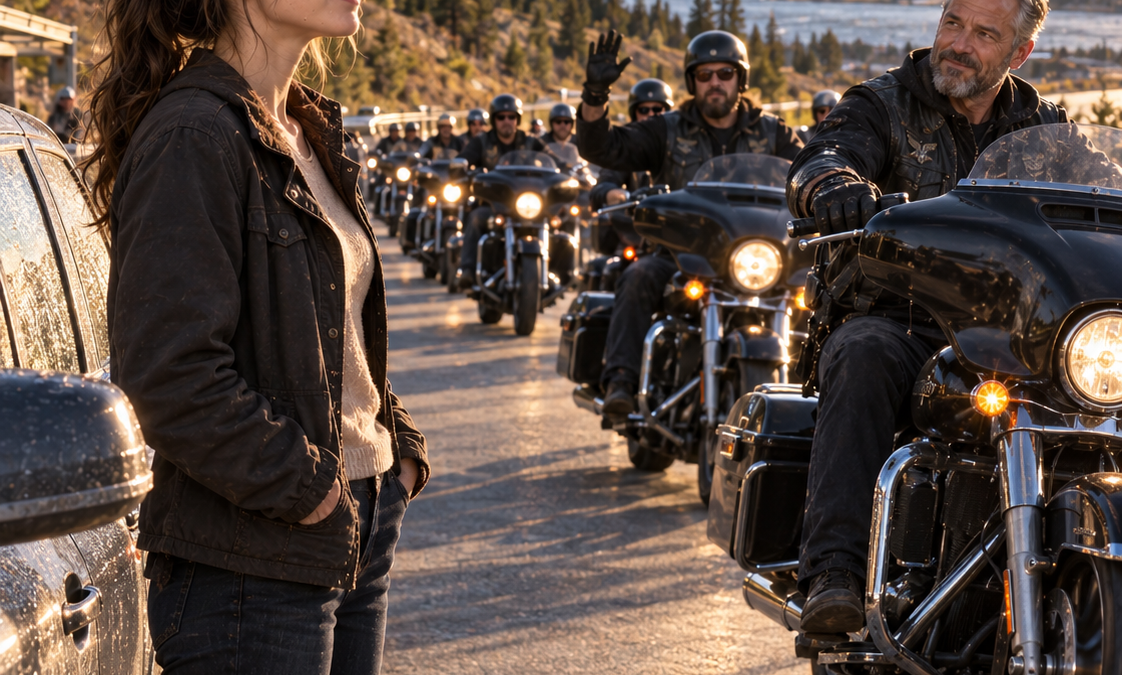
Saturday came with clouds that cleared by midm morning, and left behind the particular blue that Montana produced in September, the blue of a sky that had recently remembered how to be beautiful. Madison drove to Superior and parked near the highway junction, and waited. She heard them before she saw them.
16 engines moving in a coordinated formation coming through the mountain stretch and down toward the town. The sound of them together had a quality she had not registered on the highway in the dark. Something ceremonial about it, something that was about more than transportation, more than machinery.
It was the sound of 16 people choosing to return to a thing that had almost ended them and finishing it anyway. They came into view.
She stood beside her car with her hands in her jacket pockets and watched them come through. Cole was in front.
He saw her when he passed and gave a single nod, not a wave, not a greeting exactly, but an acknowledgement that carried the full weight of everything the two of them knew that no one watching from the sidewalk could have guessed at. The others came through behind him.
Some of them looked at her. Is Jace near the back?
Ease looked at her directly. Ease. and the expression on his face was not the apologetic one from the lobby.
It had settled into something quieter and less complicated. He raised one hand briefly as he passed. They went through the junction and turned toward the highway, and she stood and listened until the sound of them faded into the mountains.
She did not cry. She was not a person who cried easily in public or at moments of significance that she had anticipated.
The moments that undid her were always the ordinary ones, a kindness from a stranger, a particular quality of late afternoon light, the sound of a song from a specific year. Not the big things, never the big things. She drove back to her apartment.
That evening, her phone produced a stream of messages from a number she didn’t recognize, which turned out to be a group thread Cole had added her to a group that apparently functioned as the ongoing daily communication channel for all 16 riders.
full of commentary and photographs and the particular vernacular of people who had spent enough time together that their communication had developed its own grammar. The photograph Cole had sent was of the road, not the dark mountain road she knew from the night.
A daylight photograph taken from the front of the formation showing the asphalt stretching forward into open sky. The mountain falling away on both sides.
ease the kind of view that would make a person understand in their body why someone might choose to spend their life riding toward under the photo Cole had written we made it then Jace had written because someone was paying attention then another writer she didn’t know his name yet had written
Harper’s ride of honor unanimous she looked at her phone for a long moment then she typed I don’t know what that means Jace replied in under 30 seconds it means we’re unanimous that you’ve earned the right to ride with us whenever you want, which for us is a thing that doesn’t happen.
She put the phone down and looked at the wall and then quietly ease. Alone in her apartment on a Saturday evening with the last of the September light coming through the window.
Madison Harper cried, not from grief. Not from relief exactly, though there was relief in it. It was the specific crying of someone who has carried something alone for a long time, carried it competently, without complaint, without the expectation that anyone else would hold it with them and has then been told without preparation that they do not have to carry it alone anymore.
She let it run its course.
Then she picked up the phone and typed, “Thank you.”
She put the phone in her jacket pocket and went to the window and looked at the sky. 300 m away in Missoula, Travis Holloway was sitting in a county holding facility while his lawyer worked on bail.
The three men from room 206 were in separate facilities, cooperating at separate rates, each of them calculating what cooperation might buy them in a situation where the plan had gone completely wrong before a single piece of it had been executed. Mineral
County was reviewing its dispatch response protocols.
Deputy Ericson had filed a supplemental report that specifically cited Madison Harper’s testimony as the primary source of actionable intelligence that prevented 16 fatalities.
The word fatalities was in the official report. She had not seen it yet.
She would see it later when a copy of the relevant section was sent to her as part of the formal case documentation. And when she did, she would read it twice and put the document down and make a cup of coffee and stand at her kitchen window with it, thinking about 16 people who had come home to themselves after something that should have taken them away from everything. But that was later.
Right now, she stood at the window in the September evening light and thought about Danny Reeves, a man she had never known. who had died on an Idaho highway 8 years ago before sunrise and whose 16 brothers had ridden toward a trap in his name and come out the other side because a woman in a motel noticed a light under a door. She thought about all the small things that had to happen exactly as they happen for this particular outcome to exist.
The specific placement of room 206 above the section of hallway she walked every night. The gap under the door that was just wide enough. The silence of 114a m on a September Tuesday that made a hushed voice carry.
The fact that she had worked four years in an office that taught her what certain kinds of conversations sounded like. The fact that she had once paid a steep price for acting on what she heard and had not, despite everything, stopped listening. All of it.
Every piece. She thought about how easily any single piece of it could have been different. A different room, a different hour, a different clerk with a different history and a different habit of attention.
But it hadn’t been different.
It had been exactly this. She thought about that for a long time.
Standing at the window. Ease. While the Montana sky did the slow work of moving from blue to something deeper.
Ease. And the mountains held their position at the edge of everything the way they always did, indifferent and permanent and so much older than any of the things that happened in their shadow. Inside room 206 a miles away and hours ago, three men had sat with a rifle case and a map and believed that they were invisible.
They had been wrong because in the building below them, a woman was making coffee and walking hallways and paying attention to lights to her doors and the distance between their certainty and their error had been nothing more and nothing less than the width of that gap and the quality of the silence and the particular kind of person who stopped to listen to it. Travis Holloway had called her a nobody.
He had been wrong about that, too. She would find that out officially in the weeks that followed.
when the case built itself methodically in the way legal cases did and when her name appeared in documents she had not expected her name to appear in and when Cole called her one Thursday evening and told her that the three men had completed their cooperation agreements and that Holloway’s lawyers carefully constructed alibi was disintegrating against the weight of phone records that put ease
Holloway in direct contact with the men in room 206 at multiple points During the 48 hours before the planned ambush, she would find out, but right now she was at the window.
And the evening was doing what evenings do and somewhere on a Montana highway that was finally ease after everything just a road again. E 16 sets of tire tracks ran through the mountain dark toward a dawn that all 16 people who had made them were alive to see. The phone call came on a Wednesday, 3 weeks after the Saturday memorial ride at 11 in the morning.
While Madison was sleeping, she had switched her schedule around after everything, still working nights, still making coffee at midnight ease, still walking the hallways, but sleeping in later, and carrying herself through the daylight hours with the specific careful energy of someone who had not fully recalibrated yet. The body
took longer than the mind to process certain things.
She had learned that years ago and she was learning it again now in a different register. She looked at the screen.
Cole Bennett, she answered. They charged him.
Cole said there was no preamble. No good morning.
Just those three words and the specific weight they carried. Madison sat up with what? Conspiracy to commit first-degree murder.
16 counts. A pause. His lawyer tried to argue the phone contact was circumstantial.
The prosecutor disagreed. Apparently, so did the judge.
He’s 16 counts.
The number sat in the room with her for a moment.
He’s not abstract anymore.
It had faces now.
Cole’s face.
He’s Jayce’s face.
15 others she had seen in that single moment of headlights on a dark highway. What happens now?
She said he stays in custody pending trial. No bail.
The judge ruled flight risk. The cooperation agreements with the three men from the motel are finalized.
They testify. They get reduced sentences.
In exchange, they’ve provided everything.
Phone logs, payment records. A specific conversation Holloway had with the lead man, the one who came to your desk 48 hours before the ambush.
Ease.
Cole’s voice stayed steady, but underneath it, she could hear something that had been under tension for weeks, finally beginning to decompress.
He told them exactly what he wanted done, exactly how. And he told them the writers would never expect it because they trusted the road.
Madison said nothing for a moment. He knew the memorial was for Danny Reeves.
Cole said he rode that memorial with us for three years. He knew what it meant to us and he chose it specifically. The deliberateness of that, the choice to target something sacred, something that existed to honor grief was a particular kind of cruelty.
He’s not impulsive, not the cruelty of a person acting in hot rage.
The cruelty of calculation, of waiting and watching, and choosing the moment of maximum damage.
He’s Cole, she said.
I’m sorry.
Don’t be sorry for me.
His voice changed. Not harder, just different, more grounded.
I called because you have the right to know.
This wouldn’t be moving the way it is without what you gave the investigators.
Your statement, your testimony about the name, the sequence you established. The prosecutor told me directly that the chain of evidence starts with you.
She was quiet.
She wants to know if you’re willing to testify.
Cole said if it goes to trial. She thinks it likely will hollow is not the type to take a deal.
Too much ego. But she wants to know where you stand. Madison thought about standing in a courtroom.
She had thought about it before. Had thought about it in the context of Harrove Price years ago. In the weeks before that investigation had quietly dissolved into settlements and retractions in the particular institutional inertia that protected people like Douglas Mercer.
She had been prepared to testify then. She had prepared testimony, organized documents, rehearsed the clear and linear delivery of what she knew.
And then the opportunity had been taken from her, not by her own decision, but by forces that moved faster and with more resources than she had. Yes, she said.
I’ll testify.
A small pause.
I figured you’d say that, Cole said.
I told her I figured you’d say that.
2 days later, Madison received a phone call from the prosecutor’s office.
The prosecutor’s name was Diana Vasquez, 41 years old, 12 years in the county attorney’s office with a reputation that Cole had described in a single sentence as she doesn’t lose cases she should win.
Madison took that to mean Vasquez was both good and selective, which was a useful combination. They met in person on a Friday afternoon.
Vasquez was exactly what her reputation had implied direct.
He’s prepared ease.
Unhurried in the way that very competent people are unhurried. ease because they have done enough work in advance that they can afford to move at their own pace.
She had Madison’s statement in a folder in front of her along with what appeared to be several other documents.
She opened it and looked at it and then looked at Madison. You wrote this out very cleanly, Vasquez said. The sequence is clear.