“Don’t Go In! It’s a Trap!” Night Clerk Saved 16 Hells Angels From Disaster (part 3)
Part 3
The specifics are clear.
You don’t editorialize.
That’s unusual in a witness statement from a civilian.
I used to be an accountant. Madison said.
Something moved in Vasquez’s expression.
Slight recognition or recalibration. Tell me about that.
Vasquez said. Madison told her. Not everything.
Not the full emotional weight of the Harrove Price years, but the relevant architecture is the financial irregularities, the report, the termination, the way her credibility had been managed and reduced by people with better resources and more invested in a different outcome. Vasquez listened without interrupting. When Madison finished, Vasquez tapped the folder with one finger.
Holloway’s defense is going to come at you on credibility, she said.
Ease.
They’ll look at the employment termination.
They’ll characterize it in whatever way serves them.
They may try to frame you as someone with a history of making claims that couldn’t be proven someone who sees conspiracy where there isn’t one.
She delivered this without softening. I want you to hear that directly from me, not the first time from them. Madison looked at her steadily.
I heard what I heard. I have a formal statement that was given within hours. I have Cole Bennett and 15 other witnesses who can confirm what I told them on the road and what they found as a result.
I have a deputy supplemental report that names me as the primary source of actionable intelligence. She paused.
They can try. Vasquez looked at her for a long moment. Yes, she said they can.
Something in her expression settled.
And we’ll be ready.
The weeks that followed moved in two different speeds simultaneously. The legal machinery moved in its slow grinding methodical way. Motions and responses and hearings and continuences and the accumulating documentation of a case being built from the ground up.
Madison was a part of that machinery in a specific and limited way.
Consulted when needed, kept informed at appropriate intervals by Vasquez’s office.
He’s otherwise left to live her life.
Her life moved in a different speed entirely. She was still working nights at the Silver Pine Lodge. Derek had called her the Monday after the incident, and the conversation had been exactly as uncomfortable as she had anticipated and significantly shorter than she had expected.
He had said something about the lodge’s liability position and something about protocol ease.
And then he had stopped mid-sentence. She had heard him stop.
Ease had heard the specific quality of a man running out of available arguments.
And then he had said he’s in a different tone.
I should have listened to you. She had said yes, you should have. And then she had asked if her job was secure.
He had said yes.
She had said she’d see him at the next scheduling meeting and ended the call.
The Silver Pine Lodge had become a different place to work since that night, though not in any way that was visible from outside. The rooms were the same, the hallways were the same.
The ice machine on the first floor was the same. But Connie brought her coffee now without being asked.
And the morning manager, a quiet man named Albert, who had been there 12 years and said approximately 40 words a day, had stopped by her desk one evening and set a folded piece of paper in front of her and walked away without explanation. She unfolded it.
It was a note.
In Albert’s careful slightly old-fashioned handwriting, it said, “What you did here was the right thing.
I am glad you are still working here.”
A she kept it. ease.
She kept it in her jacket pocket for the first week and then she put it in the drawer of the desk at home in the same place where she kept things she did not want to lose.
The group thread with Cole’s writers had become a regular presence in her daily life, which was something she had not predicted and had not known she needed.
It was not that the content of the thread was dramatic. Mostly it was the ordinary daily communication of 16 people scattered across several states who had built a community out of shared experience and maintained it through the kind daily contact that was more texture than substance. These links to songs photographs from roads they were riding arguments about sports that ran for 20 messages and resolved in nothing.
Someone’s kid’s birthday.
Someone’s truck needing a new parties.
Someone’s mother’s health.
She did not know most of these people yet, but she was learning them through what they chose to put into the thread.
The way you learn people through what they choose to share when they’re not trying to impress anyone.
And what she learned was that they were ordinary, which was another word for human, which was the thing she had been most starved of in the 3 years of contracting her life into a smaller and smaller version of itself. Jace texted her separately one evening, not in the group thread.
please directly.
Can I ask you something?”
she typed back. Go ahead.
Do you actually want to testify or are you doing it because Cole asked and you don’t know how to say no to him?
She held the phone for a moment. I want to testify. She typed.
I’ve been in a situation before where I should have testified and the opportunity was taken from me.
This time I’m going to get to finish what I started.
A pause. What situation?
She told him. The short version in text. easier to keep it brief that way without the weight of a voice on the other end responding in real time.
Douglas Mercer, the accounts, the termination, the investigation that hadn’t quite caught enough before it ran out of momentum.
She sent it and waited. His response took 4 minutes which told her he had read it more than once.
They fired you for finding it. Yes. And then you went to a motel job and kept paying attention.
Yes. Another pause.
Madison, his name for a pause in his typing.
For what it’s worth, I think what happened at Hard Groven and Price was someone else’s failure, not yours.
And I think the reason 16 of us are here to have this conversation is because you didn’t let their failure become yours.”
She read that three times. Then she put the phone face down on the table and looked at the wall.
It was the most precise thing anyone had said to her about the years between Billings and the Silver Pine Lodge. More precise than anything she had said to herself. Because when you are inside your own story, the specific shape of it is hard to see clearly.
Jace was outside it looking at it with clean eyes and he had named it in a single sentence. She picked the phone back up and typed.
Thank you, he replied. Anytime. Then after a brief pause also, you should learn to write.
She laughed out loud. Alone in her apartment at 11:30 at night, a real laugh unguarded and surprised.
She typed, I’ll think about it.
He sent back a thumbs up and nothing else, which was exactly the right response. Three weeks after that conversation, Travis Holloway did something that no one not Vasquez, not Cole.
Ease, not the three cooperating witnesses, had anticipated. He fired his lawyer.
The news reached Madison through Cole, who called her on a Thursday morning with the specific clipped energy of a person processing information they haven’t yet fully categorized.
He fired his lawyer, Cole said. Filed a motion to represent himself.
The judge spent 40 minutes trying to talk him out of it.
He wouldn’t move.
Madison sat very still. Why?
That’s the question.
His lawyer released a very careful statement about professional differences, which means nothing. The prosecutor thinks there are two possibilities.
Cole paused. Ease.
Either he believes he can do it better himself and Holloway has always believed he was the smartest person in any room he was in or he’s planning something that his lawyer wasn’t willing to be part of.
The second possibility sat in the call between them planning what Madison said.
I don’t know.
Vasquez doesn’t know.
But when a man facing 16 counts of conspiracy to commit murder fires his defense attorney 6 weeks before trial, it’s not because things are going well.
It could be desperation, Madison said. Or it could be strategy.
Yes, Cole said, which is exactly what worries me. She called Vasquez directly after hanging up with Cole.
Vasquez answered on the second ring. I was going to call you this afternoon, Vasquez said.
Cole told me. Of course he did.
A beat, not disapproving. Just noting. I want you to hear directly from me.
This does not change the strength of the case. The evidence is what it is.
Your testimony is what it is. ease.
The cooperation agreements are what they are.
None of that is affected by whether Holloway has a licensed attorney representing him or whether he’s standing up there himself.
But it changes the dynamic. Madison said it changes the dynamic. Vasquez confirmed.
When a defendant represents himself, cross-examination becomes a direct confrontation between him and the witnesses. He can question you himself. He can stand in front of you and try to dismantle your account directly.
A pause. Please, I want you prepared for that. The weight of that landed fully.
Not fear exactly, something more precise than fear. The recognition of a specific challenge that required specific preparation.
What does that look like?
Madison said, “It looks like you and me several sessions between now and trial, working through every version of every question he might ask you and every angle he might come from.”
Vasquez’s voice was matterof fact.
He’s going to try to make you look unreliable.
He knows about Harrove and Price.
it will come out in discovery if it hasn’t already.
He’s going to use it.
He’s going to stand up there and say that you have a history of seeing crimes that weren’t prosecuted.
A history of making claims that fell apart ease. And that the night at the Silver Pine Lodge was another instance of a paranoid pattern-seeking woman who heard a conversation out of context and almost destroyed three innocent men.
Madison’s jaw set.
Let him, she said. Vasquez was quiet for a moment.
He’s Madison.
She said, I need you to understand something. In that courtroom, he is going to say things that are unfair and that feel personal and that are specifically designed to make you react.
The goal is to make you angry or defensive or uncertain. Any of those reactions will read to a jury as instability, a pause. The best thing you can be in that room is exactly what you were in this office the day we met.
Precise, unshakable. I know, Madison said. I I know you know.
I’m saying it anyway because knowing and doing are different things when the man who planned to have 16 people killed is six feet away from you and looking at you like you’re the problem.
Ease. Madison thought about the man from room 206 who had come to the front desk at 2:31 in the morning.
The careful assessment, the two casual questions, the moment he had looked at her and decided she didn’t matter.
She thought about standing in a courtroom and having Travis Holloway look at her the same way.
I’ll be ready, she said.
The preparation sessions with Vasquez were their own kind of education.
They ran for two hours each twice a week in a conference room at the county attorney’s office.
Vasquez played Holloway not cruy, not dramatically, but with a specific and clinical precision that was designed to expose every angle of weakness before Holloway could find it himself. She challenged the timeline.
She challenged Madison’s description of the rifle case, which Madison had seen only briefly through a door gap in limited lighting.
She challenged the interpretation of the phrase, “Nobody leaves.”
Couldn’t that be a figure of speech?
Couldn’t that be hyperbole?
Couldn’t a person overhearing a fragment of a conversation have constructed a narrative around ambiguous words?
Madison answered each challenge the same way she answered every challenge by returning to what was specific and
verifiable. not what she had interpreted, what she had heard exactly what she had seen exactly what she had done and in what order and the outcomes of those actions. After the fourth session, Vasquez leaned back in her chair and looked at Madison across the table.
You know what you remind me of?
She said, “What’s a very good forensic accountant I worked with once on a fraud case?
Ease.
” When the defense tried to make the numbers look complicated, tried to introduce enough complexity that the jury’s eyes would glaze over, she just kept bringing it back to the simple ledger.
Income in, income out.
Here’s what doesn’t balance.
Here’s the proof it doesn’t balance.
Vasquez tapped the table. You do the same thing. Every time I try to make it complicated, you bring it back to the ledger.
That’s my training.
Madison said, “No, Vasquez said training gives you the tool.
knowing when to use it.
That’s you.
At the end of the fifth session, Vasquez stopped before Madison reached the door. One more thing, she said.
Madison turned the Harrove and Price situation.
I’ve been looking at it.
Vasquez said it carefully in the way of someone who has found something they want to handle with appropriate weight. The regulatory file is still open. It was never formally closed.
It was suspended when the cooperative witnesses became unavailable, but it was never closed. Madison was very still.
“Douglas Mercer’s holding structure was the subject of that investigation,” Vasquez said.
“My jurisdiction is different from what you were dealing with in Billings.
But I know a prosecutor in Yellowstone County who has been looking at a series of commercial real estate cases for the past 18 months.”
A pause.
“Your original documentation.
Did you keep copies?”
The question moved through Madison like a current. Yes, she said.
I kept everything. Vasquez looked at her steadily.
He’s good.
Don’t do anything with it yet.
Let this trial run its course.
But afterward, if you’re willing, I’d like to connect you with someone.
Madison stood in the doorway. She thought about the years she had spent building documentation that no one had used.
The precision of it, the care of it, the night she had spent organizing files for an outcome that had been taken away before it arrived.
“I’m willing,” she said.
She drove home from that session differently than she had driven from any of the others. Not faster. She was a careful driver always but with a different quality of attention behind the wheel.
Something was moving in her that had been stationary for a long time. Something that was not new. It had always been there.
The same instinct if the same attention ease. The same refusal to look away from a thing that was wrong but which was finding. For the first time in years that there might be room for it in the world after all.
She thought about her mother.
Always know what’s in front of you, Maddie.
always. She thought about a motel hallway and a light under a door and 16 headlights coming down a mountain highway.
She thought about a man named Travis Holloway in a holding facility, convinced he was the smartest person in any room he occupied, preparing to question her himself in a courtroom. She thought about what Vasquez had said. The best thing you can be is exactly what you were in my office the day we met.
Clear, precise, unshakable.
She had been those things at 25, presenting findings on Douglas Mercer’s accounts to a superior who had not wanted to hear them.
She had been those things at 28, standing on a Montana highway in the dark with her hazard lights blinking and her hands in the air. She would be those things in a courtroom.
Some people spent their whole lives trying to become brave. Madison Harper had been born paying attention ease and had simply learned the hard way ease.
That attention required courage to act on and that the courage was not the absence of fear but the decision to keep moving through it. The way a person keeps walking into a cold wind because the destination is real and the direction is right. She parked outside her building and sat for a moment.
Her phone buzzed. The group thread ease.
Jace posting a photograph of a sunset from somewhere in Nevada where he was apparently riding through on a work trip. Ease with a caption ease. Some roads are worth it.
Three riders replied almost instantly with variations of agreement.
Cole sent a simple, “All roads are worth it if you’re still on them.”
Then someone, one of the riders she hadn’t met yet, whose thread name was Rabbit, replied, “Tell that to the mountain highway.”
Then someone else, Harper, tells the mountain highway whatever she wants. Then Jace, true.
Madison looked at her phone in the late afternoon light coming through the windshield.
She typed into the thread, “You’re all ridiculous.”
Six immediate responses, all of them affirmative, came back within 30 seconds. She put her phone away.
She got out of the car. Ease. She went upstairs to her apartment and put a pot of coffee on.
Not because she needed it, ease, but because the act of making it steadied her, the way it always had, the way it did, regardless of the time or the day or what the world outside had decided to do with itself. And she stood in her kitchen and let the ordinary smell of it fill the room.
In 6 days, the trial of Travis Michael Holloway would begin and Madison Harper would be there. Clear, precise, unshakable.
Ready? Part five. The trial of Travis Michael Holloway began on a Tuesday morning in November and the courtroom was fuller than anyone had expected for a case in a county that did not regularly produce cases of this scale.
In Madison arrived early. She had not slept well which she had expected and she had not eaten much which she had also expected and she had stood in front of her bathroom mirror for a longer time than usual without doing anything in particular except looking at the person looking back at her and deciding that
the person looking back at her was ready. That was the whole of the preparation she needed at that point.
Everything else had already been done. Vasquez had prepared her.
The documentation was complete. The sequence was clear.
There was nothing left to do but show up and be exactly what she had always been. She wore the same jacket she had worn the night she blocked the road.
She didn’t plan that consciously.
She reached into her closet and took the first jacket her hand found. And it was only when she was sitting in her car in the courthouse parking lot that she realized which one it was.
She considered going home to change and then decided against it. It was a jacket.
It had kept her warm on a mountain highway in September. It could keep her warm in a courtroom in November. Cole was already inside when she arrived.
He was sitting in the gallery with six of his riders, not all 16.
Because lives didn’t pause for trials, but six, which said everything it needed to say about what kind of people they were.
He saw her when she came through the door, and he stood up.
He didn’t wave or call to her.
He just stood ease and the men beside him stood with him. Ease and she walked over and they shook hands in the way they had been shaking hands since the highway brief. Real ease carrying the full weight of what was between them without needing to announce it.
You ready? Cole said.
I’ve been ready for 3 years, she said.
He looked at her. Something in his expression moved quiet and deep.
The way things moved in people who had lived long enough to recognize truth when they heard it stated plainly. Yeah, he said. I think you have been.
She went to take her place where Vasquez had told her to sit. Jace was at the end of the row. He caught her eye as she passed and gave her the same brief nod Cole had given her on the memorial ride, the acknowledgement that contained everything.
She nodded back and kept moving. Travis Holloway was already at the defense table when she came in.
She had not seen him before this moment. E.
She had heard him described Cole’s description.
Vasquez’s description.
Ease. the description in the documents. But descriptions are not the same as presence and presence was what she had now.
Was 54 years old, lean with a kind of face that had once been compelling and had become over years of sustained resentment. Something harder and more closed. He was wearing a suit that was slightly too careful.
The suit of a man who had thought about how he appeared and had made decisions accordingly. He was already looking at his notes when she came in, and he did not look up when she sat down.
But she watched his hands. They were still. That was what she noticed.
His hands on the table were completely, deliberately still. The stillness of a man who had decided he was in control of this room and was communicating that decision through every available channel. She had seen that stillness before.
Douglas Mercer had had it in the one meeting she had attended with him present before everything fell apart. the stillness of someone who was performing confidence rather than feeling it. She cataloged that, filed it away.
The trial opened with Vasquez’s opening statement, which was precise and linear and took exactly 41 minutes.
She laid the case out the way she had described it to Madison. The timeline, the evidence, the cooperation agreements, the phone records, the specific chain of communication that connected Travis Holloway to the men in room 206 to the plan on the mountain road.
She did not editorialize. She did not appeal to emotion in the way of someone who needed emotion to substitute for evidence.
She let the evidence carry itself. Then Holloway stood up. He was good.
Madison had been told he would be good and she had believed it intellectually and now she understood it experientially which was a different thing. He was organized, fluent and completely unbothered by the weight of what he was charged with or performing unbothered so skillfully that the performance itself was unsettling. Ease.
He told the jury that the case against him was constructed on the testimony of men who had agreed to say whatever the prosecution needed them to say in exchange for reduced sentences. He told them it was built on the account of a night clerk with a documented history of misinterpreting what she heard and seeing criminal patterns where none existed.
Ease.
He told them the phone contact between himself and the three men was professional, not conspiratorial, and that the prosecution’s interpretation of it was exactly as creative as it needed to be to make nothing look like something.
He said Madison’s name.
He said it twice. He said it the way people say the name of someone they are about to take apart, not loudly, not with obvious contempt, but with a particular flatness that communicated exactly how seriously he intended to take her.
She did not move. She kept her hands flat on her thighs and her breathing even and she looked at the table in front of her and she let him finish. Vasquez had told her whatever he does in that opening statement, let it go.
The opening statement is his. Your turn is the witness stand.
Her turn came on the second day. She walked to the witness stand and sat down and looked at the courtroom the jury to her left.
12 people who had been a panel of strangers 5 days ago and were now the 12 people who mattered most in the world for the duration of this proceeding. The gallery behind the bar, Cole and his writers, a reporter she had noticed on day one taking notes in a small notebook. Vasquez at the prosecution table and Holloway at the defense table looking at her now.
Their eyes met, she held it. He was the first to look down.
Vasquez took her through the direct examination in the same clean linear order they had practiced. Madison answered in the same clean these linear order she had given every account every version every formal and informal telling of what had happened from one 14a m on a September Tuesday to the moment law enforcement arrived. She was specific where specificity mattered and appropriately uncertain where appropriate uncertainty was honest.
She did not overstate. She did not understate.
The jury watched her. She could feel it, not in a way that made her self-conscious, but in a way that told her they were following her.
That the sequence she was laying down was landing as coherent and credible, the way a ledger lands when the numbers balanced. When Vasquez finished, she said no further questions. The room settled.
Holloway stood up. He walked toward the witness stand slowly, unhurried, with the full performance of a man who had decided this moment was his. He stopped at a distance that was slightly closer than standard, not violating any rule, but close enough to be deliberate, close enough to be read as an attempt to use physical proximity, the way he had once used authority to remind someone of the difference in their respective positions.
Madison looked at him and waited.
“Miss Harper,” he said, “you’ve described yourself as a night clerk.
That’s my current position.
Before that, you were an accountant. Yes.
At Harroven Price in Billings. Yes.
And you were terminated from that position. Yes.
For cause the termination paperwork described it as restructuring. He smiled.
Not broadly. Just a slight movement the paperwork.
But you believe you were terminated because you reported your employer to regulatory authorities. I know I was. You know the slight smile again.
You reported Douglas Mercer for financial irregularities. I reported specific accounting discrepancies that constituted in my assessment deliberate misappropriation of client funds and nothing came of it.
The investigation was suspended.
That’s different from nothing coming of it.
Something shifted in his face. The slightest tightening.
He had not expected push back on that particular distinction which told her something about how he had prepared. He had expected the wound of that history to silence her the way it had silenced her in other contexts and it was not silencing her. The investigation was suspended, he repeated, because your evidence was insufficient.
The investigation was suspended because key witnesses became unavailable. My documentation was complete.
Your documentation, he turned slightly, a performance for the jury.
Miss Harper, isn’t it true that you have a pattern of believing you have seen something criminal when in fact you have misread what you’ve observed?
Vasquez said, objective, sustained, the judge said. Holloway reframed.
Miss Harper, is it possible that on the night in question, you heard a conversation in room 206 that you interpreted in a particular way because of your prior experience with the Hardrove situation? No.
No. The slight smile was back.
Just no. No. What I heard in room 206 was not ambiguous.
The words were specific. The intent they described was specific.
I did not interpret them. I reported them.
You reported a fragment of conversation heard through a closed door. I reported what I heard clearly enough to retain and repeat with accuracy. including a specific name Travis Holloway that was subsequently confirmed as connected to the planned ambush by three independent cooperating witnesses by phone records and by financial transactions.
She paused one beat. That is not interpretation.
That is a chain of corroboration. The silence in the courtroom was absolute. Holloway was still.
She watched him recalibrate. She had spent enough time studying the way people processed unexpected resistance to know what it looked like. The brief internal reorganization, the search for a new angle.
He found one, Miss Harper. When you drove onto that highway and blocked the road, you did that alone without law enforcement authorization.
Yes, that’s quite a decision for a motel clerk to make in the middle of the night.
It’s the decision I made when I calculated that 16 people would die if I didn’t act and that the formal systems available to me were not moving fast enough to prevent that.
You calculated he said slightly harder now the performance was thinning in places. You decided on your own without verification that your interpretation of overheard words required you to physically obstruct a public highway. I decided that the evidence I had, the rifle case, the marked map, the specific words, the timing, the name I later confirmed was sufficient to act on.
Yes. And if you had been wrong, I was not wrong. But if you had been, she looked at him.
I wasn’t wrong about Harrove and Price either.
She said being wrong wasn’t the problem in either case.
The courtroom shifted. Not loudly, not dramatically, just the specific, almost imperceptible movement of 20 people.
adjusting to the weight of a statement that had landed exactly where it was meant to land. Holloway took a half second longer than usual to respond.
“E, I have no further questions,” he said.
He walked back to his table.
“Ease.”
His hands, when he sat down, were not as still as they had been. Madison stepped down from the witness stand.
She walked back to her seat.
“She sat.
She put her hands in her lap. She breathed. Cole, across the gallery, was looking at her with an expression she had not seen on him before.
It took her a moment to identify it because it was not a complicated expression. It was simply the expression of someone watching another person be entirely completely themselves. The trial continued for four more days.
On the fifth day, the jury went out. They came back in 3 hours and 20 minutes.
Madison was in the hallway outside the courtroom when Vasquez’s assistant came to find her and she walked back in and sat down and looked straight ahead.
The four person was a woman in her mid60s who had the look of someone who had spent her life doing difficult things competently. She stood.
She looked at the paper in her hands. She looked at the judge.
He’s guilty on all 16 counts.
The word came once. And then it came again 16 times in succession. Each count read and confirmed.
And by the fourth count, the gallery was no longer completely silent small sounds. The kind people make when relief and grief and justice and the acknowledgement of what could have happened all arrive in the same moment and the body needs somewhere to put it. Madison was still.
She was completely entirely still. Not because she was unmoved, because she was moved so deeply and in so many directions simultaneously that stillness was the only available response. She thought about the mountain road.
She thought about 16 headlights. She thought about room 206 and a light under a door and a voice saying nobody leaves.
She thought about Danny Reeves who had died 8 years ago and whose name had been on those writers lips every September. And she thought about the fact that 16 of his brothers were still alive to say it.
She thought about her mother’s voice.
Always know what’s in front of you, Maddie.
Always. Holloway was standing at his table. His hands were on the table surface.
They were not still anymore. She did not look at him for long. He was not in the end.
The part of the story that mattered most. She looked at Cole. He was looking at her already.
He nodded once. She nodded back outside the courthouse. In the cold November air.
The six riders who had come were waiting on the steps. Ease.
And when Madison came through the door, they were all looking at her. And nobody said anything for a moment because nobody needed to.
Then Jay said, “Howay picked the wrong motel.
” And despite everything, despite the four months of wait and preparation and testimony, and the specific exhaustion of having fought something large and won, Madison laughed, a real laugh, full and unguarded, the same kind she had laughed alone in her apartment when Jayce had told her she should learn to ride.
The others laughed, too. Cole put a hand briefly on her shoulder. Not a hug.
Not a dramatic gesture. Just a hand on her shoulder for 2 seconds. Ease, which was the right length of time and the right weight and said everything it needed to say.
Then he took it away. Sentencing is in 8 weeks, Vasquez said, coming through the door behind them.
She was looking at her phone and then she looked up.
He’ll get life on the conspiracy counts.
There’s no version of the guidelines that gives him anything else.
She looked at Madison and I made a call this morning. the Yellowstone County prosecutor. Her name is Ellen Park.
She wants to meet with you next week about the Harrove material. Madison stood on the courthouse steps in November and let that land. Ease.
7 years. 7 years since she had walked out of Harrove in price with a box of her personal items and the knowledge that she had done the right thing and paid for it and that the wrong that had been done was still out there uncorrected, intact.
7 years since she had started making herself smaller to fit inside a life that kept contracting around her. 7 years since she had stopped expecting the world to catch up to what she knew.
I’ll be there, she said.
Vasquez nodded.
She looked like she wanted to say more and decided the moment didn’t need it.
She went back inside. The six riders were moving toward their bikes in the parking lot.
Cole fell into step beside Madison as she walked toward her car. How are you feeling? He said.
Strange, she said honestly.
Like something I’ve been carrying for a long time just put itself down.
Yeah. His voice was quiet.
That’s what it feels like.
They walked in silence for a moment.
Madison, he said, “We’re doing the Christmas ride in 3 weeks.
Montana down through Idaho. 2 days.
We’ve done it every year for 15 years.
A pause.
Rabbit and Jace want to know if you’re coming.”
She looked at him. Rabbit and Jace and the other 14.
Cole said. Rabbit and Jace were just the ones willing to put it in the group thread first.
Ease. She thought about the road, about what it felt like to move through it at speed, something she had not yet experienced, but which she had thought about since the night she had stood at the edge of it in the dark and watched. 16 people live because of a decision she had made.
I don’t have a bike, she said.
Jace has a second one.
He’s been maintaining it for for years for a brother who moved to Oregon and never comes back to ride it.
Cole paused. He offered it 3 days ago.
I told him to wait until after the verdict. Madison stopped walking. She stood in the parking lot on a cold November morning, 4 months after a night that had started with a light under a door and a pot of coffee and the practiced habit of paying attention.
and she felt the last of the contracted space she had been living inside for seven years open up around her like a room she had always known was there.
“Tell Jace yes,” she said.
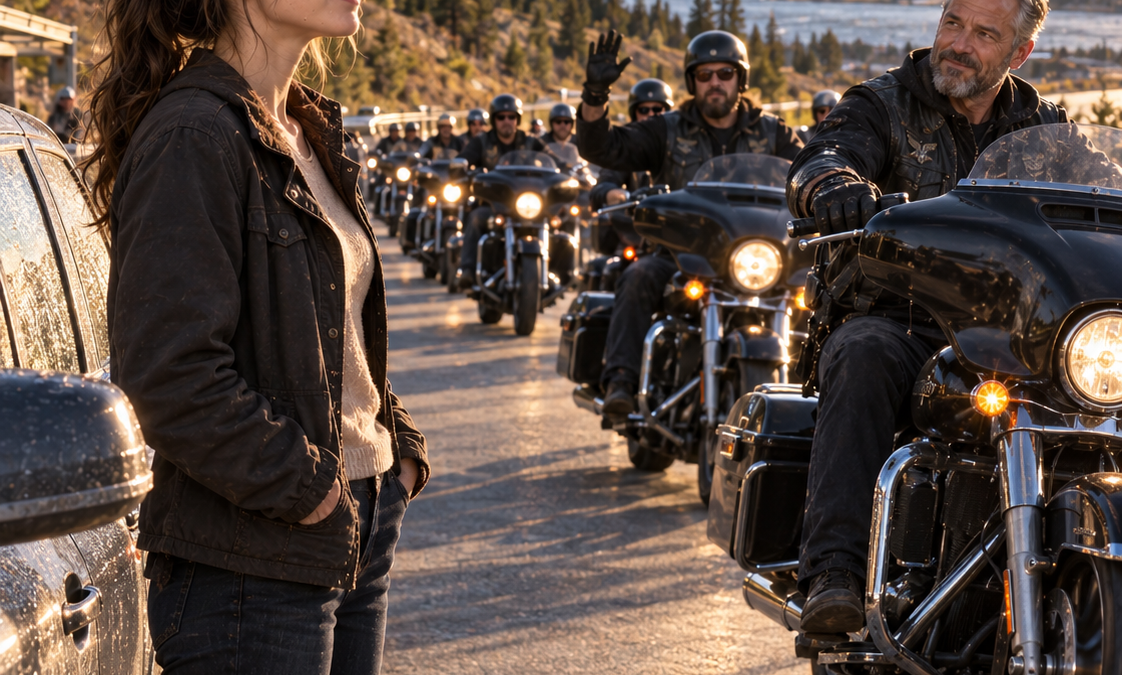
The Christmas ride left Superior on a Saturday morning at dawn. 17 bikes.
Madison had practiced on Jayce’s second bike for 2 weeks.
He’s in an empty parking lot outside town with Jace running alongside her on his own bike.
He’s calling instructions across the cold air.
He’s laughing when she wobbled and not laughing when she needed him not to.
She was not good yet. She was the kind of not good that was clearly on its way to something, which was different from the kind of not good that had no direction. On the morning of the ride, she stood beside the bike and looked at the road and felt the cold on her face and the particular aliveness that came from standing at the edge of something real.
Cole came and stood beside her.
“The road goes east first,” he said.
We’ll hit some elevation before we come down into the valley.
You stay with Jace, you’ll be fine.
I know, she said. And Madison, he looked at the road the way he looked at everything directly, fully present. Danny Reeves would have liked you.
She took that in. Tell me about him, she said.
Cole was quiet for a moment. He was the kind of person who noticed things, Cole said.
Small things, the things that other people walked past.
He said once, “I’ve thought about it a hundred times since he died.”
He said, “The world doesn’t lack for people who see what’s wrong.
It lacks for people who do something about it once they’ve seen it.”
Cole paused. He would have recognized you. Madison put on her helmet.
She thought about a motel hallway at 1:14 in the morning. A light under a door, a gap that was just wide enough. A voice that carried just far enough in the silence of a September Tuesday.
She thought about all the moments between then and now. of the 911 operator.
The dark road 16 headlights Cole’s face when she said the name Holloway Jayce’s apology in the lobby is Vasquez across the conference table a jury for person and a single word repeated 16 times and a prosecutor’s voice saying Ellen Park wants to meet with you.
She thought about her mother. She thought about Douglas Mercer and the seven years she had paid for doing the right thing. And the particular fact that those seven years had put her in exactly the right place with exactly the right habits.
On exactly the right night, she got on the bike. The engine came alive under her and she felt it the way she had heard riders describe it.
Not like a machine exactly, but like something with intention, something that was waiting to go where she decided to go. These 17 bikes pulled out of Superior Montana in the first light of a December morning moving east together.
The sound of them filling the cold air with something that was equal parts celebration and remembrance and pure uncomplicated forward motion. Madison Harper was not a night clerk anymore.
She was not the woman who had been quietly diminished by a man who thought he was untouchable.
She was not the woman who had spent three years making herself smaller so the world’s failures would have less of her to damage.
She was the woman who had stood in the dark on a mountain highway and refused to let 16 people die. She was the woman who had listened when everyone told her not to.
She was the woman who had testified clean and clear and unshakable in front of the man who had looked at her and seen nobody and had watched him realize to the exact size of his mistake. She was the woman who carried everything she had always been into a courtroom and laid it down like evidence and let it speak for itself and it had some stories end with justice.
Some end with healing. Some end with a specific quiet satisfaction of a thing completed not tidied up not made simple but genuinely honestly done.
This one ends here on a winter road with 17 bikes ease and a woman in the middle of them who had spent her whole life paying attention and had finally fully ease become someone the world was paying attention to in return. Travis Holloway sat in a holding cell while the sentencing paperwork moved through its channels. The three men from room 206 began serving reduced terms in facilities far from the mountains.
The Mineral County Sheriff’s Office updated its dispatch protocols.
The Silver Pine Lodge replaced room 206’s carpet and repainted and reopened the room, and Connie left a small folded note on the clean front desk that said simply, “She was here.
” and Madison Harper rode east into the December light with the mountains behind her and the road ahead and 16 brothers on either side and the engine underneath her and her mother’s voice somewhere deep in her chest saying the only thing it had ever needed to say, “Please always know what’s in front of you, Maddie.
Always.”
And she did.
—END—

