“You’ve Thrown Me Out of Here Twice Now—Neither Time Did You Ask Who I Was Talking To.” She Was the New Captain They Tried to Bury—Until the Whole Precinct Found Out Who Was Listening.
“You’ve Thrown Me Out of Here Twice Now—Neither Time Did You Ask Who I Was Talking To.” She Was the New Captain They Tried to Bury—Until the Whole Precinct Found Out Who Was Listening.
New Police Captain Walks Into Her Own Precinct—Then Her Own Officers Throws Her Out
You lost, sweetheart?
No, Sergeant.
I’m exactly where I need to be.
I’m just saying people like you should stay somewhere safe where you can’t cause trouble for everyone else.
If I’m somewhere unsafe, I assure you it isn’t because I wandered here by mistake.
You’ve got quite the mouth on you for someone who should know better.
I don’t wish to argue with you, Sergeant.
I only wish to be left to my own business.
Halverson’s jaw tightened, his patience wearing thin as Danica’s calm response only seemed to irritate him further.
GET HER OUT OF HERE BEFORE I LOSE WHAT LITTLE PATIENCE I have left.
It was only a matter of time before Halverson discovered exactly who he had just thrown out, and by then it would be too late.
Danica Asante had spent 22 years learning one lesson.
If you want to know a place, don’t let it know you’re coming.
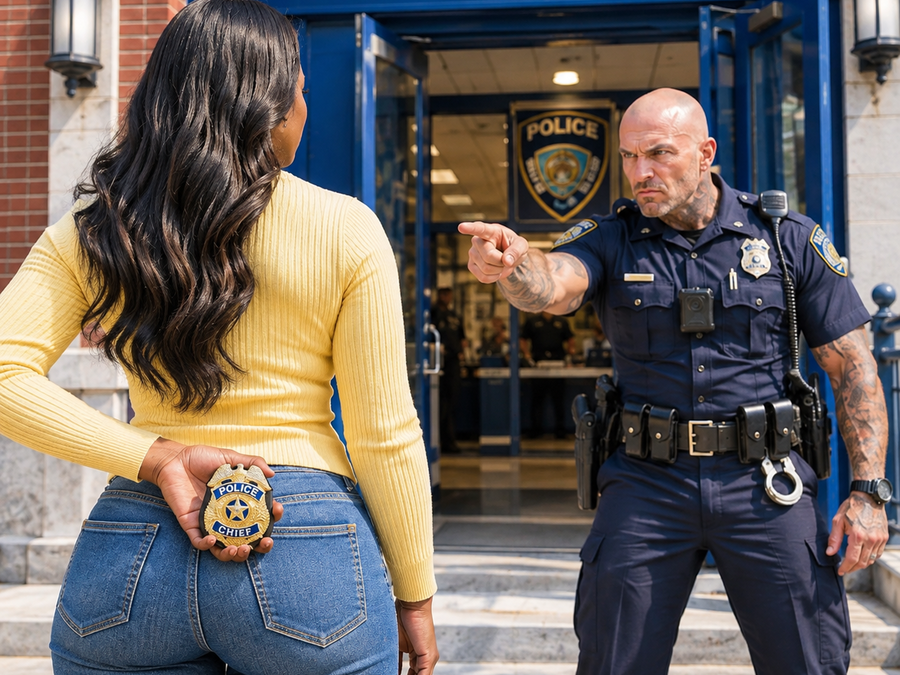
At 9 on Monday morning, she pushed open the front door of the 41st precinct with her phone pressed to her ear. She had worn jeans and a plain sweater.
Her captain’s shield hung from her belt, half covered by the sweater’s hem.
Tomorrow she would be sworn in.
Today she wanted to see this place the way everyone else saw it. She had walked this lobby as a young officer.
She had left it after her report on a crooked partner went into a drawer and never came out. 20 years later, the walls were the same dull green, and so was the smell of old coffee and floor wax.
“So, he’s flying until Thursday?”
she said into the phone.
“Yes, Captain.”
The commissioner’s aid said, “He’s over the ocean.
He can’t be reached until he lands.
Is there anything you need?
No, I’m just looking around.
She ended the call. Then she tapped one button on her screen, the same one she tapped at every new post.
A red dot glowed.
The app would send everything it heard straight to the commissioner’s secure inbox.
She had never needed it before.
She had never once been sorry she’d turned it on.
She kept the phone loose at her side and walked toward the front desk.
A big man sat behind the counter.
His arms were covered in tattoos and his chest was puffed out like he owned the building. The name plate read Halverson.
He didn’t look up from his coffee until she was right in front of him.
Then he looked her up and down slowly, and he didn’t hide what he thought.
“Help you?”
he said.
It wasn’t a question.
It was a warning.
I’m waiting for the captain, Danica said.
He snorted.
The captain?
That’s right, lady.
This counter is for complaints.
Somebody stole your purse?
I’ll take a report.
Somebody keyed your car?
Take a number.
He leaned back until his chair creaked.
But you don’t just wander into a police precinct and wait for a captain.
That’s not how it works.
I’ll wait right here.
No, you won’t.
He raised his voice so the whole lobby could hear.
Two officers by the water cooler stopped talking. Hey, boys.
This one thinks she has an appointment with the captain.
A few men laughed. One of them, a thick-necked officer with a buzzcut, stepped closer.
His name plate said Carrian. He crossed his arms and grinned like a dog that had just been told it could bite.
“You lost, sweetheart?”
Carrian asked.
“I’m exactly where I need to be.”
“Funny,” Halverson said.
“Because people like you are never where they need to be.
They’re out there.”
He jerked his thumb at the door.
“Where it’s safe for everybody.”
Danica felt the heat climb up her neck. She had heard worse in her life, but it never stopped stinging.
She let it burn and kept her face still.
Anger was loud, and loud made mistakes.
She had learned long ago that the calm one in the room always wins in the end.
“Sergeant,” she said evenly.
“What’s your first name?”
“None of your business.”
“I’ll find out.”
He laughed harder.
Oh, she’ll find out.
Write it down, Carrian.
We’ve got a detective here.
Danica didn’t answer.
She stood still and let him enjoy himself.
Every word he spoke was going into her phone.
The front door squeaked open.
An old man stepped inside. He was thin and stooped with white hair and a canvas work jacket that hung off his shoulders.
His hands shook. He kept his eyes on the floor like a boy who knew he was about to be scolded.
The whole lobby changed.
The laughing stopped.
Halverson’s grin stayed, but it went flat and cold.
“Marsh,” he said, “Right on time.”
The old man didn’t speak.
He crossed the floor with small, careful steps.
Danica noticed that his coat bulged on one side, as though something thick and square was tucked inside.
He kept one hand pressed against it.
He reached the counter.
He glanced at Danica only for a second, and his eyes held a plea she couldn’t read.
Then he looked away, pulled a thick envelope from his pocket, and slid it under the edge of the counter below where the cameras could see.
Halverson didn’t look down.
He palmed the envelope in one smooth move, like a man who had done it a thousand times. He weighed it in his hand.
He didn’t count it.
He didn’t have to.
It’s light, he said.
It’s all there, Marsh whispered.
It’s the same as always.
I didn’t ask if it was the same.
Halverson leaned over the counter, his voice dropping low and mean.
I said, “It’s light.
You’re a day short, old man.
Tomorrow, I want the rest, and I want a little extra for making me wait.”
Marsh’s whole body trembled.
Please, business has been slow and tomorrow.
Marsh nodded.
He backed away from the counter, bumped into the wall, and stopped near the door.
He didn’t leave.
He stood there, hand still on his coat, staring at the woman in the yellow sweater as if she were the last thing in the world he understood.
Danica slowly lowered her phone. The red dot kept glowing in her palm.
She watched Halverson stuff the envelope into his pocket. She watched him smile.
Then she took one more step toward the counter. Danica stopped at the counter.
Halverson was still smiling. Marsh hovered near the door, his hand clamped over the bulge in his coat.
“What was in that envelope?”
she asked. The lobby went quiet.
Halverson’s smile slid off his face.
What did you say? The envelope the old man just slid under your counter.
What was it for?
That’s none of your business.
I think it is.
For a long moment, he just stared at her. Then his face turned red, starting at the neck and climbing up like water filling a glass.
He slammed his palm on the counter.
The coffee jumped in its cup.
“Who do you think you are?”
he roared. You walk in off the street, you stand in my lobby, and you ask me questions.
You’re a trespasser.
You’re a nosy little busybody who’s about 2 seconds from a night in a cell.
Sergeant, I asked a simple question. And I gave you a simple answer.
Get out.
He pointed at the door.
Carrian Parks, get this woman out of here.
Carrian didn’t wait.
He grinned and moved in from the left.
A second officer, a lanky man who looked like he’d rather be anywhere else, came in from the right.
Neither one asked her to walk.
They just took hold.
Carrian grabbed her left arm above the elbow and squeezed hard. His fingers dug into her skin.
The other officer took her right arm and gave her a tug.
“Let go of me,” Danica said.
“Let go of me,” Carrian mimicked in a squeaky voice.
A few officers by the water cooler laughed.
“You hear that, Sarge?
She wants us to be polite.”
“Be polite when you’re out on the sidewalk, sweetheart,” Halverson said.
“Maybe you’ll learn some manners.”
They started to haul her backward, her sneakers slid on the waxed floor.
Her phone nearly fell out of her hand, and she shoved it deep into her back pocket, the light still glowing against the denim.
Her heart was pounding.
She was not afraid.
Not exactly.
She was furious in a cold, tight, careful way.
20 years ago, she had stood in the same lobby while men like these told her to keep her mouth shut.
She had kept it shut, and she had paid for that silence every day since. She would not make that trade again.
Across the room, a young officer stood by a filing cabinet with a stack of folders hugged to her chest.
She was maybe 26 with a tight bun and wide, frightened eyes.
A small camera was clipped to her chest.
The badge on her shirt read, “Voss.”
Danica looked right at her.
“Officer Voss,” she called.
“Badge 4471.
Turn on your body camera right now.”
Voss jumped as if she’d been slapped.
Her eyes went to Halverson, then to Carrian, then back to the woman being dragged across the floor.
Don’t you dare, Halverson snapped.
Voss, put those folders away.
That’s an order.
Officer Voss, Danica said.
Her voice was steady, and it carried. Everything about this room is about to matter.
Turn it on.
Voss didn’t move.
Her hand hovered near her chest. The second stretched like a rope pulled tight.
Then she pressed the button.
A tiny light blinked red on her chest. Nobody noticed except Danica.
She felt something loosen in her ribs just a little.
Put her out.
Halverson barked.
What are you waiting for?
Carrian hauled harder.
They dragged her past a bulletin board and a row of dusty plaques.
They passed a wall of framed photographs of past captains, all men, all smiling.
She noticed that even now.
Then the front door swung wide, and the morning light hit her face.
Carrian didn’t ease her out.
He shoved. She stumbled through the doorway, caught her balance on the top step, and turned just in time to see him raise a hand as if to push her again.
He stopped himself.
Maybe he remembered the crowd. There was one.
Neighbors had gathered on the sidewalk, drawn by the shouting. A woman with a stroller, two men in work boots, a teenager with a phone held up filming.
They stood in a loose half circle watching. Danica stepped down onto the pavement and her foot caught the curb.
She went down on one knee, scraping her palm on the concrete.
A woman in the crowd gasped. Halverson came out behind them, chest out, shoulders wide.
He jabbed a thick finger toward her and raised his voice for the audience.
“This is a loitering problem,” he shouted.
“We’ve had complaints.
People think they can camp out in a police station and harass officers. Not on my watch.
Move along, ma’am.
Next time it’s handcuffs.”
Sergeant, Danica said quietly from the ground.
You’ll want to take that back.
Take it back?
He laughed loud and ugly.
Lady, I don’t take anything back.
I give orders and you follow them.
That’s how this works.
That’s how it’s always worked here.
A few officers peered through the glass doors, grinning.
Carrian wiped his hands on his pants as if she were something dirty.
You people, Halverson said, shaking his head.
You come in here thinking you’re somebody.
You’re nobody.
Understand? Nobody.
He spat the last word.
Danica said nothing. She stayed down on one knee a moment longer.
She looked at the blood on her palm, then at the faces in the crowd.
Some looked away. Some looked ashamed.
One old man, Marsh, stood at the edge of the doorway with tears in his eyes. Halverson gave a satisfied nod.
He had made his point.
He turned his back on her and strode toward the doors, tossing one last remark over his shoulder.
“Somebody sweep that up,” he said.
“It’s blocking the entrance.”
Carrian laughed. Danica got slowly to her feet.
She brushed the dirt from her knee and flexed her bleeding hand. Her phone was still warm in her pocket.
Behind her, the door swung shut.
Halverson walked back toward his desk like a king returning to his throne, certain it was over.
It had barely begun.
Danica stood on the sidewalk and let the silence settle.
The crowd was still there.
The woman with the stroller, the two men in work boots, the teenager, his phone still raised. Nobody left.
They could feel it too, that something was about to happen.
Halverson had his hand on the door. Carrian stood beside him, smirking, wiping his palms on his pants.
“Sergeant,” Danica said.
He didn’t turn.
“Still here?”
“I’m not finished.”
“Oh, you’re finished.”
He swung around and his grin was ugly.
Carrian, she wants to be arrested.
Give the lady what she wants. Gladly, Carrian said, and stepped toward her.
Danica didn’t back up.
She reached down to her belt slowly, so no one could say she had made a sudden move. She lifted the hem of her sweater.
She unclipped the gold shield that had been hidden beneath it all morning. She held it up in the sunlight.
Carrian stopped.
His mouth was half open.
The shield was heavy, polished, and unmistakable.
Across the bottom, in clean raised letters, one word, captain.
Beneath it was a command number stamped in the metal. She turned it so the crowd could see.
What’s that?
The woman with the stroller whispered. Looks real, said one of the men in work boots.
Halverson let out a short bark of a laugh. Oh, come on.
That’s a prop.
Where’d you get that?
A costume shop.
He took one step toward her, his hand out.
Give me that. Impersonating an officer is a crime, lady.
You just made this a whole lot worse. Touch it, Danica said softly.
And see what happens.
Something in her voice made him stop.
It wasn’t loud.
It wasn’t angry.
It was the voice of someone who had already decided how this would end.
Carrian swallowed. Sarge.
Shut up. Sarge.
Look at the number.
I said, “Shut up.”
The door opened behind them.
The precinct’s lieutenant, a tired, gray-haired man named Doyle, stepped out.
He had clearly been watching through the glass.
He walked straight past Halverson, stopped in front of Danica, and studied the shield for a long moment. Then he pulled a folded paper from his shirt pocket, and checked it against the number stamped in the metal.
His face changed.
“Sergeant,” Doyle said quietly.
“That’s her.”
“That’s who?”
“The new commanding officer.”
Doyle’s voice cracked a little.
Captain Danica Asante. Her paperwork came through Friday.
She wasn’t supposed to start until tomorrow.
Nobody moved. The street seemed to hold its breath.
Carrian’s face went from pink to gray in about 2 seconds.
He took a step back and nearly tripped on the curb.
“No,” he said.
“No, that’s not.
We didn’t.”
“You put your hands on me,” Danica said.
She said it to him, not loudly, looking right into his eyes.
You grabbed me and you shoved me onto the pavement in front of all these people.
I didn’t know.
I swear I didn’t know.
That’s the problem, officer.
You didn’t ask.
You didn’t need to know who I was.
You just needed to decide I didn’t belong.
He opened his mouth. Nothing came out.
Halverson stood frozen with his hand halfway out. For the first time that morning, he looked small.
The color drained out of his face, his thick fingers curled and uncurled. He looked at the shield.
He looked at Doyle.
He looked at the crowd of neighbors who had watched every second.
“This is a mistake,” he said.
His voice came out thin.
She didn’t identify herself.
She never said a word about being.
I said I was waiting for the captain.
Danica said, “You laughed.
You were in street clothes.”
I was in my own precinct. A murmur ran through the crowd.
The teenager with the phone whispered something to his friend.
The woman with the stroller put a hand over her mouth.
Danica turned her head and found Marsh.
The old man stood at the edge of the doorway, one hand still pressed against his coat, the other covering his lips.
His eyes were wet.
He looked like a man seeing a ghost, or maybe a miracle. She gave him the smallest nod.
It’s all right, the nod said.
I see you. Then she turned back to Halverson.
Sergeant, she said, you have 11 minutes. 11 minutes for what?
To explain the envelope, why Mr.Marsh handed you cash, why you said he was a day short, why he looked at you like a man who’s afraid of getting hurt.
She let each sentence land.
You have 11 minutes starting now. My office, second floor.
Bring Officer Carrian and Lieutenant Doyle.
Captain, 10 minutes and 50 seconds.
Halverson’s jaw worked.
His mouth opened and closed like a fish on a dock.
He glanced at the doors where several officers had pressed up against the glass, their grins long gone. In the doorway stood Officer Voss.
She hadn’t moved since she’d stepped outside.
Her hands were at her sides. The small red light on her chest was still blinking.
Danica noticed.
Voss noticed her noticing.
Neither of them said a word, but something passed between them, something quiet and steady, and Voss lifted her chin just slightly.
Lieutenant Doyle, Danica said. Yes, Captain.
No officer leaves this building until I say so. Nobody wipes a computer.
Nobody deletes a file.
Nobody makes a phone call I haven’t approved.
Is that clear?
Perfectly clear, ma’am.
Good.
She clipped the shield back onto her belt, this time in plain sight. She smoothed her sweater.
She walked past Halverson close enough that he flinched and climbed the front steps of her own precinct.
At the door, she paused and looked back.
Halverson stood on the sidewalk with sweat running down his temples. He lifted his wrist and checked his watch.
His hand was shaking.
10 minutes and he had no answer.
The captain’s office was on the second floor.
It smelled like dust and old paper.
Nobody had sat behind the big wooden desk in 6 weeks.
Danica sat down in the chair and set her phone on the blotter. The red dot was still glowing.
She did not hide it.
At 9:25 sharp, the door opened.
Halverson came in first. His shirt was damp at the collar.
Carrian trailed behind him, staring at his own boots.
Lieutenant Doyle came last and shut the door.
PART 2
11 minutes, Danica said.
You used 10 and a half walking up the stairs. Start talking, Sergeant.
Halverson cleared his throat. He tried to stand tall, but his shoulders kept sagging.
Captain, it was a misunderstanding.
That’s all.
A big silly misunderstanding. Explain the envelope.
It was a donation. He said it fast, like he had practiced it on the stairs.
For the police widows fund, Mr.Marsh is a volunteer.
He’s been giving for years.
A good citizen. A donation?
Yes, ma’am.
Then why did you tell him he was a day short?
Halverson’s mouth opened.
Nothing came out.
Carrian shifted his feet.
The fund has a goal each month, Halverson said at last.
Mr.Marsh pledges an amount.
He was a little behind. I see.
Danica folded her hands.
Then you’ll have the paperwork, receipts, a bank account for the fund, a list of donors, a letter from the widows committee.
It’s in a drawer downstairs.
Lieutenant Doyle, have you ever heard of a police widows fund at the 41st?
Doyle kept his eyes on the wall.
No, Captain, not in 19 years.
Neither have I.
She leaned forward.
Sergeant, here is what I know. I know a frightened old man walked in with cash.
I know you took it without counting.
I know you told him to bring more tomorrow, plus extra for making you wait. That is not a donation.
That is a shakedown.
You can’t prove that.
I don’t have to prove it to you.
She tapped the phone.
I recorded everything from the moment I walked in. Your words, his words, your order to throw me out.
For the first time, Halverson’s face went truly blank.
He stared at the little red dot like it was a snake.
“That’s illegal,” he said weakly.
“You can’t record without telling.”
“Check the law in this state, Sergeant.
Then check it again.”
She sat back.
“And that’s only the phone.
Every officer in that lobby wears a body camera.”
Carrian’s head snapped up.
“They upload on their own,” he blurted.
“The cloud.
Nobody here can touch it.”
“Thank you, Officer Carrian.
That is the first useful thing you’ve said today.”
Carrian’s ears turned red.
Halverson shot him a look that could have cut glass. Danica picked up the desk phone.
“Lieutenant, send Officer Voss up.”
Doyle left.
The room was silent for two long minutes. The only sound was Halverson breathing through his nose.
Voss arrived and stood at the door, hands clasped, shoulders stiff. She would not look at the sergeant.
Officer Voss, Danica said, “Is your footage from this morning saved?”
“Yes, Captain.”
Her voice shook, but she got the words out.
“It uploaded automatically.
I checked on the stairs.
It’s all there.
The envelope, the shove, all of it.”
Thank you.
You’re excused.
Stay in the building.
Voss nodded once and left. Her hand trembled on the door knob.
Halverson watched her go.
His jaw clenched so tight a muscle jumped in his cheek.
Sergeant, Danica said, “I am ordering you to preserve every record from the front desk.
Logs, receipts, your phone.
Do not delete a single thing. If one file goes missing, I will treat it as obstruction.
Do you understand?”
I understand. Officer Carrian.
Yes, Captain.
You put your hands on a woman who was asking a question.
You’ll be hearing from me about that.
Carrian swallowed. He said nothing.
Danica opened a folder on her desk.
That’s all for now.
You may go.
They went to the door. Carrian slipped out into the hall.
Halverson stopped with his hand on the frame.
“Captain,” he said, “May I step out for one call?”
“Personal matter.
Make it quick.”
He didn’t wait.
He pulled out his phone and walked into the hallway. The glass wall of her office was clear.
She watched him lean against the far wall, one hand on his forehead, the other pressing the phone to his ear. He talked low and fast.
He glanced back at her twice.
She didn’t flinch.
She opened a drawer and started reading the old personnel files one by one as if nothing in the world was wrong. 3 minutes passed, then four.
At last, the call ended.
Halverson pocketed the phone. He stood a moment straightening his shirt, and something odd happened to his face.
The fear drained out of it, his shoulders squared. The old swagger crept back.
He walked back into her office without knocking.
“Everything all right, Sergeant?”
she asked.
“Oh, everything’s fine, Captain.”
He smiled. It was a thin, sharp smile, the kind a man wears when he is holding a card nobody else can see.
“Better than fine.
Deputy Chief Lundren is on his way.”
Danica kept her face still.
Is he?
He’s very interested in your first day.
Halverson leaned in the doorway, taking his time. He oversees this whole burrow, you know.
Internal affairs, promotions, transfers, everything.
I’m aware of the chain of command.
Good.
Then you’ll understand.
He tapped the door frame twice.
You’ll want to be nicer to him than you were to me.
He turned and walked out, whistling. Danica watched him go.
Her pulse was steady.
Her hands were still.
She picked up her phone and looked at the red dot.
Then she pulled a fresh notepad toward her and wrote one name at the top of the page. Lundren.
At 12:30 that afternoon, Deputy Chief Warren Lundren walked into the captain’s office like he owned it.
He was a tall man in a crisp uniform, silver at the temples with a smile that looked pressed and ironed. He shut the door behind him.
He took his time crossing the room. He did not wait to be offered a chair.
“Captain Asante,” he said warmly, “Warren Lundren, welcome to the 41st.
I wish we were meeting under better circumstances.”
Deputy Chief.
Danica stayed seated.
Thank you for coming. Of course.
He sat, crossed one leg over the other, and studied her like a man shopping for a used car.
I’ve heard about this morning.
A regrettable misunderstanding. Sergeant Halverson is a good man with a rough edge.
He didn’t know who you were.
No, he didn’t.
Then you see my point. Nobody meant any harm.
Officer Carrian grabbed my arm hard enough to leave marks, Danica said. Then he threw me onto the pavement.
Heat of the moment.
I was asking a question.
Lundren’s smile stayed put, but his eyes cooled a degree.
Captain, let me be friendly.
You’re new.
You don’t know how things work here yet.
The 41st has its own rhythm.
The men are loyal to each other.
They’ve been together a long time.
He spread his hands.
Here’s what I suggest.
Halverson apologizes. You accept.
We all shake hands and everyone goes back to work.
And the envelope? What envelope?
Danica looked at him for a long moment.
The one Mr.Marsh handed over at the front desk.
The one Sergeant Halverson called light. A donation.
Lundren said smoothly.
The widows fund. Lieutenant Doyle has never heard of it.
Doyle is a lieutenant.
He doesn’t know everything.
Neither do I, Danica said.
But I know there is no paperwork, no bank account, and no committee. And I know an old man shook so badly he could barely stand.
The smile finally slipped.
Lundren uncrossed his legs and leaned forward, resting his elbows on his knees.
“Captain,” he said, dropping his voice.
“I’m going to say this once as a friend.
Let it go.”
“I can’t do that.”
“You can.
You just don’t want to.”
A man was being squeezed for money in my lobby. Deputy Chief, I saw it.
I heard it.
I have it on tape.
Something flickered across his face. It was quick, but she caught it.
Fear.
Then it was gone. Buried under a harder look.
Tape, he said. Several tapes, mine, and the body cameras.
They upload to a server the precinct can’t touch.
Lundren sat back slowly.
When he spoke again, the warmth was gone from his voice.
What was left was flat and cold.
Let me tell you something about your new job, he said. I oversee internal affairs for this burrow.
Every complaint, every investigation, every disciplinary hearing crosses my desk. I decide what gets looked at.
I decide what gets buried. He let that sit.
Your first week can go smoothly, Captain, or it can go very badly.
That’s up to you.
Is that a threat?
It’s a weather report.
Danica stood. She was not tall, but she seemed to fill the room.
Deputy Chief, I spent 22 years on this job.
I’ve been threatened by better men than you, and most of them are retired now.
I am not dropping this.
If you want to protect Sergeant Halverson, I suggest you ask yourself why.
He stood too. For a second, they faced each other across the desk, close enough to hear each other breathe.
“You’re making a mistake,” he said.
Then it will be mine.
He straightened his jacket and went to the door.
With his hand on the knob, he turned back.
The smile returned small and sour. I was against your appointment, you know, he said.
I told them you wouldn’t fit here.
I see now I was right. He left.
The door clicked shut.
Danica sat down slowly. Her hands were steady, but her stomach was tight.
He was against my appointment, she thought.
Why would a man who was only here to smooth things over say that?
She wrote it on the notepad under his name.
At 2:00, she walked down to the squad room.
It was a long, low room with scarred desks and flickering lights.
The whole shift was there, some at their desks, some standing in clumps by the wall.
Conversation stopped when she came in. Halverson stood near the coffee machine with Carrian beside him.
He had his arms crossed. The sweat was gone.
He looked loose, easy, almost cheerful.
Behind him stood a row of officers who had decided which side to be on.
Their faces were hard.
“Captain,” Halverson called loud enough for everyone.
He gave a slow, theatrical bow.
Welcome to the 41st.
A few chuckles.
Everyone here is going to wish you hadn’t come, he added.
The chuckles grew. Someone near the back whistled.
Carrian grinned, his confidence creeping back like a bad habit.
Danica let the laughter run out.
She walked down the center of the room slowly past every desk. Officers looked away as she passed.
Some stared at their screens, some stared at her. She stopped beside a young woman at the end of a row.
Officer Voss.
Her tight bun was a little loose now. Her hands were folded on a stack of reports, white at the knuckles.
Danica did not turn her head. She spoke quietly so only Voss could hear.
“Then it’s a good thing I came early,” she said.
I’ve already seen everything I need to start.
Voss didn’t answer, but her breath caught just slightly and her chin came up.
Danica walked on. Behind her, the laughter faded, and nobody could quite say why.
Danica reached the front of the squad room and turned around. 40 officers stared back at her.
Some sat with their arms crossed, some wouldn’t meet her eyes.
Halverson leaned against the coffee machine like a man watching a bad play.
I’ll keep this short, she said.
My name is Captain Danica Asante.
I’m the commanding officer of the 41st precinct.
Some of you met me this morning. Not all of you were polite.
A few men shifted in their seats.
Here is how this works from now on.
Nobody in this building is above a question. Not the newest rookie, not the oldest sergeant, not me.
She turned to the far wall.
Officer Carrian.
His grin froze.
Yes, Captain.
As of right now, you’re off patrol.
You’re assigned to the records room until further notice.
You’ll be filing paperwork and nothing else.
Captain, that’s that’s
what happens when you put your hands on a woman who is only asking a question.
Be glad it isn’t worse.
A low murmur ran through the room.
Carrian’s face went dark red.
He looked at Halverson, waiting for him to say something.
Halverson said nothing. Sergeant Halverson.
Captain. He drew the word out, mocking.
You’re relieved of the front desk.
Effective now. Lieutenant Doyle will cover it.
I want your desk logs, your sign-in sheets, and your phone records for the last 12 months on my desk by morning. On what grounds?
On the grounds that I asked. Halverson smiled with half his mouth.
You’re making enemies, Captain.
I’m making a list, she said.
There’s a difference.
She dismissed the shift.
They shuffled out in clumps, whispering. Several glanced back at her.
A few looked scared. A few looked like they were already doing math, trying to guess who would win.
Carrian stormed off toward the records room, kicking a chair on his way. It was the first small cost, and everyone in the room had watched it land.
Danica climbed the stairs back to her office. She told herself to breathe.
She had won an hour, not a war. At 5:30, a knock came at her door.
A young clerk stood in the hall holding a thin envelope as if it might bite. Internal affairs captain hand delivered.
She took it.
She read the first page, then the second.
Then she sat it down and sat very still. The complaint was dated that afternoon.
It was signed by Sergeant Burke Halverson.
It claimed that Danica Asante had entered the precinct without identification, assaulted an officer in the lobby and falsified her identity to disrupt police operations. A cover memo carried a stamp from the office of Deputy Chief Warren Lundren.
It requested her immediate suspension pending review. She read it again, assaulted an officer.
She had not touched anyone. Her phone sat on the desk.
She picked it up and called the commissioner’s aid, the same woman from that morning.
Captain Asante, how is your first day? Eventful.
I need to speak with the commissioner.
It’s urgent.
I’m so sorry.
He’s still in the air.
He won’t land until Thursday morning.
No phone, no messages.
His flight is across the ocean.
Is there anyone else with authority over IIA? The aid hesitated.
Not above the deputy chief. Not until the commissioner returns.
Is something wrong? A complaint has been filed against me.
It came through Deputy Chief Lundren’s office.
There was a long, careful silence on the line.
Captain, the aid said, lowering her voice, “I shouldn’t say this, but when your name came up for the 41st, Deputy Chief Lundren pushed hard against it.
He wanted his own candidate. He argued with the commissioner for two weeks.
When he lost, he did not take it well.
Danica closed her eyes. It fit.
It fit the way a key fits a lock.
Thank you, she said.
That helps more than you know.
Is there anything I can do? Make sure the commissioner hears the recording from this morning the moment he lands.
Everything is in his secure inbox.
I’ll flag it myself.
She hung up.
She sat there with the complaint in front of her and the sun going orange in the window.
3 days.
The commissioner was gone for 3 days. And the man who ran internal affairs wanted her out.
She was on her own.
She thought about packing up and going home.
She thought about calling her sister or her old mentor or anyone who might tell her it would be all right.
Then she thought about Marsh’s shaking hands.
and the way his eyes had begged her without a word. She stayed.
By 7, the building had gone quiet. The dayshift left.
The night shift settled in downstairs, their voices low and careful. Danica locked the complaint in her desk drawer and switched off the overhead light, leaving only the desk lamp.
At 7:50, a sound came from the back of the building.
It was a soft, uneven knock on the rear door.
Not a fist, not a boot.
A knuckle tapping like someone who wasn’t sure they were allowed.
She stood. She walked down the back stairs past the empty evidence cage and put her hand on the cold metal bar.
She pushed the door open.
Ezekiel Marsh stood in the alley under a flickering light. He wore the same canvas jacket from that morning.
His breath came in short, thin puffs. Both his arms were wrapped around a flat package held tight to his chest like a child.
“Captain,” he whispered.
“I’m sorry.
I didn’t know where else to go.”
Danica looked past him down the alley.
It was empty.
“Come inside, Mr.Marsh,” she said.
“Quickly.”
Danica led Ezekiel Marsh up the back stairs and into her office. She shut the door and turned off the hall light so no one passing could see in.
She poured him a cup of water from the cooler. He held it with both hands and the water shook the whole time.
“Sit down, Mr.Marsh.”
He sat on the edge of the chair like it might bite him.
The flat package stayed pressed against his chest.
“I’m sorry about this morning,” he said.
“I saw them put their hands on you.
I saw them throw you out. I wanted to say something and I just stood there.
You were afraid.
That’s not a crime.
It feels like one.
His voice cracked.
I’ve been afraid for 11 years.
Tell me. He took a long breath.
I opened Marsh Hardware 40 years ago.
My wife and I built it. 11 years back, a new sergeant came to the desk, Burke Halverson.
He walked in and said the neighborhood was getting dangerous and a store like mine needed protection. $500 a month.
And if you refused, then the trouble started. Fines, fake complaints.
A cruiser parked out front all day so no one would come in.
One winter he had a man arrested in my aisle for no reason. My customers stopped coming.
I paid. Did the amount stay the same?
It went up 700, then a,000. He wiped his eyes with a shaky hand.
My wife got sick, Captain. The medicine cost money, and I was still paying him.
She passed 2 years ago.
I couldn’t stop even then.
I was too scared. Danica said nothing.
She let him finish.
She had learned long ago that the quiet moments often held the truth. Other shops pay, too, Marsh went on.
the bakery, the laundromat, the barber, everyone on the block.
We don’t talk about it.
We just pay and look at the floor.
Mr.Marsh, what’s in the package?
He set it on the desk and unwrapped it with careful fingers. Inside was a thick, worn notebook with a green cover held shut by a rubber band.
The edges were soft from handling.
“It’s a copy,” he said.
I made it two weeks ago at the library.
The first one stays hidden. What is it?
Every payment 11 years.
PART 3
He slid off the band and opened it. Date, amount, who took it.
I wrote it all down.
Danica pulled the lamp closer and began to read. The pages were filled in neat small handwriting.
Column after column.
March 4th, $500.
BH, April 4th, $500.
BH.
The years rolled by and the numbers climbed.
Then she noticed a second set of initials. Every month, a few days after each payment, there was a line in a different column, a smaller number.
Beside it, two letters.
WL.
She stopped.
She read the next page.
The same pattern. The next, the same.
Mr.Marsh, she said slowly. What does WL mean?
I don’t know for certain.
I only know what I saw.
He leaned forward. Once a long time ago, I came in to pay late.
Halverson was in the back room on the phone.
He said, “The envelope for WL goes out Friday.
Same as always.”
I never forgot it, so I started writing down when the money moved on.
Danica’s mouth went dry.
Warren Lundren. She thought of the man who had sat in this very chair six hours ago, smiling, calling it a weather report.
She thought of the flash of fear in his eyes when she’d said the word tape.
The money doesn’t stop with Halverson, she said quietly.
“No, ma’am.
I think it goes up.”
“Mr.Marsh, why did you keep this?”
He looked at her for a long time. His eyes were old and tired, but something steady lived in them.
Because I always hoped, he said.
I hoped that one day someone would walk through that door who wasn’t afraid of them.
Someone who would ask the question. He gave a small broken smile.
I didn’t know it would happen the way it did.
Danica felt something tighten in her throat.
She cleared it. Is this the only copy?
No.
There’s another sealed in a safe deposit box at Franklin Savings.
My wife made me promise to keep one safe. If anything happens to me, my niece has the key.
Good.
Don’t tell anyone else about that.
Not a soul.
I won’t.
She closed the ledger, wrapped it in its cloth, and carried it to the small safe behind her desk. She spun the dial, set the notebook inside, and locked it.
She tried the handle twice.
“I’ll keep this protected,” she said.
“You’ve done a brave thing tonight.”
“I don’t feel brave.
Brave people rarely do.
He stood, his knees creaking. At the door, he turned back.
“They’ll come after me, won’t they?
After tonight.”
“They won’t know about tonight,” she said.
“And if they try anything, they’ll come through me first.”
She walked him down the back stairs and out the rear door. The alley was cold now, the street light buzzing overhead.
She went with him to the corner where the side street opened onto the avenue. Across the way, his shop sat dark, its sign unlit.
Then she saw the car. A patrol cruiser sat at the curb in front of Marsh Hardware.
Its engine was running. Its headlights were off.
Two silhouettes sat inside, still as statues, watching the shop door.
Marsh’s whole body went stiff.
His hand clutched her sleeve.
“That’s Halverson’s men,” he breathed.
Danica stood very still.
The men inside had not noticed her at the mouth of the alley. She counted the seconds.
She counted her breaths.
“Mr.Marsh,” she said at last, her voice low and calm.
You’re not going home alone tonight.
Danica did not walk Marsh home that night.
She walked across the avenue instead and tapped on the cruiser’s window.
The two officers inside jumped like she’d fired a gun.
She asked them what they were guarding.
They mumbled something about routine patrol and drove off with their lights still off.
Then she took Marsh to his niece’s apartment across town.
She waited until the porch light went on and the door was locked behind him. She thought that was the end of it for the night.
She was wrong.
At 6:40 Tuesday morning, her phone rang.
It was Marsh whispering from his niece’s kitchen.
Six parking tickets had been taped to his shop shutter, and a city building inspector was already standing on the sidewalk with a clipboard. Danica got there in 20 minutes.
The inspector, a nervous man in a windbreaker, told her a call had come in at 11:40 the night before.
The caller said Marsh Hardware had blocked exits and illegal wiring.
The caller wouldn’t give a name.
The inspector had checked the number out of habit.
“It came from a desk line,” he said at the 41st precinct.
She thanked him. Then she peeled every ticket off the shutter and carried them back to the precinct in her fist.
At exactly 8, she walked into the squad room. The whole morning shift was there.
Halverson stood by the coffee machine with a fresh cup, looking like a man who had slept very well. Sergeant Halverson.
Captain.
He didn’t straighten up.
You’re up early.
She held up the stack of tickets. Six citations on Marsh hardware, blocked entrance, expired permit, unlicensed signage, all written between midnight and 4 a.m.by officers from this precinct.
Sounds like good police work. A fake code complaint was phoned in from your old desk line at 11:40 last night.
You were relieved of that desk yesterday afternoon.
Who was sitting at it?
Halverson shrugged.
I don’t keep track of who sits where.
Then I’ll tell you what I think.
She stepped closer. The room had gone completely silent.
I think you punished an old man because he talked to me.
He didn’t talk to you.
I never said he did.
Halverson’s mouth snapped shut.
A few officers glanced at each other. Danica let the slip hang in the air a second longer than was comfortable.
Then he laughed loud and ugly and turned to the room.
Listen to her.
She’s been here one day and she thinks she’s a detective.
Look, Captain, let me explain how this works.
He set down his cup. Nobody here likes you.
Nobody wants you.
Deputy Chief Lundren is already working the paperwork, and internal affairs will have you out of here by the end of the week.
You’ve got no friends, no backup, and no clue.
You’re a visitor.
Visitors leave. Are you finished?
I’m just getting started, sweetheart.
Then listen carefully. Her voice stayed low, but every officer in the room leaned in to hear it.
As the commanding officer of this precinct, I am voiding every one of these citations right now. She tore the first ticket in half, then the second.
She dropped them on the floor one by one until six torn pieces lay at his feet. The officers who wrote them will go to Marsh Hardware today.
They will apologize to Mr.Marsh in person. They will do it before noon.
You can’t order that.
I just did.
She turned to the room. Officers Puit and Dale, raise your hands.
Nobody moved for a long tight moment.
Then in the second row, a heavy set officer slowly raised one hand.
A few seats over, a younger man raised his. Both looked sick.
“Did you write these tickets?”
“Yes, ma’am,” said Puit, his voice rough.
“On whose orders?”
Puit’s eyes flicked toward Halverson.
Halverson glared at him, daring him to speak.
“I’m not asking you to testify,” Danica said gently.
I’m asking you to do the right thing before lunch.
Go see Mr.Marsh. Say you were wrong.
That’s all.
Puit hesitated. His jaw worked.
Dale stared at his boots.
Don’t you dare.
Halverson growled. You two are my guys.
You walk out that door, you’re done in this house.
Puit stood up anyway.
His chair scraped the floor.
Yes, Captain, he said.
We’ll go.
Dale rose beside him. Neither one looked at the sergeant.
They walked out together, and the door swung behind them. It was a small crack, but in a room where everyone had been afraid of one man, a crack was loud.
Halverson’s face went purple.
He stared at the torn tickets on the floor, then at the closed door.
For the first time since she’d walked in, he had nothing to say.
Dismissed, Danica said.
And Sergeant, I’m still waiting on those phone records.
They’re on your desk, he spat.
Enjoy them.
She walked out through the squad room. Officers watched her go.
Some looked afraid. Some looked thoughtful.
A few, she noticed, were looking at Halverson the way people look at a wall that has started to lean. At the back, near the lockers, stood Officer Immani Voss.
She had said nothing the entire time. She was watching Danica with the careful, steady eyes of someone making up her mind.
As Danica passed, a folded piece of paper pressed into her palm.
Voss’s hand was cold and quick.
She was already walking away.
Danica waited until she reached the stairwell. Then she unfolded it.
After shift, your office alone. At 7 on that evening, the precinct had gone quiet.
The day shift was gone.
The night shift was out on the street.
Danica sat alone in her office with the desk lamp on and the door unlocked.
She had spent the day reading Halverson’s phone records, dozens of short calls to one number, always right after Marsh’s payment day.
She had a feeling about whose number it was.
She hadn’t proven it yet.
A soft knock came at the door. Come in.
Officer Immani Voss stepped inside and shut the door behind her. She checked the glass wall, then pulled the blinds.
Her hands were shaking.
She unclipped her body camera from her chest and set it on the desk right on the blotter like she was laying down a weapon.
Captain, she said, I need to tell you something, and once I say it, I can’t take it back.
Sit down, officer.
I’d rather stand.
She drew a breath.
I’ve been on this force four years, three of them here.
I’ve watched things I should have reported.
I told myself it wasn’t my place.
I told myself I was too new. That was a lie.
I was scared. Of Halverson.
of all of them.
Of what happens to cops who talk?
Her voice wobbled. You know what happens.
You’ve seen it.
Danica’s jaw tightened.
I have this morning.
You looked right at me and said to turn on my camera.
You didn’t ask.
You told me.
Nobody has ever told me to do the right thing like I was expected to. Voss swallowed hard.
I’ve been thinking about that all day.
What do you have?
Voss picked up the camera and plugged a thin cable into the side of Danica’s computer.
3 weeks ago, I was working the evidence room. There was a drug arrest, a big one.
$6,000 in cash was seized.
It was bagged and tagged and sealed.
I was told to log it in.
She tapped a few keys. Halverson came in while I was there.
He didn’t know my camera was on.
I’d forgotten to turn it off after a shift.
A video filled the screen.
The evidence cage, grainy and green under the overhead light.
A heavy man with tattooed arms walked in and looked over his shoulder.
He peeled open a sealed bag.
He pulled out a thick roll of bills and counted off a stack. He slipped it into his own pocket.
Then he resealed the bag with a roll of tape and set it on the shelf. 6,000 went in, Voss whispered.
The log says 3500 came out. Play it again.
She did. Danica watched every second.
Halverson’s face was calm, almost bored.
He wasn’t a man doing something wrong.
He was a man doing something routine.
What case was this?
Case number 4408.
Defendant’s name was Andre Mills.
Danica pulled up the court file on her screen.
Her hands moved fast. She found the arrest report.
The cash was listed at 3500. The prosecutor had used the amount as proof of dealing.
Mills had been sentenced to 8 years. 8 years, she said quietly.
For an amount that was wrong.
There’s more.
Voss swallowed.
I looked through the other cases.
Same shift pattern, same bags. I found a second one.
Case 4291, a man named Terrence Boyd. The cash was short there, too.
Danica searched the file. Boyd had been convicted of selling drugs on the strength of a drug money count that never matched the arrest scene photographs.
He was doing 6 years.
She leaned back in her chair.
She was silent for a long time.
They’re still in prison, Voss said.
both of them because the evidence was tampered with and everyone looked away.
Why didn’t you report it?
To who, Captain?
The sergeant runs the desk.
The deputy chief runs I A.
If I’d gone to either one, I’d have had an accident by Friday.
Voss’s eyes were wet.
I didn’t know there was anybody else.
Danica reached across the desk and rested her hand on the young officer’s arm.
There is now.
Voss let out a breath that sounded like she’d been holding it for three years.
Her shoulders dropped.
A tear slid down her cheek, and she wiped it away fast, embarrassed.
I’m going to make a backup of this footage tonight.
Danica said, “Two copies.
One stays here, locked up.
One goes to the commissioner’s secure inbox where Halverson can’t touch it.
Your name will not be on any report until I decide the time is right.
They’ll find out maybe, but they will have to go through me first, and I am not as easy to move as they think.
She met Voss’s eyes.
I will protect you.
I give you my word.
Voss nodded.
She didn’t smile, but her face had changed as though some heavy thing had come off her back.
Danica plugged in a drive and began to copy the file.
The progress bar crawled across the screen.
When it finished, she made a second copy.
Then she locked one drive in the safe next to Marsh’s ledger.
She slid the second into an envelope and wrote the commissioner’s secure address on the front.
Voss stood at the door, her hand on the knob. Captain.
Yes.
The first morning when they dragged you out, you didn’t yell.
You didn’t beg.
You just kept looking at them.
She hesitated.
Why?
Danica thought about it.
Because shouting gives them something to point at, she said.
Staying calm gives them something to fear.
Voss nodded slowly.
She opened the door, stepped out, and closed it behind her. Danica sat alone with the lamp and the empty screen.
Outside, a siren wailed somewhere far off.
She stared at the names on her notepad. Mills Boyd.
This stopped being about envelopes, she said quietly to the empty room. Two men are in cells because of him.
Wednesday morning came gray and cold. Danica barely slept.
She had spent half the night staring at two case files, Mills and Boyd, and the other half running through what would happen if Lundren moved first.
At 8 a.m., she walked down to the records room in the basement.
It was a long windowless space lined with steel shelves and gray boxes. Officer Thomas Carrian sat at a small desk in the corner, buried in paper.
Nobody had spoken to him in two days.
Halverson hadn’t called or come down.
His lunch sat untouched at his elbow. He looked up when she came in.
He no longer looked like the man who had grabbed her arm. His eyes were red and his shirt was wrinkled.
“Captain,” he said.
He started to stand.
“Sit, officer.”
He sat. She pulled up a metal chair and settled across from him.
For a while, neither of them said anything.
“You asked to see me,” Danica said.
“Yesterday, you left a note with Lieutenant Doyle.”
“I did.”
Carrian rubbed his face.
Captain, I’ve been down here for 2 days.
Nobody’s come.
Not the sergeant.
Not one guy from the squad.
I’ve worked with these men for 9 years.
I took a hit for Halverson more than once.
His voice cracked.
He hasn’t even texted me.
That tells you something. Yeah, it does.
He stared at his hands.
Can I ask you something and you tell me straight?
I will.
What happens to me if I talk?
Danica did not answer right away. She studied him.
He was a big man, but he looked small right now, like someone who had run out of places to hide.
I’ll be honest with you, she said.
It won’t erase what you did.
You put your hands on me.
You’ve done worse to other people, and I know it.
That stays with you.
His face crumpled a little. He nodded.
But it will matter.
A man who tells the truth when it costs him something is not the same as a man who hides.
A judge will see that. A board will see that.
And you will see it too.
Every day for the rest of your life.
Carrian said nothing. He wiped his eyes with the back of his hand.
I need time. He whispered.
Take it. But not too long.
Things are moving. She left him there.
She went back upstairs and worked through the morning.
At 2:00, a knock came at her door.
It was Carrian standing stiff in the hall, his cap in both hands.
Captain, I’m ready.
Come in.
He sat.
She turned on a recorder and read him his rights because she wanted every word to stand up later.
He nodded through it, jaw tight.
Every month for 6 years, he began, I drove an envelope for Halverson, always the same time.
The first Friday after the collections, he’d hand it to me sealed.
I’d drive it to a building downtown.
The deputy chief’s office.
I’d leave it with his assistant.
No questions. Did you ever look inside?
Once by accident, the flap was loose.
It was cash. A lot.
He swallowed. I knew it was wrong.
I told myself it was just how things worked.
That’s what Halverson always said.
It’s how the house runs, Tommy.
Whose name was on the envelope? Just two letters, WL.
Danica held his gaze.
It matched Marsh’s ledger.
It matched the phone records.
She had three roads now, all leading to the same door.
Will you say that under oath? Yes.
His voice shook, but it did not break.
I’ll say all of it.
When he finished, she thanked him and meant it. She had a patrol officer take him home with instructions to stay inside and answer his phone for no one but her.
At 4:30, she wrote a full report.
She laid it all out, the recording, the ledger, Voss’s footage, Carrian’s statement.
She sent it to the commissioner’s secure inbox and called his aid.
I received it, Captain.
The woman said, I’ve sent it to the commissioner’s tablet with a flag.
He lands Thursday at 6:00 in the morning.
PART 4
I’ll make sure he reads it before the car reaches the city.
Will he convene a hearing? He called me from the plane an hour ago.
He’s already asked for one.
He wants everyone in the same room at the 41st. By 2:00 Thursday afternoon.
Danica set the phone down. She let out a slow breath.
By nightfall, she had everything locked in her safe, the ledger copy, the two drives.
Carrian signed statement, a full recording of her first morning, everything she needed. At 10:30 that night, the precinct was almost empty.
Rain tapped the window.
She sat alone with her coffee gone cold. She thought of Marsh, safe at his nieces.
She thought of Voss, who had finally spoken.
She thought of Carrian, who had finally stopped looking away.
Three people who had been afraid for years, and who had chosen to stand up anyway. For the first time in 2 days, she let her shoulders drop.
The hearing was less than 16 hours away. Lundren had no idea how much she had.
It looked like she had won. She leaned back in the chair and for the first time since Monday morning allowed herself to believe it was almost over.
She had no idea how wrong she was. Danica left the precinct at 11 that night.
She locked her office door and spun the dial on the safe twice.
She checked the handle one more time out of habit. Then she went home and slept for the first time in 3 days.
She did not know that someone else was awake.
At 12:15 a.m., Deputy Chief Warren Lundren sat in his car outside the precinct with Halverson in the passenger seat. Halverson had already heard the whispers.
Doyle had slipped up on the phone and mentioned a full report going to the commissioner.
Lundren had made two calls after that. One went to a locksmith with a city contract.
The other went to a night supervisor at internal affairs.
By 6:30 Thursday morning, it was done. Danica woke to her phone buzzing on the nightstand.
It was Lieutenant Doyle, and his voice was strange and tight.
Captain, you need to come in now. She was in the building by 6:50.
The lobby was full.
Officers stood in tight clusters along the walls, and conversation died as she walked in. She went straight up the stairs.
Her office door stood open. The lock was not broken.
It had been opened with a key.
The safe behind her desk hung wide. She stepped closer and looked inside.
The drives were gone.
Carrian’s signed statement was gone.
The ledger copy was gone.
Only a loose rubber band lay at the bottom, curled like a dead worm. Her stomach dropped.
She forced herself to breathe.
Lieutenant, she said, “Who had a key to this room?”
The locksmith’s work order says it was a city maintenance call signed by Deputy Chief Lundren’s office.
They said it was a safety inspection.
At 2:00 in the morning, Doyle looked at the floor.
“Yes, ma’am.”
Where is officer Carrian?
That’s the other thing.
Doyle swallowed.
A resignation letter came in at midnight.
It’s on the deputy chief’s letter head with Carrian’s name typed at the bottom.
His locker is cleared.
His phone goes straight to voicemail. A patrol car went to his house.
Nobody was home.
He wouldn’t resign.
He agreed to testify yesterday.
I know, ma’am.
and officer Voss.
Doyle’s face went gray.
Suspended, effective at 5 a.m.A charge of insubordination filed by Sergeant Halverson. She was escorted out of the building 20 minutes ago.
Danica gripped the edge of the desk.
For one terrible second, the room tilted. They had moved while she slept.
They had taken everything.
And Carrian, the only man who could name Lundren out loud, was gone.
“Captain,” Doyle said softly, “there’s one more thing.”
He pointed at the door.
Two men in gray suits stood in the hallway.
Between them was a woman in a navy blazer carrying a leather folder. Behind them, smiling, came Halverson.
He had a cardboard box tucked under one arm.
Captain Asante, the woman said, stepping inside.
“I’m from internal affairs.
I have an order signed this morning suspending you from duty pending a full investigation into charges of impersonation, assault, and misuse of authority.
It is effective immediately.”
She held out a document. Danica took it.
It had Lundren’s signature at the bottom, large and sloppy, as if he had been enjoying himself.
“I’ll need your shield and your sidearm,” the woman said.
“On whose authority?”
The deputy chiefs acting in the commissioner’s absence.
The commissioner lands in 2 hours, then he can review it when he arrives.
Danica took off her shield.
It felt heavier than it had on Monday. She unholstered her sidearm, cleared it, and laid both on the desk.
She did not say a word. Halverson stepped forward.
He set the cardboard box in front of her and grinned.
“For your things, Captain,” he said.
“Pictures, plants, whatever.”
I’d hurry.
The deputy chief doesn’t like people lingering.
Sergeant, she said.
“You are making a very large mistake.”
“No, ma’am.
I’m cleaning up one.”
He leaned in, his voice dropping.
“You thought you could come into my house and tear it apart?
You thought a few scraps of paper would save you?
Nobody’s coming for you.
Nobody’s coming for that old man either.
By tonight, you’ll be a bad memory.
By tomorrow, you’ll be a joke.
Are you finished? Walk her out, he said to the others.
Front door. Let everybody see.
She packed in silence a framed photo of her mother.
A coffee mug, a small brass name plate she had not yet set on the desk.
She lifted the box and walked out of her office with her back straight.
Down the stairs she went into the lobby.
The officers had formed two lines along the walls. Nobody spoke.
Some looked away.
A few looked ashamed.
Doyle stood by the stairs, his hand over his mouth. Puit and Dale stood near the lockers, their faces tight.
She passed the wall of old portraits.
She passed the front desk where Halverson’s chair sat empty.
She walked toward the door she had been dragged through 3 days ago. Halverson followed close behind and pushed it open for her with a mocking flourish.
After you, Captain.
Danica stepped into the doorway.
Morning light fell across her face.
Her phone sat in her pocket, small and warm. Nobody had thought to check it.
She turned back and looked at the silent room.
“You’ve thrown me out of here twice now,” she said calmly.
Neither time did you ask who I was talking to.
Halverson’s grin flickered.
He opened his mouth, but she had already stepped outside, and the door was swinging shut behind her. Danica stood on the sidewalk across from the precinct with the cardboard box in her arms.
It was 7:30 Thursday morning.
The street was waking up. A bus hissed at the corner.
Somewhere, a shop owner rolled up a metal gate.
She set the box on a bench and pulled out her phone.
Halverson had not been wrong about one thing. They had taken everything.
The safe was empty. Carrian was gone.
Voss was suspended. Her shield sat on a desk she no longer owned.
But they had never asked about the phone.
The screen lit up.
One new text sent 12 minutes ago from the commissioner’s aid.
Captain. He landed early.
Weather helped the flight.
He listened to Monday’s recording in the car.
All of it.
Call me.
Danica’s hands went still.
She pressed the number and the aid picked up on the first ring.
Captain Asante, are you all right?
I’ve been suspended by Deputy Chief Lundren.
The safe was emptied overnight. I know.
The commissioner just got the order. He is not pleased.
The aid’s voice dropped.
Captain, I need you to understand something.
The recording from Monday morning, the one that started when you first lowered your phone, uploaded the moment it began. It has been sitting in his secure inbox for 3 days.
It doesn’t depend on your safe.
It doesn’t depend on anyone at the 41st.
What’s on it?
Everything.
the envelope sliding under the counter.
Sergeant Halverson saying Mr.Marsh was a day short, his order to throw you out. And while you were being dragged away, a remark he made to officer Carrian that the phone picked up from across the room.
The aid paused.
He said, “Lundren gets his cut Friday, and nobody questions it.”
Danica closed her eyes. She breathed out long and slow.
Did the commissioner hear that? He played it twice.
Then he canceled his morning meetings. He is calling a hearing at the 41st precinct at 2:00 this afternoon.
He wants you there. He wants Deputy Chief Lundren and Sergeant Halverson there.
He says to tell you your suspension is not his order and he will deal with it in person.
I’ll be there.
Captain, one more thing.
Bring whatever you can.
He wants it all on the table. The line clicked off.
Danica stood very still.
For the first time since she’d walked out of her office, she felt the ground under her feet again.
She had a recording, but a recording of a boast was not proof of a crime.
She needed the ledger.
She needed Voss’s footage.
She needed Carrian alive and willing to speak.
She picked up the box and started walking.
Marsh’s niece opened the door of her apartment at 8:15.
Behind her stood Marsh in a clean shirt, his white hair neat, his hands steady for the first time since Monday.
He listened to Danica without a word. When she finished, he nodded.
“The bank opens at 9,” he said.
I’ll be at the door.
At 9:02, Marsh walked out of Franklin’s savings with a manila envelope under his arm.
His niece held his elbow.
Inside was the sealed duplicate of the ledger. 11 years of dates and amounts and initials, never touched by anyone at the precinct.
They took your copy, he said to Danica on the sidewalk. They did not take mine.
No, Mr.Marsh, they didn’t.
He gave her a small, tired smile.
I told you I kept it in case.
Her phone buzzed. A message from an unknown number.
Captain, it’s Voss.
I’m outside the building.
I’ve been suspended, but they didn’t take my phone.
I uploaded my evidence room footage to the commissioner’s inbox at 6 a.m.I made a second copy to my cloud before I handed in my camera.
It’s all there.
Danica let out a short grateful laugh.
She typed back fast.
You were ahead of me.
I learned from the best.
Voss wrote also I found Carrian where his sister’s house in the next county.
He didn’t resign.
They scared him.
Lundren’s people came at midnight and told him his pension was gone.
His family would be investigated and a letter was already signed.
He ran.
He is terrified, but he’ll talk.
He said, quote, “I’m done being their errand boy.”
Danica stared at the screen. A knot she had carried since the morning finally loosened.
Can you bring him already in the car?
We’ll meet you at the corner of Delansancy and Fifth at 1:30.
She put the phone away. Marsh watched her face.
Good news.
The best kind, she said.
the kind they didn’t see coming.
By 1:25, she stood at the corner.
Marsh and his niece waited beside her.
A blue sedan turned the corner and slowed.
Voss was driving.
In the passenger seat sat Thomas Carrian, pale, unshaven, his hands clasped in his lap. He got out slowly.
His eyes found hers.
“Captain,” he said hoarsely.
“I’m sorry I ran.”
You came back, she said.
That’s what counts.
The four of them stood together on the sidewalk. A retired hardware store owner, a suspended young officer, a frightened man with a conscience, and a captain without a badge.
Across the street, the 41st precinct stood in the afternoon light.
At 1:45, Danica squared her shoulders.
“Ready?”
she asked. Nobody answered with words.
They just started walking side by side toward the front door.
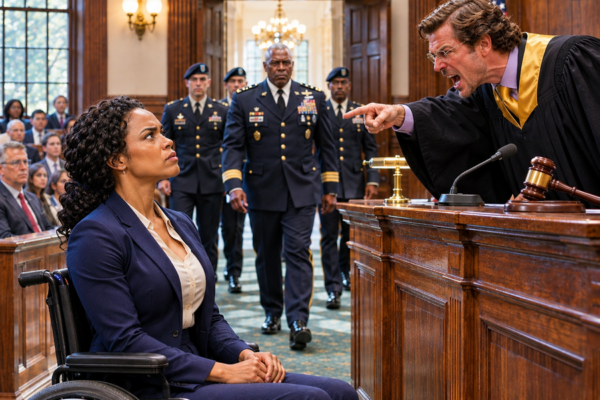
At 2:00 sharp, the squad room had been turned into a courtroom.
The desks were pushed against the walls.
A long table stood at the front, covered with a gray cloth. Chairs were lined up in rows.
Every officer on the dayshift sat or stood somewhere in the room, silent and stiff.
The commissioner sat at the center of the table.
He was a broad, gray-haired man with a heavy face and tired eyes. He had come straight from the airport.
His suit was wrinkled. He did not look like a man who had come to be polite.
Deputy Chief Lundren sat to his right, calm and pressed, his hands folded. Halverson sat beside him in a fresh uniform, one boot tapping the floor.
They looked like men at a party. They had the look of men who believed the fight was already won.
Danica walked in through the front doors with Marsh, Voss, and Carrian behind her. The room went still, heads turned.
A few officers gasped when they saw Carrian.
Halverson’s boot stopped tapping.
“Captain Asante,” the commissioner said.
His voice was low and rough. You are suspended.
You should not be here.
Commissioner, you asked me to come. I did.
He studied her face, then glanced at the three people behind her. Sit.
She took a chair at the end of the table.
Marsh sat down beside her, the manila envelope held against his chest. Voss and Carrian took the seats behind them.
Carrian’s hands shook.
Voss reached over and set one hand on his shoulder.
The commissioner cleared his throat. This hearing will review the events at the 41st precinct since Monday morning.
Deputy Chief Lundren, you filed the complaint. Go ahead.
Lundren rose smoothly. He buttoned his jacket and spoke in a warm, reasonable voice.
Commissioner, I take no joy in this. Captain Asante entered this precinct on Monday in street clothes without identification.
She harassed a desk sergeant.
When officers asked her to leave, she resisted.
She then claimed to be the new commander, a claim no one could verify at that moment.
Since that day, she has abused her office.
She has harassed good officers, reassigned men without cause, and made wild accusations against the department.
He turned his head toward her, sorrow on his face.
I believe she is unstable. I recommend immediate termination.
A few of Halverson’s friends nodded in the back rows.
Sergeant Halverson, the commissioner said, “Do you agree?”
“Every word, sir.”
Halverson stood up, thumbs in his belt. She came in like she owned the place.
She got in my face.
She’s been stirring up trouble ever since.
I just did my job. Thank you.
The commissioner turned.
Captain Asante, your response.
Danica rose.
She did not hurry. She looked at Lundren, then at Halverson, then at the room.
Commissioner, I won’t argue with the story.
I’d like to play you the truth.
She set her phone on the table and tapped the screen. At first, there was only the sound of footsteps on a waxed floor.
Then, a man’s voice, loud and bored.
Lady, this counter is for complaints.
A woman’s calm reply, a cruel laugh, a door squeaking open, a whisper, the soft slide of paper under a counter.
“It’s light,” Halverson’s voice said from the speaker.
“You’re a day short, old man.
Tomorrow I want the rest, and I want a little extra for making me wait.”
Halverson’s face lost its color.
The recording went on.
The shouting, the order to throw her out, Carrian’s laugh, her calm voice asking Voss to turn on a camera.
Then, faint but clear.
As Danica was being hauled across the floor, Halverson’s voice spoke from the back of the lobby.
Lundren gets his cut Friday, and nobody questions it.
The room froze. Even the air seemed to stop moving.
Lundren stood very still. A muscle jumped in his cheek.
“That recording is fabricated,” he said at last, his voice sharp.
“It has obviously been edited.
I demand it be struck from the record.”
The recording was uploaded to my secure inbox at 9:00 Monday morning, the commissioner said slowly. Before any complaint was filed, before any suspension, it has a timestamp that nobody in this building can touch.
He leaned forward.
It is not fabricated.
Deputy chief, I listened to it in the car.
Commissioner, sit down.
Lundren sat.
His eyes were hard now, hunting for a way out.
Halverson, the commissioner said. Is that your voice?
Halverson opened his mouth.
Nothing came out. Sweat ran down his temple and dripped off his chin.
I’ll ask again.
It’s taken out of context, sir.
It was a joke. A joke?
Yes, sir.
The commissioner turned back to Danica. His face was unreadable.
Captain, a recording shows a boast.
It does not show a crime.
Do you have anything to support it? Danica did not answer with words.
She turned her head slowly and looked at the old man beside her.
Marsh stood up.
His knees creaked.
He held the manila envelope in both hands, and for a moment he looked frail and small in the big, quiet room. Then he straightened his back.
He walked to the front of the table and slid out a thick green notebook.
He set it down in front of the commissioner with a soft final thud. 11 years, Marsh said.
His voice was thin, but it carried. Every payment, every date, and right there in the second column, every time the money went up the chain.
The commissioner opened the cover. On every page, beside every payment, two sets of initials stared back at him.
BH. WL.
The commissioner turned the pages slowly.
The squad room was so quiet that every page made a dry little snap.
He read for almost 2 minutes.
Nobody moved.
At the table, Lundren’s face had gone tight and shiny.
He had stopped looking at the notebook.
He was looking at the door.
11 years of payments, the commissioner said at last, each one followed a few days later by a second smaller entry marked WL.
He looked up.
Deputy chief, are those your initials?
Half the people in this city have those initials. Half the people in this city did not oversee internal affairs for this burrow, while a precinct under their watch collected protection money.
The commissioner closed the book.
I’ll have my accountants match these dates to your bank deposits by tomorrow morning.
I suspect I know what they’ll find.
Lundren said nothing. His jaw worked.
Captain Asante. What else?
Officer Voss. Commissioner.
Voss stood.
Her voice shook at first, then steadied.
She told them about the evidence room, the sealed bag, the $6,000 that became 3500. She had her phone ready.
The commissioner nodded and the footage played on the big screen against the wall. Every officer watched Halverson peel open the bag.
PART 5
Every officer watched him count off the bills and pocket them. A few men in the back rows put their heads down.
Case 4408, Danica said quietly.
Andre Mills, 8 years in prison. Case 4291.
Terrence Boyd, 6 years.
Both men were convicted using cash counts that were wrong.
Sergeant Halverson made them wrong.
That’s a lie, Halverson blurted.
That’s a setup.
She had that kid doctor it.
Sergeant, the commissioner said, the timestamp on this file is 3 weeks old.
Halverson’s mouth opened and closed.
Officer Carrian, the commissioner said, “I’m told you have something to say.”
Carrian rose.
He looked like a man walking onto a frozen pond. He looked at Halverson, who stared back with pure hatred.
Then he looked at Danica.
She gave him one small nod.
Every month for 6 years, Carrian said, “I drove a sealed envelope from this precinct to the deputy chief’s office downtown the first Friday.
Halverson handed it to me.
I left it with Lundren’s assistant.
It was cash. I looked once, his voice broke.
I put my hands on Captain Asante on Monday because Sergeant Halverson told me to.
Last night, men sent by the deputy chief came to my house.
They told me to resign or lose everything.
I ran.
I’m done running.
He’s a liar, Halverson shouted.
He’s weak.
Tommy, you piece of
Sergeant.
Sit down.
The commissioner said he’s lying to save himself.
I said sit.
Halverson sat.
His whole body was trembling.
Lundren finally spoke. His voice was calm, but it was the calm of a man on a cliff edge.
Commissioner, this is a conspiracy.
A new captain, a disgruntled officer, and a bitter old shopkeeper. I have served this department for 26 years.
If any of this is true, it is Halverson’s doing.
I knew nothing about it. What?
Halverson’s head snapped up.
I had no knowledge.
He ran his own desk.
I trusted him. I was deceived.
Halverson stared at him.
His face went from red to white to something that looked almost like grief. You knew nothing?
His voice cracked and rose.
I carried your envelope for 6 years, every month.
You told me to keep it quiet.
You said nobody would ever question it.
You said you’d take care of me.
He lurched to his feet.
You sat in this very room last Friday and told me if the new captain made trouble, you’d handle her.
You said you’d have her out in a week.
Sit down, Burke. Lundren hissed.
No, you’re not putting this on me.
Halverson was shouting now. Spit flying.
I’ll tell them everything.
the bank accounts, the phone calls, the two men in prison. I did that on your orders because the arrests needed to look bigger so the funding would look bigger.
It was all you.
The room erupted. Officers gasped.
Someone swore aloud.
Two men in the back rows shot to their feet.
Lundren shut his eyes. For a second, he looked 10 years older.
The commissioner raised one hand. The room fell quiet.
“Thank you, Sergeant,” he said.
“You have just saved me a great deal of work.”
Halverson froze. He realized what he had done.
His mouth hung open.
“Deputy Chief Lundren, Sergeant Halverson, stand up.”
They stood, neither looked at the other.
“By my authority as commissioner, you are both relieved of duty.
Effective now.
I will have your badges and your weapons on this table.
Lieutenant Doyle.
Sir, take their shields. Doyle walked forward.
His hands were not steady. He held out one palm to Lundren and Lundren face stone gray, unpinned his shield, and dropped it on the cloth.
Doyle turned to Halverson. Burke.
Halverson stared at the shield on his chest.
Then slowly he peeled it off. It rang against the table.
His sidearm followed.
Officers Puit and Dale, the commissioner said, “Take these two into custody.
Charges to include bribery, extortion, evidence tampering, obstruction, and conspiracy.
More will follow.”
Puit and Dale stood. They looked at each other.
Then they walked forward together and took out their handcuffs.
The cuffs clicked shut on Lundren first.
He did not resist.
He held his head up, but his face was empty. Then they cuffed Halverson.
He kept twisting around to look at the room, searching for someone who would still back him. Nobody met his eyes.
One more thing, the commissioner said, “The district attorney is on her way.
The cases of Andre Mills and Terrence Boyd will be reviewed tonight. I will personally ask for their release.
A sound rippled through the room.
It was not quite a cheer. It was something quieter, like a long-held breath finally let go.
They marched the two men down the center aisle, past rows of officers who would not look at them through the lobby and out the front doors.
Marsh and a crowd of neighbors had gathered on the steps, silent, watching.
Halverson stumbled on the top step, then caught himself. He lifted his head.
For one second, he saw the sidewalk where he had once shoved Danica to her knees.
Then the cruiser door closed on him. By 4:00 that afternoon, the squad room was nearly empty.
The desks had been dragged back into place.
The gray tablecloth was gone.
Only the long table remained, and a few officers still lingered near the walls, quiet and unsure. The commissioner stood at the head of the room.
He looked tired, but something in his face had changed.
He had come off a plane expecting a paperwork problem. He had found a rot that had been growing for 11 years under his own roof.
“Captain Asante,” he said, “step forward.”
Danica walked to the front.
Her jeans were dusty.
Her sweater was wrinkled. She had no shield on her belt, and nobody in the room had noticed anything but her face.
“First, I owe you something,” he said.
“An apology.
You were sent into this precinct by me.
You were thrown out of it by men I should have been watching.
I should have seen it sooner.”
Commissioner, you came back early. You listened.
That’s what counted.
It should not have taken a recording. He turned to the room.
His voice rose firm and clear.
Hear me all of you. The suspension of Captain Danica Asante is lifted as of this moment.
The complaint against her is dismissed.
It was false.
It was filed by men who wanted to hide their crimes.
Any record of it will be destroyed. Someone near the back began to clap, then another.
It was slow and a little shy, the sound of people who weren’t sure they were allowed.
It grew.
Doyle was clapping with his hand pressed to his chest.
Puit and Dale stood together near the lockers, clapping hard, their eyes wet.
“Officer Immani Voss,” the commissioner said.
Voss stepped out from the side wall.
She stood at attention, though her hands trembled.
“Your suspension is lifted.
Your insubordination charge is dismissed, and I’m putting a note in your file.
It says that you did what almost no one in this building was willing to do.
You told the truth when it cost you.”
Voss’s mouth opened, but no words came.
She nodded once fast, and wiped her cheek with the back of her wrist.
Officer Carrian. Carrian standing at the edge of the room flinched like a man who expected a blow.
“What you did on Monday was wrong.
You will answer for it.
There will be a hearing and there will be consequences.”
The commissioner paused, “But when it counted, you came forward.
I will make sure the board knows it will go in your file, and it may be the difference between a hard road and a dark one.”
Carrian bowed his head. His shoulders shook.
“Thank you, sir,” he said so quietly it was almost lost.
The commissioner turned back.
He reached into his jacket and drew out a small velvet case.
He opened it.
Inside lay a gold shield, polished and heavy, stamped across the bottom with a single word, Captain.
Danica looked at it. It was the same shield she had carried through the door on Monday morning, the one they had taken off her desk that morning.
Someone had polished it.
Captain Danica Asante, the commissioner said, “By the authority of this office, I formally name you commanding officer of the 41st precinct.
Raise your right hand.”
She did. In a clear voice, she took the oath.
The room stood still. Every officer listened.
When she finished, the commissioner pinned the shield to her belt himself.
She touched it once with two fingers. She had been wearing a shield for 22 years.
This was the first one that felt like it belonged to her.
“The floor is yours, Captain,” he said.
Danica turned and faced the room.
“I won’t give a long speech,” she said.
Most of you didn’t do anything wrong.
But most of you also watched and you said nothing. I understand why.
I did the same thing once in this very building 20 years ago. I kept quiet.
I let it go.
I have thought about that every day since.
Nobody moved.
This precinct belongs to the people who live around it.
Not to a sergeant, not to a deputy chief, not to me. From now on, when a neighbor walks through that door, they get a fair answer.
Nobody gets pushed out because of how they look or what they wear or who they seem to be.
If you can’t live by that, tell me today.
If you can, I’ll be proud to work beside you.
A low murmur rose.
Then Doyle in his steady voice said, “Yes, Captain.”
One by one, the others echoed it.
Danica looked toward the back of the room.
Ezekiel Marsh sat in the front row of the chairs, hat in his lap, his niece beside him.
He did not say anything. He did not need to.
He gave her the smallest nod, the same one she had given him on Monday morning.
It’s all right.
I see you.
She walked down the center aisle through the lobby toward the front doors. The crowd that had gathered outside that morning was still there.
It had grown.
Neighbors, shopkeepers, mothers with strollers, the baker, the barber, the man from the laundromat. They stood on the steps and the sidewalk, quiet, waiting.
At the front of them stood an elderly woman with a cane and a worn paper folder tucked under her arm.
She looked small and nervous.
She kept glancing at the badge on Danica’s belt.
Then at the floor, as if afraid she had come to the wrong place.
Danica stopped at the glass doors.
She put her hand on the handle.
This was the door she had been dragged through. This was the door she had been walked out of.
She pulled it wide and held it there.
“Ma’am,” she said gently, “Please come in.”
The old woman blinked.
“I only wanted to ask about my grandson, about a ticket they gave him.
I didn’t know if it was allowed.”
“It’s allowed,” Danica said.
Everything you have to say is allowed. Welcome to the 41st.
Tell me how I can help.
The woman’s face broke into a tremulous smile.
She stepped through the doorway and behind her, one by one, the neighbors began to follow.
Danica stood beside the open door and watched them come in.
The first morning they threw her out. After that, the door stayed open.
The weeks that followed were not easy ones.
The arrest of a deputy chief and a desk sergeant made the evening news for three nights running, and the phones at the 41st rang constantly with reporters asking for comments that Danica refused to give.
The district attorney moved quickly on the Mills and Boyd cases. Both men were released within a month, blinking in the sunlight outside the courthouse with their families clutching them.
Andre Mills had served four years of an eight-year sentence.
Terrence Boyd had served three of six. They would carry the weight of those years forever, but they walked free, and the city began to understand that what had happened at the 41st was not a single bad apple but a barrel that had been rotting from the top down.
The department convened a review board.
Carrian testified for two full days.
His resignation letter, it turned out, had been typed by Lundren’s assistant on instructions from the deputy chief himself.
Carrian was found to have violated procedure and use-of-force policy on the morning of Danica’s arrival and was suspended without pay for six months.
He accepted the punishment without complaint.
When the board asked him why he had come forward, he said, “Because a woman I threw on the ground asked me a question and then listened to the answer.
Nobody had done that for me before.”
He returned to the force six months later, assigned to a different precinct, and in his first year back he wrote more truthful reports than he had in the previous nine. Voss was promoted to detective.
She kept her body camera clipped to her chest even in the office, and she became the unofficial guardian of the precinct’s integrity.
New recruits were sent to her to learn what the job actually looked like. She was hard on them and fair, and she never once let a rookie walk out of a room without knowing that their voice mattered.
Ezekiel Marsh returned to his hardware store.
The city inspector who had been sent to harass him was investigated and found to have falsified three other complaints at the direction of the 41st’s old regime.
He was dismissed.
Marsh’s shop, freed from the monthly payments that had bled it dry for eleven years, began to recover.
He hired a young man from the neighborhood to help with the counter and the deliveries. On sunny afternoons he sat on a folding chair outside his door and greeted everyone who passed.
He never missed a chance to tell a newcomer that the 41st precinct had a captain who listened. Lieutenant Doyle, who had spent nineteen years looking at the wall and saying nothing, took early retirement at the end of the year.
On his last day, he came to Danica’s office and stood in the doorway with his hat in his hands.
“I should have done more,” he said.
“I knew something was wrong.
I told myself it wasn’t my place.”
Danica looked at him for a long moment.
“You brought me the work order,” she said.
“When they searched my office, you told me the truth.
That was something.”
Doyle nodded, his eyes wet.
“It wasn’t enough.”
“No,” she agreed.
“But it was something.
Go home, Lieutenant.
Enjoy your garden.”
He left with his head a little higher than it had been in years.
The precinct itself changed slowly, the way large ships change course.
Officers who had laughed in the lobby on Monday morning found themselves on the wrong end of Danica’s quiet, persistent attention.
She didn’t fire them.
She didn’t humiliate them.
She simply asked questions, every day, about every report, every stop, every arrest.
She made it clear that the door to her office was open, and that the questions she asked were the same questions the neighbors were already asking.
Some officers left on their own, unable to work under a captain who insisted on knowing the truth. Others stayed and slowly, grudgingly, began to respect her.
A few, like Puit and Dale, became fierce in their loyalty, the way people often do when they have been given a second chance they didn’t expect.
Danica kept the green notebook in the safe behind her desk. Marsh had told her to keep the copy.
He said it belonged to the precinct now. Sometimes, late at night, when the building was quiet and the paperwork had piled up, she would take it out and turn the pages.
She read the dates and the amounts and the initials, and she thought about all the years of silence that had made it possible. She thought about the young officer she had been, the one who had filed a report that went into a drawer.
She thought about the woman she had become. On a cold morning in December, a small ceremony was held in the lobby of the 41st precinct.
The commissioner came, looking less tired than he had in October.
The mayor came. A crowd of neighbors filled the lobby and spilled out onto the steps.
A plaque was unveiled on the wall beside the front door.
It listed the names of Andre Mills and Terrence Boyd, and beneath them the words: “They were failed by those sworn to protect them.
Let this serve as a reminder that justice delayed is still justice owed.”
Mills and Boyd were there, both of them, standing with their families.
Mills shook Danica’s hand for a long time without speaking.
His palm was rough and warm.
Boyd’s mother hugged her, crying, and Danica held on until the woman let go.
After the ceremony, Marsh approached her. He was wearing a suit that hung loose on his thin frame, and his hands were steady.
“Captain,” he said.
“I wanted to tell you something.
That morning, when they threw you out, I thought I was watching the end of something.
A chance, maybe the last one.
I thought they’d win.”
He looked around the crowded lobby, at the neighbors and the officers and the sunlight coming through the glass doors.
“I’m glad I was wrong.”
Danica smiled.
“You weren’t wrong about everything.
You just forgot to account for an old man who kept a notebook.”
He laughed, a dry, creaking sound.
“My wife,” he said.
“She was the one who told me to keep two.
‘Nothing in this world is real unless there are two of it,’ she said.
A copy for them and a copy for you.”
He paused.
“She would have liked you.”
Danica looked at the plaque on the wall, at the faces of the neighbors who had gathered to watch, at the new officers mingling with the old ones.
The 41st precinct was not the same building it had been on Monday morning. It was not the same because of a recording, a ledger, and a group of people who had decided that silence was no longer an option.
“Come on,” she said to Marsh, offering him her arm.
“Let me buy you a cup of coffee.
There’s a bakery on the corner.
The woman who runs it doesn’t pay protection money anymore.”
Marsh took her arm. They walked out through the front doors together, past the plaque and the sunlight and the open door that had stayed open ever since.