“Get on the Ground, Now” — He Slammed a Black Woman Face-First Into Her Own Front Door, Never Guessing the Handcuffs Were Closing Around His Own Career
“Get on the Ground, Now” — He Slammed a Black Woman Face-First Into Her Own Front Door, Never Guessing the Handcuffs Were Closing Around His Own Career
Get on the ground, now.
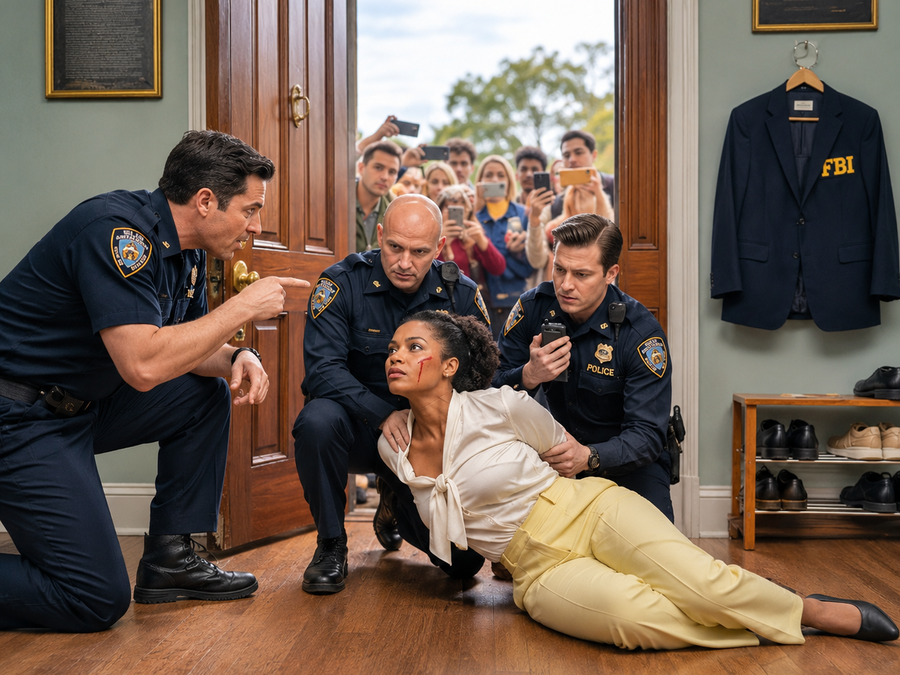
Hands behind your back. Officer Daniels slams Diana Reeves face-first against her own front door.
The sound of her cheek hitting mahogany echoing through the upscale neighborhood.
Metal handcuffs bite into her wrists as he forces her arms behind her back. Please, this is my house.
Diana tries to speak.
Shut up.
You’re under arrest for breaking and entering.
Daniels jerks her away from the door she just opened with her own key.
Neighbors peek from behind curtains as he marches her toward the patrol car like a common criminal.
Diana doesn’t resist.
Doesn’t scream.
Her silence isn’t fear.
It’s the deadly calm of someone who knows exactly what’s about to happen next.
In sixty minutes his entire world will collapse.
Three hours earlier, Diana Reeves stepped out of her marble shower and wrapped herself in Egyptian cotton. Monday mornings meant federal briefings, but today felt different.
Her phone buzzed with encrypted messages. Another dirty cop case breaking open.
Another precinct about to face her wrath. She moved through her morning routine with military precision.
Coffee from her Italian espresso machine. Toast on bone china inherited from her grandmother.
The FBI credentials clipped to her Hermes purse sat next to car keys for her Tesla.
Symbols of a career built on taking down corrupt officers who thought they were untouchable. Diana had earned this life.
Harvard Law, FBI Academy, fifteen years climbing ranks while lesser agents fell by the wayside.
Her brownstone in the city’s most exclusive neighborhood wasn’t luck.
It was justice served one dirty badge at a time.
But Karen Whitmore saw something else entirely. Karen pressed her face against her kitchen window watching Diana load files into her car.
For two years she’d been making calls.
First to the homeowners association about suspicious vehicles, then to the city about noise complaints. Each time authorities found nothing because there was nothing to find.
This morning Karen’s rage finally boiled over.
Nine-one-one, what’s your emergency?
There’s a black woman breaking into the house next door.
Karen lied into her phone, voice dripping with fake panic.
She’s been coming and going for weeks.
I think she’s casing the place for a robbery.
The dispatcher’s fingers flew across her keyboard.
Can you describe the suspect?
African-American female, maybe forty, wearing expensive clothes, probably stolen.
She has keys, but that doesn’t mean anything.
These people are getting smarter. Karen had no idea she was describing a federal agent who specialized in investigating exactly this kind of bias.
Diana’s current caseload included three precincts under federal oversight, two chiefs facing criminal charges, and dozens of officers whose careers she’d personally destroyed.
The dispatch call crackled through Officer Daniels’ radio twenty minutes later.
Possible breaking and entering, 1247 Maple Avenue.
Suspect is black female, approximately forty years old, maybe armed.
Daniels perked up in his patrol car.
This neighborhood meant money, and money meant publicity if he made a good arrest.
His partner Torres glanced at the address with concern.
That was the same street where his own captain had warned them to be extra careful about complaints.
Isn’t that the area where we had those false alarm calls?
Torres asked.
Every call is real until proven otherwise, Daniels replied, but his tone suggested he’d already made up his mind about what they’d find.
Daniels had eighteen years on the force and a philosophy that had served him well. Trust your gut, act fast, ask questions later.
His gut told him that black people in expensive neighborhoods usually meant trouble. His personnel file contained seventeen complaints about excessive force, but his sergeant always backed him up.
What Daniels didn’t know was that his precinct was already under federal investigation.
Diana’s team had been building a case for months, documenting patterns of racial bias, excessive force, and departmental cover-ups.
Her files contained Daniels’ name highlighted in red, a primary target for federal prosecution.
The irony was perfect.
The hunter about to become prey.
Diana’s phone buzzed with a text from her partner, Agent Carter.
Running late for the briefing.
Daniels’ case about to break wide open.
Where are you?
Diana typed back, Leaving now.
This one’s going to be big.
She had no idea she was about to become the star witness in her own case. As Daniels and Torres drove toward Maple Avenue, Diana locked her front door and activated her security system.
Multiple cameras captured her every movement, evidence that would later prove crucial. Her keys jingled in her manicured hands, the same hands that had signed federal arrest warrants for corrupt officers across three states.
The morning sun cast long shadows across her perfectly manicured lawn. In sixty minutes, that same lawn would be trampled by backup officers, crime scene tape, and the boots of the man who was about to make the worst mistake of his career.
Diana climbed into her Tesla, adjusted her rearview mirror, and saw Karen still watching from her window. She waved politely, the last gesture of kindness Karen would receive before federal agents knocked on her door with handcuffs.
The trap was set.
The hunters were coming.
They just didn’t know who they were hunting.
The patrol car screeched to a halt as Diana pulled back into her driveway.
She’d forgotten her laptop, the one containing classified files on police corruption that could never leave her possession.
A rookie mistake, but even federal agents were human.
Officer Daniels burst from his vehicle like a man on a mission.
His hand rested on his weapon as he approached Diana’s car, Torres trailing behind with visible reluctance.
Step out of the vehicle. Keep your hands where I can see them.
Diana turned off the engine slowly, her movements deliberate and controlled.
She’d been in worse situations.
Drug raids, armed standoffs, terrorist investigations.
But something about Daniels’ aggressive posture triggered every alarm bell in her federal training.
Officer, I live here, Diana said calmly, stepping out with her hands visible.
This is my home.
Sure it is. Daniels sneered, his eyes scanning her designer clothes with suspicion.
And I’m the Pope.
You got an ID, princess? The word hit like a slap.
Diana reached for her purse, but Daniels grabbed her wrist with bruising force. Slow.
Real slow.
What’s in the bag?
Diana’s FBI credentials were inches away, but she made a calculated decision.
Let him dig his own grave first. Let the cameras capture everything.
Let him hang himself with his own bias before she revealed the rope he was using. My identification is in my wallet, she said evenly.
Daniels snatched her purse and dumped the contents across her car hood.
Credit cards scattered. Her FBI badge clattered against the metal, face down.
Daniels saw designer makeup, expensive sunglasses, a Tesla key fob.
How’s a girl like you afford all this fancy stuff?
His tone dripped with implication.
Are you dealing drugs? Turning tricks for rich white men?
Torres stepped forward.
Dan, maybe we should— Shut up and watch the perimeter.
Daniels picked up Diana’s driver’s license, studying it like a forgery.
1247 Maple Avenue.
Same address as the house. He looked up at Diana with theatrical surprise.
Well, well.
Looks like we got ourselves a real smart criminal. Fake IDs and everything.
That’s not fake, Diana said.
I own this property. I can show you the deed.
Oh, you got papers, too? How convenient.
Daniels tossed her license back onto the pile. Let me guess.
You inherited it from your rich white boyfriend when he died.
The racism was so blatant that even Torres winced.
But Diana remained calm, her mind working like the trained investigator she was. Every word was being recorded by body cameras.
Every gesture captured by her security system. Daniels was building her case for her.
Sir, if you’d like to verify my ownership, the property records are public.
Don’t tell me how to do my job, Daniels exploded.
You people think you can just move into decent neighborhoods and nobody will notice?
Think you can buy respectability with stolen money?
That’s when Karen Whitmore made her grand entrance.
Officers, thank God you’re here.
Karen rushed across the lawn, her phone already recording. I saw her breaking in earlier.
She’s been casing this house for weeks.
Diana turned to face her lying neighbor.
Karen, you know that’s not true.
Don’t you dare speak to me, Karen shrieked, playing her victim role to perfection.
I’ve been terrorized by this woman for months.
She threatens me, plays loud music, brings drug dealers to the neighborhood.
Torres looked confused. The house was clearly well-maintained.
The woman was obviously educated, and nothing about this situation matched the 911 call. But Daniels had found his star witness.
Ma’am, are you the one who called this in?
he asked Karen.
Yes, I’ve been calling for months, but nobody listens.
These people think they can do whatever they want because of political correctness.
Diana’s jaw tightened.
Karen was lying so smoothly, so confidently, that she almost believed it herself.
This was exactly the kind of witness bias that Diana had spent her career documenting and prosecuting.
Officer, I’d like to call my attorney, Diana said.
Your attorney? Daniels laughed.
What kind of attorney does a burglar need?
The public defender’s office is going to love this one.
He grabbed Diana’s arm and spun her around, slamming her face-first against her own car.
The metal was cold against her cheek as he wrenched her arms behind her back.
You’re under arrest for breaking and entering, possession of stolen property, and resisting arrest.
I haven’t resisted anything, Diana said through gritted teeth.
You’re resisting right now.
Daniels cranked the handcuffs tight enough to cut off circulation. Stop struggling.
Diana wasn’t struggling.
She was standing perfectly still, letting him demonstrate exactly why federal oversight existed. But struggling was what Daniels needed to see, so struggling was what he reported.
Torres moved closer, his discomfort obvious.
Dan, her ID matches the address.
Maybe we should— Maybe you should do your job instead of second-guessing me.
Daniels yanked Diana upright, parading her past gathering neighbors like a trophy.
This is what happens when criminals think they can infiltrate decent communities. Mrs.Patterson from across the street lowered her phone.
She’d been recording everything, and what she saw didn’t match what Daniels was saying.
The woman in handcuffs looked more composed than the officer arresting her. Is that really necessary?
Mrs.Patterson called out.
She wasn’t resisting.
Ma’am, please step back and let us handle this, Torres said politely, but his eyes showed doubt.
Daniels shoved Diana toward the patrol car.
You picked the wrong neighborhood, princess.
These good people don’t want your kind here.
Diana’s mind cataloged every violation, every slur, every constitutional breach.
Unlawful arrest, excessive force, racial profiling, false imprisonment.
She was building a federal case in real time, and Daniels was the unwitting star witness against himself. As he forced her head down and pushed her into the backseat, Diana caught sight of her scattered belongings still spread across her car hood.
Her FBI badge lay face down in the morning sun, its gold eagle invisible but not forgotten.
The irony was so perfect it was almost poetic. The man arresting her had no idea she spent her days arresting men exactly like him.
Karen stood in the driveway filming everything with glee.
She’d finally gotten rid of the uppity neighbor who made her feel small just by existing.
She had no idea that lying to federal agents was a felony or that Diana’s security cameras had recorded every false statement she’d made over the past two years.
As the patrol car pulled away, Diana’s phone buzzed in her purse, still scattered on her car hood.
Agent Carter was calling for the third time, wondering why the FBI’s most feared internal affairs investigator was missing the biggest briefing of her career.
The briefing about the federal investigation into this exact precinct.
The investigation Diana was supposed to be leading.
The car radio crackled.
Unit 47, transport to central booking. One female suspect, breaking and entering.
Torres keyed his radio reluctantly. Copy that, central.
En route to booking. In the back seat, Diana closed her eyes and smiled.
They had no idea what was coming.
The fifteen-minute ride to the station felt like hours.
Diana sat in silence, her mind racing through federal statutes and constitutional violations.
Each bump in the road sent the handcuffs deeper into her wrists, but she’d endured worse during FBI training.
Pain was temporary. Justice was forever.
Daniels kept glancing in the rearview mirror, expecting tears or pleas for mercy. Instead, he saw a woman staring out the window with the calm focus of someone planning their next move.
You’re awfully quiet back there, he taunted.
Usually you people are screaming about your rights by now.
Diana didn’t respond.
Every word he spoke was being recorded by body cameras that would later be subpoenaed by federal prosecutors.
Let him keep talking.
Let him bury himself deeper.
Torres shifted uncomfortably in the passenger seat.
Something about this arrest felt wrong.
The woman’s demeanor, her expensive clothes, the way she carried herself.
Nothing matched the profile of a typical burglar. But questioning Daniels in front of a suspect would undermine police authority.
Dan, when we get to booking, maybe we should call the supervisor, Torres suggested quietly. For what?
This is textbook probable cause. Daniels pulled into the station parking lot with satisfaction.
Sometimes the job is just this easy. As they escorted Diana through the station doors, she memorized every detail.
Badge numbers, camera locations, witness positions.
Her federal training had taught her to gather intelligence even under arrest. Especially under arrest.
The booking officer looked up from his paperwork, his expression shifting from boredom to confusion as he saw Diana’s composed demeanor and professional appearance.
What’s the charge?
he asked. Breaking and entering, possession of stolen property, Daniels announced proudly.
Caught her red-handed in a million-dollar house.
The booking officer studied Diana’s face.
Something about her seemed familiar, but he couldn’t place it.
She had the bearing of someone accustomed to authority, not someone who broke into houses for a living.
I’d like to make my phone call now, Diana said calmly.
Daniels laughed.
Phone calls come after processing, sweetheart.
You’ll get your chance to call your drug dealer soon enough.
But Torres was studying the booking computer screen, his face growing pale.
A federal security clearance had just popped up in the database.
Active status, current as of this morning. Dan, Torres said quietly.
We might have a problem. The booking computer screen froze Torres in place.
Active federal security clearance, current status, classification level that made his stomach drop.
Dan, you need to see this, Torres whispered.
But Daniels was already strutting toward the holding cells like a conquering hero. Put her in cell three, Daniels called over his shoulder.
The one with the broken toilet. Let her get comfortable with where people like her belong.
Diana walked into the cell without protest, her heels clicking against concrete like a judge entering a courtroom. She sat on the metal bench and clasped her hands, the picture of dignified patience.
Most arrestees would be pacing, crying, or demanding lawyers.
Diana looked like she was waiting for a business meeting.
Across town, FBI Agent Sarah Carter paced the federal building’s briefing room, checking her watch for the fifth time.
Diana was never late.
Not to briefings, not to anything.
Especially not today, when they were finalizing arrests for the biggest police corruption case in the city’s history.
Where the hell is Diana?
Carter muttered, dialing her partner’s number again.
Straight to voicemail.
The irony was lost on everyone in the room.
They were planning to arrest corrupt officers from the exact precinct where Diana now sat in a cell, handcuffed by the very men they were investigating. Back at the station, Torres pulled Daniels aside with trembling hands.
We have a serious problem. Look at this.
Torres pointed at the computer screen. Federal clearance, active status.
This woman isn’t some burglar.
Daniels squinted at the screen dismissively. Computer glitch.
Happens all the time.
These criminals are getting better at identity theft.
Dan, this isn’t identity theft.
The photo matches, the biometrics match, everything matches. So what if she works for some government office?
Plenty of federal paper pushers commit crimes.
Doesn’t change anything.
But Torres was already calling the FBI field office, his voice shaking as he explained the situation to the duty agent. The response made his blood freeze.
Special Agent Diana Reeves?
Are you insane?
She’s our lead internal affairs investigator.
If you’ve arrested her, you better have ironclad evidence or you’re all going to federal prison.
Torres hung up and grabbed Daniels by the shoulder.
We arrested a federal agent.
A federal agent who investigates police corruption.
Daniels spat, but his confidence was cracking.
She’s a criminal.
I know a criminal when I see one.
The booking officer approached with Diana’s personal effects, his face pale as he held up the FBI badge that had been face down on her car hood.
Special Agent Diana Reeves, Federal Bureau of Investigation, Internal Affairs Division, he read aloud. Badge number 2847, issued January 15th, 2010.
The station went silent. Even the background chatter of dispatch calls seemed to pause as the magnitude of the situation sank in.
Daniels stared at the badge like it was a bomb about to explode.
That’s fake.
Has to be fake. Check the serial number.
The booking officer was already on the phone with FBI verification.
The conversation lasted thirty seconds. When he hung up, his face was gray.
It’s real.
She’s real.
We just arrested one of the most senior FBI agents in the country.
In her cell, Diana heard every word through the thin walls.
She’d been wondering how long it would take them to figure it out.
Longer than expected, which would make excellent evidence in court. Her phone, still scattered on her car hood back home, buzzed with increasingly frantic calls from the FBI field office.
Carter had escalated the missing agent report to the deputy director level.
Search teams were being mobilized.
Federal prosecutors were being notified.
The system Diana had spent fifteen years serving was now mobilizing to find her.
And it was about to find her in the last place anyone expected. Sergeant Murphy emerged from his office, his face red with panic as he processed what his officers had done.
Twenty-six years on the force and he’d never seen anything this catastrophic.
Release her. Now.
Cut the cuffs, apologize, and pray she doesn’t have us all thrown in federal prison.
Sarge, she was breaking into a house— She was the house.
It’s her house, her mortgage, her property.
Murphy was screaming now.
You arrested a federal agent for entering her own home based on a racist neighbor’s lie.
PART 2
Torres was already heading to the cells with the key, his hands shaking so badly he could barely fit it in the lock. But when he reached cell three, Diana held up one perfectly manicured hand.
Don’t, she said calmly.
I haven’t made my phone call yet.
Torres stopped mid-step.
Ma’am, we can release you right now.
No paperwork, no record.
This whole thing never happened.
Diana smiled for the first time since her arrest.
It wasn’t a friendly smile.
Oh, but it did happen.
And I’m going to make sure everyone remembers it.
She stood and walked to the cell phone mounted on the wall.
I’d like to make my call now.
Diana lifted the grimy jail phone to her ear and dialed a number she knew by heart. The phone rang once before a familiar voice answered.
Agent Carter.
Sarah, this is Diana.
Badge number 2847. Across town in the federal building, Carter nearly dropped her coffee.
Diana, where the hell are you?
We’ve got SWAT teams looking for you.
I’m in a holding cell at the 47th precinct, Diana’s voice was calm, almost conversational.
I’ve been arrested for breaking and entering into my own home.
The silence on the other end stretched for five seconds that felt like hours.
You’re where?
Cell three at the 47th.
The irony isn’t lost on me, Sarah.
They arrested the lead investigator of their own corruption case.
Through the thin walls, Diana could hear frantic conversations erupting throughout the station. Torres was explaining to Sergeant Murphy.
Murphy was screaming at Daniels.
Someone was frantically calling the police chief. Diana, are you hurt?
Did they— I’m fine.
Bruised wrists from overly tight handcuffs, but nothing that won’t heal.
Everything’s been recorded on body cameras.
We’ll have evidence for days.
Carter was already grabbing her jacket and federal credentials.
I’m coming to get you.
Don’t say another word until I get there.
Actually, Sarah, patch me through to Director Walsh.
It’s time to make some calls.
The phone clicked, and thirty seconds later the deep voice of FBI Director Robert Walsh filled the receiver.
Agent Reeves, what’s your status?
Detained, but unharmed, sir.
We have a situation that requires immediate federal intervention. Explain.
Diana could hear boots running through the station hallway.
Panic was spreading like wildfire.
Sir, I’ve been arrested by officers from the same precinct we’re investigating for corruption.
They handcuffed me, degraded me, and threw me in a cell based entirely on racial bias and a neighbor’s false report.
We now have ironclad evidence of the systematic problems we’ve been documenting.
Jesus Christ.
Director Walsh’s voice was barely controlled fury.
How many officers are involved? The primary arresting officer is Daniel Daniels, badge 4472.
He’s already on our watch list for excessive force complaints.
His partner Torres showed reluctance but failed to intervene. Multiple constitutional violations captured on body cameras.
Are you requesting federal intervention?
Diana paused, letting the weight of the moment settle.
This was the nuclear option.
Once she said yes, there would be no going back. The full power of the federal government would descend on this precinct like an avalanche.
Yes, sir, I am. Consider it done.
Federal marshals are en route. Nobody leaves that building until we sort this mess out.
The line went dead and Diana hung up the phone. She turned to find Torres standing outside her cell, his face pale as death.
Ma’am, Agent Reeves, I’m so sorry.
This is all a huge misunderstanding. Officer Torres.
Diana’s voice carried the authority of someone who’d sent corrupt cops to federal prison.
Everything that happened today was recorded. Your body camera, the station cameras, my home security system.
There are no misunderstandings.
Only evidence.
Torres fumbled with the cell keys.
Please, let me get you out of there.
Not yet. Diana sat back down on the metal bench, crossing her legs like she was in a boardroom.
I want to experience the full extent of your department’s hospitality before I leave.
Down the hallway, Sergeant Murphy was on the phone with Police Chief Harrison, his voice cracking with panic.
Chief, we’ve got a federal situation.
Daniels arrested an FBI agent.
Not just any agent. Internal Affairs.
The one investigating us.
Chief Harrison’s response was explosive.
What the hell did you just say?
She’s here in our holding cell.
Federal agents are on their way.
Get me Daniels now.
Daniels approached the phone like a man walking to his execution.
His swagger had evaporated the moment he saw Diana’s federal badge.
Chief, you worthless piece of— Do you have any idea what you’ve done?
Sir, I was responding to a 911 call about a break-in. You arrested the FBI agent investigating our department for corruption.
She’s been building a case against us for months and you just handed her everything she needs.
The phone slammed down, leaving Daniels staring at the receiver in shock.
Meanwhile, Diana’s arrest had triggered emergency protocols throughout the federal system.
The FBI deputy director was calling the mayor.
The Justice Department was mobilizing civil rights prosecutors. US Marshals were already in their vehicles racing toward the 47th Precinct.
Agent Carter burst through the station doors with federal credentials raised and three other agents flanking her.
I’m Special Agent Sarah Carter, FBI.
Where is Special Agent Diana Reeves?
Sergeant Murphy approached with his hands raised like he was surrendering.
Agent Carter, there’s been a terrible mistake.
The only mistake was arresting a federal agent for the crime of being black in her own home.
Carter’s voice could have cut glass.
Where is she? Cell three.
But we were just about to— Nobody moves until the US Marshals arrive. This is now a federal crime scene.
Through the chaos, Diana could hear car doors slamming in the parking lot.
Heavy boots on concrete.
The sound of federal authority asserting itself.
But the biggest shock was yet to come.
Agent Carter approached Diana’s cell and held up a classified folder marked Operation Blue Wall.
Diana, you need to see this. The timing is incredible.
Diana read the first page through the cell bars and for the first time all day, her composed facade cracked.
The federal investigation she’d been leading wasn’t just about this precinct.
It was about a network of corrupt officers spanning five precincts, including systematic racial bias, evidence tampering, and civil rights violations.
Officer Daniels wasn’t just a target.
He was the primary target. And he just arrested his own prosecutor.
Sarah, please tell me we got all of this on tape. Body cameras, security cameras, jail phones, everything.
The Attorney General wants to make this case a national example.
Diana finally smiled.
A real smile this time, not the controlled expression she’d worn all morning.
Then let’s give them a show they’ll never forget.
The sound of federal agents flooding the building echoed through the station. US Marshals, Justice Department prosecutors, Internal Affairs investigators.
The hunters had become the hunted. And Diana Reeves, still sitting calmly in her jail cell, was about to become the most powerful woman in the building.
The 47th Precinct transformed into a federal command center within an hour. US Marshals stationed themselves at every exit.
FBI technicians seized body cameras, computer systems, and surveillance equipment. Justice Department prosecutors set up interview rooms in empty offices.
Deputy Director Marcus Thompson arrived like a force of nature.
His federal credentials parting the sea of panicked officers.
At fifty-five, Thompson had spent thirty years prosecuting police corruption, and his reputation preceded him like thunder before lightning.
Where’s Agent Reeves?
he demanded. Still in holding, sir, Agent Carter replied.
She refuses to leave until she’s made her statement.
Thompson’s laugh was sharp and humorless.
She’s turning their own jail into an interrogation room.
Brilliant.
In cell three, Diana had transformed her concrete cage into a mobile office.
She’d requested legal pads, federal forms, and her personal laptop, all provided by agents who treated her requests like executive orders.
For the first time in FBI history, the most important federal investigation in the city was being conducted from inside a police holding cell. The symbolism was perfect, and Diana knew it.
Meanwhile, chaos erupted throughout the station as federal agents moved with military precision.
Evidence lockers were sealed, computer hard drives were confiscated.
Every piece of paper, every digital file, every body camera recording from the past two years was now federal evidence.
Sergeant Murphy paced his office like a caged animal, watching his career evaporate in real time.
Phone calls flooded in from the police chief, the mayor’s office, and the media.
Within hours, this would be national news.
FBI agent arrested in her own home by the very cops she was investigating. Officer Daniels sat in an empty break room, his head in his hands.
Other officers avoided him like he had the plague. His union representative had already arrived, but even the lawyer looked defeated.
There was no defense for what had been captured on camera. Jesus Christ, Danny, his union rep muttered, reviewing the body cam footage.
You called her a prostitute on camera while arresting her in her own driveway.
Thompson approached Diana’s cell with the reverence of visiting a wounded warrior.
Agent Reeves, I’m Deputy Director Thompson.
Are you ready to proceed?
More than ready, sir. Diana stood and straightened her wrinkled blouse.
I want to give my statement before they have time to coordinate their lies.
What about medical attention, documentation of injuries?
Diana held up her wrists, showing deep red marks from the handcuffs. Federal photographers are already documenting everything.
The evidence speaks for itself. Thompson nodded approvingly.
This was why Diana was the FBI’s most feared Internal Affairs investigator.
She understood that perception was reality, and reality was about to become very ugly for the 47th Precinct.
Sir, before we begin interrogations, I need to show you something.
Diana pulled out her phone, which agents had retrieved from her car. My home security system captured everything.
Not just the arrest, but Karen Whitmore’s behavior for the past six months.
The footage was damning.
Karen deliberately spreading rumors about Diana to other neighbors.
Karen timing her complaints to coincide with Diana’s arrival home from work.
Karen coaching other residents to view Diana as suspicious simply for existing in their neighborhood.
This is a conspiracy to violate civil rights, Thompson observed. Federal hate crime territory.
It gets worse, Diana continued.
I’ve been tracking similar patterns in five other gentrifying neighborhoods.
White residents weaponizing police against black homeowners through false reports.
It’s systematic, organized, and racially motivated.
Thompson’s expression hardened.
How many precincts?
Seven that we know of.
This could be the biggest civil rights case since the 1960s.
Federal agents were simultaneously conducting interviews throughout the building.
Officer Martinez, who’d witnessed Daniels’ previous racist behavior, was finally given the opportunity to report what he’d been afraid to say for years.
Detective Sergeant Williams was presenting evidence of complaint patterns that had been systematically ignored by supervisors.
The truth was hemorrhaging from every corner of the precinct. Bring me Officer Daniels first, Diana requested.
I want to look him in the eye when he realizes what he’s done.
Daniels was escorted to the interview room by federal agents, his face ashen and his hands shaking.
Gone was the swaggering bully who’d arrested Diana four hours earlier.
In his place sat a broken man who understood his career was over.
Diana entered the room still wearing her wrinkled clothes and handcuff marks.
The visual impact was devastating. The victim confronting her abuser with the full power of federal law behind her.
Officer Daniels, Diana began, her voice calm but carrying the weight of absolute authority. Do you know who I am?
Yes, ma’am, Daniels whispered.
Say it out loud for the record.
You’re— You’re Special Agent Diana Reeves, FBI Internal Affairs.
That’s right.
And do you know what I do for a living?
Daniels swallowed hard. You investigate police corruption.
More specifically, I investigate officers exactly like you. Officers who abuse their power.
Officers who violate citizens’ constitutional rights.
Officers who think their badge gives them permission to brutalize people based on skin color.
Diana leaned forward, her eyes never leaving his face.
For the past six months, I’ve been building a federal case against you and fifteen other officers in this precinct.
Sexual assault cover-ups, evidence tampering, systematic racial bias, civil rights violations. Your name is highlighted in red on my target list, Officer Daniels.
The color drained from Daniels’ face.
I— I didn’t know.
You didn’t know I was FBI, so you thought it was safe to assault me.
You didn’t know I was documenting corruption, so you thought it was safe to be corrupt.
But what you absolutely knew was that I was a black woman in an expensive neighborhood, and that was enough for you to assume I didn’t belong.
Diana pulled out a thick file folder and spread photographs across the table. Each photo showed a black person Daniels had arrested under questionable circumstances over the past three years.
Marcus Washington, arrested for suspicious behavior while jogging in his own neighborhood. Charges dropped.
Keisha Johnson, arrested for disturbing the peace while talking on her phone outside her own office building.
Charges dropped.
Jerome Phillips, arrested for loitering while waiting for his wife outside a restaurant.
Charges dropped. With each name, Daniels seemed to shrink further into his chair.
Seventeen cases, Officer Daniels.
Seventeen black citizens you’ve arrested on fabricated charges.
Zero convictions. One hundred percent dismissal rate.
Do you see a pattern?
Agent Reeves, I was just doing my job.
Your job is to serve and protect.
Instead, you’ve been hunting and harassing.
But today, you made a fatal mistake.
You arrested the person investigating you.
Diana stood and walked to the window overlooking the precinct bullpen, where federal agents were interviewing officers and seizing evidence.
Every lie you told about me today, you’ve told about others.
Every violation of my rights you’ve committed against citizens who didn’t have federal badges to protect them.
Every racist assumption you made about me, you’ve made about people who couldn’t fight back.
She turned back to face Daniels, her expression deadly serious. But I can fight back, and I will.
The door opened and Agent Carter entered with another thick file. Diana, you need to see this.
We found Karen Whitmore’s complaint history.
Diana opened the file and her eyebrows rose. Fifty-seven false reports over five years.
Forty-nine against black residents, eight against Latino families, zero against white neighbors.
It gets worse, Carter continued. We found text messages between her and other neighbors organizing to drive out undesirable elements from the community.
They’ve been using false police reports as a weapon.
The evidence was staggering. Screenshots of neighborhood group chats where Karen and three other residents planned coordinated harassment campaigns.
Detailed logs of when black families received packages, had visitors, or played music. Instructions on how to phrase 911 calls to ensure police response.
Karen Whitmore wasn’t just a concerned neighbor, Diana realized.
She was running a systematic campaign of harassment using police as her enforcers. And you were her weapon of choice.
Diana looked back at Daniels.
You responded to forty-three of Karen’s calls over two years.
Forty-three false reports targeting minority residents.
Not once did you question her credibility. Not once did you investigate whether her complaints were legitimate.
Daniels’ lawyer finally spoke up.
Agent Reeves, my client is willing to cooperate fully with any federal investigation.
Your client is going to federal prison, Diana interrupted. The only question is whether he takes the entire precinct with him or just himself.
Thompson appeared in the doorway.
Agent Reeves, we’re ready for Torres.
Officer Torres entered the room looking like a man facing execution. Unlike Daniels, Torres had shown hesitation during the arrest and Diana had noticed.
Officer Torres, you’ve been Daniels’ partner for two years.
You’ve witnessed his pattern of behavior.
You saw me produce valid identification proving I lived at that address. You heard him make racially charged comments, yet you did nothing to stop the arrest.
Torres shifted uncomfortably.
Ma’am, I— I was following my partner’s lead.
Were you following his lead when he called me princess? When he suggested I was a prostitute?
When he slammed me against my own car?
No, ma’am.
Those things were wrong.
But you said nothing. Did nothing.
In law enforcement, silence is complicity, Officer Torres.
Diana pulled out Torres’ personnel file.
Eight years on the force, decent record, no excessive force complaints, several commendations for community service.
You’re not like Daniels, are you?
No, ma’am.
I’m not.
Then why did you participate in my arrest?
Torres struggled with the question, his internal conflict visible on his face.
Because— because he’s my partner.
Because I trusted his judgment. Because I was afraid to challenge him.
And because I was black. Diana added quietly.
Torres flinched.
I— Yes, ma’am.
If you had been a white woman in that neighborhood, I would have questioned the arrest.
I would have pushed back harder.
It was the first honest answer she’d heard all day.
Officer Torres, you have a choice to make. You can go down with Daniels and face federal charges as a co-conspirator, or you can testify truthfully about what you witnessed and help us clean up this department.
Torres looked at his hands, then back at Diana.
What do you need me to do? Tell the truth.
All of it.
The racist comments, the excessive force, the pattern of behavior you’ve witnessed.
Help us make sure this never happens to anyone else.
Thompson stepped forward with federal immunity paperwork.
Officer Torres, in exchange for your full cooperation and truthful testimony, the federal government is prepared to offer you immunity from prosecution.
Torres signed the papers with shaking hands, effectively ending Daniels’ career and sealing his own redemption.
As Diana finally walked out of her own jail cell and through the precinct she just conquered, every officer she passed looked away in shame.
The hunter had become the hunted, and justice was no longer theoretical.
Six weeks later, the federal courthouse buzzed with anticipation as the most significant civil rights case in decades reached its climax.
Media trucks lined the street, civil rights leaders filled the gallery, the nation was watching.
Diana sat at the prosecution table, no longer the woman in handcuffs, but the federal agent who would reshape American policing.
Her testimony had been devastating, precise, and unshakable. Every racist comment, every constitutional violation, every moment of her arrest had been dissected under oath.
Federal Judge Margaret Carter, no relation to Agent Carter, reviewed the mountain of evidence before rendering judgment.
Body camera footage, security recordings, text message conspiracies, financial records showing the systematic exclusion of minority residents from the neighborhood.
In thirty years on the bench, Judge Carter began, I have rarely seen such a clear-cut case of institutional racism and civil rights violations. Officer Daniels sat with his head bowed as the judge continued.
Mr.Daniels, you arrested a federal agent in her own home based solely on racial bias.
PART 3
You subjected her to physical and verbal abuse. You violated every oath you took as a police officer.
Your actions represent the worst of American law enforcement.
The gavel fell with finality. Five years in federal prison, no possibility of parole.
Daniels’ wife sobbed in the gallery.
His children would grow up knowing their father was a convicted criminal.
Justice had a price and he was paying it in full.
Karen Whitmore’s sentencing was equally swift and brutal.
Ms.Whitmore, Judge Carter’s voice carried contempt.
You weaponized law enforcement against your black neighbors for over five years.
You filed fifty-seven false reports designed to harass, intimidate, and drive minority families from their homes. Your text messages reveal a level of racial hatred that belongs in history books, not modern America.
Karen’s lawyer tried one final plea for mercy, but the evidence was overwhelming.
Two years in federal prison for conspiracy to violate civil rights.
Additionally, you will pay full restitution to every family you targeted, estimated at 2. 3 million dollars in damages, legal fees, and emotional distress.
Karen collapsed in her chair.
Her house would be sold to pay the judgments.
Her social media empire of neighborhood watch groups was disbanded.
The woman who tried to destroy Diana’s life had lost everything.
But the real transformation was happening at the 47th Precinct. Federal oversight had descended like a cleansing storm.
Captain Harrison was forced into early retirement.
Sergeant Murphy faced criminal charges for covering up complaint patterns.
Fifteen officers were suspended pending investigation. Officer Torres, true to his immunity agreement, had become the star witness for reform.
His testimony helped convict three other officers and exposed a culture of racism that ran deeper than anyone imagined. Torres showed us that good cops exist, Diana explained to reporters outside the courthouse.
They just need systems that reward courage instead of silence.
The precinct’s transformation was measurable and dramatic.
New community liaisons, all from minority backgrounds, were hired to rebuild trust. Mandatory bias training became monthly, not yearly.
Body cameras were reviewed by federal monitors, not internal affairs.
Most importantly, a new complaint system allowed citizens to report directly to federal oversight, bypassing the department entirely. Torres himself had been promoted to community relations sergeant, a new position created specifically for officers willing to bridge the gap between police and residents.
Agent Reeves didn’t just save herself that day, Torres told the gathered media.
She saved our entire department from itself.
Six months after Diana’s arrest, the statistics told the story of transformation.
Complaints against the 47th Precinct dropped by seventy-eight percent. Community trust surveys showed the highest approval ratings in the city.
Use-of-force incidents fell to near zero.
Diana returned to her brownstone every evening, no longer worried about Karen’s surveillance or false reports.
Her new neighbors, the ones who’d moved in after Karen’s house was foreclosed, waved warmly from their windows.
Mrs.Patterson, who’d filmed Diana’s arrest, had become an unlikely ally and community organizer.
She helped establish neighborhood watch groups focused on actual safety, not racial profiling.
The ripple effects extended far beyond one precinct.
Diana’s case became the template for federal intervention in police departments nationwide.
The Reeves Protocol was implemented in cities across America, giving federal agents new tools to investigate and prosecute police bias. But perhaps the most satisfying moment came during a community meeting six months later.
When a young black mother approached Diana with tears in her eyes.
Agent Reeves, my son can walk through this neighborhood now without fear.
Because of what you went through, because you didn’t break, my child is safe.
Justice wasn’t just about punishment.
It was about transformation.
And transformation had come to stay.
The hunter had become the protector, and her protection extended to every citizen who’d ever been judged by their skin color instead of their character.
Diana never stopped being who she was.
She didn’t let anger consume her or bitterness define her.
She transformed her pain into purpose, her arrest into action, her humiliation into hope.
Six months after her arrest, Diana was promoted to Deputy Director of Internal Affairs, making her one of the most powerful law enforcement officials in the country. Her first initiative, training programs teaching officers to recognize their own bias before it destroys lives.
Justice isn’t revenge, Diana said during her promotion ceremony.
Justice is making sure the next person doesn’t have to go through what I went through.
Her message resonated beyond law enforcement.
In boardrooms where qualified candidates were overlooked for not fitting the culture. In schools where students were judged by zip codes instead of potential.
In everyday interactions where humanity was secondary to assumptions.
The transformation continued.
Community oversight boards now included federal monitoring. Police training included mandatory bias recognition.
Citizens had direct access to federal complaint systems that bypassed local departments entirely.
But the most powerful change happened in individual hearts. Officers like Torres who found the courage to speak truth.
Neighbors like Mrs.Patterson who chose justice over comfort.
Citizens who realized their silence enabled injustice.
Diana’s arrest lasted four hours.
Its impact would last generations. Today, that same brownstone where Diana was handcuffed serves as a community center.
The rooms where she was humiliated now host police-community dialogue sessions.
The driveway where she was degraded now welcomes neighbors of every background for monthly unity gatherings.
The irony is perfect.
The place where bias tried to destroy her became the foundation for healing.
What assumptions might you be making about the people around you? What biases might be shaping your judgments?
What opportunities for understanding are you missing because you’ve already decided who someone is before learning who they really are?
The next time you see someone who doesn’t look like you in a space where you think they don’t belong, remember Diana’s story.
Remember that the person you’re judging might be exactly the person you need.
The years that followed the trial moved with the quiet, deliberate rhythm of a life rebuilt on a foundation that could no longer be shaken. Diana did not return to the 47th Precinct as a victim or a conqueror.
She returned as a federal investigator with a mandate that extended far beyond one station house. The Reeves Protocol, as it came to be known, was not simply a set of procedures.
It was a philosophy, a way of thinking about law enforcement that began with the premise that every citizen deserved to be seen as an individual and ended with the conviction that the badge was a promise, not a shield. The first city to adopt the protocol outside the original jurisdiction was a mid-sized department in the Midwest that had been struggling with the same patterns Diana had documented for years.
She flew out to meet with the chief, a woman named Angela Morrison who had spent her career trying to reform a department that did not want to be reformed. Diana sat with her in a conference room for four hours, and by the end of the meeting, Angela had tears in her eyes.
I’ve been fighting this fight alone for eleven years, she said.
I didn’t know anyone else understood what it felt like.
Diana reached across the table and put her hand on Angela’s.
You’re not alone anymore.
That’s the whole point.
The protocol spread slowly at first, then faster.
Departments in twenty-three states had adopted some version of it by the end of the second year. The results were not perfect.
Nothing is.
But the numbers told a story that could not be ignored.
Complaints against officers dropped. Community trust rose.
Use-of-force incidents declined. And in every city where the protocol was implemented, the same thing happened.
Officers who had been silent for years found the courage to speak.
Citizens who had given up on the system found reasons to believe in it again.
The transformation was not a single dramatic moment. It was a thousand small ones, each one a thread in a fabric that grew stronger with every passing day.
Tobias Reyes, the young deputy who had lowered his gun and opened Odessa’s cell door, became one of the protocol’s most effective trainers.
He traveled to departments across the country, telling his story to rooms full of officers who looked at him with the same mixture of shame and hope that he had once felt himself. I was afraid to speak up, he would tell them.
I told myself it wasn’t my job, that someone else would do it, that I was too new to make a difference.
But the truth is, silence is a choice, and it’s the wrong one.
Every time you stay quiet, you give permission to the worst in your department.
The officers in those rooms listened, and some of them changed, and some of them didn’t, but the ones who did became the seeds of something new.
Mrs.Patterson, the neighbor who had filmed Diana’s arrest, became a community organizer in the truest sense of the word.
She did not have a title or a salary, but she had something more valuable.
She had the trust of her neighbors, earned one conversation at a time, one block meeting at a time, one small act of courage at a time.
She started a program called Neighbors Watching, which had nothing to do with surveillance and everything to do with connection. Instead of reporting each other to the police, neighbors reported to each other.
They checked in on the elderly, they welcomed new families, they organized block parties and food drives and tutoring programs for kids who needed help with their homework.
The program spread to twelve other neighborhoods within a year, and then to a hundred, and then to a thousand.
The name was picked up by a national organization, and Mrs.Patterson, who had never expected to be anything more than a retired schoolteacher, found herself speaking at conferences and accepting awards and being called a leader. She did not let it go to her head.
She kept organizing, kept connecting, kept doing the small, unglamorous work of building community one relationship at a time.
Karen Whitmore’s house was sold at auction to pay the restitution she owed.
The new owners were a young Black couple, a doctor and a teacher, who had no idea of the history of the house when they bought it. They learned about it later, from neighbors who had lived through the years of harassment.
The doctor, a woman named Simone, was initially disturbed by the knowledge that she was living in a house where so much hatred had been harbored.
But her husband, a teacher named Marcus, saw it differently. This house was used to hurt people, he said.
Now it’s going to be used to heal them.
Let’s make that the story.
They turned the house into a community resource center, with a small library, a food pantry, and a meeting room that was available to anyone who needed it.
Simone started a free clinic in the basement, staffed by volunteer doctors and nurses.
Marcus started a tutoring program for kids in the neighborhood. The house that had once been a weapon became a refuge, and the couple who lived there became beloved members of a community that had been scarred by the very hatred their home had once embodied.
Officer Daniels served his five years in federal prison.
He was released on a Tuesday morning in the fall, and he walked out of the gate into a world that had moved on without him. His wife had divorced him.
His children had grown up and moved away. His old colleagues had scattered to other departments or other careers.
He had nothing left but the clothes on his back and the memories of what he had done. He moved to a small town in another state, took a job at a hardware store, and tried to live a life that did not require him to look at himself in the mirror too often.
He never spoke publicly about what had happened.
He never apologized.
But every year, on the anniversary of Diana’s arrest, he sent a small anonymous donation to the legal aid fund she had established for victims of racial profiling.
It was not enough.
It was not even close to enough. But it was something, and sometimes something is all a person has to offer.
Diana never learned who sent the donations. She did not need to know.
She had stopped needing to know anything about Daniels a long time ago. He was a chapter in her life, a difficult one, but a chapter that was closed.
She had moved on to other cases, other precincts, other battles.
And she had moved on to a life that was fuller and richer than she had ever imagined.
She had friends who loved her, a career that mattered, a city that had become home. She had a garden that she tended on weekends, and a dog that she walked in the evenings, and a stack of books on her nightstand that she never quite finished.
She had the ordinary, unremarkable, extraordinary life of a person who had been through something terrible and had come out the other side with more, not less, of everything that made life worth living.
Diana’s mother, a retired English teacher who had raised her daughter to believe that she could be anything and do anything and go anywhere, flew in from her home in Ohio for the promotion ceremony.
She sat in the front row, a small woman with gray hair and bright eyes, and she watched her daughter receive the rank that made her one of the most powerful law enforcement officials in the country.
After the ceremony, she took Diana’s hands in hers and looked at her for a long moment.
I knew, she said finally. I always knew.
You were the kind of child who would not accept an answer that didn’t feel true, who would argue with me about the rules of the playground until I was too tired to argue back.
I knew you would grow up to fight for something that mattered. I did not know it would be this.
But I knew it would be something. Diana laughed, and then she hugged her mother, and the two of them stood there for a long moment, holding each other, while the crowd around them celebrated a promotion that meant more than any of them could fully articulate.
The brownstone where Diana had been arrested became a community center in the spring of the following year.
The rooms that had once been her home were transformed.
The living room, where she had eaten toast on her grandmother’s bone china, became a meeting room with a long table and comfortable chairs.
The kitchen, where she had made coffee in her Italian espresso machine, became a food pantry stocked with donated groceries. The front door, the mahogany door where Daniels had slammed her face, was repainted a bright blue and welcomed visitors with a hand-painted sign that read, Welcome, Neighbor.
The driveway, where Diana’s belongings had been scattered across the hood of her car, became a small courtyard with benches and a garden, where people gathered in the evenings to talk and laugh and argue about baseball and tell stories.
The irony was perfect, and Diana, who had been the first person to suggest turning the house into a community center, loved it. She still visited the community center from time to time.
She still walked through the rooms where she had lived, and she still remembered what it felt like to be handcuffed on her own driveway.
But the memories did not have power over her anymore.
They were just memories, stones in the stream of a life that kept flowing forward. She would sit in the courtyard sometimes, with a cup of coffee and a book, and watch the neighbors come and go.
Children playing, teenagers studying, mothers chatting, fathers grilling, old men playing chess. She would watch the world go by, and she would feel something that she had not felt for a long time.
Peace.
Not the peace of forgetting, but the peace of remembering and choosing, every day, to build something better.
The years passed, and the Reeves Protocol became the standard by which departments across the country were measured.
The officers who had been trained under the protocol went on to serve in other departments, and some of them went on to teach, and the teaching spread the way a ripple spreads across a pond. The ripple never stopped.
It could never stop.
It was a living thing, passed from hand to hand, from generation to generation, the way a story is passed, the way a truth is passed. The story of Diana Reeves was told in training academies and community meetings and classrooms and kitchens and churches and synagogues and mosques.
It was told by people who had never met her and by people who knew her well. It was told by her mother and by her friends and by the officers she had trained and by the citizens she had protected.
It was told by Mrs.Patterson and by Tobias Reyes and by the young Black mother who had approached her at a community meeting with tears in her eyes.
It was told by a thousand voices, a thousand times, a thousand ways. And every time it was told, it got a little stronger.
Diana retired from the FBI after thirty years of service.
She was sixty-one years old, and she had spent more than half her life in federal law enforcement.
She walked out of the office on a Friday afternoon in the spring, carrying a small box of personal belongings.
Her badge, her credentials, her files, all of it stayed behind.
She left only with the box and the memories and the certainty that she had done what she had set out to do.
She walked down the steps of the federal building, past the security guards who had greeted her every morning for the past decade, past the flagpole where the American flag snapped in the breeze, past the granite steps that had worn smooth under her feet. She stood at the bottom of the steps for a moment and looked back at the building, and then she turned and walked away.
She moved to a small house on the edge of the city, with a garden and a porch and a view of the trees. She adopted another dog, a rescue with one eye and a crooked tail and a heart as big as the world.
She spent her days reading and writing and gardening and walking the dog and drinking coffee on the porch. She spent her evenings with friends, or alone, or with the neighbors who had become her family.
She lived a life that was small and quiet and entirely her own, and it was, she thought, the best life she had ever had. On a Tuesday afternoon in the fall, a young woman knocked on her door.
PART 4
She was a reporter, a few years out of journalism school, and she wanted to write a book about Diana’s life.
Diana invited her in and made her tea and sat with her in the living room while the dog snored at their feet.
Why me?
Diana asked. Why do you want to write about me?
The reporter thought for a moment.
Because your story isn’t just about what happened to you, she said.
It’s about what you did with it.
It’s about the fact that you could have been bitter and you weren’t.
You could have been angry and you weren’t.
You chose to build something instead of tear something down.
That’s a story people need to hear.
Diana smiled. She thought about her father, who had died when she was young, and her mother, who had taught her to believe in herself, and her grandmother, whose bone china still sat on a shelf in the community center, and all the people who had helped her along the way.
She thought about the old man in the diner and the young deputy and the neighbor who had filmed her arrest and the reporter who had come to her door.
She thought about the long, strange, difficult, beautiful journey that had brought her to this quiet porch in this quiet house at this quiet moment in her life.
She thought about all of it, and she said, All right.
I’ll tell you the story.
And she did.
The book was published the following year. It was called The Handcuffed Woman, and it was dedicated to every citizen who had ever been judged by the color of their skin instead of the content of their character.
It was a bestseller, and it was translated into twelve languages, and it was taught in schools and universities and training academies across the country.
Diana did not read it.
She had lived it. She did not need to read it.
She was just glad that the story was out there, in the world, doing its quiet work. On the last page of the book, the reporter had included a quote from Diana, one of the last things she had said in their final interview.
The quote read, Justice is not a moment.
It is a practice.
It is something you do, every day, one small choice at a time.
You choose to see people. You choose to listen.
You choose to believe that every person has a story that is worth hearing.
And if you do that, if you make that choice over and over again, then justice becomes not a distant ideal but a living thing, a thing that grows and spreads and changes the world.
That is the work. That is the whole of the work.
Diana had said those words on a Tuesday afternoon in the fall, with the dog snoring at her feet and the tea growing cold in her hands and the light coming in through the window in long, golden bars.
She had said them without thinking, the way she had said a thousand things before, the way she would say a thousand things after. But the reporter had written them down, and they had become the words that people remembered, the words that people quoted, the words that people carried with them into their own lives and their own work and their own small, daily choices.
Diana did not mind. She was glad, actually.
She was glad that the words were out there, doing their quiet work, long after she had forgotten she had ever said them. Because that is how justice works.
It is not something you achieve.
It is something you practice.
And the practice is the whole point.