“She Owned the Building” — He Missed His Interview to Defend a Woman in a Wheelchair, Never Knowing She Was the Founder Everyone Thought Was Gone
“She Owned the Building” — He Missed His Interview to Defend a Woman in a Wheelchair, Never Knowing She Was the Founder Everyone Thought Was Gone
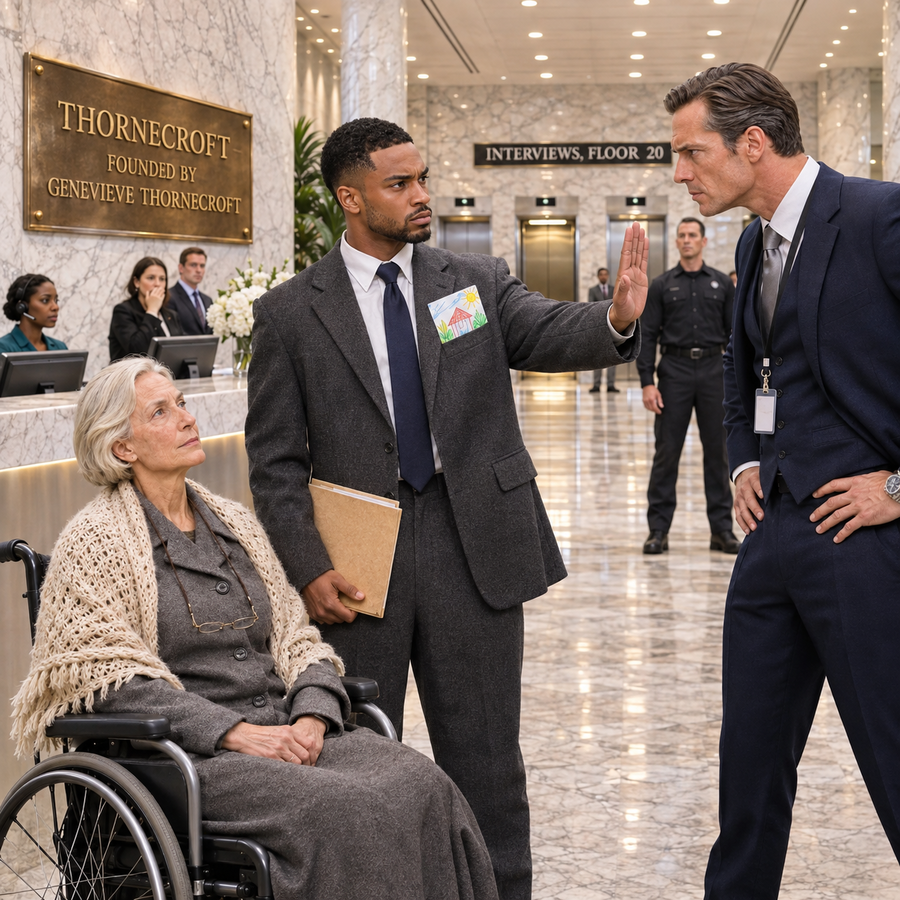
Get the wheelchair out. We don’t see charity cases here.
I can move myself just fine. Thank you.
Then move. You’ll never belong in this building anyway. Keep walking, hero. This is not your problem. Take your hands off her chair right now.
Excuse me?
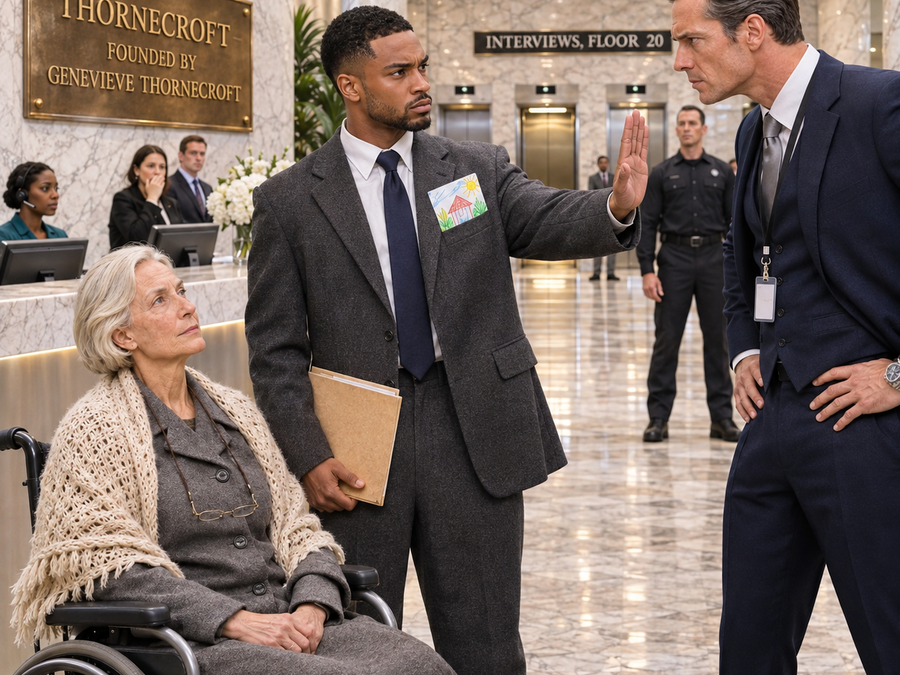
I made you something for the interview.
Yeah? That’s the best thing anybody’s ever given me.
Is it a good job?
It’s a real one, Obi. They teach you and they pay you while they do it. If I get it, we stay right here.
And if you don’t?
Then I get it anyway because you drew me a building. Shoes on. Mrs. Adewumi’s taking you this morning.
You smell like Dad trying.
That’s the exact smell I was going for.
What do they teach you there?
How to make things that last. Metal, machines, real work.
Like what you did before?
Before the plant shut down, yeah. Two hundred of us, one morning, no shop.
You’re good at starting over.
I’m getting a lot of practice. You listen to Mrs. Adewumi. I’ll be back before dark.
Go on, Obi. We’ve got cartoons and I’ve got patience.
Don’t be late, Dad. The paper says good luck, not good maybe.
Good luck it is.
Econ Mbatha, apprenticeship interview, floor twenty. I’m early.
Early’s good. They like early. You’re on the list, nine o’clock.
First real interview in months, since the plant closed.
What did you do there?
Machinist. Ran a lathe since I was nineteen. Then the whole line moved overseas.
And this is the fresh start?
Last one on my list. I don’t have a next.
What would you build if they picked you?
Anything that outlasts me. A part still turning in a machine when my son’s my age.
Keep that answer for upstairs.
Clear the floor. The board walks through in fifteen minutes. And lock the side ramp. I don’t want strollers and wheelchairs cluttering the entrance today.
That’s the COO. Big vote upstairs this week. Just keep your head down and wait for your name.
Her. By the wall. Move her to the service entrance.
Get the wheelchair out. We don’t see charity cases here.
I can move myself just fine. Thank you.
Then move. You’ll never belong in this building anyway. Keep walking, hero. This is not your problem. Take your hands off her chair right now.
Excuse me?
She said she can move herself. So let her.
Do you know who you’re speaking to?
Somebody with his hands on a chair that isn’t his.
What’s your name? I come back. I have an interview. Floor twenty. Nine o’clock.
Flag him. Causing a disturbance in the lobby. He doesn’t go up and he doesn’t come back.
Sir, he only—
Did I ask you, Miss Everly? Then you should have stepped onto it.
I couldn’t. Not with your hands on her chair.
Sentiment. That’s why you’re still looking for work. And it’s why you need a guard to move an old woman. Careful. I decide who walks through these doors.
Then decide. I’m not leaving her on the floor to catch an elevator.
You just traded your morning for a stranger.
You’re not a stranger. You’re a person. That’s enough.
Most people decide it isn’t.
Most people weren’t raised by my mother.
What did your mother do? Cleaned offices at night.
She said you can tell everything about a man by how he treats the person emptying his trash.
She sounds like someone I would have hired.
She’d have liked you. She didn’t like many people.
I just threw away his future for a woman I’ll never see again. No. I’d do it again.
Did you get it?
Not today.
Were you late?
No. I stopped to help somebody, and the man in charge didn’t like it.
Was it the right thing?
It was. But right things cost sometimes, Obi, more than they should.
Mrs. Adeyemi says you can’t undo a kind thing. It just keeps going.
Mrs. Adeyemi should run the world.
Will we still have the apartment?
We’ll figure it out. We always do.
You said that about the plan.
And we’re still here, aren’t we? Eating cereal like kings. I’ll go back tomorrow. I’ll ask for my papers. Maybe somebody up there will actually listen.
Bring the drawing.
Always.
Mr. Mbatha, your application’s been withdrawn. There’s a flag on your file. Lobby disturbance.
I didn’t disturb anything. I told a man to take his hands off a woman’s wheelchair.
The note says you refused to leave and missed your slot.
The note’s wrong. Who wrote it?
I am not able to say.
Then can I at least have my documents back? The originals. I need them for the next place.
They’re in processing. Come back Thursday.
Thursday.
There’s a vote Thursday. The whole building’s holding its breath. Nobody up there wants a lobby story today.
A vote on what?
Above my pay grade. If Mr. Caldicott wins it, that flag on your file becomes permanent.
And if he doesn’t?
Then maybe somebody reads your file instead of his note. And Mr. Mbatha, off the record, that flag came from very high up. If I were you, I’d let this one go.
If you were me, Miss Hensley, you couldn’t afford to.
For what it’s worth, a complaint came in this morning upstairs against Mr. Caldicott. The front desk says a woman in a wheelchair dropped it off. First one anyone’s dared in a year.
Will it go anywhere?
Complaints here go where he files them. But it’s the first. That’s something.
You’re here every morning now. You cold? I can get you a tea.
You’re kind. Not everyone in this building is lately.
You mean the man who moved your chair?
I mean a lot of things. How long have you worked here, dear?
Three years. It used to be a good place. People held doors. Now everyone’s scared of one man. And the man yesterday, the one who stopped him, Econ, he lost his interview for it. First real shot in months. Keep an eye out for him, Junie. People like that don’t come twice.
You talk like you know him.
I know the kind. I used to hire for it a long time ago.
You again.
You again. They locked the only ramp into my building.
Your building?
I’ve been coming here a long time, longer than most. The man from yesterday decided ramps are untidy.
Where are you trying to go?
The apprentice workshop, lower level. A friend on the board asked me to look at it before Thursday’s vote. Nobody will take an old woman down there.
That’s the program I applied to.
Then you should see it too before they decide its fate upstairs.
Freight lift’s open. It’s rough, but it’s level the whole way. Hold your tote.
You’re not afraid of getting caught twice.
I already lost the interview. Can’t lose it again.
Why did you really put a stranger’s chair before your own son’s rent?
You heard about my son.
I hear a lot sitting still. People forget I’m there.
If I’d stepped onto that elevator, I’d have written up carrying the wrong thing. I’d rather start over clean.
Clean is rarer than you think in this building.
Four CNC mills, six lathes, a welding bay, material handling installed, $480,000. Say that again.
This manifest says a half million dollars of machines were installed in this room.
I’m a machinist, ma’am.
I know what a lathe looks like. There isn’t one bolt hole in this floor. Nobody ever installed anything. They built for a shop and built an empty room.
Why would a man build for machines he never bought?
Because an empty room doesn’t ask questions.
And now they want to close the program.
So nobody ever walks in here and asks where the machines went. That’s not a budget cut. That’s a cover-up.
Keep those pictures, Mr. Mbatha. Keep them somewhere safe.
How do you know my name?
You told the whole lobby yesterday.
He shuts the program down so nobody reopens the room.
And takes the chairman’s seat so no one audits him.
That’s a half million dollars. That’s a hundred apprentices who never learn a trade.
It’s more than money. It’s a door he’s welding shut.
My whole trade’s behind a door like that. Somebody shut it on two hundred of us last spring.
And here’s another man shutting one. You keep meeting the same door.
Maybe I’m meant to be the one who opens it.
Approved and certified. Caldicott.
The lobby hero, down here in a restricted level.
The ramp was locked. I found another way with her.
What were you doing in that room?
Looking at the shop I applied to. It’s empty.
Give me the phone.
No.
You’re trespassing. One call and you’re not just banned from a program. You’re banned from this property with a report that follows your name to every job in this city.
Ban me all you want. I know what I saw in there.
You saw a storage room, friend. That’s all anyone will say you saw. Walk him out. He’s done here. And if he comes back, he’s not my problem anymore.
You should learn people’s names before you throw them out of a building.
And you should go home, ma’am, before someone calls your family to come collect you.
I don’t have family left. Only this.
Only what?
You’ll see Thursday.
The machinist was in the lab today with the old woman in the chair.
The manifest’s on the wall. Sell when you told me to leave it up.
I told you to install a shop. Instead, you cashed $480,000 and mailed me a banner.
We split that money down the middle. Don’t get righteous now.
Thursday I’m chairman. The program’s gone, the room’s a closet, and nobody audits a closet.
And the machinist with the photos?
Banned, flagged, and nobody with a cracked phone. By Friday, he’s a line in a security log.
And the old lady?
Some charity case who likes the fountain. Forget her. Keep your invoices cleaner next time.
Who do I even give this to?
The man who signed the lie is about to run the whole company. I go back Thursday for my papers anyway. I find the right room.
Are you selling your tools?
Rent’s due Friday, Obi. These might cover a month.
But then you can’t do the job. Even if they say yes.
You’re too smart for your own good.
You said the lab was empty. The one with no machines.
I did.
Then they need somebody who knows what a machine is.
They do. I’m going to go remind them. I need to get this to someone on the board before tomorrow’s vote.
Get what?
Pictures. The apprentice lab is empty. They billed half a million for machines that were never installed.
Recon. If that’s true, you can’t say it to me. I answer phones. Say it to the wrong person and it disappears. So do you.
Then who’s the right person?
I don’t know. Everyone up there works for him.
Miss Everly, is this man bothering you?
No, sir. Wrong floor. He’s just leaving. Go home. Keep the pictures where no one can reach them. I’ll watch for a door.
Why help me? You could lose your job.
Because you lost yours doing the right thing. Somebody in this building should remember how that works.
The apprentice program bleeds money. Cut it and we close the year in the black. Confirm me as chairman and I steady this company through the transition.
The founder built that program with her own hands, Selwyn.
Sentiment doesn’t pay dividends, Isadora. The numbers are the numbers.
And the numbers come from his office. Everyone.
Every number audited and filed. I’d stake my name on them.
You just did. The founder has been gone a year, Isadora. Abroad. Silent. Someone has to actually run this building. And the equipment budget? Half a million for the new lab. Where did that land?
Installed in a depreciating address. It’s in the file.
I’d like to walk down and see it.
The lower level’s closed for board week. After the vote, I’ll give you the full tour. Four to two for Selwyn as it stands.
If it ever ties, the charter sends it to the founder’s seat. And that seat has been empty for a year. We vote Thursday, ten o’clock. Everyone present.
Empty seats don’t vote, Isadora. Idris, you’ve got that logistics contract up for renewal next quarter. A chairman remembers his friends. And he remembers the ones who make him look foolish over a storage room.
Is that a vote or a warning?
It’s a courtesy. Sleep on it.
I keep asking to see the lab.
And I keep telling you after the vote.
Funny how the tour is always after the decision. You come to this plaza a lot for a stranger.
I like to watch who holds a door and who lets it slam.
Monday, you saw the man, the one in the big suit?
I saw him give up the only thing he came for for me, a woman who couldn’t do a thing for him.
Caldicott flagged him, says he caused a scene.
Caldicott says a lot of things. You’ve noticed.
Eleven years on this board and I’ve never seen it run on fear before.
Fear is cheap to install and expensive to remove. I learned that the hard way.
You sound like you’ve sat at a table like ours.
Once or twice.
Do I know you?
You will, Idris. A man asks you to vote before you can see the room. Ask yourself what’s in the room.
I’m here for my documents. Hensley said Thursday.
They’re not ready, but somebody left this for you.
Who’s G?
The lady in the wheelchair. She was here at seven. She knew you’d come back.
I’m banned from the building, Junie.
That badge says you’re a guest of the office of the founder. Nobody at that elevator argues with that badge. Go before I lose my nerve.
Two resolutions. One, discontinue the apprentice program. Two, name Selwyn Caldicott chairman. We vote by show of hands on the first resolution.
Before we do, Idris, you wanted to see the lab. Here. The apprentice lab, as built.
When was this photo taken?
At installation.
It has no date on it.
Idris, we are not going to lose a company over a timestamp. All in favor of closing the program? Idris.
Security! This man is banned from the—
Your own lobby says I’m a guest of the founder’s office.
Who let you up here?
The lady in the wheelchair. She told me to bring these.
What lady?
She didn’t give a name, just a card signed with one letter, G.
This is the same room, Selwyn. Taken Tuesday. There are no machines, no anchor bolts, nothing. That’s a storage room.
He’s a rejected applicant with a grudge and a cheap phone.
Then it costs nothing to send someone down to look right now.
The lower level is sealed for—
You keep sealing that level, Selwyn. Three days running.
I’d like it unsealed. I’m a machinist. That manifest says $480,000 of equipment was installed in that room. I stood in it. There isn’t one bolt hole in the floor.
Isadora, are we really—
Selwyn, your name is on the certification.
Certifications are signed in stacks. You know that.
Then you signed a stack with a half-million-dollar lie in it.
I signed what my contractor sent me.
Give us his name then, right now.
Ma’am, this is a closed board meeting. Somebody get her.
Sit down, Selwyn. Genevieve?
I sat beside you at that fountain yesterday.
A year in a hospital, Idris. Short hair, a chair, a plain coat. People see the coat. Hello, Isadora. The chair looks good on you. I’d like it back for ten minutes.
We were told you might not come back at all.
I’m sure you were. By whom, I wonder. For those hired while I was away. Genevieve Thorncroft. I built this company thirty-five years ago. My name is on the charter in front of you, and on the stone by the front door you walk past every morning.
You’ve been in a care facility abroad. You signed away daily control years ago.
I signed away the paperwork, not the company, not the stone with my name on it. You never met me, Selwyn. Isadora hired you the month after I fell ill. I’ve been recovering from a long illness, and watching my company from a wheelchair you tried to push out of its own lobby on Monday. I came home quietly, Selwyn. I wanted to see who this company had become when it thought I wasn’t looking. On Monday a man gave up the only interview he had left to stop you from pushing my chair. On Tuesday he found the room you built out of lies. Founder’s shares don’t lapse because I was in a hospital. I still hold thirty percent of this company, and I am invoking an audit of the apprentice equipment account effective now.
And I’m changing my vote. I don’t confirm a chairman who won’t let me see a room before I vote on it.
Then the chairman vote stands at three to three, a tie.
This is a stunt, a grudge, a photo, a woman nobody’s seen in a year.
Then explain the empty room, Selwyn, on the record to them. The charter is clear. A tie goes to the founder’s seat, Genevieve.
My one vote, no. Selwyn Caldicott will not run this company.
Then the motion fails. Selwyn, sit down.
You’re all going to regret taking the word of a janitor’s photo over your own COO.
I’m a machinist, and it’s your signature, not my photo.
The vote. All in favor of removing Selwyn Caldicott as an officer of this company pending the audit.
Mr. Caldicott, your badge and your access, now.
You were gone.
I came back. That’s the whole difference, isn’t it?
You’re the founder. I pushed the founder’s wheelchair through a freight door.
You pushed a person through a freight door. You said that was enough. You were right.
I only came for my documents.
And you leave with more than documents. That program isn’t closing. It’s getting the machines it was always owed, real ones this time. We’ll need apprentices.
Ma’am, I don’t want a thank-you job. I didn’t do it for a job.
I know. That’s exactly why I won’t give you one. You interview Monday, same floor, same nine o’clock you lost. You earned the seat like everyone else. But this time, the man at the door won’t be standing in front of it.
And this time, somebody will check the room before they vote on your future.
Why me? You can hand that program to anyone.
Because I spent a year watching clever people run my company. Not one of them stopped for a stranger. You did it in two seconds with everything to lose.
It didn’t feel like a choice.
The right ones rarely do.
What happens to him, Caldicott?
An audit, lawyers, a long, quiet fall, the kind that doesn’t trend.
And the money?
Goes back into that room as machines. Where it was always meant to be.
Monday, nine o’clock.
One more thing, the drawing in your pocket, the corner showing.
My son, he said good luck.
Children are better judges of men than boards are. Bring him sometime. I’d like to meet the artist.
Did the mean man win?
No, the quiet lady did.
The one you helped?
The one I helped turned out to own the whole building. But that’s not why it mattered.
Why did it matter?
Because I’d have helped her if she owned nothing at all. That’s the part you keep, Obi, not the building, that part.
Mrs. Adeyemi said a kind thing keeps going.
Mrs. Adeyemi has never been wrong once.
Is the lady going to be okay?
She owns a building and a third of a company. She’ll be fine.
That’s not what I asked.
No, it’s not. I think she’s been alone a long time. Today she wasn’t. Monday I go back. And this time I ride the elevator all the way up.
And if they say no again?
Then I find the next door. There’s always a next door, Obi.
Even when there isn’t?
Especially then.
Hands off the glass, Obi. You’ll smudge my good name.
You hired him after all.
He earned it on Monday, fair and square. I just unlocked the ramp.
The audit came back. Caldicott and his contractor, every dollar.
Let the lawyers have them. I only wanted my building back.
And the child at the glass?
That’s the whole point of a building, Idris. Someone small pressing his hands to the window, believing in the person inside.
You could have revealed yourself the first morning. Saved Mr. Mbatha a week.
And learned nothing about any of them. A week is cheap for the truth.
And if he had stepped onto that elevator Monday?
Then someone else would be standing at that machine today. And I would still be looking.
The Monday morning sun poured through the towering windows of the Thorncroft Building lobby, painting long golden rectangles across the polished marble floor. Econ Mbatha stood at the entrance, his worn leather shoes polished to a shine, his collar straightened, the drawing Obi had made him folded carefully in his breast pocket. He had arrived forty-five minutes early. He had promised himself he would not be late again, would not let anything—not a locked ramp, not a belligerent security guard, not a man with too much power and too little decency—stand between him and the second chance he had been given.
But this time, he was not alone.
Genevieve Thorncroft sat in her wheelchair beside him, her short silver hair freshly cut, her plain gray coat replaced by a deep navy blazer with the Thorncroft company crest embroidered on the pocket. She looked, Econ thought, like a woman who had spent thirty-five years building an empire and had never once forgotten what it felt like to be invisible.
“Are you ready?” she asked.
“I’ve been ready since the moment I walked out of that freight lift,” Econ said.
“Good. Because the board is waiting. And so is the entire company. They’ve been holding their breath since Thursday, wondering what would happen next. Wondering if the founder’s return was a fluke or a reckoning.”
“And which is it?”
Genevieve smiled. “Both.”
They moved through the lobby together—Econ pushing Genevieve’s chair, not because she needed him to but because she had asked him to, because she wanted the people who had watched him defend her to see him beside her, not behind her, not beneath her. They passed the reception desk where Junie Hensley sat, her eyes wide with surprise and delight. They passed the security station where the guard who had once ordered Genevieve out of the building now stood at attention, his face pale. They passed the elevator bank where Selwyn Caldicott had once tried to have Econ arrested.
And they stepped into the elevator together.
“Floor twenty,” Genevieve said. “The boardroom.”
The doors closed. The elevator rose.
When they stepped out, the entire board was waiting. Isadora Vance, who had voted against Selwyn and had been the first to change her vote. Idris Cole, who had once asked to see the lab and had been refused. Four other board members, each of whom had been forced to choose between loyalty to a corrupt COO and loyalty to a company they had once believed in.
And Genevieve Thorncroft, the founder, the woman whose name was on the building, rolled into the room and took her seat at the head of the table.
“Good morning,” she said. “Let’s begin.”
The meeting lasted three hours. They discussed the audit—the $480,000 that had been stolen, the equipment that had never been installed, the apprentices who had never been trained. They discussed Selwyn Caldicott, who had been removed from his position and was now facing criminal charges. They discussed the future of the apprentice program, which would be rebuilt from the ground up with real machines, real instructors, and real opportunities.
And they discussed Econ Mbatha.
“Mr. Mbatha,” Genevieve said, “you applied for this program because you wanted to build things that outlast you. You wanted a part still turning in a machine when your son was your age. That’s the kind of thinking we need here. That’s the kind of thinking we should have been rewarding all along.”
Econ stood at the foot of the table, his hands clasped in front of him. He was not nervous. He had spent the last week fighting for something bigger than himself—for Genevieve, for the apprentices who would come after him, for his son, who had drawn a building and told him good luck, not good maybe.
“I just want to work,” he said. “I want to build things. I want to teach my son that if you do the right thing, it matters. Even if it costs you. Even if nobody sees.”
Genevieve nodded. “Then let’s make sure somebody sees. The apprentice program needs an instructor. Someone who knows what a machine is, who knows what it feels like to lose a trade, who knows what it means to start over. Someone who stopped for a stranger in a wheelchair.”
The room was silent.
“You’re offering me a job,” Econ said.
“I’m offering you a seat at this table. Not as an apprentice. As an instructor. You’ll train the next generation of machinists. You’ll teach them not just how to run a lathe, but why it matters. Why craftsmanship matters. Why kindness matters.”
“I don’t have a degree. I don’t have—”
“You have something better,” Genevieve said. “You have a moral compass that doesn’t waver. You have a son who drew you a building because he believed in you. You have a week’s worth of photographs that exposed a half-million-dollar fraud. You have exactly what this company needs.”
Econ looked at her for a long moment. Then he reached into his pocket and pulled out the drawing Obi had made him. It was creased and soft from being carried, but the lines were still clear. A tall building. A small figure holding a tool. A sun in the corner. Good luck, not good maybe.
“Okay,” he said. “I’ll do it.”
The room erupted in applause. Genevieve smiled. Isadora wiped her eyes. Idris nodded, as if he had known all along.
And Econ Mbatha, a machinist from a shuttered plant, a single father who had missed his interview to defend a stranger, took his seat at the table.
The months that followed were a blur of activity. The apprentice program was rebuilt from scratch. The $480,000 was recovered through the audit and reinvested in machines—real machines, the kind that turn metal into parts that last for decades. The first cohort of apprentices was selected: twelve young people from the same neighborhoods where Econ had grown up, the same communities that had been abandoned when the plant closed.
Econ taught them everything he knew. He taught them how to read a blueprint, how to set up a lathe, how to measure a cut to within a thousandth of an inch. He taught them the difference between a job and a craft. He taught them that the work mattered, not because it paid well, but because it was honest, because it was useful, because it was something you could point to and say, I made that. I built that. That’s mine.
And every week, Obi came to visit. He sat in the corner of the workshop, drawing pictures of machines and buildings and the people who worked in them. He drew his father at the lathe, his sleeves rolled up, his face lit with concentration. He drew Genevieve in her wheelchair, smiling at the apprentices. He drew the building itself, tall and proud, with its name carved in stone above the door.
“Will I work here someday?” Obi asked.
“Someday,” Econ said. “If you want to.”
“I want to build things that last.”
“Then you will.”
Genevieve came to the workshop every Friday. She rolled through the aisles, inspecting the machines, talking to the apprentices, asking questions. She never talked down to them. She never treated them as charity cases. She treated them as colleagues—as people who were building something together.
“You know,” she said to Econ one afternoon, “I spent a year in that hospital, watching my company from a distance. I saw the reports, the numbers, the charts. But I never saw the people. I never saw the apprentices who couldn’t get trained, the workers whose wages were stolen, the machinists who lost their jobs when the plant closed. I was so focused on the big picture that I forgot to look at the details.”
“And now?” Econ asked.
“Now I see them. Every one. I see you, Mr. Mbatha. I see your son. I see the twelve apprentices who are learning to build things that last. I see Junie Hensley, who risked her job to help you. I see Idris Cole, who asked to see the lab and was refused. I see everyone who was invisible before, and I will never stop seeing them.”
“That’s the point, isn’t it?” Econ said. “That’s the whole point of a company.”
“Yes,” Genevieve said. “That’s the whole point.”
The years passed. The apprentice program became a model for other companies. Genevieve Thorncroft returned to full health, though she never gave up her wheelchair—she said it was a reminder of everything she had learned, a reminder that strength was not about standing but about showing up. Econ Mbatha became the director of the program, training hundreds of young people in the trades that had been lost when the plants closed. Obi grew up, studied engineering, and returned to the company as a designer, creating machines that were more efficient and more humane than anything that had come before.
And on the first Monday of every month, Econ and Genevieve had lunch together. They sat in the boardroom, at the same table where they had first met, and they talked about the program, about the apprentices, about the future.
“You know,” Genevieve said one afternoon, “I never asked you why you did it. Why you put your hands on my chair and refused to let go.”
Econ thought about it. “Because you were a person,” he said. “Because you needed help. Because I was raised by a woman who told me that you can tell everything about a man by how he treats the person emptying his trash.”
“Your mother sounds like someone I would have liked.”
“She would have liked you too. She didn’t like many people.”
Genevieve laughed. “I know the feeling.”
They sat in silence for a moment, looking out the window at the city below. The sun was setting, painting the sky in shades of orange and pink. The building was quiet, the apprentices gone home, the machines silent.
“Thank you,” Genevieve said. “For everything.”
“No,” Econ said. “Thank you. For giving me a chance. For believing in me. For building a company that’s worth believing in.”
“I didn’t build it alone,” Genevieve said. “I built it with people like you. People who stop. People who care. People who see the person behind the wheelchair.”
Econ smiled. “That’s the whole point, isn’t it?”
“Yes,” Genevieve said. “That’s the whole point.”
They finished their lunch and walked—Genevieve rolling, Econ walking beside her—to the elevator. They rode down together, past the boardroom, past the reception desk, past the lobby where a young man had once stopped for a stranger in a wheelchair.
And they stepped out into the sunset, into a city that was a little bit better because of the choices they had made.
“Same time next month?” Genevieve asked.
“Same time next month,” Econ said.
They parted ways, each going home to the people they loved. And the building behind them stood tall and proud, its name carved in stone above the door, a reminder that kindness matters, that courage matters, that the people who stop for strangers are the people who change the world.
The front door fits us all.
And it always would.
THE END.