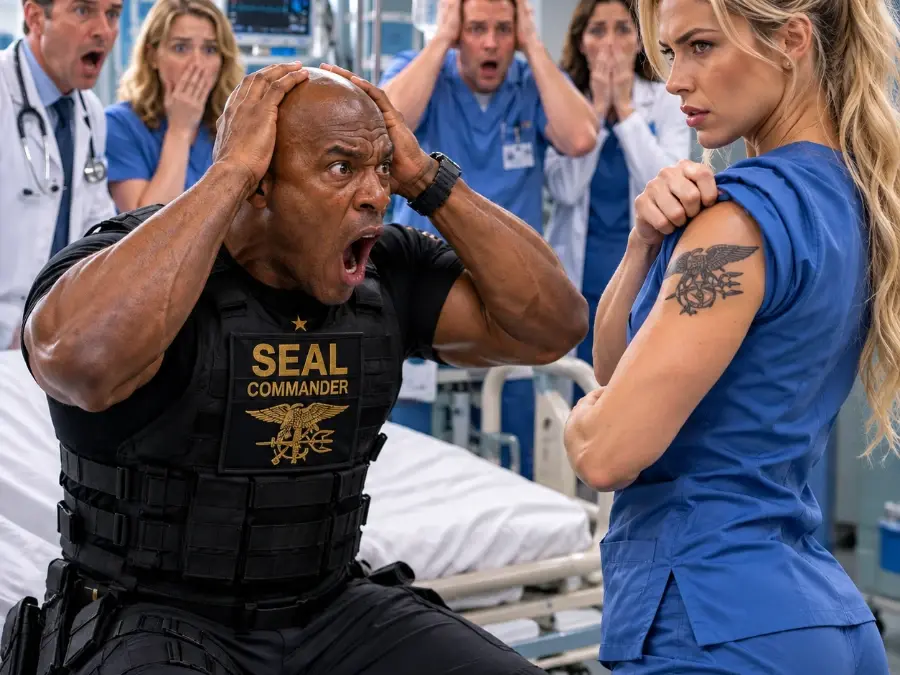
“Get Someone Competent!,” the SEAL Commander Demanded — Then the Rookie Nurse Showed Her Unit Tattoo
“Get Someone Competent!,” the SEAL Commander Demanded — Then the Rookie Nurse Showed Her Unit Tattoo
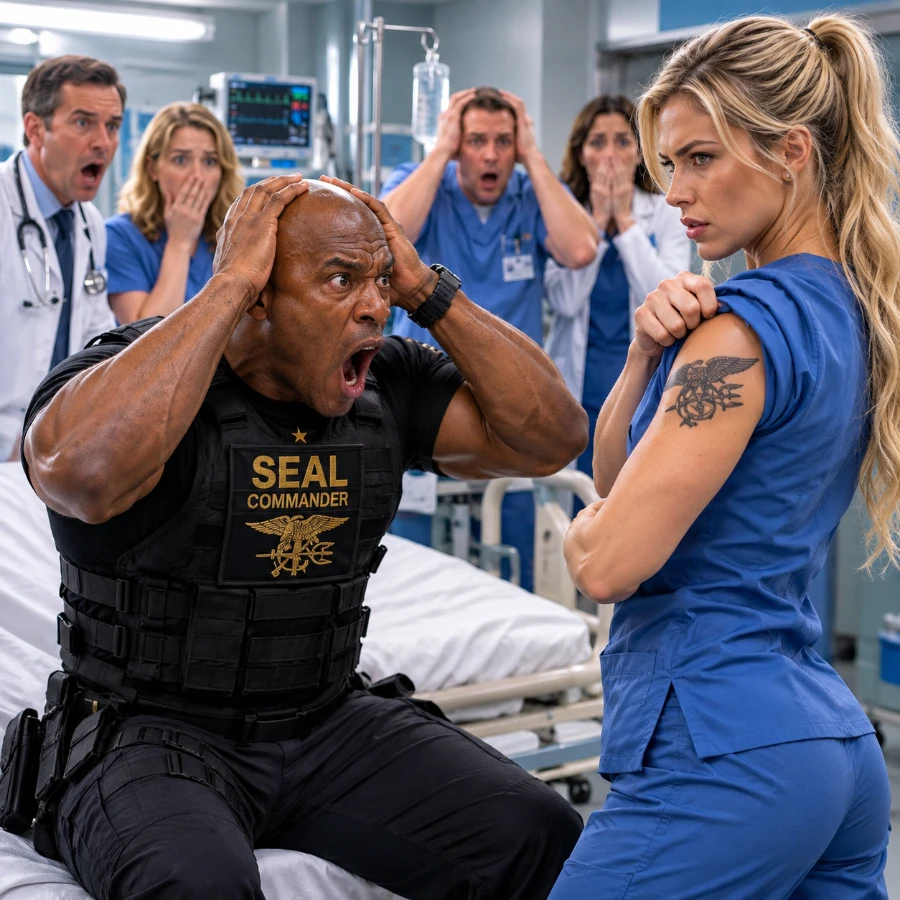
She erased her own name from a headstone in Arlington.
Erased the ribbons from her chest.
Erased everything except the tattoo on her shoulder blade no one in that hospital would ever see.
That was how Reagan Calloway survived, invisible, mopping corridors, swallowing the insults of Dr.Holloway, the social media darling who treated nurses like furniture, until the night three SEALs arrived torn apart, one of them drowning in his own blood, and the Instagram doctor froze with shaking hands above a chest he didn’t know how to open.
That was when the commander roared a word she hadn’t heard in two years, a word that belonged to a woman she had buried, a word he should never have known.
And when his eyes found hers through the chaos, Reagan understood. He knew.
He had always known.
What happened in the next three hours wasn’t medicine.
It was an oath being called in. It was a blood debt coming home.
And when the sun rose over Pensacola, the hospital discovered that the quietest woman in the building had buried more brothers than any of them would ever know. If this story pulled you in, do me a favor before you go.
Smash that like button, drop a comment telling me what city you’re listening from, hit subscribe so you never miss a story like this one, and welcome to the Silent Badgers stories.
You’re home now.
The mop water smelled like bleach and old pennies.
Reagan Calloway pushed the bucket down corridor B of Pensacola Memorial Trauma Center at 11:47 p.m.Her shoulders curved forward, her chin tucked low, her eyes fixed on the gray linoleum the way a soldier studies a minefield. Two years of this.
Two years of mopping the same floor, restocking the same supply carts, swallowing the same insults.
Two years of pretending she did not know how to stop a man from bleeding out in under 90 seconds. The fluorescent lights hummed above her, sickly and pale, the way they had hummed in the field hospital in Bagram the night she lost Tobias.
She blinked the memory away. Blinked it the way you blink sweat from your eyes during a rope insertion.
Quick, functional, move on.
Calloway, you’re slow tonight.
The voice came from behind her, smooth as oil sliding across glass.
Dr.Marcus Holloway stood in the middle of the hallway in a custom-tailored white coat that had never seen real blood, holding a phone in one hand and a paper coffee cup in the other.
His hair was perfect.
His teeth were perfect.
The little blue check mark beside his name on three social media platforms was perfect.
2. 4 million followers loved him.
He loved his reflection. I need the trauma bay sparkling by midnight.
We have a media crew coming through tomorrow for the documentary.
You understand the word sparkling, don’t you?
Reagan did not look up. Yes, doctor.
Yes, doctor what?
Yes, doctor. Sparkling by midnight.
Holloway tilted his head, studied her the way a man studies a stain on his sleeve.
You always look so tired, Calloway. Maybe you should consider whether this line of work is really for you.
Some people aren’t built for it.
There’s no shame in admitting that.
He raised the phone.
The little red light of a camera blinked on.
Smile for the camera.
Show the followers what dedication looks like.
She did not smile. She did not look up.
She gripped the mop handle hard enough that her knuckles went white.
And somewhere in the back of her mind, a woman she used to be, a woman with the call sign Halo, a woman who had jumped from a CV-22 at 11,000 ft into the black Hindu Kush, that woman whispered the breathing pattern. Four in, hold, four out, hold, tactical breathing, the kind they taught you when you were about to take a shot you could not afford to miss.
Holloway lowered the phone, annoyed.
Suit yourself.
Be invisible.
That’s what you’re good at.
He walked away whistling. His Italian loafers squeaked on the wet linoleum she had just mopped.
Reagan watched the streaks his shoes left behind, and for a single breath she thought about how easy it would be.
How easy to drop the mop.
To take three steps. To put him on the floor with a brachial stun.
Knee on the carotid. Count of six.
Lights out. She had done it to bigger men.
To worse men. In darker places.
She closed her eyes.
Let the breath out slow.
Picked up the bucket.
Kept walking.
Nurse Penelope.
Penny Hartwell came around the corner with a clipboard pressed against her chest and a look of stifled fury on her round, freckled face.
Penny was 58, 4 ft 11, built like a fire hydrant in floral scrubs. And she was the only person in this building who treated Reagan like a human being.
Did he just film you again?
It’s fine, Penny.
It is not fine. It is the fourth time this month.
I’m filing on him.
Don’t.
Honey. I will file on that peacock until the board cuts his wings off.
Penny.
Reagan finally raised her eyes. Just for a moment.
Just enough for Penny to see the thing she always hid behind the lowered lashes. The thing that made Penny stop talking mid-sentence the first time she ever saw it.
A flatness. A stillness.
The kind of look a deer never has.
The kind of look only predators have when they are choosing not to be one.
Don’t file, please.
Penny’s mouth worked.
She looked away first.
She always looked away first. Fine.
But one of these days, sugar, somebody is going to push you, and you are going to push back, and I am going to bring popcorn.
Reagan almost smiled.
Almost.
She turned her face away before it could happen. At the far end of corridor B, past the supply room and the chapel and the locked door that led to the helipad stairs, there was a single window that looked out over the Gulf of Mexico.
Reagan stopped there when she could. She did not know why.
Maybe because the dark water reminded her of the dark sky she used to fall through.
Maybe because Tobias had loved the ocean.
Maybe because the window was the only place in this building where she could see something bigger than herself. She set the mop against the wall, pressed her forehead to the cool glass.
November in Pensacola, the wind off the Gulf was sharp tonight, throwing salt against the panes. Somewhere out there, 23 miles east, the lights of Hurlburt Field burned in the dark.
The home of Air Force Special Operations Command.
She had not been able to look at those lights for the first 6 months she lived here. She made herself look at them now, the way you make yourself look at a scar, to remember what it cost.
Tobias. The name came up like vomit.
She forced it back down. Her phone buzzed in her pocket.
She pulled it out.
A weather alert. Severe weather warning, Escambia County.
Heavy rain, gusts up to 40 knots, conditions deteriorating overnight.
She put the phone away, picked up the mop, turned to go.
That was when she heard it.
A sound she had not heard in 2 years. A sound that did not belong on a civilian hospital roof.
A low syncopated thudding that vibrated through the concrete of the building before her ear ever caught it.
Two big rotors, set wide apart.
Tilt rotor signature.
The unmistakable thump-womp-thump of a CV-22 Osprey coming in hot. Reagan went very still.
Civilian medevac helicopters whined.
Coast Guard birds chopped a clean four beat. Black Hawks pounded a heavy steady rhythm.
None of them sounded like this. This was the sound of a special operations bird in tactical configuration coming into a landing zone that was not on its approved flight plan.
This was the sound of someone bypassing the rules because the rules were going to kill the man on board.
The intercom crackled.
The night supervisor’s voice came through thin with confusion.
Trauma alert, trauma alert, multiple incoming.
ETA on the helipad 2 minutes.
All available personnel to trauma bay one. Repeat.
Dr.Holloway to trauma bay one. Reagan stood frozen in the corridor with the mop in her hand.
Her heart was already running.
Already in fight rhythm.
Already counting the seconds the way it counted in the Hindu Kush.
2 minutes.
120 seconds. Plenty of time for a man to die.
She set the mop against the wall.
She did not run.
Running drew attention.
She walked the way she had walked through a hundred villages where the wrong gate would get her killed. Calm, loose, eyes down.
Down corridor B, past the chapel, past Penny who looked up startled and said, “Honey, where are you going?”
Reagan did not answer. Through the swinging doors into the ER proper where the entire night staff was already converging on trauma bay one in a tangled wave of confusion.
Holloway was at the center of it, buttoning his white coat, adjusting his hair in the reflection of the glass partition.
“Who authorized a helo landing?
Where is the paperwork?
Somebody tell me what we’re getting.
” Nobody knew.
Nobody had the answer.
The intercom said multiple incoming.
The intercom did not say from where. Reagan slipped along the wall, found the corner behind the supply cart, made herself small, made herself invisible.
Old skill. Old old skill.
From outside on the helipad above, the Osprey was setting down.
She could feel the downwash punch through the building.
She could feel the concrete tremble. She could smell, even through the closed doors, the faint sweet bite of jet fuel and seawater.
It smelled like everything she had spent two years trying to forget.
Her hands were perfectly still.
The elevator doors at the far end of the ER hissed open, and then they came. Four men came out of the elevator first, and they were not paramedics.
They were carrying a litter the way only people who have carried litters under fire carry them. One at each corner, knees bent, heads down, moving in a wedge with the casualty in the middle.
Their gear was wrong for Florida. Black tactical kit soaked through with seawater, plate carriers crusted with salt, boots leaving wet prints across the polished ER floor.
Their faces were painted in streaks of black and green grease that had run in the rain. The man on point had a beard the color of rust and a trident pinned to the front of his plate carrier where regulation said not to wear one.
Naval Special Warfare SEAL team.
Reagan’s brain processed it in less than a second, and her stomach went cold.
Two more litters came out behind them. Two more wounded.
Five operators total walking, three down. One of the walking ones was holding his own forearm together with a soaked through pressure bandage and limping on a leg that should not have been bearing weight.
“Where is your trauma surgeon?”
The bearded one, the point man, did not so much speak as deliver a sentence.
His voice was sandpaper and gravel and command.
“I need your trauma surgeon and I need him now.
I’m the attending.
Holloway stepped forward, both hands raised in the universal gesture of I am in charge here. His smile was the smile he used on camera, bright, white, confident.
Marcus Holloway, director of emergency medicine.
Gentlemen, I’m going to need you to step back and let my team You’re not a trauma surgeon.
I’m board certified emergency medicine and I assure you get me a trauma surgeon.
There isn’t one in the building.
Doctor, Patel is on call, but she’s 40 minutes out.
I am perfectly capable.
Then start, the point man snapped and shoved past Holloway as if Holloway were a coat rack. Bay one, all three, now.
The litters moved. The staff scattered.
Holloway’s face had gone the color of skim milk, but he followed because his ego would not let him not follow.
And because 2.
4 million followers were watching even when they weren’t.
Reagan stayed in her corner. She could see the bay one bed from where she stood.
She could see the man being lifted onto it. He was young, 25, maybe 26.
His face was the color of old candle wax.
His chest plate had been cut away in the bird and his combat shirt was scissored open from collar to navel and what Reagan saw underneath made the breath stop in her throat.
A penetrating chest wound, left side, mid-clavicular.
Bubbling.
Pink froth at the edges.
Tension pneumothorax in progress. Trachea already shifted right.
He had, she ran the clock automatically, maybe 4 minutes, maybe 3. And then the airway.
The airway was worse.
There was massive facial swelling, blood pooling in the hollow of his throat where a piece of shrapnel had carved a furrow under his jaw. He was drowning.
He was drowning in his own blood and his own collapsing lung at the same time. Holloway approached the bed.
Reagan watched his hands. The hands told you everything.
The hands of a surgeon who has cut into a human body in crisis do not shake when they reach for the patient.
They flow. They go where they need to go before the brain finishes the sentence.
Holloway’s hands hovered.
Hovered.
Drifted toward the chest, then away. Then toward the throat, then away.
And then settled on the patient’s shoulder in a gesture that was supposed to look reassuring and only looked lost.
Right.
Holloway said. To no one.
To the room. Right.
Okay.
We need We need imaging.
We need Somebody get a chest tube tray.
We need He doesn’t have time for imaging.
The point man’s voice was a knife.
Decompress him.
Now.
I Yes, of course.
Holloway turned.
Looking for the tray.
Looking for a nurse.
Looking for somebody to put the instrument in his hand because his hand was shaking and he did not want anyone on camera to see it shake.
There was no camera. He was looking for one anyway.
Two years of practiced motion.
Somebody angiocath 14 gauge Where is it? Penny came running with the tray.
Slammed it on the bedside table.
The instruments rattled.
Holloway grabbed for the needle and his thumb missed the cap on the first try and missed it on the second.
The point man saw it. Reagan watched his face.
Watched the read happen behind the eyes.
Watched him decide in less than a heartbeat that the man with the perfect hair was going to kill his teammate. He turned toward the door.
Toward the corridor. Toward the staff filling in behind him.
Is there anyone in this building who can do this?
Anyone? Silence.
I need someone competent right now.
I do not care what color their scrubs are.
I do not care what their pay grade is. I need someone in this room who has done this before in the dark with no power and people shooting at them because that is what this man needs and that is what is about to walk out of him.
Silence.
Holloway’s hands shook harder.
The patient on the bed made a sound. Not a word.
Not a moan. The wet rattling sound a chest makes when the chest is losing.
Reagan closed her eyes. She thought about Tobias.
She thought about the rope and the wind and the green glow of night vision. She thought about Bagram and the canvas of the field hospital and the moment she had realized she could not save him.
She thought about the headstone she had paid for and the ribbon she had mailed back to the Air Force in a Manila envelope with no return address.
She thought about the two years of mop water and Holloway’s smile and her own promise.
Her own quiet, careful sworn promise that she would never put her hands on another dying operator as long as she lived because she had failed once and she had decided, lying on the floor of a hotel room in Norfolk with a bottle of bourbon she did not drink, that one failure was the limit. That a woman who
had failed Tobias did not get to try again.
The patient on the bed made the sound a second time. Smaller.
Reagan opened her eyes.
She stepped out from behind the supply cart.
She did not say anything. She walked past Penny, who turned to look at her and then went perfectly still the way a person goes still when they realize they have been standing next to a different animal than they thought.
Past two of the staff nurses who stepped aside without knowing why.
Past Holloway, who was still fumbling with the angiocath cap and did not see her at all.
She walked to the head of the bed and she looked across the body of the dying seal, and she met the eyes of the bearded point man.
His eyes changed.
It was a small change.
The kind of change only another operator would catch.
A narrowing. A focusing.
A recalibration of threat assessment in real time. He had been looking at a hospital.
Now he was looking at her. And whatever he saw in her face made his shoulders drop 1/4 of an inch, the way shoulders drop when reinforcements arrive.
“Move,” Reagan said quietly to Holloway.
Holloway did not move.
He turned indignant, the angiocath still capped in his fist.
“Excuse me, who are you?
Get back to your station.
Move.”
She said again. And this time her voice was not quiet.
This time her voice came from somewhere deeper, somewhere older, somewhere that had carried across rotor wash and rifle fire and the screaming of dying men in three languages, and it filled the trauma bay the way a hand fills a glove. Holloway moved.
He did not mean to.
His body just did it.
He stepped sideways and his back hit the crash cart, and he stayed there with his mouth slightly open.
Reagan looked at the point man.
“Name?”
“Hayes,” the seal said.
“He’s Hayes.”
“Yours?”
A pause. The smallest pause.
“Wyatt.”
“Wyatt, you hold his head.
Both hands. In-line stabilization.
Neutral.
He has cervical involvement and I will not have him moving while I work.”
She did not wait for him to confirm. She turned to Penny.
“Penny, 14-gauge angiocath, two of them.
Cric tray. Pediatric bougie if you have one.
Adult if you don’t.
Suction at the wall, full power. Yankauer on the tube.
Two units O neg out of the fridge.
Run them now.
You can match them later. Go.”
Penny went.
Reagan looked down at Hayes. Pressed two fingers along the second intercostal space, mid-clavicular line.
Found the spot her body had not forgotten.
The skin under her fingers was clammy and tight as a drum. She looked back at Holloway.
His mouth was still open.
“Doctor,” she said, “either help or get out of my trauma bay.”
Holloway got out of her trauma bay. Penny was back in 11 seconds with the angio-cath in her hand and her eyes the size of saucers.
Reagan took it without looking. She had not held a 14-gauge needle in 2 years.
Her thumb found the cap.
Her thumb popped the cap. The motion was as automatic as drawing a sidearm.
She set her left hand on Hayes’s chest, anchored on the rib she wanted, and drove the needle straight down through the muscle and into the pleural space at a perfect 90° angle.
There was the small sickening give of the pleura tearing.
And then the hiss. A long, sharp, beautiful hiss of trapped air rushing out of a chest that had been 3 seconds from killing him.
Hayes’s whole body twitched.
A spray of pink aerated blood flecked the front of Reagan’s blue scrubs.
The pulse oximeter on the rolling pole, which had been a dying 81, climbed to 85, to 88, to 91.
Wyatt exhaled.
It was the kind of exhale a man does when he’s been holding his breath without knowing it.
Reagan heard it, filed it, did not look up.
“That’s a bridge,” she said, quiet, clinical.
She was talking to Wyatt and to no one else in the room.
“He’s still bleeding into the cavity, and that’s still a sucking wound.
I need a chest tube in him in the next 4 minutes, or the lung will not re-expand. But the airway is going first.
Look at his jaw.”
Wyatt looked at his jaw.
His face went a shade harder.
Hayes’s tongue was swelling.
The shrapnel had cut something in the floor of the mouth and the tissue was filling with blood and edema.
In a minute, maybe 90 seconds, the tongue would seal the airway entirely.
“Quick.”
Reagan said.
“He needs a surgical airway.
Penny, is that tray on the table?
Good. Wyatt, your hand stays where it is.
Do not move.
If he seizes, you ride him like a horse.”
“Copy.”
“Copy.”
The word landed in the room like a coin dropped on stone. The nurses heard it.
Wyatt heard himself say it. Holloway in the corner heard it.
Reagan ignored all of them. She tore open the cricothyrotomy tray.
The instruments were laid out in the same configuration she had used in a tent in Helmand a thousand years ago.
Scalpel, tracheal hook, bougie, tube.
She palpated the front of Hayes’s throat, found the thyroid cartilage, slid her thumb down, found the cricothyroid membrane, the little soft hollow that is the only place in a human body where you can cut a clean hole to the lungs in under 30 seconds without killing them.
“Wyatt, look away if you don’t want to see this.”
“I’ve seen it.”
“Then watch his pulse on the pole and tell me if it drops.”
She made the incision. One pass, horizontal, 1 and 1/2 centimeters.
The blade went through skin and through the membrane in one motion because that was the only motion that worked. Blood welled.
She set the tracheal hook, pulled the trachea forward, slid the bougie through the opening into the airway, threaded the tube down the bougie, pulled the bougie out, and connected the bag valve to the end of the tube.
Penny squeezed the bag.
Hayes’s chest rose.
Penny squeezed again, the chest rose again.
The pulse oximeter climbed to 94.
The trauma bay had gone completely silent.
Reagan became aware of it the way you become aware that a generator has stopped running by the absence.
She did not look up. She secured the cric tube with a length of cotton ribbon from the tray, the way she had been taught by a man named Doc Reardon in 2014.
She wiped her gloved hands on her scrubs.
She turned to Wyatt.
“He needs a chest tube and he needs to be in an OR inside 20 minutes.
Is the bird still on the roof?”
“Spinning.”
“Good.
He goes back up.”
“Eglin has a surgical team standing by.”
“Hurlburt does.”
“Better.”
She paused, looked at Wyatt, properly looked.
“How many more do you have?”
“Two.”
“Show me.”
Wyatt did not move. He looked at her and she could see the question in his face.
The question that had been forming since she said the word copy out loud.
She did not look away.
She let him look.
She let him add it up.
“Halo.”
He said quietly.
Not a question. A confirmation.
“You’re Halo.
” The trauma bay was already silent.
It got more silent.
Reagan did not answer. She did not have to.
The set of her shoulders had answered.
The angle of her wrists had answered. The way she had spoken the word copy had answered.
Two years of mop water did not undo what 12 years of pararescue had built into her bones and the man in front of her had been trained by people who had been trained by people who had trained her. And he could read her body the way she could read his.
“I thought you were dead.”
Wyatt said.
“Command put out you were KIA Bagram 2023.”
“We held a service.”
“There’s a name on the wall at Hurlburt.”
“Show me the other two.”
Reagan said.
Wyatt held her eyes a beat longer than he turned.
“Bay two, bay three.
Aubrey and Marsh.
Aubrey’s leg is the problem.
Femoral, junctional.
We packed it in the bird but the tourniquet won’t hold high enough.
Marsh has shrapnel through the abdomen. Vitals are okay for now.
Aubrey first.
She moved.
She moved past Holloway, who was now pressed against the wall like a man trying to be furniture, and she walked into bay two.
And the SEAL on the bed, there was a kid, maybe 24. His left thigh was wrapped in three layers of soaked combat gauze, and a CAT tourniquet had been ratcheted as high on the leg as a tourniquet could go, which in his case was not high enough, because the bleed was junctional.
It was coming out of the femoral artery up in the groin where you could not put a tourniquet without putting it on his abdomen.
The gauze was a deep, glossy black, the kind of black blood gets when there is too much of it and it has been sitting too long.
His pressure was 80 over 40 and falling. Reagan turned to Penny, who had followed her with the quick tray still in her hands.
“I need a combat application junctional if you have one.
If you don’t, I need a sandbag 10 lbs and I need a fist, mine.
We don’t have junctional tourniquets.”
“Then I’m the tourniquet.
Get me a sterile drape. Get me more combat gauze.
Get me four units O neg in here right now and get whoever drives the helicopter to tell me how long until we can move both of these men.”
“6 minutes to rotors hot.
” said a voice from the doorway, one of the walking SEALs.
He had blood drying on the side of his face, and he was holding the doorframe to stay upright.
“Sit down before you fall down.”
Reagan said without looking at him.
“Penny, gauze.”
She unwrapped Aubrey’s leg.
What she saw underneath would have made a first-year resident vomit.
The wound was high and ragged, and the femoral artery had been opened along almost an inch of its length.
And the only thing holding Aubrey’s blood inside Aubrey’s body was the prayer of clotting factor and a wad of gauze that had reached the end of its useful life.
Reagan did not flinch. She did not breathe in.
She did not breathe out.
She slid her right fist into the wound, found the bone of the pelvis through the muscle, and drove her knuckles down against the artery where it crossed the bone. The bleeding slowed, did not stop, slowed.
“Aubrey,” she said.
The kid’s eyelids fluttered.
“Aubrey, look at me.
What’s your blood type?”
A pause. Barely a whisper.
“Good boy.
Stay with me.”
She looked up at Penny.
“Run the O neg until A pos comes out of the fridge.
Run it fast.
Pressure bag.
Both arms.
Penny, your hand.”
Penny set the Cricut tray down and put her small freckled hand into Reagan’s.
“Right here,” Reagan said.
She guided Penny’s fist into place beside her own.
Pressed Penny’s knuckles down onto the spot.
“Lean.
Lean with your whole shoulder. You are going to hold him for 6 minutes.
You are not going to move.
If you move, he dies. Look at me.
Yes.
Look me in the eye and tell me you are not going to move.”
“I am not going to move.”
“Good.
Talk to him.
Tell him about your dogs. Tell him about anything.
Keep him with you.”
Penny nodded once. Reagan slid her own hand out.
Penny’s hand stayed.
The bleeding did not get worse.
Reagan stood up, looked at her own arm. Her sleeve was soaked to the elbow.
Black, glossy, the way it had been the night Tobias died.
She did not look at it for long.
She turned and there was Wyatt in the doorway watching her.
“Bay three,” she said.
“Bay three,” he said.
They moved. Marsh was the easier one, the way Seals talked about easier.
Shrapnel through the right upper quadrant.
Abdomen tense, but not yet rigid.
Pressure holding at 110. He was conscious.
He was making jokes, the bad, dry, terrible jokes operators made when they were trying to convince themselves they were not going to die. Reagan let him make them.
She palpated his belly, found the rigidity starting to build under the right costal margin, made a decision. Liver lac, probably grade three.
He goes to the OR with the other two.
He’s stable enough to fly.
Do not let anybody on this floor open his abdomen.
Get him on the bird. Copy.
She straightened.
Wiped her wrist across her forehead and left a streak of someone else’s blood there.
Looked up.
Wyatt was still in the doorway watching her. Not the patient.
Her. Halo.
Quieter this time.
How are you alive?
I’m not Halo.
Reagan said. Yes, you are.
I’m a nurse.
You were never just a nurse. He took one step into the room.
Only one. What happened in Bagram?
Reagan looked at him. She thought about telling him the truth.
She thought about telling him about Tobias, about the rope, about the canvas of the field hospital and the way the lantern had swung when the wind hit the tent. She thought about telling him that the name on the wall at Hurlburt belonged to her because she had asked for it to be there, because she had needed to bury the woman who had let Tobias bleed out under her hands.
She did not tell him any of it.
She said, “Get your men on the bird.
I’ll come up to the roof and ride with you to Hurlburt.
They go into surgery faster if I hand them off myself.”
Wyatt watched her for another beat, then he nodded. The nod of a man who knew when not to push.
Roger that. He turned.
He went to organize his men. Reagan stood in bay three alone for two seconds.
Two seconds, which is the longest you can let yourself stop in a casualty event. She rolled her right sleeve up to the elbow because it was soaked anyway.
And as she did it, the cuff dragged across her shoulder blade and the collar of her scrub top shifted and she felt the cool air of the room hit the skin over her left shoulder for the first time in 2 years. She thought just for 1 second about the tattoo there.
The PJ flash.
The motto inked under it in letters the size of a fingernail. That others may live.
Tobias had been there when she got it.
Tobias had held her hand through the third hour of the needle and said, in that quiet Mississippi drawl of his, “Baby, you are going to regret this when you are 60.
” She had said, “Tobias, I am not going to make it to 60.”
He had not laughed.
He had said, “Yes, you are.
You are going to make it because I am going to be there to drag you across the line.”
And then 6 months later, he was the one who did not make it, and she was the one who carried him to the medevac, and she was the one whose hands had been on his chest when the chest stopped moving, and she was the one who had decided, alone in a hotel room in Norfolk, that the woman with the PJ flash on her shoulder was going to be buried with
him.
2 years.
2 years of mop water. 2 years of Holloway.
2 years of not looking at the lights of Hurlburt. And tonight, in 23 minutes, she was going to walk into the trauma center at Hurlburt Field with three seals on litters and a soaked sleeve and a name they all thought was on a wall.
She lowered her sleeve. She walked out into the corridor.
Holloway was standing at the nurses station with his phone in his hand, not filming.
Just holding it, looking at her.
His face was the color of paper. The bright white smile was gone.
2.
4 million followers were not watching this. 2.
4 million followers would never know that he had stood with a capped angiocath in his shaking hand while a janitor with a mop bucket had walked past him and saved three lives in 9 minutes. He opened his mouth.
He closed it. He opened it again.
“Who?”
he said.
“Who are you?”
Reagan stopped, looked at him, really looked at him.
For the first time in 2 years.
“I’m the nurse.”
she said.
She walked past him.
Penny was still in bay two, both hands deep in Aubrey’s leg, talking softly to him about a golden retriever named Buster.
Wyatt was at the elevator with two of his men, holding it for the litter team.
The Osprey was spinning on the roof. And Reagan could feel the deep pulse of its rotors through the soles of her shoes, and somewhere behind her ribs a thing she had buried 2 years ago was sitting up.
She did not look at Holloway again.
She went looking for the stairs to the helipad.
The stairwell to the helipad smelled like wet concrete and aviation fuel, and the salt of the Gulf coming up through the vents. Reagan took the stairs two at a time.
The litter team was ahead of her.
Four SEALs, Hayes on the litter, Wyatt at the head. The rhythm of their boots on the metal steps a sound she had not heard in 2 years and had not forgotten in 2 seconds.
Behind her two more teams were coming up with Aubrey and Marsh. Penny was somewhere in that procession, still pressing on the femoral.
The hospital was emptying its trauma corridor up a single flight of stairs and onto a flat roof in the rain because the rules of who got to land where did not apply to men who had been bleeding for 40 minutes over open water.
She hit the roof door with her shoulder.
The wind hit her in the face. November in Pensacola, 40 knots and rising, the Gulf throwing rain sideways across the helipad lights.
The Osprey sat in the middle of the painted circle with its rotors at idle, the twin nacelles tilted partway up, the loading ramp down at the back. The crew chief was at the ramp waving the men with both hands.
Reagan put her hand up to shield her eyes from the downwash and ran.
Wyatt was already at the ramp. He turned.
He saw her coming and he stopped.
Held a fist up to the crew chief. The crew chief held.
The litter paused at the foot of the ramp with Hayes on it.
“You don’t have to come.”
Wyatt shouted over the rotors.
“We can take him from here.”
“Aubrey’s bleed is mine.”
Reagan shouted back.
“He doesn’t lose that pressure point until I tell him to.
I’m coming.”
Wyatt looked at her for one long second.
Rain ran down his beard. He nodded.
He turned and waved the litter team up the ramp.
The second litter came up behind, then the third.
Reagan went up last.
The ramp closed behind her with the sound of hydraulics and the storm cut off the way a storm cuts off when you put a steel skin between yourself and it. The interior of the Osprey was lit red.
Tactical lighting. Two crew chiefs strapped into the side seats.
The three litters locked into the deck rails along the center line. The walking wounded, three of them now, the fourth had stayed below.
Slumped against the bulkhead with their helmets off and their faces gray.
Reagan crouched between Aubrey’s litter and Hayes’s litter and got her right hand back into Aubrey’s groin where Penny’s had been.
Penny stayed for half a second to make sure the pressure transferred. Then Penny climbed off the ramp and ran back down the stairwell into the building.
Reagan watched her go and felt, for the first time in 2 years, the small private ache of leaving someone behind who was on her side.
The pilot’s voice came through the intercom.
“Spinning up.
Hurlburt in 11 minutes.
Weather’s turning ugly.
Brace.”
The rotors wound up. The Osprey lifted.
The deck tilted under Reagan’s knees and she rode it the way she had ridden a hundred deck tilts before.
Her left hand braced on Hayes’s litter.
Her right fist locked into Aubrey’s wound.
The bird climbed into the rain. The wind hit it once, hard, and Reagan felt the airframe shudder.
And one of the crew chiefs swore quietly in a voice that did not carry past the cabin. Halo.
Wyatt was crouched across from her on the other side of Aubrey. He had taken his helmet off.
His hair was matted to his forehead and there was a cut above his right eyebrow that he had not noticed yet.
Talk to me.
What’s the pressure?
Holding 90 over 50.
The fist is doing its job.
He needs whole blood and a vascular surgeon and he needs them 10 minutes ago.
Hayes.
Wyatt reached up, pressed two fingers to Hayes’s wrist.
Strong, steady.
Marsh.
Awake, cranky.
Good.
Then I’m not going to lose any of them tonight.
She said it before she meant to. She said it the way she used to say it in the back of birds with names like Talon and Pedro and Jolly in the years before Bagram.
She heard herself say it.
She felt Wyatt hear it.
He did not say anything for a moment.
He just looked at her across the body of his bleeding teammate and the red light of the cabin made his face look like a face out of a memory.
What happened in Bagram?
He said again, quietly.
Just the two of them now. The rotor noise eating the words for anyone else.
Reagan kept her fist where it was, looked at the rivets on the bulkhead. 12 years in pararescue had taught her many things and one of them was that you did not talk on the ride.
You did not talk on the ride because the ride was for the wounded.
The ride was their time.
You did not put your story on top of their story, but Wyatt was waiting. And Wyatt was looking at her the way men looked at her in the years she had still been someone, which was the way men looked at someone they trusted to bring them home.
And the bird was loud and the night was loud and Aubrey was unconscious now and could not hear her and she had not said the name out loud in two years. Tobias Callaway, she said.
Senior Master Sergeant P. J.
, my husband.
Wyatt’s eyes did not move.
We were running a CSR pickup outside Bagram.
Compound extract. Two state assets pinned down by small arms.
We went in low, got the assets, lifting out. He was on the hoist with the second package.
Took a round through the upper chest. Brachial plexus and into the thoracic.
The hoist kept coming. I had him on the floor of the bird in 90 seconds.
I packed the chest. I had him intubated in 3 minutes.
I had two units in him in five.
I did everything. She paused.
I did everything I had ever been trained to do, and I did it in the right order.
And I did it inside the window, and he died on my hands at 3 minutes and 40 seconds after we set down in Bagram. The casualty review board said it was unsurvivable.
The chest cavity had taken too much.
The pulmonary artery was severed.
They said I did everything right.
You did, Wyatt said.
That doesn’t matter, Reagan said.
When you do everything right and the man still dies, you have a choice.
You can decide the choice was the dying, or you can decide the choice was you.
I made my choice. I walked into the personnel office at Hurlburt 3 months later.
I asked for separation.
I asked for them to put a name on the wall. I told them I needed to be dead in the records because the woman in the records was the one who let him bleed out, and I could not be her anymore.
They gave it to me. Quiet discharge, sealed file.
The Air Force is very kind to its grief when nobody is looking.
And you came here. I came here because Pensacola is where Tobias was born.
And I could not stand to be in the same country as Hurlburt without being in the same country as him. She finally looked at Wyatt.
You can take my name off the wall now if you want.
I won’t fight you on it.
Wyatt held her eyes. The bird rocked through a column of rain.
The rotors strained.
One of the crew chiefs muttered something into his headset about a crosswind component the Osprey did not like.
The airframe shuddered.
Aubrey moaned in his unconscious place and his head rolled.
Reagan steadied him with her free hand and felt his pulse in the side of his throat.
Still there.
Still there.
Halo.
Wyatt said, your name stays on the wall.
Why?
Because I was the second man on that hoist. I was the one your husband pulled out before he got hit.
He let that land. He watched her face.
I have been waiting 2 years to thank you for what you did that night.
Tobias kept me alive on that rope by jamming his body between mine and the muzzle flash.
He did that because he knew you would be in the bird when he came up.
He died because he was certain you would be there to catch him. And you were.
You did everything.
Wyatt’s voice did not break.
He was a SEAL. It did not break, but it went somewhere else.
Somewhere flatter and softer.
He did not die because of you.
He died trusting you.
There is a difference. And I have been carrying that difference for 2 years waiting to give it to you.
Reagan looked away.
Looked at her hand and Aubrey’s wound.
Looked at the rivets.
Felt the thing she had buried in Norfolk sit all the way up.
She did not cry. She did not have the equipment for it anymore.
But she put her free hand against the side of Hayes’s litter and she held on to it the way you hold on to a railing.
The bird hit another column of rain. The pilot fought it.
The crew chief on the left side closed his eyes for 2 seconds, which was the only prayer a crew chief allowed himself in the air.
Reagan watched him and remembered the name of the prayer.
It was Doc Riordan’s prayer, the same one she had said over Tobias.
“How long until Hurlburt?”
she said.
“7 minutes.”
“Tell the surgical team we have a junctional bleed, a sucking chest, and an abdominal, in that order of priority.
I will hand off in person.”
“Roger that.”
Wyatt got on his radio, spoke quietly.
The cabin filled with the soft static of a tactical net.
Reagan kept her fist in Aubrey’s leg and the heel of her free hand on the railing of Hayes’s litter, and she rode the 7 minutes out the way she had ridden a hundred rides out before, in the back of birds with names she would not say
again, in the years before this one.
Somewhere over the second to last mile, Marsh lifted his head from the third litter and looked at her across the cabin. His face was the color of old paper.
He smiled the bad, dry, terrible smile of an operator who has decided he is going to live.
“Ma’am,” he said, “are you the new instructor at Hurlburt?”
“I am not.
” “Son, you should be.”
The Osprey set down on the Hurlburt pad at 1 minute past midnight in a wind that was no longer manageable.
Reagan felt the bird hit harder than it should have.
She felt the pilot fight the crosswind on the last 20 feet of descent and lose half of that fight and recover the other half by power.
The deck slammed up against her knees. The ramp dropped before the rotors had fully spun down because the surgical team on the pad could not afford the wait.
She came off the ramp last, walking backwards, her fist still in Aubrey’s groin, the litter team carrying him along beside her in lockstep.
The wind tore at her scrubs. The rain hit her face sideways.
The Hurlburt trauma annex was 40 yards across the pad, a low building with a roll-up door that was already open, and the figures coming out of it were in olive flight suits and white coats and were running. A woman in a flight suit hit her at 10 yards.
Older, silver at the temples. A patch on the shoulder Reagan recognized, the 24th Special Tactics Squadron.
The unit Reagan had been part of before she had been part of nothing.
The woman’s name tape said Wright.
Reagan had served with a Major Wright in 2019.
This was her. Older, harder, but her.
Wright’s eyes hit Reagan’s face.
Wright did not stop running. Wright did not slow.
Wright did not say anything for a half second.
Wright just kept moving toward Aubrey’s litter and her hands were already pulling on a sterile glove.
Talk to me.
What do I have?
Junctional, left groin, femoral artery laceration approximately 1 inch. Packed and held under direct manual pressure for 31 minutes.
Four units in, pressure 90 over 50. Last check 90 seconds ago.
Blood type A positive confirmed by patient. Got it.
Hand it off on my count of three.
1 2 Wright’s hand slid in under Reagan’s.
Reagan slid hers out. The transfer was perfect.
The bleeding did not change.
“Three.”
Wright said.
“Move.”
The litter team moved.
Wright moved with it. Reagan straightened up and Wright looked back over her shoulder at her for 1 half second and her mouth opened and her mouth closed and she said nothing because the man on the litter mattered more than the woman who had just walked off it.
Wright disappeared through the roll-up door with Aubrey.
Hayes followed.
Marsh followed.
Reagan stood on the pad in the rain.
Wyatt came up beside her.
“Wright’s a good surgeon.”
he said.
“I know.
I trained with her.”
“She knew you?”
“Yes.
What happens now?”
Reagan looked at the roll-up door, at the building behind it, at the runway lights beyond.
She had stood on this pad 700 times. She had eaten breakfast in the chow hall 50 yards to the left.
She had run laps around the perimeter four mornings a week for six years. She knew the ground under her boots.
The ground knew her.
“Now I help them get those three boys through the night.”
she said.
“Then I go back to the hospital.”
“Back to the hospital.
” “I have a shift in 7 hours.”
Wyatt looked at her.
Did not smile. Did not laugh.
Looked at her.
“Halo, you are not going to mop floors anymore.”
“I have not been mopping floors.”
“I am a registered nurse.”
“I work the night shift.”
“That is a job.”
“That is not your job.”
“It has been my job for 2 years.”
“You are running this op right now and you are going to tell me you are going to drive back to a civilian ER and clean trauma bays for a man who could not put a 14-gauge needle through a piece of pleura.
” She did not answer.
He waited.
She said, “I do not know what I’m going to do, Wyatt.”
“I have known for 9 minutes that I am not dead.”
“Give me until morning.”
He nodded.
“Until morning.”
“Inside.”
“Now.”
“They need you in there.”
She went inside. The trauma annex at Hurlburt was a small, brutal, perfect place.
Two operating rooms, three trauma bays, a blood bank, a CT scanner, a full set of tools and a thin set of staff. Reagan walked through the door into the brightness and the smell of disinfectant and the immediate complete familiarity of the place.
And her body knew where everything was before her eyes had finished focusing. She washed in at the scrub sink without thinking.
She gowned at the second hook on the left without thinking.
She moved into OR 1 without thinking.
Wright was already cutting on Aubrey. Wright did not look up when Reagan came in.
Wright said, “Tell me what you packed and where.”
Reagan told her.
They worked.
Aubrey’s femoral artery came up to the surface in Wright’s clamp.
The bleed stopped.
The blood started moving the right way for the first time in 43 minutes.
Aubrey’s pressure climbed to 115 and stayed there.
In OR 2, Hayes was on the table. A chest tube went in clean.
The cric tube was replaced with a proper trach. The pneumothorax decompressed and his lung re-expanded and his oxygen sat climbed to 98 and held.
In Bay 3, Marsh got his abdomen opened.
The liver lac was grade three, just as Reagan had called it.
They packed it.
They closed temporary.
They would go back in 12 hours. By 2:00 in the morning, all three seals were stable.
All three were going to live.
Reagan was in the scrub room washing her hands when Wright came in.
Wright had her mask down around her neck and a smear of Aubrey’s blood across the bridge of her nose.
Wright leaned against the door and looked at Reagan.
“They told us you were dead,” Wright said.
“I asked them to.”
“Why?”
“You know why.”
Wright looked at the wall.
Looked at the ceiling. Looked back at Reagan.
“I went to your service.
I helped write the eulogy.
The chaplain read what I wrote about you.
I am sorry, Allison.”
“Don’t be sorry.
Be back.”
Reagan rinsed her hands, turned the water off, reached for a paper towel.
“I have a job,” she said.
“You have a calling.
The job is the place the calling makes you go. The calling did not change.
The job needs to change.”
Reagan dried her hands, folded the towel, put it in the bin.
“I cannot put the uniform back on, Allison.”
“Then don’t put the uniform back on.
Put something else on.
Hurlburt is standing up a new program, civilian instructor track, tactical medicine for medics rotating through 24th STS.
We need somebody who who done it and who can teach it. Somebody whose name is already on a wall, so the young ones know what the wall costs.
Wright held her eyes. I have been trying to find a candidate for 14 months.
I have not been able to because the candidate I needed was supposed to be dead.
Reagan did not answer. Wright pushed off the door, walked past her, stopped at the door to the hall.
Sleep on it. Wright said, come see me at 0900 either way.
Allison. Yes.
Thank you for the eulogy. Wright did not turn around.
Wright said, it was the easiest thing I ever wrote. And then Wright was gone.
At 4:00 in the morning Reagan rode back to Pensacola Memorial in the front seat of a base sedan driven by a young airman who did not know who she was and who therefore drove the whole way in respectful silence. The storm had blown out.
The sky over the Gulf was scrubbed clean and the stars were sharp.
Reagan watched them through the windshield and did not think about anything in particular.
The not thinking was a skill. She used it.
The sedan dropped her at the staff entrance of the hospital at 4:40. She walked in.
The night was over.
Day shift was coming on.
The corridor smelled like fresh coffee and disinfectant and somebody’s perfume.
Holloway was waiting at the nurses station. He had not gone home.
His hair was no longer perfect.
His shirt was rumpled and there was a coffee stain on the left cuff of his white coat.
He had been there since she had left and he was still there now and Reagan understood looking at him that he had stood in that spot for 5 hours waiting for her and that those 5 hours had cost him something he was going to spend the rest of his life trying to get back. Calloway.
He said it quietly. Doctor, I need to talk to you.
I have a shift in 2 hours, doctor.
I am going to go change. Calloway, please.
She stopped. She turned.
She looked at him.
The pleas was new. The pleas did not belong on him.
He set his coffee cup down. He was not holding his phone.
The phone was nowhere. He had put it away.
“I was the senior physician in that room.”
he said.
“I was responsible for that patient.
And I could not do what needed to be done.
I have been standing here trying to write the incident report. I have written it nine times and torn it up nine times.
I do not know how to write a report in which the answer to who saved the patient is the woman I have been calling slow for two years.
” Reagan looked at him.
He looked smaller than he had looked the day before. He looked like a man who had been seeing himself in a mirror for 15 years and had finally at 3:00 in the morning seen himself in a window.
“Write it true.”
she said.
“Write that the patient was decompensating.
Write that a member of the nursing staff with prior tactical medical experience intervened under the direction of the patient’s escort escorted officer.
Write that the patient was stabilized and transferred.
Sign it.
Submit it. Go home.
That is not the whole truth.
It is the only truth that helps the patient.
The rest is your problem, Doctor.
You do not get to put it on the patient.”
He was quiet for a moment.
Then he said, “I am sorry.”
She had not expected that word.
She did not know what to do with it.
She nodded once the way she nodded to strangers in elevators and she turned and walked toward the locker room.
He said behind her, “Were you really?”
She stopped.
Did not turn around.
“Yes.”
she said.
“How long?”
“12 years.”
“And you stayed here cleaning up after me?”
“I stayed here.”
she said.
“The cleaning up was incidental.”
She walked away.
Three steps. Then she stopped again.
Turned.
Looked at him.
“Doctor.”
“Yes.”
“The followers are not the work.
The work is the work.
If you do not know how to put a 14-gauge needle through a chest wall in a hospital with the lights on and the supplies stocked and a nurse handing you the cap, you do not get to be the senior physician in a trauma room.
You get to be a student.
There is no shame in being a student.
There is only shame in not being one when you should be. She let that land.
Hurlburt runs a tactical medicine refresher course four times a year for civilian docs.
It is 2 weeks. It is hard.
You will be the worst student in your class for the first 3 days. I will be one of the instructors.
If you sign up, I will not go easy on you.
I will also not embarrass you.
Whether you take that or not is up to you.
But it is the only piece of advice I am ever going to give you. So, listen to it once.
He stared at her. His mouth was open.
The thing that was breaking in his face was not pride.
It was the wall that had been holding the pride up.
She watched it crack and she felt nothing about it one way or the other.
Then she turned and she walked away and this time she did not stop. At 6:00 in the morning, Penny found her sitting on the bench in the locker room with her duffel bag open between her feet.
Penny sat down beside her without asking. Penny did not say anything for a while.
They watched the lockers across from them.
“Sugar?”
Penny said eventually.
“Are you quitting on me?”
“Not on you.
On the hospital.
Yes.”
Penny nodded. Did not look surprised.
Did not look sad. Looked like a woman watching the weather do what the weather was going to do.
“I knew.”
Penny said.
“I knew the first week.
I did not know what you were. I knew you were not what you said you were.
I figured you would tell me when you were ready.
I was prepared to wait.”
“Penny?”
“Yes.”
“You are the best nurse I ever worked with.
Penny smiled. A tired, beautiful smile.
Sugar.
You worked with me for one shift. We did not work together for two years.
We worked next to each other for two years. Last night we worked together.
You have never worked with me before last night.
Reagan looked at her.
I will work with you again. Once a month.
I am taking a teaching job at Hurlburt.
They are going to send me back here on civilian rotations.
You will see me. You will come visit.
I will come visit. You will bring me good coffee, not this swill.
I will bring you good coffee.
Penny patted her knee, stood up, pulled her floral scrubs straight, walked to the door, stopped. You did good last night, Halo.
Penny.
I know.
I will not say it again.
But once. I had to say it once.
Penny left.
Reagan sat on the bench. After a while, she stood up.
She zipped the duffel. She walked out of the locker room and down the corridor and out the staff entrance and across the parking lot in the gray pre-dawn light to her truck.
The Gulf was flat and silver behind her.
The lights of Hurlburt were small and yellow to the east.
She put the duffel in the bed.
She opened the driver’s door.
She did not get in for a moment.
She stood with her hand on the door and she looked east. Tobias.
She said his name out loud for the first time in two years. The wind took it.
The Gulf took it.
The lights of Hurlburt took it.
I am going back to work, she said out loud to him.
Not the way you would have wanted.
A different way. I am going to teach the young ones.
I am going to make sure the next ones know what to do when the bird is in the rain and the man on the litter is the one they love.
I’m going to tell them about you.
I’m going to say your name.
I’m going to put it back on the things it belongs on.
Is that all right with you, baby? The wind did not answer.
The wind never answered.
But it moved her hair across her face the way it had moved his hand across her face on the porch of the rental house in Destin the summer they got married.
And she took that for an answer and she got in the truck. She drove east toward Hurlburt at 0700.
The sun came up over the runway as she pulled through the main gate.
The young airman at the gate looked at her ID, looked at her face, looked at the ID again, and his eyes went very wide.
“Ma’am,” he said, “Senior Master Sergeant, welcome back to Hurlburt.”
“I’m a civilian, son.”
“Yes, ma’am.
Welcome back to Hurlburt anyway.
” She drove through the gate.
The runway lights were still on.
The morning was clear.
Inside the perimeter, the base smelled exactly the way she remembered.
Jet fuel and cut grass and the faint salt of the Gulf coming over the fence.
She drove past the chow hall, drove past the chapel where she and Tobias had been married on a Tuesday because Tuesday was the only day they could both get leave, drove past the wall.
She did not stop at the wall. She would stop, just not today.
Today there was work.
Wright was standing outside the trauma annex with a cup of coffee in each hand. She held one out as Reagan got out of the truck.
“You’re early,” Wright said.
“Habit.”
“You sleep at all?”
“No.”
“Good.”
Wright handed her the coffee.
“We have a class of 15 pararescue trainees rotating in at 0800.
I told them their new tactical medicine instructor was going to introduce herself this morning.
Do you want to do that today or do you want a week?”
Reagan held the coffee, looked at the runway, looked at the trainees forming up in the distance under the rising sun in their training uniforms. 15 young bodies in two ranks.
the next set of people who were going to put their hands on dying operators in the back of birds in the rain.
15 kids who did not know yet what it was going to cost.
15 kids who deserved to be taught by somebody who did. Today, she said.
Wright nodded.
They walked toward the building.
What do you want them to call you?
Wright asked. Reagan thought about it.
Thought about the name on the wall, which would stay on the wall because the woman who had left Bagram had needed to die so the woman walking across the tarmac now could live. Thought about Tobias and the rope and the porch in Destin.
Thought about Penny and the mop bucket and the two years of not looking at the lights.
Thought about the 15 young bodies in the formation and the bird that was going to come in some night in the rain. Callaway, she said.
Just Callaway is fine.
Callaway it is.
They went inside. The classroom was at the back of the annex.
15 folding chairs, a whiteboard, a pile of CAT tourniquets on the front table, a trauma mannequin on a gurney along the sidewall. It was the room she had taken her own initial training in 11 years ago when she was 23 and certain and stupid and certain.
The trainees filed in. They were so young, so young.
The boys had jaws that had not finished setting.
The two women had the kind of compact watchful energy Reagan recognized in her own bones.
They sat down.
They looked at her.
They saw a woman in civilian clothes with a stain on her sleeve they did not know was blood.
Wright introduced her without ceremony. This is senior instructor Callaway.
She is your tactical medicine lead for the rotation. She does not have time for ceremony, so neither do you.
Listen to her.
She knows what she’s talking about.
Callaway, the floor is yours. Reagan stepped to the front of the room, set the coffee down, looked at the 15 faces.
“My name is Reagan Callaway,” she said.
“12 years Pararescue, 24th Special Tactics.
I have buried 16 friends.
One of them was my husband. I let him bleed out on the floor of a CH-47 outside Bagram in 2023.
The Casualty Review Board said it was unsurvivable. The board was right, and also the board was not the point.
The point was that I was the medic and he was my husband, and he died on my hands. I have spent 2 years thinking about what I would teach you if I ever stood in front of you.
I have decided I am going to teach you three things.
The first is the thing they put in the books.
The second is the thing they do not put in the books. The third is the thing nobody is going to tell you because nobody wants to say it out loud.
We start with the third one.
The third one is this.”
She looked at them.
They looked at her.
“You are going to do everything right one night, and the man on the litter is going to die anyway.
It is going to be the man you trained with.
It is going to be the man you ate breakfast with that morning. It is going to be the man you love, and he is going to die on your hands, and the board is going to tell you it was unsurvivable, and you are not going to believe them.
You are going to spend 2 years not believing them. And then, if you are lucky, you are going to meet a man who was on that hoist with him, and he is going to tell you that your friend did not die because of you.
He died trusting you.
And you are going to have to learn the difference between those two sentences. That difference is what this job costs.
I am telling you the cost up front so you have it before you sign anything else. If you cannot pay that cost, you walk out of this room right now, and there is no shame in it, and the door is over there.
If you can pay that cost, we will start with the first thing in the books at 08:15, which is in 9 minutes.”
Nobody walked out. Reagan looked at the 15 faces and the 15 faces looked at her.
The sun came through the high windows of the classroom and fell on the trauma mannequin on the gurney.
“All right,” she said.
“Welcome to tactical medicine.
Open your books.”
And somewhere in the trauma center at Pensacola Memorial, a janitor was already mopping the floor of corridor B and three seals were waking up in recovery in beds at the end of the hall.
And a man in a wrinkled white coat was sitting at a desk in his office writing an incident report he was going to sign true. And on a wall at Hurlburt Field, 23 miles east of the city where she had hidden for 2 years, the name of Senior Master Sergeant Reagan Halo Callaway stayed where it was.
Because the woman it belonged to had needed to die so the woman who taught the next ones could live and the wall had room for both of them.
The end.