“Don’t Touch Her!” the SEAL Admiral Shouted — Until the Night Shift Nurse Saw What 8 Doctors Missed

“Don’t Touch Her!” the SEAL Admiral Shouted — Until the Night Shift Nurse Saw What 8 Doctors Missed
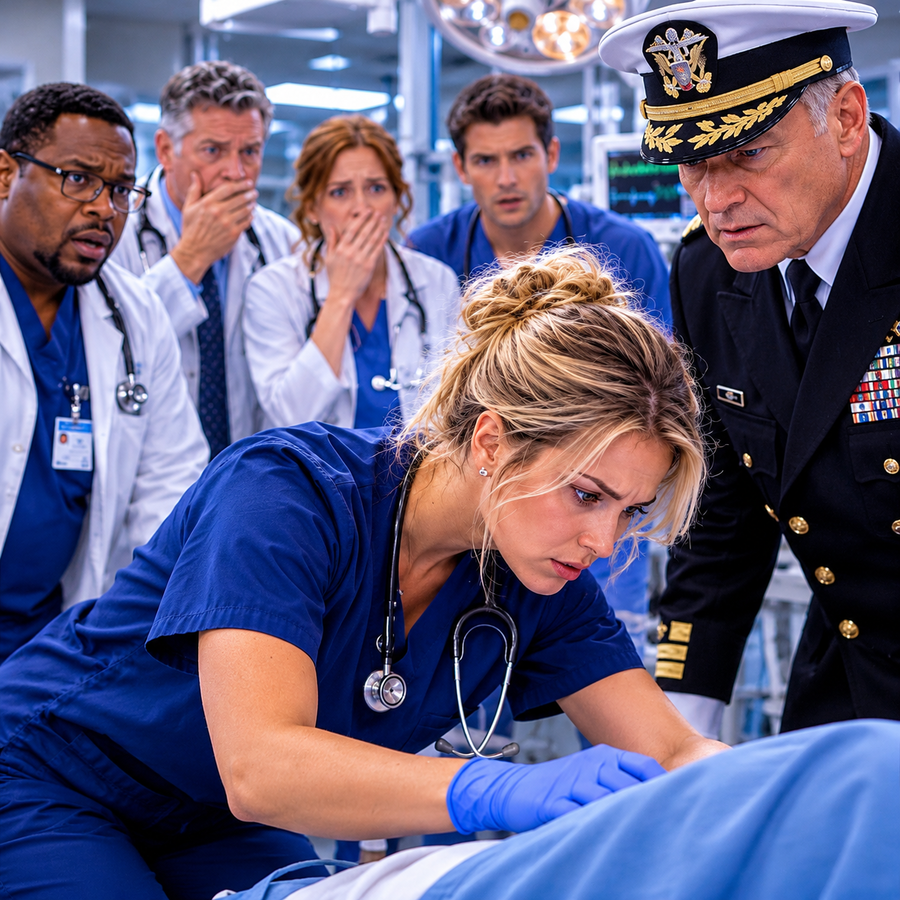
The emergency department was unusually quiet that night, not empty. Never empty.
Hospitals were never truly empty. There were still monitors beeping behind closed doors, nurses moving quickly through fluorescent hallways, the distant sound of wheels rolling across polished floors, and the occasional overhead announcement that made everyone stop for half a second before continuing with whatever crisis was already in front of them.
But compared with most nights, the trauma unit was calm until the helicopter arrived. The sound of the blades could be heard through the reinforced windows long before the landing team reached the emergency entrance.
Nurse Maya Collins looked up from the medication cart.
She had been working the night shift for almost four years, and she knew exactly what that sound meant.
Someone was coming in fast, someone important.
Someone who had probably run out of time somewhere else. Maya pushed the cart aside and headed toward trauma room three.
She was halfway down the corridor when the doors opened. Two paramedics rushed inside with a small stretcher between them, and it was a little girl.
She couldn’t have been more than seven years old.
Her face was pale.
A soft cervical collar surrounded her neck, and a faded pink stuffed elephant was tucked beneath one arm. Seven-year-old female, one of the paramedics announced.
High-speed vehicle collision, passenger side impact, brief loss of consciousness at the scene.
Initial vitals were stable. Maya moved closer.
Any vomiting? No.
Seizure activity? None witnessed.
Unequal pupils?
Not at the scene.
Maya nodded and looked at the monitor.
Heart rate, 104.
Blood pressure, 108 over 72.
Oxygen saturation, 98%.
Nothing immediately catastrophic, but Maya had learned something during the years she spent working emergency medicine. Numbers could lie, bodies rarely did.
She looked at the girl’s face.
The child was unconscious, but not deeply. Her breathing was regular, almost too regular.
Something about her bothered Maya.
Before she could investigate, another set of footsteps entered the room. A tall man in a dark uniform appeared behind the physicians, Rear Admiral Thomas Reid.
He was the girl’s grandfather.
His face was hard, controlled, and completely terrified that he moved directly toward the stretcher.
girl’s name seemed to break something inside him that he reached for her hand that a physician stepped forward.
Sir, please give us some room. Reid ignored him.
Is she going to be okay? We are still evaluating her.
Then evaluate her.
His voice wasn’t loud.
IT didn’t need to be.
Everyone in the room knew who he was. Eight medical professionals were now surrounding the bed, a pediatric emergency physician, a neurosurgeon, two trauma surgeons, three nurses, a respiratory therapist, and Meyer.
The neurosurgeon, Dr.Adrian Keller, stepped toward the monitor.
He was considered one of the best pediatric specialists in the region. He reviewed the paramedic report, looked briefly at the girl, and then checked her pupils.
Probably a concussion, he said. Meyer looked at him.
Doctor, can I check her ears? Keller barely looked up.
Why?
I noticed some fluid near the left ear.
It’s probably from the accident.
Maybe.
He finally looked at her. Meyer, we are handling it.
She nodded, but she didn’t move away.
There was something she wanted to say, something she had learned not from textbooks, but from years of situations where there was no time for a textbook. Please, she said.
Just 30 seconds. Keller frowned.
She’s already been examined.
I understand. Then step back.
Meyer glanced at the child’s grandfather.
Admiral Reid was staring at her now.
He looked like a man trying to decide whether to trust someone he had never met.
Then he said something that surprised everyone. Let her check.
Keller sighed.
Fine.
Meyer put on a fresh pair of gloves.
She gently stabilized him his head and leaned toward the left ear.
The room was filled with noise, monitor alarms, footsteps, quiet conversations, the hiss of oxygen, but Meyer’s attention narrowed to one tiny detail.
There was dot a clear, almost watery discharge, not blood, not ordinary ear fluid.
She moved the light slightly.
Then she saw the discoloration behind the ear dot a faint bluish-purple mark dot a T was easy to miss, especially beneath the child’s hair.
Maya froze.
She had seen that pattern before, years earlier, far from this hospital, far from this quiet city dot a in the middle of freezing ocean water. Doctor.
Keller looked over.
What? I need you to examine the area behind her left ear.
He walked closer. Maya pointed.
There’s bruising here.
I see it. And fluid coming from the ear.
Keller’s expression changed slightly.
It could be trauma-related.
It is trauma-related.
What are you suggesting?
Maya looked directly at him.
A basilar skull fracture. Silence.
Keller stared at her. The other physician stopped talking.
Admiral Reed looked between them dot Keller’s voice became colder.
Are you diagnosing my patient? No.
Because it sounds like you are.
I’m telling you what I found.
And what exactly makes you think you understand this better than the trauma team? Maya took a breath.
Because the bruising is behind the ear, not around the scalp injury, and because the fluid is clear.
Keller didn’t answer.
Maya continued.
If there’s a fracture at the base of the skull, that could be cerebrospinal fluid.
One of the other physicians stepped closer.
She’s right about the pattern.
Keller looked at him.
Don’t start.
Maya turned back toward the monitor, and then she saw something else dot Emma’s heart rate had changed point 104, then 98, then 91 dot Maya watched.
The number kept dropping.
She looked at the girl’s chest.
The breathing pattern had changed too dot a little shallower, then a pause point two breaths, another pause. Maya felt something cold move through her stomach.
She had seen this before, not in a hospital dot a in the field dot a in places where there were no MRI machines dot a in no surgical teams dot a in no clean operating rooms. Only seconds she looked at Keller.
Doctor, her respiratory pattern is changing.
She’s sedated.
She’s not sedated.
Keller glanced at the monitor. Her vitals are acceptable.
They were.
Maya pointed. Look at her blood pressure.
The reading had begun to climb 112 over 76 then 126 over 82 then 141 over 88. Keller stepped closer.
Maya watched Emma’s breathing irregular slow then fast.
The combination made her heart pound, increased blood pressure, changing pulse abnormal breathing a warning pattern.
Something was happening inside the girl’s skull.
Her intracranial pressure is rising, Maya said.
Keller looked at her.
You can’t know that from this.
We need imaging.
We already have imaging scheduled.
When?
After the trauma evaluation. How long?
Keller hesitated.
10 minutes.
Maya looked at the child. 10 minutes could be an eternity.
She doesn’t have 10 minutes.
Keller’s expression hardened.
Maya, step away from the bed.
She didn’t.
Doctor, she is deteriorating. You are a registered nurse.
Yes.
You do not order emergency imaging.
No.
She looked at Emma’s eyes.
But I can recognize a patient who is dying.
The room went silent.
Keller’s face turned red.
You are out of line.
Maya didn’t answer.
She checked the pupils again.
Her heart stopped for half a second. The left pupil was slightly larger and slower to react.
Her left pupil is changing. Keller moved immediately.
He checked it himself.
His expression changed.
Turn up the light.
The respiratory therapist adjusted the lamp. Keller checked again.
The difference was unmistakable now.
The left pupil was dilating.
Maya looked at the grandfather. Sir, we need to move.
Keller snapped.
No.
Maya looked at him. Doctor.
No. He stepped between her and the bed.
You don’t make this call.
Admiral Reed finally spoke.
Doctor.
Keller turned.
Sir. What is she telling you?
Keller didn’t answer immediately.
Reed pointed toward his granddaughter. Look at her.
Everyone did.
The little girl was breathing differently. Her blood pressure continued rising.
Her heart rate was slowing. Her pupil was changing.
Reed looked at Maya.
You believe she’s in danger?
Yes.
How much time?
Maya swallowed.
I don’t know.
That answer frightened him more than anything else. Then do something.
Keller hesitated.
Maya moved.
Raise the head of the bed.
The nearest nurse obeyed. Prepare oxygen.
The respiratory therapist moved immediately. Call CT.
Keller opened his mouth, but before he could object, Admiral Reed spoke.
Do it.
The charge nurse grabbed the phone. Portable CT to trauma three.
Pediatric emergency.
Possible intracranial bleed.
Keller looked furious. You are allowing a nurse to take control of my trauma room.
Reed’s eyes hardened.
I’m allowing someone to try to save my granddaughter.
Maya never looked away from Emma. She adjusted the oxygen.
Keep her head midline. Yes.
Don’t flex her neck.
The nurse nodded. Vitals.
Blood pressure 154 over 94.
Maya’s stomach tightened.
Heart rate. 76.
Too low. Keller finally understood.
Possible herniation. Maya looked at him.
That’s what I’ve been saying.
For the first time that night, DR.Keller stopped fighting her.
Get the CT here now. The room exploded into motion.
The portable scanner was brought through the doors. The team moved Emma carefully.
Maya stayed beside her.
The stuffed elephant remained beneath the child’s arm.
Its pink fabric was stained with dirt from the crash.
Maya kept one hand near Emma’s shoulder.
Stay with us, sweetheart.
The little girl didn’t respond, but Maya kept talking.
You’re not alone.
The scanner was positioned.
Everyone stepped back.
The images appeared. T first, nothing seemed obvious.
Then the radiologist leaned toward the screen. Wait.
Keller stepped closer.
The image sharpened. A dark collection appeared inside the skull.
DR.Keller’s face went pale.
Epidural hematoma.
Maya closed her eyes for half a second. She had been right.
The bleeding was compressing the brain.
Keller looked at the surgical team.
Operating room. Someone ran for the phone.
How fast? Now.
Emma was moved toward surgery.
Maya stayed beside the bed until the last possible second. As they passed through the doors, Admiral Reed caught her arm.
Will she survive? Maya looked at him.
I don’t know.
He stared at her. She continued.
But they’re operating now.
He nodded.
Then the doors closed.
Maya stood in the hallway. Her hands were shaking.
Only now. Only after the danger had moved beyond her control, she looked down.
Her gloves were still on. She slowly removed them.
Behind her, DR.Keller appeared.
He was no longer angry.
He looked exhausted.
You recognized it before I did. Maya said nothing.
Why? She looked toward the operating room.
Experience.
That’s not an answer.
It is. Keller shook his head.
You knew exactly what you were looking for. Maya looked at him.
I knew what looked like. Where did you learn that?
She hesitated before she could answer.
A woman in a grey suit approached the hospital’s clinical operations director, Ms.Collins.
Maya knew immediately that this wasn’t going to be good.
Yes. We need to discuss what happened now.
Yes.
Maya glanced toward the operating room.
My patient is in surgery and you’re involved in a scope of practice concern.
Maya stared at her. I reported a clinical finding.
You gave instructions because the patient was deteriorating.
You challenged an attending physician because I believed the child was dying. The woman tightened her lips.
That’s not how hospital hierarchy works.
Maya almost laughed.
Almost instead, she said quietly, maybe that’s the problem.
The woman looked stunned. You will be asked to provide a written statement.
I will.
And until this is reviewed, you should avoid discussing the case.
Maya nodded. Then Admiral Reid stepped into the hallway he had heard everything.
Excuse me. The woman turned.
Admiral. I want the entire trauma record.
Of course.
I want the names of everyone who was in that room. Sir, I understand your concern.
No.
His voice was calm.
You don’t.
He looked directly at her. My granddaughter came into this hospital alive.
He pointed toward the operating room.
She’s alive because that nurse refused to ignore what she saw.
The woman remained silent.
Reid continued.
If anyone tries to punish her for that, they will have to explain it to me.
Maya looked at him.
Sir, you don’t need to do this.
He turned toward her.
Yes, I do.
Why? He paused.
Because I know what looks like when people stay silent because they are afraid of authority.
Maya said nothing. Reed looked at her badge.
Maya Collins. Yes.
Who taught you to recognize that injury? She hesitated, then finally answered.
The Coast Guard. His expression changed.
Coast Guard.
Maya nodded.
Eight years.
What was your specialty?
She looked down the empty hallway. Search and rescue.
Reed stared at her.
Rescue swimmer.
Maya nodded once. That word changed everything.
Reed had spent decades around military personnel.
He knew what that training meant. You were an aviation survival technician.
Yes. You jumped into open water.
Many times.
In storms.
Sometimes. Night rescues.
Most of them.
Reed looked at her hands.
You’ve seen people with head injuries in the field.
Yes. Without a CT scanner.
Without almost anything. He looked toward the operating room.
Why did you leave?
Maya’s face became distant.
My shoulder.
What happened?
Training accident.
She didn’t elaborate.
Reed waited. After a few seconds, she continued.
I couldn’t perform the hoist work anymore.
So you left?
I had to.
And became a nurse. I wanted to keep helping people.
Reed nodded slowly. But you hid that part of yourself.
Maya looked at him.
I didn’t hide it.
You didn’t tell anyone.
There’s a difference.
Reed smiled faintly.
Not in hospitals.
Maya almost smiled back.
Then the operating room doors opened.
Dr.Keller walked out. Everyone turned.
He removed his surgical cap. The procedure went well.
Admiral Reed took a step forward.
She’s alive.
Yes.
She’s stable.
Yes.
Keller smiled. We evacuated the hematoma before the pressure caused permanent damage.
Reid closed his eyes. For the first time all night, his shoulders dropped.
Is she going to wake up?
That’s what we are hoping.
Maya stood quietly. Keller looked at her, then walked over.
You saved her. Maya shook her head.
The surgical team saved her.
You gave us the time.
He extended his hand. Maya looked at it for a moment before taking it.
I’m sorry.
She raised an eyebrow.
For what? For not listening.
Maya nodded. Thank you.
Keller looked almost embarrassed.
I’ve been doing this for 20 years.
I know.
And I nearly missed it. You corrected it.
He nodded. Because you spoke up.
That night, Maya went home after sunrise.
She barely slept 0. 3 days later.
She returned to the hospital.
She wasn’t scheduled to see Emma, but when she walked past the pediatric floor, she heard a familiar voice.
Excuse me.
Maya stopped.
She turned.
Emma was sitting in a hospital bed. The pink stuffed elephant was beside her daughter.
Bandage covered part of her head. Her grandfather sat next to the window.
When he saw Maya, he stood.
Come in. Maya smiled.
How are you feeling?
Emma lifted a juice box. Better.
Good.
My grandpa says you saved me. Maya looked at Reid.
Your grandpa tells very dramatic stories.
I’m not dramatic, Reid said.
Emma giggled.
Maya smiled.
Then Emma reached toward the stuffed elephant.
He was with me. Maya looked at it.
I see. He helped me.
I’m sure he did.
Emma looked serious.
What’s your name Maya.
Maya. Yes.
Thank you for finding my head.
Maya laughed softly. I think the doctors found your head.
Emma shook her head. No.
You did.
Maya looked away for a moment. Those simple words hit harder than she expected.
Reed walked toward her. I have something for you.
He handed her an envelope.
Maya opened it. Inside was a letter that IT came from the hospital board.
They wanted to create a new emergency recognition program for nurses and support staff. The program would teach rapid trauma assessment, field recognition, and early warning signs that could be missed during chaotic emergencies, and they wanted Maya to lead it.
She looked up.
I can’t do this.
Reed smiled. Why?
I’m not a professor.
You don’t need to be.
I’m just a nurse.
Reed shook his head.
That’s what you said the night you saved her.
Maya looked at the letter again.
You know what I think. What?
I think the hospital doesn’t need another program.
Reed waited.
It needs people who are willing to speak when something doesn’t look right.
He nodded. Then teach them that.
Maya looked at Emma. The little girl was drawing something with a box of crayons.
What are you drawing? A person.
Who? Emma held up the paper.
IT was a picture of a woman standing beside a helicopter.
There was a little girl in the water, and the woman was reaching for her. Maya stared at the drawing.
She hadn’t told Emma about the helicopter.
She hadn’t told her about the ocean.
She hadn’t told anyone in the hospital about the year she spent jumping from aircraft into darkness.
For three years, she had convinced herself that part of her life was over. She had buried the uniform, the rescues, the fear, the discipline, the memories.
She thought becoming a quiet night shift nurse meant leaving that woman behind. But standing in that hospital room, Maya finally understood something.
She hadn’t stopped being a rescuer.
She had simply changed the place where she rescued people. The ocean had a hospital.
The waves had become alarms.
The rescue basket had become a hospital bed, and the person who needed her was no longer somewhere beneath a helicopter in freezing water. She was a seven-year-old girl holding a stuffed elephant.
Maya folded the letter.
I’ll do it.
Read smiled. Good.
But I have one condition.
What?
No one gets ignored because of their job title.
Read extended his hand. Agreed.
Maya shook it.
And for the first time in years, she didn’t feel like she had to hide who she used to be.
She understood that experience didn’t become less valuable simply because nobody could see it printed on a badge.
Sometimes the person who notices the most important detail isn’t the person standing at the head of the table.
Sometimes it’s the nurse in the corner.
The paramedic everyone forgot to ask.
The technician who noticed something strange. The quiet person who has seen the impossible before.
And sometimes when everyone else is convinced that everything is fine, that person is the only one standing between a patient and tragedy.
Maya Collins had learned that lesson in the middle of the ocean. She learned it again in trauma room three dot.
And from that night forward, whenever a young nurse questioned whether her voice mattered, Maya told them the same thing.
Your title doesn’t determine how valuable your observation is.
Your experience doesn’t disappear because someone outranks you.
And when a patient’s life is changing in front of you, don’t be afraid to speak.
Because sometimes 30 seconds is all you get.
Sometimes one observation is all that separates a warning from a catastrophe. And sometimes the quietest person in the room is the one who sees the truth first.
Maya had spent years believing her greatest rescues were behind her. She was wrong.
Her greatest rescue wasn’t behind her.
It was simply waiting for the night when someone needed her to notice what everyone else had missed.
And that night, she did.