I Left My Porch Light On for My Neighbor’s Late Shifts. Tonight, She Came Inside Instead
I Left My Porch Light On for My Neighbor’s Late Shifts. Tonight, She Came Inside Instead
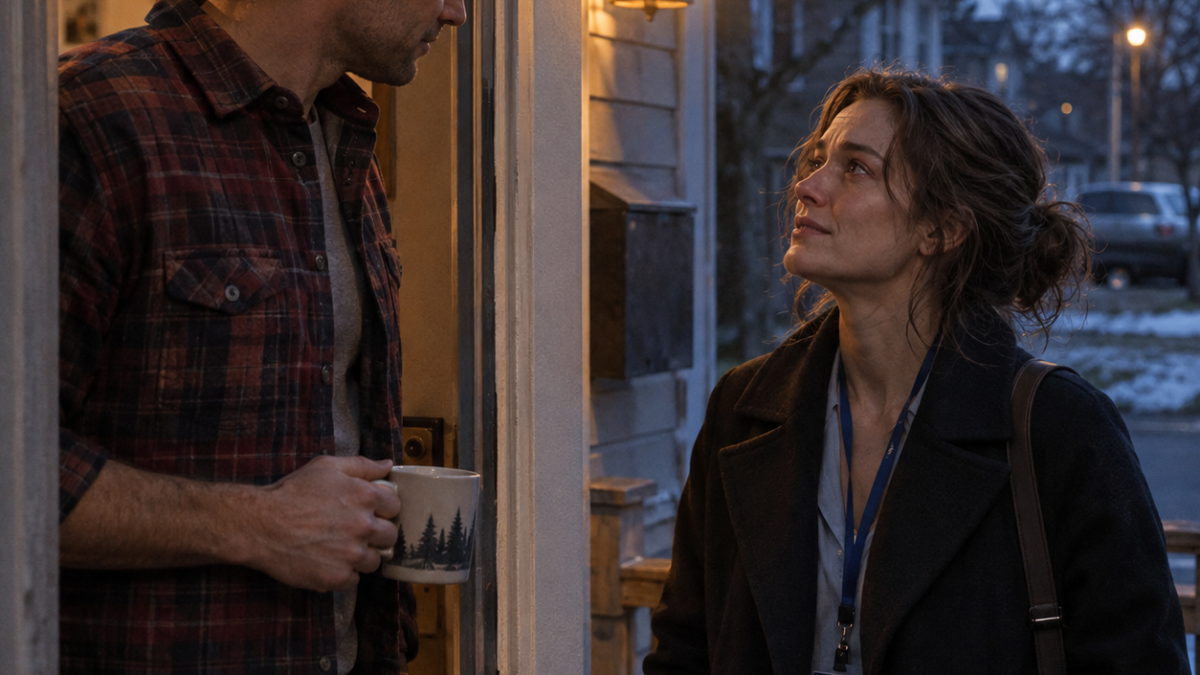
The doorbell rang at ten to five on a Tuesday morning, and I knew who it was before I got up from the couch because only one person on our block walked home at that hour. I had been awake for a while, drinking coffee in the front room with the lamp off, a habit I would have denied if anyone had asked. Through the window, I had watched Cecilia Romano come down the sidewalk from the bus stop, slower than usual, with her work lanyard still around her neck.
She reached her own walkway two doors down and stood there a long moment with her keys in her hand. Then she kept walking until she turned up my steps and into the glow of the porch light. My name is Warren Halberg; I fix cars for a living, and in nearly a year of waving to her across a strip of grass, I had never once heard her ring my bell.
I had the door open before she could decide to ring it again. She looked like someone who had been holding herself upright for 16 hours on nothing but habit. Cecilia ran the overnight desk at a downtown hotel, and she usually came home with a tired sort of humor—some story about a guest who tried to check in with a live lobster—yet that morning her eyes were red at the edges, and she didn’t have a story.
– I know this is a strange time to knock, she said, her voice coming out thinner than I had ever heard it. Gus died last night, right before my shift. I went to work anyway because nobody could cover, and now I’m standing in front of my house and I can’t make myself open the door.
I told her I was sorry and I meant it, because I had met that gray-muzzled old beagle mix over the fence a dozen times and he had never once failed to inspect my boots. I said there was coffee made, a couch, and no opinions about either one, adding that if she only wanted to stand on the porch for a minute, that was fine, too—and she said that coming in had sort of been the idea.
She stepped past me into a house she had never seen beyond the doorway, taking in the plain front room with its worn rug, the couch I had covered with a clean blanket on instinct, and an old armchair by the window with a spring I kept promising to fix. I had expected her to take the couch since I had basically set it up for her without admitting it, yet she walked right past it and settled into the broken armchair, which I apologized for—and she said it was perfect because it had the best view of the street, making me realize after a while that from that chair she could see her own front door.
I brought her coffee and sat on the far end of the couch, leaving the cushions between us without asking a single question. When the silence got long, I told her about the Buick that had come into the shop Monday with a full bird’s nest in the air filter, and she let out something close to a laugh.
She talked about Gus after that in small pieces that came whenever she was ready: he was 14 and nearly deaf, yet he had always known when she was coming up the walk and had waited at the front window every morning at 7:30 for years. This morning she had stood on her own steps knowing nobody was at that window, saying the worst part was how ordinary the house looked from the outside—the porch swept and the mail slot closed as if nothing inside had changed.
I did not tell her he had lived a long life or that it was for the best, figuring she had heard those lines all night already; I just said Gus had a very good routine and that I had always respected it. She looked at me over the rim of her mug for a second, nodded, and kept drinking her coffee.
Sometime after 5:30, she held the mug in both hands and asked without looking up whether the porch light was for her. I could have told her it was on a timer or that I kept forgetting to shut it off and she probably would have let me; instead, I said yes, explaining that I had started leaving it on in March after watching her walk home alone in the dark, and that I had never meant it to be anything she had to answer.
– You don’t owe me a conversation, I said, or a thank-you, or a visit, and you’re free to walk under it every morning for a year and never look up.
Cecilia nodded slowly and said she had figured it was for her, admitting she had spent most of the summer not asking in case the answer turned out to be that I did it for everybody.
– I’m not that generous with electricity, I told her.
She smiled at the carpet—a real one this time, small and tired—and the room felt different after that, as if the light on my porch had finally been given its proper name. By a quarter to six, the window had gone from black to a thin gray, and a delivery truck was working its way down the block.
Cecilia set her mug on the arm of the chair and sat very still for a moment, the way people do when testing whether they can stand up, before getting to her feet, carrying the mug to my kitchen sink, and rinsing it before I could tell her not to bother. She said she thought she could open her door now, and understanding she was telling me rather than asking, I didn’t offer to walk her over or suggest she sleep on the couch—only saying the light would be on tomorrow like it always was.
– I know, she said, pausing at the door with one hand on the frame to tell me I had gotten to the door awfully fast.
I admitted I had been awake, and she said, “Of course you had been.” I watched from the doorway as she walked the length of the sidewalk, climbed her own steps, and stood there for a long breath with the key in the lock; when the door finally opened and closed behind her, a lamp came on in her front window, and I let out a breath I had been holding for an hour.
My house felt larger afterward, and the armchair was still warm—no longer a hypothetical place she might one day visit, because she had sat in it and washed her cup in my sink. The next time we crossed paths, there would be no terrible night to explain it, and I had no idea whether she would want to walk up my steps anyway.
The porch light went on that night the way it always did, and I spent the next morning making sure it meant nothing more than that. Before Cecilia’s visit, I had sat in the front room with the lamp off watching the sidewalk like a man pretending he wasn’t; now I carried my coffee into the kitchen at the back of the house where the window faces the yard and the radio talks about weather, reasoning that a light somebody keeps checking on turns into a question she had never agreed to answer.
The same thing happened Thursday, and I went to the shop both mornings without knowing whether she had used it—an odd kind of discipline, leaving a door open and walking away from it, that I was not as good at as I would have liked. I finally ran into her on Thursday evening while dragging my trash bins to the curb, finding Cecilia at the end of her walkway in a gray sweatshirt going through mail with her hair still flat on one side from sleeping.
I asked how she was doing plainly, the way I would ask whether a car was running better.
– Terrible, she said. But I slept 11 hours and ate a whole sandwich, so the hotel industry is lucky I’m not on duty.
I said I would take the sandwich as good news and would not ask any follow-up questions unless she wanted me to, which she called the most restful thing anybody had said to her all week. For a moment she was her old self—quick, dry, and a half step ahead of me—even telling me about a guest on Tuesday who had asked the front desk to hold his emotional support goose while he used the pool.
Then she turned over the last envelope in her hand and stopped talking: it was a coupon flyer from the pet supply store on Center Street addressed to Gus Romano offering a discount on senior dog food. She read it twice as the humor drained from her face as slowly as water from a sink, and rather than handing her something tidy that wouldn’t fit, I waited a moment before speaking.
– Gus would have been insulted by the word “senior,” I said, and he would have wanted the steak flavor regardless.
She laughed once—a short, surprised sound—wiped under one eye with her wrist, and folded the flyer in half to put in her back pocket instead of throwing it away. Fighting my bad habit of handing over a whole list of ready-made decisions about her life—bringing dinner, finding puppies, stopping by Saturday—I put the list down and told her what I actually wanted instead.
I said I was off Sunday afternoon and would like to sit and talk sometime when nothing was wrong and nobody was tired, adding she was free to say no with no reason attached and the light would stay on either way. Cecilia studied me with her head tilted a few degrees.
– Is that an invitation? she asked. Or are you going to show up with a casserole?
– It’s an invitation, I told her. A casserole would be a separate decision we could make together.
She said she would think about it without telling me when she would be done, and I went back inside and stood in my kitchen aware I had said far less than I meant without regretting any of it. Friday and Saturday morning I kept the same arrangement—the light on, coffee in the back room, eyes on the radio—passing Gus’s dark window at 7:30 on my way to the shop and occasionally catching myself glancing toward the hotel as if the building might tell me something.
On Saturday afternoon there was a knock at my front door, and I opened it to find Cecilia standing on the mat in jeans and sunglasses with her hands in her sweatshirt pockets, sunlight all over the porch and the bulb above her pale and unused in the glare. She did not step over the threshold, and I did not step aside to make room for her.
– I’m not coming in, she said, as though she had practiced it on the walk over. I just wanted to say yes standing up in daylight without having been awake for 20 hours.
I told her Sunday suited me, and she picked 2:00 because she wanted to sleep late and still have time to be a person; when I offered to fix the armchair spring or put a warning sign on it, she told me to leave it alone since it belonged to the chair’s character. She went back down my steps on her own legs and her own schedule, leaving me with the sudden realization that I had never hosted Cecilia when nothing was wrong—and would find out in plain daylight at 2:00 tomorrow how we talked without a terrible night holding us up.
At 2:00 exactly on Sunday, Cecilia knocked wearing a green cardigan and holding a white bakery box with both hands, rested with color in her face and her hair pulled back as she walked across my threshold like she had been doing it for years.
– Lemon bars, she said, holding the box up. Not a casserole, so you can relax.
Having spent the morning deliberately arranging nothing, I asked whether she wanted coffee in the front room or something cold in the kitchen so she could choose the spot herself. She chose the kitchen to test a theory that I had moved, standing in the back doorway looking at the table, radio, and yard window before admitting she had walked under my porch light at ten to five on Wednesday to find my front window dark and hadn’t known whether to feel relieved or insulted.
– So you were hiding from me out of respect, she said when I admitted moving my coffee so I wouldn’t watch the sidewalk.
– More like hiding from myself, I said, and she nodded as though that were perfectly reasonable.
Heading into the front room, she stopped at the armchair where I had taped an index card in my best shop handwriting: “Reserved for C. Romano. The spring is part of the character.” She laughed hard enough to set the box on the rug, bounced twice on the spring to verify its character, and carried the lemon bars into the kitchen while scolding me for owning plates so plain.
We sat at the kitchen table with the radio low and the back door open to the yard, discovering that without anyone rushing off to work, our jokes finally had room to finish—from her 3:00 a.m. caller asking whether the hotel pillows were emotionally supportive to my customer who spoke encouragingly to his transmission until it lasted another 11,000 miles. I noticed she looked straight at me when finishing her sentences rather than past me across a front lawn, and at one point she realized she had been talking about Gus unprompted, pausing mid-bite to explain how her body still woke up at 7:15 listening for his nails on the hardwood before she got up to eat toast on the back step.
Rather than offering platitudes, I asked what kind of bread, and when she smiled and said sourdough—because Gus had always gotten the crust—I let the sentence stay hers. From there, conversation drifted into our lives beyond that week: she had taken the overnight desk for the pay while saving up and was starting to want normal mornings, while my boss Dale had hinted at selling me a share of the shop.
– That’s a coward’s answer, she said with flat certainty when I claimed I’d keep the name Dale’s Auto, insisting I would call it Halberg’s—making my neck go warm as I realized being glad to host her no longer fit inside a box marked “neighborly.”
Around five, glancing at the stove clock in genuine surprise at how long she had stayed, she mentioned she hadn’t eaten lunch and ought to go in the tone of someone leaving room to be contradicted. Refusing to decide for her, I told her I had eggs, bread, and cheese for grilled sandwiches if she wanted to stay, or she could head home while the afternoon was still good—and she agreed to stay on condition she got to supervise the pan, standing at my elbow to adjust my heat settings twice because she was right both times.
We ate on the back step in the last of the sun with her sitting one stair above me close enough to smell lemon on her fingers, and she left at a quarter to seven while the porch was still bright and the bulb above the door was off.
– This wasn’t a date, she said at the door, wanting it on the record.
– Noted, I said. I won’t file it under anything.
– But I’d like another one—of whatever this was.
I told her I was off again next Sunday, and she walked across the grass lifting a hand without turning around, leaving the empty lemon-bar box on my counter like proof she had come and stayed because I had asked instead of arranged.
She came back the next Sunday for two hours on the back step with a ball game neither of us followed on the radio, sharing that the hotel had finally given her two consecutive nights off. By the week after, she was stopping at the bottom of my porch steps on her way home from the bus for five or twenty minutes at a time—and without admitting it, I began timing my coffee pot to finish just before ten to five and moved my armchair back to the front window, mistaking small hospitalities for adjustments rather than unapproved decisions about her mornings.
By the third week, knowing which stair she leaned against and which jokes she pretended not to like, I heard her heels on a gray Thursday morning and made a mistake: I poured two mugs, carried them onto the porch in my socks, and stood waiting. Cecilia came up the walk with her lanyard in one hand and her coat over her arm, stopping at the foot of the stairs without reaching for either mug.
– I was going to go straight home, she said.
When I said that was fine, she shook her head—not sharply, just enough to show I had missed it—explaining she had spent the whole bus ride thinking about her own couch, her own blanket, and a quiet house she was slowly learning to stand in, only to look up and see me holding coffee like a man at a stage door.
– You didn’t even ask, she said. You just came out here ready, and now if I walk past, I’m walking past you.
Closing my mouth on an excuse about the mug being optional, I realized I had dressed up an assumption as hospitality.
– You’re right, I said. I made that decision for you.
I offered no defense about being awake or enjoying her visits, and seeing I wasn’t retreating into wounded pride, some of the stiffness left her shoulders.
– I’m not sorry I came in that night, she said more quietly, or on Sunday, or any of it. I just want to be the one who picks the day.
I told her that was easy to respect and that the porch steps were hers whenever she wanted them, and after a dry glance at the mugs she remarked my coffee was going to get cold before walking on to her front door. I poured one cup down the sink like a small funeral, drank the other at the counter, and kept sitting in my front armchair afterward without retreating to the back kitchen—letting the street do whatever it wanted because if she walked past without looking, that made me a neighbor on her block rather than a rejected man.
The next few mornings tested me quietly: on Friday she passed with headphones on and lifted two fingers off her bag, on Monday she paused at the steps to tell me about a caller asking if the hotel ice machine was plumbed to the ocean before we both went our ways without lingering, and on Wednesday when she walked past gray-eyed with exhaustion I swallowed my full list of helpful offers, said simply “Rough one,” and went inside for my keys—realizing as I watched her unlock her door under my pale daytime porch light that treating her as someone who needed nothing from me felt like standing on level ground.
What kept me up Saturday night was wondering whether she would ever choose me on an ordinary day with no grief to carry and no kindness to answer. That week she settled back into ordinary rhythms—carrying a full bag of dog food down her steps on Monday, coming home laughing on the phone with her sister on Tuesday, and leaving her front curtain closed at 7:30 on Wednesday—while I stayed out of both her good days and her bad ones.
On Thursday afternoon, while I was washing my truck in the driveway in an old shirt, her screen door slapped shut and Cecilia came out in jeans and a faded sweatshirt to water the geraniums on her porch rail. Instead of going back inside, she walked across the grass to the low fence between our yards, set the empty watering can on the post, and told me I had been very quiet lately.
– You did, though, she said when I told her I had taken her at her word. You really did.
She admitted she had spent a week waiting for the other shoe—either another pair of mugs on the porch or a wounded silence she’d have to apologize out of—rather than an ordinary wave from the window and a simple “All right” when she was tired. I told her doing it on purpose had been harder than fixing a head gasket, and she laughed and leaned her forearms on the fence, keeping us talking for 40 minutes about the pet store finally removing her from its mailing list, the shelter taking the unopened dog food, and her sister’s upcoming March visit for a full hotel tour including the ocean-plumbed ice machine.
Recognizing how easily I could let the pleasant afternoon slide past without saying what mattered, I turned off the hose so the water wouldn’t fill the silence for me.
– I’d like to spend more time with you, I said, wanting to be clear because that first night was so bad it can make everything after look like something else. It’s not because I think you need looking after. I like your company, and I’d like it on days when nothing’s wrong.
I added that she didn’t have to answer on a fence and that if she said no, the light would stay on and I would wave from the window just the same. Studying the geranium and then the toe of her sneaker, she made up her mind.
– Knock on my door Saturday, she said. Not the porch—the door. Three o’clock in the afternoon, in the daylight. I’ll be home because I want to be home.
When I offered to bring whatever she wanted, she said she wanted nothing—calling it a challenge to my instincts—and admitted honestly she didn’t know yet what it meant when I crossed her threshold, only that after four months under my light and one terrible night in my house she wanted to see what it looked like the other way around. She walked back across the grass, raised her watering can an inch at the top of her steps like a toast, and went inside.
On Saturday at two minutes to three, I crossed the grass empty-handed—having put a bag of bakery cookies back in my cupboard and left my keys on the hook so I wouldn’t be tempted to fix a hinge or a rail. Walking up her swept steps past blooming geraniums, I knocked three times at a regular volume, and Cecilia opened the door in jeans and bare feet with her hair down, checking my empty hands before meeting my eyes.
– On time and carrying nothing, she said. I’m impressed and slightly suspicious.
Stepping inside the house I had watched across the grass for nearly a year, I saw a blue leash hanging on a hook by the door and a steel bowl with a dry ring on the kitchen floor.
– I haven’t moved them, she said evenly as she watched me notice both. I’m not ready to, and I’m also not going to hide them just because you’re here.
I told her I wouldn’t have wanted her to, and then noticed the spot she had made for me: a mismatched mug with a chipped rim on the end table beside the couch, wearing an index card taped to the handle in neat desk-clerk printing—”Reserved for W. Halberg. The chip is part of the character.”
My neck went warm for the second time in three weeks as she poured strong black coffee she’d guessed I drank from my truck, and I noticed the curtain at Gus’s front window pulled all the way back so the house would stop looking like it was holding its breath. Sitting on her couch with a cushion between us, we traded dry remarks about the ice-machine caller until I set my mug down and skipped every speech I had rehearsed all week.
– Cecilia, I said, I’d like to take you on a date—a real one with an evening and a reservation where I knock on this door and you decide whether to come out of it. It’s not about Gus and it’s not about the light.
She turned her whole body toward me on the couch.
– You’re asking.
– I’m asking, I said, and you can say no and I’ll drink the rest of the coffee and be a neighbor about it.
Giving the question the respect it deserved, she crossed to the refrigerator and studied the hotel gift-shop calendar stuck under a magnet.
– Friday, she said. It’s my second night off in a row, so I’ll actually be awake. Seven o’clock. I pick the restaurant, you pick the dessert, and if it turns out terrible, we’re only out one evening.
– That sounds like an excellent warranty.
Walking back across the room to where I had risen to my feet, she stopped close enough for me to see a faint line of sunlight in her eyes.
– I decided something on Wednesday, she said quietly, and I’m checking whether it holds up in my own front room.
Resting one hand flat against the front of my shirt to feel how steady I was, she smiled when I said I couldn’t speak for the shirt yet was holding up fine, rose on her toes, and kissed me—unhurried, warm, and entirely her idea. When she pulled back, keeping her hand where it was, she told me honestly that the past month hadn’t fixed everything and that there would still be mornings she wouldn’t answer her door, needing me to know a closed door on one of those days wouldn’t mean no to me.
– I can live with unanswered doors as long as you tell me when you feel like it which kind it was, I said.
– Deal, she said, and we shook on it—neither promising that every visit would have a plan, glad to have afternoons that were nothing at all.
Three weeks later on a Sunday, she rang my doorbell at 2:00—the same bell she had rung that gray morning at ten to five—arriving on a planned day off with a grocery bag holding a lemon and a pound of butter because she had decided I owed her a better grilled sandwich. I opened the door before she could ring twice, and she hung her coat on the hook and settled into the creaking armchair where the softened index card still sat taped to the arm.
That morning she had come home from her last overnight shift, glanced up at my porch light, lifted two fingers toward it, and gone straight into her own house to sleep. The light was still burning when I left for the shop, doing the same ordinary job it had always done, now just one of the ways we had of finding each other—because the light only got her as far as my door, and the rest took two people knocking, asking, and answering on days when nothing was wrong.
So tell me in the comments: do you think a love that begins on someone’s hardest night needs a moment in daylight before it becomes a real choice? If you enjoyed this story, please like and subscribe, and I will see you in the next one.