I Won a Romantic Weekend for Two—Then My Beautiful CEO Said, “I’ve Already Packed!”
I Won a Romantic Weekend for Two—Then My Beautiful CEO Said, “I’ve Already Packed!”
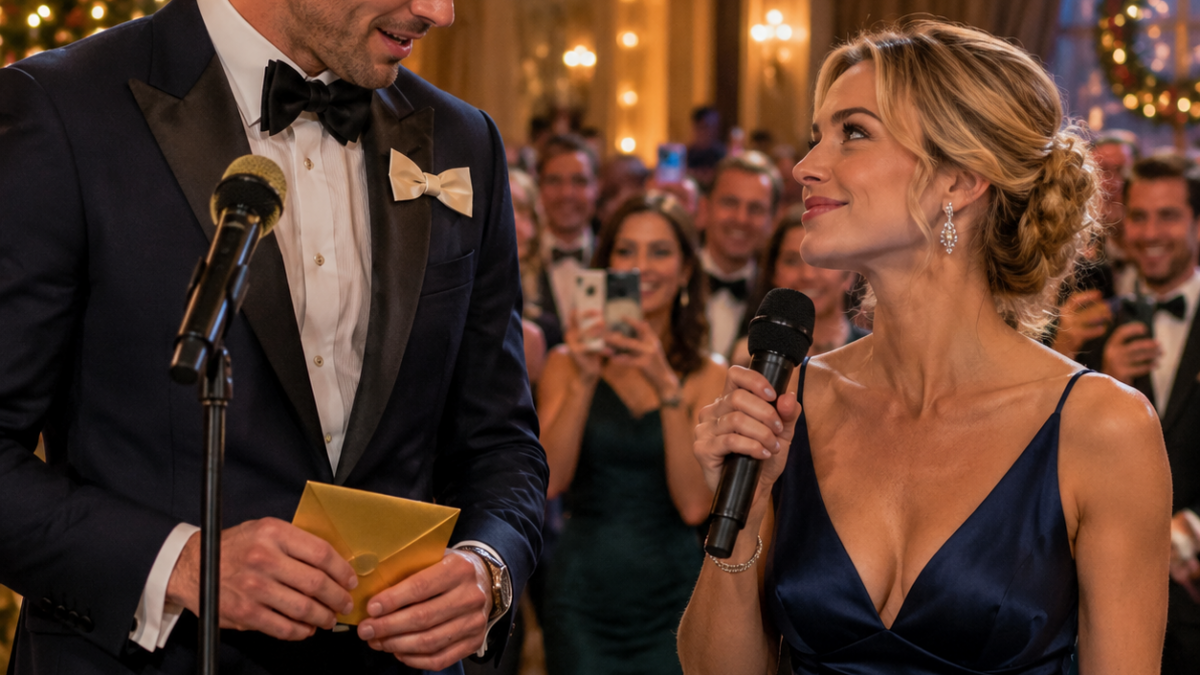
The entire ballroom went quiet when my CEO stepped onto the stage and announced that she had already packed a suitcase for a romantic weekend with me. I was holding a gold envelope, three coworkers were filming, and the woman I’d been secretly in love with for two years was smiling as though she’d just ordered dessert.
– Genevieve, I whispered into the microphone. You know the prize is for two people, right?
– I’m an excellent counter, she said. I’ve packed for one.
Everyone laughed; I couldn’t. Genevieve Laurent was 30, the CEO of the company where I worked, and the one person who could turn my carefully organized life into a spectacular mess—while I was Sebastian Reed, 34, a finance specialist who could spot a bad forecast from 50 feet away yet couldn’t ask a woman to dinner without rehearsing it in the elevator. She’d funded the prize, hadn’t chosen the winner, and now the winner was me.
Before I tell you how a weekend of mistaken honeymoon reservations, terrible dancing, and one kiss beneath fireworks changed everything, tell me this: would you take that trip with your boss? If you love unexpected romances like this story, subscribe and share your answer in the comments.
To understand why I looked as if I’d been handed a live grenade wrapped in a gift certificate, you need to know two things about Alder and Finch. First, we were a Chicago investment and advisory firm with a holiday party budget large enough to make sensible accountants uncomfortable; second, our CEO had a reputation for getting exactly what she wanted, even when what she wanted was a replacement toner cartridge at 11:00 on a Tuesday night. Genevieve had taken over after our founder retired three years earlier, rebuilding a struggling regional firm into a profitable one without ever mistaking a nice office for a successful business—and whenever she spoke in meetings people listened, whereas whenever she walked past my desk I sometimes forgot my own password.
I managed financial forecasting for our infrastructure clients, living around operating margins, risk exposure, and the comforting fact that numbers didn’t normally flirt with you, with three nearly identical blue shirts, lunch in a dented steel container, and the belief that romance happened to other people with better timing. My best friend at work, Tessa Morales, believed my problem was more serious.
– You have an advanced degree in waiting for permission, she’d told me that Friday as we hung paper snowflakes in the conference room. Ask her out.
– She’s my boss.
– She’s everybody’s boss. Not everybody turns the color of a fire alarm when she says good morning.
– I’m concerned about workplace boundaries.
– Wonderful. Be concerned while standing within speaking distance of a single woman.
I’d told Tessa to spend more time on her own expense reports. The party was held in a hotel overlooking the river, and Tessa clipped a paper bow tie onto my suit just before Genevieve arrived in a midnight-blue dress and noticed it.
– An unconventional accessory, Mr. Reed?
– I lost a bet with the holiday committee.
– It suits you.
– The bow tie?
– The fact that you kept your promise.
Then she continued toward the board members, and I spent the next 10 minutes considering whether a man could survive entirely on one compliment. The raffle was the last event of the night—raising money for a local housing charity where everyone attending had one entry regardless of rank or donations, with Tessa making me check the rules because she didn’t trust management with statistics. The grand prize was a two-night stay at the Blue Heron Lodge in Lake Geneva, Wisconsin, featuring lake-view accommodations, dinner, a cooking class, and a winter festival with fireworks.
– Romantic weekend for two, announced our master of ceremonies, Daniel from Human Resources. The winner may bring any consenting adult guest—before Legal calls me, yes, that is the official wording.
He unfolded a slip from the glass bowl.
– Sebastian Reed!
Tessa screamed, someone knocked over a spoon, and I stood up under the strange impression that my legs had been leased to me by a third party. On stage, Daniel handed me the envelope and asked whether I had anyone special in mind.
– No, I said, which was both accurate and the least accurate thing I’d ever said aloud.
– Then this weekend may improve your odds.
From the front table, Genevieve rose without having touched her dessert, moving toward the stairs at the edge of the stage with an expression I knew from negotiations—completely calm, slightly dangerous.
– I’ve already packed, she said into Daniel’s spare microphone.
The room erupted, my face burned, and Daniel blinked hard enough to make me worry about his contact lenses.
– Is that an executive order? I managed.
– No, consider it a very enthusiastic application.
She turned to the room before anyone could mistake her joke for an instruction.
– Sebastian gets the prize. Sebastian chooses his guest. I simply happened to be available.
That small clarification mattered more than the applause, though I didn’t understand that until later. We posed for the raffle photo—Genevieve looking delighted and me holding the envelope at chest height like a protective shield—and she leaned close enough for me to catch the clean, faint scent of her perfume.
– I realize I may have embarrassed you, she said quietly. I didn’t plan that.
– You packed accidentally?
Her eyes sparkled.
– I planned to take a weekend off. I packed last night. The surprise was your name coming out of the bowl.
– You funded this?
– I sponsored the trip, yes. The committee chose the venue, and Daniel handled the draw. There wasn’t a secret plan to make you win, in case your finance brain is already looking for one.
– It was considering an audit.
– I’d expect nothing less, she said, stepping back and lowering her voice. Seriously, Sebastian. Take whomever you want. You can even ask them to remove my photograph from the group chat if it becomes annoying. I’ll help.
– It’s already the group icon.
– That’s horrifying.
– It has a crown emoji.
– I’ve survived worse.
She gave me an easy exit, making the prospect of saying yes far more difficult after two years of telling myself not to confuse her kindness with personal interest while she stood right in front of me looking hopeful without demanding an answer.
– I’ll think about it, I said.
– Good, she replied. I respect careful decisions.
Then she went back to her table, and Tessa appeared beside me a moment later carrying two glasses of sparkling water.
– Well?
– Well what?
– Are you taking the woman who just volunteered to spend 48 hours alone with you?
– It’s a professional complication.
– So is your inability to breathe.
I accepted the water.
– What if she was joking?
Tessa studied me, then pointed toward the dance floor where Genevieve was laughing at something Daniel said while still glancing in my direction.
– Sebastian, she’s the CEO. If she wanted to tell a joke, she could afford to hire a comedian.
On Monday morning, a small white envelope waited beside my keyboard holding a printed itinerary and a handwritten note: “No pressure. The prize remains yours either way. If you’d rather travel with a friend, I’ll be happy for you. If you choose me, I promise not to discuss quarterly earnings over breakfast. — G.” At the bottom she’d drawn a tiny suitcase with a crooked wheel, and staring at it for a full minute made the fact that Genevieve Laurent could doodle badly seem almost indecently human—right as my phone vibrated with a text from Tessa: “If you don’t ask her, I will report you to the Department of Missed Opportunities.”
I typed a reply, deleted it, typed another, and finally walked to her office before fear could become a spreadsheet; her assistant, Priya, looked up and said Genevieve had asked to let me in if I came—using the word “hopeful”—and Genevieve put down the proposal she was reviewing by the window the moment she saw me.
– I have a question, I said.
– Only one? You’re slipping.
– If you come with me, can we actually have a weekend? Not a company retreat disguised as a date? Not a test of whether I’m an agreeable employee?
Her smile softened.
– That’s exactly what I’d want, but I’d also understand if it’s too complicated.
– It is complicated.
– Yes, she said, searching for words for the first time since I’d known her. I think I’d like to go with you anyway. Then I would very much like to go with you.
I made it halfway to the door before she added one more thing.
– One thing. There are separate rooms available, and I asked the lodge to reserve them until you decided. No awkward surprises.
– Thank you.
– And Sebastian?
I turned.
– The suitcase isn’t hypothetical anymore.
By Wednesday we had checked the practical details with Priya and the head of People Operations—the raffle was above board, neither of us owed the company an explanation for leisure plans, yet because Genevieve was the final executive responsible for budgets my team examined, any dating had to be disclosed with a real separation from employment decisions. She raised the issue first in a private conversation.
– I don’t want you wondering whether saying no could hurt your job, she said. And I won’t ask you for secrecy if the weekend changes things. We can keep our personal lives private, not deceptive.
– That almost sounds romantic.
– I’m still learning. I thought clear governance was irresistible.
– To a finance guy, it comes close.
I had no idea whether we were preparing for a date or an exceptionally well-controlled compliance exercise, yet Friday afternoon, seeing Genevieve waiting beside a slightly battered dark green Volvo with a suitcase in the trunk and two paper coffee cups on the roof, the answer began to feel less important.
– Are we taking this? I asked.
– Her name is Margaret, and she’d appreciate some respect.
– You named your car?
– My aunt did. I inherited both Margaret and her questionable sense of direction.
The passenger door made a noise like a protesting goose, and Genevieve winced.
– She’s sensitive about criticism.
I put my modest canvas duffel in the trunk beside her enormous pale-yellow suitcase.
– You packed for the weekend, I observed.
– I packed for contingencies—such as snow, dinner, a medical emergency involving uncomfortable shoes.
– That’s three pairs.
– Eleven.
– I said contingencies, plural.
She handed me the coffee with my name written on the lid in her careful handwriting and the same crooked suitcase drawn underneath, and when I laughed just outside the garage she looked at me as though making that sound had been her destination all along.
The drive from Chicago to Lake Geneva should have taken under two hours, yet took nearly three amid highway traffic and Margaret’s navigation system treating a road closed in 2018 as an exciting shortcut—a unit Genevieve refused to replace because her aunt used to argue with it, saying “You first” when it pointed left into a cornfield. It was the first time I’d heard her speak of her Aunt Eleanor without using “founder” or “former chair,” who had started Alder and Finch in the back room of a print shop and left Genevieve voting shares that made strangers assume her success had been delivered in a pretty box.
– Was she the person who taught you to run the firm? I asked.
– She taught me to ask where the money went. Other people taught me how to run the firm. Some of them were patient about it.
– You weren’t?
– I wasn’t patient with myself. I thought if I made one mistake, the board would say I was only there because of my last name.
I’d seen her work through that fear during her first year as CEO—taking pre-dawn meetings, checking invoices herself, keeping office lights on so late Tessa threatened to hide circuit breakers.
– People stopped saying it, I said.
– Most people did, she glanced over.
– You never did.
– Because it wasn’t true.
She smiled at the windshield.
– You make things sound simple. They aren’t simple. They’re just true.
Changing the subject to my disastrous holiday decorating—including an artificial tree leaning so far left my neighbor suggested registering it with the city—made her laugh until she pulled into a gas station for water and spent four minutes deciding between two sour candies.
– Is there a financial model behind this? I asked.
– Yes. Expected joy per dollar.
– Which one wins?
– Both. Diversification.
At checkout I put my card down first over her attempt to pay for everything.
– I can afford candy, I said.
– I never suggested otherwise. Sorry, have it, she said, her hand lingering on the counter for a moment. Sebastian, I offered to come because I wanted to be with you, not because I thought you needed someone to take care of you.
– I know, I said, looking at the small pile of chocolate bars.
– Do you?
Wanting to say yes with certainty, I admitted instead that I was trying to, and she simply nodded once—no teasing, no rescuing me from discomfort—an ordinary act of respect I thought about for the next 40 miles.
Blue Heron Lodge rose above the lake behind bare trees with lantern-lit stone doors and a string quartet playing inside while snow dusted the lawns over dark, restless water. Looking from our reservation to Genevieve’s massive yellow suitcase, the receptionist lit up.
– Welcome, Mr. and Mrs. Reed! Congratulations!
I made a sound that wasn’t quite a word while Genevieve set the yellow suitcase down with complete composure.
– I’m sorry, she said. We’re not married.
Frowning at her monitor, the receptionist explained the package was labeled “Honeymoon Weekend” and the welcome team must have copied the note even though the additional room was reserved; just then a bellhop arrived carrying two white robes embroidered with “Forever Begins Today.”
– I believe, I said, rubbing my eyes, we may need to revise the forecast.
The bellhop looked from the robes to us.
– Would either of you like a different message?
– Yes, I said, temporarily unsure.
Genevieve laughed so hard she had to lean on the counter, and after the receptionist confirmed our separate rooms on the same hallway, Genevieve kept the robes anyway as souvenirs of the world’s fastest imaginary wedding—mine fitting badly and hers with sleeves swallowing her hands.
We met downstairs an hour later for dinner, with Genevieve in a simple black sweater and dark trousers looking younger and less guarded without a boardroom or podium between us—and leaving me speechless when she stopped to hold a door for an elderly couple and helped the man pick up a dropped glove. In the dining room packed with Winter Lights Festival couples, a small “Just Married” sign stood on our table, which I turned face down before she sat.
– Something wrong? she asked.
– Nothing our relationship counselor can’t fix.
– Good. I booked us one for never.
When the waiter brought complimentary sparkling cider and I explained the booking error, he offered a replacement, yet Genevieve raised her glass.
– To the world’s shortest marriage, she said. And an extremely amicable divorce.
We clinked glasses while a solemn child in red pajamas at a nearby table gave us two thumbs-up approving our settlement, sending Genevieve laughing over her napkin as we ordered fish, roasted vegetables, and a spun-sugar dessert sphere she broke cleanly with her spoon.
– Tell me something I don’t know about you, she said when the plates were cleared. You know my productivity targets, annual leave balance, and all my expense submissions. There’s almost nothing left.
– I’m serious.
I looked down at my hands.
– I fix clocks.
Her eyebrows rose.
– Actual clocks?
– Old mechanical ones. My father had a workshop when I was a kid. After he retired, he gave me a box of broken watches and a warning that patience can’t be bought.
– Can you fix all of them?
– No. Some need parts nobody makes anymore. Sometimes all you can do is clean them, understand why they stopped, and decide whether they’re worth another try.
– That sounds suspiciously like a philosophy.
– It’s mostly an excuse to own very tiny screwdrivers.
Resting her chin on her hand, she dropped her teasing tone.
– I like that you mend things. It’s cheaper than replacing them.
– I didn’t mean cheaper.
Giving me space to absorb a compliment without turning it into a joke, she waited until I spoke more gently.
– Your turn. Something I don’t know.
After thinking a moment, she admitted she had once failed a driver’s test by explaining right-of-way to the examiner while rolling through a stop sign, sending a polite letter afterward before passing the second time—and then grew quiet.
– There’s another thing. I haven’t had a real vacation with someone I cared about in years.
Tired of easy evasions, I didn’t pretend she might have meant a family member or friend.
– Does this count? I asked.
– I hope so, she said, holding my eyes.
After dinner we walked an ice-crunching path lined with paper lanterns through illuminated gardens toward the boathouse, where a brass band fought the wind; when she rubbed her thin-gloved palms together I gave her my spare pair from three winters and a subway turnstile, and her smile flexing the oversized fingers nearly stopped me mid-path. Back in the lobby, an activities coordinator with a clipboard mentioned tomorrow’s couples cooking challenge included in the prize.
– Is it competitive? Genevieve asked.
– Only a little.
A dangerous light entered her eyes.
– We’re going to be unbearable, I said.
– Not we. You. I’ll be gracious when we win.
On Saturday morning, instructor Luis greeted four couples beneath copper pans with a 90-minute mystery-basket three-course lunch challenge for a ceramic trophy shaped like a chef’s hat—which Genevieve stared at like an acquisition proposal.
– We should establish roles, she said. You have a plan?
– I have a color-coded plan.
– Of course you do.
She put me on the main course—chicken without alarming the fire department—and volunteered for pastry, where she measured flour like a forensic scientist and declared baking powder and baking soda essentially the same thing until I warned her snow was white too and shouldn’t go in the batter; Luis peered into her bowl and suggested starting over, earning a look of wounded dignity that made me turn toward the stove to hide my laughter. Beside us, retired teachers Helen and Frank shaped handmade pasta effortlessly, and Helen told a whisk-struggling Genevieve not to fight the batter and let it tell her what it needed—prompting Genevieve to remark that hers was requesting legal representation.
When our first dessert collapsed, instead of insisting on a restart she tasted the broken cake, layered it in small glasses with berries and whipped cream, and called it a “deconstructed masterpiece” over my “disaster in formal clothes”; we didn’t win the hat, yet Luis gave us a creativity ribbon because our improvised dessert tasted better than it looked, which Genevieve pinned to my sweater with a theatrical bow. Taking lunch to a lake-facing table with flour on her sleeve, she admitted she’d cried privately in the pantry after losing yet liked watching Helen and Frank disagree without keeping score.
– You seem pretty good at it, I said.
– I can be good at negotiations. That’s not the same thing, she said, picking at the ribbon. I dated someone a few years ago who liked my job more than he liked me. At dinner, he’d ask who I was meeting rather than how I was feeling. When I told him I was exhausted, he suggested I hire another assistant.
– I’m sorry.
– He wasn’t cruel. He just thought everything uncomfortable could be outsourced. Afterward, I decided not to confuse admiration with affection. It’s harder than it sounds.
– I know something about that.
– You do?
I told her about Caroline, who had moved to Seattle four years earlier—we’d lived together, she wanted bold future promises while I wanted to make sure we could afford them, and on the day she left she said she’d spent two years wondering whether I was choosing her or just failing to choose anything else, because I’d turned caution into a habit so strong I didn’t know how to say I loved her in a way that cost me anything. Genevieve turned toward me fully.
– That must have hurt.
– It did, mostly because part of it was true.
– For what it’s worth, taking this trip wasn’t a passive decision, she said, looking down at her hands.
– I know. You risked being photographed with me in a paper bow tie—an enormous sacrifice.
We smiled, something important shifting as I realized she had chosen to be here and was asking if I could do the same. In the afternoon we joined a beginner’s dance class I’d spotted on the board—which startled her—and instructor Nia paired us immediately while Helen and Frank glided effortlessly across the room.
I stepped on Genevieve’s foot within six seconds and again right after.
– Are you attempting to make sure I can’t escape? she asked.
– I’m establishing a perimeter.
She laughed and placed my right hand properly at her shoulder blade with her left resting in mine, devastating my ability to count “1, 2, 3” until she told me to look at her instead of screens—noting her small gold earrings, a faint freckle near her left eye, and a smile that grew stronger when she felt safe.
– You’re doing it, she whispered.
– What?
– Dancing.
Looking down made me miss a step, she caught my elbow to steady us closer than the lesson required, Nia told us to keep that frame, and Genevieve’s hand tightened slightly on mine.
– Should we?
– Keep the frame? The part where you’re looking at me.
Before I could say I’d been doing that for two years, the music ended and we separated slowly. Walking back past a display of historical lake photographs, we stopped before a 1950s black-and-white wedding portrait.
– Do you ever wonder whether people in photographs knew which days would matter? she asked.
– Probably not. They were busy trying not to blink.
She smiled.
– I keep thinking about your face on stage. You looked genuinely horrified.
– I was afraid you might regret it.
– And if I don’t?
– Then I have to stop pretending I don’t know what this is.
Her eyes brightened and she reached for my hand, just before my phone buzzed with a preview from Tessa: “Please don’t panic, but someone is asking whether the raffle affected staffing decisions.” The warmth in my chest turned abruptly cold as I opened the message to see a party photo circulating beyond our company chat with colleagues speculating whether Genevieve’s supposed new boyfriend would become head of finance—threatening credibility for the North Harbor redevelopment risk assessment my team had spent months preparing for Monday’s investment committee review, where I’d warned of underestimated maintenance costs and overstated cash flow.
Genevieve noticed my expression and read the screen without flinching.
– That’s unfair to you, she said. It’s unfair to both of us.
– Yes. We should probably stop giving them material.
Lowering her hand, she asked what that meant, and I felt the familiar pull toward caution.
– I don’t know, I hesitated. Maybe we should finish the weekend as friends. Nothing that needs explaining on Monday.
She held still for a moment.
– Is that what you want, or what you think will keep you safe?
I didn’t answer quickly enough.
– I’m not asking you to gamble with your reputation, she continued. I’ve worked hard for mine, too. But I can’t promise to become invisible whenever someone makes an assumption.
– I’m not asking you to become invisible.
– Then please don’t make the decision for both of us.
Without anger, her words were harder to dismiss.
– I’ve got a call from the investment committee secretary at 4:00. They moved Monday’s North Harbor review earlier, and I need to confirm the agenda. After that, I’d like to talk properly.
I nodded as she walked toward the elevators, leaving me beside the 1950s bride and groom feeling foolish for looking for reasons her choice couldn’t be real the moment she chose me. Sitting in the lobby over untouched tea, Frank joined me with the chef’s hat trophy in a paper bag.
– Your wife looks unhappy, he said.
– She’s not my wife.
– Ah, your girlfriend.
– Not that either.
– Then you’ve still got time to make a good impression.
Laughing despite myself as a little girl tried to convince her mother the lobby fireplace could roast marshmallows, I asked Frank how he and Helen knew when they were protecting each other versus protecting themselves.
– I ask whether I’m willing to tell her the whole reason for what I want, he said, shifting the bag onto his knee. If I’m not, there’s probably something I don’t want her to see.
– That’s annoyingly sensible.
– I’ve had 46 years to practice. And for the record, Helen and I don’t agree about everything. She thinks that trophy looks good on our mantel. I think it ought to be hidden in the basement.
After thanking him, I wrote the truth in my notes app: “If people think she chose me because I’m useful, I’ll start believing I have to be useful to keep her”—recognizing that watching my father exhaust himself on a failing business and proving my worth through dependability had made me suspicious of generous love, leaving me confident in being respected for work yet unsure how to be wanted for myself. At 4:30 Genevieve came downstairs in a gray coat, leaving room for me to approach.
– The call’s done, she said. And before you ask, I’m not discussing North Harbor with you here. Your written report will go to the committee through the normal process. I’ll make sure every question is on the record.
– Thank you.
– Would you walk with me?
Down by the boathouse, as temperatures dropped and the lake turned nearly black under wind and string-light tests along the rail, we stopped by an empty bench.
– I owe you an apology, I said. I asked if we could be friends for the rest of the weekend because I was frightened. I made it sound as though you were the problem.
– I know why the rumors bother you.
– They do, but there’s more. I worry that if I let myself believe you want me, I’ll spend the rest of my life wondering whether I deserve you. And if I don’t believe you, I can’t really meet you halfway.
Looking out over the dark water, she spoke very quietly.
– Do you know how many people have asked me what I can do for them before asking whether I’ve had lunch? Enough that sometimes, when someone is kind, I wait for the invoice. But you don’t do that, Sebastian. You tell me when our projections are wrong. You remember which day Priya’s son graduates. You listen when someone isn’t asking you for anything. That’s what I noticed about you.
My throat tightened.
– When?
– Two years ago, my first month after the board confirmed me as CEO. Everyone kept congratulating me while the office heating system broke. You found me in the kitchen at midnight, staring at a vending machine that had stolen my dinner money.
I remembered retrieving a sandwich with a borrowed maintenance ruler and sharing half my homemade soup.
– You told me it’s hard to make responsible decisions while hungry, she said. I thought you were joking. Then you sat down and ate with me without asking a single question about the company.
– It didn’t occur to me.
– That’s why I remember it, she said, turning toward me. I’ve liked you a long time. I’ve done a terrible job of saying it because I didn’t want my position to make you feel cornered. The raffle was a chance I didn’t expect, not a strategy I’d arranged. When your name came out, I was so happy I forgot how public a room can be.
The words escaped without ceremony.
– I’ve loved you for two years.
– You have? she whispered.
– Yes, which is a ridiculous amount of time to spend pretending I was merely interested in your budgeting priorities.
She laughed once, a little shakily.
– I wondered why you kept bringing me graphs.
– I thought charts were my best feature.
– They’re not even in the top 10.
Standing close without reaching out yet, I wanted both a kiss and something we could defend to ourselves on Monday morning.
– I don’t want this weekend to cost you your freedom to say no, she said. If we do this, I want it to be separate from your job. We should talk to People Operations together, document the relationship, and change any reporting or compensation decisions that could become conflicts. I won’t be part of decisions about your position.
– I want that too. And I want my North Harbor assessment judged on its facts, even if it makes the company postpone a deal.
– It will be, she said, looking straight at me. You don’t have to agree with me to be loved by me.
For the first time I understood she wasn’t offering an escape from reality, but asking to enter it with me—including the awkward parts.
– Then I’m choosing you, I said. Not because I want a prize—because you’ve been the person I want to tell things to, even when telling you is difficult.
She held out her hand, I took it, and we stayed along the lit shoreline as yellow and blue reflections trembled across the water and a child ran past in a glowing star crown.
– I wish we’d done this sooner, Genevieve smiled, looking at my hand around hers.
– So do I. Would it ruin the moment if I told you I’m freezing?
– Not at all. I’ve brought backup gloves.
– I’m still wearing the first pair, she said, lifting both hands.
– Then we are an exceptionally prepared couple.
Walking back into the crowd, I bought hot chocolate and she insisted on a huge cinnamon pretzel to share; by the dock railing, as the festival countdown began for fireworks, we stood away from the loudest gathering.
– Sebastian?
– Yes?
– May I ask you something unprofessional?
– Please do.
– Are you ever going to kiss me, or should I submit a written request?
– No forms required.
– Excellent.
As a firework streaked white across the sky, I leaned in and paused just enough to let her close the distance—a gentle, slightly clumsy kiss full of smiles that made the cold vanish while silver and gold bursts reflected on the lake. Pulling back, she touched my cheek with a gloved hand.
– Worth packing for?
– Even with 11 pairs of shoes?
– Especially with 11 pairs of shoes, she said, sliding her arms around me. So who pays for our next romantic weekend?
– I will, but only if you agree to be my boyfriend for the rest of your life.
– That’s a long-term contract.
– You work in finance. Read the conditions.
– Is there an exit clause?
– Only if you want one.
Even now, she still left the choice in my hands.
– Then I’d like to sign, I said. But next time, I’m buying the tickets.
– Negotiated and accepted.
She kissed me again beneath the cheering crowd while neither of us watched the sky. Sunday morning brought no dramatic declaration at breakfast—just scrambled eggs, spilled jam, Genevieve passing me a napkin before I knew I needed one, wearing my spare gloves on the walk out, returning the wedding robes, and thanking a relieved receptionist as we checked out of separate rooms.
On the drive home we made practical plans to meet with the head of People Operations on Monday so the Chief Operating Officer could oversee my team’s evaluations with independent board committee review, with Compliance deciding any travel-benefit reimbursement rather than bending rules or making private promotion promises. The first office meeting was awkward and the second useful, and by week’s end a formal conflict-management agreement separated my performance, compensation, and advancement from Genevieve while my North Harbor report went forward unchanged and was delayed for cost testing—no applause needed, just as intended, while coworkers soon returned to deadlines and coffee machines and Tessa left a miniature plastic suitcase on my desk with a slip reading “Finally.”
Three months later we took another weekend trip—at a quiet inn with no honeymoon package, no cooking contest, and no raffle, booked by me and paid for by her—still debating directions as Margaret the Volvo protested the passenger door, until Genevieve appeared with the same enormous yellow suitcase over my two small bags.
– Have you brought the entire shoe collection again? I asked.
– Only the essentials.
Opening the case, she revealed on top of her clothes a small wooden clock with hands stopped at 11:58 and a loose brass pendulum she’d been trying to fix for weeks so we’d have something to work on together on rainy days.
– That’s not exactly a romantic present, I told her.
– No, she said. It’s a promise that neither of us has to be perfect to be worth keeping.
Setting the clock down gently, I didn’t wait for the right words the way I might have two years earlier.
– I love you, Genevieve.
– I love you too, Sebastian, she answered, pointing at the open trunk. And if you love me, you’ll help me lift this suitcase.
Laughing together over the ridiculously heavy case, we lifted it and drove off with nowhere urgent to be. I used to think a grand romantic moment would arrive once I became important enough to deserve it, yet mine began with a raffle ticket, a terrible joke, and a woman brave enough to say she’d packed—and the rest wasn’t about winning her, but learning day by ordinary day how to choose each other.
If this story made you smile, please like it and subscribe for more love stories, and tell me in the comments: would you have accepted that weekend invitation or been as nervous as I was? Sometimes the biggest chance we take is believing someone means it when they choose us.