ER Director Threatens a Rookie Nurse — Until a Retired Navy SEAL Recognizes Her Scar
ER Director Threatens a Rookie Nurse — Until a Retired Navy SEAL Recognizes Her Scar
Riley Hennessey takes everything St.Brendan’s throws at her.
The triple shifts, the brutal patients, and most of all Dr.Garrett Pierce, the ER director who humiliates nurses for sport.
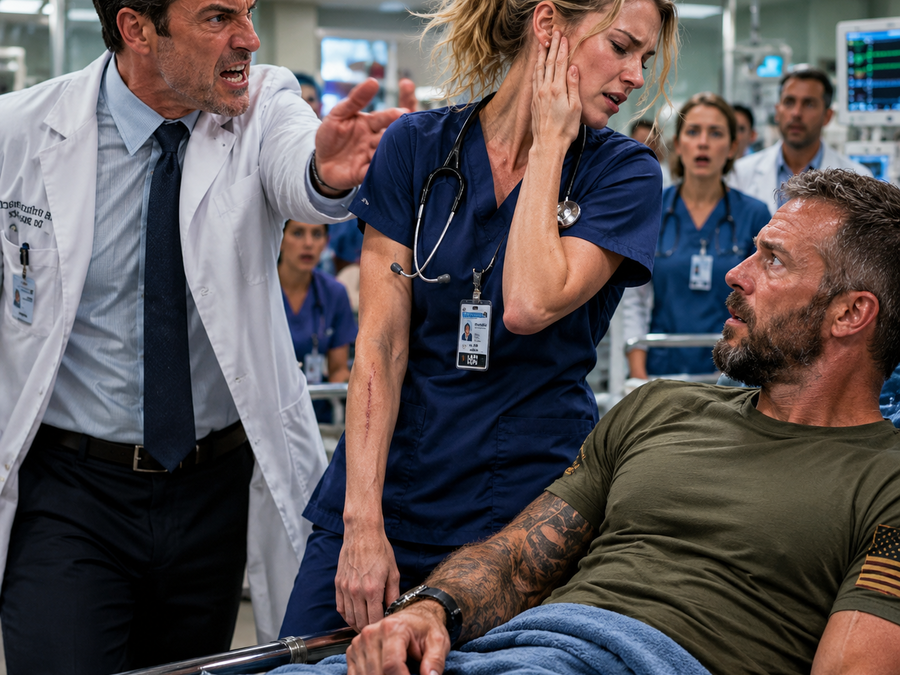
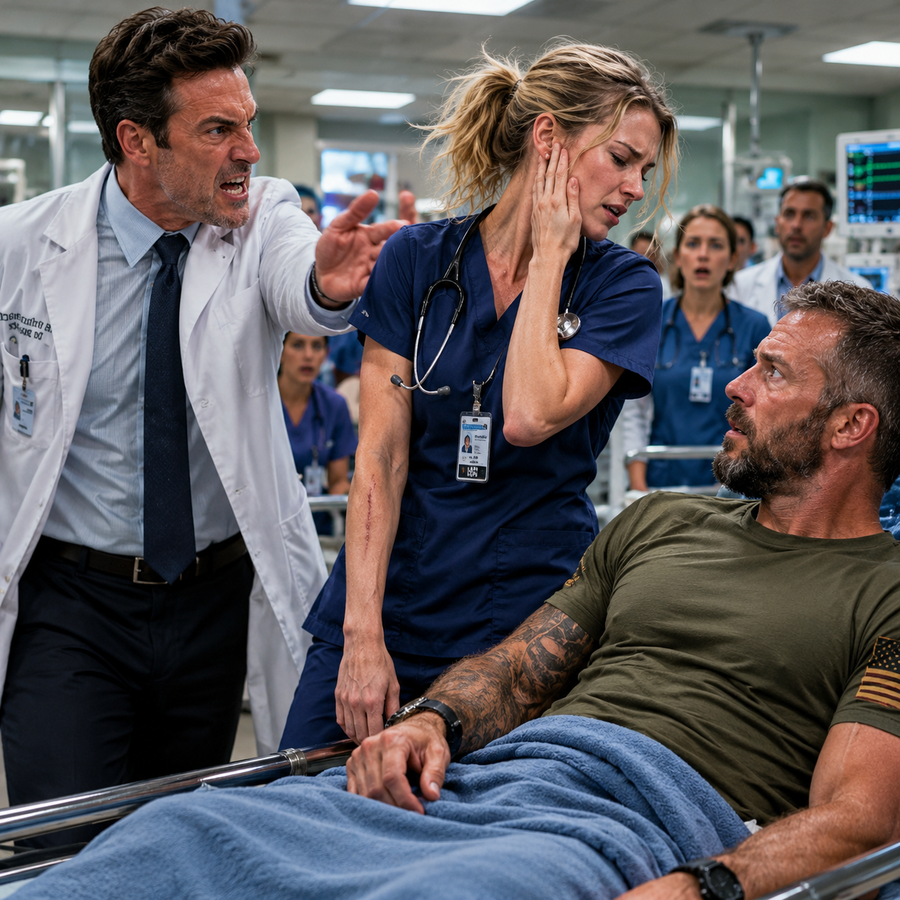
But the night he crosses the line and slaps her across the face in front of the entire team, her sleeve rides up and the patient on the gurney beside her, a retired Navy SEAL Master Chief deep in a PTSD spiral, sees the scar on her forearm, a scar he knows from a place that doesn’t exist on any map, from a night neither of them was
supposed to survive.
He whispers a call sign she buried 3 years ago and the quiet nurse everyone thought they had figured out starts to come apart in front of them because the woman they’ve been mocking for 14 months isn’t who she said she was.
Not even close.
If this story pulls you in, do me a favor before you go. Hit that like button.
Drop a comment telling me what city you’re listening from.
I want to see how far Riley’s story travels tonight.
Subscribe to Silent Badge’s stories and welcome aboard because we tell stories about the quiet ones nobody saw coming.
Stay until the end.
You’re going to want to hear how this one ends.
The slap landed before anyone in the trauma bay even realized Dr.Garrett Pierce had raised his hand.
The sound of it cracked off the tile walls of St.Brendan’s trauma center level one, sharp and obscene, louder than the heart monitor screaming in bay four.
For one long second, nobody breathed.
Then Riley Hennessey’s head turned slowly back to face him.
A thin red mark was already blooming on her left cheek.
Her green eyes did not water.
Her jaw did not tremble.
She just looked at him.
And Pierce, 6’2″ and used to being feared, took half a step back without realizing he had done it.
He covered it with a sneer.
“Next time I tell you to move, you move.
His voice was loud enough to carry through the entire emergency department.
I don’t care how long you’ve been here.
I don’t care what shift you pulled.
When I say step aside, you step aside.
Understood? Riley did not answer.
The silence in the trauma bay stretched until even Pierce felt it. A young resident, Dr.Lopez, was frozen with a chest tube tray in her hands.
Two nurses by the supply cart had their mouths half open.
The paramedic at the doors had stopped talking mid-sentence. The patient on the gurney, an elderly man with a broken hip, was the only one moving, groaning softly as the morphine started to take.
Pierce wiped his palm on the front of his white coat as if she had dirtied it.
Get out of my trauma bay.
Restock cart three.
And if I see you put your hands on a critical patient again without my direct order, you’re done at this hospital.
Do you hear me, Hennessey? Riley nodded once, just once.
She turned and walked out of the bay.
The fluorescent lights above the corridor hummed at a frequency that lived behind her teeth.
She walked past the nurses’ station without looking up.
Past the triage desk. She pushed through the door to the supply room and let it swing shut behind her.
Then she stood very still in the center of the room and stared at the wall.
The wall was beige.
She told herself three times that she was not in Yemen before her hands stopped shaking.
By the time someone tapped on the door, her face had gone smooth again.
Jenna Marlow, the charge nurse on nights, slipped into the supply room and closed the door behind her with a soft conspiratorial click of someone who knew the building’s blind spots.
Jenna was 51, built like she had carried six children and a thousand patients, with steel-gray hair clipped short.
She looked at Riley’s cheek, and her face did something complicated.
Honey, I’m fine.
Honey, he hit you.
I said I’m fine.
Jenna let out a long breath through her nose.
You’re not fine.
None of us are fine.
He’s been escalating for months, and admin keeps protecting him because his last name is on the surgical wing.
But that, Riley, that was assault. You can press charges.
I’ll be your witness.
Lopez will be your witness.
We’ll go to the union tonight.
Riley pulled a box of gauze off the shelf.
Then she put it back. Then she pulled it off again.
I’m not pressing charges, Jenna.
Why the hell not?
Because charges meant a record. A record meant a courtroom.
A courtroom meant a public docket. And a public docket meant a name and a face attached to a Cook County address, searchable by anyone who knew how to look.
And there were still people who knew how to look. Riley said none of that.
She said, “Because I need this job, and he’s the director.”
Jenna’s mouth twisted.
Sweetheart, you’re the best nurse in this department.
Pierce knows it.
That’s half the reason he goes after you.
The other half is that you don’t react.
He’s used to people crying.
He’s used to people quitting.
You just stand there and look at him like he’s a stranger speaking a language you don’t know.
It drives him insane.
He’s going to keep escalating until you give him something.
Riley pressed her palms flat against the metal shelf. The cool of it bled into her skin and steadied her.
Then I’ll keep not giving him something.
Riley, I’m okay.
Jenna, I just need a minute.
The older nurse studied her for a long time.
Then she nodded slowly and reached for the door.
Cart three is already stocked.
Jenna said quietly.
Has been since 7:00.
I did it myself when I came on shift. He sent you out here to make you feel small.
He didn’t send you out here for a reason.
She paused with her hand on the knob.
And just so you know, the EMS Bay just radioed in. Two more incoming, one critical.
Old man, late 60s, severe agitation, possible psychiatric break, found by his daughter screaming at someone who wasn’t there.
ETA 4 minutes. Riley nodded.
Thank you, Jenna. Jenna slipped out.
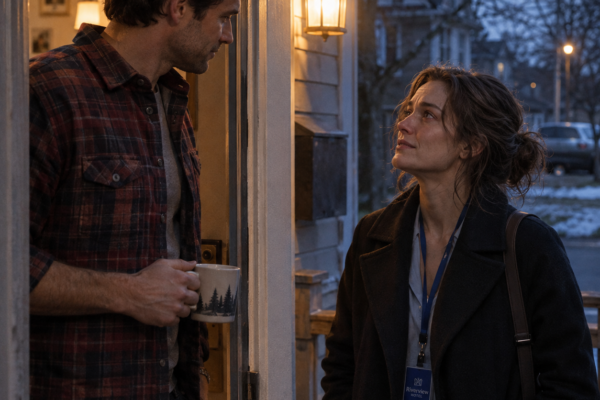
Riley pulled her left sleeve up to look at her forearm. The scar was still there.
3 in, slightly curved, running from the soft place below her elbow toward her wrist.
It had faded over the years from raised pink to a clean silver line. But in the fluorescent light of the supply room, it looked fresh again.
Like someone had drawn it on her skin 5 minutes ago.
She had gotten it in a stone house on a hillside outside Marib. A man with a knife had reached for her in the dark, and she had taken it away from him with the side of her own hand.
The blade had gone deep but missed the tendon.
She had treated it herself in a black SUV racing south toward the coast. Three of her teammates already dead in the backseat.
The radio in her ear playing nothing but static where their voices used to be. That was 3 years ago.
That was a thousand years ago.
That was Yemen. This was Chicago.
She pulled the sleeve back down past her wrist and tugged the cuff tight. She straightened her ID badge.
She rolled her shoulders once, the way she used to before going into a building, and the slight curve in her spine smoothed out and then came back as she remembered to put it back.
Slumped, she told herself, “Tired night nurse, forgettable.”
She opened the supply room door and walked back into the corridor just as the ambulance bay doors hissed open and the paramedics rolled the first gurney in.
The man on the gurney was big, 6 ft 4, maybe 220 lb even at 60-something, the kind of big that did not soften with age but only got more compact. His gray beard was streaked with what looked like dried oatmeal.
His hospital pajamas were soaked through at the chest with sweat.
He was strapped down at the wrists and ankles and he was screaming.
Not words, not at first, just a long ragged sound like something tearing inside him.
The kind of sound Riley had heard before in places she did not let herself remember during the day.
The paramedic at the head of the gurney was a young woman with a long braid and panic in her eyes. 67-year-old male.
Biba from his daughter’s residence found in the backyard at 03:15, screaming, swinging at people who weren’t there, refusing meds.
Daughter says he’s a veteran, retired, Navy.
Severe PTSD episode.
We tried 2 mg of versed in the rig and he barely slowed down.
Vitals are tachy but stable.
BP 160/98. Pulse 132.
Sats 96 on room air. She paused, lowering her voice.
He keeps saying a name.
I think it’s a name.
He keeps saying Reaper.
Riley’s hand, reaching for the chart, stopped 2 in above the clipboard.
She let it finish the motion.
She picked up the chart.
She read the top line. Patient name McNair Daniel J.
DOB 1958 Service USN retired Next of kin Sarah McNair, daughter.
The pen in Riley’s other hand did not tremble.
The chart in her left hand did not tremble.
Her face did not change at all.
She walked alongside the gurney into bay two. Pierce was already there, snapping latex gloves on, looking at the patient the way a man looks at a wasp inside his car.
Christ, another loon. Restraints stay on.
Get me four of Haldol and two more of Ativan IM, both thighs. I want him snowed before he hurts somebody.
Lopez trailing behind with the medication tray opened her mouth.
Doctor, his vitals are still elevated and combining Haldol with the versed he already got in the field, we might want to start with something. Did I ask you, Lopez?
No, sir. Then push the meds.
Riley stepped to the head of the bed. The big man on the gurney had stopped screaming words and was now breathing in great heaving gulps.
His eyes squeezed shut, his head thrashing from side to side. There was blood on his lip where he had bitten it.
Riley leaned in close to the man’s ear.
She did not touch him.
Not yet. Master Chief, she said very quietly.
Pierce snapped his head around. What did you just say to him?
Riley did not look at Pierce.
Master Chief, she said again, in the same low voice just above the man’s ear.
You’re in a hospital in Chicago.
You are safe. The building is secure.
Nobody here can hurt you.
I’m going to count to three and then I’m going to put my hand on your right shoulder.
Just my hand. You ready?
One, two, three. She put her hand on his shoulder, gently.
Three fingers, not five.
Pressure soft, the way you would touch a stray dog that had been kicked too many times.
The man on the gurney stopped thrashing.
His breath caught. He went very, very still.
Then his eyes opened. They were pale blue, almost gray, and they were full of tears that had not yet fallen.
He looked up at her face. For a long moment, he just looked.
His mouth moved without sound. Pierce was saying something behind her.
Somewhere down the corridor, a monitor was going off. Riley did not hear any of it.
She was looking at the man on the gurney, and the man on the gurney was looking at her, and his eyes were tracking across her face, the way a man reads a map he has not seen in years, looking for the road that used to be there. His gaze dropped to her arm, to where the cuff of her bright blue scrub had ridden up an inch and a half when she lifted her hand to his shoulder, to the silver line of the scar on her inner forearm.
The man on the gurney made a small sound, not a scream, almost a laugh, almost a sob.
His cracked lips moved. Reaper.
He whispered.
Oh my god. Is that you?
Pierce’s voice cut through the bay like a wire.
What the hell did he just call you? Riley did not turn around.
She kept her eyes on Daniel McNair. His pupils were blown wide.
His breathing was still ragged, but the screaming was gone, and so was the thrashing.
Master Chief, listen to me. My name here is Riley.
The team is gone.
The mission is over.
We came home.
You came home.
You’re in Chicago.
Your daughter brought you in tonight. Her name is Sarah.
Do you remember Sarah?
McNair’s eyes filled.
The tears spilled this time.
Sarah, he repeated.
Sarah brought me.
I wasn’t in.
I was in the yard.
There were men in the trees. There are no men in the trees, Master Chief.
Just oak trees.
Chicago oak trees.
The kind that drop those little brown helicopter seeds in the fall.
McNair made a sound that was halfway between a laugh and a wet cough.
Maple. Those are maple, Reaper.
You always got the trees wrong. I always got the trees wrong, she agreed.
Behind her, Pierce was still talking. He had moved from confused to angry to the particular shade of vicious that happened when a man like Pierce realized other people in the room had stopped paying attention to him.
Hennessey.
Look at me when I’m talking to you.
Is he a relative?
Did you know this patient?
You should have disclosed that the moment he came in.
Lopez said quietly, “Doctor, his vitals are coming down.
Pulse 110.
BP 148 over 92.
He’s coming out of it.”
I don’t care what’s coming down.
I asked her a question. Riley still did not turn.
She kept her hand on the Master Chief’s shoulder.
Three fingers. The same soft pressure.
Daniel.
I need you to do something for me.
Breathe in for four counts.
Hold it for four. Out for four.
Just like we used to do. Yeah, Reaper.
Don’t call me that here.
She said it quietly so only he could hear. So close to his ear that her lips almost brushed it.
Please. Not here.
My name here is Riley.
Just Riley.
McNair’s eyes focused on her face for a long moment.
Then the old discipline came back into to in a slow wave.
The way muscle memory comes back into a man’s hands when he picks up a tool he hasn’t used in 20 years.
He took a breath in for four counts. He held it.
He let it out. He nodded.
Just Riley. Just Riley.
Pierce stepped forward and tried to put himself between Riley and the patient.
He couldn’t quite manage it because the head of the bed was against the wall, but he loomed, and that was usually enough.
Step back from this patient. We are going to chemically restrain him, and then we are going to have a very serious conversation in my office about future employment.
Lopez, push the Haldol.
Lopez looked at the syringe in her hand.
She looked at the patient, whose pulse was now visibly slowing on the monitor, whose breathing had settled, whose eyes were tracking and aware. She looked at Pierce.
She did not move.
Lopez, I gave you a direct order.
Sir, he doesn’t need it anymore.
He’s de-escalated.
If we push four of Haldol on top of the versed he already got, we are going to over sedate him. Lopez, you push that medication, or I will have you off this rotation by the end of the week.
The resident’s hand started to shake.
Lopez was 28, six figures in debt, two years from being able to call herself an emergency physician, and the ER director was telling her to throw her career away or push a drug her clinical judgment said was wrong.
Riley turned around, slowly.
She let go of McNair’s shoulder, but only after she gave it one more soft squeeze, the way you tell a frightened dog you’ll be right back.
Then she faced Pierce.
The slumped shoulders were still there. The forgettable posture was still there.
But something in her green eyes had gone perfectly still. Dr.Pierce.
Her voice was low and even.
The patient is no longer a danger to himself or to staff. He is responsive, oriented, and following commands.
Chemical restraint is no longer clinically indicated. Pushing additional sedation on a 67-year-old with a likely diagnosis of severe PTSD and known cardiovascular history is going to put him into respiratory depression.
Dr.Lopez is correct.
Pierce stared at her. Did you just Sir, I am asking you to reconsider the order.
As a senior nurse on this floor, that is within my scope. I am not refusing care.
I am flagging a clinical concern in real time.
On the chart, in writing, with two witnesses present.
Dr.Lopez. Jenna.
Jenna Marlowe, who had appeared in the doorway sometime in the last 60 seconds without anyone noticing her arrive, said softly, Witnessed. Lopez said, Witnessed.
Pierce’s face went from red to a deeper red.
The jawline he was so proud of was clenched so hard a muscle was jumping in it.
He looked at Riley. He looked at the patient.
He looked at the two witnesses. He looked back at Riley.
Then his eyes dropped very briefly to her left forearm. The cuff of her scrub had ridden up again.
The silver scar was just visible above her wrist.
Pierce did not know what he was looking at.
But something in his lizard brain understood that whatever it was, it did not belong on the arm of a nurse. He covered the moment by sneering.
Fine.
Don’t push it.
But this conversation is not over, Hennessey.
You and I are going to talk tonight in my office before your shift ends. He stalked out of the bay.
Lopez exhaled so hard she almost folded in half.
Oh my god.
Breath, Lopez. Oh my god.
Breath in.
Breath out.
You did the right thing.
Sit down. Jenna was already moving toward the fridge.
Lopez sat down hard on the wheeled stool, the syringe of Haldol still in her trembling hand. Riley took the syringe gently from her, capped it, and dropped it into the sharps bin.
Then she crouched in front of the resident.
Maria, look at me. You just protected a patient from a bad order from your attending.
That is the job.
That is exactly the job. You did not freeze, you did not cave, and you did not push a medication you knew was wrong.
He’s going to ruin me.
He’s not going to ruin you.
Not tonight.
Tonight you go finish your charting and you tell the night attending exactly what happened, and you let me worry about Pierce.
Lopez nodded. Jenna came back with the Gatorade.
Riley straightened up and turned back to the gurney. The Master Chief was watching her.
His eyes were clear now, fully present, and there was something in them that had not been there before. Not just recognition, calculation.
The look of a man who had served 30 years in special operations, and who had just watched a senior nurse de-escalate a critical patient, identify an unsafe medication order, manage two terrified subordinates, and stare down a 6’2″ attending physician without raising her voice once.
The look of a man putting pieces together. Riley.
His voice was hoarse. Yes, Master Chief.
We need to talk.
I know.
Not here.
Later, Master Chief. After your daughter sees you.
After my shift.
There’s a coffee shop across the street from the south employee entrance.
Open 24 hours.
I’ll meet you there.
His pale blue eyes held hers.
You’re not going to run, are you, Reaper?
I’m not going to run.
You sure?
She thought about Yemen.
She thought about three names she still said out loud every night before she let herself sleep.
She thought about the slap.
About Pierce. About Lopez shaking on the stool.
About 14 months of folding herself smaller.
She thought about how tired she was of folding.
I’m not going to run, Master Chief.
Good. Because if you ran, I would find you.
And next time I might not be having a bad night.
He almost smiled. Then his eyes drifted shut.
The monitor beeped softly.
His pulse was 88.
He was asleep.
Jenna got Sarah McNair back to her father 3:45 in the morning.
The daughter was 41 years old with her father’s pale eyes and her mother’s small frame.
She came into the bay holding a paper coffee cup with both hands. And the moment she saw her father asleep on the bed with a clean blanket over him and a saline drip running.
She sat down hard in the visitor chair and started crying again.
But quieter this time.
Riley stepped in.
Mrs.McNair. Just Sarah, please.
Sarah.
Your father is stable.
He had an acute PTSD episode. We got him calmed down without having to use a lot of medication, which at his age is good.
The on-call psychiatry attending will see him in the morning. Has he been on anything?
Sarah wiped her eyes with the back of her hand. He was.
For years.
But after my mom died last spring, he stopped taking it.
He said the pills numb the grief and he didn’t want to be numb to her anymore.
So, he just stopped.
And he was doing okay for a while.
And then about 3 weeks ago, he started not sleeping.
And then tonight, he was in the yard yelling at trees and I didn’t know what to do.
Sarah looked up at Riley. Did he say anything?
Riley considered her answer carefully.
He recognized me eventually.
Sarah blinked.
He recognized you? From where?
From a long time ago.
The daughter’s face went through several expressions in quick succession.
Confusion, disbelief, then something more complicated.
She looked at Riley’s face.
She looked at the scrubs, the ID badge, the badly tied ponytail.
Then her eyes went slowly to Riley’s left forearm.
It was a different kind of look than the Master Chief’s had been.
Sarah did not recognize the scar, but she had heard about it. Riley felt that, too.
The way you feel the air change in a room.
Oh, Sarah said. Just that.
Just oh.
Riley said, “I’m going to be in the building until 7:00.
If he wakes up and asks for me, just have Jenna page me.”
Sarah nodded. Riley turned to go.
Jenna was waiting in the corridor outside the bay and fell in beside her.
Pierce is in his office, door closed.
He’s been on the phone for 20 minutes.
Who with?
Don’t know, but it’s loud.
Okay. Riley.
Mhm. What is going on?
Riley stopped walking. Jenna.
I’m not asking you to tell me.
I’m asking you to tell me how scared I should be.
Riley thought about that.
Not scared. Just careful for the next 48 hours.
If anything that feels wrong comes in through the doors, you find me first before security.
You find me.
Jenna nodded slowly. Okay.
And Riley, it’s my job to take care of my nurses, honey.
All of them.
Even the strange, quiet ones.
Especially the strange, quiet ones.
Those are usually the ones worth keeping. She walked off toward the station.
Riley stood in the corridor alone under the fluorescent hum and rolled her shoulders once.
She thought about how she was going to walk into Pierce’s office before the end of her shift.
She thought about Yemen and Sarah crying with her father’s pale eyes and Lopez shaking on a stool with a capped syringe in her hand.
She thought about how tired she was of being small.
She finished her charting at 6:51.
Pierce’s door was still closed.
Riley walked past it without slowing, dropped her last chart at the station, signed out on the board, and pushed through the side door into the staff hallway.
She did not go to her locker.
She went to Pierce’s office, and she knocked once, and she opened the door without waiting for an answer.
Pierce was behind his desk with a half-empty bottle of something amber in his hand. The office was small, expensive, and smelled like cologne and bourbon.
He looked up at her with a bleary fury of a man who had been drinking through a phone call he had not wanted to make. Get out of my office.
Riley closed the door behind her.
She did not sit. She stood with her hands at her sides and her shoulders no longer that Pierce did not consciously register it, but big enough that something in him went quiet for the first time all night.
Dr.Pierce, I came to give you a chance.
A chance?
A chance to do this the easy way.
I’m going to file a formal complaint with HR and with the state nursing board about the slap.
There were three witnesses.
I have a contusion you can still see in good light.
The complaint is going to be filed today, whether you want it filed or not. What you get to decide is whether the complaint is the only thing that lands on your desk this week.
Pierce set the bottle down very carefully. Are you threatening me?
No, sir.
I am offering you a choice.
Option one.
You take a leave of absence starting today.
You apologize to Dr.Lopez, to Jenna Marlowe, and to me in writing with copies to HR. You step down from the director role and accept reassignment to a non-supervisory position.
The complaint still gets filed, but I add a letter recommending leniency. You keep your license.
You keep your job.
Just not this one.
You get to be a doctor somewhere else, somewhere where you don’t get to hit people.
Pierce laughed.
It was an ugly little sound. And option two.
Option two?
I file the complaint. I add the prior incidents I have documented over the last 14 months.
I add the prior incidents Jenna has documented over the last 6 years.
I add the chart on bay two from tonight, including the part where you ordered a resident to push a contra-indicated medication on a stable elderly veteran, and I let the system do what the system does.
She paused. And then I make some phone calls.
Phone calls?
Yes. To who?
Riley did not answer that.
She just looked at him.
She looked at him for a long time.
Pierce’s eyes drifted again to her left forearm.
The cuff of her scrub had not ridden up. He could not see the scar now.
But he remembered seeing it earlier. And the memory of it was suddenly very loud in his head, the way some memories get loud when your body knows something your brain has not figured out yet.
He swallowed.
Who are you? Riley said.
I am the senior nurse on your night shift. I have been for 14 months.
I am very good at my job. The patient in Bay 2 is going to be discharged later today with a new outpatient plan.
Doctor, Lopez is going to make a fine emergency physician.
Jenna Marlowe has run this department better than anyone with an MD has run it in the last decade.
None of us deserved any of what you have put us through. You have until end of business tomorrow to give me your answer.
If I do not hear from you by 5:00 p.m.tomorrow, I file.
Are we clear? Pierce did not answer.
Riley let herself out of the office. She closed the door softly behind her.
The coffee shop across from the south employee entrance was called Junie’s.
Daniel McNair was sitting in the back booth in a pair of clean sweats his daughter had brought him with a cup of black coffee in front of him and a plate of untouched eggs.
Sarah had gone home to sleep. Riley slid into the booth across from him.
He waited until the waitress had brought her a coffee and walked away.
Reaper. Riley.
Riley. He nodded slowly.
Okay.
Riley.
He turned his coffee cup with both hands. He had not been a small man before tonight.
He was not a small man now, but he was older than she remembered and tired her.
And there was a stillness in his hands that had not been there in Yemen.
I’m not going to tell anyone, Riley.
I know.
Sarah doesn’t know what she saw.
She knows there’s something.
But she doesn’t know what.
I know. He looked up at her.
The pale blue eyes were rimmed red.
I thought you were dead.
I know.
They told us you were dead. The whole team.
They said you didn’t make it out of the country.
I know. I went to your funeral, Riley.
The fake one.
The one they did in Virginia for the family that wasn’t really your family.
I sat in the back row. I cried.
I cried for a year.
Riley’s throat did something she had not allowed it to do in 3 years.
She drank her coffee.
The coffee was bad. The coffee was perfect.
I’m sorry, Master Chief.
Don’t be sorry.
Just tell me one thing. Okay.
The three. His voice caught.
The three we left in that house.
Did you bring them home?
I brought them home, Master Chief.
All three.
I drove them 300 miles south with a hole in my arm and a broken radio.
I got them on the boat. I got them on the plane.
They went home under the names they were born with.
Their families know. The families do not know how or where or who I am.
But the families know their boys came home.
Daniel McNair put one massive scarred hand over his eyes. His shoulders shook.
He did not make a sound. After a long minute, he lowered his hand.
Okay.
He said. Okay.
Thank you.
Thank you, Reaper.
I needed to hear that. I have needed to hear that for 3 years.
I needed to say it for 3 years, Master Chief. They sat for a while.
Outside, the Chicago sky was starting to go gray with morning. Riley.
Yes. What do you want to do?
Riley thought about Pierce. She thought about Lopez.
She thought about Jenna saying especially the strange quiet ones.
She thought about the slap and about Yemen. And about three names she said every night.
And about the long pull of 14 months of folding herself smaller and smaller in a building that needed her bigger.
I think I want to stop running Master Chief. Okay Reaper.
I think I want to stay. Okay.
I think I want to do this job and do it right. And I think I want to make Pierce go away.
And I think I want to stop pretending I am someone I am not.
Good.
He took a slow sip of his coffee.
There’s a thing I want to ask you Riley.
You don’t have to answer.
Ask.
There’s a unit at Great Lakes that trains corpsman for fleet deployment.
Tactical medicine. Austere environments.
They lost their senior instructor last spring to retirement and they have not been able to replace her. The CEO is a friend of mine.
The slot is part-time. Two weeks a quarter.
You could keep this job.
You could keep being Riley.
But you could also He let the sentence trail off.
Riley looked at him. Master Chief.
Are you trying to recruit me?
No ma’am.
I’m trying to give you a doorway.
Same building.
Two rooms. You decide which one you want to be in on which day.
Riley looked down at her coffee. Her hands were perfectly steady on the cup.
Outside the window of Junie’s, a paramedic rig rolled past with its lights off.
The night shift going home.
Somewhere in the building across the street 14 months of Riley Hennessey were still walking the halls.
She was not sure yet which version of herself was going to walk back through those doors at 7:00 p.m.tonight. But for the first time in 3 years, she knew that whichever version it was, it was going to walk through under her own name.
Riley slept 4 hours in the small studio apartment she rented above a Polish bakery on Milwaukee Avenue. She set two alarms.
She woke before either of them. She lay in bed for a long minute looking at the water stain on the ceiling shaped vaguely like the state of Florida.
Then she got up, made coffee in a stovetop percolator that had belonged to a woman she had never met, and stood at the window watching the cars go by on Milwaukee.
The phone on her counter was a cheap prepaid flip from a drugstore on the corner. She had three of them.
She picked up the one that had not been used in 11 months, and she sat down at the small wooden table, and she dialed a number she had memorized once six years ago and had never written down anywhere.
The phone rang four times. A woman picked up.
Yes.
It’s Reaper.
There was a long pause on the other end.
Then the woman said, in the careful neutral tone of someone who knew that careful neutral tones were the only safe ones, Reaper is deceased. I know what the file says, Catherine.
I’m calling anyway.
Another pause. Then a small exasperated sound that was almost a laugh.
God damn it, Riley. Hello, Catherine.
Where are you?
I’m not telling you where I am.
Are you safe?
I’m safe.
I have a job. I have an apartment.
I have a regular paycheck and a regular pharmacist and a regular dentist.
I’m fine.
Then why are you calling me on a line you swore to me you would never call again?
Riley turned her coffee cup with both hands, the same way Daniel McNair had turned his last night at Junie’s.
The gesture, she realized, had not been his.
It had been hers before.
He had picked it up from her. They had all picked things up from each other in that house in Marib in the months before that house had stopped being a house.
I have a situation, Catherine. Tell me.
So, Riley told her. She told her about the slap.
She told her about the patient in bay two. She told her about Daniel McNair recognizing the scar.
She told her about Sarah’s face when she made the connection she could not name.
She told her about Pierce in the office at 6:51 in the morning.
She did not tell her about the offer at Great Lakes. She wanted to think about that one more day.
Catherine listened. Catherine had been listening to Riley for almost 12 years, since Riley had been a 24-year-old Army medic with a knack for languages and an eye for detail and a way of moving through a room that made certain kinds of people look up.
Catherine had been the one to recruit her.
Catherine had been the one to walk her into Yemen.
Catherine had been the one to walk her out 3 years ago when the only walk anyone expected Reaper to take was the short one into the ground. When Riley was finished, Catherine was quiet for a long time.
All right, she said. Here is what we are going to do.
Catherine, I am not coming back in.
I am not asking you to come back in. I am asking you to let me do my job.
Daniel McNair is a problem we already knew about.
We have eyes on him through the VA system. He is read in at a level that allows him to know certain things and not know others.
He has been compliant, and he will continue to be compliant.
He is not the leak. Sarah is not a leak because Sarah does not know enough to leak anything.
And Pierce, Pierce is a different kind of problem.
Pierce saw the scar.
Pierce did not recognize what he was looking at, but Pierce is the type of man who googles things he does not understand at 2:00 in the morning. And Pierce has the kind of network of golf friends and donor friends and old college roommates that includes at least three people who would notice if certain queries crossed certain databases.
So, so we are going to make Pierce a very small problem before he becomes a slightly larger one. Riley closed her eyes.
Catherine, I do not want him disappeared.
I do not want him hurt.
I want him gone from that hospital, gone from any hospital. And I want him to never think about me again.
Of course, Riley.
I’m not 85 years old yet.
We don’t disappear people for being We disappear them for being threats.
Pierce is going to be neither. Pierce is going to be a man whose Illinois medical license review hearing has been moved up by a sympathetic clerk to next Tuesday at 9:00 a.m.He is going to be a man whose hospital board chair receives a very thorough confidential file by courier on Monday morning containing several documented incidents we did not collect, none of which are about you, all of which are about other things he has done in other rooms with other people.
He is going to be a man who quietly accepts a generous severance package on Wednesday and moves to his vacation house in Naples, Florida on Thursday and does not practice medicine again.
Does that work for you?
How long have you had a file on Pierce? Riley, we have files on a lot of people who run trauma centers next to bases.
We are not interested in him. We are interested in what walks into his ER.
Sometimes what walks into his ER includes people we are interested in. Riley sat with that for a moment.
I see.
Yes. And me?
What about me? There was another long pause.
Riley, I am going to ask you something and I would like you to answer it honestly. Okay.
Are you happy?
Riley looked at the steam coming off her coffee. She looked at the water stain on the ceiling shaped vaguely like Florida.
She looked at her own left forearm where the scar was almost invisible under the long sleeve of her sweater.
I don’t know what that word means anymore, Catherine.
Try a different word then. I am useful.
I am useful at that hospital. There are people there who are better at their jobs because I am there.
There are patients who go home alive who would not go home alive otherwise.
I am tired all the time and I am scared most of the time and I cry in the supply room about once a week, but I am useful. That is the closest word I have.
Catherine made a small sound. It could have been a laugh.
It could have been a sigh.
All right. All right, what?
All right, Riley. You stay.
You stay at St.Brendan’s.
You stay, Riley Hennessey. We move your file two more layers deeper and we put a soft watch on your address and your prepaid lines.
Very quiet.
You won’t see it.
You call me if anything else cracks.
And when McNair’s friend at Great Lakes calls you, you tell him yes.
Riley’s breath caught.
I didn’t tell you about Great Lakes.
Riley. Honey.
Of course you didn’t.
I’m telling you.
Take the slot. Two weeks a quarter.
Use your real training. Stop folding yourself in half over a washbasin in a public hospital.
You’re going to break something that won’t grow back.
You think nobody can see you in there?
I can see you.
McNair could see you.
The thing that made Pierce hit you was that on some level he could see you, too.
You don’t fit in that uniform anymore.
You stopped fitting in it about 8 months ago.
The only person who hadn’t noticed was you.
Riley closed her eyes.
The percolator on the stove ticked as it cooled.
Catherine. Yes.
I don’t know how to be both.
Nobody does, Riley. We figure it out as we go.
That’s all anybody ever does.
Okay. Take the slot.
Okay.
And Riley.
Yes. Welcome back.
A little bit. Not all the way.
Just a little bit. Catherine hung up.
Riley sat at the table for a long time with the silent phone in her hand.
Then she pulled the battery out of the back of the phone, dropped the battery into one coffee cup full of water, and the SIM card into another, and tossed the empty phone shell into the kitchen trash. She washed her hands.
She dressed for her shift. She braided her hair tighter than she had braided it in 3 years, and she did not slouch her shoulders down before she left the apartment.
She did not slouch them all the way back up, either. She left them somewhere in the middle.
Somewhere honest.
She walked into St.Brendan’s at 6:58 p.m.Jenna saw her come through the doors and stopped mid-sentence at the nurses station.
She had been talking to a tech about a supply order. Whatever she had been about to say next, she lost it.
Riley.
Hi, Jenna.
You look Jenna searched for a word. You look taller.
I’m 5 ft 5.
You look taller, Riley.
Riley smiled.
It was a small smile, careful, the kind of smile that did not know yet how far it was allowed to go.
Jenna stared at it like she had never seen one before.
Maybe she hadn’t.
Riley had not smiled in this building in 14 months. Pearson?
Pierce did not come in tonight.
Pierce called in sick. Pierce has, according to the rumor that started somewhere around 3:00 this afternoon, taken an emergency leave of absence pending an external review.
The board chair came in personally at 5:00.
They have moved Dr.Anand up to interim director. Anand is fine.
Anand is human.
Anand cried twice this afternoon in the cafeteria, but she’s fine.
Riley nodded slowly.
How did all of that happen so fast?
Honey, I have absolutely no idea. I assumed you knew.
The chart you filed this morning was 46 pages long.
I read it.
We all read it. It was a masterpiece.
But 46 pages does not move a hospital board in 8 hours. That was something else.
Riley shrugged.
Things move when they want to move. Jenna looked at her for a long moment.
Then she nodded the slow nod of a 51-year-old charge nurse who had seen a great many things in her life and had stopped trying to find names for the ones that did not fit.
Okay.
Well, we have a full board tonight.
Three traumas already up in the rotation, two transfers from Stroger inbound for stabilization, and I’d like you to take charge of Bay 1 because Lopez is back on shift, and I think you working her tonight will be good for her nerves.
Done. And Riley, yes.
It’s good to see you, honey.
It’s good to be seen, Jenna.
She walked into the trauma bay and the night began.
The night moved the way nights moved at St.Brendan’s in long flat stretches of charting and small bursts of organized panic.
By 11:00 p.m.Riley had stabilized a chest pain who turned out to be a panic attack, a panic attack who turned out to be a heart attack.
And a teenager who had crashed his bicycle into a parked car at 30 miles an hour. And who now had a fractured clavicle and a story he was very proud of.
By midnight she had taken charge of Bay one for a transfer from Stroger. A 44-year-old woman with septic shock and a history that did not match her chart.
And Riley had spent 40 minutes with her until the woman was warm and stable and looking up at the ceiling tiles with the particular gratitude of a person who had not expected to look at any more ceiling tiles.
By 12:47 a.m.Lopez had stopped flinching every time the radio crackled. By 1:15 she had stopped flinching at all.
Then the doors hissed open and the paramedics rolled in the first stab wound of the new night.
A 23-year-old kid with a kitchen knife still in his right neck.
Blood pouring around the handle in pulsing arterial spurts that told Riley everything she needed to know in the first half second she saw him.
Bay one.
Now, Lopez, with me.
Jenna. Page anesthesia and ENT and tell them we have an active junctional bleed with retained foreign body.
Surgical airway likely. Page the OR.
Tell them we may be coming up in less than five.
Lopez was already moving.
The paramedics rolled the gurney in fast and the kid on it was the color of skim milk under the fluorescence. His lips blue.
His eyes half open and unfocused. The handle of the knife stuck out of his neck just below the angle of his jaw on the right side.
And Riley could see the pulsing pattern in the blood around the wound.
And she did not need a monitor to tell her that the carotid was clipped or partially severed.
And that the kid had maybe three minutes before he was a different kind of patient.
The paramedic at the head of the gurney said, “23-year-old male.
Bar fight on Western. Knife strike to the neck.
The bystanders held pressure until we got there.
We did not pull the knife.
BP was 80 over palp on scene, dropped to 65 over palp in the rig. Two large bore IVs, one unit of LR running wide open, sat 90 on a non-rebreather.
Good move.
Riley was already gloved.
He was She put one hand flat on the kid’s chest to hold him still and the other on the side of the knife to feel the angle of the blade through the skin.
The knife was a 6-in kitchen knife. The handle wooden.
The blade buried almost to the hilt. The angle was downward and slightly medial.
The blade had gone in along the line of the sternocleidomastoid and was angled toward the upper mediastinum.
If she pulled it out, she would let go of whatever it was tamponading and the kid would exsanguinate on her table in under 60 seconds.
She did not pull it out. Lopez, tell me what you see.
Penetrating neck trauma zone two, retained foreign body, active bleed, signs of class three to four hemorrhagic shock, possible airway compromise from expanding hematoma. Good.
What do you not do? Do not remove the knife.
Good.
What do you do?
Stabilize the foreign body, pack around it, maintain airway, get blood up, get him to the OR with the knife still in.
Excellent. Riley was already moving as she spoke.
She took a fistful of combat gauze from the kit the paramedic was holding open and packed it tight around the base of the knife, pressing hard with the heel of her hand, feeling for the angle of the blade beneath the skin, packing more gauze until the gauze itself was holding the knife in place.
The arterial spurting slowed. It did not stop.
It slowed.
Jenna came back. Anesthesia is 2 minutes out.
ENT is in the elevator. OR 3 is open and prepped.
Good. We are not waiting for anesthesia.
His airway is going.
Look at his neck.
The kid’s neck was visibly thickening.
The hematoma under the skin was expanding around the knife.
His tongue had started to look too big in his mouth. His sats had dropped from 90 to 86 in the time it took Riley to pack the wound.
Lopez, I am going to do a surgical airway on this patient.
You are going to help me. I want you pressure on the gauze around the knife, exactly where my hand is now.
Exactly the same pressure while I go below it.
Are you ready?
Lopez’s face went white.
Riley, I have never The protocol says we wait for ENT to ENT will be here in 90 seconds.
We do not have 90 seconds. His sat just dropped to 84.
If we wait for the elevator, he loses his airway in this hallway and his brain in the next 4 minutes.
Are you ready?
Lopez took a breath. The breath did not shake.
The hand she put on the gauze did not shake either.
I’m ready.
Riley moved. She found the cricothyroid membrane below the level of the hematoma, a soft small notch just above the cricoid cartilage.
She made a horizontal incision through the skin 1 and 1/2 cm wide. The skin opened cleanly.
She made a second incision through the membrane itself.
There was a small puff of air from the new hole.
The kid’s chest moved a fraction.
Riley took a 6-0 endotracheal tube from the tray Jenna had quietly placed at her right hand and threaded it down into the trachea, inflated the cuff, connected the bag valve to the end, and squeezed. The chest rose.
The sats started to climb.
86 88 91 We’re up.
Let’s move.
Jenna hit the brakes off the gurney.
Lopez, do not let go of that gauze. Walk with us.
We are going to the OR right now. They moved.
The bay doors swung open and they took the corridor at a run.
Riley at the head bagging. Lopez beside the bed maintaining the pressure with both hands.
Jenna at the foot with the IV poles. The second unit of saline flowing into the kids left antecubital.
They hit the elevators and the ENT attending. A 42-year-old man named Wexler, who Riley had worked with three times before, was waiting with the doors open.
Wexler looked at the kid.
He looked at the surgical airway in his neck just below the knife handle. He looked at Riley.
Who put that in?
I did.
Who are you?
Senior night nurse, bay one.
Wexler’s eyes narrowed for half a second.
Then they smoothed out into the bright clean focus of a surgeon who had just been handed a problem he could solve.
All right.
Tell me what you’ve got.
Riley told him. Vitals, mechanism, packing, position of the blade, time from incision to inflation, units transfused, last sat.
Wexler listened. When she finished, he nodded once.
Good work.
Let’s get him upstairs.
The elevator doors closed. Riley stood in the corridor with Lopez and Jenna and a small slow drip of blood on the tile floor at her feet.
Lopez was breathing in big slow gulps with her eyes closed. Her hands were shaking now that they were allowed to.
Jenna was leaning on the wall with both palms flat against the paint behind her.
Riley.
Yes, Jenna.
What in God’s name did you just do?
I bought him about 90 minutes.
We’ll see if anybody upstairs can buy him the rest.
Riley.
Yes.
Where did you learn to do that?
Riley looked at her. She thought about Catherine on the prepaid phone that morning.
She thought about Daniel McNair turning his coffee cup with both hands. She thought about Pierce in a vacation house in Naples, Florida that he probably did not yet know he was about to move to.
She thought about Sarah crying in the visitor chair with her father’s pale eyes.
She thought about the kid on the elevator with a 6-in kitchen knife still in his neck. She thought about how tired she was of lying.
Army, she said.
A long time ago, I was a medic. They taught us things.
Jenna looked at her for a long moment. Then she nodded slowly.
The slow nod of a woman who had decided not to ask the next question on the list. Army.
Yes. All right.
All right.
Lopez opened her eyes. Riley.
Yes.
Thank you.
For what?
For not letting me push the Haldol last night. For not letting that kid die in the hallway tonight.
For just thank you.
Riley put her hand on the back of Lopez’s neck the way her own first instructor had put a hand on the back of her neck a long time ago.
She squeezed once gently.
Go finish your charting, Maria.
And tomorrow when you wake up in the afternoon, write a sentence on a piece of paper.
The sentence is I did not freeze.
Tape it to your bathroom mirror.
Read it every day until you don’t need to anymore.
Lopez nodded. She walked off down the corridor with her hands in her pockets and her head up.
Jenna and Riley stood in the silence for a long moment.
Then Jenna pushed off the wall.
I’m going to go make coffee.
The bad kind. The kind we always make.
The kind that’s burnt.
Make a lot of it. We have hours.
We always have hours, honey. Jenna walked off.
Riley stood alone in the corridor for one more breath. Then she walked back to the bay where the blood was still on the floor and the gauze wrappers were still in a small pile by the foot of the bed where she had dropped them.
And she pulled on a fresh pair of gloves and she started to clean. The kid with the kitchen knife in his neck was named Marcus Bell.
He was 23 years old.
He had been at a bar on Western with his cousin watching a Bulls game on a television that was too small for the room when another man, drunk and angry about something nobody could later explain, had grabbed a knife off the wall display behind the bar and stabbed him for reasons that did not survive into morning.
Wexler, the ENT, and a vascular surgeon named Bott, who had been pulled out of bed at home, worked on Marcus Bell for 4 hours in OR 3. They repaired the partial laceration of the right common carotid.
They evacuated the hematoma.
They left the surgical airway Riley had placed in the field because it had been placed correctly and there was no reason to do further harm by changing it.
At 7:40 a.m., 6 minutes before the end of Riley’s shift, Wexler came down to the ER in his scrub cap with his mask pulled down around his neck and he stood at the nurses’ station and he waited until Riley turned around and saw him.
He’s going to live, Hennessey.
Riley nodded once.
Good. Long ICU stay.
Possible permanent voice changes.
Possibly some weakness in the right shoulder if the spinal accessory took a hit.
Won’t know for 2 weeks.
But he’s going to live.
He’s going to walk out of this hospital.
That’s good news, Dr.Wexler.
Wexler studied her for a long moment.
He was a careful man.
He did not ask questions he had not first arranged in his head.
Who taught you that cricothyrotomy, Hennessy?
The army. What unit?
I’d rather not say.
Wexler nodded slowly.
Okay. He paused.
There’s a thing called a hospital case conference.
We do them once a month. The interesting cases, the teaching cases.
Marcus Bell is going to be one of those cases because that kid should not be alive.
I would like you to present it.
With me.
At the case conference next month. Will you do that?
Riley considered. She thought about Catherine saying you stopped fitting in that uniform about 8 months ago.
She thought about Lopez writing the sentence on a piece of paper, taping it to her mirror.
She thought about Daniel McNair turning his coffee cup with both hands.
Yes, Dr.Wexler.
I’ll present it.
Good. He turned to go.
He paused. Hennessy.
Yes.
I have been an ENT surgeon in this city for 19 years.
I have watched a lot of nurses in this department do a lot of things.
What you did in that hallway last night was not a nurse thing.
I just want you to know I noticed.
I’m not going to ask any more questions.
But I noticed.
He walked away.
Riley stood at the nurses’ station with a stack of charts under her arm.
She watched him go through the double doors at the end of the corridor and turn the corner.
Then she finished her last chart. Then she signed out on the board.
Then she walked out into the cold March morning where the wind off the lake was sharp enough to make her eyes water for an honest reason, and she walked to Junie’s coffee shop across the street.
Daniel McNair was in the back booth again. Sarah was with him this time.
They both had eggs. They had ordered Riley a coffee before she came in and the cup was waiting on the table in the third seat with two sugars and a little tub of cream beside it, just the way she liked it.
She did not remember when she had told either of them that.
Riley sat.
Master Chief, Sarah. Riley.
Master Chief, how are you feeling?
Better.
Got 6 hours of sleep last night.
First time in 3 weeks. My psychiatry appointment is at 11.
I’m I’m okay.
Good. She looked at Sarah.
How are you?
Sarah looked at her father.
She looked at Riley. She looked at her own hands on the table.
I think I have some questions, Riley.
I think I have been working up to having some questions all night.
I don’t know how to ask any of them and I don’t think I’m allowed to know the answers anyway.
Is that close to right?
Riley smiled.
Just barely.
That’s very close to right.
Okay.
Sarah took a small, careful breath.
Then can I ask you something that isn’t a question about what you used to be?
Yes.
Will you be my dad’s friend?
Riley felt something open behind her sternum that she had been holding closed for 3 years.
Yes, Sarah.
He doesn’t have anyone, Riley.
He had my mom. He had the men from the team.
My mom is gone and the men from the team are mostly gone, too.
The ones he was allowed to talk to.
And the ones who are left don’t live in Chicago and they don’t pick up the phone when he calls.
I worry about him.
I worry about him a lot.
I worry about him in the middle of the night.
And last night when I saw him calm down, when I saw him calm down for you, I thought She stopped. She wiped her eye.
I thought maybe you could just be his friend.
Just dinner once a month or whatever. Just a person in this city who knew him from a part of his life I am not allowed to know about.
So that when the bad nights come there’s somebody he can call.
Riley looked at Daniel McNair. The Master Chief was looking at his eggs very intently.
He was not eating them.
He was looking at them.
Master Chief.
Mhm. Dinner once a month.
Yeah, Riley.
Junie’s makes a meatloaf on Thursdays.
Says so on the menu.
I have never tried it. Me, neither.
Want to try it next Thursday?
Yeah, Riley. I do.
Okay.
She looked back at Sarah. Dinner once a month.
Junie’s when he wants.
My place sometimes if he wants something home cooked.
You have my pager number and Jenna will always page me if you need me and he can’t reach me himself.
We’ll figure the rest out as we go.
Sarah put both hands over her face and cried for about 10 seconds.
The short hard kind of cry that comes out of a person who has been holding back a long one.
Then she wiped her face on her sleeve, picked up her fork, and started eating her eggs.
The Master Chief picked up his fork and ate his eggs, too.
Riley drank her coffee. The coffee was bad.
The coffee was perfect. She slept 4 hours again in the apartment above the bakery.
When she woke up at 3:00 p.m., she walked down to the bakery and bought a kolache and ate it standing at the counter while old Mrs.Stasek told her about her grandson in Krakow who was studying to be an engineer. Then Riley walked back upstairs and she called the number Catherine had given her that morning on a scrap of paper she had memorized and then burned.
A man’s voice answered, gruff and Midwestern.
Great Lakes.
Petty Officer Jenkins speaking.
Unsecured line, sir or ma’am?
I was told to call this number and ask for Captain Voss.
There was a pause.
And who am I telling him is calling, ma’am?
Riley took a breath.
She thought about the slap. She thought about Lopez in the hallway.
She thought about the kid named Marcus Bell whose mother was probably crying in a waiting room two floors above the ER at this exact minute.
She thought about every supply room she had ever stood in counting boxes of saline to keep her hands from shaking.
She thought about the name on her ID badge and the name in her file at Catherine’s office and the name on her birth certificate.
She thought about how all three of them had been her the whole time.
The only one who hadn’t figured that out being her.
Tell him Riley Hennessy is calling.
From St.Brendan’s in Chicago.
Master Chief Daniel McNair referred me about an instructor slot.
One moment, ma’am.
There was a click. There was a long pause.
Then the line picked up again and a different voice, older and warmer, said, Ms.Hennessy, Dan called me yesterday afternoon.
I have been hoping you would, too. Thank you for calling.
Do you have 10 minutes to talk about an opportunity? Riley sat down at her small kitchen table with her coffee cup in her hand and the late afternoon sun coming through the window at an angle that made the steam look like something solid.
She
looked at her own left forearm.
The scar on it was almost invisible in the light. Captain Voss, she said, I have 10 minutes.
She talked to him for 23.
When she hung up, she stood up from the table, walked to her closet, opened the wooden box at the back of the top shelf and took out the small folded American flag and the three small dog tags that lay underneath it.
She did not look at the names on the tags.
She did not need to.
She knew the names.
She closed her hand around the tags.
She held them for a long moment. Then she put them back in the box.
She put the box back on the shelf.
She did not weld the shelf shut this time.
She just closed the closet door.
That night she walked into St.Brendan’s at 6:58 p.m.Exactly 2 minutes early as always.
And Jenna at the nurses station looked up and said, “Hi, honey.”
And Lopez waved from across the bay with the dumb shy smile of a resident who had taped a sentence to her bathroom mirror that morning and read it twice before brushing her teeth. And the doors of bay three swung open as a new patient rolled in.
A heart attack in his 50s, scared, hanging on.
Riley pulled on her gloves. She walked into the bay.
She did not slouch her shoulders down. She did not have to anymore.
The mark on her cheek had faded in the night to nothing at all.
She put one hand on the patient’s chest to steady him.
“Sir, my name is Riley.
I am your nurse. I am very good at my job and I am right here with you.
And you are not going to die tonight. We are going to take care of you.
Squeeze my hand if you can hear me.”
The man on the bed squeezed her hand.
Riley smiled.
The lesson, if there was a lesson, was small and quiet and had taken her 3 years to learn. You do not have to choose between the person you were and the person you became.
You do not have to bury one to be the other. The strongest people in any room are usually the ones nobody is looking at.
The most dangerous thing you can ever do to a quiet woman is mistake her quietness for weakness. And if you ever ever raise your hand to a nurse on her own floor, you had better hope she is not the kind of nurse who used to carry three names home through a desert with a hole in her arm, because that kind of nurse does not forget.
That kind of nurse does not break.
That kind of nurse just stands up one morning taller than she stood the night before and starts to be both of the things she was always going to be.
The end.