One Special Forces Commander Takes on Corrupt Cops, Powerful Politicians and Drug Lords!

THE DESERT EAGLE
A Soldier’s Return
The first thing Cole Banning did when he reached Pine Creek was stop at his mother’s grave.
The second was promise her that he would find the men who had killed her.
He stood beneath a pale Arizona sky, holding an apple pie wrapped in a white kitchen towel. The cemetery was quiet except for the wind moving through the dry grass and the distant rumble of trucks on the highway.
Two years.
Two years since Margaret Banning had died. Two years since Cole had missed her funeral because the military had declared him missing in action. Two years since his sister had stood alone beside their mother’s coffin, listening to people offer condolences they didn’t mean.
Cole placed the pie beside the headstone.
“Mom,” he said quietly, “your son made it home.”
He touched the cracked face of his wristwatch. It had belonged to Margaret. The glass was broken, the hands permanently stopped at 4:37. She had worn it for thirty years, getting up before dawn to bake pies for the truck drivers who passed through Pine Creek.
She had always said that a good pie, like the truth, should be served hot.
Cole had never understood the second part until now.
His phone vibrated.
A message from Caitlyn.
Once you’ve paid your respects, come to the diner. I’ll make you breakfast.
He smiled faintly.
“Your sister still thinks she can tell me what to do.”
He turned toward the road.
A black-and-white patrol vehicle was waiting near the cemetery entrance.
The sheriff’s cruiser rolled forward and stopped in front of him. Its emergency lights remained dark. The driver’s door opened, and a heavyset deputy stepped out.
“Afternoon. License and registration.”
Cole glanced at the cruiser.
“I’m on foot.”
“Then identification.”
“I don’t have it on me.”
“Where are you from?”
“Out of town.”
The deputy looked at the pickup parked near the gate. It was an old vehicle, its paint faded and its rear bumper held in place by a length of wire.
“That’s yours?”
“Yes.”
“Open it.”
“What’s the problem?”
The deputy smiled without humor.
“You’re the problem.”
A second officer emerged from behind the cruiser. He held a cigarette between his fingers and watched Cole with the relaxed expression of a man who had never expected anyone to challenge him.
Cole studied them.
Their uniforms were clean. Their boots were polished. Their hands were positioned close to their weapons.
But neither man was watching the road.
They were watching him.
“Turn around,” the first deputy ordered.
Cole slowly raised his hands.
The search began with his pockets. Then the cab. Then the bed of the pickup.
A minute later, the second officer called out.
“Boss. Found it.”
He was holding a plastic-wrapped package.
The deputy looked at Cole.
“Well, well. That’s quite a surprise.”
Cole stared at the package.
He had never seen it before.
“How much?” the deputy asked.
“Enough to send him away for twenty years.”
The deputy nodded.
“Congratulations, stranger. You just ruined your afternoon.”
Cole lowered his hands.
“You planted that.”
The deputy struck him across the face.
“Watch your mouth.”
Cole tasted blood. He looked at the two officers, then at the road beyond them.
Three men. Two visible weapons. One cruiser. A pickup with a clear line of retreat.
He could disarm them.
He could put all three on the ground before the second officer finished reaching for his holster.
But if he did, the package would disappear, the report would be rewritten, and the men responsible for his mother’s death would remain protected.
He had spent years learning how to win battles.
Now he needed to learn how to let one go.
The deputy pushed him against the pickup.
“Welcome to Pine Creek.”
By sunset, the entire town knew about the drifter who had been caught carrying narcotics.
The sheriff’s office released no official statement. It didn’t need to. Word traveled faster in Pine Creek than any police radio.
At the diner, Amy Miller heard the story from a customer who had been standing outside the courthouse.
“Apparently, he got mouthy with Deputy Doyle.”
Amy continued wiping the counter.
“Did he?”
“Didn’t you hear me? They found drugs in his truck.”
“Then I suppose the police have their man.”
The customer laughed.
“You’re too trusting, Amy.”
She looked toward the front window.
A battered pickup was parked across the street.
The driver was not inside.
Amy felt a familiar unease settle in her stomach.
She had seen that truck before.
Not long ago. It had been parked outside the cemetery, and the man beside it had stood at Margaret Banning’s grave for nearly an hour.
She knew the family. Everyone in town did.
Margaret had fed half of Pine Creek during the worst years of the recession. She had given meals to men who couldn’t pay and sent children home with pie whenever their parents lost work.
Her son had disappeared.
Her daughter had become governor.
And someone had made sure Margaret never lived to see either of them come home.
Amy lowered her eyes and continued wiping the counter.
She had learned that survival sometimes meant pretending not to notice.
Outside, the pickup’s engine started.
The truck drove away.
Cole was released before midnight.
No paperwork. No explanation. No apology.
Deputy Doyle handed him the truck keys.
“Get out of town.”
Cole looked at him.
“Am I free to go?”
“Don’t make me repeat myself.”
Cole took the keys.
He had spent three hours in a room without windows. During that time, he had heard the sheriff’s men discussing a reporter named Danny, a missing hard drive, and an abandoned copper mine.
One name had been repeated more often than the others.
Boone.
Sheriff Boone had controlled Pine Creek for twenty years.
Cole knew the type. A man who wore the law like a uniform but treated it like private property.
He drove away from the station.
He didn’t head for the highway.
He went to the diner.
The back door was locked. He knocked once.
No answer.
He knocked again.
A light appeared in the kitchen.
Amy opened the door with a wooden rolling pin in her hand.
“What do you want?”
“Hot water.”
“It’s midnight.”
“I noticed.”
She looked at his bruised face.
“Are you the man they arrested?”
“Depends who’s asking.”
“Someone who doesn’t want trouble.”
“Then you’ve opened the wrong door.”
Amy hesitated before stepping aside.
Cole entered the kitchen. The room smelled of cinnamon, flour, and baked apples.
He looked at the old oven.
For a moment, he was a child again.
Margaret stood at the stove, sleeves rolled to her elbows, flour on her cheek. She would let him steal pieces of dough when she thought he wasn’t looking.
He swallowed.
Amy noticed.
“You knew Margaret?”
“She was my mother.”
Amy’s expression changed.
“Then you’re Cole.”
He said nothing.
“Your sister has been looking for you.”
“I know.”
“She’s worried.”
“She has enough to worry about.”
Amy set a kettle on the stove.
“Your mother used to bring me here when I was little. She taught me how to make her apple pie.”
Cole looked at the cooling rack.
“Did she?”
Amy nodded.
“I’m still trying to get it right.”
He picked up a small slice.
One bite was enough.
The crust was too thick. The filling needed more cinnamon. But the apples had been cooked slowly, and the pastry had the same faint sweetness Margaret used to insist on.
Cole set the slice down.
“It’s close.”
Amy smiled.
“That’s the nicest thing anyone has said about my baking.”
He looked around the kitchen.
“What happened to the place?”
“Nothing.”
“Someone searched it.”
Amy stopped moving.
Cole pointed to a cabinet.
“The hinges are new. That flour sack has been opened and folded again. The drawer beneath the counter is scratched.”
She studied him.
“You’re observant.”
“It’s a habit.”
“They weren’t looking for money.”
“What were they looking for?”
Amy turned off the stove.
“I don’t know.”
Cole waited.
Finally, she said, “A reporter named Danny used to stay in the attic. He disappeared two years ago. Your mother knew him.”
Cole felt something tighten in his chest.
“Tell me about Danny.”
Amy looked toward the front windows.
“Not here.”
Caitlyn Banning arrived in Pine Creek shortly before dawn.
Her motorcade entered the town through the eastern highway, accompanied by state security vehicles. She was no longer the young woman who had left Pine Creek years earlier with a suitcase and a scholarship. She was the governor of Arizona, and the people around her had learned to recognize the expression that meant she had made a decision.
Her first stop was the hospital.
Cole was lying in bed 204.
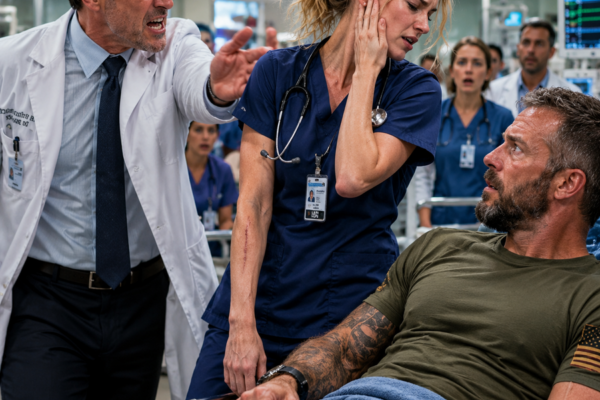
His right leg was immobilized. Three ribs were fractured, his spleen was bruised, and his body was covered in deep purple marks. A doctor had already warned Caitlyn that he had been lucky to survive.
She stood beside the bed.
For several seconds, she didn’t speak.
Then she reached out and touched his hair.
“You idiot.”
Cole opened his eyes.
“Good morning, Governor.”
She almost laughed. Instead, she gripped his hand.
“You were gone for three years.”
“I know.”
“Do you have any idea what I went through?”
“I heard you on the phone.”
Her expression hardened.
“What?”
“You were telling someone to turn Pine Creek upside down.”
“I was going to.”
“Don’t.”
Caitlyn stared at him.
“Don’t?”
“Not yet.”
She pulled a chair closer.
“The Pentagon has been looking for you. They’re sending a recovery team tomorrow. I’m holding a press conference. Boone and his deputies will be arrested before lunch.”
Cole looked at the ceiling.
“If you do that, the people above Boone will disappear before the cameras arrive.”
“Then we’ll arrest them too.”
“You don’t know who they are.”
“I know my own state.”
“You know its laws. That’s not the same as knowing its criminals.”
Caitlyn stood.
“Who did this to you?”
“Boone’s men.”
“Then we’ll start with Boone.”
“No. We’ll start with the reason he thought he could do it.”
She looked at him for a long time.
“What are you hiding?”
Cole turned toward her.
“Two years ago, Danny was investigating drug shipments through the border. He found evidence of police officers protecting the routes, county officials collecting money, and state politicians dividing the profits.”
“Where did you hear that?”
“From Boone’s men.”
Caitlyn’s face went pale.
“Danny was your mother’s friend.”
“He was more than that. He was the last person she spoke to before she died.”
“Her death certificate says heart failure.”
“Mom climbed stairs every day carrying trays of food. She worked fourteen hours a day and never complained. She didn’t die because her heart suddenly stopped.”
Caitlyn looked away.
She had suspected something was wrong. She had never been able to prove it.
“Why didn’t you tell me?”
“Because I didn’t know until tonight.”
He took a slow breath.
“Danny had a hard drive. The people who killed him wanted it. Mom knew where it was.”
“Do you think they killed her for it?”
“I know they did.”
Caitlyn sat down again.
For the first time since entering the room, she looked less like a governor and more like a daughter.
“What do you want me to do?”
“Keep working in the open. I’ll work in the shadows.”
“You can barely stand.”
“That’s temporary.”
“You’re not going anywhere.”
“I’m already gone.”
She looked at him sharply.
Cole continued.
“They think I’m dead. The men who buried me in that mine believe they finished the job. Let’s keep it that way.”
Caitlyn was silent.
Then she nodded.
“Three days.”
“What?”
“I’ll give you three days. After that, I’ll bring in the National Guard.”
Cole smiled faintly.
“Fair.”
“One more thing. No more disappearing without telling me.”
He looked at her.
“I can’t promise that.”
“Then I can’t promise not to kill you myself.”
For the first time, they both laughed.
It didn’t last long.
The mine had been abandoned for nearly a decade.
Cole returned there the following night.
He moved slowly, leaning on a walking stick. His ribs hurt with every breath, and the fracture in his leg made each step a negotiation with pain.
At the entrance, he found a burned patch of earth where his belongings had been destroyed.
His mother’s pocketwatch was gone.
So was the photograph he had carried since childhood.
The men had taken everything.
He knelt beside the ashes.
“I’m sorry, Mom.”
The wind moved through the empty mine.
He remembered the night he had been thrown into the shaft. The beating. The blood. The sound of Boone ordering his men to make it look like an accident.
He remembered the darkness.
And he remembered the voice that had pulled him back.
Cole. Cole, stay with me.
Caitlyn.
His sister had found him before he died.
He stood and examined the ground near the mine entrance. Tire tracks crossed the sand. One set belonged to the sheriff’s cruiser. Another belonged to a heavier vehicle.
The third was unfamiliar.
He photographed the tracks and sent them to Caitlyn through an encrypted channel.
Then he walked toward town.
The investigation had begun.
The next morning, Cole entered the sheriff’s office through the public entrance.
Doyle was behind the front desk.
The deputy looked up.
For a moment, he seemed unable to understand what he was seeing.
Then his hand moved toward his weapon.
Cole raised his own hand.
“Easy.”
Doyle stared.
“You’re dead.”
“Not today.”
“Boone said—”
“Boone says a lot of things.”
Cole leaned against the counter.
“I hear the state attorney general is offering immunity to informants.”
Doyle frowned.
“Who told you that?”
“Everyone’s talking about it.”
“No, they aren’t.”
“They will be.”
Doyle’s eyes shifted toward the corridor.
Cole watched him calculate.
The deputy had spent years obeying orders because he believed obedience would protect him. Now he was discovering that the man giving those orders had no intention of protecting anyone.
“Think carefully,” Cole said. “The first man to cooperate may walk away with a deal. The last man standing beside Boone will take the fall for everything.”
Doyle swallowed.
“You don’t know what you’re talking about.”
“Then you have nothing to worry about.”
Cole turned to leave.
“Wait.”
He stopped.
Doyle looked toward the corridor again.
“Boone killed Danny.”
“Where?”
“I don’t know. I drove the car. Boone chose the mine shaft.”
“And my mother?”
Doyle’s face changed.
Cole stepped closer.
“What happened to Margaret Banning?”
“I wasn’t there.”
“Who was?”
Doyle said nothing.
Cole waited.
Finally, the deputy whispered, “Boone.”
The office door opened.
Two men in plain clothes entered.
“Deputy Doyle?”
Doyle froze.
“Special Investigations Unit. We need to speak with you.”
Cole stepped aside.
The men approached the desk.
Doyle looked at Cole.
“You set me up.”
“No,” Cole replied. “You did that yourself.”
By noon, Doyle had agreed to cooperate.
He identified Boone as the person who had ordered Danny’s disappearance and directed the destruction of evidence. He also described a shipment route that ran through an abandoned copper mine.
The state attorney general secured a search warrant.
Before the warrant could be executed, Doyle was found dead in his holding cell.
The official report called it suicide.
Cole read the report twice.
Then he put it down.
“Boone doesn’t leave loose ends.”
Caitlyn stood beside him in the hospital corridor.
“Doyle’s testimony was recorded.”
“Was it backed up?”
“Three places.”
“Good.”
She looked at him.
“There’s something else.”
She handed him a photograph.
It showed the remains of Margaret’s diner.
The building had been searched and partially demolished under the pretext of an illegal structure inspection.
Cole stared at it.
“They’re destroying the evidence.”
“They’re looking for the hard drive.”
“Then we need to find it first.”
Caitlyn hesitated.
“Cole, there’s a problem. Boone has friends in the state government. If I use my office too openly, they’ll accuse me of abusing my authority.”
“Let them.”
“You don’t understand. They can suspend the task force. They can freeze the investigation.”
“Then don’t let them know what we’re doing.”
He pointed to the photograph.
“Mom left something behind.”
The letter was found in the remains of the diner.
It had been tucked inside a metal tin beneath the floorboards of the kitchen.
The paper was stained with grease and smoke, but the handwriting was unmistakable.
My child,
If you’re reading this, then you’ve come home.
Remember where our family always sat for Sunday service. The fifth pew on the aisle.
I kept something for you. Don’t trust the police officers you see. Not all of them wear the same uniform, but they all answer to the same people.
The truth will grow legs of its own. Sometimes it just needs someone with a gun to clear the road.
Your mother.
Cole read the letter twice.
Caitlyn stood behind him.
“She knew.”
“She knew enough to be afraid.”
“Why didn’t she tell me?”
“Because she was protecting you.”
He folded the letter carefully.
“The fifth pew.”
They drove to the old church that afternoon.
It was a small building with white walls and a red roof. Margaret had attended Sunday service there for most of her life. The fifth pew stood near the center aisle.
Cole ran his hand beneath the wooden seat.
He found a small envelope taped to the underside.
Inside was a key.
No label. No explanation.
Caitlyn examined it.
“Safe-deposit box?”
“Probably.”
“Which bank?”
Cole looked toward the old cemetery visible through the church window.
“Mom would have chosen somewhere nobody thought to look.”
They drove to the regional bank in the next town.
The clerk recognized Margaret’s name immediately.
“She rented a private box three years ago. Paid ten years in advance.”
“Did she leave any instructions?”
The clerk checked the record.
“Yes. She said her son would come for it one day.”
Cole closed his eyes.
Even after death, his mother had continued to prepare for his return.
The box contained a small external drive, a handwritten list, and a photograph of Danny.
Caitlyn connected the drive to a secure laptop.
The first folder contained payment records.
The second contained police reports.
The third contained shipping manifests.
The fourth contained names.
Dozens of them.
Some belonged to local officers. Others belonged to county officials, state contractors, and politicians.
One name appeared repeatedly.
Senator Whitman.
Caitlyn stared at the screen.
“That’s the Senate president.”
Cole scrolled through the files.
“Look at the dates.”
Eight years of transactions. Drug shipments crossing the border under the protection of local law enforcement. Payments routed through three states. Officials receiving money in exchange for amendments to a border security bill.
The evidence was substantial.
But it was incomplete.
Half the files were encrypted.
“Where’s the original?” Caitlyn asked.
Cole looked at the drive.
“Mom made copies. This isn’t the only one.”
“How many?”
He remembered the letter.
“Three, according to her records. The original, her backup, and one held by a state police captain.”
Caitlyn looked at him.
“Who has the original?”
“I don’t know.”
He picked up the handwritten list.
At the bottom, Margaret had written a single sentence.
The people who fear the truth most are the ones who will try to bury it.
Pine Creek changed after the first arrests.
The sheriff’s deputies stopped collecting protection money. The drug shipments slowed. Two local businesses reopened after years of paying for permission to operate.
But the town did not become peaceful.
It became frightened.
People who had spent twenty years obeying Boone suddenly found themselves unsure who was in charge.
Cole understood that fear.
He had seen it in villages overseas, in the eyes of men who knew armed strangers could arrive at any hour and take whatever they wanted.
Pine Creek had simply been conquered without an invasion.
Amy’s diner reopened in a temporary building near the highway.
Cole helped repair the kitchen.
“You don’t have to do this,” Amy said.
“I know.”
“You’re supposed to be hiding.”
“I can hide while carrying lumber.”
She laughed.
Then she noticed the way he favored his right leg.
“Your injuries aren’t healed.”
“They’re improving.”
“That’s not what I asked.”
He put down the hammer.
“Why did you stay?”
Amy looked at the empty road.
“Margaret helped me when I had nowhere else to go. I was sixteen. My father had disappeared, and my mother was sick. She gave me a job and a room above the diner.”
“She never told me.”
“She didn’t want you to think she was doing anything extraordinary.”
Cole looked at the half-built counter.
“That’s how she was.”
Amy brushed dust from her hands.
“She used to say the diner belonged to anyone who needed a place to sit.”
Cole nodded.
“Then we’ll keep it open.”
The first attempt on Caitlyn’s life came three days later.
She was traveling from the hospital to the state security office when her vehicle’s brakes failed.
Her driver shouted a warning.
Caitlyn grabbed the dashboard as the car accelerated toward a sharp bend.
The driver fought the steering wheel.
“Governor!”
“Downshift!” she ordered. “Use the engine. Turn toward the rock wall!”
The vehicle struck the barrier and spun across the road.
The airbags deployed.
For several seconds, nobody moved.
Then Caitlyn pushed open the door.
She was bleeding from a cut above her eyebrow, but she was alive.
State investigators found the brake line had been cut.
A bullet hole was also discovered in the rear panel of the vehicle.
The shot had come from a hillside overlooking the road.
Caitlyn ordered the scene secured.
She did not cancel her public schedule.
That evening, Cole visited her at the governor’s residence.
“You’re going to get yourself killed,” he said.
She gave him a tired smile.
“Look who’s talking.”
He examined the photograph of the damaged car.
“Whitman is running out of patience.”
“Or he’s getting nervous.”
“Same thing.”
Caitlyn placed a folder on the table.
“We traced several payments through accounts in three states. The money belongs to Whitman, but it passes through a private security company connected to a woman named Vera.”
Cole recognized the name.
“Who is she?”
“An intermediary. She handles drug shipments, illegal labor, and armed protection.”
“Where is she?”
“Across the border, most of the time.”
Cole studied the records.
There was another name.
Ramirez.
A man wanted by federal authorities for drug trafficking and organized violence.
Caitlyn closed the folder.
“This is bigger than Pine Creek.”
“It always was.”
The next week, a group of armed men attacked the diner after closing.
They wore masks and carried military-grade weapons.
They smashed the windows, overturned tables, and set fire to the storage room.
Amy escaped through the back door.
Cole arrived before the fire department.
He found one attacker in the alley and two more near the highway.
The fight lasted less than a minute.
The attackers had weapons, but they lacked discipline. They were accustomed to frightening unarmed people, not fighting someone trained to recognize movement before it became an attack.
Cole disarmed the first man, broke the second man’s wrist, and forced the third to surrender.
He found a military supply label on one of the rifles.
The serial number had been filed down.
He photographed it.
Then he saw something that made his blood turn cold.
A small insignia etched into the weapon’s stock.
It was the mark of a unit that had operated near Mosul.
Three years earlier, Cole’s team had been betrayed during a mission in that region. Two soldiers had died. Their position had been revealed to an enemy force before the operation began.
The informant had disappeared.
The investigation had gone nowhere.
Now the same network was supplying weapons to Vera.
Cole stared at the insignia.
“Dawson,” he whispered.
His former teammate had once told him that a man could run from a crime, but he could never outrun the people who remembered it.
Cole had remembered.
He would not forget.
Vera made contact two nights later.
Her message was delivered through a burner phone.
The woman is alive. Midnight. Old warehouse. Bring the hard drive.
Cole listened to the recording twice.
Amy had been taken.
Caitlyn wanted to send a tactical team.
Cole refused.
“They’ll kill her if they see uniforms.”
“Then we send plainclothes officers.”
“They’ll know.”
“Cole, this is exactly what they want. You alone, carrying evidence.”
He looked at his sister.
“I’m not bringing the drive.”
“Then what are you bringing?”
“My memory.”
Caitlyn stared.
He explained that he had memorized the essential contents of the files: payment dates, account numbers, shipping routes, names, and the locations of the original documents.
The hard drive itself would remain with the federal task force.
Caitlyn understood.
“It’s a trap.”
“Yes.”
“Then we’ll turn it into one.”
The abandoned warehouse stood near the old railroad yard.
Cole entered through the main door.
Vera was waiting beside a metal table.
She was elegant, composed, and entirely out of place among the rusted machinery.
Amy sat in a chair behind her. Her hands were tied.
“You came alone,” Vera said.
“You asked me to.”
“Where’s the drive?”
“Let her go.”
Vera smiled.
“You don’t understand how negotiations work.”
“I understand them perfectly.”
Cole looked at Amy.
She was frightened, but she was alive.
Vera nodded to a man behind him.
The man searched Cole and found nothing.
“No drive,” he reported.
Vera’s expression hardened.
“You’ve wasted my time.”
“No. I’ve brought you an opportunity.”
“What opportunity?”
“To leave this town alive.”
Vera laughed.
“You think you can threaten me?”
“No. I think you know the people you work for will abandon you the moment you become inconvenient.”
For the first time, Vera’s smile faltered.
Cole continued.
“Boone is gone. Doyle is dead. Whitman’s accounts are being frozen. Your routes are disappearing. You have one chance to cooperate.”
Vera stood.
“Take him.”
The warehouse lights went out.
A flashbang detonated near the loading entrance.
Men shouted.
Cole moved toward Amy, cutting the rope around her wrists. A second team entered from the rear, led by Dawson.
“Good to see you,” Dawson said.
“Thought you were retired.”
“I was.”
“Then why are you here?”
Dawson checked his weapon.
“Because you called.”
They secured the warehouse in less than five minutes.
Vera escaped through a side exit, but the task force recovered her ledgers and several encrypted phones.
Amy was taken to safety.
Cole watched the ambulances leave.
For the first time in two years, he allowed himself to believe that the network might actually be coming apart.
Then Caitlyn called.
“Whitman has moved.”
The Senate president had spent twelve years building his influence.
He had helped finance campaigns, controlled appointments, and maintained a private collection of secrets on nearly every important official in the state.
His power did not come from the office he held.
It came from the people who were afraid of losing theirs.
The moment the task force began freezing his accounts, Whitman activated his political network.
A legislative hearing was announced.
Caitlyn was accused of misusing public funds, abusing her authority, and protecting a wanted fugitive.
The task force was ordered to suspend its operations pending review.
The attorney general received a private call.
An hour later, the case files were sealed.
Caitlyn stared at the order.
“He has the attorney general.”
Cole shook his head.
“He has something on the attorney general.”
“What’s the difference?”
“The first one is power. The second is blackmail.”
She looked at him.
“The hearing is in five days.”
“Then we have five days.”
“You can’t enter the legislature.”
“I don’t need to.”
She studied him.
“I’m scared this time.”
Cole nodded.
“Good.”
“Good?”
“Fear keeps you from making careless decisions. Just don’t let it make the decisions for you.”
She gave him a tired smile.
“Mom would have said the same thing.”
The leak came from inside Caitlyn’s office.
The first witness protection address was compromised. The second was compromised. A third witness disappeared before federal agents could reach him.
Cole examined the communication logs.
Each leak had occurred shortly after a meeting with the governor’s senior staff.
Only one person had access to every schedule, every location, and every internal document.
Greg Morrison.
He had worked for Caitlyn for ten years.
He had helped arrange her campaign appearances, managed sensitive correspondence, and attended nearly every closed-door briefing.
Caitlyn refused to believe it.
“He’s been with me since the beginning.”
“That’s why he knows everything.”
“I paid for his daughter’s education.”
Cole looked at the financial records.
The tuition had cost more than a hundred thousand dollars a year. Greg’s salary could never have covered it.
Whitman had paid the difference.
“Your trust was his cover,” Cole said.
Caitlyn closed the folder.
“How do we prove it?”
“Give him something worth stealing.”
The next day, Caitlyn announced that the original hard drive would be transferred to federal custody on Friday morning.
She told Greg that the drive was stored in the underground vault beneath the governor’s residence.
She gave him the password.
Her birthday.
It was a deliberate mistake.
Greg took the bait.
At 2:14 a.m., security cameras recorded him entering the residence.
At 2:19, he accessed the vault.
At 2:23, he left carrying a small case.
Cole was waiting in the garage.
“Looking for this?”
Greg stopped.
For several seconds, he stared at the case in Cole’s hand.
Then he began to shake.
“You set me up.”
“No,” Cole replied. “You chose the money.”
“I gave Whitman ten years of my life.”
“You sold your governor’s trust for ten years of tuition payments.”
“You don’t understand. He has people everywhere.”
“Then you should have thought about that before you helped him.”
Greg tried to leave.
Cole blocked the door.
“Where is Whitman keeping the original records?”
“I want a lawyer.”
“Fine.”
Greg looked at him.
“Do you think he’ll protect me?”
Cole said nothing.
Greg understood the answer.
“The beach house. The private jet. The accounts in Nevada. It was all Whitman.”
“And the witnesses?”
Greg’s face collapsed.
“He gave the locations to Vera.”
Caitlyn entered the garage.
She looked at the man who had worked beside her for ten years.
“Why?”
Greg began to cry.
“Because I thought it would never end.”
Caitlyn’s voice was quiet.
“It ended the moment you betrayed us.”
Greg was arrested.
But before he could testify, he died in custody.
The medical report listed cardiac arrest.
Cole read it and closed the folder.
“Another heart attack.”
Caitlyn looked at him.
“Someone is cleaning the board.”
“Then we need to move faster.”
The hearing began on a Monday morning.
The legislature chamber was full.
Reporters crowded the aisles. Political aides whispered behind closed doors. Security officers watched the entrances.
Caitlyn entered alone.
She carried no prepared speech.
She placed a single folder on the table.
The Senate president sat across from her.
Whitman was in his late sixties, silver-haired and immaculate. He had the practiced expression of a man who had never been forced to answer a question he didn’t want to hear.
“Governor Banning,” he began, “do you deny that your office has used state resources to protect a fugitive?”
Caitlyn looked at him.
“I deny that my office has protected a criminal.”
“Your brother is wanted in connection with arson.”
“My brother is a witness in a federal investigation.”
“Then why hasn’t he turned himself in?”
“Because the people who murdered our mother are still free.”
A murmur passed through the chamber.
Whitman leaned forward.
“Are you accusing someone?”
“Yes.”
“Who?”
Caitlyn opened the folder.
“You.”
The room went silent.
She presented the first document.
Then the second.
Then the third.
Payment records. Border patrol schedules. Shipping manifests. Wire transfers. Communications between county officials and private security companies.
The evidence was overwhelming.
But it was not enough.
Half the original files remained encrypted.
Whitman stood.
“This is fabricated material. The governor has abused her office and manipulated evidence to attack political opponents.”
Caitlyn did not respond.
She knew he was waiting for her to lose control.
She had no intention of giving him that satisfaction.
Then the lights flickered.
A gunshot shattered the chamber window.
Caitlyn fell.
Cole heard the shot through his earpiece.
“Governor down!”
He was outside the building, watching the eastern entrance.
He ran.
A security officer shouted for him to stop. Cole ignored him.
Inside, Caitlyn lay on the floor with blood spreading across her shoulder.
“Cole,” she whispered.
He dropped beside her.
“Stay with me.”
“Don’t let them stop the hearing.”
“Don’t talk.”
“Cole—”
“Save your strength.”
The medical team arrived.
A paramedic examined the wound.
“She needs a transfusion immediately.”
Cole looked up.
“Take mine.”
The paramedic hesitated.
“Are you certain?”
“Same blood type.”
They moved Caitlyn toward the ambulance.
An officer grabbed Cole’s arm.
“Commander, you need to come with us.”
Cole looked at the officer.
“Not now.”
“Sir, you’re a wanted fugitive.”
Cole’s voice dropped.
“My sister is fighting for her life. Anyone who gets in my way will regret it.”
The officer released him.
The surgery lasted four hours.
Caitlyn survived.
The bullet had missed the artery by less than two centimeters.
Cole remained outside the operating room until the surgeon emerged.
“She’ll recover.”
He closed his eyes.
For the first time in years, he felt his legs weaken.
He sat down.
A uniformed officer approached.
“Commander Banning?”
Cole looked up.
The officer carried a sealed envelope.
“The Department of Defense has confirmed your identity. They have been searching for you for three years.”
Cole said nothing.
“Your unit designation is Desert Eagle?”
“Yes.”
The officer nodded.
“Your service record has been verified. The President has approved the retroactive presentation of your Medal of Honor.”
Cole looked through the glass toward his sister.
“Tell them to wait.”
“Sir?”
“My sister comes first.”
The investigation expanded overnight.
Federal agents recovered the missing portion of the hard drive from a protected state police archive. The second backup was found in the possession of a retired captain who had been receiving payments from Margaret for years.
He had been one of her informants.
He had kept the drive because he knew she would eventually need it.
The files revealed the full extent of Whitman’s operation.
Drug routes. Smuggling networks. Bribed officials. Illegal labor camps. Weapons shipments. Murder orders.
And one more name.
Ramirez.
He was not merely a drug lord.
He was the financier behind the entire border network, controlling armed groups on both sides of the border and using political officials to keep law enforcement away from his operations.
Vera worked for him.
Whitman protected him.
Boone had handled the local murders.
Margaret had been killed because she refused to reveal where Danny’s evidence was hidden.
The final file contained a recording.
It was dated two years earlier.
The night Margaret died.
Cole listened to it alone.
He heard Boone’s voice.
He heard Vera’s.
Then he heard his mother’s.
She was weak, but her voice remained steady.
“You can beat me until I stop breathing. You can burn my diner. You can take everything I own. But you’ll never get the drive.”
Boone laughed.
“Where is it?”
“Somewhere your kind will never find.”
There was a sound of a blow.
Then silence.
Cole stopped the recording.
He sat in the dark for a long time.
His mother had faced the men who killed her without giving them what they wanted.
He would not let her courage become another forgotten case.
Ramirez responded with an army.
The first intelligence report described a convoy of more than sixty vehicles moving toward the border.
Armed personnel. Heavy weapons. Military-grade equipment.
The National Guard prepared to intercept them.
But Pine Creek stood directly in their path.
Evacuating the town would take six hours.
The convoy could arrive in four.
Caitlyn was still recovering in the hospital when Cole received the briefing.
“Move the children and the wounded first,” he ordered. “Then the elderly. Keep the evacuation routes open.”
A state police captain looked at the map.
“We can’t hold the perimeter with the personnel available.”
“We don’t need to defeat them here. We need to buy time.”
“And if they reach the town?”
Cole looked around the room.
“Then we make sure they find nothing but an empty street.”
An old man entered.
He was called John. He had once worked with Margaret and had spent ten years passing information to the field office.
He placed a folder on the table.
“My records.”
Cole opened it.
“Ten years of informant payments?”
“Yes.”
“You know what happens if you sign this?”
John nodded.
“I’ve spent enough time hiding from what I did.”
A younger man followed him.
“My father was taken by Boone. I want to help.”
Cole looked at him.
“Do you know how to shoot?”
“No.”
“Then you stay with the evacuation team.”
The man looked disappointed.
Cole put a hand on his shoulder.
“Protecting people doesn’t always mean carrying a gun.”
The convoy reached the outer road before dawn.
The National Guard established roadblocks along the main highway. State police positioned armored vehicles near the canyon.
Pine Creek was nearly empty.
The diner stood dark.
Cole walked through its kitchen one final time.
He touched the counter where Margaret used to prepare dough.
Then he stepped outside.
A radio crackled.
“Convoy approaching.”
“Hold position.”
“Multiple vehicles. Heavy weapons confirmed.”
“Do not engage until they cross the perimeter.”
The first explosion came from the southern road.
A second followed.
The convoy split into three groups.
Cole watched the tactical map.
“They’re trying to force a breach.”
A captain turned toward him.
“Orders?”
Cole pointed to the western road.
“Let them think it’s open.”
The captain frowned.
“That’s the route to the old smuggling tunnel.”
“Exactly.”
Whitman was supposed to be under federal guard.
Instead, he disappeared from custody.
A forged transfer order had moved him from the detention center to a private medical facility. By the time the authorities discovered the deception, he was already on the road.
His first call went to Ramirez.
“I have a route out.”
Ramirez’s voice was cold.
“You have a great deal of debt.”
“I can give you the governor.”
“And the hard drive?”
“I can get it.”
“You have until noon.”
Whitman ended the call.
He believed that if he escaped across the border, he could rebuild his influence.
He did not know that Cole had been waiting for him.
The route he had been given was the only one not blocked by federal checkpoints.
It led directly into a controlled interception zone.
When Whitman’s vehicle reached the canyon, armored units closed the road.
“Hands where we can see them!”
Whitman stared at the soldiers.
“Do you know who I am?”
A federal marshal approached.
“Yes. You’re a fugitive.”
Whitman was pulled from the vehicle and placed in handcuffs.
His empire had begun to collapse.
Now it was his turn.
Ramirez retreated to an underground stronghold near the border.
The compound had been built around an abandoned smuggling network. Its tunnels connected to multiple routes across the international boundary.
The task force found the entrance using maps recovered from the warehouse.
Cole studied the layout.
“Forty guards. Two heavy weapons positions. Three exits.”
The captain nodded.
“We can storm the main entrance.”
“No. We close the exits first.”
“What about the weapons?”
“Disable the positions. Then wait.”
“Wait for what?”
“For Ramirez to believe he still has a way out.”
The operation began at midnight.
Federal agents secured the outer perimeter. National Guard units blocked the northern approach. A special operations team moved through the drainage tunnel.
Cole entered with the first group.
The compound was larger than expected.
He found ledgers, cash, weapons, and rows of storage containers.
The walls were covered in maps.
Twenty years of criminal operations.
The entire network was there.
“Commander,” Dawson said over the radio. “We’ve secured the eastern chamber.”
“Any sign of Ramirez?”
“Negative.”
Cole looked toward the main tunnel.
“Leave it open.”
The captain frowned.
“He’ll escape.”
“No. He’ll come through.”
Cole knew men like Ramirez.
They could abandon money, weapons, and even loyal followers.
But they could not accept defeat.
Ramirez would come looking for the man who had destroyed his operation.
The tunnel lights flickered.
A figure emerged from the darkness.
Ramirez.
He was accompanied by two armed guards.
Cole stepped forward.
“It’s over.”
Ramirez looked at the soldiers behind him.
“You think you can take me?”
“We already have.”
Ramirez laughed.
“You’ve destroyed twenty years of work.”
“You built it on dead people.”
“Dead people don’t matter.”
Cole’s expression did not change.
“My mother did.”
Ramirez stared at him.
“Margaret Banning.”
“You remember her.”
“I remember stubborn women.”
“You remember the night Boone killed her?”
Ramirez’s smile faded.
Cole held up a small recorder.
“We have the testimony. We have the payment records. We have the routes, the officials, and the orders.”
“You have nothing without me.”
“We have everything without you.”
Ramirez reached for his weapon.
Cole moved first.
The guards were disarmed. Ramirez was forced against the tunnel wall.
For the first time, the man who had controlled the border stood with nowhere to run.
“You could have taken the money,” Ramirez said.
Cole looked at him.
“I didn’t come home for money.”
He nodded to the federal agents.
“Take him.”
The trial lasted months.
Whitman was convicted of murder, bribery, drug trafficking, obstruction of justice, and organized crime. He was sentenced to life without the possibility of parole.
Vera accepted a plea agreement and received the same sentence.
Ramirez was convicted of drug trafficking, money laundering, murder, and running an armed criminal organization. He would spend the rest of his life in federal prison.
Boone was convicted of first-degree murder, drug trafficking, and abuse of power. The evidence proved that he had ordered the deaths of Danny and Margaret.
The jury found him guilty on every count.
Doyle’s death was reclassified as murder.
The remains of reporter Danny were recovered from the abandoned mining district.
His family finally received a proper burial.
And Margaret Banning’s case was officially reopened.
The recording from the night she died became the final piece of evidence.
The town listened to it in silence.
No one forgot her voice.
The morning of the sentencing, Cole visited the cemetery.
He brought a fresh apple pie.
The old watch had been repaired. Its hands moved again, ticking steadily beneath the glass.
He placed it beside the headstone.
“Mom,” he said, “they’re all gone.”
The wind moved through the trees.
“Boone. Vera. Ramirez. Whitman. They’re going to spend the rest of their lives answering for what they did.”
He looked at the watch.
“Danny’s family has his remains. Dawson’s family has the truth about Mosul. The town is safe.”
He paused.
“I still owe you one thing.”
A voice behind him interrupted.
“You owe me breakfast.”
Caitlyn stood near the cemetery gate.
Her shoulder was still healing. She moved carefully, but she was no longer using a cane.
Cole smiled.
“Governor.”
“Don’t start.”
She walked toward the grave and placed a small bouquet beside the pie.
“Mom, your daughter is still working too much.”
Cole looked at her.
“Some things never change.”
Caitlyn laughed.
Then she became serious.
“The legislature passed the resolution this morning.”
“What resolution?”
“Margaret Banning Day. Every year, on the anniversary of her death, Pine Creek will close its government offices and hold a public remembrance.”
Cole looked down.
“That’s good.”
“There’s more. The diner has been officially designated a historic community building. The town is funding its restoration.”
“Who suggested that?”
“Everyone.”
They stood quietly for a moment.
Then Caitlyn took his hand.
“You know, Mom would have hated all this attention.”
“She would have complained about the paperwork.”
“And then she’d have baked everyone a pie.”
Cole nodded.
“That’s what she’ll be remembered for.”
The Pentagon ceremony took place at Arlington National Cemetery.
Cole stood in dress uniform before a row of military officers.
His service record had been reviewed. The mission near Mosul, the rescue of his squad, and the operation that had earned him the Medal of Honor were all confirmed.
The award had been delayed because he had disappeared before the investigation was completed.
Now the President formally presented the medal.
“Commander Cole Banning,” the citation began, “for extraordinary courage and conspicuous gallantry in action…”
Cole listened without moving.
He thought about the two soldiers who had not come home.
He thought about Dawson.
He thought about Margaret.
When the ceremony ended, a senior officer approached him.
“The Department would like you to return to active service. We’ve prepared a position for you at the Special Operations School.”
Cole looked at the medal in his hand.
“What position?”
“Commandant. It would be a significant responsibility.”
“I appreciate the offer.”
“Then you’ll accept?”
Cole looked toward Caitlyn.
She stood at the edge of the crowd, waiting.
He smiled.
“Tell them my war is over.”
The officer seemed surprised.
“Commander, you’re one of the youngest candidates we’ve ever considered.”
Cole handed the medal back to the presentation case.
“My mother used to say that the truth should be served hot.”
He paused.
“So should pie.”
Pine Creek’s diner reopened in the spring.
The new building had a wide front window, a larger kitchen, and a small wooden sign above the door.
MARGARET’S PIE HOUSE.
Amy kept the original recipe exactly as Margaret had written it.
Four-thirty in the morning, every day.
The first batch sold out before sunrise.
People came from neighboring towns. Truck drivers stopped along the highway. Children sat at the counter and asked for extra cinnamon.
On the first Margaret Day, the entire town gathered outside.
They brought flowers, photographs, and apple pies.
Some remembered Margaret as the woman who had given them a meal when they were hungry. Others remembered her as the person who had helped them find work, paid a medical bill, or listened when nobody else would.
Cole stood near the back.
He had brought his sister.
He had brought Dawson’s wife and child.
He had brought the families of the soldiers who had died overseas.
And he had brought a small framed photograph of Margaret standing behind the old diner counter.
Amy approached him.
“Your mother would have loved this.”
Cole looked around.
“I think she would have complained about the crust.”
Amy laughed.
“She would.”
A little girl ran past them carrying a plate with a slice of pie.
“Mom says this is the best pie in Arizona!”
Cole watched her disappear into the crowd.
For a moment, he could almost hear Margaret laughing.
That evening, Cole returned to the cemetery with Caitlyn.
The sun was setting behind the mountains.
He placed the repaired watch against the headstone.
“Mom,” he said, “I brought the family this time.”
Caitlyn stood beside him.
“Your son finally learned to come home.”
Cole smiled.
They remained there until the last light disappeared.
A week later, an invitation arrived from the Pentagon. The Special Operations School was still offering him the position of commandant.
Caitlyn read the letter over breakfast.
“You’re turning it down?”
“Already did.”
“You could make a difference there.”
“I know.”
“Then why?”
Cole looked toward the kitchen.
Amy was taking a fresh pie from the oven. The smell of apples and cinnamon filled the room.
“Because I spent too long believing that the only place I could be useful was somewhere people were shooting at me.”
Caitlyn folded the letter.
“And now?”
“Now I want to stay.”
She looked at him.
“Are you sure?”
Cole nodded.
“My mother spent thirty years waking up before dawn to feed people. She never needed a medal to know her work mattered.”
He stood and carried the pie to the counter.
Amy cut the first slice.
Caitlyn took a bite.
Then she closed her eyes.
“That’s Mom’s recipe.”
Cole smiled.
“Close enough.”
Outside, the highway carried another line of trucks through Pine Creek. Their headlights moved across the windows, one after another, like small stars passing through the dark.
The town was no longer afraid of the men who wore badges.
The diner was open.
The watch was ticking.
And Cole Banning, the soldier once known as Desert Eagle, was finally home.
“Mom,” he whispered, looking toward the mountains, “the pie is baked. The house is settled.”
He took his sister’s hand.
“Your son isn’t leaving again.”