Sheriff Mocked the Quiet Night Nurse — Until His Prisoner Saw Her and Begged “Keep Her Away From Me”
Sheriff Mocked the Quiet Night Nurse — Until His Prisoner Saw Her and Begged “Keep Her Away From Me”
Nobody asked the night nurse.
Sheriff Dale Pruitt said it loud, loud enough for the whole emergency room to hear. Sloane Whitaker stood at the foot of the gurney, clipboard in hand, bright blue scrubs wrinkled from 10 hours on her feet.
Sheriff, he hit his head in a rollover. He needs a CT scan.
We don’t have one here.
He needs a cell.
Pruitt hooked his thumbs into his gun belt.
Drunk drifter rolled his truck into Miller’s Creek.
Patch him up.
I’m taking him before sunrise.
One deputy laughed.
The younger one didn’t.
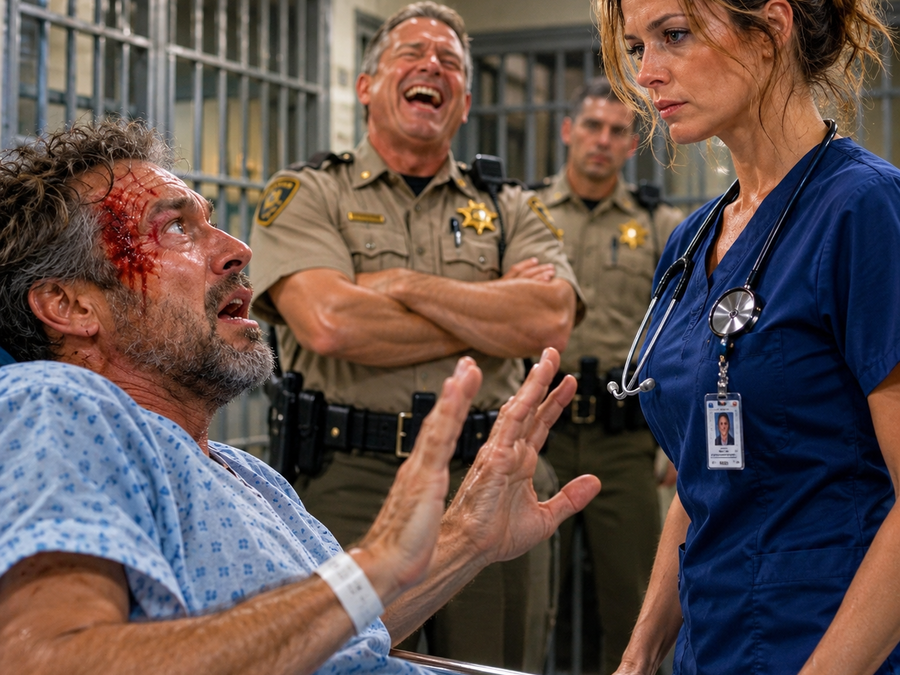
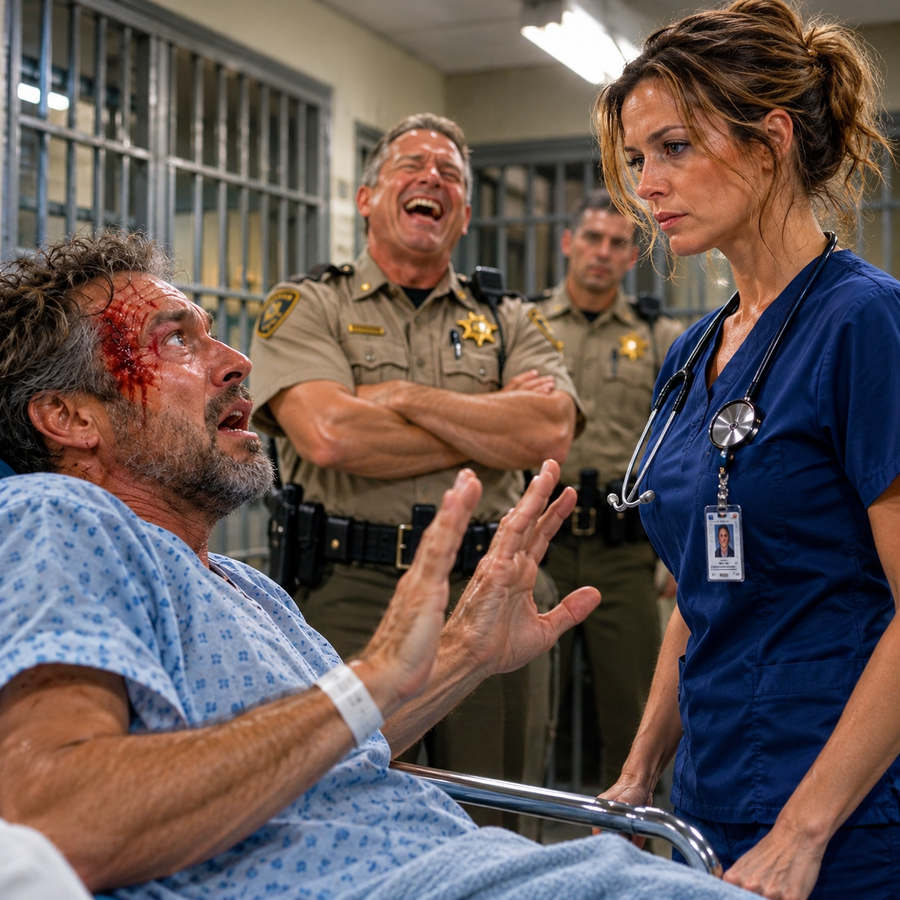
On the gurney, the prisoner groaned. Both wrists were cuffed to the steel rails.
Dried blood streaked his gray beard. Then he opened his eyes.
He looked at the sheriff first, then at the ceiling lights, then at the nurse, and every drop of color drained from his face.
His breathing turned fast and shallow.
The cuffs rattled against the rails. No, he whispered.
No, no, no. Settle down, Pruitt snapped.
The man didn’t settle.
He twisted away from Sloane like she was holding a blade. Keep her away from me.
His voice cracked.
Sheriff, I’m begging you.
Keep her away from me.
For the room went dead silent.
Then Sheriff Pruitt burst out laughing. You hear that, boys?
Big tough drifter scared of the night nurse.
He slapped the rail.
What’s she going to do, pal?
Take your temperature?
The older deputy laughed harder.
Sloane didn’t laugh.
She didn’t move at all because she knew that face.
She had seen it 6 years ago over the sights of a pistol in a rain-soaked alley in Mobile, Alabama.
She had put handcuffs on that man herself.
And he was supposed to be locked inside a federal prison for the next 25 years. Before we find out what Sloane did next, I want to know something.
Where in the world are listening from tonight? Tell us in the comments.
If you believe the quiet ones deserve more respect, tap that like button and subscribe so the next story finds you. Welcome to Hidden Badges Stories.
Harland Creek Community Hospital had 12 beds, one ambulance bay, and no surgeon after 6 p.m.It sat at the end of a two-lane road in the Ozark Mountains of northern Arkansas.
The nearest trauma center was 2 hours away.
On a clear night, the helicopter could make it in 40 minutes.
Most nights, nothing happened. Most nights, Sloan Whitaker liked it that way.
She had worked the night shift for 4 years, always nights, never weekends off, never a complaint. The town knew three things about her.
She was 39.
She was divorced or maybe widowed.
Nobody was sure.
And she didn’t talk much.
They didn’t know the rest.
They didn’t know why she always sat with her back to a wall or why she knew every exit in every room or why her eyes went to a man’s hands before they went to his face.
Old Bev Tolliver, the charge nurse, called it Sloan’s thing.
She’s just careful, Bev would say.
Some people are careful.
Sheriff Dale Pruitt called it something else.
He called her nurse paperwork.
The name started last spring.
A deputy had brought in a young man from the county jail. The kid had bruises on his ribs, fresh ones shaped like the toe of a boot.
Sloan documented every bruise. She measured them.
She photographed them. She filed a report with the state.
Nothing came of it, nothing ever did in Harland Creek, but Pruitt never forgot. Every time he walked into the ER, he made sure everyone remembered too.
Careful what you say, boys, he’d grin.
Nurse paperwork is taking notes. People laughed.
Sloan kept working. She had learned a long time ago that silence was not weakness.
Sometimes it was the only armor you had left.
Now she stood beside a man who should not exist in this room.
Vance Kettering, 51 years old, armored truck robber, shot a guard in Pensacola and left him in a wheelchair, ran for 14 months before Sloane’s task force found him.
She kept her face blank. Her hands stayed steady on the clipboard, but inside the memory hit like a wave.
Rain on concrete, a stairwell that smelled like rust, her partner Deputy U.
S.
Marshal Eli Navarro on his back with a bullet wound in his neck. Her fingers pressed into the wound.
11 minutes of pressure, 11 minutes of telling him to stay with her.
He didn’t, and somewhere below them, Vance Kettering had been running.
She had chased him four blocks in the rain, alone. She had brought him down on the hood of a parked car.
At his trial, Kettering’s lawyer asked if he had any regrets.
Kettering had looked straight at Sloane.
Only one, he said, that I didn’t run faster from her.
Sloane blinked. The memory faded.
The fluorescent lights came back.
She stepped closer to the gurney. Sir, I need to check your pupils.
Kettering flinched so hard the rail clanged.
Don’t, he breathed.
Whitaker, please.
Her name, her real name, spoken by the one man in Arkansas who knew what it meant. She leaned down with her penlight, close enough that only he could hear.
Hello, Vance. His eyes filled with something she had seen before, not anger, fear.
Pupils equal, reactive. Good.
She moved her hand to his abdomen.
Kettering winced when she pressed the upper left side. A purple seat belt bruise crossed his chest and belly like a sash.
She checked the monitor. Heart rate 118, blood pressure 102 over 64.
Too fast, too low for a man lying still, that bruise, that injury, that pulse. His spleen was bleeding, slowly now.
Not slowly for long.
She straightened up and turned to the sheriff.
What’s his name?
Pruitt shrugged. Says Bobby Lee Carter.
No ID, no wallet.
Did you run his prints? The sheriff smiled, froze for half a second.
Just half. Sloan saw it.
Machines down, he said.
We’ll do it at the jail.
The younger deputy shifted his weight.
His name tag read Rash. He was 24.
He had been a deputy for eight months.
He didn’t look at the sheriff.
He didn’t look at anybody.
Sloan filed that away too. Doctor Martin Ames came in from the back office, rubbing his eyes.
He was 64, a family doctor who covered ER nights because nobody else would. He examined Kettering for two minutes.
His face grew serious. Possible splenic injury, he said.
He needs imaging and a surgeon. We should call for the helicopter.
No.
Pruitt didn’t even let him finish.
He’s a drunk with a belly ache.
The county is not paying $10,000 to fly a drifter to Springfield.
Sheriff, if he’s bleeding internally.
Then stop the bleeding, Doc.
That’s your job.
Pruitt pointed at the door. My job is getting him to my jail.
4:00 a.m.he’s gone.
Dr.Ames opened his mouth, then he closed it.
Dale Pruitt had been sheriff for 16 years.
He knew every family in the county. He knew who owed money and who drank too much.
In Harlan Creek, people didn’t argue with him.
Bev touched Sloan’s arm.
Leave it, honey, she whispered.
It’s not worth it.
Sloan looked at the clock.
2:58 a.m.4 o’clock.
That was a strange time to move a prisoner.
Too early for the jail, too late for a shift change, and the sheriff didn’t come out himself at two in the morning for a drunk driver, not unless the drunk driver was worth something.
Pruitt clapped his hands.
All right, new rule tonight, all phones in this bucket. He grabbed an empty glove box from the counter.
Prisoner security, nobody takes pictures of my detainee.
Dale, that’s not Dr.Ames began.
Phones, doc. One by one they dropped their phones in the box.
Bev, Dr.Ames, the older deputy, Briggs.
Even Deputy Rash hesitated, then dropped his own.
Sloane held her phone a moment longer. Pruitt stepped close to her.
He smelled like coffee and cigarettes. Problem, nurse, paperwork?
She dropped it in the box. No problem, sheriff.
He grinned and walked away. Sloane went to restock the trauma cart.
Her hands moved on their own, gauze, tape, large-bore IV catheters. But her mind was somewhere else, a federal fugitive, no booking, no prints, no phones, a 4:00 a.m.pickup.
She had seen this pattern before in other towns, in other states.
This wasn’t an arrest, it was a delivery.
Ma’am?
The voice came from behind the curtain of bed two.
Sloane pulled it back.
Hollis Dean was sitting up against his pillows, 78 years old, pneumonia, admitted two days ago.
He had been an army military police officer for 22 years.
He still wore his old unit cap in bed.
You should be sleeping, Mr.Dean.
Can’t sleep.
Too much fun out here. He lowered his voice.
Come closer. She did.
You sit like a cop, he said. I sit like a tired nurse.
No, ma’am.
He tapped his own temple.
I did 22 years.
I know a cop’s eyes when I see them.
You check hands first, always hands, then doors. Sloane said nothing.
That man in the cuffs knows you, Hollis went on.
He’s scared to death of you, and the sheriff isn’t booking him.
I’ve watched the whole thing, no paperwork, nothing.
You notice a lot, Mr.Dean.
There’s more.
The old man glanced toward the window behind his bed.
It faced the back parking lot. 20 minutes ago, the sheriff stood right out there on his cell phone, his personal phone, not the radio.
What did he say? Hollis Dean repeated it word for word.
His old MP training still worked.
4:00 back bay and bring the rest of it. Sloane felt the air go cold around her.
The rest of it, the rest of the money.
She squeezed the old man’s hand.
Thank you, Mr.Dean.
Stay in this bed, no matter what you hear.
Ma’am, he said quietly, who are you?
She pulled the curtain closed without answering.
The medication room was the only room with a keypad lock.
It also had the only landline phone that Pruitt hadn’t thought about.
Sloane locked the door behind her.
She didn’t need a phone book.
Some numbers you never forget.
She dialed from memory. It rang four times.
Hollander. The voice was rough with sleep.
Ray, it’s Sloane Whitaker.
Silence. Then the sound of a man sitting up fast in bed.
Ray Hollander had been her team leader on the Gulf Coast Regional Fugitive Task Force.
Now he was the chief deputy US Marshal for the Western District of Arkansas in Fort Smith.
Sloane, it’s 3:00 in the morning.
Are you okay?
I’m fine.
Listen to me.
She kept her voice low and flat. I have Vance Kettering in bed four, Harland Creek, Arkansas.
For a second, she heard nothing at all.
Say that again.
Vance Kettering, rollover crash, possible splenic bleed. The county sheriff brought him in as a John Doe.
He hasn’t been printed.
He hasn’t been booked.
Sloane Catering went out the back of a Bureau of Prisons transport van in Oklahoma 19 days ago.
Every marshal in America is looking for him.
I know.
That’s why I called.
His brother Wade was spotted near Fayetteville last week.
Ray’s voice hardened.
If the sheriff’s sitting on him pick up is at 4:00 a.m.back ambulance bay.
Someone’s bringing money.
How do you know that? A retired MP with pneumonia heard it through a window.
Ray almost laughed.
Almost. Okay.
My team is 2 hours out, maybe more.
I’m calling Arkansas State Police right now.
Their closest unit could be there in 40 minutes. 40 minutes, she repeated.
That’s tight.
Sloane, listen to me.
His voice softened.
You are not a deputy anymore.
You don’t have a badge.
You don’t have a weapon.
Do not engage. Do you hear me?
Sloane looked down at her hands.
They were perfectly steady.
I hear you, Ray.
I know exactly what I am.
The door handle jerked.
Someone was punching the keypad. Wrong code again, again.
Then a fist hit the door. Open it.
Pruitt, Sloane spoke fast. Ray there.
The door flew open.
Bev stood behind the sheriff, white-faced.
She had given him the code.
Pruitt snatched the phone from Sloane’s hand.
He listened. The line was already quiet.
Ray had hung up the instant he heard the shouting. Old habits.
Pruitt slammed the receiver down. Then he ripped the cord out of the wall.
Who are you calling? The pharmacy in Springfield.
Sloane said evenly.
We’re low on tranexamic acid.
Pruitt stared at her for a long moment.
His jaw worked.
You think I’m stupid?
I think your prisoner is bleeding, sheriff, and I think I’d better get back to him.
She stepped around him.
He grabbed her arm.
For one instant, everyone in the hallway saw something strange.
Sloane didn’t pull away.
She didn’t flinch.
She simply looked down at his hand on her arm, then up at his face.
Her eyes were calm, flat, cold as creek water in January.
Pruitt let go.
He didn’t know why.
Do your job, nurse, he muttered.
That’s all I’ve been doing all night.
The monitor in bed four began to alarm. Sloane reached it first.
Heart rate 132, blood pressure 88 over 52.
Kettering’s skin was gray and slick with sweat.
His lips had gone pale. Doc, she called.
He’s dropping.
We need blood now.
Dr.Ames came running.
Bev wheeled the trauma cart.
Kettering’s eyes rolled towards Sloane.
Don’t let me die here, he whispered.
Not here.
Nobody’s dying in my ER tonight, Vance.
Not even you.
She tied a tourniquet on his arm. His veins were flat, collapsed.
Shock does that. The body pulls blood away from the skin to save the heart and brain.
She tried once. Nothing.
Dr.Ames was already shaking his head.
We’ll have to do a central line.
That’s 10 minutes at least.
He doesn’t have 10 minutes.
Sloane grabbed the intraosseous drill from the cart, a small battery-powered device. It drives a needle directly into the bone where the marrow can carry fluid straight into the bloodstream.
Most rural nurses had seen it in a training video, maybe once.
She cut away Kettering’s sleeve.
She rotated his arm inward and placed his hand on his belly. With two fingers, she found the bump of the humeral head at the top of his shoulder.
She placed the needle, squeezed the trigger.
One smooth push. 3 seconds.
She pulled the stylet, confirmed the flush, and connected the line. Humoral IO is in.
Hang the O negative, doctor. Ames stared at her.
Where on earth did you learn a humeral IO like that? Night school.
Bev hung the first unit of O negative blood.
The tiny hospital kept only four units on hand.
They were going to need them. Sloane drew up the tranexamic acid, 1 g slow push over 10 minutes.
The crash had been just after 1:30. They were still inside the 3-hour window where the drug could help his blood clot.
Warm the second unit, she said, and get the pelvic binder, just in case.
Bev moved without a word. 30 years of nursing, and she had never seen anyone run a trauma like this, not in Harland Creek, not anywhere.
Slowly the numbers turned.
Blood pressure 96 over 58, heart rate 121, not safe but alive.
Deputy Rash stood by the curtain.
He had watched every second.
Ma’am, he said quietly, can I tell you something?
Sloane didn’t look up.
Talk while I work.
The sheriff told me not to run his prints. He said the machine was down.
The young deputy swallowed hard.
The machine isn’t down.
I used it yesterday. I know Cody, you know?
I’ve known since he said it.
Across the room, Sheriff Pruitt checked his watch.
3:44.
He walked to bed four and leaned over Kettering.
16 minutes, he whispered.
Your brother’s almost here.
Just keep breathing.
Kettering grabbed the sheriff’s sleeve with his cuffed hand.
His voice was weak but sharp.
You fool, you don’t know who she is.
Who? The nurse.
She’s a United States marshal.
Kettering’s eyes burned.
She ran me down in Mobile, four blocks in the rain. She put me away for 25 years.
Pruitt laughed, but it came out thin.
She’s a small town nurse, Vance.
She empties bed pans. She was on that phone.
I saw her face when she came out. Kettering let go of the sleeve.
They’re already coming.
You just don’t know it yet.
Sheriff Pruitt straightened slowly.
He turned around. Sloane was standing 3 ft behind him.
She had heard every word.
Who are you? Pruitt asked.
For four years, Sloane Whitaker had answered that question the same way.
I’m just the night nurse.
Tonight, she didn’t.
My name is Sloane Whitaker. I served nine years with the United States Marshal Service, supervisory deputy, Gulf Coast Regional Fugitive Task Force.
Her voice was low and steady.
And that man is a federal fugitive, Dale. The hallway went silent.
Bev put a hand over her mouth. Dr.Ames sat down on a stool like his legs gave out.
Deputy Briggs, the older one, took a step back from the sheriff, then another.
You’re lying, Pruitt said.
The Western District of Arkansas is sending a team. State police are already on the road.
She stepped closer.
Right now, you’re a sheriff who made a bad call.
But if you hand him to his brother at 4 o’clock, you become an accessory to a federal escape.
Pruitt’s hand drifted toward his holster.
Sloane watched the hand, not the face, always the hand.
Don’t, she said softly.
You’ve got two deputies watching you.
You’ve got a doctor and a nurse and an old MP in bed two.
This is not a back road, Dale.
Too many witnesses. His hand stopped.
Put your weapon on the counter, she said.
Call off whatever is coming. And maybe you live long enough to see a courtroom.
Sweat ran down the side of Pruitt’s face.
He looked at the clock.
3:51.
I can fix this, he muttered.
I’ll tell them.
I’ll tell Wade the deal’s off.
Dale, don’t go out there.
But he was already moving toward the back hallway. Deputy Briggs pulled his keys from his pocket.
I’m not part of this, he said to nobody.
I’m going home.
He walked out the front door and drove away. Now it was only Cody Rash.
At 3:58 headlights swept across the back windows. A white van rolled into the ambulance bay.
The words on its side read Ozark Medical Transport. There was no such company.
Sloane had worked in this county for four years. Through the glass she watched three men climb out.
The tall one in front had the same gray eyes as the man in bed four, Wade Kettering.
Sheriff Pruitt walked out to meet them.
His hands were raised.
He was talking fast.
Sloane couldn’t hear the words.
She didn’t need to.
She saw Wade’s face change.
She saw his hand go behind his back. Down, she shouted.
Everyone down. The gunshot cracked through the bay like a dropped steel door.
Dale Pruitt fell backward onto the concrete.
Inside Bev screamed.
Dr.Ames froze.
Sloane did not freeze.
She had not drawn a weapon in five years. She had not cleared a hallway or given a tactical command or heard a shot fired in anger.
None of that mattered now.
Her shoulders went back. Her spine straightened.
She pulled the band from her ponytail and twisted her hair into a tight knot at the back of her head.
The quiet night nurse was gone.
Bev, take Dr.Ames to the medication room.
Lock the door.
Get Mr.Dean in there with you. Use his wheelchair.
Bev stared at her. Bev.
Now.
Bev ran.
Sloane turned to the young deputy.
He was gripping his pistol with both hands.
His knuckles were white. His whole body was shaking.
Cody, look at me.
He looked.
What are you carrying? Glock.
Glock 22.
Good.
You see that concrete pillar by the nurse’s station?
Get behind it. Watch the hallway.
You only fire if someone points a gun at a person.
Say it back to me. Only if someone points a gun at a person.
Breathe in, hold it, breathe out. Your hands will steady.
Trust me.
He did it.
His hands steadied.
Sloane moved to the wall panel and killed the main lights. The ER dropped into darkness.
Only the red exit signs glowed. The men outside would be walking in from bright headlights.
Their eyes would need time to adjust. She would not.
She pulled the red fire extinguisher from its wall bracket.
Carbon dioxide, 20 lbs.
She pressed her back against the wall beside the sliding doors, and she waited.
The doors hissed open. Wade Kettering came in first, pistol raised.
A heavier man followed with a short shotgun. The third stayed by the van.
Vance, Wade called into the darkness, we’re getting you out.
He took one step past the door frame.
Sloane pulled the pin.
She blasted the carbon dioxide straight into his face from 2 ft away. A freezing white cloud exploded across his eyes and mouth.
Wade staggered, choking and blind. She dropped the extinguisher, caught his gun wrist with both hands, and drove it hard into the steel door frame.
Once, twice.
His fingers opened.
The pistol fell. She swept his leg.
He hit the floor hard.
In one motion, she scooped up the pistol, checked the chamber by feel, and turned toward the second man.
The shotgun was coming up.
Sheriff’s department, Cody shouted from behind the pillar.
Drop it. Drop it now.
The heavy man swung toward the voice.
Look at me, Sloane said.
Her voice was not loud.
It didn’t need to be.
The man turned. He saw the pistol aimed at the center of his chest.
He saw her eyes behind it, calm and level in the red light.
You’ve got one chance to put that down, she said.
I won’t offer two.
He lowered the shotgun to the floor.
He laid down on his face beside it.
Outside the van’s engine roared.
The third man was fleeing. He made it 200 yards.
At the end of the hospital road, blue lights exploded out of the darkness.
Two Arkansas State Police cruisers swung sideways across the pavement. The van skidded into the ditch.
4:06 a.m.Ray had kept his promise.
Sloane pressed her knee into Wade Kettering’s back.
She pulled a roll of medical tape from her scrub pocket and bound his wrists tight.
Cody, cuff the big one, then take this.
She handed him the pistol grip first.
Hold it on them until the troopers come through that door.
Yes, ma’am.
You did good, Cody.
Real good.
Then she was running, not toward safety, toward the man who had mocked her for months.
Sheriff Dale Pruitt lay in the ambulance bay, gasping. Blood soaked the right side of his uniform shirt.
His eyes were wide and terrified. Sloane dropped to her knees beside him and tore his shirt open.
One entry wound, right side of the chest below the collarbone.
No exit wound.
With every breath, the hole made a wet, sucking sound.
An open chest wound. Air was being pulled in through the hole instead of through his lungs.
She slapped her gloved palm over it to seal it. Bev, she shouted.
Trauma cart and a vented chest seal. Bev came running out of the dark, pushing the cart.
She was crying.
She didn’t stop.
They didn’t have a vented seal.
Rural budget.
Sloane didn’t waste a second.
She ripped open a sterile glove package and tore out the smooth plastic inner wrapper. She placed it over the wound and taped it down tight on three sides.
She left the bottom edge open. When Pruitt breathed in, the plastic sucked flat and sealed the hole.
When he breathed out, trapped air could escape through the open side. A homemade one-way valve.
She had built hundreds of them in training.
Pruitt grabbed her wrist. Why?
He choked. Why are you save your air, Dale?
Dr.Ames knelt across from her. The overhead lights flickered back on.
Cody must have found the panel.
For two minutes, Pruitt held steady, then he didn’t.
His breathing grew faster, shallower. The veins in his neck swelled like ropes.
His lips turned blue.
Sloane pressed her stethoscope to his chest.
Left side, clear breath sounds.
Right side, nothing.
Silence.
She felt his windpipe. It had started to shift toward the left.
Pressure? She asked.
Bev read the portable monitor.
74 over 40. Heart rate 142.
Oxygen 79%.
Tension pneumothorax, Sloane said. Air is trapped in his chest.
It’s crushing his lung and squeezing his heart.
My seal isn’t venting enough.
I’ll get the chest tube kit, Dr.Ames said.
Get it.
But he won’t last that long.
I’m decompressing him now.
She tore open a large needle, 14 gauge, 3 and 1/4 in long, long enough to get through the muscle of a big man’s chest wall.
She lifted Pruitt’s right arm above his head.
She counted ribs with her fingers.
Fifth intercostal space, anterior axillary line, the side of the chest just in front of the armpit.
The site combat medics now prefer because it is safer and more reliable than the old spot under the collarbone.
Swab above the rib, never below it. The nerves and vessels run along the bottom edge.
She pushed the needle in, steady and straight.
A loud hiss of escaping air filled the bay, like a tire letting go.
Everyone heard it.
Pruitt took one huge ragged breath, then another.
Oxygen 85, Bev called.
88, 91. Pressure 96 over 60.
Heart rate coming down, 126.
Sloane pulled out the needle and left the catheter in place.
She taped it so it couldn’t kink.
Dr.Ames was back with the chest tube kit.
His hands were shaking. Doc, Sloane said gently.
You’ve done this before.
Not in 11 years.
Then I’ll talk you through it.
Fifth space, same spot, blunt dissection over the rib.
You’ve got this.
And he did.
With Sloane’s calm voice in his ear, Dr.Martin Ames placed his first chest tube in more than a decade.
Dark blood drained into the collection chamber.
Not too much. The bleeding was slowing.
The state police troopers burst through the doors.
Wade Kettering and his partner were dragged out in real handcuffs.
A trooper sergeant stood over Sloane with a radio.
Ma’am, are you Sloane Whitaker?
I am.
Chief Deputy Hollander says you’re to sit tight until he gets here.
He also said the sergeant glanced at the tape around Wade’s wrists.
He said to tell you that you never once followed an order to not engage. Despite everything, Sloane almost smiled.
Tell him I was following a nursing order, sergeant.
Preserve life.
Pruitt’s eyes found hers.
His face was gray, but his breathing was steady now.
Why?
He whispered.
After everything I said to you, why save me?
Sloane looked down at the man who had called her nurse paperwork since spring, the man who had laughed while a fugitive begged to be kept away from her.
Because that’s the job, Dale, she said.
It was the job tonight. It was the job six years ago.
You don’t get to choose who deserves it.
The sheriff closed his eyes.
Tears ran down into his ears. At 4:40 the first air ambulance landed in the field behind the hospital.
A white civilian helicopter, rotor wash flattening the frozen grass.
Vance Kettering went first. His spleen was still bleeding and he needed a surgeon more than anyone.
A state trooper flew with him, one hand never far from his holster.
As they rolled him out, Kettering turned his head towards Sloan.
You could have let me bleed, he said weakly. No, she said.
I couldn’t.
He stared at her for a long moment. Then he looked away.
20 minutes later a second helicopter landed for Sheriff Pruitt and then for the first time all night the hospital was quiet.
Sloan walked into the supply room. She closed the door and her hands began to shake.
It started in her fingers, then her wrists, then her whole body.
She slid down the wall until she was sitting on the floor between the shelves of gauze and saline. She smelled rain on concrete.
She saw Eli’s face.
She felt the warmth under her fingers in that stairwell. 11 minutes that never ended.
Breathe in, 4 seconds. Hold, 4 seconds.
Breathe out, 4 seconds.
Hold again.
The door opened quietly. Bev Tolliver stepped inside.
She didn’t say anything.
She didn’t ask questions.
She just lowered her stiff 61-year-old knees to the floor and sat beside Sloan.
After a while she took Sloan’s shaking hand and held it.
I gave him the code, Bev whispered. To the medication room.
I’m so sorry, honey.
He’s the sheriff, Bev.
You were scared.
Everyone was scared.
You weren’t.
Sloan laughed softly. It came out broken.
I was terrified.
I’ve been terrified for 6 years.
I just learned how to work They sat in the supply room until the trembling stopped. At 10 after six, as the sky over the mountains turned from black to pale gray, three black SUVs pulled into the hospital lot.
Chief Deputy US Marshal Ray Hollander stepped out of the first one.
He was older now, grayer at the temples, but he walked the same way like a man who had never once been late when it mattered.
By then, half of Harland Creek had gathered in the parking lot.
News travels fast in a small town.
Gunshots travel faster. They watched the federal agents walk through the front doors.
They watched them stop in front of the night nurse in the wrinkled blue scrubs.
Ray looked at her for a long moment.
Supervisory Deputy Whitaker. Not anymore, Ray.
Kettering’s going back inside.
Wade’s facing attempted murder of a law enforcement officer.
Their whole network is coming apart this morning.
He shook his head slowly.
Six years and you still bring them in?
I didn’t bring anyone in.
A deputy, a charge nurse, an old doctor, and a retired MP did that. I just made some noise.
Ray almost smiled.
Then his face turned serious.
There’s an opening.
Supervisory slot.
The task force out of Little Rock.
The director’s office already called me about you.
He paused. They want you back, Sloan.
I want you back. For a moment, the whole lobby seemed to hold its breath.
Sloan looked around at Bev, red-eyed and exhausted behind the nurse’s station, at Dr.Ames, still in bloodstained scrubs, sitting in a chair by the window, at Cody Rash, the young deputy who had found his courage behind a concrete pillar, and at Hollis Dean, who had wheeled himself out of the medication room and was watching from the end of the hall.
Ray, she said, when Eli died, I thought I left the marshals because I failed him.
I kept pressure for 11 minutes and it wasn’t enough.
It wasn’t your fault.
I know that now.
She nodded slowly.
But I didn’t come here to hide.
I came here because I still wanted to keep people alive. I just wanted to do it without a gun.
She looked down at her bright blue scrubs.
This isn’t my disguise, Ray.
This is who I chose to be. And this town needs a night nurse more than the marshals need another supervisor.
Ray studied her face. Then he held out his hand.
Then I’ll need you as a witness.
Kettering’s escape case, Pruitt’s too.
I’ll be there.
You’d better be.
He shook her hand.
Not one inch of you has changed, Whitaker.
Everything has changed, Ray.
That’s the point.
In the weeks that followed, the truth came out piece by piece.
Sheriff Dale Pruitt survived.
His surgeons in Springfield said the needle in his chest had bought him the minutes that saved his life.
He was also charged with harboring a federal fugitive and accepting a bribe.
$40,000 in cash had been in a bag in the van. Another 10 had already been paid to him the night before he resigned from his hospital bed.
Two days later, a letter arrived for Sloan at Harlan Creek Community Hospital. The handwriting was shaky.
Ms.Whitaker, I called you nurse paperwork.
I laughed at you in front of my men.
I was going to hand a dangerous man back to the people who would have hurt others.
And when it all came down, you were the one kneeling on that concrete keeping me alive.
I don’t know how to repay that.
I just wanted you to know that I know. Dale.
She read it twice.
Then she put it in her locker.
She didn’t answer it.
Some things don’t need an answer.
The county commissioners appointed an interim sheriff.
Then, at a packed town meeting, someone stood up and asked about the young deputy who had held the line.
Cody Rash, 24, was promoted to sergeant.
The first thing he did was order a full review of every complaint ever filed against the department, including a report from last spring about a young man with bruises shaped like the toe of a boot. Dr.Martin Ames asked for a meeting with the hospital board.
He told them the truth, that he had stayed quiet when he should have spoken, that a nurse had carried the whole night on her back. Then he asked them for one thing, a real trauma training program for rural staff taught by someone who knew what she was doing.
Sloan Whitaker teaches it every other Saturday now. Humeral IOs, chest seals, needle decompression, how to stay calm when the lights go out.
She still works nights.
She still sits with her back to the wall, but she doesn’t keep her head down anymore.
Hollis Dean was discharged the following week. His pneumonia had cleared.
On his way out, he stopped at the nurses’ station and waited for her to look up.
Told you, he said, cop’s eyes.
Nurse’s eyes, Mr.Dean, Sloan said, turns out they’re almost the same thing.
You spend your whole life watching for who’s about to get hurt.
The old man laughed.
Then he slowly straightened in his wheelchair, touched the brim of his faded unit cap, and gave her a small nod, one professional to another. That night at 2:47 a.m., the ambulance bay doors opened again.
A farmer had cut his hand on a hay baler. Nothing dangerous, nothing dramatic.
Sloan Whitaker walked out to meet him in her bright blue scrubs, calm, steady, present. Just the night nurse, exactly who she chose to be.
Sheriff Dale Pruitt laughed at the quiet nurse. He thought silence meant weakness.
He thought a woman with tired eyes and a clipboard had nothing to teach him.
The man in handcuffs knew better.
He was the only one in the room who knew what she had already survived. Never measure a person by how quietly they work.
The quiet ones have often lived through the worst night of their lives and they still choose to show up for yours.
Respect isn’t given by a title or a badge.
It’s earned by what you do when no one is watching and by who you save when no one would blame you for walking away.