8 Nurses Quit Because of the Chief Surgeon — Then Callie Walked In

8 Nurses Quit Because of the Chief Surgeon — Then Callie Walked In

Eight nurses had already quit Covenant Bay Medical Center because of chief surgeon Caleb Sterling before Cali Marsh took the job nobody else wanted.
She already knew the cost.
Another day of quiet humiliation. Another day with her sleeves pulled low over old scars nobody was supposed to notice.
What nobody expected was that she was also quietly noticing something Sterling had been hiding in patient records.
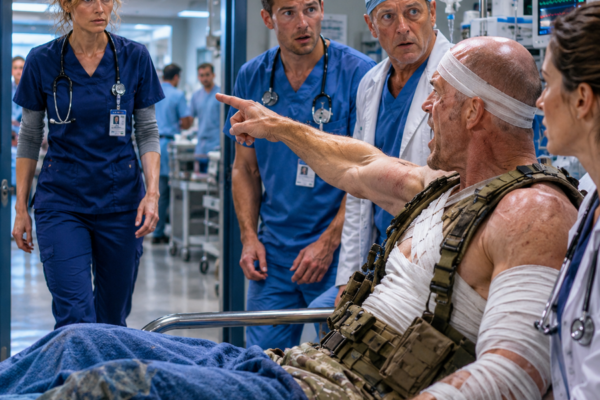
A pattern of buried complications and files that simply disappeared. when a convoy of unmarked SUVs brings a wounded operator through the doors under federal escort and his body starts sliding into a shock the doctors cannot control.
Callie has to choose between staying invisible forever or using a skill she swore she would never need again.
What she knows about recognizing and stopping catastrophic bleeding is about to save a life and finally bring Caleb Sterling’s secret into the light.
Because the truth underneath Covenant Bay is only getting started.
The break room at Covenant Bay Medical Center still smelled like burnt coffee when Callie Marsh clocked in for her first shift, and the whiteboard by the door told her everything she needed to know before she even lifted her badge.
Eight names were crossed out in red marker under the heading trauma floor nursing staff and someone had written a single word beside the list. Survivors.
She did not laugh.
She folded her coat over her arm, pulled her sleeves down over her wrists out of old habit, and walked toward the nurse’s station like a woman who had already decided not to be noticed.
She was wrong within the hour.
Dr.Caleb Sterling moved through Covenant Bay the way certain men moved through rooms they believed belonged to them.
chin lifted, white coat pressed, a trail of interns hurrying to keep pace behind him like ducklings terrified of falling out of formation. He stopped at the whiteboard, read the names, and smiled.
The way a man smiles when he has already forgotten the cost of something. Then his eyes landed on Callie.
New hire, he said, not to her, but to the charge nurse standing beside her. Number nine.
The interns laughed, quiet and obedient. the sound of people who had learned that laughing along was safer than staying silent.
Kelly kept her eyes on the supply cart in front of her, counting gauze packs she did not need to count and said nothing. She had learned a long time ago that silence cost nothing and revealed even less.
Let us see how long this one lasts, Sterling said, already turning away, already moving on to the next thing that interested him more than the woman standing at the cart.
I give her a week.
Cali Marsh had been called worse things by better men and she had buried three of them.
She did not flinch. She simply logged the comment the way she logged everything, filed under information that might matter later, and went back to work.
The morning passed the way mornings did in a hospital that ran on fear instead of respect.
Sterling corrected her charting in front of a patients family, loud enough for the hallway to hear, though her charting had been accurate.
He told a resident that real nurses did not need to be told twice. Glancing at Callie as he said it, though she had asked exactly zero questions since arriving, he walked past her twice without acknowledging she existed, which she found privately to be the least offensive thing he had done all day.
By noon, she understood why eight women had walked out the door before her.
It was not one insult. It was the accumulation, the daily erosion, the sense of being ground down one small humiliation at a time until there was nothing left to hand your resignation to except a version of yourself too tired to remember why you had ever wanted to help people in the first place.
She had written her own resignation letter three times already back when she first considered taking this job. She had not turned it in.
Its sat folded in the pocket of her scrubs now, soft at the creases from being unfolded and refolded so many times.
A habit she had picked up without noticing, the way some people bit their nails. She was not sure yet whether she kept it as a plan or as a warning to herself.
Maybe both. Dorene Whitfield, the only other nurse on the floor who had survived Sterling longer than 2 months, found her in the supply room around 1:00 in the afternoon, restocking trauma carts with the kind of focused efficiency that suggested either military training or deep personal rage, possibly both.
You’re doing that wrong, Dorene said, leaning against the door frame with a coffee that had gone cold an hour ago.
Callie glanced up. I have restocked a trauma cart before.
Not that.
Dorene gestured vaguely at all of Cali. The folded shoulders, the downcast eyes, the sleeves pulled low, even in the overheated supply room.
That the invisible thing you are doing. It does not work on Sterling.
He smells fear the way sharks smell blood.
And pretending you have none just makes him hungrier. I am not pretending anything, Callie said.
Dorene studied her for a long moment. the kind of look that came from a woman who had spent 15 years learning to read people in a building where everyone lied about how they were doing.
“Sure you are not,” she said finally.
And something in her tone suggested she did not believe it for a second, but had decided generously not to push. Welcome to Covenant Bay.
Try not to become name on that board before Friday.
The afternoon brought two car accidents, a diabetic emergency, and a 7-year-old with a broken wrist who cried until Cali sat with him and taught him a trick for breathing through pain that she had not used since a jungle somewhere she tried very hard not to think about anymore. He stopped crying.
His mother thanked her twice. Sterling walked past the room without looking in, already moving toward his next surgery, already forgetting the small kindness had happened at all.
Around 3, she made a detour to room 14, where an 81-year-old veteran named Walter Higgins had been admitted for chest pain that had turned out to be nothing more sinister than anxiety and a stubborn refusal to take his blood pressure medication. Walter had fought in a war Cali had only read about in history books, and he talked about it constantly to anyone who would sit still long enough to listen, though most of the staff had learned to nod politely and keep moving.
Callie sat.
You are the first one all week who did not look at the clock while I was talking,” Walter said, patting the blanket over his knees with hands spotted and thin but still strong in the grip when she checked his pulse.
“Most of them treat old soldiers like furniture, something to step around.”
“I am not most of them,” Callie said.
“No,” Walter said, studying her with the particular clarity old men sometimes carried, the kind that saw past the folded shoulders and the downcast eyes to something underneath.
“I do not suppose you are.
You hold my wrist like someone who has done this before.
Not nursing school before.
Before before.
Callie said nothing, but she did not pull her hand away either. And Walter smiled like a man who understood the value of a silence that was really an answer.
She was still smiling faintly 10 minutes later, folding a fresh blanket over Walter’s legs while he drifted towards sleep when the trauma pager on her hip screamed loud enough to make the old man startle awake.
It was nearly 4:00 in the afternoon when the ambulance bay radio crackled with a call that did not sound like the others.
Incoming, the dispatcher said, voice tight in a way that made every nurse within earshot straighten.
Not from county.
Federal escort. ETA 4 minutes.
One patient, male, gunshot, and blast trauma.
Unknown origin.
No additional information authorized for release. Callie felt something cold settle into her spine.
An old and familiar alertness.
She had spent three years trying to unlearn.
Federal escort meant no records, no explanation, and men in suits standing in doorways asking questions no civilian hospital had trained anyone to answer.
She had seen this exact scenario before in a different hospital wearing a different uniform, watching men who claimed to be federal agents walk with a posture that no federal agent she had ever met actually carried. She did not have time to think about that now.
She moved.
The trauma bay doors slammed open 2 minutes later and two black SUVs pulled into the ambulance bay with a precision that made the regular paramedics step back instinctively.
The way people stepped back from anything that moved with more discipline than the world around it expected. Four men climbed out first, dressed like federal agents, moving like something else entirely.
Weapons visible but not raised.
Eyes constantly scanning exits and roof lines in a pattern Callie recognized in her bones before her conscious mind had finished. the thought.
Then they pulled the gurnie from the second vehicle, and Callie’s whole body went still.
The man on it was young, maybe 26, dressed in civilian clothes that had been cut away in places to expose a wound in his lower abdomen that was bleeding faster than his body could compensate for.
His skin already gray at the edges, his breathing shallow and fast in the particular rhythm Cali had learned to recognize as the body’s last honest warning before it stopped negotiating.
Blood soaked through a field dressing someone had applied in a hurry. Someone who had known what they were doing but had run out of time to do it well.
Sterling arrived at a jog, coat flapping, already barking orders that sounded confident and were, Calli noted immediately, dangerously wrong. Get him to O2, prepped for exploratory laparottomy.
Someone page anesthesia, Sterling said, hands already reaching for the gurnie rail, his voice carrying the particular authority of a man who had never once doubted his own competence in a crisis.
Callie looked at the wound, at the color of the blood, at the way the young man’s pulse fluttered visible and frantic at his throat, and she understood two things in the space of half a second.
The first was that Sterling was about to make a decision that would kill this man before he ever reached an operating room. The second was that she was the only person in the bay who knew it.
“Wait,” she said.
The word left her mouth quieter than she intended, but it cut through the chaos of the trauma bay like something with weight.
Sterling turned, already annoyed, already composing the sentence that would put her back in her place.
“Excuse me,” he said.
Kelly Marsh looked at the wound again at the man dying in front of her, and felt something old and disciplined rise up through the layers of quiet she had spent 3 years building over herself.
Her hands, which had trembled that morning while charting under Sterling’s watchful contempt, went suddenly, completely still.
He is not bleeding from where you think he is bleeding, she said. And if you move him before that is controlled, he will not survive the elevator ride.
This is the moment worth understanding clearly because the difference between panic and precision here is the difference between a life saved and a life lost. What Cali recognized in that trauma bay was a body sliding into hemorrhagic shock.
A condition that happens when someone loses enough blood that the heart no longer has enough volume left to circulate to the vital organs.
The warning signs are the ones she saw instantly.
Skin turning pale or gray as blood retreats from the surface to protect the core. A pulse that races because the heart tries to compensate by beating faster instead of stronger.
Breathing that goes shallow and quick.
Confusion or a strange dreamy calm as the brain runs short on oxygen. The mistake almost everyone makes, even trained professionals under pressure, is treating the visible wound while missing where the real bleeding is happening.
often deeper in the body where pressure alone cannot reach it. Before anyone can safely move a patient like this, the priority is controlling catastrophic bleeding at its source.
For a wound on a limb, this means a tourniquet, a wide strap tightened firmly above the injury, close to the body, tight enough to stop the bleeding completely rather than simply slow it down. It should be applied high and tight, checked for a moment when the bleeding actually stops.
And the time it was applied should always be noted because that detail matters enormously to the doctors who take over afterward. For bleeding in the torso where a tourniquet cannot reach, firm direct pressure and getting the patient to surgical care as fast as possible becomes the only real answer.
Callie did not have time for hesitation. She had time only for the sequence her body had learned to trust long before she ever wore a hospital badge.
And in that sequence, seconds decide everything.
Callie moved before Sterling could finish forming his objection.
She grabbed the emergency tourniquet kit from the crash cart with a motion so fast it looked rehearsed because in a way it was muscle memory from a life she had spent 3 years trying to bury under scrub tops and quiet shifts.
She was not looking at the abdominal wound the paramedics had bandaged and Sterling had fixated on.
She was looking at the young man’s right thigh, where a second wound, smaller and hidden beneath torn fabric, was pumping blood in the unmistakable rhythmic spurt of an arterial bleed.
“That is the source,” she said, already wrapping the tourniquet high on his thigh, cinching it with a motion that had nothing hesitant in it at all.
“The abdomen is bad, but this is what kills him in 90 seconds if nobody touches it.”
“Serling’s mouth opened, closed, opened again.”
Nurse,” he said in the tone of a man reasserting territory.
“That is not your call to make.
It is the only call that matters right now,” Callie said and pulled the strap tight.
The bleeding stopped almost immediately, the frantic red pulse at the wound slowing to a trickle and then nothing at all, and the change in the patients color was visible within seconds, the gray at his lips easing back toward something closer to human. One of the men who had arrived with him, a broad-shouldered operator with a jaw- like poured concrete and eyes that had not stopped scanning the room since he walked in, stepped forward and looked at Cali with an expression that shifted in the space of two heartbeats from suspicion to something
much sharper.
“Where did you learn to do that?”
he asked, voice low, meant only for her. Callie did not answer.
She was already calling out vitals, already reaching for a second dressing to apply firm pressure to the abdominal wound.
While a resident, finally useful, started a second IV line on the patients opposite arm. Sterling stood frozen for one full second, staring at the tourniquet at the bleeding that had stopped at the nurse he had mocked 6 hours earlier.
Now running his trauma bay better than he was. Get him to or two, Sterling said finally, voice tighter now, less certain.
Now someone move. They moved him fast.
Gurnie wheels screaming against tile.
Calli walking alongside with one hand still pressed against the abdominal dressing, calling out the tourniquet time to the resident so it would not be forgotten in the chaos.
A detail she knew mattered more than almost anyone in that hallway understood.
The broad-shouldered operator walked on the other side of the gurnie, matching her pace exactly, watching her hands instead of the patients face. I am Havoc, he said, as if that explained anything.
As if it were the only introduction that mattered between people who spoke the same unspoken language. That is Flint.
He is my responsibility. You just kept him alive.
Callie kept her eyes forward.
He is not out of danger yet. No.
Havoc agreed.
But he would have been gone in the elevator if you had not done what you did.
I have seen combat medics with a decade of field time who could not have called that faster.
Callie said nothing because there was nothing safe to say.
And because some part of her, the part that had folded and refolded a resignation letter until the creases went soft, understood that she had just made a mistake she could not take back.
She had been seen, not looked at the way Sterling looked at her, cataloging her as a problem to be managed. Seen the way only certain people ever managed to see each other.
The recognition of someone who has stood in the same kind of fire. They reached the O doors and the surgical team took over.
And for a moment, Callie stood in the hallway with her scrubs soaked through with someone else’s blood, her hands finally beginning faintly to shake.
The delayed tremor of adrenaline finding its way out now that the emergency had passed into other hands. Dorene appeared at her side with a fresh pair of scrubs and an expression of undisguised awe.
What in the actual hell was that?
She said.
I have worked here 6 years and I have never seen anyone move like that.
You looked like you had done it a hundred times. I have restocked a lot of trauma carts, Cali said.
Uh-huh. Dorene said, clearly not believing a word of it and clearly deciding again not to push.
Well, whatever that was, Sterling looked like someone slapped him with a fish. I have never seen him speechless before.
I am framing this day.
But the moment of levity did not last.
20 minutes later, Sterling emerged from the surgical wing, coat changed, composure rebuilt, and found Callie at the nurse’s station, charting the incident with the same careful precision she brought to everything.
His expression had shifted from shaken to something colder, more calculating.
The look of a man recalculating a threat he had underestimated, a word, nurse Marsh, he said, “In my office.” The office was small, immaculate, decorated with framed commendations and photographs of Sterling shaking hands with men in suits Callie did not recognize, but instinctively distrusted.
He closed the door behind her with a deliberate click.
“You overstepped today,” he said, sitting behind his desk without offering her a chair.
“You made a unilateral medical decision without physician authorization.
In a court of law, that is called practicing medicine without a license.
I stopped an arterial bleed that would have killed him,” Callie said, keeping her voice level.
“You were about to move a patient in shock toward an elevator.
I did what the situation required.
You did what you wanted to do,” Sterling said, leaning forward.
“And something in the way you did it tells me you have training this hospital knows nothing about.
I do not like surprises on my floor, nurse Marsh.
I especially do not like surprises that make me look incompetent in front of federal escorts. Callie held his gaze and said nothing, and the silence stretched long enough to become its own kind of answer, the kind Sterling clearly hated more than any words she could have offered.
“Eight nurses left this floor before you arrived,” he said finally, voice dropping into something almost pleasant, which made it worse.
“I wonder how long you will last now that I am paying attention to you.”
Callie thought of the resignation letter folded soft in her pocket, and for the first time since writing it, she felt something other than the urge to use it.
She felt something closer to the old familiar readiness she had spent 3 years trying to forget how to feel. Eight nurses could not survive you, she said quietly.
I never planned to be the ninth. She left his office before he could respond and did not look back to see the expression on his face, though she suspected correctly that it was the first time in a very long while that Caleb Sterling had been left without the final word.
Dorine was waiting outside, pretending not to have been listening through the door, which fooled absolutely nobody.
So she said, falling into step beside Callie as they walked back toward the trauma floor. On a scale of one to fired, how bad was that?
He is recalculating, Callie said. That is worse than fired.
Whether I am a problem he can bury or a problem he needs to be careful with, Callie added.
Dorian gave her a long assessing look, the coffee cup in her hand forgotten, but did not push further, and instead Callie busied herself checking the posttop board, watching Flint’s status update from critical to guarded to an hour later stable.
She found herself standing outside his recovery room without quite deciding to walk there, watching through the narrow window as Havoc sat in a chair beside the bed, posture alert, even in stillness.
The posture of a man who did not fully trust hospitals to keep the people he was responsible for safe, he looked up and caught her watching.
Instead of waving her off, he tilted his head toward the empty chair on the other side of the bed, an invitation.
She should not have gone in. She knew that even as she pushed the door open.
“He is going to make it,” Havoc said when she settled into the chair, not quite relaxed.
Hands folded in her lap the way she had trained herself to hold them years ago.
“Because of you.”
“He would have made it either way,” Callie said.
“Somebody would have caught it.”
Havoc shook his head slowly.
“No,” he said.
“They would not have.
I have watched men die from exactly that kind of wound because nobody looked past the bigger, louder injury in time. You looked past it in about 4 seconds.
That is not luck. That is pattern recognition trained into someone under fire.
I am a nurse, Callie said. The sentence sounding thinner in her own ears than it had the first hundred times she had said it.
Sure, Havoc said in a tone that was not quite disbelief and not quite acceptance, but something patient. waiting.
The tone of a man who had learned that some doors opened on their own time and pushing only made people brace harder against the frame.
Whatever you say, nurse Marsh.
Before she left the room, she glanced at the chart clipped to the end of Flint’s bed.
An old habit, checking vitals one more time before her shift ended.
What she saw instead made her stomach tighten.
Stapled behind the current admission sheet was a fragment of an older record, a scanned page that did not belong to Flint at all, bearing a different patient name that had been redacted with black markers so aggressively it had torn the paper. The surgeon of record on that fragment, still legible beneath the damage, was Caleb Sterling.
The outcome field beside it, only half obscured, read deceased. She did not touch it.
She memorized the layout, the torn edge, the shape of the redaction, and slid the chart back into its holder exactly as she had found it. Her pulse steady on the outside and racing underneath, the old instinct returning without invitation.
Somebody had been careless. Somebody had let a piece of a buried file end up somewhere it was never supposed to be.
And somebody, she was beginning to understand, had been burying things at Covenant Bay long before she ever walked through its doors. She almost told Dorene about the torn page.
She got as far as opening her mouth twice during the walk to the parking garage before closing it again both times. Old training reasserting itself.
The reflex that said information was a liability until you understood exactly who might be listening.
Instead, she drove home in silence, replaying the shape of the redaction, the half-visible word deceased. the certainty that whatever had happened to that unnamed patient had been important enough for someone to physically destroy the record rather than simply delete it.
Records got deleted by accident. Records got torn on purpose.
She did not sleep well.
The next morning brought administrator Diane Kesler to the trauma floor before Callie had even finished her first cup of coffee.
Moving with the brisk efficiency of a woman who managed a hospital’s reputation with the same care most people reserved for a dying relative.
Kesler found Callie at the supply closet and closed the door behind them both with the particular gentleness of someone about to say something unkind. I understand you had quite a first day, Kesler said, arms folded, smile fixed in place like something bolted on.
Dr.Sterling tells me you made an unauthorized clinical decision.
I stopped an arterial bleed.
Callie said the patient is alive because of it.
Kesler’s smile did not move, but something behind her eyes recalibrated.
the look of a woman doing quiet arithmetic about risk and liability and donor relationships. Dr.Sterling has been chief of surgery at this hospital for 11 years.
She said, “His outcomes are the reason our trauma center holds its level one designation.
His research funding alone accounts for nearly a third of our surgical department’s budget.
I need you to understand the position you are putting me in when you undermine him publicly, regardless of the medical outcome.
” The medical outcome was a man not dying.
Cali said. There are channels, Kesler said, her voice cooling several degrees.
Concerns get raised through incident reports, through the chain of command, not through unilateral action in front of federal personnel who already make this hospital nervous enough.
Do you understand me, Nurse Marsh? I understand that eight nurses quit before I got here, Callie said.
And I understand why now better than I did yesterday.
Kesler’s expression flickered just barely.
something that might have been discomfort or might have been irritation gone too fast to read clearly. That is unfortunate turnover, she said.
It is not evidence of anything beyond a demanding work environment.
Dr.Sterling holds this floor to a very high standard.
He holds this floor hostage, Callie said and immediately regretted the word choice, watching Kesler’s face close like a door.
I would be very careful with language like that. Kesler said quietly.
This conversation is over. Try to remember that gratitude looks better on a resume than confrontation, nurse Marsh.
She left without waiting for a response, heels clicking down the hallway with the particular rhythm of a woman who believed the conversation had ended in her favor. Callie stood in the supply closet a moment longer, the resignation letter in her pocket feeling heavier than it had in weeks, and thought, not for the first time, about how many institutions ran on exactly this kind of quiet complicity.
protecting the man at the top because the alternative meant admitting the foundation itself was cracked. She found Dorene 20 minutes later restocking the crash cart on the second floor.
And this time she did not hesitate. I need to ask you something and I need you to actually think before you answer.
Callie said, keeping her voice low.
Dorene straightened, sensing the shift in tone immediately.
Okay.
Has a patient ever died on Sterling’s table and had the records handled strangely afterward?
Callie asked. Missing pages, redactions, anything that felt off.
Dorene went very still.
Why are you asking me that?
I saw something yesterday, Callie said.
A torn record stapled behind Flint’s chart.
Different patient. Sterling was surgeon of record.
The outcome field said deceased.
And somebody had gone out of their way to make sure nobody could read the name.
Dorene glanced toward the hallway, checking it was empty before answering, her voice dropping to barely above a whisper.
There was a patient about 14 months ago.
Before you started, young guy, military, came in through a similar back channel.
No full records released to the floor staff.
Sterling operated.
The guy died on the table. There was an internal review that lasted exactly one week before it got quietly closed.
Two nurses who asked too many questions about it were gone within the month. I always figured they quit because of the General Sterling experience.
Now I’m wondering if I figured wrong.
Do you remember his name?
Callie asked. No, Dorene said.
Nobody ever told us his name.
That was the part that always bothered me most. Callie thought about that for a long moment.
About a young man dying under Sterling’s hands 14 months ago.
About two nurses who asked questions and disappeared from the roster shortly after.
about the careful architecture of an institution built to protect its most prestigious asset regardless of what it cost.
She thought about Flint, stable now, but still recovering three floors above them, and about Havoc’s watchful, disciplined eyes, and felt the old instinct sharpen into something with a shape and a direction.
Whatever Sterling had buried 14 months ago, it had not stayed buried.
It had simply been waiting for someone with the right training and the right stubbornness to notice the torn edge of the page.
“I am not going anywhere,” Callie said quietly, more to herself than to Dorene.
“Good,” Dorene said.
And for the first time since Callie had arrived at Covenant Bay, she saw something other than caution in Dorne’s expression.
She saw the particular relief of a person who had been carrying a suspicion alone for a very long time, finally handing half the weight to someone else.
because I am done watching this place eat good people and call at a high standard. Later that afternoon, Callie made a detour back to room 14 before her shift ended and found Walter Higgins sitting up in bed watching a game show with the volume too loud.
The way old men sometimes did when the silence of a hospital room grew too heavy to sit inside alone.
“You look like a woman carrying something,” he said, muting the television without being asked.
“I am fine,” Callie said out of reflex.
the same automatic denial she had offered a hundred times to a 100 people who had never actually wanted the truthful answer. Walter gave her a look that suggested he had heard that particular lie from better liars than her over the course of 81 years and at least one more.
I did four tours before I was 35.
He said, “I know the look of somebody who just found out the ground under them is not as solid as they thought.
Whatever it is, you do not have to carry it by yourself. That is the mistake most of us make.
We think carrying it alone is the same thing as being strong.
It is not.
It is just lonely.
Callie sat on the edge of his bed without quite deciding to, the resignation letter creasing faintly in her pocket.
I think something bad happened here, she said carefully before I started. I think people got hurt trying to say something about it and I think it is still happening.
Then you already know what you are going to do about it, Walter said.
because women like you do not ask that question unless you already know the answer and are just working up the nerve to admit it. She did not answer, but she did not need to.
And Walter reached over with one spotted hand and patted the back of hers.
The same gesture he had made 20 times a day to nurses who barely paused to notice it, except this time it landed somewhere that mattered.
“Whatever it costs you,” he said, it costs more to stay quiet.
I learned that the hard way once a long time ago in a place that was a lot uglier than this hospital.
Silence has interest.
It compounds.
Pay the debt now while you can still afford it.
She left his room 20 minutes later, steadier than she had entered it, and found Dorne waiting by the nurse’s station with two coffees, one of which she pushed into Callie’s hands without ceremony.
You have the face of someone who just got advice from Walter.
Dorene said, “He does that.
Should be charging by the hour.
He is not wrong very often.
Callie said he is not wrong ever.
Dorene said it is deeply annoying.
Also, before you ask, I already pulled the old staffing roster from 14 months ago while you were in there being counseledled by our resident philosopher King. Two names jumped out.
A nurse named Pria Oay and an orderly named Marcus Webb.
Both gone within 3 weeks of each other. Both with resignation letters on file that used almost the exact same phrasing about pursuing other opportunities.
Nobody writes their own resignation like that unless somebody handed them a template and stood over their shoulder while they signed it. Callie felt the cold certainty settle deeper into her chest.
That is not a coincidence, she said. No, Dorene agreed.
It is a pattern, and patterns do not happen by accident in a place this well-run.
Somebody built this. Somebody has been maintaining it for a long time.
They stood together at the nurses station for a moment in silence. two women who had just quietly decided without saying the words aloud that they were no longer willing to be furniture in a building that specialized in making inconvenient people disappear one resignation letter at a time above them on the third floor.
Havoc stood at the window of Flint’s recovery room, watching the parking garage where Callie’s car had pulled out the evening before and made a phone call that would within 72 hours bring a very different kind of attention to Covenant Bay Medical Center than anyone on the administrative floor was prepared for.
The name came back to Dorene 3 days later, delivered in a text message with no context beyond a single word.
Kowalsski. It took Callie a full minute standing in the hospital parking garage before her phone screen to understand why the name felt like a hand closing around her throat.
She had known a Kowalsski once. Not the same one, she told herself, walking to her car with her keys gripped too tight in her fist.
There were a hundred Kowalsskis in the service. Thousands probably.
Common enough a name that the coincidence meant nothing. But the doubt sat in her chest anyway, cold and persistent.
all the way home through a dinner she did not eat.
Through a night where sleep arrived late and left early and brought with it a dream she had not had in over a year.
The particular dream where she was kneeling in dust and heat beside a man whose name she would not let herself remember on purpose. Her hands pressed hard against a wound that would not stop.
Her voice saying, “Stay with me.
Stay with me.
Stay with me.”
In a rhythm that had become its own kind of prayer right up until the moment his eyes stopped tracking her face.
She had not saved him. That was the wound underneath all her other training, the one no tourniquet could touch.
And Kesler’s careless torn record with its half- vvisible word deceased, had reached directly into that old grief and pulled it back to the surface without asking permission.
By the time she reached the hospital for her next shift, she had folded the feeling down into something manageable.
The way she had learned to fold every difficult thing down into something manageable and walked onto the trauma floor with her face arranged into its usual careful calm. It lasted exactly as long as it took Sterling to find her.
“My office,” he said, without preamble, and this time there was no pretense of a chair offered or declined.
He simply stood behind his desk, arms folded, and slid a single sheet of paper across the surface toward her. A formal complaint typed and signed, alleging that nurse Calli Marsh had exhibited erratic behavior, insubordination, and a pattern of overstepping clinical boundaries dangerous to patient safety.
I did not file a complaint against myself, Callie said, reading it once, then again, understanding with a sick clarity that the signature at the bottom was not hers, though it had clearly been designed to look close enough to pass a cursory glance.
“I am aware,” Sterling said, and something in his voice suggested he was enjoying this part more than the rest.
“It was filed by a concerned colleague, anonymously, of course, for their own protection.
Given your demonstrated volatility, I am obligated to open a formal review during which naturally your clinical privileges on this floor will be restricted pending outcome. You are suspending me, Calli said flatly.
I am protecting this hospital, Sterling said. There is a difference, though I understand you might not see it that way from where you are standing.
Callie looked at the paper again, at the fabricated signature, at the careful bureaucratic language designed to make an obvious retaliation look like due process, and felt something in her chest go very still and very cold.
The particular calm that used to arrive right before difficult decisions.
The calm she had spent 3 years trying to convince herself she no longer needed.
“You are doing this because I saw something in Flint’s chart,” she said.
“Not because of anything I did in that trauma bay.”
Sterling’s expression did not change, but his silence lasted a fraction too long, and in that fraction, Callie found her answer.
“I do not know what you think you saw,” he said finally, each word measured and precise.
“But I would strongly advise you to keep your speculation to yourself, for your own sake.
This hospital has resources, nurse Marsh, and relationships, and a great deal invested in protecting its reputation from unfounded accusations by nursing staff with a documented history of instability.
I have no documented history of anything, Callie said. Because there is nothing to document.
There will be, Sterling said quietly. By the time this review concludes, people believe what they are shown, and I am very good at deciding what people are shown.
She left his office with the suspension notice folded in her hand, walking numbly past the nurse’s station, past Dorene’s questioning look, past the recovery wing, where Flint sat propped up in bed watching a baseball game with the particular boredom of a man used to far more dangerous ways of spending an
afternoon.
She did not stop until she reached the small chapel on the ground floor, empty at that hour, and sat in the back pew with her hands folded exactly the way she had once folded them beside a dying man in the dust, and let herself finally, for the first time in 14 months, cry. It was Havoc who found her there 20 minutes later.
He did not say anything at first. He simply sat two pews back, giving her the kind of space that only someone who understood grief firsthand would know how to give and waited.
“I lost someone,” Callie said eventually without turning around.
The words coming out easier in the dark, empty chapel than they ever had anywhere else. In the field a long time ago, I could not stop the bleeding fast enough.
I have spent 3 years convincing myself that becoming invisible was the same thing as making peace with it.
It is not the same thing at all. No, Havoc agreed quietly.
It never is. I think Sterling killed a soldier on his table 14 months ago and buried the record, Kelly said.
I think he is trying to bury me now before I can prove it.
Havoc was quiet for a long moment.
Then tell me his name, he said.
The soldier, if you know it.
Kowalsski, Callie said. That is all I have.
A last name and a torn page.
Havoc’s posture changed, subtle but unmistakable.
the shift of a man recognizing a name he had not expected to hear in a hospital chapel three states from where he had last heard it spoken aloud in a briefing room in a very different tone.
“I know that name,” he said quietly.
“Everyone in my unit knows that name.
He was Navy Corman.
Went in for what should have been a routine repair after an IED strike.
Survivable injury.
Good prognosis.
He never came back out of surgery.”
The official report said complications. Nobody in the community ever believed that was the whole story, but nobody could prove otherwise because the hospital that treated him made sure the records disappeared before anyone with the right clearance could look at them properly.
Callie felt the floor tilt
slightly beneath her. The private grief she had carried alone for so long suddenly, impossibly connected to something much larger than she had ever let herself imagine.
That was here, she said.
That was Covenant Bay. That was here.
Havoc confirmed.
And I think you just found the piece nobody else could ever get close enough to find.
They sat together in the chapel a while longer.
The quiet stretching comfortable rather than heavy now.
Two people who had each spent years learning to carry things alone.
Finally setting a small piece of the weight down in the same room. Eventually, Havoc spoke again, his voice lower, more deliberate.
I need you to understand something before we go any further, he said.
If this is what I think it is, it does not stay small.
It does not stay quiet.
There are people above my pay grade who are going to want answers about what happened to Kowalsski.
And once they start asking, this hospital is not going to be a peaceful place to work anymore.
Regardless of what happens to Sterling personally, “I already lost the peaceful version of working here,” Calli said.
Sterling made sure of that this morning.
“Tell me,” Havoc said.
She told him about the suspension notice, the fabricated signature, the careful bureaucratic language designed to make retaliation look like procedure, and watched something harden behind his eyes as she spoke. The particular fury of a professional soldier recognizing an enemy who fought with paperwork instead of weapons because paperwork was harder to return fire against.
That is not going to hold up, Havoc said. Not once people who actually investigate these things start looking at the timeline.
suspending you two days after you save a federally escorted patient’s life immediately following your discovery of a torn record connected to an unresolved death.
That is not subtle.
That is desperate. Desperate men still win sometimes, Calli said.
Especially when they control the paperwork and the administration and the story everyone else gets told.
Not always, Havoc said.
Not when somebody with the training to recognize what she is looking at refuses to look away. Callie found Dorene an hour later in the breakroom, staring at her phone with an expression that mixed outrage and grim satisfaction in equal measure.
She looked up when Callie walked in and held up the screen without preamble.
“You will not believe this,” Dorene said.
“I pulled the personnel file access logs, which I absolutely should not have access to, but nobody ever bothered locking down properly because who reads personnel access logs?”
Guess whose login accessed the archived records room three separate times in the last week? Always after hours.
always for exactly the duration it takes to remove a physical file and put it back.
Sterling, Kelly said.
Sterling, Dorene confirmed.
He has been in that records room going through old files like a man tidying up before an inspection, which incidentally tracks with something else I found.
There is an accreditation review scheduled for this hospital in 11 days. Full site visit, full chart audit, the kind of review that goes back years if the reviewers are thorough.
I think our chief surgeon is trying to make sure 14 months of buried complications are gone before anyone official comes looking. That gives us 11 days, Callie said half to herself, already calculating.
11 days to prove a man is a murderer before he finishes erasing the evidence.
Dorene said, no pressure.
Also, and I cannot stress this enough, you are technically suspended right now, which means if anyone catches you anywhere near that records room, this stops being a heroic whistleblower story and starts being a very short unemployment story with possible criminal trespassing charges attached. I am aware, Callie said.
Are you though?
Dorene said, because you currently have the exact facial expression of a woman about to do something extremely unwise in that records room the second visiting hours end.
Callie did not answer, which Dorene apparently took as sufficient confirmation because she sighed the long-suffering sigh of a woman who had decided against her own better judgment to become an accomplice.
“Fine,” Dorene said.
“If you are doing this, you are not doing it alone, and you are not doing it without a lookout who happens to know every camera blind spot on this floor from 3 years of sneaking snacks past the night supervisor.
Consider this my one act of documented insanity for the year.
” That evening, Callie sat in her car outside the hospital for a long time before going in.
The suspension notice folded on the passenger seat beside her.
Walter’s words returning unbidden.
Whatever it costs you. It costs more to stay quiet.
Silence has interest.
It compounds.
She thought about Kowalsski, a name she now understood belonged to a stranger who had somehow still felt from the moment she read that torn page like family.
She thought about eight nurses who had walked away before her, and two more who had disappeared entirely 14 months ago for asking the same question she was about to ask again. She thought finally about the resignation letter in her pocket, soft at every crease, and made a decision that had nothing to do with resigning at all.
Dorene met her at the service entrance near the loading dock, dressed for a night shift she was not actually scheduled to work. A badge reader borrowed from a friend in facilities tucked into her scrub pocket like contraband.
“Last chance to change your mind,” Dorene whispered, glancing down the empty corridor.
“Once we are in that room, there is no version of tonight where we did not go looking for something we were not supposed to find.
I stopped having a version of tonight where I look away 3 days ago. Callie said when I read the word deceased on a page somebody tried to tear into nothing.
Dorene studied her for a moment then nodded once decisively the nod of a woman who had made her own peace with the risk.
Okay then, she said. Records room is two floors down past radiology.
Camera on the main door, but the maintenance corridor behind it has a blind spot big enough to walk an elephant through.
Assuming the elephant knows to duck under the pipe on the left, they moved together through the quiet hospital, footsteps careful on tile that seemed louder than usual in the after hours stillness, past the glow of monitors in rooms where patients slept, unaware that two nurses were creeping past their doors on a mission neither of them would have believed
themselves capable of a week earlier.
Somewhere above them on the third floor, Havoc sat in a darkened recovery room beside Flint, watching a hallway camera feed on a laptop balanced on his knee, ready to move the instant either woman’s radio crackled with trouble.
The records room door was exactly where Dorene said it would be, and exactly as locked as Callie had expected. The kind of lock designed to discourage casual curiosity rather than someone who had spent years learning to move through spaces that did not want her in them.
This is the part where I remind you I am only a lookout.
Dorene whispered, positioning herself at the corner of the corridor with a clear line of sight to the elevator bank.
Whatever happens in there is between you and your very concerning skill set. Callie did not answer.
She was already listening to the small familiar click of a mechanism giving way under patient practiced pressure. And the records room door swung open into darkness that smelled like old paper and dust and somewhere underneath it.
the particular staleness of secrets that had been sitting undisturbed for far too long.
She went inside.
The records room was smaller than Callie expected, rows of filing cabinets pressed close together under a single humming fluorescent light that Dorene had told her to leave off, forcing her to work by the narrow beam of a small flashlight she kept angled low away from the door.
She found the section for archived surgical cases 14 months back within a few minutes.
muscle memory from years of navigating unfamiliar spaces under time pressure, guiding her hands faster than conscious thought could have managed alone. The Kowalsski file was not where it should have been.
In its place sat a thin manila folder with nothing inside but a single index card. The kind used to mark where a file had been pulled for review.
Except this one had no review number, no signature, no date, only three handwritten words in the corner that made Callie’s stomach drop.
Permanently removed.
authorization CS.
Caleb Sterling had not just buried the record.
He had begun physically destroying it and the timing days after Callie’s discovery told her everything she needed to know about how much time she actually had left.
She almost missed the second folder, tucked sideways behind the empty one, as though someone in a hurry had grabbed the wrong file first and shoved the correct one back imprecisely.
She pulled it free and opened it beneath the flashlight beam.
And there finally was the full record Sterling had spent 14 months trying to erase.
Petty Officer Secondass Daniel Kowalsski, Navy corsman, admitted with a survivable IED fragment injury, surgical repair performed by Dr.Caleb Sterling. And then in the surgical notes themselves, a detail that made her blood run cold.
An anesthesia dosage error clearly documented in Sterling’s own handwriting before the correction had been crossed out and rewritten in a different pen, a different hand entirely.
Someone else altering the official record after the fact to shift blame toward equipment malfunction instead of surgeon error.
He had made a mistake.
A survivable patient had died because of it. And instead of reporting it, instead of learning from it, Caleb Sterling had spent 14 months and considerable institutional power making absolutely certain nobody would ever be able to prove it happened at all.
Callie’s radio crackled softly against her hip.
Dorene’s voice barely above a whisper.
Movement in the east hallway.
Someone is coming this way, and it is not a night nurse.
Move now. She photographed six pages as fast as her hands would allow.
camera flash disabled, fingers steady despite the adrenaline flooding her system, and slid the folder back into its place exactly as she had found it, leaving no trace beyond the knowledge she now carried that could not be erased or torn or crossed out with a different pen. She was easing the records room door shut behind her when a shape rounded the corner at the far end of the corridor, silhouetted against the dim emergency lighting, moving with a purposeful stride, Callie recognized instantly, even in shadow.
Sterling.
He was not looking toward the records room yet.
His attention on his phone, but he was close enough that another 10 seconds would put him directly in her path.
Dorene appeared at her shoulder without a sound, grabbed her wrist, and pulled her through the maintenance corridor Dorene had mentioned earlier, ducking beneath the low pipe, just as Callie heard Sterling’s footsteps pass within feet of where they had been standing moments before.
They did not speak again until they had reached the stairwell three floors up.
both breathing hard, adrenaline making Dorne’s hands shake in a way Callie’s own had long since learned to suppress.
“Please tell me that was worth nearly getting caught by the actual devil himself,” Dorene whispered.
“It was worth it,” Callie said, holding up her phone, the six photographed pages glowing faintly on the screen.
“He made a mistake, a dosage error.
He is not covering up an unavoidable death.
He is covering up his own negligence.”
Dorine stared at the screen, then at Callie, and something in her expression shifted from adrenaline into something colder, more focused.
That changes everything, she said. That is not a bad outcome anymore.
That is malpractice, deliberately concealed with falsified records.
That is the kind of thing that ends careers and starts criminal investigations. They separated at the stairwell.
Dorene heading home to sleep before her actual scheduled shift.
Callie climbing instead toward the third floor recovery wing, unable to settle, unable to stop replaying the crossed out dosage number in Sterling’s own increasingly frantic handwriting.
She found Havoc awake, as she had somehow known she would, sitting beside Flint’s bed with a laptop closed now watching the door.
“We have it,” she said, showing him the photographs.
Havoc studied the screen for a long moment, his jaw tightening as he read and then looked up at her with an expression that had shifted somewhere in the last hour from professional respect into something closer to recognition. The particular look of a man realizing he was standing across from someone who belonged to the same quiet fraternity of people who ran toward danger instead of away from it.
This goes to people who can actually act on it.
He said, “Tonight, I have a contact who works directly with the office responsible for reviewing service member deaths connected to civilian care contracts.
This is exactly the kind of evidence that moves fast once the right person sees it.”
“Do it,” Calli said.
Flint stirred in the bed between them, awake longer than either had realized, his voice rough but steady.
“I heard some of that,” he said.
“Kowalsski, I trained with a guy who trained with him years back.
Good Corman.
Everybody liked him. His family never got a straight answer about what happened.
If you are the reason they finally do, that matters more than you probably understand right now.
Callie sat with that for a moment.
The particular weight of it, the idea that a stranger’s family somewhere might finally sleep easier because of a torn page she had refused to look away from.
She thought of Walter downstairs.
Silence has interest. It compounds and understood more fully than she had allowed herself to before.
Exactly what he had meant. She checked on Walter before finally heading home near dawn, finding him awake despite the hour, watching the darkened window with the particular restlessness of old men whose bodies no longer required much sleep.
“You looked different,” he said when she sat beside his bed.
“Lighter, whatever you were carrying, you finally started putting some of it down.”
“I am starting to,” Callie said.
“Good,” Walter said, patting her hand the way he always did.
It is a heavy thing, carrying the truth alone, heavier than most people ever admit until somebody finally helps them set it down.
Havoc’s contact called back faster than any of them expected.
By 7 that morning, while Callie sat in the hospital cafeteria pretending to eat toast she had no appetite for, her phone buzzed with a message from Havoc that contained only four words.
They are sending someone fast.
Dorene slid into the seat across from her 20 minutes later, sunglasses on despite being indoors, the universal uniform of a woman running on 2 hours of sleep and pure spite.
“Okay,” she said, dropping into the chair.
“I have been thinking about this all night instead of sleeping like a reasonable person, and I need you to talk me through what happens next because I am starting to feel like we lit a fuse without checking how long it actually is.”
Whoever Havoc contacts, if they move fast, they will want to secure the physical evidence before Sterling finishes destroying it.
Calli said that probably means today, which means Sterling is going to feel the walls closing in before he understands exactly why.
And men like that do not respond well to feeling cornered.
Comforting, Dorene said. Truly, have I mentioned I am only a lookout in this story?
In case anyone asks, you have mentioned it four times, Calli said.
I intend to mention it a fifth time under oath if it comes to that, Dorine said, stealing a piece of Callie’s toast without asking, which felt in its own strange way like the first genuinely normal moment either of them had shared in days.
The normaly did not last. At 9, administrator Kesler appeared on the trauma floor flanked by two members of hospital security, her expression carrying none of the practiced smoothness from their earlier conversation in the supply closet.
Nurse Marsh,” she said, voice tight.
“My office.”
Immediately, Callie followed, aware of eyes tracking her down the hallway, aware that whatever was about to happen would not stay contained to a private conversation for long.
Kesler’s office door closed behind them with a finality that felt different from before.
I received a call this morning from a federal oversight office I did not know existed until an hour ago, Kesler said, sitting heavily behind her desk, all pretense gone, asking very specific questions about a patient named Kowalsski, about surgical records from 14 months ago, about whether this hospital had, and I am quoting directly, engaged in the deliberate falsification of a deceased patients chart to conceal a medication error.
Callie said nothing, watching Kesler’s face cycle rapidly through several emotions.
Fear, calculation, and finally something that looked almost like relief. The particular relief of a person realizing the decision they had been avoiding was no longer theirs to make.
Is it true?
Kesler asked quietly. Not as an accusation, as a genuine question.
From a woman who suddenly seemed considerably less certain of the ground she had been standing on for 11 years. I saw the record myself, Callie said.
Sterling’s original dosage note and a second hand that altered it afterward to hide the error.
I have photographs.
Kesler closed her eyes for a long moment.
I built my career protecting this hospital’s reputation, she said more to herself than to Callie.
I never once asked myself what I was protecting it from. That is going to follow me for a very long time.
That is not my problem to solve for you, Callie said. Not unkindly, but not gently either.
It is yours.
Kesler opened her eyes, and something in her posture straightened, the shift of a woman deciding finally which side of the coming reckoning she wanted to stand on. Then help me solve it correctly, she said.
Because in about 20 minutes, Dr.Sterling is going to find out federal investigators are asking questions. And I have known that man for 11 years.
He does not accept consequences quietly. He looks for someone else to blame first.
and I suspect that someone is about to be you.”
She was right.
Callie stepped out of the administrator’s office into a hallway already tightening with tension.
Staff members exchanging glances, phones held low and half hidden.
The particular electricity of a building that sensed something enormous shifting beneath its routine, even before anyone had explained why.
She had barely reached the nurse’s station when Sterling’s voice cut across the floor, louder than she had ever heard it, stripped entirely of its usual polished control.
You, he said, striding toward her with his coat unbuttoned, his composure visibly fraying at the edges.
You did this. Whatever is happening this morning, whatever calls Kesler is fielding, it traces back to you.
The entire trauma floor went quiet, monitors beeping steadily into a silence otherwise thick enough to feel.
Every nurse, every resident, every visible eye turning toward the confrontation building in the center of the room. I did not falsify a chart to hide a dosage error that killed a man, Callie said, her voice steady, carrying clearly across the frozen room.
That was you.
Sterling’s face went through a rapid, ugly transformation.
The polished veneer cracking to reveal something raw and frightened underneath. A man who had spent 11 years believing his own reputation made him untouchable now realizing in real time exactly how wrong that belief had been.
“You have no idea what you are talking about,” he said.
But his voice had lost its certainty. The words coming out faster than his usual measured delivery.
Whatever you think you saw in that records room, you broke into a secured area to see it. That is a crime, nurse Marsh.
That is exactly the kind of thing that ends careers. I know what breaking a lock feels like, Callie said.
I also know what watching a man die on a table because nobody wanted to admit a mistake feels like.
I have carried that second thing for 3 years without ever knowing your name attached to it. I do not intend to carry it quietly anymore.
Behind Sterling, security personnel exchanged uncertain glances, unsure whose authority to follow in a moment that had clearly outgrown the ordinary hierarchy of the hospital.
Dorene stood frozen near the supply cart. Phone in hand, thumb hovering over the record button with the particular instinct of a woman who understood exactly how important documentation would become in the hours ahead.
And somewhere down the hallway, moving with unhurried purpose that made everyone instinctively clear a path, Havoc approached with his phone pressed to his ear, listening to something that made his expression settle into the calm, dangerous focus of a man who had just received confirmation that the fuse he lit the night before
had finally reached its charge.
“They are here,” he said, loud enough for the whole floor to hear, lowering the phone.
“Federal investigators, parking garage, level two.
They would like to speak with everyone currently standing in this hallway, starting with you, Dr.Sterling.
The federal investigators moved through Covenant Bay with a quiet efficiency that made the hospital’s usual controlled chaos feel almost gentle by comparison.
Two agents took Sterling directly into the small conference room near administration, his protests growing progressively quieter as the reality of his situation compressed around him. A third agent, an older woman named Patricia Ruiz, who introduced herself with the particular calm of someone who had done this exact conversation a hundred times before, found Callie at the nurses station and asked gently if there was somewhere private they could talk.
They ended up in the same small chapel where Havoc had found her days earlier, the quietest room in a building suddenly full of noise.
“I need to understand your role in discovering this,” Ruiz said, notebook open, but pen still.
watching Callie with an attentiveness that suggested she was reading more than the words being spoken.
Your personnel file lists you as a civilian nurse with no prior service record.
But the way you handled that patient in the trauma bay, the way you accessed and photographed a secured file without triggering a single alarm, that is not civilian training, Ms.Marsh. Kelly sat with the question for a long moment, feeling the old instinct rise up automatically.
the practiced deflection, the folded shoulders, the small, careful lies that had kept her safe and invisible for three years.
Then she thought of Kowalsski’s family somewhere out there who had waited 14 months for a truth that had finally surfaced only because someone had refused to look away.
She thought of eight nurses who quit and two who disappeared and one old veteran who had told her more than once that silence has interest and it compounds.
I served, she said quietly.
Navy corman attached to a special operations unit for the last two years of my time in. My call sign was Valkyrie.
I left the service after losing someone I could not save and I told myself becoming invisible was the same thing as healing.
It was not. It was just hiding with better lighting.
Ruiz did not react with surprise, only a small respectful nod. The reaction of a professional who had suspected as much and appreciated the honesty of finally hearing it stated plainly.
Those are not a nurse’s hands,” she said, glancing briefly at the faint scars visible where Callie’s sleeve had written up during the confrontation in the hallway.
“That is battlefield training.
It shows in everything you did this week, whether you meant it to or not.”
Word moved through the hospital faster than any official statement could have managed, the way it always did, nurse to nurse, resident to attending, until by early afternoon, the entire trauma floor understood in fragments and whispers that the quiet new hire everyone had watched Sterling humiliate on her very first day was the reason a 14-month cover up had finally collapsed, and that the woman behind it had once carried a rank and a call sign that outranked the
man who had mocked her. Dorian found her near the supply closet, arms crossed, expression somewhere between awe and betrayal.
You could have told me, she said.
I could not tell anyone, Callie said.
That was the point of disappearing.
Well, Dorene said the correction of a woman recalculating an entire friendship in real time.
I would like to formally register my complaint that you let me call you a lookout for 3 days while you were apparently some kind of legendary combat medic this whole time. That feels like relevant information a friend shares.
I am telling you now, Callie said. Dorene studied her for a moment longer, then softened, the irritation dissolving into something warmer.
For what it is worth, she said, you were still the best lookout partner I’ve ever had, even if you undersold your resume by approximately everything that mattered.
By late afternoon, administration had suspended Sterling’s privileges pending the outcome of a federal investigation that Ruiz confirmed in a brief public statement to hospital staff would extend backward through his entire 11-year tenure, examining every case where an outcome had been quietly reclassified or a record had inexplicably gone missing.
Kesler stood beside Ruiz during the statement, visibly shaken, but present, choosing publicly and deliberately to cooperate rather than continue protecting the institution’s reputation over its patients.
A decision Callie suspected would cost her considerably, but respected nonetheless.
Havoc found Callie afterward on the rooftop garden where staff sometimes ate lunch. The late afternoon light turning the parking structure below into something almost beautiful.
Flint is being discharged tomorrow, he said.
He asked me to tell you something before we leave.
He said to tell you that you gave him back a life he almost lost twice this month.
Once to the wound and once to a hospital that would have let the truth about it die with the wrong man’s reputation intact.
Tell him I am glad he is going home.
Callie said I will.
Havoc said and then after a pause added we could use someone like you.
Not permanently necessarily, but there are programs, consulting roles, ways to use exactly the training you spent 3 years trying to bury without going back into the field yourself. Think about it.
No pressure. But think about it.
I will think about it, Callie said, and meant it, though she suspected, watching the light shift over the parking garage that whatever answer she eventually gave would not involve leaving Covenant Bay behind entirely.
Not now.
Not after everything the last two weeks had shown her about exactly how much damage silence could do when the wrong people were allowed to keep it comfortable.
She found Walter Higgins one final time before her shift ended.
Sitting up in bed with the television off for once, waiting as though he had somehow known she would come.
I heard the whole hospital talking.
He said, “Valky.
That is a fine name. Suits you better than invisible ever did.
I am sorry I did not tell you sooner.”
Callie said sitting beside him.
Do not apologize for carrying your own truth on your own schedule.
Walter said, “You told me when you were ready, and you acted long before you were entirely ready, which takes considerably more courage than waiting for comfort that may never come.”
That old surgeon should have been more careful about who he decided to underestimate.
“Eight nurses quit before you walked through that door.
He should have asked himself why none of them ever came back to fight.”
“She was never hiding weakness,” Callie said quietly, almost to herself.
The words arriving finally in the shape they had been waiting to take since the day she first read the torn page. She was hiding command.
Walter smiled, the particular smile of an old soldier recognizing something true when he heard it spoken aloud. That he said, sounds exactly right to me.
That evening, before she left the hospital, Kesler found her one final time near the elevator bank.
Her usual polished composure replaced by something raw, more honest than anything Cali had seen from her before.
I want you to know I am submitting my own resignation tomorrow, Kesler said.
Not because anyone is forcing me to, though I imagine that conversation would have come eventually regardless, because I spent 11 years telling myself that protecting this institution’s reputation was the same thing as protecting the people inside it.
You showed me today exactly how wrong that math was. I do not expect you to forgive that.
I would not in your position. I do not need to forgive it, Callie said.
I need it to change. What you do next matters more than what you say now.
Kesler nodded slowly, absorbing that, and for a moment something almost like respect passed between two women who had started the week on opposite sides of a very different conversation.
Whoever replaces me, she said, is going to inherit a hospital that finally has to answer for 14 months it spent looking away. I hope they are better at the job than I was.
I hope more than that that they listen the first time someone like you tries to tell them something is wrong instead of needing federal investigators to force the point.
She left without waiting for a response and Callie stood alone by the elevators for a long moment feeling the strange unfamiliar shape of an ending that did not resolve into anything as simple as villains punished and heroes celebrated.
Only the slower, more honest work of an institution beginning reluctantly to hold itself accountable. The following days brought a version of Covenant Bay that felt almost unrecognizable.
Nurses who had watched Sterling humiliate colleagues for years began speaking openly in break rooms about incidents they had never felt safe reporting before. A slow unlocking of stories that had been sealed shut by fear of exactly the kind of retaliation Cali had faced and survived.
Dorene took to keeping a running list, half joking and half deadly serious, of every small injustice staff members finally felt comfortable naming aloud.
taping it inside a supply closet door where only nursing staff would see it.
A private monument to a silence finally broken.
“You started something,” Dorene told her.
One afternoon, restocking a crash cart with the same focused efficiency Callie remembered from her very first day.
“People are talking.
Really talking. Not just complaining in the parking lot where nobody official can hear them.
That does not happen by accident.
That happens because somebody proved it was survivable to speak up first.
I did not do it alone, Callie said. No, Dorene agreed.
But you did it first, which is the hardest part, and also incidentally, the part that means you owe me a drink for 3 days of unpaid lookout services rendered under false pretenses regarding your actual skill level. Callie laughed, a real laugh, the first one that had come easily and longer than she wanted to admit, and found herself thinking, not for the first time that week, that some kinds of family did not require a shared uniform to feel real.
3 weeks later, Cali Marsh stood in front of the hospital board, no longer suspended, no longer invisible, and delivered testimony that would become the foundation of a formal restructuring of Covenant Bay surgical oversight, a mandatory second review process for any surgical outcome involving military patients, and a new complaint system designed specifically to prevent any single physician, regardless of prestige or funding brought to the institution, from operating beyond meaningful accountability again. She did not ask for recognition.
she asked simply for the system that had failed Daniel Kowalsski and nearly failed eight departed nurses before her to be rebuilt so it would not fail the next person who walked through Covenant Bay’s doors with something to hide and something to prove.
After the testimony, one board member, an older physician named Dr.Renfield, who had sat mostly silent through the entire proceeding, stopped Callie in the hallway outside the conference room. In 30 years on this board, he said, I have never heard a nurse describe a systemic failure with that much precision and that little interest in personal credit.
Most people in your position would have spent half that testimony making sure everyone understood how heroic they had been.
You spent all of it talking about Kowalsski and the two nurses who disappeared before you and the eight who quit rather than stay silent. That tells me something important about who you actually are.
I did not do this to be called a hero, Callie said. I did it because somebody finally had to.
Renfield nodded slowly.
Then perhaps, he said, “This hospital should consider itself fortunate that the somebody turned out to be you and should think very carefully about building a culture where the next somebody does not have to break into a locked records room at midnight just to be believed.”
She stayed at the hospital afterward, not because anyone required it of her, but because she had finally understood.
standing in that chapel with her hands folded the way she once folded them beside a dying man in the dust. That healing did not mean disappearing.
It meant showing up fully, scars and training and all, and refusing to fold herself smaller just to make other people comfortable with what she actually was.
The resignation letter stayed folded in a drawer at home, unused, a reminder rather than a plan.
And every morning she walked onto the trauma floor with her sleeves no longer pulled quite so low, her shoulders no longer quite so curved. A woman finally allowing herself to take up exactly as much space as she had always deserved.
Walter was discharged the following month steady enough on his own two feet to go home for the first time in weeks. and he made Callie promise, hand gripped firm around hers at the hospital entrance, that she would visit occasionally, not as a patients nurse, but as a friend who understood exactly what it cost to carry a war home and keep living anyway.
She promised, and she meant it, and standing in the same lobby where she had once walked in with her eyes fixed carefully on the floor, she found she no longer needed to look down at anything at all. The end.
The medical emergency at the center of this story was hemorrhagic shock, a life-threatening condition where a person loses enough blood that the body can no longer keep vital organs properly supplied.
Recognizing the early warning signs, pale or gray skin, erasing pulse, shallow breathing, and confusion can mean the difference between life and death long before a hospital is ever reached. Controlling severe bleeding on a limb quickly using firm direct pressure and a properly applied tourniquet placed high and tight above the wound remains one of the single most effective actions any bystander can take in an emergency.
It is a skill that takes only a few hours to learn properly and it belongs in the hands of ordinary people just as much as trained professionals because in the first critical minutes after a serious injury, it is very often a bystander, not a surgeon, who determines whether someone survives long enough to reach one.
Anyone can learn this. Anyone can be the reason someone else gets to go home.