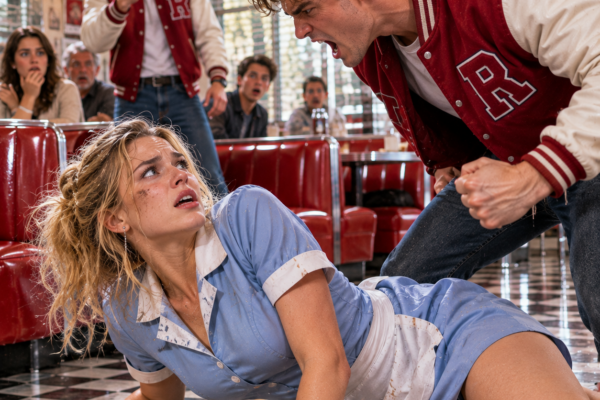
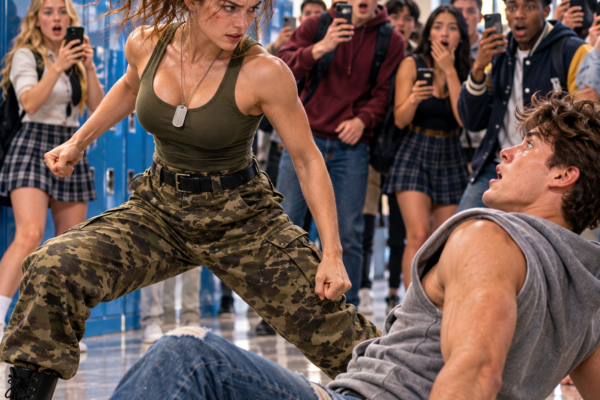
Bullies Target The Wrong Waitress— Unaware She’s A Karate Black Belt Working Part-Time
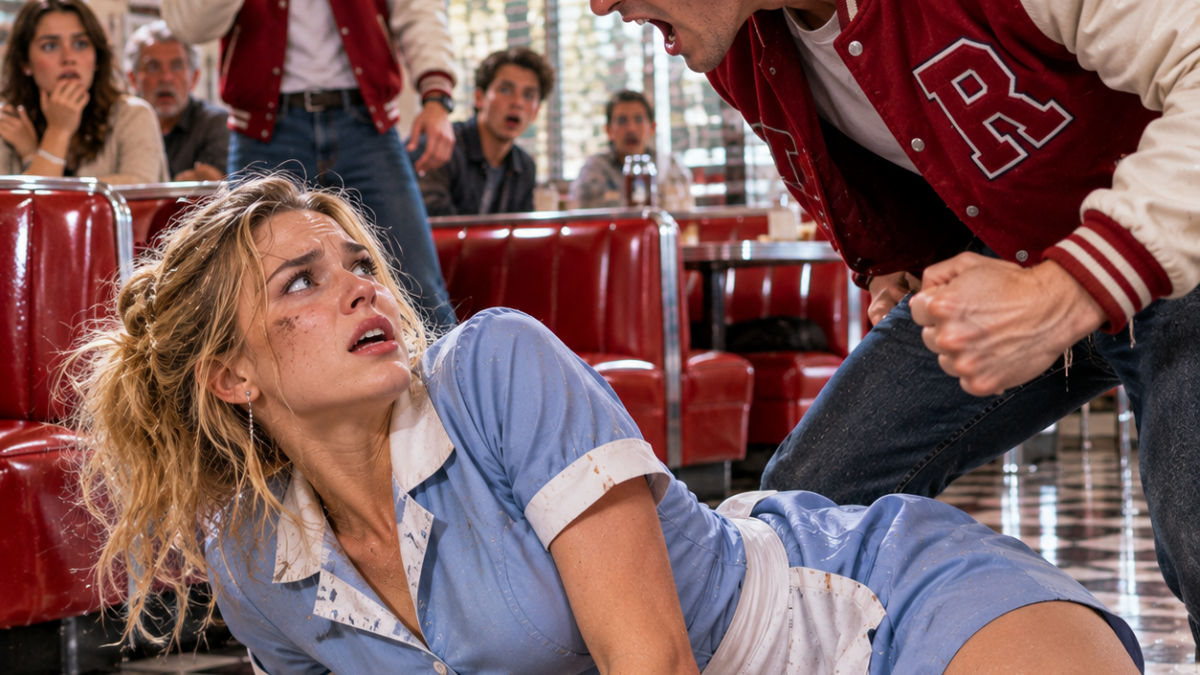
Bullies Target The Wrong Waitress— Unaware She’s A Karate Black Belt Working Part-Time
The courthouse lawn was strung with lights, and the whole town was watching.
A young man, broad as a door and 61, had a hand clamped around an old womans arm.
He swung her hard, and her shoulder struck the stone wall with a sound nobody there would ever forget.
A pie tin rolled across the grass. Then a girl with a light brown braid stepped between them, very calm, her voice hardly louder than a whisper.
Stay down.
You are not touching her again.
Nobody spoke. Dozens of phones rose into the evening air, glowing like small windows.
Three weeks earlier, none of it would have been possible.
Three weeks earlier, Pine Hollow, Minnesota, was a town where people remembered who had mowed whose lawn. It sat on the east shore of Long Reed Lake, about 3,400 souls, one blinking light on Front Street, and a rusted water tower that had needed paint since before anyone could say.
Down on the lakefront stood the old Northshore Canery, shuttered and silent, its windows gone the color of dishwater, and at the corner of Cedar and Forth stood the Blue Heron Cafe. It had been open 38 years.
The booths were green vinyl, patched twice, and the patches were a slightly different green, which everyone agreed gave them character.
A piecase hummed beside the register.
Over the door hung a brass bell that announced every single person who came in, whether they wanted announcing or not.
And in the front window, a handpainted sign read, Coffee is always fresh. Gossip is always free.
Every booth had its story. The one by the radiator belonged to a couple who came each year on their anniversary and ordered exactly what they had ordered on their first date, a grilled cheese and one slice of pie with two forks.
The corner table belonged to a retired school teacher named Mrs.Dah, who graded imaginary papers in red ink out of pure habit, and who had once been seen crying quietly over the lemon meringue. Tessa Lindquist had been working there for 12 days.
She was 21, pale with a long, light brown braid that she wore over one shoulder and tucked into her apron strings when the kitchen got hot.
She was quiet, not shy exactly, but careful.
the way a person is careful carrying a full cup across a crowded room. In the afternoons, she took online accounting classes at the end of the counter with a laptop and a cold cup of tea.
And in the mornings, she carried plates. The cafe belonged to her grandmother.
Opel Lindquist was 78 with a silver bun pinned high on her head and a habit of humming hymns while she wiped down the tables. She hummed, Abide with me, on slow days, and how great thou art, on days when the pie came out right.
She had raised Tessa from the age of six, after a cold winter afternoon, when an ice road across Long Reed Lake gave way under Tessas mother and father, Karen and Paul. Tessa did not talk about the lake, but she never sat with her back to it either.
And Opel had noticed that and said nothing and set the cherry pie a little closer. By the register in a glass case sat a brass fire helmet.
It had belonged to Arin Lindquist, Opels husband, who had been the volunteer fire chief of Pine Hollow for 31 years.
Four years ago, he had gone to bed one night and simply not woken up. The helmet sat in its case beside the cash drawer, polished by opal every Sunday, and one corner of the glass was cracked, where somebody had once bumped it with a mop.
Nobody moved it, nobody touched it.
Regulars paying their bills would glance at it and lower their voices a little, the way people do in church.
Arn had taught Tessa to ride a bicycle, to bait a hook, and to hold a door for strangers.
He had also taught her one sentence years ago on the porch with his big scarred hand wrapped around hers. Anybody can make a fist, Tessa, he had said.
The hard part is keeping the hand open.
She had never forgotten it. She had also on one terrible day she thought about more than she wished to failed it.
But that was a story for later.
The morning began as it always did at 6.
The street outside was still blue, and the lake was breathing fog. Tessa unlocked the front door, flipped the sign, and tied on her apron.
The cafe smelled the way it always smelled at that hour, of coffee and old wood, and faintly lake water drifting in under the door.
She set out the napkin dispensers and the little glass jars of sugar.
She straightened the pie case, where Opels rhubarb pie sat in a golden row, still warm from the oven. Marisol Reyes came through the back at 10 past, hair half pinned, yawning so wide her jaw clicked.
She was 22, quick to laugh, and the first real friend Tessa had made in years. Dont say it, Marisol groaned.
I know Im late. I wasnt going to say anything.
You were going to say it with your eyebrows.
Tessas mouth twitched. It was as close to a smile as she got before 7.
In the kitchen, Les Tomlin was already at the grill.
Less was 54, thick through the shoulders, a man of very few words who had cooked at the Blue Heron for 22 years. He hummed when he thought nobody was listening.
Low and tuneless, and if you stood still long enough, you could tell it was Hank Williams.
This morning, it was, Im so lonesome, I could cry.
A small boy had wandered in with his mother, nose barely clearing the counter, and Les slid an extra pancake onto the kids plate without a word, without a glance, as if the pancake had simply landed there on its own.
The mother mouthed her thanks. Les studied his spatula very hard.
At 7, the bell rang, and Cal Brangan came in.
He was 79, tall and a little stooped, a retired sheriffs deputy who still walked as though he were checking the perimeter. He took the window booth every morning, the same one.
He ordered black coffee and rye toast, and he worked the newspaper crossword in pen, because he said, A man ought to commit. Tessa brought the pot.
She poured a full cup, steady as a table, not a drop on the saucer.
And while she poured, her eyes flicked once toward the kitchen passrough, where less had gone quiet. She had a way of knowing where everyone was in a room without seeming to look.
Cal noticed. Cal noticed most things.
Thank you, Tessa, he said.
Youre welcome, Mr.Branigan.
Cal.
Cal.
He lifted the cup and watched her walk away. Something in the set of her shoulders in the unhurried way she moved reminded him of a man he had known for 40 years.
A man who had stood just like that at the back of every crowded room. He did not say the mans name.
He filled in seven across, a six-letter word for regret. And he did not say that either because that was another thing about Tessa.
She watched the doors.
Every time the bell rang, her eyes went to it quick and light and then went back to her work. She stood where she could see the front and the back at once.
She set her tray down on the side nearest the exit.
Marisol had teased her about it once. Tessa had only said old habit and gone to refill the ketchup.
There was more to her than a quiet girl in an apron.
Anyone could feel that.
But what exactly?
Nobody in the Blue Heron could have said.
The morning rush came and went. Plates clattered.
The bell rang. Opal hummed.
By 9:30 the cafe had settled into its midm morninging lull, and the lake outside had gone from gray to silver. Then the bell rang again, and it did not ring gently.
Four young men came in together, loud as a parade.
They wore matching red and white jackets with northern state football stitched across the back, and they took up the space of a dozen people. The tallest was a big, handsome kid with a sunburned neck and an easy, careless grin.
The others fell in around him the way iron filings fall toward a magnet. Thats Dalton Price, Marisol whispered at Tessas elbow, reaching for menus.
Gordon Prices son plays linebacker.
The other three are Brent, Tyler, and Mason.
Tessa knew the name Gordon Price because everyone did. It was on half the new signs in the county, on the marina expansion, on the bank building, on the little banner outside the high school gym, Price Lakeshore Holdings.
His silver hair and his camel coat were as familiar in Pine Hollow as the water tower.
The boys dropped into the big corner booth, the one Mrs.Doll usually took, and Mrs.doll, who had been about to sit, quietly moved to a table by the window. Tessa came over with a pot and four mugs.
Good morning, coffee. Dalton looked up at her slowly.
He had pale eyes and a way of tilting his head as though everything he saw had been put there for him.
Is the coffee any good?
he said. Or is it dishwater?
Brent snickered. Tyler drumed the table.
Tessa poured the first mug level and clean. Its fresh, she said evenly.
Opel makes it strong. Opal?
My grandmother. She owns the place.
Huh?
Dalton took a sip and made a show of considering it.
Its okay. Ill have the big breakfast.
Eggs over hard, which means actually hard, and bacon that doesnt taste like a shoe.
Ill tell the kitchen. You do that, sweetheart.
Tessa did not blink. She wrote it down in her careful hand, collected the others orders, and walked back to the pass through with her breathing steady.
Four slow in, four slow out, the way she always did, counting without moving her lips. Behind her, one of the boys laughed at something that was not funny.
10 minutes later, Cal folded his crossword and rose, one hand on the edge of his booth. His knees were not what they had been.
He started toward the counter to pay, and the aisle between the booths ran narrow and old, worn in the middle where 50 years of shoes had passed.
Dalton, lounging in the corner booth with his arm along the seat, slid one boot slowly into the aisle.
Cals foot caught it. He pitched forward, his hand shot out and found the booth edge, and he hung there for one long, awful heartbeat, the coffee cup still in his other hand, tilting toward the floor.
Watch it, Grandpa, Dalton said, grinning. The cup never fell.
Tessa had been across the room at the far end of the counter.
A full tray balanced on her palm.
Now the tray was on the counter, and she was at Cals side, one hand under his elbow, the other cuped beneath the tilting cup, and she had crossed that distance in what seemed no time at all.
The coffee slopped once against the rim and held. Ive got you, she said quietly.
Youre all right. Im all right, Cal murmured.
His eyes, sharp and blue under his white brows, were not on Tessa.
They were on the boot.
Thank you. Dalton had stopped grinning.
He stared at her, and for the first time, something other than boredom crossed his face. It looked a lot like curiosity.
Huh, he said.
Quick for a waitress. Tessa said nothing.
She helped Cal upright, set his cup carefully on the counter, and gave him her arm as far as the register.
Then she went back to her tray, and she did not look at the corner booth again because she knew exactly what it would cost her if she did. Dalton sat a moment longer.
Then he stretched, got up, and wandered off between the tables, hands in his jacket pockets, in no hurry.
He stopped at the register, where Opels cash drawer sat beside the glass case. He looked at the pie.
He looked at the old photographs taped along the wall. And then he looked at the case and the brass helmet inside it.
He lifted the lid.
No stranger had ever lifted it.
His hand closed around the old brass and he raised Arn Lindquists helmet out of its case, turned it in the light, and smiled. Cute, he said.
The diner went still. The helmet struck the counter with a sound like a dropped bell.
brass on laminate, flat and loud and final. Nobody breathed.
The piecase hummed.
Dalton Price looked down at his hands as if they belonged to somebody else. And then he laughed, a short, surprised laugh, and the laugh was the worst part.
Behind him, Tyler Voit already had his phone up. Tessa had not seen herself cross the room.
One moment she was standing at the end of the counter with the coffee pot, and the next she was at the register, and the helmet lay on its side with its old brass crest turned toward the ceiling. The glass case stood open.
At its lower corner, where the wood met the pain, a crack ran white and thin, the length of her finger. Oh, said Opel.
It was only one small word, but Tessa had never heard her grandmother say anything so quietly.
Opel came around the end of the counter, one hand on the edge for balance, and she lowered herself to her knees on the worn lenolium. It took her a long time.
Her silver bun had slipped a little to one side. Her hands, which had rolled 10,000 pie crusts without a tremor, shook as she reached for the helmet.
Tessa knelt beside her. She put her own hands over her grandmothers, and she felt the cold of them and the small, fast pulse in the thin wrists.
I have it, Grandma.
She said, look, it is not damaged.
Its only the glass, and glass can be mended.
Opel did not answer. She was turning the helmet slowly, touching the brass with one fingertip, the way a person touches a face.
Tessa lifted it with both hands and set it upright on the counter, the crest facing the room.
And then she stood and she turned around.
Her heart was going hard. She counted four breaths in, four breaths out.
the way Sensei had taught her years ago.
And she let the count finish before she spoke. You will apologize to my grandmother, she said.
Dalton raised his eyebrows. To who?
To the woman whose cafe you are standing in. Then you will pick up that case and you will say you are sorry for the helmet because it belonged to a man who spent 31 years pulling strangers out of burning buildings.
He laughed again, louder this time, and glanced at his friends to make sure they were laughing, too. Tylers phone stayed steady.
Its a hat, lady, Dalton said.
Its an old hat in a box. Tessa did not raise her voice.
She did not step closer either.
She stood with her hands loose at her sides and her weight even on both feet, and she looked at him, and she said in a level, ordinary tone, I did not ask what you thought it was. I asked you to apologize.
Something moved across his face. She saw it.
Perhaps it was only a flicker.
The look of a big boy who has leaned on a door and found it was not a door, but a wall. The laugh went out of his eyes, though his mouth kept it.
He was 6 1 and 20 years old.
And a girl in a faded apron who came up to his chin had just made the back of his neck go warm.
Wo, he said, and he held up both palms to his friends.
Easy. Shes going to get me with the karate.
Mason snorted.
Tyler behind the phone said, Keep going.
This is gold. From the window booth came the scrape of a chair.
Cal Brangan rose slowly, all 6 ft of him, 79 years old and straight as a fence post.
He set his pen down on the cross. He did not say a word.
He simply stood there in his gray cardigan with his big spotted hands at his sides and the whole room turned to look at him and the grin on Mason Reeds face quietly packed up and left. Tessa, Opel said.
She had gotten up with Tessas arm under her elbow and her voice was soft and clear. Never mind it, dear.
She looked at the boys. Your check is on the house.
All of it.
I would like you to go now. For a moment, Dalton seemed to weigh it.
Then he dug into his jacket, pulled out a $10 bill, crumpled it in his fist, and dropped it onto the counter beside the helmet. He gave a little two-fingered salute to Opal.
A mock salute, lazy and bright.
Keep the change, Grandma, he said. The brass bell rang them out, one after another, and the door swung shut on the sound of their laughter in the street.
Then the cafe came alive all at once, like a pond after a stone.
Ruth Anne from the florists was first to Opel and then the Hendrickk cousins from the corner booth and a man in a seed cap whose name Tessa had never learned. They pressed around patting Opels shoulders bringing her a chair she did not want, saying it was a shame, a crying shame.
Marisol came out from the back with her order pad crushed in her fist. Her dark eyes were blazing.
Do you know who that is? She said low and fierce.
Thats the price boy, the developers son.
I should have dumped the whole pot of coffee in his lap. I would have if you had not been standing right there looking like a statue.
I know, Tessa said.
You know, I heard Tyler say it.
Price. She smoothed her apron.
Her hands had begun now that it was over to shake a little.
Is that bad? Marisol opened her mouth, then closed it and glanced toward the kitchen.
Tessa followed her look.
In the pass through window stood Les Tomlin, the quiet cook, the man who had flipped eggs in this kitchen for 22 years, and spoken perhaps 200 words to her in 12 days. He had a dish towel in his hand.
He was not drying anything with it.
He stood rigid as a post with his gray head lifted, and his eyes were fixed on the door through which the boys had gone.
The humming that usually floated out of his kitchen, thin and tuneless as a kettle, had stopped completely.
When he saw Tessa watching, he turned away. A moment later, the grill began to hiss again, loud and busy.
She carried the helmet carefully into the back office, set it on Opals desk on a folded dish towel, and came out again. The regulars had drifted back to their booths.
The cafe was settling into itself the way a house does after a storm. Only Cal had not sat down.
He was standing at the end of the counter looking at the $10 bill, still balled up beside the register. Ill take that, Tessa said, and reached for it.
Leave it a minute. His voice was gruff.
He smoothed the bill flat with two fingers slowly as though it were something he needed to read. You did right, you know.
Not many your age could have stood there like that. I wanted to hit him, she said before she could stop herself.
I expect you did. A faint dry smile crossed his lined face and was gone.
He was quiet for a long while. Outside, a truck rumbled by on Cedar, and the light through the front window turned the steam from her coffee pot to gold.
Gordon Price, he said at last. The father.
I knew him since he was a boy in short pants.
Tessa waited. Cal looked at the $10 bill.
His jaw worked once, and the muscles in his neck stood out like cords.
Well, he said.
Thats a story for another day. He folded the money into a small square, laid it in the tip jar, and went back to his window booth.
He picked up his pen.
He did not write anything.
Tessa watched him for a minute.
The old man staring at nothing with his coffee going cold.
And then the bell rang and a customer came in and she went to work.
She did not sleep much that night.
And when she did, she dreamed of her grandfathers garage.
She was 10 years old again, sitting on an upturned paint bucket under a bare bulb with the smell of oil and cut cedar and old coffee all around her. Ara Linquist was bent over the workbench, a big slow man with sawdust on his forearms.
He held up a length of yellow rope.
Round the tree, out through the hole, back behind the tree, he said.
A rabbit does it, so can you.
Her fingers were clumsy.
The rope kept slipping. She pulled it tight and it came apart in her hand and she threw it down on the concrete and kicked the bucket and her eyes stung hot.
Arn said nothing.
He picked up the rope.
He held out his own hand, the palm open and wide as if he were offering her a gift.
Anybody can make a fist, Tessy, he said.
The hard part is keeping the hand open.
Now try again. She tried again.
The knot held. It had been that same week that she had fought Billy Danner behind the school over some small cruelty about her parents and had come home with a torn sleeve and a split lip.
She remembered how she had stood in the kitchen, chin up, waiting to be praised. Arnne had looked at her a long moment.
Then he had walked her all the way back to the Danner house, a mile and a half in the dusk, and he had stood on the porch with his cap in his hands while she said she was sorry. She had hated him for it that night.
She had never forgotten it since.
In the morning, the garage was gone, and so was he, and the alarm clock was ringing. The bell over the door rang at a quarter 9, soft and polite, and Tessa looked up from the piecase.
A man stood in the doorway holding a basket wrapped in clear cellophane.
He wore a camel overcoat buttoned, though the day was mild, and his silver hair was combed back from a high tanned forehead. He was perhaps 54.
He had the easy settled look of someone who had never in his life been kept waiting for a table. Mrs.Linquist, he said, smiling past Tessa.
Gordon Price.
I believe weve met at the chamber breakfasts. May I?
Opel came out of the kitchen drying her hands.
She did not smile, but she did not frown either.
She only waited, her head a little to one side, the way she waited for bread to rise.
I wanted to apologize in person, Gordon said. My son was thoughtless yesterday.
Hes 20 and 20 is a poor age for manners.
Im mortified.
He set the basket on the counter.
It held pears and a wedge of cheese, a tin of shortbread, and a bottle of something with a gold ribbon. Beside it, he laid a long envelope.
And this is for the case.
Whatever the repair costs, and then some. I insist.
Opel looked at the envelope. Then she slid it back across the counter to him with one finger.
The glass is a small matter, Mr.Price, she said. My husband kept that helmet for 31 years, and it never needed insuring.
We will see to the case ourselves. She touched the basket, but it was kind of you to come.
Thank you for the pairs.
A shade of something crossed his face, quick as a clouds shadow over a field, and then it was gone. Of course, he said warmly.
Of course, pride is a good thing.
I always say a place like this has got a lot of pride, its what makes it so hard when the block changes. He said it lightly.
The way a man mentions the weather.
Then he seemed to hear himself and the smile steadied. When the block changes, Opel repeated.
Change comes to every town. He waved a hand.
Then his gaze moved to Tessa, and the smile warmed by a degree.
And you must be the granddaughter. Tessa, isnt it?
Ive heard so much.
They tell me youre quite the young woman studying accounting and a black belt besides. Who told you that?
She asked. Oh, Pine Hollow is a small place.
Everybody tells me everything. He laughed gently.
He looked at her for a moment longer than was polite.
His pale eyes moving across her face and her braid and her folded hands quietly and thoroughly as a man reads a contract. You have your grandfathers jaw.
I remember an very well.
A chill walked down her spine.
Though the cafe was warm, she had the odd sure feeling of being measured for something. Take care of this place, he said, and tipped an invisible hat, and the bell rang him out.
Through the window, Tessa saw a younger man in a gray suit tape, a sheet of paper to the glass, and then follow Gordon to a long black car.
She stepped outside and read it. It was heavy white paper with a blue letter head.
Price Lakeshore Holdings.
A notice of public hearing.
A proposal called Lakeshore Commons to be put before the Pine Hollow City Council for a vote on the evening of harvest days on the courthouse steps.
She took it down and carried it in.
Opel was sitting on a stool by the register with the helmet in her lap wrapped in its dish towel.
She took the paper and held it at arms length and read it.
Then she read it a second time, her lips moving slightly.
Her hand began to tremble just as it had on the floor the night before.
Grandma, its our block, Opel said in a small voice Tessa had never heard from her. It says Cedar and Fourth, Tessa.
Every building on the corner, the cafe, Henrys dojo, the hardware store, all of it.
The brass bell swung once on its spring ticked and was still.
When is the vote?
Tessa asked. Opel looked up.
Her eyes were very clear and very tired. Harvest days, she said.
24 days. Tessa took the notice gently out of her grandmothers fingers and laid it on the counter, smoothing out the crease.
She put her hand over Opals. Then we have 24 days, she said.
And we are not going to lose the blue heron without a fight. The dining room was dark except for the pie case, which hummed and glowed amber in the corner.
Tessa sat alone in the back booth with her shoes off and her feet tucked under her. The chairs were up on the tables and the only sound was the old refrigerator shuttering in the kitchen.
She was looking at the glass case by the register.
Even from here, she could see the brass helmet inside it, dull in the low light and the little crack in the lower corner of the case that nobody had ever fixed. Her grandfathers helmet.
31 years of fires and floods and car wrecks. And now it just sat there and customers said good morning to it as they paid.
She did not mean to remember, but the dark did that.
The memory came the way water comes up through sand.
She was 7 years old, a year after the ice, and Arn had walked her down to the dock at the edge of the lake, the same lake. She had stood at the end of the boards with her arms wrapped around herself and refused to look down.
He had not pushed.
He had sat on the dock and dangled his big boots over the edge and said, I used to be afraid of it myself.
You know, you were not.
She had said, Every summer until I was nine.
Come on, Ill hold you up. I wont let go until you tell me to.
And he hadnt.
She remembered his hand under her back, wide and rough as a breadboard, and the cold green water closing around her ears, and his voice very near and very calm, saying, Kick. Thats it.
Breathe out slowly.
Count it with me.
1 2 3 4. Then after what felt like an hour, she had looked up and seen that his hand was no longer there.
He was standing 2 ft away with his arms folded and a grin on his face. She had been floating by herself.
You let go, she had said, spluttering.
You never told me to, said Anne.
You just didnt need me anymore.
Thats the best part of holding on to someone, knowing when to open your hand. Tessa pressed her fingertips against her eyes.
She breathed in for four counts, held for four, and let it out for four.
Then she put on her shoes, turned off the piecase, and let herself out into the cool night, locking the door with the brass key that was still a little too heavy for her pocket. By morning, the whole town had heard.
The news traveled down Front Street faster than the mail. At the barber shop, old Walt Peterson told three customers in a row that Gordon Price was bringing 400 jobs to Pine Hollow, and that the young people would finally have a reason to stay.
In the bakery, two women lowered their voices and wondered aloud what would happen to the little shops on Cedar and Fourth, because the drawings in the paper showed a parking structure where the Blue Heron stood. But look what hes done for us, said one of them.
the library roof, the little league fields, that van that takes the seniors to the doctor. Who else has ever given us anything?
Nobody, said the other, and neither of them looked happy about it. Margaret Ellsworth came into the cafe at 10 2 that afternoon when the lunch crowd had thinned.
She was the council chair, a tall woman with silver rimmed glasses and a calm, practiced smile. The brass bell on the door announced her.
She took a stool and ordered tea. Tessa, refilling the sugar jars, noticed that Margarets eyes kept drifting to the walls, to the booths, to the piecase.
The way a buyer looks over a used car. It is a lovely place, Opel, said Margaret at last.
It always has been.
I do hope you will keep an open mind about the plans.
Progress is not always unkind. I have kept an open mind for 78 years, Margaret said.
Opel, wiping a spotless counter.
It has not fallen out yet.
Margaret laughed politely and went out. Cal Brangan in the window booth turned a page of his crossword and said to no one at all, Seven letters bought and paid for.
Nobody answered him.
That night, Tessa climbed the narrow outside stairs beside the old hardware store on Fourth Street. At the top, a plain wooden door stood open and warm yellow light spilled onto the landing.
The dojo smelled of floor wax and old cedar. Sensei Henry Toshiro, 68 years old, small and straight as a fence post, was kneeling at the far wall with his eyes closed, and he did not open them when she bowed at the threshold.
You are late by 4 minutes, he said.
The dinner crowd then you are exactly on time. They did not spar.
They had not sparred in four years. They drilled and the drills were slow.
A block, a turn, a stance held until the thighs shook. The floorboards creaked under her bare feet.
Sensei walked behind her and she felt his eyes on her shoulders and her hips without a single word of correction, which was somehow worse than a scolding.
After an hour, he lifted one finger and she stopped.
Tell me what you are thinking about, he said. the man who wants to buy the town.
Ah, he nodded slowly.
And your hands know it.
They are tight, Tessa. Look.
She looked down.
Her fists were clenched so hard the knuckles had gone white. She opened them one finger at a time.
There are two kinds of strong, said Sensei.
The first kind needs to be feared. It is loud and it is very tired because it must prove itself every day.
The second kind is quiet.
It does not need anyone to know. It only needs to be ready.
He went to the wall, took down a folded white towel, and handed it to her. You are closer to the second kind than you think.
I am not so sure.
I know that is why you are closer. He almost smiled.
The ones who are certain are always the first kind.
They bowed to each other at the end, long and slow, as they always did. Karate begins with courtesy and ends with courtesy.
He had told her when she was 14, and everything between is only the proof that you meant it.
Halfway down the stairs, she stopped on the landing because the words had stirred something she kept buried.
The gymnasium in Rochester had smelled of rubber mats and floor polish and nervous sweat.
She was 17.
It was the state tournament, the final round, and she was winning. The crowd was a warm roar.
Across the mat stood a tall girl with a dark ponytail, Kira Voss, who had been her rival for two years and whom she had almost, almost liked.
Then came the cheap shot. It happened low and fast and against every rule.
A sweep to the back of her knee while the referee was looking the other way.
Tessa went down hard. Pain flashed white.
She heard someone laugh or thought she did.
and something inside her that had been folded very small for 11 years simply tore open. She got up.
She did not remember getting up. She remembered the girls wrist in her hand and the twist and the sound.
It was a small sound like a green branch snapping. Then Kira screamed.
After that came the silence. 400 people in a gymnasium and not one of them made a noise.
Even the referee stood frozen with his whistle halfway to his lips. Tessa stood over the mat looking at her own hands as if they belonged to someone else.
Kiras mother was running across the floor. Somebody was shouting for a doctor.
Tessa did not wait to be disqualified.
She bowed because her body did not know what else to do, then turned and walked off the mat, past the judges, past her own stunned teammates, out through a side door into a cold parking lot.
She sat on the curb until sensei found her and she told him everything and he said nothing at all for a very long time.
Then he sat down beside her on the curb in his good gray suit. She never competed again.
Her grandparents were told only that she had hurt her knee.
Nobody in Pine Hollow knew the rest. Nobody but Sensei, who had never once spoken of it since.
 [Tap here for the Next Part ]