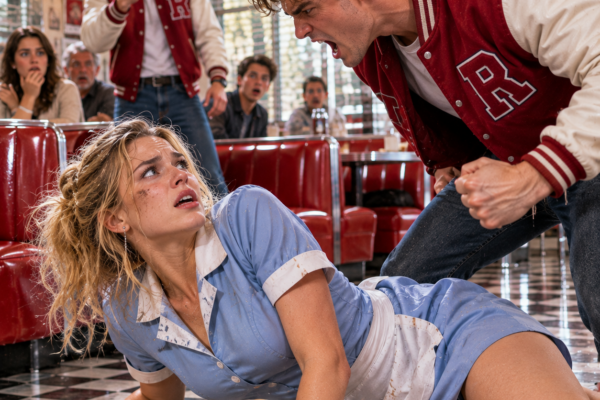
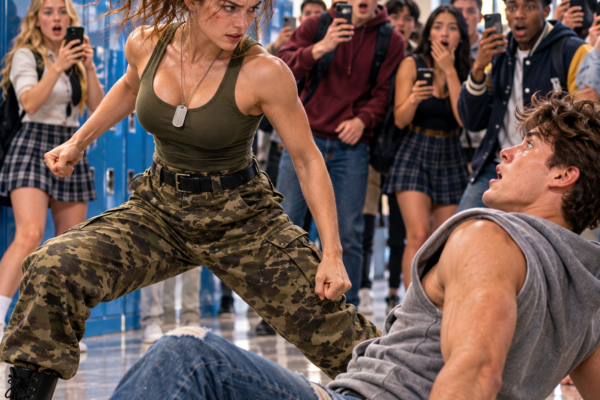
Part 4: Bullies Target The Wrong Waitress— Unaware She’s A Karate Black Belt Working Part-Time
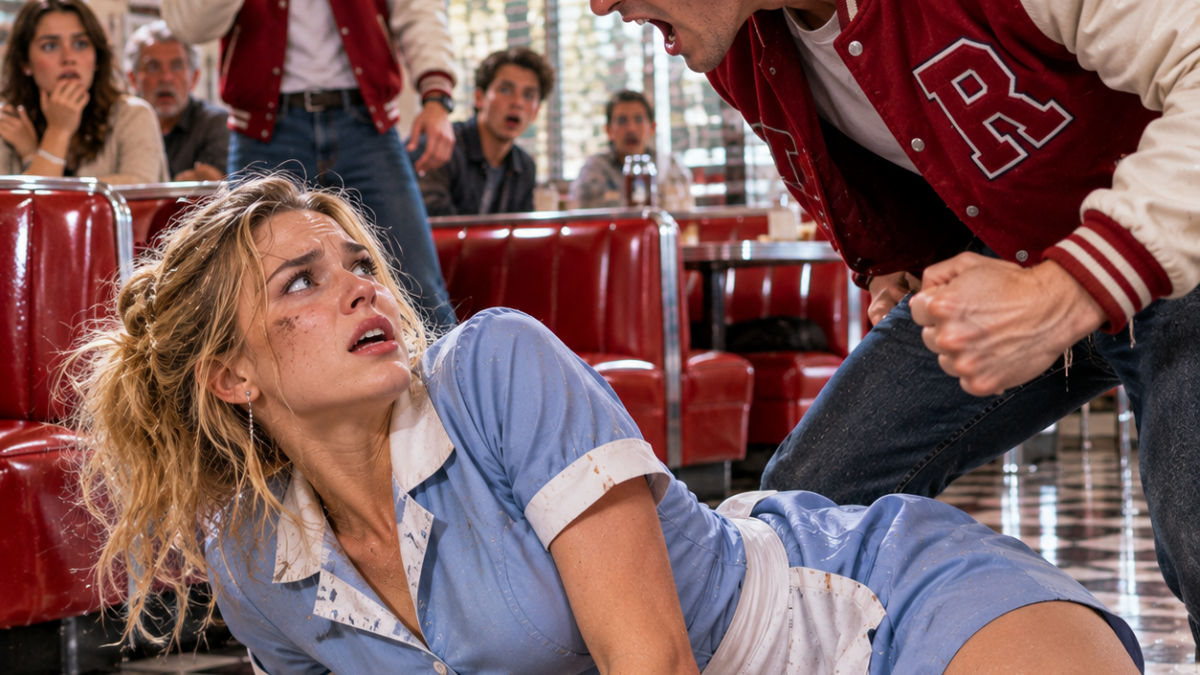
The sedan sat there, its headlights steady in her mirror, close enough now that she could see the shape of a single driver. She counted through it again.
A mile went by and then another.
Opel began very softly to hum the old hymn about the bridge over troubled waters of the heart, and Tessa thought she had never heard anything braver.
The turnoff for the lake road came up on the right, a narrow gravel lane between two stands of cedar.
Without a signal, the sedan swung into it and was gone, its tail lights flickering out among the trees.
Tessa let out a breath she had not known she was holding. Well, Opel said, and her voice trembled only a little.
That was somebody lost. Yes, Tessa said.
Somebody lost. Neither of them believed it.
They came into Pine Hollow at dusk with the water tower black against a sky of pewtor and rose and the one light on front street blinking its slow yellow blink. Tessa turned onto Cedar Street and slowed and then she stopped.
The blue herons big front window was gone. Not cracked, gone.
The glass lay across the sidewalk in bright ragged pieces and the green vinyl of the nearest booth glittered with it.
The piecase stood open to the evening air.
Someone had hung the closed sign crooked in the doorway, and the brass bell above it moved a little in the wind and rang once, thin and small.
On the door, in red spray paint, in letters as tall as her forearm, was a single word, weak. Stay in the car, Tessa said.
I will not, Grandma.
I have been in that building longer than you have been alive, young lady.
Opel was already opening her door. Tessa got out first.
Glass crunched under her shoes.
She stepped to the edge of the empty frame and looked in at the booths, the counter, the glass case by the register where Arins brass helmet still sat untouched, its cracked corner catching the last of the light. Whoever had come had come for a message, not for anything else.
Her pulse was loud in her ears. She counted in for four.
Across the street, in front of the closed hardware store, a black pickup was parked at the curb with its engine ticking as it cooled.
A tall young man was leaning against the fender, arms folded, one boot crossed over the other.
Dalton Price looked straight at her, and he was smiling. Tessa crossed Cedar Street on foot, and she did not hurry.
One breath in for four, hold for four, out for four. Her hands hung open at her sides, palms a little forward, the way Sensei Tashiro had taught her to carry them when a room got loud.
Dalton Price stood by the tailgate of the black truck with his two friends behind him.
Broken glass glittered on the sidewalk behind her in front of the blue heron. The night wind off Long Reed Lake smelled of cold water and wet leaves.
Im not going to fight you, she said.
Her voice came out level, almost gentle.
Not tonight, not ever.
Id like you to take your friends and go home. Not going to fight me.
He laughed and it was a thin sound. Thats funny.
Thats real funny coming from you.
I mean it, Dalton. He stepped in close.
He was a head taller and she could smell the beer on him.
For a moment, she felt the old heat climb her neck, the same heat she had felt at 17 on a gym floor in St.Paul.
She breathed in for four. She let it go.
He shoved her with the flat of one hand, hard square in the shoulder.
Every muscle she owned knew what to do. Seven years of drills sat ready in her hips and her wrists.
She let them sit.
She let the push carry her back two full steps, and she planted her feet and stood there with her hands open. Come on, Dalton said.
Do something. She said nothing at all.
Behind him, Brent Kowal flinched.
He had been staring at the sidewalk and now he looked up at her then at his own friend and his face went the color of paper. Tyler Voit was holding up his phone.
Brent reached over and pushed it down.
Dalton noticed none of it. He was looking at Tessa and his smile had begun to slip.
You know what my father says about your family? He said lower now.
He says youre a mistake.
A mistake this town is about to correct. your grandmothers, your grandfathers, all of it.
Come harvest days, it is gone.
Tessa heard it go into her like cold water.
Still, she did not move.
Good night, Dalton, she said.
She turned her back on three men and walked across Cedar Street, counting. Each step was harder than the one before.
She was stacking the last clean mugs behind the counter, close to midnight, when the brass bell on the door gave a small, uncertain ring.
She looked up with her whole body ready. It was Brent Kowal alone with his hands jammed into the pockets of his team jacket.
He did not come past the mat. I wont stay, he said.
I just I had to tell you what you saw. Whats online?
That was cut. Tyler cut it.
He took the 15 seconds he liked and threw out the rest. I know, Tessa said quietly.
My dad told me to keep my head down, but Daltons father, he swallowed.
Mr.Price was in the car that afternoon outside the dorm and he was yelling at Dalton.
I heard every word. He said, Just make her lose her temper.
Thats all it takes.
Make her lose it like it was nothing. The refrigerator hummed.
Tessa set the mug down very gently.
Thank you for telling me, she said.
That was not easy.
Im sorry about the window. His eyes went to the plywood colored dark where the glass had been.
I didnt throw anything.
I swear it. But I stood there.
Standing there is a thing you can change, she said.
Go home, Brent.
He nodded and the bell rang him out. Ferris Doyle had been out on the sidewalk since the truck pulled away.
He was 71 with a camera around his neck that had once belonged to a television station. And he moved along the broken glass like a man at a funeral, taking his pictures slowly and in order.
The front window, the brick that lay among the shards, the black paint across the door, still wet, that said, get out. Ill make you copies tonight, he told Opel.
Timestamps and all.
and the porch camera caught the street and the truck and the whole 8 seconds before that business with the clip. Nobodys cutting those.
Chief Dale Ror came at last a little after 11 in a cruiser with no siren. He was sweating in the cold.
He took off his hat in the doorway and turned it around in his hands.
Opel Tessa. He cleared his throat.
Ill need to write this up proper. Every detail.
Then write it proper, Dale.
Opel said. She did not raise her voice.
She did not need to. He took out his notebook and wrote for a long time.
Twice he glanced across the street where the black truck was gone, but its tire marks were not. And twice he looked away again.
When he finished, he had filled four pages, and he tore the carbon copy out and handed it to Opel with both hands.
Its formal, he said.
Its in the record.
He sounded as if he were trying to convince himself.
By midnight, the dark street was alive. Marisol came first in her coat over her pajamas with a push broom and a dustpan on a stick.
Then the Hrix Ry and June who had been married 55 years and swept in the same rhythm like one person with four arms.
Clem Ostrander arrived on his bad knees with a borrowed sheet of plywood and a saw and he cut it on two saw horses under a street lamp, muttering about measuring twice.
Birdie Nash came last.
80 years old, carrying two steel thermoses in a canvas bag. Coco, she said, and coffee for the ones who think Cocos for children.
She poured the first cup for Tessa and closed Tessas fingers around it with her own.
I was mugged outside that grocery 2 years ago, Birdie said. Nobody came out of any door that night.
I told myself Id never forget how that felt. She patted Tessas hand.
So here I am. Tessa could not answer.
She drank the cocoa instead, and it was hot and too sweet, and it was the best thing she had ever tasted.
Glass rang into the dustpan.
Plywood went up with a drills wine and a dozen steady hands.
Nobody made a speech.
The town, she thought, was turning the way a great slow boat turns so gently that you only knew it by the shoreline moving. Near 1:00 in the morning, the helpers drifted home, and the lights in the blue heron dimmed to the kitchen bulb alone.
Less Tomlin had stayed.
He stood by the walk-in cooler, wiping a clean counter that did not need wiping, and Opel came through the swinging door with the old cedar box held against her chest.
She had carried that box all week.
Less had watched her do it, and he had never asked. Les, she said, Sit a minute.
Im all right standing, Opal.
Then stand.
But listen. She set the box on a flower sack and rested one hand on its lid.
Whats in here concerns your father. It concerns Amos.
The towel stopped moving in his hand. Down the hall, the old refrigerator shuddered and went quiet.
I cant tell you all of it tonight, she said very softly.
It isnt mine alone to tell. And I want it right.
But I wont lie to you either.
Not after 22 years of you making my eggs. Les looked at the box for a long time.
Then he lowered himself onto a 100-PB flower sack slowly, like a man much older than 54, and he folded the towel across his knees.
He did not ask a single question. He did not hum.
His big hands lay flat on the cloth, and he stared at the floor tiles as if his fathers name were written there.
Opel laid her palm on his shoulder.
They stayed that way until the kitchen clock said two.
In the morning, the plywood was up and the Blue Heron smelled of coffee.
Anyway, Tessa wiped the piecase with a rag and Cal Branigans window booth sat empty, which was wrong, and every regular who came in had a hand on her shoulder or a kind word, or simply set down a dollar bill for a cup that cost half that. At 10 8, the brass bell rang, and Gordon Price came in.
He wore the camel coat, buttoned to the throat, and he smiled with his teeth.
He did not look at the plywood. He looked at Opel, who stood by the register in her apron, humming, Nothing at all.
Mrs.Lindquist, he said warmly.
Ill be brief.
Ive had my people revise the offer. He laid a cream folder on the counter.
Tessa, setting down a plate, saw the number, and felt the floor tilt.
Three times what the building was worth on any honest day, and under it, a lifetime pension paid monthly for Opal alone.
I regret last night. Gordon said, Truly a most unfortunate business, young people, you know, but Id hate for one ugly evening to cost you a very comfortable life.
Sign, And you never work another day. His right hand had come to rest on the door knob while he spoke, as if he were already leaving.
Tessa watched it. The knuckles were pale, and the fingers were shaking, only a little, like a leaf on a windless day.
Opel turned the folder over so the number faced down. She did it kindly.
Gordon, she said, Ive known you since you were in short pants, and your mother used to send you here for pie. Ive always thought you were a good boy gone wrong somewhere, and I think so still.
She folded her hands.
No, thank you. The cafe isnt for sale, and neither is the name on it.
His smile held Opal. Be reasonable.
I am being reasonable. I have a letter, Gordon, from Arn.
Nothing in the room moved. The pie case hummed.
A fork touched a plate somewhere and stopped.
He wrote it before he died. Opel went on in the same mild voice she used for pie orders.
He asked me to open it if the time came.
It came last week. Ive read it twice and Ive read it again at night.
She tilted her head.
I think you know what a man like an might have to say to a man like you.
The smile did not fall. It froze the way a pond freezes all at once and everywhere with something moving underneath.
Gordons gaze flicked just for an instant to the glass case by the register and the brass helmet inside it. Ill let myself out, he said.
He pulled the door. The brass bell rang behind him, bright and clear and quite ordinary, and the cold morning came in and went out again.
The day was long, and so were the next ones. On the 23rd evening, the eve of harvest days, strings of white lights went up across the courthouse lawn, bulb by bulb, and from the cafe doorway, Tessa could see the whole square begin to glow.
Ladders leaned on lamp posts.
Somebody tested a speaker, and a brass band tuned a long, wobbling note.
Long after closing, she was drying cups in the kitchen when someone knocked on the back door. three slow wraps.
She opened it on the chain.
Cal Branigan stood in the alley light with a brown paper bag held against his coat. He looked as if he had been carved out of old stone, gray and heavy and still, and his eyes went past her to the dim hall where Opels cedar box sat waiting.
Tessa, he said, his voice scraped.
I have carried something 30 years, and Im done carrying it.
Behind her, Les had stopped moving at the sink.
Opel stood at the end of the hall with her hand on the wall. Cal drew a long breath that seemed to cost him.
I am ready to tell it, all of it, and I want less to hear it first. The pans were still ringing.
up on their hooks above the prep table. The big copper-bottomed ones swung a little and tapped one another, and the sound went thin and then thinner until the kitchen of the blue heron held only the hum of the walk-in cooler and the tick of the clock over the dish pit.
Less Tomlins fist lay flat on the steel table where it had come down.
He did not lift it. For a long moment, nobody in the room seemed to breathe.
Not Opel in her chair with her hands folded over her bag.
Not Tessa by the back door, and not Cal Branigan, who sat on an upturned breadcrate with his cap in his hands and his crossword pen forgotten in his shirt pocket.
It had taken Cal nearly 20 minutes to say it.
He had started badly with the weather, with the year, with the cold snap of that October, as if the story might be easier to carry if he walked around it first.
Then Opel had said his name once softly, the way she might call a boy in from a frozen yard, and he had stopped circling. I was 29, he had said.
4 years on the job.
I was driving the lakefront road a little after 1:30 in the morning, checking the padlocks on the boatous, and I saw a truck coming up from the canery with its lights off. No lights at all, Les.
A dark green Ford with a toolbox in the bed.
I pulled onto the shoulder and let it pass me and the man behind the wheel was Gordon Price. At 1:40, Opel had said quietly.
140. I wrote it in my notebook.
20 minutes later, the sky over the canery went orange and by morning the whole east wall was gone. Cal had turned the cap around in his hands.
I went straight to the sheriff with my notebook. He read it standing up.
He tore out the page and put it in his pocket. and he told me that Harlon Price had built half this county and that a young deputy with a notebook had better be very sure of what he thought he saw.
Tessa had watched his face while he talked.
The old mans jaw worked and his eyes were wet and red, but his voice never broke.
He seemed to have decided long ago that he would not be allowed to. They said the night watchman had been careless.
Cal went on.
A space heater, a rag, a man asleep on duty. And they said it so many times that people started saying it on their own.
Amos Tomlin got 18 months.
I stood at the back of that courtroom in my uniform and I said nothing. And he looked right at me when they let him out.
He didnt know what I knew. That was the worst part.
He just looked at me like I was somebody who might help.
Less had not moved through any of it. He had stood with his back against the cold stove, a big, quiet man in a stained white apron.
and he had listened the way a man listens to a verdict. Arn found me years later, Cal said now into the silence after the blow.
It was a cold march and he came to my door with his hat in his hands and he said he had the proof, the real report, and that he needed one honest man to stand beside it.
I told him I would.
I told him I would speak when the time was right.
He drew a long breath.
The time was never right. It was never going to be.
There was always a mortgage or a pension or a daughter getting married or one more winter. And then Arn was gone and I sat in that window booth every morning and I told myself it was too late to matter.
Opel reached across the table but less spoke before her fingers could find anything. My father hummed that same Hank Williams tune in his cell.
His voice was low and level and that was what frightened Tessa.
My mother told me she went to see him every other Sunday and every time she came home and said he sat on that steel cot and hummed and you sat in that booth every morning for 30 years and ate your toast. Cal lifted his eyes and met him.
He did not say he was sorry because the word was too small and he did not say he had been young or afraid or ordered.
He simply sat there and let it land and that was the only honest thing left to him.
Tessa saw Less hand curl slowly into a fist again on the steel. She knew that curl.
She had felt it in her own fingers on a gym floor in St.Cloud 4 years ago with the referees whistle still hanging in the air and a girl named Kira Voss on the mat holding her wrist and staring up at her with a face Tessa had not been able to forget since.
In that second she had wanted the pain to be larger. She had wanted it to be for something, and a bone had snapped, and the wanting had not gone anywhere afterward.
She crossed the kitchen and stopped on the far side of the table, close enough that Les could see her without turning his head. Less.
She kept her voice low. I am not going to tell you what to feel.
I have no right, but I want you to know something, and then Ill be quiet. He did not look at her.
He did not tell her to stop. I broke a girls wrist when I was 17.
She hit me where the referee couldnt see and I answered with everything I had and it wasnt a fair answer. I have counted my breaths for 4 years because of it.
She swallowed.
Nobody told me restraint was a choice.
I thought it was something you either had or didnt. It turns out you decide it again and again 100 times a day.
And sometimes it costs you almost everything youve got. Thats all.
Im not asking you to forgive him. I would never ask that.
The refrigerator compressor clicked off. The kitchen went so still that she could hear the lake wind testing the loose pain in the pantry window.
Les opened his hand.
He did it slowly, one finger at a time, and laid the palm flat against the table, and the whole length of his shoulders let go of something it had held for most of his life. I dont want him hurt, he said at last.
I thought I might.
For about a minute there, I thought I might want that. He shook his head.
But hurting an old man wont give me back one day my father lost.
What I want is simple.
I want it said out loud in front of this whole town in daylight. I want my fathers name cleaned with his name on it so that when I walk down Front Street, nobody lowers their eyes.
He turned and looked at Cal finally with a gaze that was heavy but no longer burning. And youre going to be the one to say it.
Yes, Cal said I am. They planned until nearly 3:00 in the morning over cold coffee and the heel of a rhubarb pie that Opal cut into four crooked pieces.
Ferris Doyle would bring his projector and throw Judith Marshs photographs against the pale stone of the courthouse large enough for the back of the lawn to see. Chief Ror would be told to come and told why.
And Opel said she would telephone him herself because he owed Arn more than he knew.
Cal would take the stand when the council opened the floor, and Opel would read Arns letter, every word, in her own voice, from the steps where her husband had once stood on harvest nights with his helmet under his arm. Can you do it?
Tessa asked her on the way out as the first gray was lifting off the lake.
Opel patted her cheek.
I have read Arns handwriting for 51 years, sweetheart. I think I can read it one more time.
Tessa did not sleep. She lay on top of her quilt in her clothes and watched the ceiling lighten.
And at a/4 to 7, she heard a knock below her window.
Three light taps unhurried. Sensei Henry Toshiro stood on the porch in his gray wool coat, holding a white cloth bundle against his chest.
He did not ask how she was. He looked at her face for a moment, took in whatever there was to take in, and nodded.
She went down to the front room, and he followed. From the bundle he drew out her old black belt, the one she had hung on a nail in the dojo four years ago, and never touched again.
The cotton had gone soft, and the ends were frayed to threads.
He held it out between his two hands, and she understood, and she stood straight with her arms at her sides.
He wrapped it around her waist once, twice, and drew the knot with the slow exact pull she remembered from the first day he had ever done it.
When she was 14, and her feet barely reached the mat, he tightened it and smoothed the ends flat. He said nothing at all.
Behind him, the kettle began to tick on the stove. Then he stepped back, put his heels together, and bowed.
Tessa bowed back lower than she ever had. and when she came up her eyes were stinging, and his were perfectly calm and perfectly kind.
He picked up his empty cloth, nodded once more, and let himself out into the cold, bright morning. By noon, the courthouse lawn was full.
Pine Hollow had hung string lights from the oaks to the lampposts, and though the sun was still high, they glowed already, small and gold against the brick.
Folding tables ran along the walk, heaped with squash and cider jugs and quilts.
A fiddler tuned up by the bandand.
Children ran with caramel apples in both fists, and the smell of wood smoke, popcorn, and fresh coffee drifted over the whole square, mingling with the cold mineral scent that rose up from the lake.
The pie tent sat near the old fountain, a long white canopy with the judges at a table in the front. Birdie Nash took the blue ribbon with her cranberry crumble, and she stood holding it up to her chest with both hands, glowing, while Clem Ostrander clapped so hard his bad knees nearly gave way.
Opels rhubarb pie took second.
She accepted the red ribbon with a polite little nod, said it in her tote bag, and laughed softly at herself.
First time in 30 years I havent minded, she told Tessa. I had my mind on something else.
Across the lawn stood Gordon Price in his camel coat, silver hair combed back, working through the crowd with a handshake for every hand and a hand on every shoulder.
He laughed in the right places.
He asked after a farmers daughter by name.
A few steps behind him came Dalton in a stiff white shirt buttoned to the collar, pale under the string lights, his jaw tight, and his fingers drumming against his leg.
He was not watching the pies or the fiddler. He was watching Opals tote bag.
Tessa saw it from across the lawn. The way his eyes slid to the bag and stayed, and her breath caught, and she began to count.
In for four, hold for four.
Out for four.
Beside her, Les stood with his arms folded, his own gaze fixed on the same spot, and Cal in his good jacket leaned on his cane at the edge of the tent.
Marisol was somewhere by the cider table.
Ferris was still setting up his projector on the far side of the courthouse. There were friends in every direction.
Even so, her feet were already shifting under her.
At a/4 to 6, with the sun going low in amber, the loudspeaker crackled, and Margaret Ellsworths voice invited everyone toward the courthouse steps for the evening meeting. The crowd began to drift.
Opel squeezed Tessas hand, shouldered her bag, and set off.
Ill take the shortcut, she said.
Past the fountain.
These shoes and that crowd dont mix. Graham, wait.
Ill walk with you. Go and help Ferris with his cords, dear.
Ive walked this lawn for 70 years.
She smiled, and she was already moving, humming one of her hymns under her breath. Silver bun bright in the low light.
Tessa turned toward the courthouse and took three steps.
And then something made her look back. Opel was alone on the narrow path where the stone wall curved behind the dry fountain.
The noise of the lawn suddenly far away.
The envelope was in her bag.
The string light swayed a little in the wind. Dalton stepped out from behind a lamp post and his hand closed on Opals arm.
Time slowed down the way it does when something terrible is already happening and nobody can stop it. Tessa saw his fingers close around her grandmothers thin arm.
She saw the canvas bag swing out from Opels hip, the strap pulling tight across her shoulder.
She saw Opels mouth open, not in a scream, but in simple surprise, as if someone had spoken to her in a language she had never heard.
Then Daltons other hand wrenched the bag free, and his whole weight shoved forward. Opel stumbled backward three steps.
Her heel caught the edge of the curb.
Her shoulder struck the courthouse wall. Old gray stone that had stood there since 1911, and the sound it made was a dull, awful thump that Tessa would hear in her sleep for a long time.
Somewhere in the crowd, a woman gasped, one breath shared by a hundred people.
Tessa was already moving.
She did not decide to move.
Seven years of Sensei Tashiro mournings had decided it for her long before.
Her right foot swept Daltons leading ankle out from under him.
A small exact motion, no more force than a hand brushing a table.
His balance went as he pitched forward. Her left hand found his wrist and turned it and her right forearm slid across the back of his shoulder, and she guided him down to the grass of the courthouse lawn, the way you would lower a sleeping child into a crib.
He landed on his chest with a grunt.
The canvas bag skidded out of his hand and lay on the grass, harmless. Tessa knelt with her knee beside his ribs and his shoulder pinned under her palm.
His arm was bent behind him, locked, held just short of the place where it would hurt. She could have taken it that last inch.
She felt exactly where that inch was.
She left it alone.
Stay down, she said.
Her voice was low and level.
You are not touching her again. Nobody spoke.
The string lights hummed overhead. All around the lawn, phones had come up.
Dozens of small glowing rectangles.
Every one of them pointed at her. 3 weeks ago, a single 15-second video had told the world a lie about her.
This time, she thought nobody was missing the first second.
She did not look at the phones. She looked at her grandmother.
Opel stood with one hand flat against the stone.
Her silver bun had slipped sideways. Her glasses hung crooked on her nose, but she was standing and her eyes were open.
And when they found Tessas, they were clear. Im all right, honey, Opel said.
It came out thin. Im all right.
Hold on to him.
Cal reached her first, faster than a man of 79 had any right to move.
His cane forgotten somewhere behind him.
He took her elbow gently. Birdie Nash came up on the other side and slipped an arm around Opals waist.
And between them, they eased her onto the courthouse step. Let me see that shoulder, Cal said.
Its a shoulder, Cal.
Itll live. Humor and old deputy footsteps pounded across the lawn.
Chief Dale Ror came through the crowd at a run. One hand holding his hat, his face the color of paper.
He stopped short when he saw the scene.
The boy flat in the grass, the girl kneeling over him, the old woman on the step.
Tessa, he said. Let me take over.
Not until youre here, she said. Im not letting go until youre standing right here.
Im here.
She waited one more breath. Then she loosened her hold slowly and stood back.
From the edge of the crowd, a tall young man in a northern state sweatshirt stepped forward. It was Brent Kowal.
He had gone gray around the mouth, and his hands were shaking. Chief, he said.
I saw all of it. I saw him grab her.
I saw him push her.
He swallowed.
And I saw what happened at the cafe, too. I should have said something weeks ago.
Im sorry.
I am so sorry. Nobody answered him.
But Ror nodded once and wrote something down.
Dalton rolled onto his side, panting. Grass stuck to his cheek.
He pushed himself up on one elbow and stared at Tessa.
Three weeks he had spent calling her weak.
Little waitress, coffee girl.
He had said it across the counter and across the lawn and she suspected to his friends in the locker room and he had believed every word.
Now he looked at her as if he had never seen her before.
You, he said horse, you could have. Yes, Tessa said quietly.
I could have.
I held back for 3 weeks. I would have held back three more.
His mouth worked, but nothing came out. Ror pulled him to his feet and took out the handcuffs.
The metal clicked. A small plain sound in the silence.
Dalton Price, the chief said.
Youre under arrest for assault.
Dale. The voice came from the crowds edge, smooth and carrying.
Gordon Price was walking across the grass in his camel coat, his silver hair catching the lamplight, one hand lifted as if he were stopping traffic. Dale, lets be reasonable.
My son is a young man who made a mistake. Surely this can be settled without.
Ror turned. For a moment, he seemed to be looking at a man he had known a very long time and seeing him for the first time.
Not today, Gordon, he said. That was all.
He walked Dalton to the cruiser, and Gordon stood alone on the lawn with his hand still raised and slowly lowered it.
The meeting began at 7 as it had been scheduled to for a month. Nobody had suggested cancelling it.
The whole town simply drifted from the lawn to the courthouse steps as the sky went from rose to violet carrying folding chairs and paper cups of cider and a hush that did not belong at a harvest festival.
Someone had strung an extension cord from the clerks window.
A microphone squealled once and went quiet. Margaret Ellsworth sat at a folding table at the top of the steps, her reading glasses on a chain, her gavvel beside a stack of papers.
She looked older than she had that morning.
This meeting of the Pine Hollow Council will come to order, she said and wrapped once. We have one item, the Lakeshore Commons proposal, and the vote on the cedar and fourth block.
Mr.Price, you have the floor.
Gordon came up the steps alone. His attorney, Hollis Crane, followed a pace behind with a leather folder.
Gordon wore the same camel coat, the same calm face, and he said a single sheet of paper on the lectern as if nothing at all had happened an hour before. He spoke for 11 minutes.
He spoke about jobs, about a new marina, about 42 units of lakefront housing, and a tax base that had been shrinking since the canery closed. He was good at it.
He had always been good at it. A few heads nodded in the crowd, out of habit.
When he finished, he stepped back and Margaret looked down the steps. Is there anyone who wishes to speak in opposition?
Opel stood up.
She had refused to go home.
She had refused the ambulance and Cals arm and Tessas pleading. She had only asked for her good cardigan from the cafe and her reading glasses and the envelope.
Now she climbed the steps one at a time with her hand on the rail, and in her other hand she held a sheet of yellowed paper folded in thirds.
Tessa sat on the bottom step and watched her go up and her whole body leaned after her. My husband wrote this 30 years ago, Opel said into the microphone.
Her voice shook, then steadied. He never gave it to me.
He left it where he knew I would find it when I was ready.
I wasnt ready until today. She unfolded the paper.
She put on her glasses.
Dear Opal, if you are reading this, then I am gone and the helmet has finally been opened, and I am sorry it fell to you.
Her voice went on quiet and plain, and the crowd leaned in to hear it. Arn wrote of a night in 1994.
He wrote of a fire on the lakefront, and a report he had written, and a report that disappeared. He wrote of a watchman named Amos Tomlin, who had been put away for something he did not do.
 [Tap here for the Next Part ]