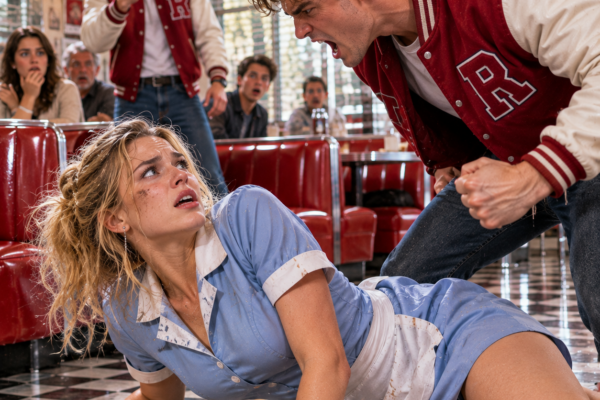
Part 5: Bullies Target The Wrong Waitress— Unaware She’s A Karate Black Belt Working Part-Time
He wrote that the name of the man who set the fire was in the folder and the name of the man who paid for it and that he had kept silent because he had been afraid and because he had been told that silence was kindness.
He wrote that he had been wrong.
I have kept my fists closed too long. Opel read, The hard part is keeping the hand open.
Open it, Opel. Open it for Amos.
She folded the letter. Nobody breathed in the lamplight on the second row.
Less Tomlin sat completely still.
His apron was still tied around his waist. He had come straight from the cafe grill.
His hands lay open on his knees and they were trembling.
Then Cal rose. He did it slowly with a hand on the chair in front of him and the whole crowd heard his bad knee crack.
He walked to the foot of the steps and did not go up. He took off his cap.
Im Cal Branigan, he said. Most of you know me from the window booth.
In 1994, I was a deputy, 29 years old. And on the night of the Canary fire, I saw a mans truck leave the lakefront with its lights off.
I knew the truck.
I told the sheriff. The sheriff told me to forget it.
He turned his cap over in his hands. I forgot it for 30 years.
I want to say before God and all of you that I never did, and I want to say to Les Tomlin that I am sorry.
Less stood up.
He did not say anything.
He walked down the row step by careful step.
And when he reached Cal, he did not stop.
He stood beside the old deputy shouldertosh shoulder and faced the council. Thats my fathers name in that letter, Les said.
His voice was rough. Id like to hear the rest.
A rustle ran through the crowd.
Ferris Doyle was on his feet at the back, tugging at something. He and Clem Ostrander had hung a white bed sheet from the courthouse wall with clothes pins and masking tape, and he now crouched over a small projector on an upturned crate, his big hands steady for the first time all day.
Ive got photographs, Ferris called.
Arn took them.
They were in the folder, and Judith Marsh kept them for 30 years. I scanned them this afternoon.
The lights dimmed, the sheet glowed white, and then a picture bloomed across it. Black and white and grainy.
the canery burning. A truck at the edge of the lot.
A young man with fair hair standing with a red can in his hand.
His face turned toward the camera by chance. A sound went through the crowd low like wind in a field.
Margaret Ellsworth had taken off her glasses and the statement from Mrs.Marsh.
She asked here.
Chief Ror had come up the steps quietly, his uniform still creased from the lawn. He held a typed page.
Judith Marsh signed this at Maple Grove two days ago with a nurse and a notary present.
Ill read it if the council allows.
Read it.
He read it.
Judiths words were short and exact.
The words of a woman who had spent 40 years getting records right. She had filed the original report in 1994.
She had watched it taken.
She had kept a carbon copy in her sewing box for 30 years because it was wrong and she had never been able to throw away what was wrong.
When he finished, the only sound was the wor of the projector fan. Objection, said Hollis Crane.
He had risen smooth and brisk folder in hand. Madame chair, this is a council meeting, not a court.
These are unauthenticated photographs. A letter from a dead man and a statement from an elderly woman in a care facility.
None of it has been tested. None of it is relevant to a zoning vote.
Mr.Crane. Margaret looked at him over the table.
I have sat on this council for 22 years.
In that time, I have never once thrown out a thing that was true because it arrived in the wrong order. She set down her pen.
Overruled. Sit down.
Crane sat.
Gordon had not moved. He stood at the side of the lectern with his hands at his sides.
He looked at his watch as though a train were due.
He looked at the crowd, the faces turned up in the lamplight, hundreds of them, familiar, silent, not one of them looking at him with the old respect. Then his eyes went to the second row and to the cook in the stained apron who stood beside the old deputy and who was looking at him with Amos Tomlins tired and steady eyes.
Gordon looked at Les for a long time. Tessa climbed the steps and sat down beside her grandmother in the shadow of the pillar.
Opels hand found hers. It was cold and it was steady.
Tessas was not. Now that there was nothing left to do, she was shaking hard from her shoulders down to her fingers.
The way a leaf shakes after the wind has gone.
Breathe, honey, Opel whispered. In fours, Tessa counted.
In for four, hold for four. Out for four.
Opels thumb moved slowly across her knuckles and somewhere under the lamplight she was humming very softly the first line of a hymn.
Gordon cleared his throat.
Madame chair, he said.
Id like to speak.
Margaret nodded.
The crowd went so still that Tessa could hear the lake a quarter mile away, laughing at the canerys rotting pilings.
Gordon stepped up to the lectern, gray in the face, his hands gripping the wood.
I was 24 years old. Under the lamps on the courthouse steps, Gordon Price let go of the railing.
The camel coat hung open on him, and for the first time anyone in Pine Hollow could remember, he did not look like a man who owned the ground he stood on. His face was the color of old ash.
Hollis Crane reached for his sleeve, and Gordon moved the arm away without looking. I was 24 years old, he said again, and his voice cracked on the last word.
I would like to say it plainly because I have spent 30 years saying it every way but plainly. Nobody on the lawn moved.
The string lights hummed.
My father, Harlon Price, wanted the Northshore Canery gone. The insurance was worth more than the building, and the land under it was worth more than both.
He told me what to do and how to do it, and he told me when, and I did it.
I carried the cans myself. I struck the match myself.
He stopped and swallowed. Nobody forced my hand, Chief Ror.
My father gave the order, but I was the one who lit it.
A sound went through the crowd, low like wind coming through a screen door.
There was a night watchman, Gordon said.
Amos Tomlin. I let them put it on him.
I stood in my fathers kitchen while they did it.
I told myself I would make it right when I had money of my own.
when I had a name of my own. When my father was gone and I could.
And then my father was gone and I had the money. And I found out that the longer you wait to do a right thing, the heavier it gets until you cant lift it at all.
He turned his head.
His eyes went along the front rows and stopped.
And Tessa, standing at the foot of the steps with Opels arm tucked through hers, knew exactly where he was looking.
Less Tomlin stood at the edge of the lamplight, still in his white kitchen apron under his jacket. He had come straight from the stove at the blue heron.
His big hands hung at his sides, and his jaw was working slowly, the way it did when he was holding a tune back. Mr.Tomlin, Gordon said, less.
I have no right to say your name.
Im going to say it anyway.
Your father died in 1999 believing that the whole town thought him a thief and a firebug. He wasnt.
He was the only honest man on that dock. I am sorry.
I know that is a small word to set beside 18 months and a lost life.
It is all I have that is true. Less said nothing.
The silence stretched so long that Tessa found herself counting breaths in fours. In and hold and out and hold the way Sensei had taught her.
She counted three rounds.
Opels fingers tightened on her arm.
Then Les gave a single nod. It was small and slow.
no more than a man settling a heavy thing onto a shelf. It was not forgiveness.
It was only an answer.
I heard you.
I wont carry hatred for you, Les said at last in the rough, quiet voice that most of the town had heard say perhaps a hundred words in 22 years.
My dad wouldnt have wanted it.
He drew a breath. But I want his name back written down in the countys own hand where it was taken from him.
That is what I want. You will have it, Gordon said.
Whatever it costs me.
Margaret Ellsworth at the council table that had been carried out onto the top step had been sitting with both hands flat on the papers in front of her.
Now she rose. She looked at the gavl now as though she had forgotten what it was for.
Mr.Price, she said, I think you should sit down.
Then she turned to the other four members.
I move that this council reject the Lakeshore Commons proposal in its entirety tonight with no amendments and no further study. I further move that Price Lakeshore Holdings be referred to the county attorney for review of every filing and every payment it has made to this town.
For a moment, nobody seconded. Then old Harold Beck, who had voted with the prices on every question since Tessa was in grade school, cleared his throat.
Second, he said, and he sounded relieved.
All in favor. Five hands went up.
There was no pause between them and no glance toward the silver-haired man in the camel coat. Margaret counted them anyway, aloud, as the rules required, and then said, Opposed?
None. The motion is carried unanimously.
The lawn came apart. People shouted and clapped, and June Hendrickk was crying openly into her husbands shoulder.
Marisol had both fists over her head.
Somebody started singing the first line of a hymn, and Opel, who had not hummed a note all evening, took it up in a thin, steady voice. Chief Dale Ror came down the steps with his hat in his hands.
He raised one palm, and the noise fell back in waves until he could be heard.
Folks, he said, I have been chief of this department for 9 years, and I have not always done what I should have done. He looked at the ground, then up again.
Tomorrow morning, I am calling the state fire marshalls office to reopen the file on the Northshore Canary Fire.
Tonights statement and the records Judith Marsh kept all these years will go with it. When that file is closed again, it will say what is true.
Amos Tomlin will be cleared. I give you my word on that in front of you all.
It was later past 10 when the crowd had thinned to stacked chairs and sleepy children carried to cars.
The night had turned cool, and the lake sent its cold, clean smell up front street. Opel sat on the bench by the courthouse wall.
A blanket Marisol had found around her shoulders. The mark of Daltons grip had darkened on her arm, but she held it quite naturally, as if it belonged to someone else.
Cal Branagan lowered himself onto the other end of the bench. He took a long time doing it.
He set his cane against his knee, and he did not look at her. Opal, he said.
30 years ago, I saw Gordons truck come off the lakefront road with its lights out.
I told the sheriff.
When he told me to let it lie, I let it lie.
Ara asked me once, years later, if I knew anything. I said, No.
His voice shook, which it never did.
I would like to ask your forgiveness.
Opel was quiet. I cantunkt give you that one, Cal, she said gently.
It isnt mine to give. Ask it of Les and then ask it of Arn at his grave.
She patted the back of his hand once like a woman smoothing a tablecloth. Hed have heard you out.
He always did. Now go and do it while youve still got the breath.
Cal nodded.
He sat a little longer and she let him.
In the holding room at the back of the sheriffs annex, Dalton Price sat on a metal chair with his hands between his knees.
His football jacket was gone.
Brent Kowal came in with a deputy at his shoulder and stood just inside the door. I told them everything, Brent said about the video, about Tyler cutting it.
I should have said it two weeks ago. Dalton did not look up.
Yeah, he said. You should have.
He was quiet a moment. So should I.
Brent did not know what to say to that, so he stayed a minute longer and then went out. Tessa came to the annex a little before midnight.
Chief Ror met her at the door of the holding room with his hat still in his hand and he said, You dont have to.
And she said, I know. Dalton raised his head.
His eyes were swollen up close without his friends and his father and the lights.
He looked exactly 20 and no older. He opened his mouth and nothing came out.
He tried again.
His throat worked and still there was nothing, only breath. Tessa stood in the doorway and thought of Kira Voss and of a wrist that had cracked in her grip four years ago and of how many nights she had wished someone would simply say something to her that was not an excuse.
She had no speech. She had only the one true thing she had learned.
A hand can stay open, she said quietly, even after its been a fist.
Its harder, thats all. Daltons face crumpled.
He bent forward until his forehead nearly touched his knees. And the sound he made was the sound of a boy, not a linebacker.
Tessa did not move toward him and did not move away. She stayed one more breath, then another.
Then she nodded to Ror and walked out into the night air.
There was no triumph in her, none at all, only a great tiredness and a strange light ache under her ribs. The days after were quieter than anyone expected.
The county attorney moved fast. Hollis Crane, to the surprise of several people, withdrew the complaint against Tessa before it was ever argued.
Dalton stood before a judge in Lake City with Brents statement and Ferriss 8 seconds of porch video on the table, and he pleaded to what he had done to Opal.
The judge gave him 200 hours of community service and a record that would be wiped clean if he kept to his word for 2 years.
He started on a Saturday in October at 6:00 in the morning at the back door of the Blue Heron.
Les was waiting with a rubber apron and a pair of yellow gloves. Dishes, he said, Pots after floor last.
Yes, sir, said Dalton.
He was awful at it.
He stacked plates the wrong way and ran the hot water until the steam fogged his face.
But he came back the next Saturday and the one after. Les said very little.
Once passing behind him, he reached over and turned the plates around so the rims faced up. Dalton looked at them, then turned the rest of the stack to match.
In November, the town gathered on the lakefront, where the canerys black foundation still ran down into the water like a broken tooth. A small bronze plaque had been bolted to a block of granite.
Margaret Ellsworth read the words aloud with her glasses sliding down her nose.
Amos Tomlin, night watchman, Northshore Canaryy, an honest man, his name restored by the people of Pine Hollow.
Les stood beside the stone in his good brown suit. He laid his hand flat on the metal over the first letter of his fathers name and held it there while the wind came off the lake.
Behind him, Tessa heard him humming very softly, something slow and old by Hank Williams.
Gordon Price was not there. He had sent a letter instead, two typed pages with his signature at the foot, setting down everything he had done and everything his father had done, with dates and amounts and the names of the men who had helped.
Chief Ror read one line of it aloud and then folded it away.
He says he will not ask to be forgiven, Ror said.
He says only that he wants it to be true on paper. On the Monday after the blue heron opened at 6 as it always had.
The bell rang over the door and Cal Brangan came in and walked slowly to the window booth.
He sat, unfolded his crossword and clicked his pen.
Less came out of the kitchen.
He had a plate in his hand and on it sat one pancake golden at the edges, a pad of butter just beginning to melt. He set it down in front of Cal.
He did not say a word, and neither did Cal. The old deputy looked at the plate for a long moment, then picked up his fork with a hand that was not quite steady.
Less went back to the kitchen.
A moment later, from behind the swinging door, came the low murmur of a tune. A year went by, the way years do in a small town, with the lake freezing and thawing, and the water tower getting its fresh coat of paint at last.
On the last Saturday of the next September, the courthouse lawn was strung with lights again.
By the front door of the Blue Heron, on the morning of harvest days, there hung a new corkboard, and it was crowded with photographs.
There was sensei Henry Tashiro in his white ghee, a rare small smile on his face.
There was Ferris Doyle behind his porch camera.
There were Birdie, Clem, Rey, and June lined up in the community hall, their fists loose at their sides and their hands.
Everyone open under them.
Someone had pinned a card in Opels careful hand. Anybody can make a fist.
Opels rhubarb pie won first place that afternoon.
Aras helmet had gone into a new glass case by the register with a clean corner and a brass plate, and the folded letter inside it was no longer a secret. People say silence is a kind of peace, and sometimes it is.
But in Pine Hollow, they had learned what it could cost. One mans quiet had taken another mans name and a whole towns for 30 years.
The strongest person in a room is very often the one who holds back, who has the power and chooses not to use it, who keeps the hand open and waits.
On a gray Monday morning early, Tessa tied her apron behind her. The cafe smelled of coffee and lake water and warm rhubarb.
Opel hummed in the back. Cal was already in his booth.
Her braid lay over one shoulder and her hands were quiet at her sides. She was strong enough not to need the fist at all.
The brass bell rang over the door.
The door swung open on the cool, bright morning, and Tessa lifted the pot and poured the first cup of the