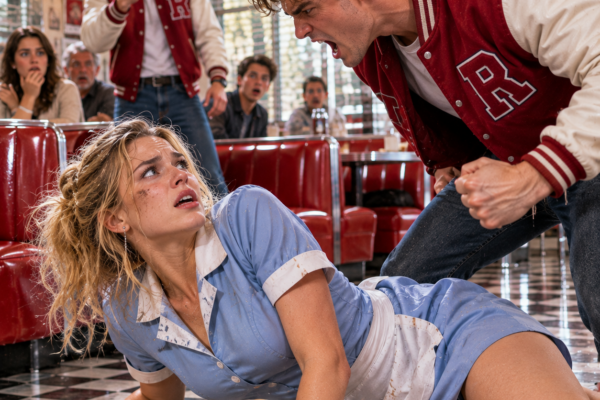
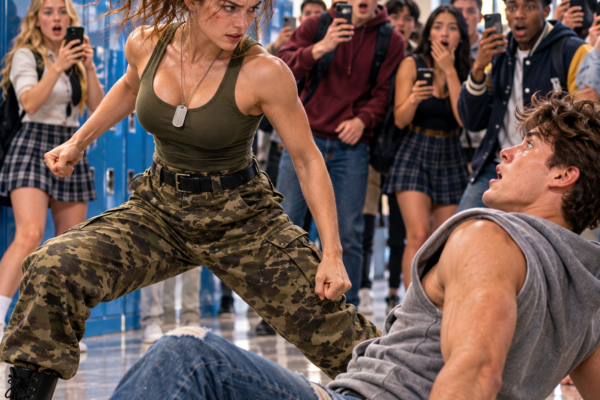
Part 2: Bullies Target The Wrong Waitress— Unaware She’s A Karate Black Belt Working Part-Time
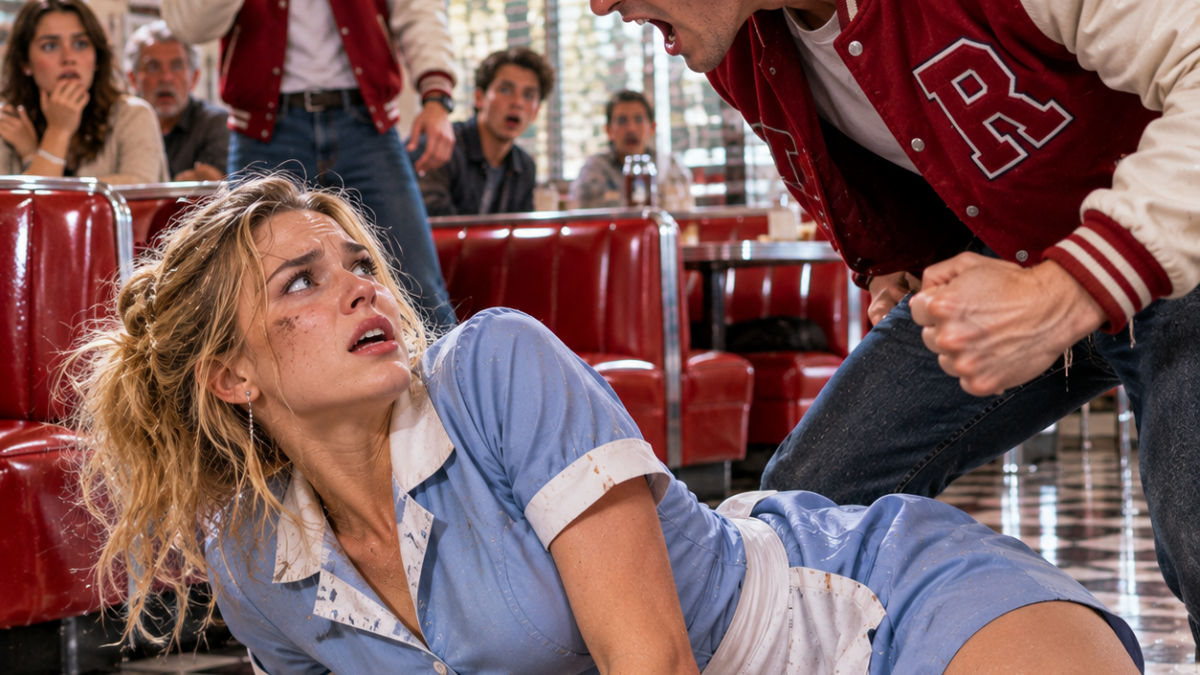
The landing was cold.
Tessa folded the towel, breathed in for 4, and went home. On Sunday morning at 5 minutes to 7, the Pine Hollow community hall smelled of burnt coffee and floor cleaner.
Tessa had pushed back the folding tables and set out a row of metal chairs in a half circle.
Her class came in the way, a class of seniors always does, one at a time and all complaining.
Birdie Nash was first, 80 years old and 411 in a purple windbreaker and sensible shoes. Two years ago, a man had pulled her purse off her arm outside the grocery store, and she had hit the sidewalk, and since then, she had not walked to the store alone.
I am too old to be afraid of the grocery, she announced, sitting down. It is embarrassing.
Clem Ostrander followed a retired male carrier with a cane and two bad knees. 34 years I walked this town, he said.
Dogs never got me. Ry and June Hendrik came in arm in-armm as they had for 55 years.
Ry carried the thermos.
June carried the opinions. He signed us up, she told Tessa, because he read a newspaper article and got worried.
I came to keep an eye on him.
She came because Im better looking in a gym, said Rey. You are not, said June, and kissed his cheek.
The last to arrive was a long stooped man in a corduroy jacket with white hair combed carefully over a bald spot and a pair of binoculars hanging around his neck for no reason at all.
Ferris Doyle, 71, a widowerower for 6 years, had worked behind the cameras at a television station in Duth for 30 years.
He sat down in the back row and said nothing.
And Tessa thought she had never seen anyone look so much like he was waiting to be asked to leave.
Good morning, everyone, she said. Thank you for coming.
Before we start, I want to tell you what I am not going to teach you.
I am not going to teach you to win a fight.
Clem raised an eyebrow.
Then what are we doing here?
Learning not to be in one.
For an hour, she showed them the plain things.
How to stand with one foot back and both palms raised, open and easy, as though about to say, Pardon me. How to shout.
A real shout from the belly, not a squeak. how the best move in any bad situation is the one that ends with you walking away.
The exit is your first technique, said Tessa.
Know where it is when you walk into a room.
Leave before anything starts.
During the water break, Ferris drifted over to her. You said you watch the doors, he murmured.
I noticed. I do too these days.
Habit, said Tessa.
I have a camera on my porch, he said as if confessing. Across from the cafe.
It records all of Cedar Street right up to your windows.
I tell people it is for the birds and the neighbors dog.
He studied his shoes.
The truth is I put it up after Marjgerie passed. I like to watch the street.
It is company. That does not sound like a crime, Ferris.
No, he said and looked up with a small, shy smile.
Just lonely. Near the end, she had them practice the open hand and the exit together over and over until Birdie could shout, Step back and leave through the door of the hall in 3 seconds flat.
She received a round of applause from the Hendris.
Birdie went pink to her ears.
That evening, Marisol Reyes drove Tessa home in her dented blue Corolla with the windows down. Marisol was 22, quick and darkeyed, and she talked the way she drove with both hands.
She was saving $400 a month for community college, she said.
And the cafe was all she had.
And if anything happened to the blue heron, she did not know what she would do. Nothing is going to happen to it, said Tessa.
You dont know that. Marisol glanced at her.
You never say anything about yourself.
You know, 12 days and I know you take accounting classes and that is it.
There isnt much.
There is always much, said Marisol and let it go. Monday brought the lunch rush and a cold wind off the lake.
At 12:15, the brass bell rang and Tessa knew without looking.
Dalton Price came in first, broad and loose limbmed with Tyler Voit and Mason Reed behind him like a pair of bookends. Brent Kowal trailed at the back, hands deep in his jacket pockets.
They took the big center booth and talked loudly enough for every table to hear.
There she is, said Dalton, and grinned. The new girl.
Hey, new girl. Is the coffee still bad?
Is the pie still stale? said Tyler.
I bet she bites, said Mason.
And all three laughed. Cal Branigan lowered his pen.
At the counter, the Hrix stopped chewing. Tessa felt the whole room tighten like a drawn string.
She counted four breaths, sat down her tray, and walked over with a plain smile.
Welcome back, she said.
What can I bring you?
She brought it all. The coffees, the burgers, the pie they did not eat.
When they had finished and stood up, wallets out, she asked pleasantly. Is there anything else I can bring you?
Nope, said Dalton. Youve done great, new girl.
Brent was the last to go. At the door, he paused, and she saw his gaze slide to her, then to the floor and back, as if he wanted to say something and could not find the first word.
Then Mason called his name and he went. Dalton lingered a moment longer, one hand on the door frame.
He leaned in so only she could hear. My father owns the roof over your head, he said softly.
And I am going to make sure you remember me.
The small cruelties came one after another, and each was a little worse than the last.
On Wednesday, Dalton sent back a cheeseburger because it was too round.
On Thursday, he sent back a bowl of Less chili, declared it cold, and when Tessa carried it away and returned with a fresh one, he sent that back, too.
On Friday, a handful of quarters hit the floor around her shoes, ringing like tiny bells, and Mason Reed said, Keep the change, sweetheart.
Looks like you need it.
Tessa knelt and picked up every coin.
She put them in the tip jar by the register, one at a time, and she did not say a word.
The next Monday, Dalton knocked a chocolate milkshake off the table with his elbow.
It broke across the floor in a long brown tongue, and he said, Oh, wow.
Accident.
Tyler Voit sat across from him with his phone held low, tilted just so, and he was smiling at the screen. She fetched the mop.
She wiped the floor until it shone. She felt the eyes of the whole room on the back of her neck, and she kept her face as smooth as a lake on a windless morning.
That night in the kitchen, Opel took Tessas hands in her own, the way she had when Tessa was small and had scraped her knees.
Please, honey, she said.
Please, we cannot afford to give them what they want.
Whatever they say, you stay calm. I am calm, Grandma.
I know you are. Opals thumbs moved over her knuckles.
That is what frightens me. I know exactly what it costs you.
From his window booth, Cal Branigan had watched all of it over the top of his crossword.
On the fifth day, he waited until the lunch crowd thinned, and then he lifted two fingers, the way he always did when he wanted the coffee pot.
Tessa came over and poured. You are doing the hard thing, he said without looking up.
His pen tapped a blank square. Most folks never learn how hard it is.
Letting a fool be a fool and walking away takes more than any punch ever did. Thank you, Mr.Branigan.
Cal.
He finally raised his eyes, pale, blue, and tired. But hear me, men like that boy count on the hard thing.
They poke and poke, and they bet you will break first.
Someday the poking stops being a game.
You watch his hands, not his mouth.
Tessa felt a small chill, though the afternoon was warm.
Why are you telling me this?
Because I have seen it before, said Cal, and he went back to seven across.
In the kitchen, Les Tomlin stood at the flattop, turning hash browns with a steady hand.
He was a broad, quiet man with gray in his short hair, and in 22 years, Marisol liked to say he had spoken maybe 300 sentences. When he thought the kitchen was empty, he hummed Hank Williams, low and a little sad.
One afternoon, Tessa came through the swinging door with a tray and two old fishermen at the counter were talking loudly about the lakefront.
They say Price will tear down the old canery first thing.
One said, Good riddance. That place has stood empty since the fire.
The spatula stopped.
For one breath, Less whole body went still, as if somebody had called his name from far away.
Then he flipped the hash browns harder than he needed to and the humming did not start again that day. Tessa set her tray down slowly.
Marisol, she said later, by the dish pit.
What is it with Less in the canery? Marisol dropped her voice.
His dad worked there.
Night watchman, I think. He died long before I was old enough to know him.
Less never talks about it. Nobody asks.
Never?
Not in this town. Marisol shrugged, but her eyes went toward the kitchen.
Some things sit in a room so long that everybody walks around them.
By the second week, Price Lakeshore Holdings had a booth in front of the hardware store on Front Street.
It had a striped awning, a bowl of butterscotch candies, and a table of glossy brochures.
The cover showed a lake at sunset, a boardwalk, and a smiling couple with a stroller. Lakeshore Commons, it said.
A future for Pine Hollow.
Tessa took one on her way to the bank.
Inside, a drawing of the cedar and fourth block had been softened with trees, and there was no cafe in it. She folded the brochure in thirds and put it in her pocket, and her hand was not quite steady.
On Saturday, Gordon Price spoke at the Rotary Breakfast in the church basement.
Opel had been asked to bring pies, so Tessa carried them in.
She stood against the back wall and watched him work the room. He wore the camel coat even indoors.
His silver hair caught the fluorescent light, and he told a story about his first job sweeping a hardware store.
And he told it so well that grown men wiped their eyes. I love this town, he said, spreading his hands.
I want my grandchildren to love it, too.
Is that so much to ask? The room clapped.
It clapped warmly for a long time. Even the barber clapped.
Tessa realized she was the only one in the basement with her arms folded and she unfolded them slowly and put her hands together once, twice so as not to stand out.
Gordon found her afterward by the pie table. He took a slice of rhubarb, tasted it, and closed his eyes.
Your grandmother is a treasure, he said. And you must be Tessa.
My son tells me you are very dedicated. Thank you, sir.
I hope you will always feel welcome here.
His smile was perfect. His eyes, she thought, were like windows with the curtains drawn.
Midweek, she stopped at the grocery for oatmeal and tea.
She was reading a label in the cereal aisle when she heard sneakers squeak behind her. Dalton and Mason Reed stood at either end, easy as two men waiting for a bus.
When she turned her cart to leave, Dalton stepped in front of it and rested one big hand on the handle. Where you going, new girl?
Excuse me, Tessa said.
Nope.
I am thinking about it.
He leaned close. His breath smelled of mint over something sour.
I am thinking you got a real attitude for somebody who pours coffee. Her heart was knocking against her ribs.
Her feet shifted almost by themselves into the stance sensei had given her 7 years ago.
She felt how easy it would be.
Then she let her weight slide back, softened her knees, and stepped aside.
1 2 3 4. She breathed in for four counts and out for four.
Then she left the cart where it stood with the oatmeal and the tea in it, and she walked down the aisle with her back straight.
Behind her, Dalton laughed. At the end of the aisle, a bagger in a green apron, a boy of maybe 16, had stopped with a paper sack in his arms.
He had seen all of it. For a second, their eyes met, and she saw him swallow.
Then he looked down at his sack and said nothing at all, and she did not blame him.
That night, she climbed the narrow stairs above the old hardware store, and the dojo was dark except for the lamp by the shrine.
Sensei Tashiro sat on his heels, waiting, a cup of tea steaming beside him, as if he had known. I am tired of swallowing it, she said, still standing.
I want to say something back, just once.
He did not answer right away. He poured a second cup and held it out to her and she knelt and took it.
Restraint is not the absence of skill, he said finally.
It is a skill, the hardest one perhaps. Anyone can strike.
Fewer can stay still when every part of the body says move.
And if staying still stops working, then you will know it, said Sensei. You will know it, and you will choose, and the choice will be yours rather than his.
On Sunday afternoon, the cafe was closed and the kitchen smelled of butter and tart rhubarb.
Opel rolled out crust on the old marble slab with Tessa beside her trimming stalks. The oven ticked.
Somewhere in the walls, an old pipe sang.
Na used to eat this pie at 2:00 in the morning.
Opel said, standing in his socks. After a bad call, he never wanted to talk.
He would just sit at this table with a fork and a quiet face, and I would sit across from him.
She smiled, but she was looking at something far away. Once he came in smelling of smoke with soot in his eyebrows.
He had carried a little boy out of a farmhouse and the boy was fine.
And your grandfather cried over a slice of pie and said it was the best thing he had ever tasted. Tessa laid down her knife.
Grandma, why does Cal watch me?
Not like the others do.
Like he is waiting for something. Opels hands paused in the flour.
For a long moment, only the oven ticked. Cal has carried things a long time, she said quietly.
Heavy things. When he is ready to set them down, he will.
Do not push him. What things?
That is his to tell.
She pressed the crust into the pan, and her thumb left a small, neat ridge.
Hand me the sugar, honey. Day 12 fell on a Saturday, the church supper, with long tables and paper tablecloths and 100 casserles.
Tessa came late in her good blue sweater because Birdie Nash had asked her to sit with the class. Birdie was 80 and little, and she wore a brooch shaped like a robin.
Dalton came in with his fathers group and stopped to stack a plate near the ham.
Birdie, who had never in her life let a young person pass without a kind word, looked up and said, Good evening, young man. I hope you are enjoying the supper.
Dalton looked at her.
He looked at her cane, her curled fingers, the brooch.
Good evening, young man, he repeated in a quavering old lady voice.
A few boys nearby laughed.
Somebody get her a nap.
Birdies smile did not fall, but it trembled. Her hand slid across the tablecloth and gripped Tessas wrist hard, harder than Tessa would have believed from such small fingers.
Tessa felt the pulse in it, quick as a birds. She felt her own pulse answering, thuing in her ears.
She did not move. She held Birdies hand under hers and said in a perfectly level voice, Pass the rolls, would you clim.
And the table, bless it, began to talk about rolls.
Two days later, on Friday evening, the Blue Heron was full to the walls. It was the end of a long week.
The lake pink in the windows, and every booth had its crowd.
Ry and June Hendrik shared a slice of lemon meringue by the door. Ferris Doyle had a corner table with his battered laptop closed beside his plate.
The barber was there and Margaret Ellsworth with two councilmen and a family from the lake road with three sleepy children. Cal sat in his window booth with his rye toast and less worked the grill in a cloud of steam.
Marisol swept by with a tray of coffees held high.
Table 9 is asking for you, she whispered.
And I think the milkshake mans about to come in. Why?
because it is Friday and he has a feeling for a crowd.
The brass bell above the door jangled hard as though someone had thrown it open with his shoulder. The room turned as rooms do.
Dalton Price stood in the doorway with Tyler and Mason, his face flushed, his shirt untucked, a half empty bottles worth of bravery on his breath.
Brent Kowal hung behind them pale hands in his pockets. Evening Pine Hollow, Dalton shouted, heads turned, forks stopped.
We came for the famous service. Nobody answered him.
Tessa sat down the coffee pot and wiped her hands on her apron, and her eyes went over the room, the exits, the booths, the distance to each door, the way she always counted them. He cut through the tables with a swagger that bumped chairs, and made coffee slop in saucers.
Marisol was just then crossing in front of him, carrying a loaded tray to table six, and Dalton stopped right in her path so that she had to stop too. Hey, he said, grinning.
Hey, you dont walk away from me.
I am working, Marisol said, and her voice shook. Please let me by.
Say please again.
She tried to step around him.
He stepped with her and then his hand shot out quick and loose with drink toward her arm. Tessa was already moving though she did not remember deciding to across the floor between the tables and her hand moved before she could think.
It took 2 seconds. Afterward, Tessa would count them over and over the way you count stairs in the dark and she would always arrive at the same number.
Marisol was coming down the aisle with a tray balanced on one palm. Four plates of meatloaf and a bowl of soup with steam curling off it.
The brass bell had stopped ringing a minute before.
The lunch crowd had thinned to a few tables and the piecase hummed in the corner. And somewhere in the kitchen, Les was humming along with a song nobody could hear.
Dalton Price sat in the big booth by the piecase with his three friends. He had been loud all afternoon.
He had sent back his coffee twice.
When Marisol passed his elbow, he reached out without looking up from his phone and closed his hand around her wrist.
Hey, sweetheart, wheres my refill?
The tray tipped.
The soup bowl slid toward the edge.
Marisol made a small frightened sound and her face went white.
Tessa was 8 ft away with the coffee pot.
She never remembered crossing the space. She remembered only that her right hand was suddenly closed around Daltons wrist, her thumb finding the soft place below the bone, and that she turned it just a quarter turn, just enough.
His fingers sprang open. Marisol pulled free and caught the bowl against her chest with a gasp.
Then Dalton screamed. It was a big ripping sound, far bigger than anything the turn could have caused.
He fell sideways against the vinyl and clutched his arm to his stomach. She broke it.
Oh god, she broke my arm.
Across the table, Tyler Voit already had his phone raised and the little red dot was glowing.
He had it pointed at Tessas face. He did not look surprised at all.
Tessa let go.
She had let go before the scream ended, and she knew it the way she knew her own name.
She stepped back one full step and then another, and she opened both hands and held them out at her sides, palms forward, empty where everyone could see them.
The coffee pot sat forgotten on the nearest table.
Mysisol, she said, and her voice came out low and steady, which surprised her. Are you all right?
Marisol nodded. She was shaking so hard the silverware on her tray chattered.
Im okay. Im okay, Tess.
He grabbed me.
She attacked me, Dalton said loud enough for the whole room. He was already sliding out of the booth, his face red and wet, his good hand wrapped around the wrist that showed no mark at all.
You all saw it. I didnt do anything.
I asked for a coffee and this psycho came out of nowhere.
Thats right, said Mason Reed. He had half risen, his big hands flat on the table.
She jumped him.
Weve got it on video.
Every second, Tyler said and smiled at his screen.
The cafe had gone very quiet.
A farmer in a feed cap turned all the way around in his chair. Two women near the window whispered behind their hands, and Tessa could not tell whether they were whispering about her or about Dalton.
A man at the counter shook his head slowly, and she could not tell that either.
It was a mixed room, a muddy room, and she felt it tilting under her feet. Then the window booth creaked.
Cal Brangan got up the way he did everything slowly and with a hand on the table. 79 years old, he stood straight anyway, a tall man gone thin with his crossword still folded in his shirt pocket and his pen still behind his ear.
Son, he said, I was sitting right there and Ive got good eyes.
You took hold of that girls arm when she hadnt done a thing to you. This young lady only opened your hand.
Thats all I saw. and Ill say it to anybody who asks.
For a moment, it seemed that might settle everything.
Then Gordon Prices son pushed past him, shoulder first, and the four of them were moving toward the door.
Dalton still groaning theatrically, Brent Kowal trailing behind with his eyes on the floor, the brass bell jangled over their heads. Youll hear from us, Mason said from the doorway.
The bell rang again and the door swung shut and the light from the street lay across the empty booth where a coffee cup sat untouched.
Tessa did not sleep that night.
She lay on top of the quilt in her small room above the cafe with the window cracked.
Listening to the lake slap against the old canary pilings a/4 mile off. The smell of coffee and cold water drifted in.
Down on Front Street, the one light blinked yellow, yellow, yellow across her ceiling.
She replayed it. She replayed it again.
Her thumb below the bone, the quarter turn, the open fingers.
She had done nothing a firstear student could not do.
She had hurt nobody. And still her stomach turned over because for one half second when his hands sprang open, something old and hot had stirred in her chest, something she knew very well and had spent four years trying to bury.
She breathed in for four counts, held for four, out for four, held for four. The counting slowed her heart, but it did not quiet her mind.
Kira Vosss face kept floating up. The sound of that wrist at the state tournament, the gym going silent.
She pressed her palms against her eyes.
The mattress dipped.
A familiar hand, dry and warm and smelling of flower, settled on her ankle. I heard you walking, Opel said.
She sat on the edge of the bed in her flannel robe, her silver bun coming loose, and she was humming under her breath, something slow, a hymn without words.
Then she stopped. Marisol told me everything.
Called too, twice. Grandma, I didnt hurt him.
I know that.
I let go the second I could.
I made sure my hands were open.
I know that, too. Opels thumb moved back and forth over Tessas ankle bone.
The room was dark and her face was only a pale shape. Sweet girl, listen.
You did exactly what Arin would have done. You saw somebody being hurt and you stepped in and you stopped when it was over.
And you also did exactly what he always feared would be used against you.
Tessa swallowed. What do you mean?
Your grandfather used to say, A good person is the easiest person to trap because they will always step in.
Those boys know you will step in. Opal sighed.
a long tired sound. I dont say that to frighten you.
I say it so you know you did not do wrong. Somebody else is going to try to make you feel that you did.
She stayed until the window turned gray.
Neither of them said another word. At some point, Tessa realized she had stopped counting.
The clip was online before the cafe opened.
Marisol found it first.
She came through the kitchen door at 6:40 with her coat still buttoned and her phone held out in front of her like something that might burn her hand. She did not say anything.
She just handed it over.
15 seconds. Tessa watched it twice, standing between the grill and the dish pit with the smell of bacon in her nose.
It began with her hand already closed on Daltons wrist. Nothing before that.
Nothing of Marisols tray or the soup bowl sliding or the fingers clamped around a waitresss arm. It began at the grab and it ended with Daltons scream and Tessas face sharp, pale, strangely fierce in the frame.
Somebody had added a caption in big white letters across the bottom.
Waitress attacks college athlete. Underneath a number by 9:00 it was 11,000.
By noon it was 40,000. Tessa made herself read the comments, which was a mistake.
A 100B girl beating up a football player, one said, and then a row of laughing faces.
Another said she ought to be fired and arrested and run out of town. Somebody wrote that women like her gave good waitresses a bad name.
She put the phone face down on the steel counter and breathed in fours until her hands stopped shaking.
They didnt show the beginning, Marisol said.
Her eyes were red rimmed. They didnt show what he did to me.
I know. Im going to post it.
Ill tell everybody what really happened.
She did.
She sat in the corner booth between the breakfast and lunch rushes and typed with both thumbs. A long, careful, honest account, every detail with her own name on it.
She read it aloud to Tessa before she posted it.
Tessa squeezed her shoulder. Within the hour it had been buried.
Marisol watched the numbers crawl.
60 views, then 80, then stuck.
Beneath her post, strangers she had never met called her a liar and a friend of a violent girl.
A few people shared it.
Most of them were already people who loved her.
It doesnt go anywhere, Marisol whispered.
It just sits there.
At 11:40, the cafe phone rang. Opel answered it in her calm front counter voice and listened for a long moment.
And when she hung up, her face had gone careful.
That was the mayors office.
She said they would like to know whether the blue heron has a statement.
The envelope came a little after two. Hollis Crane did not send it with anyone.
He brought it himself in a charcoal suit that did not belong in a cafe with patched green booths.
He was a narrow man with a narrow smile, and he laid two thick envelopes on the counter without sitting down, without ordering, without even glancing at the piecase. Ms.Linquist.
He said, A formal complaint filed this morning on behalf of my client, Dalton Price, alleging assault and battery. A copy went to Chief Ror an hour ago.
This second copy is for your insurer. I took the liberty of delivering it myself as a courtesy.
Tessa kept her hands flat on the counter.
You have the video.
We have a great many things.
He turned the envelope so that the printed name faced her.
I would advise you to speak to a lawyer. I would advise your grandmother to do the same.
The brass bell rang behind him as he left.
Cal in the window booth set down his pen very slowly and said nothing. The paper lay on the counter between the sugar jars, white and heavy, and Tessa found that she could not stop looking at the word assault.
The insurance agent came at 4.
His name was Walt Havery, and he had insured the blue heron since before Tessa was born.
He was a soft, balding man with a briefcase older than she was, and he took off his hat at the door like a man entering a church. He did not take a booth.
He stood with the hat held against his chest and spoke to the floor tiles.
Opant you know that I fought for this. I called three people in the home office.
I told them Ive known this family 40 years.
Im sure you did, Walt, Opel said.
But with that video and with a complaint pending, they say the policy is at risk if she keeps working the floor. He winced.
Its only for now until its sorted.
They want her to step back from shifts.
Thats what they said. Step back.
Opel turned to Tessa. She had pressed her lips together and her eyes were wet.
And for the first time in all the years Tessa had known her, she looked old.
I am so sorry, honey, she said. I am so sorry.
Its all right, Grandma. It is not all right.
Its all right, Tessa said again because someone had to say it.
She reached behind her back and pulled the knot loose.
The apron came away in her hands, blew and faded. A little coffee stain near the pocket.
12 days of her life.
She smoothed it flat against the counter. She folded it in half and in half again, the way Sensei had taught her to fold a ghee, corners square, and she set it down beside the register near the glass case with Arns brass helmet.
They were divided, the regulars, as plainly as if a line had been drawn across the floor.
Two men at the counter looked at her the way you look at a dog that has bitten once and might again. But the farmer in the feed cap crossed the room and shook Tessas hand without a word.
And Marisol, still in her apron, came and stood at her left shoulder.
Then Cal slid from his booth and stood at her right.
Three people in a row. It was not much.
It was something. Tessa went out through the back at 5 because she could not walk through the front.
She sat on the porch steps behind the cafe where the alley met the gravel with her braid hanging over one shoulder.
The sun was dropping behind the roofs along cedar.
The air was cool and tasted of lake water.
One day she thought it had taken just one day. Yesterday she had been a waitress with a braid and an accounting textbook trying to be quiet and useful and invisible.
Now there were 40,000 strangers who knew her face. There was a lawyers paper in a drawer.
There was an apron folded by a register.
Her name was in peoples mouths. and none of them were saying it kindly.
She had spent four years trying to become somebody who would never again be that girl in the gym.
She had thought it was working.
She put her face in her hands. She did not hear the footsteps until they were on the gravel.
When she looked up, a figure stood at the end of the alley.
A thin man in a cardigan with the sleeves pushed up, breathing a little hard, as though he had hurried across Cedar Street. Under one arm, he carried a battered laptop with a strip of duct tape across its lid.
Ferris Doyle lifted his free hand like a man hailing a bus.
Tessa, he called. Miss Linquist, do not throw that apron away.
I may have the 8 seconds before.
The laptop fan was worrying when Tessa stepped into Ferris Doyles workshop.
A high, tired sound like a bee trapped against a window.
It was the back room of his house, and it looked like the inside of a television station that had been dropped from a great height. Monitors with cracked casings sat stacked beside spools of cable.
A tripod leaned in one corner. Coffee cans full of screws lined the shelves, each one labeled in neat block capitals, and on the wall hung a faded photograph of a younger ferris with a heavy camera on his shoulder, squinting into some long ago sun.
Mind the cord, he said, not looking up. I have lost two good pairs of glasses to that cord.
Opel had come along, and Marisol and Tessa could feel the little room tighten around the four of them. Ferris pulled a stool out for Opel with his foot.
Then he held up a memory card no bigger than a postage stamp. This came out of my porch camera an hour ago, he said.
It records in a loop. Every so many hours it writes over itself like a man painting over his own mistakes.
Most folks never think about it.
I thought about it the minute I saw that clip. And said Marisol.
Her voice was thin. He tapped the screen.
A smear of gray and green boxes crawled across it and a sound like wet gravel came out of the speaker and the part we want is half chewed up. The end of the loop caught it midight.
I can see where the picture should be. I just cannot see the picture.
Tessas stomach dropped.
Ferris must have seen it on her face because he finally turned around and his eyes behind the mended glasses were gentle. 40 years I pulled pictures out of tape that other people called ruined, he said.
Give me tonight.
I will take it apart a frame at a time. I am not promising, but I am patient, and patience is most of the trade.
Tonight, said Opel softly. We can wait one night.
Tessa did not think she could, but she nodded. She did not stay home that day.
Staying home felt like agreeing with them, so she put on her old gray jacket, tied her braid back tight, and walked down Front Street under the blinking light, the way she had walked it a thousand times.
It was not the same street. A woman she had known since kindergarten saw her coming and became very interested in the window of the shoe store.
Two men outside the hardware counter stopped talking as she passed and started again lower once she was behind them. A boy on a bicycle slowed down, stared, and pedled off fast.
She counted her breaths in fours. In for four, hold for four, out for four.
It helped a little, the way a handrail helps on ice. At the barber shop, the door stood open for the warm afternoon.
Old Gil Petty Bone, who had cut her grandfathers hair for 30 years, stood sweeping beside the chair, and he did not trouble to lower his voice. Violent streak, he said to the man in the chair.
Always figured there was something behind that quiet.
Put a girl in a uniform and teach her to hit.
And what do you expect? Tessa kept walking.
 [Tap here for the Next Part ]