Heiress Slapped a Black Grandmother in a Wheelchair — Minutes Later, Her Son Canceled the $1.4 Billion Deal
“Excuse me. Could someone show me where the ballroom is?”
The elderly woman’s voice was gentle, almost apologetic. She sat in a wheelchair near the grand entrance of the Grand Western Hotel, holding a worn leather handbag in her lap. Her navy-blue dress was simple but neatly pressed, and her silver hair was carefully arranged. She had spent nearly an hour getting ready that evening, determined to look her best for an occasion that meant more to her than anyone in that building could possibly imagine.
Sloane Pemberton looked her up and down.
“Why is there a homeless woman in my lobby?”
The question was delivered loudly enough for several employees to hear. A concierge glanced over, then immediately returned to her computer.
Irene Washington blinked.
“I’m not homeless, ma’am. My son invited me to the gala tonight.”
“Your son?”
Sloane gave a short, mocking laugh.
“What is he, a busboy? A dishwasher?”
Irene tightened her fingers around the handles of her handbag.
“Please, just check the list. His name is Terrence Washington.”
“SHUT YOUR MOUTH!”
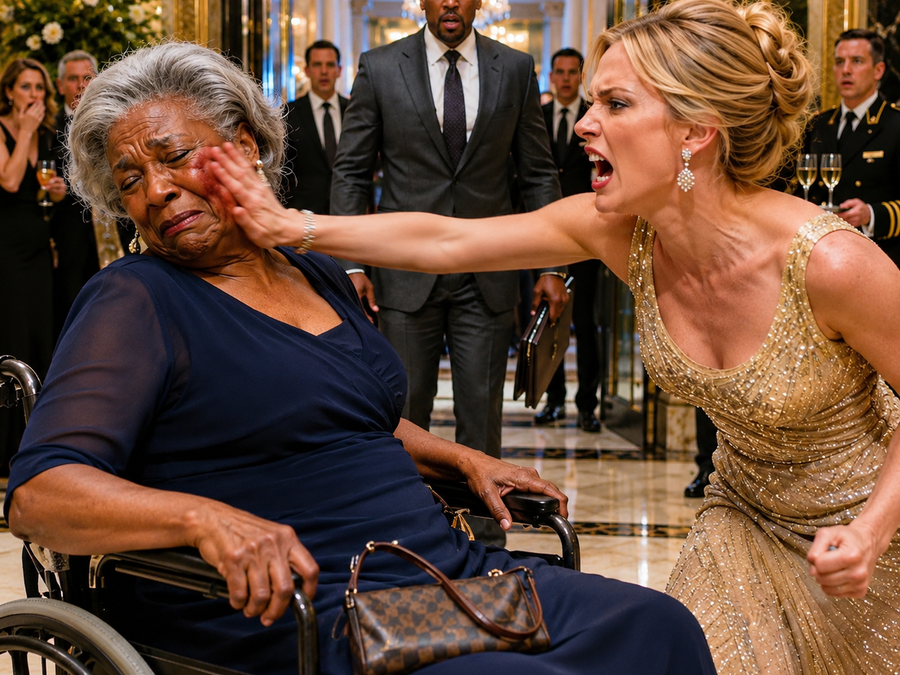
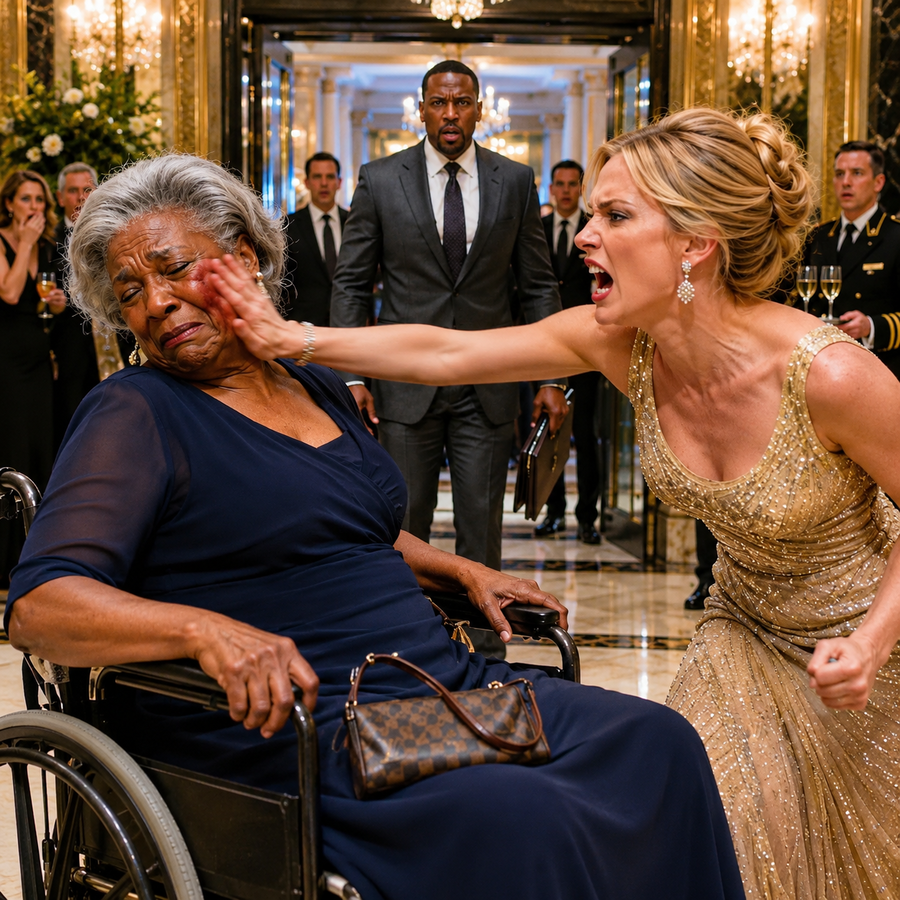
Sloane’s hand flew before Irene could finish speaking.
The slap cracked across the marble lobby.
Irene’s head snapped sideways. For a moment, the world seemed to tilt around her. A burning sensation spread across her left cheek, and four red fingerprints appeared against her dark skin.
She slowly turned her face back toward the woman standing over her.
“What did you just do?”
Her voice trembled.
She was seventy-two years old. She was sitting in a wheelchair. And she had just been slapped by a woman less than half her age in front of a room full of people.
Sloane crossed her arms.
“Know your place. Don’t dirty up my event.”
Nobody moved.
Nobody spoke.
The employees who had witnessed the assault suddenly found reasons to look away. One adjusted a stack of brochures. Another stared at the reception computer. Two security guards stood near the elevators, their expressions uncomfortable but their feet firmly planted.
Irene looked from one face to another.
She had not come there to cause trouble. She had not asked for special treatment. She had simply wanted to attend the celebration her son had invited her to.
But Sloane Pemberton had already decided that Irene did not belong.
And before the night was over, that decision would cost the Pemberton family almost everything.
The Grand Western Hotel was one of Manhattan’s most prestigious venues. Its entrance was decorated with enormous floral arrangements, polished brass fixtures, and crystal chandeliers that reflected light across the marble floors. That evening, it was hosting the fiftieth-anniversary gala of Pemberton Properties, a real estate company founded by Sloane’s grandfather.
Three hundred guests were expected.
Among them were wealthy investors, corporate executives, prominent politicians, and some of the most influential families in New York.
Sloane had spent six months organizing the event. She had selected the flowers, approved the menu, chosen the music, and personally reviewed the seating arrangements. Every detail had to be perfect.
Her father, Preston Pemberton, had given her considerable freedom because he wanted the evening to demonstrate that she was ready to take on a leadership role within the company.
Sloane wanted more than a successful gala.
She wanted the board to see her as the natural successor to her father.
She wanted the guests to admire her.
And most importantly, she wanted everyone to understand that the Pemberton name still carried power.
The only problem was that the company was in serious financial trouble.
Pemberton Properties had accumulated hundreds of millions of dollars in debt. Several developments had failed to generate the returns Preston had promised investors, and the company was approaching a financial deadline it could not meet without new capital.
The negotiations with Washington Capital had therefore become the most important business opportunity in the company’s history.
The proposed investment was worth $1.4 billion.
If the deal went through, Pemberton Properties could restructure its obligations, protect its remaining developments, and continue operating.
If it failed, the company could collapse.
Preston had spent eight months negotiating with Terrence Washington, the founder and chief executive of Washington Capital. Terrence was a disciplined investor known for demanding transparency and refusing to be impressed by expensive offices, elaborate dinners, or influential family names.
He had agreed to attend the gala because the final documents were nearly ready.
Sloane knew the deal mattered.
She simply did not understand how close her family was to losing everything.
And she certainly did not know that the elderly woman she had just slapped was Terrence Washington’s mother.
Irene Washington remained in the lobby.
Her cheek hurt, but she tried not to touch it. She had learned long ago that some people interpreted any visible reaction as weakness. She did not want to give Sloane the satisfaction of seeing her cry.
She looked toward the entrance.
“I’m waiting for my son,” she said quietly.
Sloane turned away as though the matter had been settled.
Five minutes passed.
Then ten.
Irene kept her hands folded in her lap. She occasionally glanced at the clock above the reception desk, then toward the entrance.
She had spoken with Terrence earlier that afternoon. He had reminded her that the gala began at seven and that a car could collect her if she did not want to travel alone.
Irene had refused.
She wanted to arrive independently. She wanted to surprise him by being there early.
Terrence had laughed when she told him she had already ironed her dress.
“Three times, Mama?”
“Two times wasn’t enough.”
“You look beautiful no matter what you wear.”
“That is because you are my son. You have to say that.”
He had promised to meet her at the hotel.
Irene had looked forward to that promise all day.
Her son had worked hard to reach the position he held. She had watched him grow from a curious little boy who sat beside her at the kitchen table into a man whose decisions affected businesses across the country.
But to Irene, he was still the child who used to fall asleep against her shoulder on the bus after she finished a late shift.
She had raised him alone.
There had been years when money was so tight that she divided one meal into two portions and told him she had already eaten. She worked cleaning offices during the day, took evening shifts at a neighborhood laundry, and accepted weekend work whenever someone needed help.
When Terrence was young, she sometimes brought him to the apartment where she worked because she could not afford childcare. He would sit quietly with his homework while she cleaned floors.
She never wanted him to feel ashamed of their circumstances.
She wanted him to understand that being poor did not mean being less worthy.
That was the lesson she had repeated throughout his childhood.
Treat people with respect, especially those who have nothing to offer you.
Irene had never imagined that a woman in a designer dress would need that lesson more than anyone else in the room.
Sloane returned from the reception desk.
“You’re still here?”
“Yes, ma’am.”
“I told security to remove you.”
“I explained that my son invited me.”
Sloane looked toward the guards.
“What are you waiting for? Get her out.”
The taller guard shifted his weight.
“Ma’am, she says she’s on the guest list. Perhaps we should check.”
“Check what?”
Sloane gestured toward Irene’s wheelchair and her plain navy dress.
“Look at her. Does she look like she belongs at a Pemberton event?”
The guard lowered his eyes.
Sloane crouched until her face was level with Irene’s.
“Let me make this very clear. You are trespassing. If you are not gone in sixty seconds, I will have you arrested. And trust me, the police in this neighborhood do not ask questions when I call.”
Irene looked directly at her.
She recognized the expression in Sloane’s eyes. It was not simply anger. It was the certainty of someone who had never seriously considered that another person might have rights equal to her own.
“Sixty seconds,” Sloane repeated.
Then she stood and walked toward the ballroom.
Irene sat alone.
Her handbag had slipped partly from her lap during the confrontation. She adjusted it carefully and looked toward the entrance again.
She was not going to leave.
Not yet.
Twenty minutes later, Sloane returned.
She had expected the woman to be gone. Instead, Irene was sitting in exactly the same place.
“You have got to be kidding me.”
Sloane’s voice carried across the lobby.
Two bellhops froze. A concierge looked up from her screen.
“I gave you sixty seconds. That was twenty minutes ago!”
“I told you, ma’am. My son is coming.”
“Stop saying that.”
Sloane turned toward the gathering group of employees and early-arriving guests.
“Does anyone know who let this woman in? Because someone is going to answer for this tonight.”
Nobody answered.
She approached Irene again.
“You know what I think? I think you wandered in off the street because you saw the lights and the fancy people. I think you made up a story about a son because you thought we’d feel sorry for you.”
She leaned closer.
“And I think you’re sitting in that chair not because you can’t walk, but because it gets you more sympathy.”
Irene’s chin trembled.
“That is not true. I’ve been in this chair for eleven years.”
“I don’t need your life story. I need you gone.”
“My son has the invitation. He’s on his way. If you could just—”
“Convenient. Your magical son has the magical invitation. How perfect.”
Sloane turned toward the guests who had stopped near the entrance.
“Ladies and gentlemen, I apologize for this disruption. We have an uninvited guest who wandered in off the street. It’s being handled.”
A few guests nodded.
A woman wearing a fur stole pulled her coat closer. A man in a tuxedo shook his head and muttered something about security.
Nobody asked whether Irene might be telling the truth.
Nobody suggested checking the guest list.
Nobody asked why a seventy-two-year-old woman in a wheelchair was being treated this way.
Irene looked around the lobby and understood something that hurt almost as much as the slap.
The woman standing over her was responsible for the cruelty.
But the people watching were responsible for allowing it to continue.
She had spent much of her life believing that most people were fundamentally decent. Yet there she was, surrounded by people who could afford expensive clothes, expensive jewelry, and expensive champagne, while not one of them could spare a moment to help an elderly woman retrieve her belongings.
Sloane noticed that Irene was still calm.
That calmness irritated her.
“Give me your bag.”
Irene looked up.
“Excuse me?”
“Your bag. If your so-called son really invited you, there should be something in there. An email, a printed ticket, a text message, something.”
“Please don’t.”
Sloane reached down and grabbed the handbag.
Irene tried to hold on, but her movements were slow. Her fingers closed around empty air as Sloane pulled the bag away.
Then Sloane unzipped it and turned it upside down.
Everything fell onto the marble.
A wallet.
A bottle of blood pressure medication.
A folded church program.
A photograph of Terrence in his college graduation cap.
A small Bible with a cracked leather cover.
A pack of tissues.
A tube of hand cream.
Three dollars in cash and a handful of loose change.
The coins rolled across the floor, striking the base of a marble column.
“There,” Sloane announced. “No invitation. Just junk.”
She nudged the Bible with the toe of her designer heel.
Irene stared at the objects scattered around her.
“That Bible belonged to my mother.”
“I don’t care whose Bible it was.”
Irene tried to lean forward, hoping to reach the photograph.
It had landed face down.
She could see the handwriting on the back.
Love you forever, Mama.
She wanted to pick it up.
She wanted to hold it against her chest.
But the wheelchair kept her too far from the floor.
A waiter carrying a tray of champagne passed nearby. Sloane lifted a glass.
She took a slow sip while looking down at Irene’s navy dress.
The dress had taken three days to prepare. Irene had washed it carefully, ironed it that morning, and laid it across the back of her bedroom chair so it would remain smooth.
She had wanted to look nice for her son’s important evening.
Sloane tilted her glass.
Champagne poured down the front of Irene’s dress.
The liquid soaked through the fabric, turning the navy material nearly black. It ran into her lap and dripped between the wheels of her chair.
“Now you match your situation,” Sloane said.
She placed the empty glass on the reception desk.
“Wet, messy, out of place.”
Three guests gasped.
One woman covered her mouth. A man in a gray suit took out his phone and began recording.
Still, nobody stepped forward.
Irene looked down at her ruined dress. Her hands rested flat in her lap.
The champagne was cold against her skin.
Her eyes burned, but she blinked away the tears.
“I will wait for my son,” she said.
Her voice was quiet, but steady.
“Right here.”
Sloane stared at her.
She had expected begging. She had expected an apology. She had expected Irene to wheel herself out of the hotel in tears.
Instead, the old woman continued to sit there.
That refusal felt like defiance.
And Sloane could not tolerate being defied by someone she had already decided was beneath her.
“Fine,” she whispered. “You want to play stubborn? Let’s see how far that gets you.”
She moved behind the wheelchair and grabbed both handles.
“What are you doing?” Irene asked.
“What I should have done twenty minutes ago.”
Sloane pushed.
Hard.
Not toward the front entrance, where arriving guests and photographers might see what she was doing.
She pushed Irene across the lobby, past the reception desk and the kitchen entrance, toward the service corridor at the back of the hotel.
“Stop. Please stop.”
Irene gripped the armrests.
The wheelchair rolled through a set of heavy swinging doors and into a dim hallway. The polished marble disappeared beneath the wheels, replaced by stained concrete.
The air smelled of industrial cleaner, old grease, and damp cardboard.
Fluorescent lights buzzed overhead.
Sloane pushed the chair toward a stack of empty bottle crates and flattened boxes.
“This is where you belong,” she said. “Not in my lobby. Not at my gala. Here, with the rest of the garbage.”
Irene’s arms were shaking.
Her soaked dress clung to her legs. The corridor was much colder than the lobby.
“You can’t leave me here.”
“Watch me.”
Two kitchen employees had witnessed the scene. A young man in a white apron stood near a stainless-steel preparation counter. A middle-aged woman held a ladle beside a simmering pot.
Sloane pointed at them.
“If either of you helps this woman—water, food, a blanket, a phone call, anything—you are fired. Tonight. No severance, no reference. I’ll make sure you never work in a kitchen in this city again. Are we clear?”
The employees nodded slowly.
Sloane checked her reflection in a stainless-steel panel, adjusted a strand of hair, and walked away.
The swinging doors closed behind her.
Irene was alone.
The corridor became quiet again.
The refrigerator hummed. Somewhere beyond the loading dock, a delivery truck reversed with a distant warning beep.
Irene looked down at her dress.
Her cheek throbbed. The bruise was beginning to darken, and her arms were covered in goosebumps.
She tried to move her wheelchair toward the door, but the narrow space and the boxes made it difficult.
Her handbag was still in the lobby.
So were her phone, medication, Bible, and the photograph of her son.
She had no way to contact Terrence.
For a moment, she considered leaving.
She could wheel herself out through the loading dock and find a taxi. Her apartment in Harlem was less than an hour away. She could change clothes, make tea, and sit with her cat.
She could pretend the evening had never happened.
But then she imagined Terrence arriving at the gala.
He would walk into the ballroom, look for her, and ask the staff where she was.
He would wonder why she had not arrived.
He might think something had happened to her on the way.
And she could not bear the thought of her son spending the evening searching for her.
She had promised to be there.
So she stayed.
Twenty minutes passed.
Then thirty.
On the other side of the wall, the ballroom came alive. The doors opened, and guests entered beneath crystal chandeliers. A string quartet began playing Vivaldi. Waiters moved between tables with trays of hors d’oeuvres, and laughter filled the elegant room.
Every seat was occupied except one.
At the VIP table near the stage, a small placard read:
RESERVED — WASHINGTON CAPITAL
Preston Pemberton stood near the ballroom entrance, shaking hands and accepting congratulations. He smiled whenever someone mentioned the company’s anniversary, but his eyes repeatedly returned to the empty VIP table.
He pulled his assistant aside.
“Has Washington arrived?”
“Not yet, sir. His team confirmed thirty minutes ago that he was on his way.”
“The moment he enters, I want to know. Walk him to his table personally. Make sure the reserved Bordeaux is ready.”
Preston loosened his collar.
“Do you understand what this deal means? If Washington Capital pulls out, we could be restructuring within ninety days. We are leveraged to the ceiling. This is not just a dinner. This is our lifeline.”
His assistant nodded.
Sloane appeared beside him, radiant and confident.
“Everything looks perfect,” she said.
“It needs to be perfect.”
“Relax, Dad.”
“I will relax when Terrence Washington’s signature is on that contract.”
Sloane rolled her eyes.
“I’m always charming.”
“Tonight, I need you to be more than charming. We need this man more than he needs us.”
She lifted her champagne glass.
“Then let’s make sure he has a wonderful evening.”
Preston watched her walk away.
He had spent years trying to prepare his daughter for the responsibilities of the company. She had been raised in luxury, educated at prestigious schools, and introduced to influential people from childhood.
He knew she could be impatient.
He knew she could be demanding.
But he had convinced himself that those qualities would disappear once she had enough responsibility.
He did not know that, less than an hour earlier, she had assaulted the mother of the very man whose investment could save his company.
Back in the corridor, Irene shivered.
The champagne on her dress had dried in patches, leaving the fabric stiff and uncomfortable.
She looked toward the kitchen.
The two employees continued working, avoiding her eyes.
She did not blame them.
They needed their jobs. Sloane had made her threat clear, and people who lived paycheck to paycheck could not always afford to be brave.
Then a young woman appeared from behind the preparation counter.
She had dark hair pulled into a neat bun, and her hotel uniform was clean and pressed. Her name tag read EMILY TORRES.
She carried a glass of water and a folded white napkin.
She glanced toward the swinging doors, then hurried to Irene’s wheelchair.
“Ma’am?”
Irene opened her eyes.
“I’m so sorry,” Emily whispered. “I’m so sorry about what happened to you.”
She crouched beside the chair and offered the water.
“Thank you, sweetheart.”
Irene took the glass with both hands. They were shaking so badly that the water trembled.
Emily unfolded the napkin and gently pressed it against the champagne stain.
“She said she’d fire anyone who helped you.”
“I heard her.”
“I’m sorry. I should have said something sooner.”
Irene looked at the young woman.
“You could lose your job, honey.”
Emily shook her head.
“Some things matter more than a job.”
She glanced at the bruise on Irene’s cheek.
“Does it hurt?”
“A little.”
Emily’s eyes filled with tears.
“That’s not right. None of this is right.”
Irene reached out and gently touched the young woman’s hand.
“What is your name?”
“Emily. Emily Torres.”
“Thank you, Emily.”
“You don’t have to thank me.”
“Yes, I do.”
Irene squeezed her hand.
“Kindness is never something we should take for granted.”
Emily looked down at the napkin in her hands.
“I just couldn’t leave you here.”
Irene studied her face.
She saw fear in the young woman’s expression, but she also saw determination.
For the first time that evening, a tear rolled down Irene Washington’s cheek.
It was not from the slap.
It was not from the humiliation.
It was because someone had finally treated her like a human being.
Emily stayed beside her for several minutes. She brought another napkin, found a clean blanket from a nearby storage room, and draped it across Irene’s shoulders.
Then she asked whether Irene needed medical assistance.
“My son will be here soon,” Irene replied.
“Do you know his name? I might be able to contact him.”
“Terrence Washington.”
Emily paused.
“Terrence Washington?”
“Yes, sweetheart.”
Emily had heard the name during the hotel’s preparations. The general manager had repeatedly reminded the staff that Washington Capital’s chief executive was the most important guest of the evening.
She looked at Irene again.
“Is he the investor?”
Irene smiled faintly.
“He is my son.”
Emily stared for a moment.
Then she lowered her eyes.
“I’ll make sure he finds you.”
At exactly 8:45 p.m., a black sedan pulled up to the front entrance of the Grand Western Hotel.
The valet opened the rear door.
A tall Black man in a custom charcoal suit stepped out. His shoes were polished Italian leather, and his cufflinks caught the light from the entrance.
He carried himself with quiet authority.
Two men in dark suits followed him. One held a leather briefcase, while the other checked a phone.
An older silver-haired man walked at his left.
Raymond Cross was senior counsel for Washington Capital and one of the most respected corporate attorneys on the East Coast.
The hotel general manager hurried forward.
“Mr. Washington! Welcome to the Grand Western. We’ve been expecting you.”
Terrence offered a polite nod.
“Thank you.”
“Your table is prepared. Mr. Pemberton is waiting inside.”
Terrence scanned the lobby.
“My mother should already be here.”
The general manager blinked.
“Your mother, sir?”
“Irene Washington. She’s seventy-two and uses a wheelchair. Could you point me toward her?”
The general manager’s expression changed.
“I’m not sure, sir. Let me check with the front desk.”
“She arrived over an hour ago. I spoke with her at seven.”
Terrence smiled briefly.
“She was very excited. She ironed her dress three times this morning.”
The general manager hurried toward the reception desk.
Two employees shook their heads when he asked about Irene.
Nobody seemed to know where she was.
Inside the ballroom, Preston received the news that Terrence had arrived.
He set down his wineglass and hurried toward the entrance.
“Mr. Washington!”
He extended both hands.
“Welcome. I can’t tell you what it means to have you here tonight. This is a milestone evening for my family, and having you share it with us—”
“Thank you, Mr. Pemberton.”
Terrence’s expression remained polite, but his eyes continued searching the lobby.
“Before anything else, I need to find my mother.”
Preston’s smile faltered.
“Your mother?”
“Yes. Irene Washington. She arrived early.”
Preston turned toward his assistant.
“Please check the guest list.”
The assistant opened his tablet and searched.
There was no immediate answer.
Terrence pulled out his phone and called his mother.
It rang five times.
Then voicemail.
He tried again.
The same result.
A third call went unanswered.
A shadow crossed his face.
“She always answers my calls,” he said.
His voice had changed.
The professional warmth had disappeared, replaced by something much harder.
“She knows I’m coming. She keeps her phone in her hand whenever we’re meeting.”
Sloane appeared at her father’s side.
She was holding another champagne glass.
“Mr. Washington, I’m Sloane Pemberton. I organized tonight’s gala. Everything has been arranged to make your visit—”
“Have you seen my mother?”
Sloane stopped.
“Your mother?”
“An elderly woman. Wheelchair. She would have arrived alone around seven.”
Sloane’s smile froze.
For a brief moment, she seemed to remember the lobby.
The wheelchair.
The simple navy dress.
The old woman who had refused to leave.
But the connection did not fully form.
There was no possible universe, she thought, in which that woman could be the mother of Terrence Washington.
“I’m sure the front desk can help,” she said.
Terrence did not take her offered hand.
He turned away.
“I need to speak with whoever was working the lobby between seven and eight tonight. Right now.”
The front desk manager picked up an internal phone with trembling fingers.
Before he could speak, a young woman stepped forward.
Her hands were clasped tightly in front of her.
It was Emily Torres.
“Sir?”
Terrence turned.
“I know where your mother is.”
The lobby fell silent.
“Where?”
Emily swallowed.
“Please follow me.”
She looked at Sloane, then at the marble floor, and finally back at Terrence.
She understood that speaking might cost her job.
But she also understood that remaining silent would make her part of what had happened.
“Please,” she repeated. “Come with me.”
Emily led Terrence through the kitchen entrance.
Preston followed, confused and increasingly anxious.
Sloane followed behind him, her champagne glass still in her hand.
Raymond Cross and the general manager came next.
The group passed through the swinging doors and entered the service corridor.
The temperature dropped immediately.
The fluorescent lights buzzed overhead. The concrete floor was stained and cracked. Empty bottle crates stood against the wall, beside garbage bags and a mop bucket.
At the far end of the corridor sat Irene Washington.
Her wheelchair faced a stack of flattened cardboard boxes.
Her dress was soaked and stained. Her cheek was swollen, and a purple handprint was visible across the left side of her face.
She had her arms crossed over her chest, trying to keep warm.
The white napkin Emily had given her rested in her lap.
The glass of water sat untouched on a crate beside her.
Irene heard the footsteps and turned.
Then she saw her son.
Her face changed.
She smiled.
“Baby,” she said. “You came.”
Terrence stopped walking.
For three seconds, he did not move.
His eyes traveled across the corridor.
The garbage bags.
The empty crates.
The mop bucket.
The stained concrete.
Then his gaze settled on his mother’s face.
He saw the bruise.
He saw the wet dress.
He saw her trembling arms.
And his hands began to shake.
Not with fear.
Not with sadness.
With anger so deep that it seemed to quiet everything around him.
He walked forward and dropped to his knees beside her wheelchair.
“Mama.”
His voice cracked.
He took her hands between his palms.
They were cold.
“What happened?”
“It’s all right, baby. I’m fine now.”
“Look at me.”
He gently lifted her chin.
The bruise was worse than he had imagined. Four fingerprints and a swollen palm marked the face of the woman who had raised him.
“Who did this to you?”
Irene looked beyond his shoulder.
Her eyes found Sloane Pemberton.
She did not point.
She did not accuse.
She simply looked at her.
That was enough.
Sloane’s face went pale.
The realization came in pieces.
The elderly woman.
The wheelchair.
The slap.
The champagne.
The handbag scattered across the marble.
The service corridor.
The threat to the employees.
The woman she had treated as though she were worthless was Terrence Washington’s mother.
Preston looked at his daughter, then at Irene, then at Terrence.
His expression changed as the consequences became clear.
Sloane’s champagne glass trembled in her hand.
She opened her mouth.
Nothing came out.
Terrence removed his suit jacket and draped it around his mother’s shoulders.
He tucked the fabric carefully around her arms.
Then he picked up the glass of water and held it to her lips.
“Drink a little, Mama.”
Irene obeyed.
He brushed a strand of silver hair away from her forehead.
“I’m here now.”
Only after he had made sure she was warm did he stand.
He turned toward Sloane.
Every person in the corridor seemed to take a step backward.
“You.”
It was a single word.
Sloane’s champagne glass slipped from her fingers and shattered against the concrete.
Terrence looked at the broken glass, then at her.
“My mother called me at 7:15 tonight. She said she had arrived early. She told me she was nervous because she had never attended a gala before. She said a young man at the front desk had pointed her toward the lobby.”
He paused.
“She told me she had ironed her dress three times.”
His voice tightened.
“Three times. Because she wanted to look right for me.”
Sloane’s lips parted.
Terrence took one step toward her.
“And then I arrived. Nobody knew where she was. Nobody could tell me whether she had entered the building. Nobody could tell me why she wasn’t answering her phone.”
He glanced toward Emily.
“Until this young woman had enough courage to speak.”
Emily lowered her head.
Terrence turned back to Sloane.
“Let me understand what happened. You slapped my mother. You poured champagne on her dress. You emptied her handbag onto the lobby floor. Her wallet, her medication, her Bible, and a photograph of me at my college graduation.”
He paused.
“You pushed her wheelchair into this corridor and left her beside the garbage. Then you threatened to fire anyone who gave her a glass of water.”
Sloane shook her head.
“I—”
“Is that what happened?”
Her mouth moved, but no words came.
Preston stepped forward.
“Mr. Washington, please. I had no idea. This is a misunderstanding. My daughter didn’t know who your mother was.”
Terrence turned toward him.
“She didn’t need to know.”
Preston fell silent.
“She didn’t need to know my mother was related to me. She didn’t need to know my name, my company, or how much money I have. She needed to know how to treat another human being.”
He pointed toward Irene.
“An elderly woman in a wheelchair asked for help. Your daughter slapped her across the face.”
Preston tried to respond.
“Mr. Washington, I assure you—”
“Stop.”
Terrence’s voice was still controlled.
“I came here tonight to sign a deal worth $1.4 billion.”
The words seemed to drain the color from Preston’s face.
Terrence continued.
“That deal is dead.”
For a moment, nobody spoke.
Raymond Cross stepped forward and opened his briefcase.
He removed a document and placed it on top of a stack of empty crates.
“This is formal notice of withdrawal from all pending agreements between Washington Capital and Pemberton Properties, effective immediately.”
Preston stared at the paper.
“No.”
He looked at Terrence.
“Mr. Washington, we have been negotiating for eight months.”
“Eight months.”
“Please. We can discuss this privately.”
“There is nothing to discuss.”
Preston’s voice broke.
“You cannot cancel an agreement over an incident involving my daughter. She made a terrible mistake, but we can make this right.”
Terrence looked at him.
“Your company is asking me to invest $1.4 billion. You want me to trust your leadership, your judgment, and your ability to manage people and property.”
He gestured toward Irene.
“Tonight, I saw how your family treats someone they believe has no power. I saw your employees stand silent because they were afraid of your daughter. I saw a hotel full of wealthy guests watch an elderly woman being humiliated and decide that their evening was more important than her dignity.”
He shook his head.
“What exactly am I supposed to trust?”
Preston looked toward Sloane.
She was standing against the corridor wall, trembling.
“I didn’t know,” she whispered.
Terrence looked at her.
“You didn’t know she was my mother.”
Sloane nodded desperately.
“I swear. I thought she was—”
“You thought she was nobody.”
Terrence finished the sentence.
“You thought she was a poor old Black woman who had wandered into your hotel. And because you thought she was nobody, you decided you could treat her like garbage.”
Sloane’s knees weakened.
She caught herself against the wall.
Mascara began running down her cheeks.
Terrence did not move toward her.
He did not raise his voice.
He did not insult her.
He simply turned toward the general manager.
“I want copies of every security recording from seven o’clock onward. Every camera. Every angle. Preserve the footage immediately.”
“Yes, sir.”
“My legal team will be contacting the hotel in the morning. I also want the names of every employee who witnessed what happened.”
The general manager nodded rapidly.
Raymond Cross closed his briefcase.
“We will handle the necessary legal notices.”
Terrence looked at Preston one last time.
“You invited me here to celebrate your company’s milestone. I came. I just didn’t expect the milestone to be this.”
Then he turned back to his mother.
“Mama, we’re leaving.”
Irene touched his arm.
“Baby, you don’t have to let this ruin your evening.”
He crouched beside her again.
“It’s already ruined. But not because of you.”
He kissed her forehead.
“We’re going home.”
Then he looked toward Emily.
“Would you walk with us?”
Emily’s eyes widened.
“Me, sir?”
“Yes. I’d like to speak with you before we leave.”
She nodded.
“Yes, sir.”
Terrence pushed his mother’s wheelchair through the corridor.
Emily walked beside them.
Raymond followed with his briefcase.
They passed through the kitchen, across the lobby, and out through the hotel’s front entrance.
Three hundred guests remained in the ballroom.
They were still laughing.
Still drinking.
Still celebrating the fiftieth anniversary of a company that might not survive another ninety days.
Preston Pemberton remained in the service corridor.
His daughter stood on the concrete floor, staring at the broken glass.
He looked at her.
Then at the mop bucket.
Then at the empty space where Irene’s wheelchair had been.
He finally understood what she had cost him.
Everything.
The consequences began before sunrise.
A guest at the gala had recorded the slap on her phone. The video lasted fourteen seconds.
It showed Sloane Pemberton approaching an elderly Black woman in a wheelchair, exchanging a few words with her, and then striking her across the face.
There was no audio.
It did not need any.
The footage was uploaded shortly before midnight.
By six in the morning, millions of people had watched it.
By noon, the video had a name.
The internet called it the Pemberton slap.
News organizations across the country reported the incident.
The headline was almost impossible to ignore:
HEIRESS SLAPS ELDERLY GRANDMOTHER IN WHEELCHAIR — HOURS LATER, HER SON CANCELS $1.4 BILLION DEAL.
As more information emerged, public anger intensified.
The champagne poured over Irene’s dress.
The handbag emptied onto the floor.
The Bible kicked aside.
The photograph of Terrence’s graduation left among the scattered belongings.
The wheelchair pushed into a service corridor.
The threat made against the kitchen employees.
The story became more disturbing with every new detail.
Sloane’s attorney released a statement that afternoon.
She expressed regret and described the incident as an unfortunate misunderstanding. She said she had not known Irene’s identity and asked the public for compassion.
The statement made matters worse.
People noticed what was missing.
There was no meaningful acknowledgment of Irene’s suffering.
There was no explanation for why an elderly woman had been assaulted.
There was no recognition that Irene deserved respect regardless of her financial circumstances or family connections.
The apology seemed to say that Sloane regretted the consequences more than the act itself.
Terrence did not respond publicly.
He was at home with his mother.
Irene sat in her apartment in Harlem, wearing a clean sweater and resting in her favorite chair.
Her apartment was modest. The furniture had been there for years, and family photographs covered the walls. A small piano stood near the window.
Terrence had arranged for a doctor to examine her cheek and check her blood pressure.
Fortunately, there were no fractures or serious injuries. The bruise would take time to heal, and the shock of the incident had left her exhausted.
Terrence sat beside her.
“I should have come earlier.”
Irene looked at him.
“Don’t say that.”
“I should have made sure you got there safely.”
“You cannot protect me from everything.”
“I could have prevented this.”
She reached for his hand.
“Listen to me, baby. What happened was not your fault.”
Terrence looked down.
“I keep thinking about you sitting in that hallway.”
“I was waiting for you.”
“You were cold. You were hurt. You couldn’t even call me.”
“I knew you would come.”
He closed his eyes.
That was the part he could not forget.
His mother had been abandoned in a service corridor, surrounded by garbage, and she had still believed he would find her.
He had built a company by learning to recognize risks, evaluate people, and make difficult decisions. He had negotiated with executives who had spent their lives trying to gain an advantage over him.
But nothing in his professional experience had prepared him for the sight of his mother sitting in that hallway.
“I should have known,” he whispered.
Irene squeezed his hand.
“You came. That’s what matters.”
She looked toward the piano.
“Did you see the photograph?”
“The graduation picture?”
“Yes.”
“I’ll get it back.”
“I hope it wasn’t damaged.”
Terrence smiled sadly.
“Mama, you were worried about the picture?”
“It means a lot to me.”
He leaned forward and kissed her hand.
“I know.”
For a while, they sat quietly.
Then Irene asked about Emily.
“Did you speak to that young woman?”
“I did.”
“What’s going to happen to her?”
Terrence looked at his mother.
“She won’t lose her job because she helped you. I’ve already made sure of that.”
“Good.”
“She did something brave.”
“Yes,” Irene said. “She did.”
Terrence had offered Emily a substantial financial reward, but she had hesitated to accept it. She had told him she did not help Irene because she expected payment.
She simply could not leave an elderly woman alone in a cold hallway.
Terrence respected that answer.
He had also learned that Emily was a recent college graduate who had taken the hotel job to support herself while looking for a permanent position in community outreach. She had studied social work and hoped to work with older adults.
Her actions that evening had revealed something about her character that no résumé could have shown.
Terrence wanted to give her an opportunity.
But first, he needed to deal with the consequences of what had happened.
The legal process moved quickly.
Raymond Cross filed assault charges on Irene’s behalf and requested preservation of the hotel’s security footage.
The recordings showed the entire sequence.
They captured Sloane slapping Irene.
They showed her taking the handbag, scattering its contents, and pouring champagne over the elderly woman’s dress.
They showed her pushing the wheelchair through the service corridor.
They also captured her threatening the employees who might have helped.
The evidence was difficult to dispute.
Sloane was arrested on a Tuesday morning outside her TriBeCa apartment.
Photographers were waiting when she emerged.
She was taken into custody and later released on bail.
The photograph of her in handcuffs replaced the glamorous pictures from the gala that had once filled society pages.
Preston tried to contain the damage to his company.
He called investors.
He contacted the board.
He requested emergency meetings with lenders.
But the withdrawal of Washington Capital had created a financial crisis that could not be solved through public relations.
Without the $1.4 billion investment, Pemberton Properties could not meet its upcoming obligations.
The company defaulted on its bond payments within sixty-three days.
Its board voted to file for Chapter 11 restructuring.
Preston resigned as chairman.
The Pemberton family sold its East Hampton estate, its Park Avenue apartment, and the vintage Porsche collection that Preston’s father had spent four decades assembling.
Even those sales were insufficient.
The company’s liabilities exceeded its remaining assets by more than eighty million dollars.
The name that had once represented influence in Manhattan real estate became associated with a spectacular business collapse.
Sloane’s legal case continued.
She eventually pleaded guilty to misdemeanor assault in exchange for a sentence that included 180 hours of community service at a senior care facility.
During sentencing, the judge addressed her directly.
“Miss Pemberton, you are not here because you made a mistake. You are here because you decided that some people do not deserve to be treated as people.”
The judge paused.
“That is not a mistake. That is a choice.”
Sloane lowered her head.
For the first time, she had to listen to someone speak to her without caring about her family name.
Several weeks passed.
Irene’s bruise gradually faded, although she still experienced discomfort when she touched her cheek.
She returned to church on Sunday.
The congregation welcomed her with hugs and prayers. Some people had seen the news, while others had heard about the incident through friends.
Her pastor asked whether she wanted to speak about what happened.
Irene declined.
She did not want the church service to become a discussion about Sloane Pemberton.
She wanted to sing.
Her fingers were slower than they had been before the wheelchair, and the arthritis in her hands sometimes made the piano difficult to play. Still, she sat at the instrument and began a familiar hymn.
The congregation joined her.
For a few minutes, the world felt ordinary again.
Terrence sat near the back.
He watched his mother play and remembered the small apartment where she had taught him to recognize musical notes. He remembered her humming while preparing dinner and singing softly when she thought he was asleep.
He had spent years building a financial empire.
But the greatest gift he had ever received was a mother who had taught him how to remain decent when the world offered him every reason to become hard.
Three weeks after the gala, Terrence decided to speak publicly.
He did not arrange a press conference.
He did not choose a television studio or a luxury hotel ballroom.
Instead, he returned to Harlem.
At a small community center six blocks from Irene’s apartment, he stood before forty people: neighbors, church members, local business owners, and representatives of organizations that worked with older residents.
Irene sat in the front row.
She wore a new navy dress.
It was simple, clean, and neatly pressed.
Beside her sat Emily Torres.
Emily was no longer wearing her hotel uniform. She had a professional blazer and a leather portfolio on her lap.
Three days after the gala, Terrence had offered her a position with a new foundation he was establishing.
She had accepted.
Her title was community outreach coordinator.
Her first assignment was to build a volunteer network for home-bound seniors across Upper Manhattan.
She was twenty-two years old.
She was nervous.
And she was ready.
Terrence stepped up to the podium.
“Thank you all for coming.”
He looked around the room.
“Most of you know why we’re here. A few weeks ago, my mother experienced something no elderly person should ever have to endure. She was assaulted, humiliated, and abandoned because someone believed she did not belong in a place where wealthy people were gathering.”
He paused.
“I could spend the rest of my life talking about the person who did it. But I don’t want this evening to be about her.”
He turned toward Irene.
“I want it to be about the woman who raised me.”
The room grew quiet.
“Her name is Irene Washington. She worked multiple jobs to make sure I had opportunities she never had. She taught me that money could buy comfort, but it could never buy character. She taught me that a person’s worth was not measured by their clothes, their address, or the people they knew.”
He looked down briefly.
“And she taught me something else. When you see someone being treated unfairly, you do not look away.”
He turned toward Emily.
“That lesson was demonstrated to me by a young woman who risked her job to offer my mother a glass of water and a little kindness.”
Emily lowered her eyes, visibly emotional.
Terrence continued.
“Today, I am announcing the creation of the Irene Washington Foundation.”
Applause filled the room.
The foundation would provide legal assistance, medical transportation, emergency housing, and support services for elderly residents facing abuse, neglect, or discrimination.
Its initial budget would be twelve million dollars.
It would work with churches, senior centers, local medical providers, and community organizations to identify people who needed assistance but did not know where to turn.
Terrence explained that the foundation would not simply provide financial support.
It would help older residents navigate the systems that often left them feeling powerless.
It would offer transportation to medical appointments, connect people with legal representation, and provide emergency assistance when someone was unsafe in their home.
Most importantly, it would make sure that people who were often ignored had someone willing to listen.
Irene sat quietly in the front row.
She did not speak.
She did not need to.
After the ceremony, a reporter approached Terrence.
“Mr. Washington, may I ask why you chose to name the foundation after your mother rather than yourself?”
Terrence looked toward Irene.
She was speaking with a neighbor, holding the woman’s hand with both of hers.
It was the same way she had held Emily’s hand in the service corridor.
“Because she taught me everything I know about strength,” he said.
“Not the kind of strength that builds companies. The kind that sits in a cold corridor, soaked and bruised and alone, and still believes her son will come.”
He paused.
“That is the strongest thing I have ever seen anyone do.”
Emily’s life changed in ways she had not expected.
Her new position brought responsibilities she had never handled before. She spent long days meeting with senior residents, visiting community centers, and speaking with organizations that could help identify people in need.
Terrence did not treat her as a charity case.
He expected her to work, learn, and contribute.
He also listened when she spoke.
Emily quickly discovered that many older people did not ask for help because they were embarrassed. Some feared losing their independence. Others worried that asking for assistance would become a burden on their families.
She remembered Irene sitting in that corridor.
She remembered the way the older woman had thanked her for something as simple as a glass of water.
That memory stayed with her.
Within six months, Emily had helped establish a network of volunteers who visited home-bound seniors, delivered groceries, and arranged transportation to medical appointments.
She also helped organize workshops at local churches about elder abuse and financial exploitation.
Whenever she met someone who felt invisible, she remembered the night at the Grand Western.
She understood that a small act of kindness could become the beginning of something much larger.
Irene became involved with the foundation in her own way.
She attended meetings when her health allowed, offered suggestions, and insisted that the organization treat every person with dignity.
She did not want people to feel that they were receiving charity from wealthy strangers.
She wanted them to feel that they belonged to a community.
One afternoon, Emily visited Irene’s apartment.
They sat near the window with cups of tea.
“Mrs. Washington,” Emily said, “I wanted to ask you something.”
“Call me Irene, sweetheart.”
Emily smiled.
“Irene, do you ever think about that night?”
“Sometimes.”
“Does it still hurt?”
Irene considered the question.
“My cheek healed.”
“I meant what happened.”
Irene looked out the window.
“Some things stay with you. But I don’t want that woman to take more from me than she already did.”
Emily nodded.
“That’s understandable.”
Irene turned back toward her.
“You know what I remember most?”
“The slap?”
“No.”
“The champagne?”
“No.”
Irene smiled.
“I remember a young woman bringing me water.”
Emily’s eyes filled.
“I was scared.”
“I know.”
“I thought I would lose my job.”
“But you came anyway.”
Emily looked down at her tea.
“I don’t think I did anything special.”
Irene reached across the table and took her hand.
“That’s what makes it special.”
The Grand Western Hotel continued operating, although the gala that had once been its most prestigious annual event was never held again.
The hotel conducted an internal investigation and revised its staff policies. The general manager was replaced, and employees received additional training on handling discrimination, accessibility, and customer complaints.
The Pemberton name disappeared from the hotel’s promotional materials.
The ballroom remained beautiful.
The chandeliers still sparkled.
Fresh flowers still decorated the lobby.
But the anniversary celebration was remembered for something very different from what Preston Pemberton had intended.
For years, he had wanted the Pemberton Properties name to represent success and influence.
Instead, the name became a warning about what could happen when wealth was mistaken for worth.
Preston eventually withdrew from public life.
He sold most of his remaining possessions and moved away from Manhattan.
He and Sloane rarely appeared together in public after the company’s collapse.
The relationship between father and daughter became strained. Preston blamed her for destroying the company, while Sloane resented him for allowing her to grow up believing that money and status could excuse almost anything.
Whether she ever fully understood the harm she had caused remained uncertain.
Her community service placed her in a senior care facility, where she had to work alongside people whose lives were very different from her own.
There were residents who struggled to walk.
Others needed help eating or remembering medication.
Some had no family members who visited.
Sloane could not simply order people to move aside.
She had to listen.
She had to follow instructions.
She had to learn patience.
For the first time, she was in a place where her family name meant nothing.
It did not erase what she had done.
It did not restore the company.
And it did not obligate Irene to forgive her.
But it gave her an opportunity to confront the kind of person she had chosen to become.
Irene still lived in her Harlem apartment.
Her piano remained beside the window.
The photograph of Terrence’s college graduation had been recovered from the hotel after the incident. Its original frame had cracked when it struck the marble floor, so Terrence had replaced it with a new one.
Irene placed it on top of the piano.
The Bible that had belonged to her mother was also back where it belonged.
The navy dress she had worn that night was never worn again.
Not because she was ashamed of it.
But because she did not want to remember the evening every time she opened her wardrobe.
On Sunday mornings, she still went to church whenever her health allowed.
Her fingers moved slowly over the piano keys, but the music remained familiar.
Terrence visited often.
Sometimes he arrived with groceries. Sometimes he brought dinner. Sometimes he simply sat beside her and talked about ordinary things.
He had continued running Washington Capital, but the incident had changed the way he approached his work.
He paid closer attention to the people affected by the companies in which he invested.
He asked more questions about employees, working conditions, and community impact.
He had always believed that a successful business needed good financial judgment.
Now he understood that financial judgment alone was not enough.
A company could have billions in assets and still be poor in the things that mattered most.
One evening, Terrence sat beside his mother while the sun faded over Harlem.
“Are you happy, Mama?”
Irene smiled.
“I have my health, my home, my church, and my son. What more could I ask for?”
He laughed softly.
“You could ask me to visit more often.”
“I already do.”
“I know.”
She reached for his hand.
“Baby, don’t let what happened turn your heart bitter.”
He looked at her.
“I don’t think it will.”
“Good. You have too much good to do.”
Terrence nodded.
Then he looked toward the photograph on the piano.
“Do you remember when I graduated?”
“Of course.”
“You cried more than I did.”
“I did not.”
“You absolutely did.”
Irene laughed.
“I was proud of you.”
He squeezed her hand.
“I hope you still are.”
She looked at him as though the question itself was ridiculous.
“Always.”
The Grand Western Hotel still stands on the corner of Lexington Avenue and Fifty-Second Street.
The lobby still smells of fresh flowers.
The marble floors still reflect the chandeliers.
Guests still arrive wearing expensive clothes, carrying expensive bags, and expecting to be treated like important people.
But the Pemberton name is gone from the directory.
The gala has not been held since that night.
And somewhere in Harlem, Irene Washington still plays piano on Sunday mornings.
Her fingers are slower now.
Her voice is softer.
But the music is the same.
She keeps the photograph of her son’s graduation on the piano, inside its new frame.
She never replaced the navy dress.
She does not need to.
She remembers that evening, but she refuses to let it define her.
She remembers the cruelty, but she also remembers Emily’s kindness.
She remembers the cold corridor, but she remembers her son’s arms around her.
And she remembers that even when a room full of people looked away, one young woman chose to step forward.
The $1.4 billion deal was canceled.
Pemberton Properties collapsed.
A powerful family lost its empire.
But those were not the most important consequences of that evening.
The most important consequence was what happened afterward.
A foundation was created to protect elderly people who had nowhere else to turn. A young woman found a career devoted to helping others. A son was reminded that his greatest responsibility was not to the company he had built, but to the people who had helped him become the man he was.
And a seventy-two-year-old grandmother who had been treated as though she were invisible became the inspiration behind an organization that would help thousands of people be seen.
Irene had entered the Grand Western Hotel hoping to share an important evening with her son.
She left wrapped in his jacket, holding his hand, and surrounded by people who finally understood what they had failed to see.
She had never needed to prove that she belonged.
She had belonged there all along.
Because a person’s dignity does not come from wealth, influence, family connections, or the clothes they wear.
It is something they possess simply because they are human.
And the greatest measure of someone’s character is not how they treat the people who can help them.
It is how they treat the people they believe can do nothing for them.
THE END.