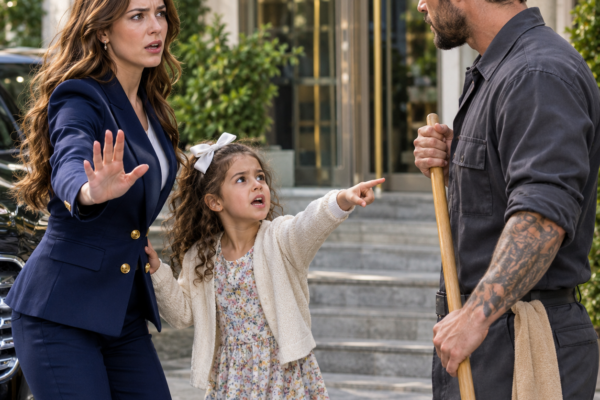
Part 4: She Rejected a Poor Single Dad—Until Her Daughter Pointed at Him and Said, “That’s My Dad!”
Something more like the feeling of watching something difficult become something worth the difficulty of watching a thing that had been broken find a different shape and discover that the different shape was stronger. She thought out what she had been at 30.
certain, fast, clean, wrong.
About the investors in their conference room who had looked at a veteran mechanic and seen a liability and looked at an ambitious young CEO and seen an asset, and about how she had let them do that math for her because she had not yet learned to trust her own.
About the morning shed driven away from Daxs neighborhood and told herself she was making a strategic decision and known somewhere beneath the strategy that she was making a frightened one.
She thought about Sadi at 7 years old, carrying a photograph for 4 months in a purple backpack covered in iron-on patches, searching every face in every crowd for a man shed never met and somehow already missed.
You do not deserve your childrens love.
That was something Blair had come to understand in the strange excavating year behind her.
Childrens love is not payment for good parenting or reward for being present.
It is something given freely, and the most honest thing you can do with it is try to be worth it going forward.
even knowing you cant go back and earn it retroactively. Sadi had looked at her mothers failures and decided to walk through them toward what was on the other side.
That was not something Blair had taught her.
That was something Sadi had done entirely on her own out of some deep and uncorrupted instinct about what mattered and what didnt.
She thought about Dax, about a man who had every right to close every door and had instead opened one crack and waited to see what she would do with it. about the patience it required to watch a person learn in real time what they should have understood years earlier and to resist the urge to withhold the credit when they finally get there about the specific kind of strength it takes to remain soft enough to let someone back in without pretending the wound was never there.
She had not understood at 23 that strength like that existed. Shed thought strength was the clean decision, the forward motion, the refusal to be slowed by sentiment.
Shed built an entire career on that misunderstanding and had been by most external measures spectacularly successful. But success measured from the outside is a strange kind of measurement.
It tells you what youve accumulated.
It doesnt tell you what anything cost or who paid or whether the price was ever actually worth it.
Dax was worth it.
He had always been worth it. and the fact that it had taken her seven years of wrong and one October afternoon and 8 months of Wednesday evenings and a drive to Mil Haven with broken air conditioning to arrive at a place she could have been standing in years ago.
That was not a triumph. She was clear on that.
It was a failure that had, through the persistence of a 7-year-old and the patience of a man whod had more taken from him than he deserved, become something salvageable. Salvageable was enough.
More than enough. It was, she had come to understand, what most of real life was made of.
The wedding was in September. Dax had been adamant about small, and Blair had agreed with the whole of herself for the first time in years without negotiating towards something bigger.
40 people, a rented space at the community center, Petra had offered it the day after theyd announced the engagement and declined to hear any argument about it. with folding chairs and the kind of food that Gerald had organized through the meal service team because hed asked to and theyd said yes.
It was not elegant in the conventional sense.
The chairs were the same folding chairs they used for training sessions.
There were flowers, but they were from the market, not a florist, put together by Owen with guidance from a YouTube video hed watched 17 times and about which he had strong feelings. Sadi had opinions about the arrangement that she expressed directly, and Owen had defended his choices with the datadriven composure he brought to arguments, and the resulting compromise was imperfect and entirely theirs.
Blair wore a dress that was not white and was not formal, and fit her like something chosen rather than performed.
Dax wore a jacket hed owned for years that Blair had quietly sent to be cleaned and pressed without telling him.
and when he appeared in it at the ceremony, hed looked at her and said he didnt know jackets could be that clean, and shed said, Welcome to the next chapter. Sadi and Owen stood beside them.
There had been no question about this.
The question had never been raised. Sadi had decided months earlier that she intended to hold the rings, and Owen had decided he was going to be the one to say if anyone objects, because hed seen it in a movie and thought it sounded like a significant responsibility.
And neither of these positions had been up for debate. They exchanged vows that Dax had written and Blair had written, and theyd read to each other for the first time, standing in front of 40 people, which had been Daxs idea, and which Blair had resisted for exactly 3 days before understanding that this too was the right thing.
No rehearsal, just the words theyd actually meant, said directly.
In the room where the work happened, in front of the people who had watched them do it, Dax said, I am not going to promise you a life without difficulty.
Im going to promise you that when things are difficult, I will stay. I will tell you the truth.
I will show up. I will not let the hard parts of who we are become reasons to leave because Ive learned that the hard parts are where the real thing lives.
Blair said, I spent a long time believing that moving fast was the same as moving forward. I know the difference now.
And what I know is that there is nowhere I want to move to without you beside me.
Not because you complete me or any of the easy things people say, but because you make me slower. And slower for me is the direction of honest.
Sadi during these vows was extremely still in the way she got when something was landing.
Owen had his hands folded in front of him with the formal bearing of someone taking his ring related responsibilities seriously.
When it was done, when the brief ceremony had reached its end, and Dax had kissed Blair once steadily with the same directness he brought to everything, Sadi looked up at both of them. Good, she said.
That was good. Owen, who had successfully not said if anyone objects, looked quietly satisfied.
There is a particular thing that happens in a life when you stop running from the version of it that frightens you and start building it instead. It doesnt announce itself.
It doesnt arrive with resolution or clarity or the clean sense of an ending. It arrives in the accumulation of ordinary things.
In a kitchen table conversation that goes on longer than planned, in a childs laugh recognizable from across a park, in a mans hand covering yours without ceremony or explanation, just covering it. Blair knew this now.
She knew it the way you know things that have been learned through cost rather than instruction. not as a concept, but as a physical understanding, something in the body rather than the mind.
She had built a company on the belief that the fastest path was always the best one. She had learned through a series of decisions she couldnt take back and consequences she was still in small ways continuing to face that the fastest path is often just the path that gets you to the wrong destination sooner.
what she had now, the house that was no longer only on Mercer Lane, but also the blue grey house with the basketball hoop and the truck that ran the way it ran because someone understood every part of it. What she had was slow and real and imperfect in the specific ways that things are imperfect when they are being genuinely lived rather than strategically managed.
Dax had not become wealthy. He had not joined her company or taken a position or allowed any version of her resources to reshape who he was.
He had accepted the trade program funding through the board process which had grown in its first city and was now at month 12 showing the kind of results that come from doing things carefully. Not spectacular numbers, just real ones, the kind that represent actual people with actual changes in their actual lives.
He went to work every morning and came home in the evening and was a father to Owen in the consistent unremarkable essential way that fathers are fathers. by being there, by showing up, by making sure the person who needed him knew they could count on it.
He was the same with Sadi.
Not with the performed intensity of someone making up for lost time, but with the steady reliability of someone who understood that presence accumulated over ordinary days, was the only currency that actually mattered.
And Sadi, who had at 7 years old carried a photograph in a purple backpack through every crowded place she visited on the off chance she might find its subject, had found him, had walked across a park with a broken bicycle in a photograph, and the unshakable instinct of a child who knew what she was looking for. Blair thought about this sometimes in the way you return to a certain image, not with guilt anymore, but with a kind of wondering about the particular courage of that child, about what it required to carry a hope thats specific for 4 months without telling anyone.
About what kind of person is formed when they learn young that things can be found if you keep looking. That questions can be asked even when theyre frightening.
that the photograph in your backpack is worth carrying even when you cant be certain youll ever get to use it.
She thought about all the things she had not taught her daughter and all the things her daughter had taught her. She thought about the fact that Sadi had in her own way done more to fix what was broken than either adult had managed alone.
There was a morning about 6 months after the wedding when Blair came downstairs early and found Dax already at the kitchen table there. their kitchen table now in the house theyd spent three months deciding on and another month moving into a place between Mercer Lane and the blue gay house neither and both with his coffee and the newspaper and Owens latest library book which Owen left in rooms like evidence of his passage he didnt hear her on the stairs he was reading or not quite reading looking at the page with the slightly distant expression of someone whose attention had drifted somewhere private she stood in the doorway and looked at She thought about everything it had taken to get to this kitchen this morning, this ordinary view of a man at a table.
She thought about how far wrong you can go believing you were going right. She thought about the specific mercy of being given the chance to find out the difference.
She went and got coffee and sat down across from him. He looked up.
Morning, he said. Morning.
He went back to his newspaper.
She held her coffee cup outside. The morning was doing what mornings did, going from dark to light with the unscheduled indifference of something that doesnt require your readiness.
Sadi came down at 7:15, rumpled and barely awake, and sat in the chair between them and put her head on the table.
I dont want to go to school, she said into the table surface. I know, Blair said.
Why do we have to go every day? Because thats how it works, Dax said.
Thats not a reason.
Its the reason.
Sadi lifted her head and looked at him with the expression she deployed for arguments she hadnt decided whether to pursue.
Then she looked at her mother.
Then she looked at the coffee cup in Blairs hand.
Can I have some? she asked.
No, both adults said at exactly the same moment with the same flat certainty. Sadi put her head back on the table, but she was smiling.
They could both see it even with her face down.
The way the corners of it turned up, the small private smile of a child who has gotten what she actually wanted, which wasnt the coffee, but the answer that came from both directions at once without hesitation, without gap.
The answer that meant we are here, both of us at the same table. And were not going anywhere.
That was what it sounded like in the end. Not a grand statement, not a resolution with appropriate music, just two people saying no to a coffee request at the same moment, and a child smiling into a kitchen table, and the morning coming in through the window the way it always had and always would, indifferent to everything except the fact of its own arrival.