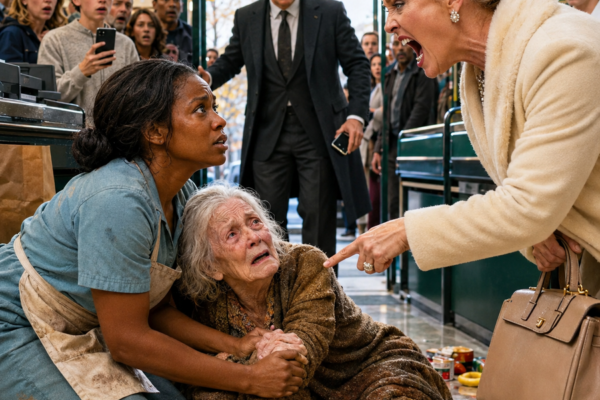
Bullies Poured Hot Coffee On A Waitress — What Undercover Boss Did Next Will Shock You

Bullies Poured Hot Coffee On A Waitress — What Undercover Boss Did Next Will Shock You

Look who it is.
Oops.
Maybe watch where you’re going next time.
Nobody said a word.
That’s the thing about this kind of room.
Everyone sees it.
Nobody stop. Nobody in that diner knew who he was yet.
By Sunday morning, the coffee hit her before she could move.
Scalding hot. full pot.
Claire screamed.
She went down on one knee.
Her right hand slammed against the table edge. The carffe shattered on the floor.
The whole diner froze.
Garrett Voss looked down at her.
“Oops,” he said.
Just like that, casual, like he had bumped into someone in a hallway.
“Maybe watch where you’re going next time.”
Marcus was still filming.
Nobody moved.
Nobody said a word. Then a chair scraped back from the corner booth, slow, deliberate.
An older man stood up, gray at the temples, flannel shirt.
Nobody had paid him any attention all evening. He crossed the room without rushing.
He crouched beside Clare. Voss looked down at him.
Mind your own business, old man.
The man did not answer right away.
He helped Clare to her feet carefully.
Then he turned and looked at Voss. Not angry, not threatening, just looked.
Three full seconds. Voss held it for maybe half that before his eyes moved away.
The old man said quietly.
I’ll remember that.
Nobody in that diner knew who he was yet.
By Sunday morning, everyone would.
Some mornings you wake up and you just know.
You know it before your feet hit the floor, before the coffee brews, before the news comes on.
You just know something is about to change. Franklin Marorrow had that feeling on a Friday afternoon in October.
He was 64 years old. He had built something from nothing.
And somewhere along the way, he had stopped paying attention to the foundation.
That was about to cost him.
He pulled his truck into the parking lot of Delvy’s Classic Diner just after 4 in the afternoon.
The place sat on the edge of Mil Haven, Georgia. Population 12,000.
One stoplight on Main Street. The kind of town where everybody knows your business before you do.
The diner itself was not fancy. Never had been.
Red vinyl booths, laminate countertops worn smooth at the edges, a pie case by the register with a rotating stand that squeaked every time it turned. The sign out front had a letter missing.
It had been missing for 3 years, according to the maintenance reports Franklin had read on the drive down.
He noticed that right away.
He sat in his truck for a moment, just looking.
A man in his 60s with gray at his temples and a flannel shirt that had seen better days. His hands rested on the steering wheel.
Rough hands, the kind you get from years of work, not years of meetings. He pulled on a plain ball cap, pushed his door open.
Nobody looked up when he walked in.
That was fine.
That was the point. He took the corner booth, the one near the window, back against the wall.
old habit.
He liked to see the room. Always had.
A laminated menu sat between the napkin holder and the salt shaker.
He already knew what he wanted.
He had been coming to places like this his whole life.
He knew the menu before he read it. A young woman came to his table with a water glass and a smile that looked like it cost her something to hold on to.
She was maybe 21. dark hair pulled back.
Her name tag said Clare.
Her uniform had a small stain near the hem that she had tried to blot out.
Her shoes were the kind you buy when you are trying to be practical and failing slightly because you cannot quite afford the good ones.
Franklin noticed all of it, not because he was judging, because he had spent his whole life noticing the things that told the real story.
She set the water down clean. No spill.
Good grip.
What can I get you? She asked.
Coffee black, he said.
And a slice of whatever pie is freshest.
Apple just came out 20 minutes ago, she said. Apple.
Then she wrote it down even though it was two items. Some people thought that was unnecessary.
Franklin thought it was professional. She walked away and he looked around the room.
The place was filling up for the dinner rush.
Friday afternoon, families coming in after work.
A few regulars at the counter who looked like they had been sitting there since 1987. A couple of booths occupied by people who were clearly local.
Everyone comfortable, everyone settled. The kind of place that had been part of a community for a long time.
The kind of place that mattered, even if nobody said so out loud.
Clare brought his coffee back in under three minutes.
She set it down with a small ceramic cup of cream on the side, even though he had not asked for it.
“In case you change your mind,” she said.
He did not change his mind, but he appreciated the instinct. He pulled out his phone, opened an internal application.
The logo that appeared was small and clean. Two words, Marorrow Group.
He scrolled through the report he had asked his assistant to compile.
Delvey’s classic Milh Haven, Georgia, one of 22 locations operating under the Marorrow Group portfolio across five southeastern states.
The numbers were not good.
Customer volume down 11% over 18 months. Revenue per table declining.
Staff turnover up 40% in the same period. Five formal complaints filed by employees in the past year and a half.
All five marked closed.
No investigation notes attached to any of them. Franklin read that last part twice.
Five complaints.
Zero investigations. He set his phone face down on the table.
Took a slow sip of coffee.
The coffee was good.
That was something.
He had opened his first diner in 1989 with a $12,000 loan from a credit union in Knoxville, Tennessee. He had personally worked the counter 6 days a week for the first 3 years.
He had mopped floors, fixed the ice machine himself twice because he could not afford the repair bill.
He had learned every person’s name who walked through the door in those early years.
That diner became two.
Two became four.
Four became the Marorrow group. But somewhere between that first coffee machine and 22 locations, he had let distance get in the way.
He had let people manage the managing. And now he was sitting in the original location, the one he had built with his own hands, reading a report that told him something was deeply wrong.
He had not told anyone he was coming. No advanced notice to the regional manager, no heads up to the local staff, no corporate visit protocol.
He had driven down from Atlanta himself in his personal truck with a change of clothes in a duffel bag. He wanted to see it real.
He was seeing it. The bell above the door rang.
Three of them came in together. Franklin had spent enough years around enough different kinds of people to read a room entry the way some people read a first sentence.
You could tell a lot from how people walked through a door.
These three came in like they owned the place, not in the way of someone who was comfortable, in the way of someone who wanted you to know they were comfortable. There was a difference.
And the one in front was maybe 22. tall, broad shoulders, wearing a college lacrosse jacket with a name stitched on the chest.
Garrett Voss, dark hair, sharp jaw, the kind of face that probably got him out of a lot of things growing up.
Behind him were two others, one with reddish hair, one with a close fade, all three wearing variations of the same casual wealth, clothes that were expensive, but designed to look effortless. They did not wait to be seated.
They moved through the diner like they were navigating a space that existed for their convenience. Took the large booth in the center of the room, the one that could seat six.
There were three of them. Voss dropped into the seat with an easy sprawl.
Pulled out his phone, said something that made the other two laugh. Franklin watched without watching.
It was a skill he had spent decades developing.
Clare crossed the room toward them with her notepad.
Something shifted in her posture when she recognized who it was. It was small, barely visible, a tightening across her shoulders, a half breath that did not quite complete itself.
She kept walking. She kept the smile.
Hey guys, what can I get you started with?
Voss looked up from his phone slowly. The kind of slowly that communicates that you are not worth the speed.
Well, he said, “Look who it is.”
“I can get you some menus,” Clare said.
“Even tone, professional.
We know the menu,” Voss said.
He glanced at his friends with a little pull at the corner of his mouth.
Then he started ordering. He ordered three separate appetizers, then changed two of them.
ordered a burger with seven specific modifications. Sent Clare back for a different kind of soda than what was on tap.
Asked whether the bacon was crispy or not, then said he needed it extra crispy, even though crispy was already the default. Marcus, the one with the reddish hair, started filming on his phone.
Not the food, Claire. She went through it all without a stumble.
wrote everything down, read it back, got it right.
Voss watched her the whole time with an expression that Franklin had a word for.
Not anger, not cruelty.
Exactly. Contempt.
The specific kind of contempt that comes from someone who has never once been told that they are not the most important person in the room.
It was quiet and it was practiced and it was deeply familiar with its own power. Clare went back to the kitchen.
Voss said something low to Marcus. More laughter.
Franklin looked down at his pie.
He took a slow bite, set his fork down.
He looked toward the counter where Norah Stills was standing. She was the manager on duty.
He had read her file on the drive down. 51 years old, 12 years with the company, consistently solid performance reviews until about 18 months ago when the notes started getting vague.
She was watching the booth. She had already seen enough to know that something was wrong.
Franklin could see that plainly. She was not moving.
He stayed in his corner, not because he did not care, because he needed to understand what he was actually dealing with.
Not just the event, the whole picture, the environment that had allowed this to exist.
There is a difference between reacting and responding. He had learned that the hard way.
Clare came back out with drinks.
She sat them down efficiently.
Garrett Voss had his arm resting along the back of the booth seat, taking up space the way some men do when they want to make clear that the space is theirs.
You got a little something, Voss said.
gesturing vaguely at Clare’s uniform.
There was nothing there.
It was just something to say.
She did not look down.
She just said, “I’ll check on your food.”
And turned.
Voss looked at Marcus.
Marcus was still filming. Franklin looked at his coffee.
He thought about a man he used to know, his father’s oldest friend, a man named Theodore Al who had run a hardware store in Chattanooga for 38 years.
Never raised his voice once in his life.
But when Theodore Alston walked into a room, people stopped and paid attention.
Not because of anything he demanded, because of something he carried.
Franklin’s father had once said that some men get loud because they are afraid of being quiet and some men are quiet because they have already seen what happens when things go wrong.
Theodore Alustin had been the second kind.
Franklin had spent most of his life trying to be the second kind. He was still trying.
The food came out.
Clare balanced the plates with the kind of efficiency that only comes from months of doing something hard and refusing to let it break you. She said everything down correctly without referring to her notes.
Every modification right. Every plate in the right place.
Voss looked at his burger.
Looked up at Clare. I said extra crispy.
He said the bacon is extra crispy.
Clare said calmly. Vos picked up a strip of bacon.
Looked at it. Set it back down.
This is regular crispy.
He said there’s a difference.
There was not a difference. Everyone in earshot knew there was not a difference.
Clareire said, “I can send it back if you’d like.”
“I would like,” boss said.
She picked up his plate, carried it back to the kitchen.
Franklin watched Norah at the counter. She had seen the exchange.
She was looking at her clipboard. He took another slow sip of coffee.
Clare came back 8 minutes later with a new plate.
fresh bacon exactly the same as before because extra crispy is extra crispy.
She set it down in front of Voss.
Voss looked at it, looked at his friends, looked back at Clare.
You know what?
I changed my mind, he said.
I want the chicken sandwich instead. A pause, short, almost nothing.
Then Clare said, “Of course, I’ll put that in.
” She reached for the plate and Garrett Voss shifted in his seat just slightly, just enough to bring his elbow into contact with the coffee carff she had carried out with her.
It was not an accident.
The angle was wrong for an accident.
The timing was wrong for an accident. The small movement of his arm was deliberate in the way that something can be deliberate while maintaining perfect deniability.
The carffe tipped coffee freshly brewed full pot.
It hit Clare on the right side, shoulder and upper arm down across her uniform. The sound she made was not a scream exactly.
It was the sound a person makes when pain arrives faster than their body can process it.
She stumbled back against the adjacent table. One hand went out to catch herself.
The carffe hit the floor and shattered. The diner went quiet.
Not completely, but the kind of quiet that comes when a room full of people collectively decides to hold its breath. Clare was bent slightly at the waist.
Her right hand was pressed against her left shoulder. Her face had gone white.
Voss looked down at her. Oops, he said.
He said it the way you say it when you bump someone in a hallway.
Casual, unconcerned.
Maybe watch where you’re going next time.
Marcus lowered his phone slightly, but did not stop filming. Drew laughed once, then stopped as if he was not quite sure he was supposed to.
Norah came around the counter fast. She had a stack of napkins in her hand before she got there.
Oh, honey,” she said.
She pressed the napkins toward Clare. Clare straightened up slowly.
Her face was controlled, but her eyes were wet at the edges.
Franklin was already out of his booth. He crossed the room without rushing.
Without any performance of urgency, he moved the way a man moves.
When he has seen a situation and made a decision, he came to Clare’s side.
Not between her and Voss, just beside her.
“Let me help you to the back,” he said quietly.
“Cold water first.”
Clare looked at him.
Something in her expression shifted.
“Not relief exactly.
Something more like the moment when a person realizes they do not have to hold the whole weight alone.
” “I’m fine,” she said automatically.
You’re not, he said.
And that’s okay.
Come on.
He walked with her toward the kitchen.
Behind him, he heard Voss say, “Mind your own business, old man.”
Franklin stopped.
He turned. He looked at Garrett Voss.
It was not a threatening look. It was not angry.
It was the kind of look that comes from a man who has spent a long time understanding exactly what he is seeing and exactly what it costs. He held it for 3 seconds.
Voss held his gaze for about 1 and a half of those seconds before looking away.
Franklin turned back and walked into the kitchen.
Hank Delveio was at the stove. 60 years old, broad through the shoulders, a man who had been cooking in professional kitchens since he was 19.
His hands moved with the automatic efficiency of someone who could do this work in his sleep. He looked up when Franklin and Clare came through.
She needs cold water on that burn, Franklin said.
Have you got a first aid kit?
Cabinet by the back wall. Hank said.
He was already moving. Then Hank looked at Franklin again.
Looked properly this time.
Something happened in Hank’s face.
A kind of stillness. the recognition of something unexpected.
He did not say anything. He opened the first aid cabinet and pulled out the kit.
He ran cool water from the utility sink.
He helped Clare hold her arm under it. He knew what he was doing, the kind of knowing that comes from having been trained somewhere in the past to handle exactly this kind of thing.
Franklin stood nearby. He pulled out his phone.
He opened the Marorrow Group app. He typed two words to his assistant.
Words that set something in motion. Then he put his phone away.
Clare stood at the sink, arm under cool water, looking at the floor. She was not crying.
She was doing something harder than crying.
She was holding herself together so completely that the effort of it was visible. Do you want to call the police?
Franklin asked. She was quiet for a moment.
Then she said, “His dad is Congressman Voss.
Roy Voss.
He represents this district.”
She paused. 3 months ago, they destroyed my car in the university parking lot.
I reported it. Sheriff Pharaoh took the case.
The file disappeared.
She said it without bitterness. That was the thing.
She said it like someone reporting a weather pattern.
========== PART 2 ==========
Franklin looked at her for a moment.
“You reported it and the file disappeared,” he said.
“Yes, sir.”
“Has this happened before?”
“Here at work.
” She looked at the floor again.
“They’ve come in a few times.
Usually, I can manage.”
She stopped.
“Tonight, I couldn’t manage.”
Hank was listening from the other side of the kitchen. His back was to them, but he was listening.
Franklin said, “You have a name.”
What’s your last name?
Claire. Ashton.
She said, “Claire Ashton.
How long have you worked here?”
“8 months.
Are you a student?”
“Ped at Milhaven Community.
I’m saving for the transfer application to Georgia State.”
She paused again.
“My mom is sick.
She can’t work right now, so I’m here as many hours as I can get.”
Franklin nodded slowly. He did not say he was sorry.
He had found that sorry was often the least useful thing you could offer to someone who was already carrying more than their share.
Instead, he said, “You handled yourself out there professionally.
I want you to know that I saw that.”
She looked up at him.
“I appreciate that,” she said carefully.
But I don’t know who you are.
That was fair. Franklin pulled his phone from his pocket, opened his wallet instead, pulled out a plain business card, set it on the counter near her.
He did not say anything yet. She looked at the card.
The look on her face changed in the way that a room changes when someone turns a light on that you did not know was off. Marorrow group, Franklin Marorrow, founder and chairman.
She looked at him.
He said, “I know this is a lot to take in.
We can talk more later.
Right now, let’s make sure your arm is properly taken care of.”
She kept looking at the card for another moment.
Then she nodded. Franklin stepped out of the kitchen.
He walked back through the dining room. Voss was at the booth.
He had his food now.
The chicken sandwich had arrived somehow.
He was eating it with one hand and looking at his phone with the other.
Franklin did not go to that booth.
He went to the counter.
Norah Stills was there pretending to do inventory.
Franklin sat on a stool.
He kept his voice level and quiet so only she could hear. How often does something like that happen?
He asked. Norah did not look at him right away.
That pause was its own answer. I need to understand the full picture, Franklin said.
Not to get anyone in trouble.
To understand what I’m actually dealing with, Norah turned to look at him.
She had the face of a woman who had been bracing for an uncomfortable conversation for a long time.
“They’ve been in before,” she said quietly.
“Those boys.
It’s usually not quite that bad.
But it’s always something.
And you don’t ask them to leave.
Another pause.
Mr.Faulk, she said. Dennis Faulk, the regional manager.
His name in her mouth carried a weight.
Franklin waited. He called me last Tuesday.
Norah said.
He told me that the branch was being evaluated, that a sale was being considered, and that any employee who generated complaints or caused problems during the evaluation period would be let go before the sale completed. She stopped.
He said it very clearly.
Franklin looked at her.
So when you saw what happened tonight, he said, I didn’t know what to do, she said.
And her voice cracked on the last word. Just slightly.
Just enough. You have a daughter, Franklin said.
He had read her file.
She’s a junior at Georgia Tech, Norah said.
Her tuition is not cheap. I cannot lose this job.
Franklin looked across the dining room at the booth where Garrett Voss was eating his sandwich. At the table where a family of four was trying to have a quiet Friday dinner and not look at what had happened.
At the counter where the regulars sat with their coffee and their silence.
He looked at all of it.
Then he looked back at Nora.
You didn’t know what to do.
He said that’s different from not caring.
She nodded. Her jaw was tight.
I need you to trust me, he said, and I need you to stay exactly where you are for now. He stood up from the stool.
He went back to his corner booth.
He sat down.
He picked up his fork and finished his apple pie.
The filling was good, cinnamon heavy.
The crust was not quite as good as it could have been, a little thick at the edge, but the apples were real, and the whole thing tasted like something somebody had made rather than something that had arrived on a truck.
That still meant something.
Voss and his friends stayed for another 20 minutes. Loud, unbothered.
Voss made a comment when Clare passed their table with a tray.
Something Franklin could not fully hear from his corner.
The two friends laughed.
Clare kept walking.
Voss left a 12% tip. He probably thought that was generous.
Franklin watched them go. He sat in the quiet after they left for a long moment.
Over in the corner at the far end of the dining room, an older man sat alone.
had been sitting there before Franklin arrived.
70ish, weathered face, a light jacket with a lot of pockets. A small compact camera rested on the table beside his coffee cup.
He had not taken his eyes off the room for most of the last hour. He and Franklin had made eye contact once, brief, mutual, the kind of eye contact between two people who have both spent enough years observing things to recognize when they are in the company of someone else who does the same.
The older man gave a small nod. Franklin gave one back.
He did not know yet what that man had in his pocket.
He would find out later.
But he noticed him. He always noticed.
Outside the Georgia sky was going gold and orange at the edges. The kind of October evening that made you remember why the South could be beautiful when it wanted to be.
The diner hummed with the ordinary sounds of a Friday. Forks against plates.
A coffee machine cycling.
The rotating pie stand squeaking its same faithful squeak. Franklin pulled out his phone.
A message had come back from his assistant.
The report he had requested, 18 months of internal data, five complaint files, and at the bottom, one additional note. The lease agreement for the original location, Mil Haven, Georgia, signed 1989.
His signature was still on file. This was where it had all started.
this particular building, this particular town, this particular counter where people had been coming for 35 years to eat something warm and feel like somebody saw them.
He had not been back in nearly 4 years. That was on him.
He folded his phone away. He left a 20 on the table.
He stood up, pulled his cap down, and walked toward the kitchen door. He pushed it open.
Hank Delvecio looked up from where he was wiping down the prep surface. Their eyes met.
This time Hank did not look away.
He said in a voice pitched low.
I wondered when you’d finally come back.
Franklin said, “It took me too long.”
Hank nodded once slowly.
with the kind of weight that tells you a man has been carrying something for a while and is relieved to set it down.
There’s a lot you need to know, Hank said.
I know, Franklin said.
We’ll talk tonight.
He pushed back out through the kitchen door, walked through the dining room, pushed out the front door into the evening air. He stood in the parking lot for a moment.
The neon sign for Delveies buzzed quietly above him. that missing letter still missing.
He had built this place with a $12,000 loan and a belief that people deserved somewhere good to sit down and be treated with decency. Somewhere along the way, he had let that drift.
A young woman inside had a burned arm and a file that had disappeared and three months of fighting alone ahead of her with no end in sight.
A good woman inside had made a terrible choice because a bad man had put her in an impossible position. An old man had built a record nobody had asked him to build because he believed that truth deserved a witness.
Franklin Marorrow stood in the parking lot of the place he had built from nothing and looked up at the broken sign.
He thought about what his father used to say.
The only difference between a man who stands up and a man who doesn’t is the moment when he decides which one he’s going to be.
Franklin had already decided.
He just needed one more day to do it right.
He walked to his truck. He had phone calls to make.
Franklin sat in his truck for a long time after the diner closed. The parking lot was empty except for two cars near the back.
One belonged to Hank. One belonged to Nora.
The diner lights went off in sections.
First the dining room, then the counter, then the kitchen light last, casting a long yellow rectangle through the small back window before it too went dark. He looked at the broken sign one more time.
Then he called his assistant.
I need everything, he said.
Full audit trail. Every complaint filed at the Mil Haven location going back 3 years.
every communication between the regional office and the branch, every access log on the security system and pull the HR files for Dennis Faulk going back to when he took the regional position. His assistant said she would have it by 6:00 in the morning.
Franklin said thank you and ended the call.
He sat in the quiet for another minute. Then he pulled out of the lot and drove to the motel 2 mi down the road.
the kind of place with exterior corridors and a vending machine that hummed too loud. He paid cash.
He did not use his corporate card.
He was not here officially. He had not been here at all.
He sat on the edge of the motel bed and looked at the wall.
He thought about Clare Ashton standing at that sink with cool water running over her arm and saying it like a weather report. The file disappeared like that was just how things worked.
like she had already adjusted to a world where the systems that were supposed to protect her simply did not function. She was 21 years old.
She was studying medicine because she wanted to help people.
She was working extra shifts because her mother was sick and the bills did not wait. And she had spent 3 months fighting something alone that she should never have had to fight at all.
Franklin set his phone on the nightstand. He turned the light off.
He did not sleep much. The diner opened at 6:30 on Saturday mornings.
Franklin was in the parking lot at 6:15. He had stopped at the gas station down the road for a large coffee because he did not want to walk in before the place was ready.
He sat in his truck and watched the lights come on inside. Watched Hank arrive first, same as yesterday, same flannel jacket, same steady walk.
Watched the morning prep begin through the window.
At 6:30, he walked in.
A young man Franklin did not recognize was setting up the counter. A weekend morning staff.
He nodded at Franklin and said, “Good morning.
” Franklin nodded back and took his same corner booth.
Hank came out of the kitchen 4 minutes later.
He came straight to Franklin’s table and sat down across from him without being invited.
Set two mugs of coffee on the table, his own and Franklin’s.
He did not say good morning.
He said, “How much do you already know?”
Franklin said.
“Tell me what you think I need to hear.”
Hank wrapped both hands around his mug.
He looked like a man organizing thoughts he had been organizing for a long time.
Waiting for the moment when it was finally worth saying them out loud. I was in the Gulf, Hank said.
91 supply convoy out of Saudi Arabia.
I did two years over there total.
He paused. I came home and I could not sit still.
Tried a few things. Ended up in kitchens because kitchens made sense to me.
The pace, the discipline.
Everybody has a job.
You do your job. The whole thing works.
Franklin listened.
I’ve been in this kitchen for 6 years, Hank said.
I took the job because the original Delveies meant something to me. I knew what it was supposed to be.
I figured I could be part of keeping it that way. He stopped.
And then Faulk took over the regional position.
He said the name landed flat between them.
Dennis Faulk.
Franklin said he came in three years ago.
Hank said.
At first, it was just small things.
Cutting corners on supply orders, pushing the hourly staff on tips, reporting.
Nothing you could point at directly. He paused.
Then it became something else.
Complaints started coming in from staff, good staff, people who had been here for years.
And every single one of those complaints went to Faulk’s office and never came back out.
Franklin said, “I read the files last night.
Five complaints closed with no investigation notes.”
“Seven,” Hank said.
Franklin looked at him.
“Seven,” Hank said again.
“Two of them never made it into the system.
I know because I watched two people write them and hand them directly to Nora, and they were never entered.”
He paused.
One of those was filed by a woman named Bethany Marsh.
No relation to the Voss family. She was a morning server.
She lasted 4 months before she quit. Good worker.
Left because of repeated harassment from a regular customer that Norah would not address because Faulk had told her not to rock the boat.
Franklin was quiet.
“And then there’s Clare,” Hank said.
Tell me about Claire.
Hank took a long breath. She started eight months ago.
Showed up for the interview 10 minutes early with a printed resume. I saw her through the kitchen window.
I told Norah to hire her before the interview was even over.
He stopped.
She’s the kind of worker you don’t get very often.
Precise, calm under pressure, good with difficult customers.
She studies on her break. Medicine.
She wants to be a doctor. He paused.
6 weeks after she started, Garrett Voss and his friends came in for the first time.
I don’t know if he knew her from before or if he just picked her because she was there.
But it started that night. Small things, demeaning comments, sending food back for no reason, trying to get a reaction.
And she didn’t give them one, Franklin said.
She never gave them one, Hank said. Which made it worse for them.
Some people when they can’t get a reaction, they escalate.
That’s what happened.
He folded his hands on the table. 3 months ago, they waited by her car in the university parking lot.
Four of them that time. They kicked in the door panel, slashed one tire, scratched the hood.
Claire reported it to campus security and to Pharaoh’s department.
Hank’s voice stayed even throughout.
The even voice of a man who had learned a long time ago that anger was most useful when it was controlled.
Pharaoh sent a deputy to take her statement.
2 days later, Clare called to follow up. She was told there was no active file under her name.
Franklin set his coffee mug down.
The file disappeared, he said. The file disappeared, Hank confirmed.
And then Clare came back to work here and kept going.
Franklin said she came back the next morning. Hank said on time, uniform pressed.
I watched her come through that door and I thought, “This is the toughest person in this building right now.”
And nobody knows it except her.
They sat in that for a moment.
Outside the diner, the Saturday morning was coming on slow and gray. A few cars going by on the main road.
A couple coming in through the front door.
Regulars by the look of them. The weekend was starting.
Franklin said, “You mentioned something last night.
You said there’s a lot I need to know.
Is there more than what you’ve told me?”
Hank looked at him. Then he reached into the pocket of his apron, pulled out a small notebook, black cover, spiralbound, worn at the corners.
He set it on the table between them. I started keeping this 5 years ago, he said.
Every incident, every complaint I personally witnessed, every time I saw something get buried, names, dates, what was said, what was done, what the response was, he paused.
My sergeant in the Gulf told me once that in a situation where the system is not functioning, the most valuable thing any individual can do is maintain an accurate record. Because the truth does not defend itself, it needs witnesses.
Franklin looked at the notebook.
He did not touch it yet.
You kept this for 5 years, he said. I kept it because I believe that someday the right person would need to see it.
Hank said. I did not know if that person would ever come, but I kept it anyway.
Franklin put his hand on the notebook. He looked at Hank.
Why didn’t you send this to corporate to the board?
To anyone above Faulk.
Hank said, “I tried once 18 months ago.
I found an email address for someone on the Marorrow Group board. Sent a summary.
No names, just an overview.”
The email bounced back two weeks later with a notification that the address was inactive. He stopped.
After that, I did not know who to trust and I could not risk losing this job.
I have a daughter at home. She is 17.
Her mother passed 4 years ago.
It is just the two of us.
Franklin was quiet for a long moment. He looked at the notebook on the table.
========== PART 3 ==========
He thought about 35 years, 22 locations, hundreds of employees whose names he did not know.
People who had been showing up every day to do honest work inside something he had built, trusting that the structure around them was sound. He had let the structure go wrong.
That was not Dennis Faulk’s fault alone.
That was his.
He said, “I’m going to make this right, Hank.
I want you to know that not as a corporate statement, as one person to another. Hank looked at him steadily.
I know, he said.
Otherwise, you wouldn’t be sitting here at 6:30 on a Saturday in a flannel shirt.
Something in that made Franklin almost smile.
Hank went back to his kitchen.
Franklin opened the notebook. He read for an hour and a half.
By the time he was done, his second coffee had gone cold, and the diner was filling up with the Saturday morning crowd.
He sat with a notebook closed in front of him and looked out the window at the gray October sky. The things in that notebook were not dramatic in the way that headlines are dramatic.
They were the ordinary, steady grind of a system, corrupted slowly over time by one person’s small decisions to put self-interest above decency.
A complaint buried here. A good employee pressured out there.
A manager threatened into compliance. A community institution quietly hollowed from the inside.
It was the kind of damage that was hard to see from a distance. You had to be in the room.
Franklin’s phone rang.
He looked at the screen.
The name that came up was not one he had expected this early in the morning. Congressman Roy Voss.
He answered, “Mr.Marorrow,” the voice said.
“Warm, the practiced warmth of a man who had spent 20 years making people feel like he was their friend.
I hope I’m not calling too early.”
“You’re not,” Franklin said.
“I wanted to reach out personally,” Voss said.
“I understand there was an incident at one of your establishments last evening involving my son and a member of your staff.
a pause. I want to assure you that Garrett is a good kid.
He can be thoughtless sometimes.
I think we both know how young men can be.
Franklin said nothing, Voss continued.
I’d like to handle this quietly if we can.
Manto man.
I think we both benefit from keeping things simple.
Your location here depends on a county operating license that comes up for renewal in February. I sit on the committee that oversees those renewals.
Another pause, lighter this time, as if he was mentioning something incidental.
I just want to make sure we’re on the same page.
Franklin waited until Voss had finished.
Then he said, “Congressman, a young woman was burned by a hot beverage in my establishment.
She required first aid. She has an existing complaint history involving your son that includes property destruction and a police report that was subsequently closed without investigation.
He stopped. That is not an incident.
That is a pattern and it is not going away. Silence on the line.
I’d encourage you, Franklin said, to speak with your son about the events of last night and advise him to cooperate fully with whatever process follows.
That is the best outcome available to your family right now. Another silence.
Then Voss said, “I see in a voice that was no longer warm.”
“Have a good morning, Congressman,” Franklin said.
He ended the call.
He sat with a phone in his hand for a moment. Then he opened his contacts and found a number he had not dialed in almost 2 years.
He typed a text instead of calling.
Claire Ashton, can you meet me here at the diner at 10:00? I would like to talk with you properly if you are willing.
He put the phone in his pocket. He went to get a fresh coffee.
She came at 5 to 10. She was not in uniform, jeans and a plain gray sweater.
Her right arm had a proper bandage on it now, the kind from a pharmacy, not the taped gauze from the night before. She had dressed the wound herself.
He noticed that a person who was going to be a doctor already taking care of herself the way she would take care of patients someday. She sat across from him.
She looked at him directly.
She had that quality. Direct eye contact without challenge.
The kind that just meant she was paying attention.
You’re really the owner, she said.
founder and chairman.
He said, “Yes.”
She absorbed that for a moment.
“You were sitting there the whole time,” she said.
“I come to locations without announcement sometimes,” he said.
“To see things as they actually are.”
“And what did you see?”
He said, “I saw a young woman handle an impossible situation with more professionalism than most people twice her age could manage.
and I saw the systems that were supposed to protect her fail completely.
She looked at the table for a moment.
Then she looked back up. What happens now?
She said, “It was not quite a question.
It was the voice of someone who had been disappointed enough times to stop expecting good news.”
Franklin said, “I need you to tell me everything from the beginning.
Not what you told the police.
everything.
She told him she started three months back the parking lot coming out after a closing shift to find her car with a caved door panel and a slashed tire.
Filing the report with campus security and then with Pharaoh’s office, the deputy who took her statement, the follow-up call 2 weeks later when she was told there was no file.
Then 6 weeks ago, she had filed a formal complaint with her university student conduct office.
Voss had been in two of her classes the previous semester. He had made her life difficult in the specific way that smart people with resources make life difficult for people without them.
Small things with plausible deniability.
speaking over her in group settings, having his friends make comments when she walked by, sending her emails she could not prove were hostile, but felt that way. She had documented all of it.
She had filed carefully.
Voss had filed a counter complaint 2 days later. Harassment.
He claimed she had been targeting him. His family had an attorney.
Clareire had a printed guide from the university’s student resources website.
The conduct committee had suspended the investigation pending further review.
That had been 4 weeks ago. She had heard nothing since.
She worked four shifts a week at the diner.
The money paid for her mother’s prescriptions and a portion of their rent.
Her mother had been diagnosed with an autoimmune condition 18 months ago. She could not work full-time.
The medical bills were manageable for now, but only barely, and only because Clare had stopped buying anything she did not strictly need. She said all of this in the same level voice she had used at the sink the night before.
Not performing strength, just being it the way some people are, the ones who have had to be.
Franklin listened without interrupting.
When she finished, he said, “You have been fighting this alone for 3 months.”
“Yes,” she said.
“That ends today,” he said.
She looked at him carefully.
“I’ve had people say things like that before,” she said.
“Usually they mean well and then nothing happens.”
“I know,” he said.
“I’m not asking you to believe me right now.
I’m asking you to let me show you.”
a pause.
Then she said, “Okay.”
He said, “I’m going to need you to do one thing.
Write down everything you just told me. Dates, names, what happened, what was said.
As specific as you can.
Can you do that today?”
“I already have it,” she said.
“I’ve kept notes since the beginning.
I have a document on my phone and a printed copy at home.”
He looked at her.
“Your sergeant told you to keep records,” he said.
She looked briefly confused.
“No,” she said.
“My mother did.”
She said, “If something is happening and nobody believes you, the only thing you can control is making sure you have a clear account of the truth.
” Franklin thought about that.
He thought about Hank’s notebook and Clare’s document and an old woman’s advice to her daughter and a veteran’s advice from a man who had led convoys in the desert.
All of it pointing at the same thing. The truth needs witnesses.
He said, “Send the document to this email address.”
He wrote it on a napkin.
And Claire, what you’re doing here, what you’re trying to build, medicine, taking care of people, don’t let any of this stop you.
She looked at him steadily.
“It was never going to stop me,” she said.
“I just needed it to stop happening.”
She left at 10:45.
Franklin sat alone for a moment.
Then his phone rang again. He looked at the screen.
“Dennis Faulk,” he answered.
The voice on the other end was professional and controlled. Dennis Faulk was 55 years old.
He had been in regional food service management for over 20 years. He was good at a certain kind of conversation, the kind where nothing direct was said, but the meaning was absolutely clear.
Franklin, he said, I heard you stop by the Mil Haven location.
I did, Franklin said. I wish you had let me know.
Faulk said I would have come down myself.
We could have done a proper walk through.
I preferred to come unannounced, Franklin said. A brief pause.
Of course.
How did you find things? Franklin said.
The board meeting is Sunday morning.
That’s right.
Faulk said.
9:00.
I’ve prepared a thorough presentation on the case for devesting the Milhaven location.
I think once you see the full financial picture, you’ll agree it’s the right move.
I look forward to seeing your presentation, Franklin said. Another pause.
Something shifted in Faulk’s tone slightly.
I want to make sure we’re aligned going in, Faulk said.
This location has been underperforming for 2 years. The numbers support the sale.
I think you know that.
I’ll see you Sunday morning, Franklin said.
He ended the call.
He set the phone on the table. He looked at it for a moment.
Then he picked it up and called his assistant again. The board meeting, he said.
Change the location.
She said, “To where?”
He looked around the diner at the regulars at the counter.
At the pie case with the rotating stand that squeaked at the kitchen door and the man behind it, who had kept a notebook for 5 years on the chance that it would someday matter.
here,” he said.
“The Milhaven location.
Tell them to come to the diner.”
His assistant was quiet for a half second.
“That’s unusual,” she said.
“Yes,” he said.
“That’s the point.”
She said she would arrange it.
He thanked her and put the phone away.
He went back to his corner booth and sat down and ordered lunch.
He asked for the soup and a grilled cheese.
The soup was tomato.
The grilled cheese was on white bread with American cheese.
And it was exactly what a grilled cheese at a diner should be. Sometimes the simple things done right were the most honest argument for why something should still exist.
After lunch, he walked into the kitchen.
Hank was between the lunch rush and the dinner prep. He was sitting on an overturned milk crate by the back wall, eating a sandwich and reading a folded newspaper, the way people used to read newspapers, fully committed, he looked up.
Franklin said, “You mentioned last night that the original signature was on this wall.
” Hank stood, set down his sandwich, walked to the far wall of the kitchen, the one behind the secondary prep surface.
It was painted over twice at least, maybe three times over the years. The color now was a sort of institutional off-white that matched nothing in particular.
Hank pointed to a spot near the baseboard. The paint there had bubbled slightly, and in one corner it had peeled back a little, and underneath, in a different paint color entirely, something was visible.
Franklin crouched down. The letters were partially obscured, but enough was there to read.
His own handwriting from 1989. He had signed the wall the first night the diner opened.
After the last customer left, and the door was locked, and he had sat alone in his restaurant for the first time, and thought about everything it had taken to get there.
He had taken a marker and signed the wall near the baseboard like a sailor scratching his name into a ship’s hull.
his name, the date, one line underneath.
He could not read the full line anymore, but he knew what it said because he had written it and he had meant it.
A place where anyone can sit down and be treated with dignity.
He stayed crouched there for a moment.
Hank stood behind him, quiet. Franklin stood back up.
He said, “Sunday morning, 9:00.
I need you here.
” Hank said, “I’ll be here.”
That evening, Franklin walked through the diner during the dinner service, not in an official way. He just moved through the room slowly, the way a man moves through a place he is thinking about carefully.
He stopped by the table of the older man he had noticed the night before, the one with the camera.
He was there again. Same corner, same jacket, the camera on the table beside his coffee.
Franklin sat across from him without asking.
The man looked at him with the calm of someone who had expected this.
“Owen Graasby,” he said.
He did not offer his hand across the table.
He just said his name.
“Franklin Morrow,” Franklin said.
“Owen Graasby looked at him.”
Something shifted in his face, but he did not say anything immediately.
Then he said, “I know who you are.”
I figured, Franklin said. I was with the Associated Press for 39 years, Owen said.
Retired 6 years ago.
I’ve been living about 4 miles from here for the past decade.
My wife grew up in this town. She passed 2 years ago.
He paused. I come here every Friday.
Have for 16 years.
This place was important to Margaret.
She liked the pie. Franklin nodded.
Owen said, “I carry a camera out of habit.
I always did.”
“Some habits are too deep to give up.”
He paused.
“Last night, I filmed what happened.
The words sat between them.
” Franklin said, “All of it.”
From the moment those three boys sat down, Owen said, “I had a clear angle.
The camera is small.
Nobody pays attention to old men with small cameras. Franklin looked at him.
Owen said, “I have been coming to this diner for 16 years.
I have watched this town look away from things it should not look away from.
When that young woman went down with that coffee on her, and the manager handed her napkins and walked away, I decided I had already looked away enough in this life.”
He turned the camera slightly on the table.
4 minutes and 12 seconds, he said. Clear audio, clear visual.
The face of the young man who tipped that carff is visible for three separate moments. He paused.
I was an investigative journalist for most of my career. I know what constitutes evidence.
Franklin said, “The security camera footage was erased.”
Owen said, “I know.
I heard Norah on the phone last night after it happened.”
She looked upset.
I suspected that’s what had occurred.
He stopped.
That’s why I did not say anything last night.
I wanted to know if the system was going to handle this or not.
And if it had, Franklin said, “Then I would have kept this to myself.”
Owen said, “I’m not interested in causing chaos.
I’m interested in whether the right thing happens.”
Franklin said, “It is going to happen.”
Owen looked at him.
Then he said, “I know.
Otherwise, you would not still be here.”
A pause.
“You are either the owner or someone who cares very much about a diner he does not own, and you don’t look like the second kind.”
They sat for a moment in the quiet of the dinner rush, moving around them.
Then Franklin said, “Sunday morning, 9:00.
I need you here.”
Owen picked up his coffee.
He said, “I’ll be here.
” Franklin walked back to his corner booth.
He sat down. His phone was buzzing.
His assistant had sent the full audit report, 18 months of data. He opened it and read for 20 minutes.
By the time he finished, his face had not changed, but something behind it had. Faulk had sent the board presentation directly at 2 in the morning.
Bypassed Franklin’s office entirely.
Sent it to three board members individually. The presentation was thorough and polished, and it built the case for selling the Mil Haven location using data that was accurate, but framed in a way that told only part of the story.
The declining numbers without the context of what had caused them, the staff turnover without mention of why people had left.
It was not lying exactly. It was the specific art of arranging true things to arrive at a false conclusion.
Franklin had seen it before. He set his phone down.
Outside the diner window, the October dark had settled over Mil Haven.
The street light at the corner made a small pool of orange light on the sidewalk.
A couple walked past holding hands. A dog on a leash pulled ahead, nose to the ground, following something only it could smell.
Franklin thought about what his father had said.
A man is not measured by what he builds in the good times.
He is measured by what he goes back to fix when he discovers he let something go wrong.
He had let something go wrong. he was going back.
He called the number he had been saving for last. It rang three times.
A woman’s voice answered, clear and unhurried, even at 11 on a Saturday night.
Judge Loretta Bird. Franklin, she said.
It’s been a while.
It has, he said.
I’m sorry to call late.
You have never called me late without a good reason.
========== PART 4 ==========
She said, “What do you need?”
He told her, “Not everything.
The shape of it, Claire’s history, the file that had disappeared, Sheriff Pharaoh’s inaction, the video evidence in the hands of a retired AP journalist, the assault charge that needed to be properly filed.”
He told her about Sunday morning and what he needed to have in place before then. Judge Bird listened the way good judges listen, without interrupting, without filling silence, letting the account be complete before responding.
When he was done, she said, “The girl has been dealing with this for 3 months.”
“Yes,” Franklin said.
She said, “And the file at Pharaoh’s office disappeared.”
“Yes, a pause.
I can have a county injunction processed by 7 Sunday morning, she said.
And I will make a call to the state attorney’s office tonight.
This will be assigned to someone who does not play golf with Roy Voss.
Franklin said, “Thank you, Loretta.”
She said, “Don’t thank me.
I’m doing what the job requires.”
A pause. But Franklin, you need to understand something.
what you’re describing in that diner.
The complaints buried, the manager threatened, the staff left unprotected.
That is not just one bad regional manager. That is a failure of oversight at the top.
He was quiet. I know, he said.
Good, she said. Because fixing Sunday morning is not enough.
The whole structure needs looking at. I know that too, he said.
I’m starting here.
This is where it began. She said good night.
He sat in the dark parking lot of the motel for a while after the call.
The October air was cold now, the real cold that comes after 9 at night in Georgia in autumn.
The kind that reminds you winter is a few weeks away. He thought about a $12,000 loan in 1989.
He thought about a wall with a signature underneath three coats of paint. A place where anyone can sit down and be treated with dignity.
He had meant that.
He still meant it.
Tomorrow he was going to prove it. He got out of his truck and walked to his motel room.
He had one more day to get this right.
He intended to use all of it.
Franklin did not set an alarm.
He had not needed one in 30 years. His body woke him at 4:55 the same way it always did.
Some internal clock set long ago and never adjusted. He lay in the dark of the motel room for a moment looking at the ceiling.
He thought about the day ahead. He thought about everything that could still go wrong.
Then he got up.
He showered and dressed in the same kind of clothes he had worn the two days before.
plain flannel, work pants, ball cap. He was not dressing for a board meeting today.
He was dressing for a diner.
He drove to Delvy’s.
The parking lot was empty. The sign was dark.
The missing letter was still missing. He had a key.
He had always had a key to every location he owned.
It was one of his rules.
Not because he needed to surprise anyone. because he believed an owner who could not walk through his own door at any hour was not really an owner.
He was just a name on a document.
He unlocked the front door and went inside.
He did not turn on the dining room lights. He went to the kitchen and turned on the single light above the prep surface.
It cast a low, warm glow through the pass through window into the dining room.
Enough to see by, enough to think by.
He made coffee. He had made coffee in this kitchen the first week the diner opened in 1989.
The machine was different now. The layout had shifted slightly over the decades.
But the smell of a commercial coffee machine at 5 in the morning in an empty diner. Was the same smell it had always been particular and grounding and honest.
He poured a mug and sat at the counter.
He spread the documents his assistant had sent across the surface in front of him, the full audit, the five complaint files, the email chain between Faulk and three board members, the original lease agreement from 1989, the print out of Clare’s written account that she had emailed him at 11 the previous night.
22 pages, detailed, dated, clear. He read through all of it one more time, not because he needed to, because he wanted to know it completely.
Every name, every date, every moment where someone had made a choice to look away, and that choice had cost someone else something real.
He wanted to understand the full weight of what today needed to carry. The back door opened at 5:40.
Hank came in the same way he always came in. flannel jacket, steady walk.
He saw Franklin at the counter and did not look surprised.
He poured himself a coffee and sat two stools down. They did not talk for a while.
Just two men in an empty diner in the early morning with coffee and the weight of the day ahead.
After a while, Hank said, “You sleep some?”
Franklin said.
Hank said, “Me, too.”
Another silence.
Then Hank said, “You know what I remember about the golf?
Not the hard parts. I remember that the guys who held up the best were always the ones who knew exactly why they were there.
Not the big reasons, the specific ones, the name of somebody at home they were doing it for.”
“Franklin looked at him.
” “Claire Ashton,” Franklin said.
Hank nodded. and the 14 people on this staff who have been showing up honest every day inside something that was going crooked around them.
Franklin looked at his coffee and the people who built this place with me, he said.
The ones from the beginning. I owe them this, too.
Hank said, “Yes, you do.
It was not said unkindly, just plainly.
The way men who respect each other can say hard things. Franklin nodded.
They finished their coffee.
Hank went to start prep.
Franklin stayed at the counter and waited for the morning to come. At 7:15, Owen Grasby walked in.
He came through the front door in his usual jacket with the many pockets.
He looked at Franklin at the counter. He looked at the documents spread in front of him.
He sat down two stools away without being asked.
Franklin said, “Coffee?”
Owen said, “Please.”
Franklin poured it.
He had been refilling his own mug for over an hour. He was comfortable in this kitchen.
Had always been.
Owen wrapped his hands around the mug.
He said, “I called my former editor last night.
22 years working together. I told him what I had.
He told me if it comes to anything newsworthy, he would like to have the story.”
Franklin said, “Let’s make sure the right things happen first.”
The story can follow, Owen said.
Agreed.
He paused.
I have covered a lot of things in my career. Floods, elections, corporate investigations, three different trials that people told me would go one way and went the other.
He stopped.
I have never had 4 minutes of footage that told a story this clearly. The angle is clean.
The audio is better than it has any right to be.
You can see his face when he moves his arm.
You can see he knows exactly what he is doing.
Franklin said, “I need that footage secured.
Multiple copies.”
Owen reached into the inside pocket of his jacket and produced three items.
a USB drive, a printed photograph, still image capture from the video showing Garrett Voss’s face at the moment his elbow connected with the carffe, and a single sheet of paper with a typed summary of what the video contained, timestamped, signed with Owen’s name and his AP press credentials number.
“I prepared these last night,” Owen said.
Franklin looked at the photograph.
Boss’s face was clear.
The expression on it was the most important part. It was not surprise.
It was the face of a person who had made a decision and was watching it execute. That face was going to matter a great deal today.
Franklin said, “Owen, I want to ask you something directly.
” Owen waited.
“You have been coming here for 16 years.”
Franklin said, “You saw what this diner was supposed to be.
You have watched things get harder here. He paused.
Why keep coming?
Owen was quiet for a moment.
Then he said, “Because Margaret liked the pie.”
He said it simply. Then he looked at the counter and because giving up on a place that was once good is a habit I refuse to develop.
The world has enough people willing to walk away from things worth saving.
Franklin looked at him.
He said, “Thank you.”
Owen said, “Don’t thank me yet.
Let’s get through Sunday morning first.”
They sat in the quiet until the rest of the morning staff began to arrive. Norah came in at 8.
She stopped when she saw Franklin at the counter.
She was in her manager’s uniform.
Her face carried the particular exhaustion of someone who had not slept, but had been very busy inside their own head.
She stood inside the door for a moment.
Then she walked to the counter and sat down.
Franklin poured her a coffee without asking.
She wrapped her hands around it.
She said, “I owe you an apology.”
Franklin said, “Tell me what you want to tell me.”
She said, “When Faulk called me last Tuesday and told me what he told me, I knew it was wrong.
I knew what he was asking me to do was wrong.
But I had my daughter’s tuition and my rent and 12 years in this company and I did the calculation and I chose the wrong thing.
She stopped. Her voice was steady, but it was costing her.
And then last night happened and that young woman had coffee poured on her in my dining room and I handed her napkins and I have been sick about it ever since.
Franklin said, “You were put in an impossible position by someone who should not have that kind of power over you.
” “That does not make what I did right,” she said.
“No,” Franklin said.
“It doesn’t.”
She nodded.
She had expected him to say that.
She looked like she needed him to say it.
But understanding why something went wrong is part of making sure it doesn’t go wrong again.
He said, “That’s different from excusing it.”
She looked at him.
“What happens to me today?”
She said it was a direct question.
The voice of a woman who had decided she was done not asking direct questions.
“That depends on you,” Franklin said.
“I need you present this morning.
I need you to tell the truth about what Faulk told you. All of it.
Can you do that?”
She was quiet for a moment.
Then she said, “Yes, then you have a job here.
” He said, “With conditions and we will talk about those conditions after today.”
She nodded once.
Then she said, “Claire, is she coming in today?”
I told her she did not need to be here.
Franklin said, “This morning is not for her to manage.
It’s for the people who failed her to fix.”
Norah looked at the counter.
“Okay,” she said.
She stood up.
She smoothed her uniform. She went to open the dining room for the Sunday morning service.
Franklin watched her go.
He thought about what Judge Bird had said.
“Fixing Sunday morning is not enough.
The whole structure needs looking at.
She was right.
But you had to start somewhere. You had to start where it went wrong.
At 8:30, Franklin’s phone showed a message from Judge Bird.
County injunction confirmed. Assault charges formally filed with state jurisdiction.
Deputy assigned from outside Pharaoh’s department.
Voss will be served this morning.
He read it twice.
He put his phone in his pocket. He went to the wall, the far wall of the kitchen behind the secondary prep surface.
He crouched down the way he had the day before. The paint bubbled and peeled at the baseboard.
Underneath, in a different color, the letters of his handwriting from 1989. He pulled a small pen knife from his pocket.
He had carried it for 40 years. He used the flat of the blade to gently work at the edge of the peeling paint carefully, not to damage anything, just to clear the surface enough to see what was underneath.
The letters emerged slowly.
his name, the date, and then the line. A place where anyone can sit down and be treated with dignity.
He stayed crouched there for a moment.
Hank came to stand beside him. He had seen Franklin come to the wall, but had said nothing.
He stood there now looking at the exposed words. He said nothing.
He did not need to. Franklin stood up.
He said, “Leave this wall as it is today.
I want people to see it.”
Hank said, “Yes, sir.”
Franklin walked back through the kitchen to the dining room.
The Sunday morning crowd was coming in now.
Families, couples, the regulars at the counter, who were probably also there on Saturdays and possibly on weekdays, too.
The ones whose stools had their shapes pressed into them by years of occupancy.
The kind of customers who were not just customers, but part of the architecture of a place. A place has to earn that.
You do not buy it with a business plan. You build it over decades of showing up and getting it right.
Franklin sat in his corner booth.
He waited. At 8:57, a black SUV pulled into the parking lot, then a second one.
Dennis Faulk came through the door first. He was wearing a sport coat and carrying a laptop bag.
The regional manager, 55 years old, the face of a man who had spent 20 years learning to look confident regardless of what he actually felt. Behind him came two board members Franklin recognized.
Gerald Fipps, Thomas Ray, both in their 50s, both men who understood numbers better than they understood rooms.
They stopped just inside the door. The diner was full.
Sunday morning service in full swing.
The smell of coffee and bacon and something sweet from the kitchen.
The ordinary beautiful machinery of a diner doing what a diner is supposed to do. They had expected a conference room.
Faulk looked around and found Franklin in the corner.
Something shifted in his face.
Franklin stood up. He crossed the room to meet them.
He did not rush.
He moved at the same measured pace he had moved at all weekend. The pace of a man who understood that speed is not always the same thing as strength.
He shook hands with Fipps and Ray nodded at Faulk.
Let’s find a table, he said.
He led them to the large center booth, the same one where Garrett Voss had sat two nights before.
They sat down. Faulk opened his laptop.
I’ve prepared a full presentation on the divestment case, he said.
If we could get started, I think the numbers will speak clearly. In a moment, Franklin said.
He set the documents on the table.
Not all of them.
Not yet.
He set down the five complaint files first, printed and clipped, labeled with dates and names.
Fipps looked at them.
These are employee complaint files from this location, Franklin said. Five official complaints filed in 18 months.
All five closed with no investigation notes attached.
Faulk said the regional process for handling complaints at this scale involves discretionary closure when the matter is resolved informally.
Franklin said these were not resolved.
They were buried. He said it without raising his voice, the same level tone he had used all weekend.
I have spoken with three of the five individuals who filed these complaints. One left the company under pressure.
One is still employed here and was explicitly threatened by regional management last week. The third is a current employee who filed a complaint three months ago regarding ongoing harassment that escalated to physical injury on Friday evening.
He set down CLA’s written account, 22 pages, printed and dated.
Fipps picked it up, started reading.
Ray looked at Faulk.
Faulk said, “Franklin, I understand there was an incident Friday, but that’s a local matter for the police to handle.
It doesn’t have bearing on the financial case for the sale.”
Franklin said the incident on Friday was the result of a pattern of harassment that was reported and ignored.
“The ignoring was not accidental.
It was directed.”
He paused.
“By you?”
Faulk said.
That’s a serious accusation.
Franklin put Hank’s notebook on the table.
He said, “Five years of documented incidents, dates, names, descriptions, written by a member of this kitchen staff who has been with this location since before you took the regional position.”
He looked at Faulk. every incident where a complaint was buried, every communication you had with Norah Stills, including the call last Tuesday in which you told her that any employee who generated complaints during the evaluation period would be terminated before the sale completed.
Faulk looked at the notebook. His face was doing a careful calculation.
He said, “This is hearsay from a disgruntled employee.”
Franklin said, “No, it’s contemporaneous documentation from a credible witness over a 5-year period.”
He paused.
It’s also corroborated.
He set down the printed transcript, the phone call, the congressman’s voice in black and white on paper, the references to the operating license, the committee, the gentle leverage.
Fipp sat down Clare’s account and looked at the transcript.
He said, “Franklin, where did this come from?”
Franklin said, “Georgia is a one party consent state.”
I recorded the call. Silence at the table.
The diner moved around them, the regular sounds of Sunday morning, plates and coffee, and the pie stand squeaking its faithful squeak.
Nobody at the surrounding tables was paying particular attention, just people having their breakfast.
Ry said, “What are you asking for here, Franklin?”
Franklin said, “I’m not asking for anything.
I’m telling you what I found when I came to this location unannounced and watched it operate for 2 days.”
He paused.
This branch is not underperforming because of the market.
========== PART 5 ==========
It is underperforming because it has been mismanaged and the people in it have been failed by the structure above them.
The case for selling it is built on numbers that are accurate but deliberately stripped of context. That context is sitting on this table right now.
He looked at Faulk.
He said, “Dennis, you are terminated.
Effective this moment.”
Faulk looked at him.
He said, “You can’t do that in a diner in front of customers.”
Franklin said, “I can do it anywhere.
It’s my company.”
Faulk looked at Fipps, then at Ry, finding something that was not there.
He closed his laptop.
He said, “You’ll be hearing from my attorney.”
Franklin said, “I expect so.
We’ll be in touch.
” Faulk stood up.
He took his laptop bag. He walked through the diner with the careful, controlled walk of a man trying to look like he had chosen to leave.
The door closed behind him. Fipps and Ray sat at the table.
Fipp said, “The board is going to need to review all of this.”
Franklin said, “I know.
I will prepare a full report this week.
The Mil Haven location is not being sold.
It is going to be restructured, properly staffed, and given the operational attention it should have had 3 years ago. That is not a proposal.
That is a decision.
Fip said, Franklin, Franklin said, Gerald, this is the original location. This is where everything started.
If I sell this place because it was failing, I’m selling a problem I created by not paying attention.
That is not how I do business.
He paused.
And it is not who I am. Fipps looked at the notebook, the complaint files, the transcript on the table.
He said, “No, I suppose it isn’t.”
Ry was looking at the pie case.
He said almost to himself, “Is the apple pie any good here?”
Franklin said.
“It’s the best thing on the menu.”
The door opened at 9:20.
Franklin had been watching for it. Two officers in county deputy uniforms came in, not local.
State jurisdiction. Judge Bird had been exact.
Behind them, Garrett Voss.
He had not known what he was walking into. He had come in with Marcus and Drew the same way he always came in.
They owned the place walk. the easy sprawl of someone accustomed to going wherever he wanted without consequence.
He saw the deputies a half second after the door closed behind him. He stopped.
The whole diner did that thing again. That collective held breath.
The way a room goes when it suddenly understands that something significant is happening in it. One of the deputies said his name, Garrett Voss.
His face went through several things in a short period of time.
confusion, then a flicker of his father’s name in his eyes, then the specific fear of a person who has spent their whole life confident that the right phone call would make any problem disappear and is now for the first time not certain that is true.
The deputy said, “You are being served with a formal assault charge.
State jurisdiction.
You are required to appear for arraignment Monday morning.”
He handed Voss the papers. Voss took them.
Marcus and Drew had backed up two steps toward the door.
One of the deputies said their names, too.
Both were required to appear for questioning regarding the Friday incident. They would need to present themselves voluntarily or be formally summoned.
They nodded. Neither of them looked at Voss.
Voss stood in the middle of the diner holding the papers. He looked around the room.
He found Franklin in the corner booth. He looked at him for a long moment.
Franklin looked back. No threat in it.
No satisfaction either.
Just the steady look of a man who had done what needed doing.
Voss looked away first.
He walked back out through the door.
The deputies followed. The diner stayed quiet for another moment.
Then the ordinary sounds came back. forks against plates, coffee being poured.
Somewhere in the kitchen, Hank was doing something that produced a brief sharp sound of a pan being set down.
The world continued. Owen Graasby was at his usual corner table.
He had watched everything with the particular quality of attention he had developed over 39 years of watching things that mattered.
He caught Franklin’s eye from across the room.
He gave a small nod. Franklin gave one back.
Then Franklin stood up. He stood up in the middle of the dining room on a Sunday morning, and he looked around at the room he had built from a $12,000 loan and a belief that places like this mattered.
He took off his ball cap. He said in a voice that was not loud, but carried clearly through the diner.
“My name is Franklin Morrow.
I built this place in 1989.
It was the first thing I ever built. The room was listening.
I have not been here in nearly four years. That is on me.
And I am here now because two nights ago, something happened in this room that should not have happened. And it should not have been able to happen in a place I built.
He stopped. Norah was standing behind the counter.
She was looking at him with her jaws set and her eyes wet.
She did not look away.
Hank had come to the kitchen doorway.
He stood with his arms folded, the way a man stands when he has been waiting a long time for something, and it is finally arriving.
Owen had his hands around his coffee mug.
Fipps and Ray were still at the center booth, neither of them looking at their phones.
The regulars at the counter had turned on their stools. The families in the booths had gone quiet.
Franklin said, “A young woman named Clare Ashton has been working here for 8 months.
She is a premed student.
She works to support herself and her mother.
She was harassed repeatedly in this building and in her life outside it.”
She reported it. The report was buried.
The system that was supposed to protect her did not.
He paused. That failure did not start with the people in this room.
But it happened in front of people in this room and that matters.
He stopped.
He looked at the counter at the regulars who had turned to listen.
He said, “I know some of you have been coming here for a long time.
This place means something to this community. It is supposed to mean something.
That is what it was built for.”
He looked at the kitchen door. I have an obligation to the people who work here to make sure the place they come to every day is worth coming to.
I have not been meeting that obligation.
He paused. Starting this week, I am going to meet it.
He put his ball cap back on.
He sat down. The room was quiet for a moment.
Then one of the regulars at the counter, a man about Franklin’s age, who had been there every morning he had been in the diner this weekend, said without fanfare, “About time.
” A few people laughed.
The soft kind of laugh that releases tension without making light of anything.
The diner went back to its Sunday morning. But it was not the same Sunday morning.
Something had shifted.
The way a room shifts when a window is opened and fresh air comes in. You cannot always point to exactly where the air is coming from.
But you know it arrived.
At 10:30, Norah came to Franklin’s table.
She sat down across from him.
She said, “There’s something I want to show you.”
She put her phone on the table.
Text messages. A chain going back 3 months.
The messages were from Faulk. They documented clearly.
and in his own words, every instruction he had given her, the complaint suppression, the staff management, the directive about the evaluation period, things he had apparently never imagined would be read by anyone but Nora. Franklin looked at the messages.
He said, “You kept these.”
Norah said, “My daughter told me to.”
She said, “If someone in a position of power is asking you to do something wrong, make sure you have proof that the wrong thing came from them and not from you.”
She paused.
“She is studying law at Georgia Tech.
” Franklin looked at her.
He said, “She sounds like a good lawyer already.”
For the first time in two days, Norah still smiled. It was a tired smile.
The kind you smile when something that has been weighing on you has finally been set down somewhere safe.
Franklin said, “These messages go to the board report and to the state attorney’s office.”
Norah said, “I know.
That’s why I’m showing you.”
She picked up her phone. She went back to work.
At 11:15, Franklin walked into the kitchen.
Hank was between the morning service and the lunch prep.
He was doing what he always seemed to be doing when he was not cooking.
Standing at the wall, looking at the exposed signature.
Franklin came to stand beside him. They looked at the words together.
A place where anyone can sit down and be treated with dignity.
Franklin said, “I want that uncovered properly.”
“The whole wall.
I want to find out what’s underneath.”
Hank said, “I know a painter, good man.
He can do it careful so the original doesn’t get damaged.
” Franklin said, “Tell him I want it done this week.”
Hank nodded.
Then he said, “Claire came in this morning.”
Franklin looked at him.
“She came in through the back.”
Hank said she was not supposed to work today.
She said she heard something happened this morning.
She wanted to know if the place was still standing. He paused.
I told her it was.
Franklin said, “Where is she?”
Hank tilted his head toward the small breakroom off the kitchen.
Franklin walked back. The breakroom was not much.
A small table, four chairs, a rack for coats, a microwave on a shelf.
Clare was sitting at the table with a cup of tea. She was in jeans and her gray sweater again.
The bandage on her arm was fresh. She looked up when Franklin came in.
He sat across from her. They were quiet for a moment.
She said, “What happened this morning?”
He told her all of it. Faulk, the board members, the deputies, Voss being served, what he had said to the room.
She listened the way she had listened when he told her other things completely without performance. When he finished, she was quiet.
Then she said, “His charge, the assault that will actually go through.”
He said, “State jurisdiction outside Pharaoh’s department.
Judge Bird oversaw the filing herself.”
He paused.
And there is video evidence.
She looked at him.
He said, “A retired AP journalist named Owen Graasby has been coming to this diner every Friday for 16 years.
He had a camera.
He filmed everything.”
Something moved across Clare’s face.
Not surprise, exactly. Relief was not the right word, either.
It was the particular expression of someone who has been carrying the weight of I cannot prove it for a long time and has just been told they do not have to carry it anymore.
Her jaw tightened.
She looked at the table. She breathed slowly.
She said, “My mom is going to want to know.”
Franklin said, “Tell her.”
She nodded.
Franklin said, “There is one more thing.”
She looked up.
He said, “The Marorrow group has a legal support program for employees who have experienced workplace related incidents.
I want you to know that program is available to you at no cost for everything.
The assault charge, the conduct complaint at the university, the property damage to your car, all of it.”
She looked at him carefully.
She said, “That’s real.”
He said, “Yes.”
She said, “You’re not going to call me next week and tell me there’s a process or a waiting list or a form I didn’t fill out.
” He said, “No, I will give you the name and direct number of the attorney this afternoon.
She works for me.
She is very good, and she will return your calls.”
Clare looked at the table.
She was quiet for a long moment.
Then she said, “I have wanted to be a doctor since I was 12 years old because my grandmother got sick and nobody explained anything to her.
The doctors would come in and say things and leave and she would look at me and her eyes would be scared because she did not understand what was happening to her.”
She stopped. I decided then that I was going to be the kind of doctor who made sure nobody felt like that, who made sure people understood, who made sure people felt like somebody saw them.
She looked up at him.
She said, “I am not going to let any of this stop me.”
He said, “I know you’re not.”
She said, “I just needed it to stop happening.”
He said, “It stopped.”
She nodded.
She picked up her tea.
She looked at him over the rim of the cup.
She said, “Mr.Marorrow, the apple pie here is actually really good.”
Franklin said, “I know.
I always thought so.
” She almost smiled.
She said, “You should come back more often.”
He said, “I intend to.”
She finished her tea. She stood up.
She said goodbye.
She walked out through the kitchen, saying something brief to Hank as she passed.
He said something back. She went out the back door into the Sunday morning.
Franklin sat in the breakroom alone for a moment.
He thought about his father. His father had run a hardware store, not a chain, not a corporation, one store in one town for 31 years.
He had known the name of every person who came through the door.
He had stayed open late when someone needed something urgently. He had let people pay him back when they could not pay him then.
He had not done these things because they were good business. He had done them because he believed that the purpose of building something was to make the lives of the people around it better.
Franklin had believed that too. He had believed it enough to build something from nothing.
He had just forgotten somewhere in the middle of the building that the belief was the foundation, not the revenue, not the portfolio, not the 22 locations, the belief. He stood up.
He walked back through the kitchen. Hank was at the stove, working the lunch prep with the quiet efficiency of a man who had made peace with his work a long time ago.
He did not look up. He did not need to.
Franklin pushed through the kitchen door into the dining room.
The Sunday service was at its peak.
Every booth full, the counter full, the rotating pie stand doing its faithful squeaking rotation. The smell of everything that a good diner smells like.
coffee and something warm from the oven and the particular combination of a hundred ordinary meals being shared by people who needed somewhere to sit and be fed. Franklin walked to his corner booth.
He sat down. He ordered coffee black and a slice of apple pie.
The young man from the morning service brought it out. Set the coffee down clean.
Set the pie down with a fork lined up neatly alongside it.
Franklin looked at the pie.
The filling was deep and amber colored. The crust was better today than it had been two days ago.
Someone had adjusted the thickness. He noticed that.
He noticed a lot of things.
He ate slowly.
He looked out the window at the October afternoon. The light was coming down at that late season angle that made everything look slightly more valuable than it was.
The kind of light that makes an ordinary parking lot look like something worth painting.
The kind that makes a diner with a missing letter in its sign look like exactly what it was.
A place that had been here for a long time.
A place that intended to keep being here. Owen Grasby was at his corner table.
He had a fresh coffee. His camera was on the table beside it.
He caught Franklin’s eye and lifted his mug slightly.
the minimum necessary gesture of acknowledgement between two men who had been through something together. Franklin lifted his.
He finished his pie. He pulled out his small notebook, the one he carried in his shirt pocket, not his phone, the notebook.
He had carried one since he was 26 years old. His father had carried one before him.
He opened it to a fresh page. He wrote one word at the top, Milh Haven.
Underneath it, he began to write, not the corporate report, not the board summary. Those would come later, written by other hands in other rooms with the proper language of business.
This was different. This was his own account of what he had seen here.
The broken sign, the missing letter that had been missing for three years, the five complaint files with no investigation notes, the notebook Hank had kept for 5 years on the belief that truth needed witnesses. The woman at the sink with cool water on her arm saying it like a weather report.
The file disappeared. Owen at his corner table with 4 minutes and 12 seconds of footage because some habits are too deep to give up.
Norah with her jaw set and her eyes wet choosing finally to stand up.
He wrote all of it. Not in legal language, in plain words.
the words of a man who had come back to the place where everything started and found that it was still worth saving, that it had been worth saving all along, that the people inside it had been holding it together with their own decency for longer than anyone had asked them to. He wrote until the afternoon light shifted.
Then he stopped.
He closed the notebook. He sat in the corner booth of the first place he had ever built.
He thought about what his father used to say.
The only thing that separates a good place from a great one is whether the people inside it know they matter.
He had forgotten to tell them that was going to change.
He sat there until the dinner rush began until the diner filled again with the sounds and smells of a Friday. except it was Sunday and the sounds were the same because they were always the same because the particular music of a diner in full service does not care what day of the week it is.
It just keeps going the way good things do when you let them. He left his usual 20 on the table.
He stood up.
He put on his ball cap.
He walked to the door and pushed it open. He stood on the step for a moment.
The sign buzzed above him. The missing letter was still missing.
It would be fixed by Wednesday. He had already called it in.
He looked at the parking lot at the ordinary Sunday evening of a small town settling into itself, at the light going gold at the horizon.
He thought about a $12,000 loan. He thought about a signature on a wall.
A place where anyone can sit down and be treated with dignity.
He had meant it in 1989.
He meant it now.
He walked to his truck.
He had a lot of work to do. He was looking forward to it.