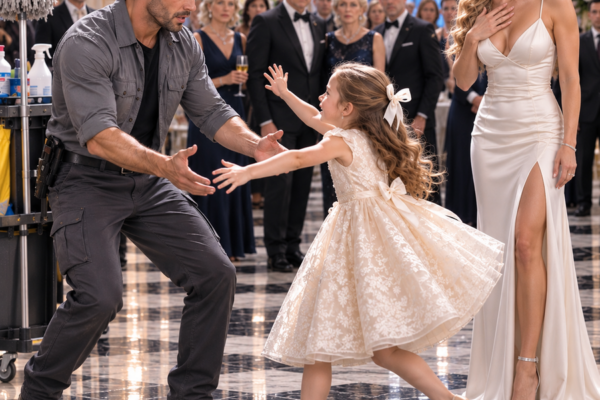
Billionaire Froze When Her Silent Daughter Said “Hi” to a Single Dad—Then Learned His SEAL Past
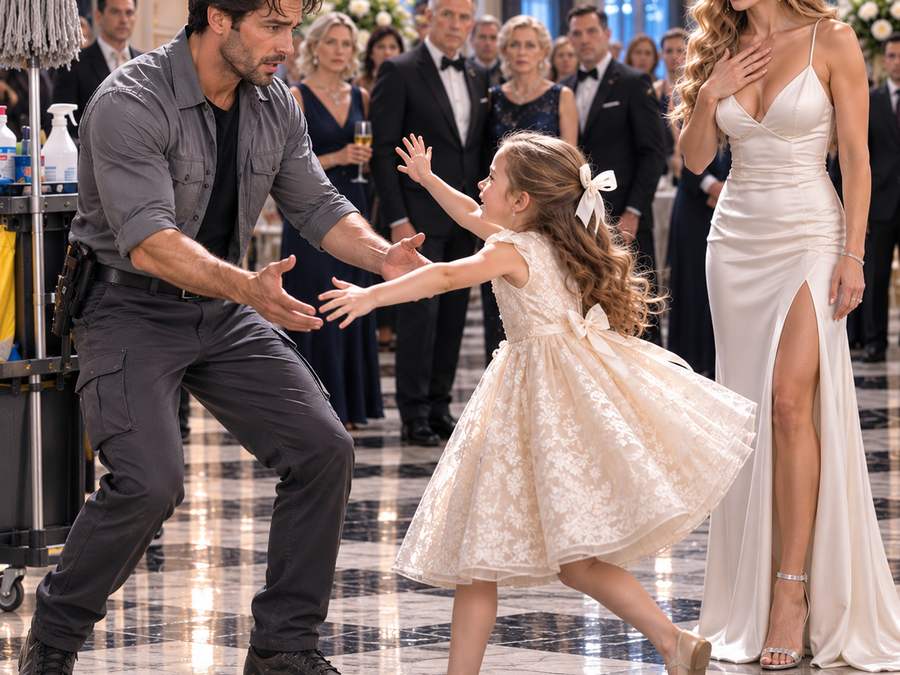
Billionaire Froze When Her Silent Daughter Said “Hi” to a Single Dad—Then Learned His SEAL Past
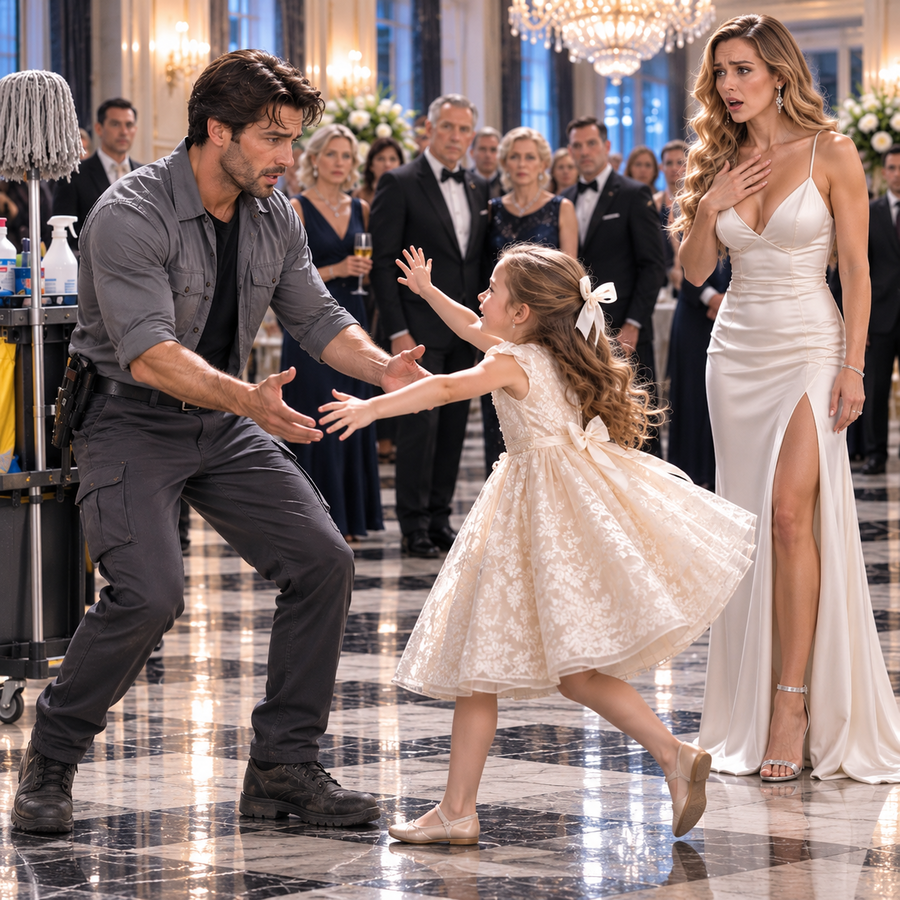
A story of a billionaire
a janitor
and the little girl who chose her own family.
She had everything money could build and nothing love could fix.
Vivian Hartwell stood in the center of a five-star hotel lobby worth more per night than most people earned in a year
and she was losing her mind over a 6-year-old who wouldn’t speak.
Not to doctors, not to therapists, not to her own mother.
But tonight
in front of 200 of New York’s most powerful people
her daughter ran straight past all of them and stopped in front of a janitor pushing a mop cart.
And then said the one word that shattered everything Vivian thought she understood about her child.
This is a work of cinematic fiction created entirely for entertainment.
All characters, events, organizations, and locations are imaginary.
Any resemblance to real persons or actual events is purely coincidental.
The storm had been building over Manhattan since 4:00 in the afternoon
the kind that pressed down on the city with low bruised clouds and made the air feel like wet wool against your skin.
By the time the black SUV pulled up to the Crown Meridian Hotel on 57th Street
the rain had gone from polite drizzle to something with genuine malice sheeting sideways across the pavement.
Sending well-dressed doormen scrambling with umbrellas that kept turning inside out.
Vivian Hartwell stepped out of the vehicle without acknowledging any of it.
She was 30 years old
wearing a midnight blue dress that had cost more than her first apartment in Brooklyn
and she moved through the rain like weather was something that happened to other people.
Behind her, her assistant Marcus jogged to keep up.
One hand pressed over his earpiece
the other clutching a tablet with a cracked corner he’d been meaning to replace for 3 weeks.
Behind Marcus
two members of her private security team exited the second vehicle and fell into loose flanking positions without being told.
And then there was Lillian.
Her daughter emerged from the car last
dressed in a white blouse and dark navy pinafore that the stylist had chosen
which meant Lillian had been dressed by a stranger again because Vivian had been in conference calls since 6:00 that morning.
The little girl stood on the sidewalk for a moment
the rain peppering her shoulders
and looked up at the hotel’s facade
all lit glass and polished stone
with an expression that wasn’t exactly fear.
It was more like recognition
like she already knew this place was going to be too loud
too bright
too many people wanting things from her.
Lillian.
Vivian held out her hand.
Come.
Lillian looked at her mother’s outstretched hand for a half second longer than was comfortable
then took it.
She didn’t squeeze.
She just held on the way you hold a railing on stairs because you’re supposed to
not because it helps.
The lobby of the Crown Meridian was the kind of space designed to make you feel small in a way that was supposed to feel impressive.
Marble floors so polished they threw your own reflection back at you.
Chandeliers the size of small cars suspended above the central atrium
dripping crystal light.
The charity dinner
the Hartwell Foundation’s annual fundraiser for childhood literacy
which Vivian had founded 3 years ago and which now raised more than $40 million a year
was being held in the grand ballroom on the second floor.
Down here, the lobby was already full of arriving guests.
Clusters of silk and cashmere moving between the reception tables
flutes of champagne appearing and disappearing from passing trays.
200 of the most powerful people in New York
and they were all going to want 5 minutes with her.
Vivian felt the familiar tension move up the back of her neck like a current.
She was good at these evenings.
She’d trained herself to be good at them
the handshakes
the eye contact
the measured smile that said I’m listening when she was actually cataloging three other things simultaneously.
What she hadn’t solved in 3 years of trying was how to be good at them and also be a mother to Lillian at the same time.
Because the problem with Lillian
the specific shape of it
was this: people noticed her.
And when people noticed her, they spoke to her.
And when they spoke to her, they expected her to speak back.
And Lillian did not do that.
Had not done that, not to strangers, not voluntarily in nearly 2 years.
It had started around her fourth birthday
which was also
not coincidentally
around the time her grandmother died
and around the time Vivian had launched the international expansion of Hartwell Technologies and had been on a plane
more days than not.
The therapists used terms like selective mutism and acute situational anxiety and complex childhood stress response.
What they meant
translated
was
“Your daughter has decided the world outside her small circle of safety is not worth the risk of speech.”
Spoke to Vivian quietly at home when it was just the two of them.
She spoke to her nanny
Dara
who had been with the family since Lillian was an infant.
She sometimes spoke to Marcus because Marcus had the rare gift of never looking at Lillian like she was a problem to be diagnosed.
But in rooms like this
full
bright
loud rooms where adults crouched down and said things like
“Oh
she’s so precious.
What’s your name, sweetheart?”
Lillian went somewhere inside herself, and the door closed.
And no amount of money or expertise had found the right key.
“Ms§ Hartwell
” the event coordinator
a thin man named Gregory
who always smelled of fresh ink
materialized at her elbow.
Your table is ready.
We’ve seated the Callaway Foundation directors adjacent
per your request
and the microphone check is confirmed for 8:15.
Fine.
She passed Lillian’s hand to Dara, who had appeared silently from somewhere.
Dara was excellent at silent appearance
and let Gregory lead her toward the bank of elevators.
She glanced back once.
Lillian was standing with Dara, looking at the floor.
Not at the chandelier.
Not at the arriving guests.
At the floor where the marble made a pattern of dark and pale squares that nobody else in the room was paying attention to.
She’s okay, Vivian told herself.
She’s with Dara.
She’s okay.
The dinner was going the way these dinners always went
which was to say efficiently and exhaustingly.
Vivian delivered the opening remarks exactly as written
departing from the text in two places where she knew the room needed something less polished.
The crowd laughed when they were supposed to.
The applause was warm.
Three trustees wanted to discuss the expansion of the literacy program into rural school districts
which was a real conversation she was glad to have.
And four people wanted to take photographs
which she was not glad to have
but did anyway.
Lillian sat beside her through the meal
eating the dinner roll from her plate
and leaving everything else.
Vivian noticed, but said nothing.
She’d stopped the food battles eight months ago
on the advice of a specialist who explained that control over food was sometimes the only control an anxious child felt she had.
Pick your fights.
Let the dinner roll be a dinner roll.
It was during the post-dinner mingling that things came undone.
Hartwell Technology’s CFO
Raymond Holt
arrived with his wife and two children.
And Raymond’s wife
Patricia
was one of those generous
warm-hearted women who had absolutely no ability to read a child’s discomfort.
She swept toward Lillian with open arms and a voice calibrated to carry.
Oh, look at you.
Aren’t you the most beautiful little thing?
What are you, five?
Six?
Can you Can you say hi to me?
Say hi.
What’s your name, sweetheart?
Tell Aunt Patricia your name.
Vivian was 3 ft away
turning from a conversation she couldn’t exit cleanly
watching the whole thing unfold in the way you watch something fall off a shelf clearly
too slowly to catch it.
Lillian’s face went the way it went.
The light behind her eyes did something complicated
and she pressed herself back in her chair
and her hand found the edge of the tablecloth and gripped it.
She didn’t cry.
She never cried in public.
She just went very still
the way small animals go still when they’re deciding whether running is worth the effort.
Vivian crossed to the table.
Patricia, so wonderful to see you.
Would you excuse us for one moment?
She helped Lillian out of her chair and steered them both away from the table
one hand on her daughter’s shoulder
guiding rather than pulling.
She could feel the tension in Lillian’s body under her palm
that subtle rigidity like something bracing.
You’re all right
she said
quiet enough that it was just for the two of them.
Nobody’s going to make you talk.
Let’s get some air.
She found a quieter edge of the room near the hallway to the private elevators
and they stood there together for a moment
Vivian with one hand resting on Lillian’s shoulder.
Lillian staring at the middle distance with that expression that felt like being stood on the other side of glass.
I don’t know how to reach you, Vivian thought, not for the first time.
I don’t know what I’m supposed to do differently.
She didn’t say it.
She’d learned not to say it.
Then Lillian moved.
Not much
a small shift of attention
like when a cat’s ears swivel toward a sound before the rest of its body commits.
Vivian felt it in the hand on her shoulder
a change in the quality of the stillness.
She followed Lillian’s gaze across the marble lobby near the service corridor that ran alongside the elevator bank
a man in a gray janitor’s uniform was pushing a cleaning cart along the edge of the room.
He was moving unhurriedly
with the practiced efficiency of someone who had learned how to be invisible in spaces like this
not cringing
not apologetic
just quiet.
He was tall
mid-30s
with the kind of build that suggested something more demanding than mop work
though the uniform and the cart told their own story.
On the front of the cart
hooked to one of the metal rails
was a small plastic horse
the cheap kind you found in packs of farm animals at a dollar store.
White and slightly scuffed
like it had been carried around and handled for a long time.
It was the horse that Lillian was looking at.
Vivian was almost certain of it.
Before she understood what was happening, Lillian’s hand slipped out of hers.
Lillian But Lillian was already moving.
Not running
exactly walking fast
the way she moved when she wanted something she wasn’t sure she was allowed to want.
Weaving between a cluster of cocktail dresses
past the corner of a reception table
directly across the open marble floor of the lobby.
Toward the janitor.
Vivian followed
heart moving into her throat the way it did during the specific breed of parental terror that isn’t about physical danger
but about the unbearable potential of watching your child get hurt in ways that don’t bruise.
He’s a stranger.
She’ll freeze.
She’ll panic.
Someone will try to help and make it worse.
The man had stopped moving.
He’d noticed the small girl approaching him.
His hands had stilled on the cart handle
and he was doing something that Vivian realized
even in her panic
was unusual.
He was not crouching.
He was not making a face of exaggerated welcome.
He was not saying anything at all.
He was just waiting.
Watching Lillian with a kind of quiet patience that made no demands and issued no invitations.
Lillian stopped in front of him.
The distance between them was maybe 2 ft.
Vivian stopped behind her daughter
close enough to intervene
far enough not to interfere.
Her hands were at her sides.
She was not breathing correctly.
Lillian looked directly at the man’s face
eye contact
full eye contact
the kind she so rarely offered
and then at the small white horse on the cart rail.
Then back at his face.
The man looked at her.
Not down at her the way adults usually looked at children
that angled condescending lean.
He just shifted his weight slightly
bringing himself more onto Lillian’s level without making a production of it.
Like he was just settling.
Lillian’s mouth moved, one word.
“Hi.”
It came out small and careful
the way you’d release a bird you weren’t sure wanted to fly
but it came out.
Voluntary, unprompted, directed at a stranger she had never seen in her life.
Vivian’s chest did something she didn’t have a name for.
Not relief, exactly.
Relief was too simple.
This was something older and harder and more complicated than relief
the thing that lives just underneath hope when you’ve been afraid to hope for a very long time.
The man looked at Lillian with an expression that Vivian
in the weeks afterward
would struggle to describe accurately.
It wasn’t surprise.
It wasn’t the performance of being charmed.
It was something simpler and less calculated than either of those things.
He said, “Hey.”
That was it, one word back, no follow-up.
No “What’s your name?”
or “Aren’t you sweet?”
or “Can you Say it again?”
Just “Hey
” offered and left there
like something you set down on a table and don’t hover over.
Lillian looked at the white horse.
Vivian watched her daughter reach out one small hand
not touching
just pointing
a question being formed without words
and the man unhooked the horse from the cart rail and held it out to her.
Not pressing it into her hands, just offering.
Lillian took it.
She turned it over in her fingers
studying it with the specific gravity children bring to objects that matter to them.
Then she looked back up.
“It’s white,” she said, “like the horse in my book.”
Three sentences in two years to a stranger.
Vivian pressed her fingers hard against her own mouth and did not make a sound.
The man nodded once.
“White horses are the best ones,” he said.
His voice was unhurried
the flat vowels of someone from the Midwest somewhere
not performing warmth
just talking.
“That one’s got a name.
His name’s Captain.”
Lillian looked at the horse.
“Captain,” she repeated, like she was testing the weight of it.
“He goes everywhere with me.
Has to, or he gets nervous.”
Lillian looked up.
“Why?”
“Because some things just don’t like being left alone.”
He said it without looking at Vivian.
He may not have even registered Vivian yet
or he was doing her the courtesy of pretending he hadn’t.
“My son picked him out.
Said he needed a job.”
“What’s your son’s name?”
“Noah.
He’s seven.”
Lillian considered this.
“I’m six,” she said.
“And three quarters.
That’s practically seven.”
Something moved across Lillian’s face that Vivian had not seen in a long time.
Not a full smile.
Lillian had never been a child who smiled easily even before all this.
Something looser.
Something that wasn’t bracing.
Vivian became aware that her security chief
a large man named Denton
had appeared at her elbow.
She could feel his presence before he spoke.
“Ms§ Hartwell.
” His voice was the kind of low that still managed to carry.
“Should we know?”
she said, barely audible.
“Stay where you are.”
She stood there and watched her daughter
her silent
sealed-away daughter hold a plastic horse named Captain and talk to a janitor she had never met in the middle of a five-star hotel lobby while 200 wealthy guests ate charity dinners 40 ft away.
Lillian asked about Noah
what he looked like
whether he liked horses or just Captain
whether Captain had ever been lost.
The man Elias
Vivian would learn his name from the hotel staff registry later that night
answered each question with the same unforced patience.
Not performing ease, not managing the situation, just present.
The way certain people are present who have learned
somewhere and at great cost
that presence is a thing you can offer that money can’t manufacture.
Vivian watched for 7 minutes.
Then she stepped forward because the evening coordinator was signaling from the ballroom doorway
and she was was already 14 minutes behind schedule
and because she was not yet ready to understand what she had just witnessed.
Not fully.
Not in a way she could hold.
She rested her hand on Lillian’s shoulder.
We need to go back in, baby.
Lillian looked up at her
then at Elias
then handed Captain back carefully the way you return something you know belongs to someone else.
Elias took it without ceremony, hooked it back on the cart rail.
Thank you, Vivian said to him.
It came out less polished than her usual language.
Less composed.
I don’t know what you She stopped.
Thank you.
He looked at her for the first time not the way men sometimes looked at her
which was with some calculation about who she was and what that might mean.
Just looked at her the way someone looks at another person they can see is having a hard time.
She’s all right, he said simply.
Like it was obvious, and she just needed to hear it.
Vivian nodded and steered Lillian back toward the ballroom.
She felt the back of her neck, the tension that had lived there all evening.
It was still there
but something underneath it had shifted in a way she didn’t have words for yet.
Denton fell into step beside her.
I’ll run a background on the employee, he said.
Standard.
Yes, Vivian said.
She walked back into the noise and the light
her daughter’s small hand in hers
and for the first time in longer than she wanted to admit
Lillian did not let go first.
The background check on Elias Rourke came back at 11:17 that night.
While Vivian was still in the back of her car
somewhere on 5th Avenue
Lilith was asleep against her shoulder with Captain the plastic horse
which Elias had pressed into Lillian’s hands as they left
saying Noah had others clutched loosely in one small fist.
Denton sent the file to her tablet without comment.
That was how she knew it was going to be complicated.
When Denton had commentary, he sent commentary.
Silence meant he was waiting to see what she’d do with it.