I Joined a Cooking Class in Porto. The Woman From My Morning Café Said, “I Followed You Here.”
I Joined a Cooking Class in Porto. The Woman From My Morning Café Said, “I Followed You Here.”
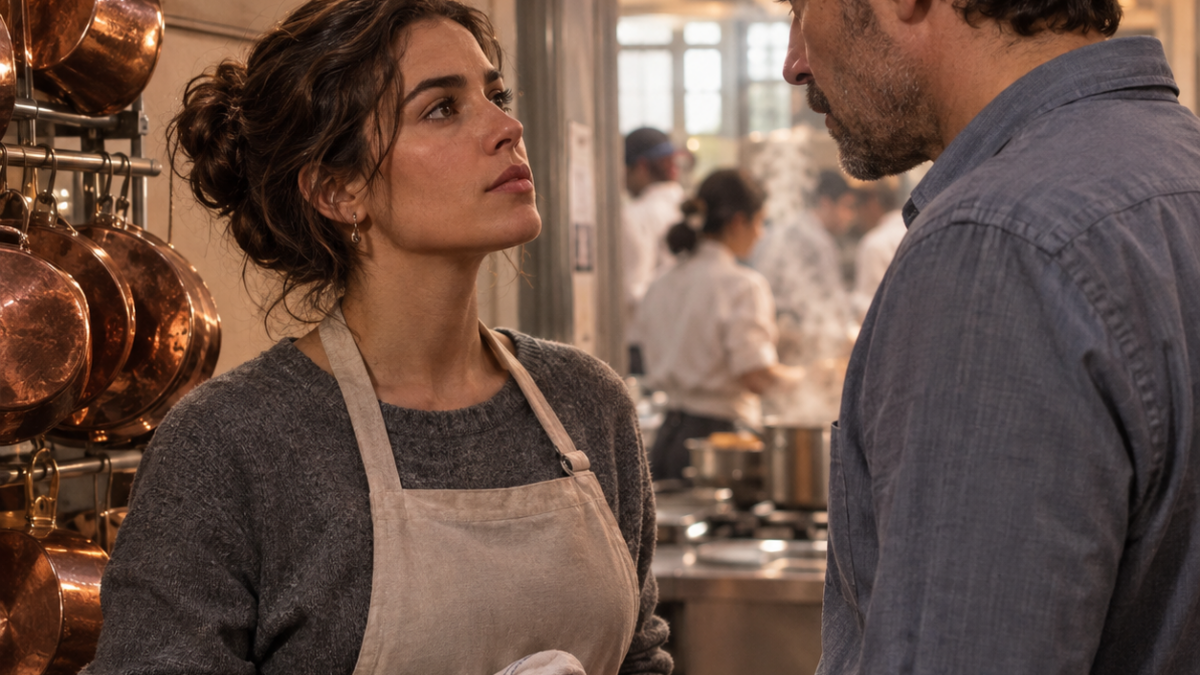
Beatatrice Figueiredo caught my sleeve while the rest of the class was still arguing over how thin a garlic clove could be sliced. She steered me past a rack of copper pots into the narrow hall by the back door.
– “I followed you here,” she said, chin up, both hands wrapped around a dish towel as if it might escape. “For a second, I assumed it was a joke, because you were the woman who poured my morning coffee at her family’s café, and you were standing in a cooking school.”
I had joined three days earlier. What stopped me from laughing was that she hadn’t smiled yet, and she always smiled right after saying something outrageous. I’m Vincent Adler, an operations manager from the States, and I had spent six weeks in Porto learning the exact rhythm of her mornings.
She wore her hair pinned up before the commuters arrived, argued with the espresso machine in two languages, and kept my usual order ready before I reached the counter. I had noticed her the moment the class started, standing at the far station with an apron over a gray sweater and the faint smell of coffee still on her. I had waved like a man greeting a neighbor in the wrong building, and she had waved back so calmly that I decided we were both just surprised.
Clearly, she had not been surprised at all. She told me the rest in a quick, practical voice, the way she might explain a delivery error. On Monday, I had been sitting at the corner table with a colleague, and I had mentioned that my rented kitchen had produced nothing but scrambled eggs for a month, so I’d signed up for a Thursday class for foreigners.
She had been wiping the next table and heard every word. By the afternoon, she had copied the school’s name onto the back of a receipt and paid for a spot.
– “I do not need to learn caldo verde,” she added, lifting the dish towel like evidence. “I have been making it since I was nine years old, and the instructor looked at me very strangely when I asked what a ladle was.”
I laughed at that, and she let herself smile for half a second before it faded again. Her voice dropped, and she said that at the counter everything could be called politeness: a regular customer, a friendly owner, a few minutes of conversation before the bus. She was tired of letting it be called that.
So she had come to a place where it couldn’t be. I noticed that she was not looking at my face, but at my collar, which told me how much the sentence had cost her.
Nothing in my job had prepared me for a woman who simply told me the truth in a hallway that smelled of garlic. I answered the way I answer most things, which is plainly.
– “Do you want to spend time with me outside of this class?” I asked, and I made myself stand still instead of filling the silence with something clever.
She lifted her eyes at last and held mine for a moment.
– “That is the whole reason for the onions,” she said.
I told her I was glad she had come, that the mornings at her counter had become the part of my day I looked forward to most, and that I was only in Porto for a limited time and didn’t want to pretend otherwise.
– “I know where your passport lives, Vincent,” she said, and her mouth tilted. “Right now, I am asking about Thursday.”
We went back into the kitchen, where the instructor was holding up a pan of onions that had slid well past golden. He looked at the two of us with the patient expression of a man who had seen a great many students disappear into hallways. Beatatrice took the station beside mine, and I realized I had never stood this close to her without a counter between us.
She watched me slice kale and informed me that my knife grip was acceptable, but my Portuguese was a crime because I kept putting the stress on the wrong syllable of cebola. At the café, she had been too polite to correct me, she said, and with no counter in the way, she saw no reason for mercy. I repeated the word three times while the kale went into the pot, and each time she shook her head with a seriousness that made my ears warm.
By the end of the evening, the soup had come out better than anything I had cooked in that apartment, though most of the credit belonged to the person who wasn’t supposed to need the class. The other students drifted out in twos and threes, and I stayed to rinse my pot longer than the job required. When I finally dried my hands, I asked if she would walk with me for a while.
She said yes before I had finished the question, and she pulled her coat on with the brisk motion of someone who had already decided. I think we were both a little relieved that the answer hadn’t needed a second try. Outside, the street dropped steeply toward the river, with tiled facades glowing orange under the lamps and the cobblestones slick from an earlier rain.
She walked on the downhill side with her hands in her pockets, setting a pace that was fast enough to feel like her city and slow enough to let me keep up. I told her I wanted to see her again without the lesson as an excuse, and that I would rather say so now than leave her to guess. She considered it for half a block, past a bakery with its shutters already down.
– “Not Thursday, then,” she said. “Anything but Thursday, because Thursday you were already coming for the onions.”
At the bottom of the hill, where she turned toward her own street, I asked what day she had in mind, and she shook her head with the expression of a woman who intended to make me wait.
– “Ask me tomorrow at the counter,” she said, “when I am not holding a knife.”
She said it lightly, but she took a few steps backward before turning, watching to see how I would take it. I stood there for longer than I should have, listening to her footsteps fade up the wet stones. Somewhere on the walk home, it occurred to me that tomorrow morning I would order my usual coffee, and for the first time in six weeks, neither of us would be able to pretend that was all it was.
The next morning, I reached the café ten minutes later than usual because I had changed my shirt twice like a teenager and was annoyed with myself for it. Beatatrice was behind the counter with her hair pinned up, and my coffee was already sitting on its saucer. She greeted me the way she had for six weeks, with a nod and a ‘bom dia, Vincent’ that carried no extra weight.
For half a second I wondered whether the hallway had been a dream. Then she slid the cup toward me and said, quietly enough that the people behind me could not hear:
– “I meant everything I said last night, but this is my workday, so do not plan to sit in that corner for an hour.”
I looked past her at the commuters already crowding the door and saw exactly what she meant. She was not pushing me away; she was drawing a line around the part of her life that belonged to her customers.
I told her I understood that, and then I asked what I should have asked at the bottom of the hill, which was when she would actually like to see me. She wiped the counter once while she thought about it, and she did not give me an easy answer.
– “Tonight,” she said. “We close at eight, and you come to the door at eight, not at seven-thirty to hover like a lost tourist.”
She added that I should wear shoes meant for walking, since her city had strong opinions about hills. I drank my coffee standing up, paid, and left before the rush reached the register, and I felt oddly proud of how well I had followed the rules. At the door, I glanced back and she was already pouring for someone else, though she lifted two fingers from the pot in a small wave.
In six weeks, she had never waved at me on my way out. At eight, I was standing outside the café in my good walking shoes, watching her pull down the metal shutter with a hard, practiced yank. She locked it, shoved the keys deep into her coat pocket, and looked me over with open approval.
We started down toward the river, taking a stairway so steep that the handrail had been polished smooth by generations of people hanging on to it. I had rehearsed a sentence all day, and I delivered it near the first landing.
– “I thought we could walk for a while if you’re not too tired, and maybe see where the evening goes.”
She stopped on the step above me, which put her eyes level with mine.
– “Where it goes is very vague, Vincent,” she said. “Tell me which part you want, and I will tell you which part I want, and then we will both know.”
It was the kind of challenge I normally enjoy, but it caught me with nowhere to hide. I told her I wanted to spend the evening with her specifically, that I did not care much where we walked, and that I would like her to tell me if I was wrong about any of it. She nodded slowly, as if grading an exam.
– “Better,” she said, “though you are still asking permission to want something.”
I laughed because she was right, and she started down the stairs again with the satisfied look of a woman who had won something small and meant to collect on it later. By the time we reached the river, the lights on the far bank had come on in long wobbling lines on the water.
We leaned against the railing, and the cold came up off the river and into my sleeves. I told her my end date there because it seemed worse to say it somewhere warm and comfortable.
– “My assignment finishes five weeks from Saturday,” I said, “and my flight home is already booked, and I wanted you to hear that from me before you ever had to wonder.”
She kept watching the lights across the water and did not say anything for a while. She did not ask me to extend the assignment, and she did not pretend the date was nothing. Then I made the mistake of adding that I would understand completely if she preferred to keep things simple, since a short stay was probably complicated enough for anyone.
– “Understand what?” she said, turning her head. “You keep saying you understand, and what you mean is that you have already decided for me.”
She said it without raising her voice, and it landed harder than if she had shouted. I admitted that I had been trying to spare her something, and she said that sparing her was her job, thank you, and she was not hiring. A woman who opened a café at six every morning did not choose the simple thing, she told me.
And if some part of this turned out to be too complicated, she would be the one to say so. I stood there feeling the particular heat of being correctly corrected.
– “Fine,” I said. “Then I want to see you for the next five weeks, and I know how long that is, and I’m not going to apologize for either part.”
Her smile came back slowly, and it looked like relief. The following days settled into a rhythm that neither of us had announced. At the café, I ordered my coffee and drank it standing, and sometimes she corrected my Portuguese across the counter while the line grew behind me, so that even the regulars began to smile whenever I tried to say cebola.
On Tuesday night, she met me at her shutter again, and we climbed to a viewpoint above the cathedral where she pointed out the roof of her grandmother’s old apartment. On Wednesday, I texted her at four to ask if she was too tired for a short walk, and she wrote back that I was learning, but the answer was yes.
– “Ask again Friday.”
I found I did not mind being refused, because every answer she gave me was a real one. We had both stopped using the word maybe, and the silence where it used to be felt like a promise neither of us had spelled out. We settled the dinner on Tuesday at the viewpoint with the wind pulling at her coat.
She asked what I intended to do with my new skills, and I said I wanted to cook for her after Thursday’s class in the apartment where scrambled eggs had been my only achievement. She said she very much wanted to see the crime scene.
– “Say what it is,” she added, and I could hear that she was teasing and also that she meant it.
– “It’s a date, Beatatrice,” I said. “Dinner at my place after class, and the cooking is not homework.”
She held out her hand as if sealing a business deal, but she kept my fingers in hers for far longer than a handshake needed. We walked back to her door that way in no hurry at all, and I understood somewhere on the last hill that a kitchen with a closed door would give us none of the cover the counter in the classroom had always provided. By Thursday, I had stopped pretending the class was the point.
Beatatrice arrived five minutes early, took the station beside mine without asking, and set her knife on the board like a woman claiming her side of a table. The instructor was demonstrating a roast chicken with lemon and paprika, and she followed him with such exaggerated attention that I knew it was for my benefit. When he asked why the skin had to dry before it went into the oven, she answered in flawless Portuguese and then raised her eyebrows at me, waiting to be admired.
I told her I was mostly impressed that he still pretended to teach her, and she bumped my elbow with hers. She did not move away afterward, and neither did I. We both knew the evening would end in a kitchen with a door, and it made every potato I peeled feel like a rehearsal.
I had bought a second chicken and a bag of potatoes on the way to the school, and they had spent the lesson in the instructor’s refrigerator, which he accepted with the weary dignity of a man who had stopped asking questions. We carried them through the wet streets to my apartment, a third-floor rental with a good window and a kitchen that had never been used properly. At the door, I told her she was a guest tonight, that she hadn’t come to supervise me, and that her only assignment was to sit down.
She looked at the one chair I owned, then at the stove, and decided against it. Within five minutes, she was leaning against the counter with a glass of the vinho verde she had brought, inspecting my pans with the suspicion of a customs officer.
– “You own one good knife and four bad ones,” she said. “I am not here to improve you, but I am going to say that out loud.”
We had two ways of approaching dinner, and they showed up quickly. I had a timeline in my head with the chicken in by nine-fifteen and the potatoes started ten minutes before; Beatatrice tasted the lemon, shook paprika into her palm, and adjusted things by smell. And when I mentioned the clock, she stared at me as if I had pulled out a ruler.
– “Your timeline is very nice, Vincent,” she said. “The chicken does not know about it.”
I ended up laughing at my own phone, and I turned it face down on the counter. By the time the oven door closed, we had settled into a rhythm of me reading the steps and her ignoring most of them, and somehow the kitchen smelled better than it ever had. We ate at the small table by the window with the lights of the street coming up through the glass.
The chicken was good, better than anything I had managed alone, though she insisted on pointing out which parts of it were mine. She told me about her grandmother’s habit of slapping the back of her hand whenever she reached for food before the table was set, and I told her about my father’s fixed Sunday schedule, down to which sock he put on first. Neither of us said anything about the date on my calendar, though I thought about it every time she laughed.
When the plates were empty and the wine was nearly gone, she began stacking dishes without asking where they went. I stood at the sink running the water while she dried, and it was nearly eleven when I felt myself slipping into an old habit. I started to say that it was late and she opened the café at six and that she shouldn’t feel she had to stay.
I stopped halfway through the sentence because I could hear what I was doing, which was deciding on her behalf again. I set the plate down and asked her instead whether she wanted to stay a while longer or go home. She hung the towel over the oven handle and thought it over with the seriousness she gave to everything.
– “I want to stay for a coffee,” she said, “and I will leave at midnight because I open at six, and that is my decision.”
Then she stepped closer and added:
– “You may ask the other question too, if you have it.”
I did have it, and I asked it without anything clever on top.
– “Can I kiss you?”
She answered by putting her hand flat against my chest, and when I leaned down, she met me halfway with her fingers curling into my shirt. It was unhurried and certain, with the faint taste of wine and lemon, and it felt like something we had both been walking toward since the hallway at the school. When we separated, her forehead stayed against mine for a moment, and I could feel her breathing as unevenly as my own.
I made her the coffee afterward, mostly because my hands needed a task. She drank it sitting on the counter beside the stove, watching me with a kind of dazed amusement that I would have liked to preserve in some form.
At midnight, she put on her coat, and at the door she held her keys in her fist as if they were the only thing keeping her honest. I told her I wanted to see her again on Sunday, and that it was not an extension of tonight or a way of making it mean something grander than it did.
– “It is a kiss, Vincent,” she said, “not a contract.”
Her voice was steady, though her cheeks were pink.
– “I would like Sunday. I would also like to be the one who says when it is too much.”
I said that was fair, and she nodded and kissed me once more quickly before going down the stairs two at a time. On Sunday, we walked along the river while the café sat closed behind us. And halfway to the bridge, she told me what she had been avoiding all week.
For months she had been working on a plan to serve a few evening meals in the café: six tables, a short menu, nothing to do with the tourists. She had started rearranging the room and drafting the dishes late at night after the books were done. She said it plainly, in the voice she used for things that mattered, and when I opened my mouth to offer help, she looked at me and I closed it again.
– “I am not telling you so you can fix it,” she said. “I am telling you because it is my life and you are in it now.”
I understood then that Porto was not a problem waiting for me to solve, because she had chosen it and I had no right to treat it like anything less. I also understood that my departure date, which I had always spoken of as my own business, now sat inside a plan that was hers, and I could not keep talking about it as if it belonged to me alone. The next two weeks settled into a pattern that I would have called a routine if either of us had been willing to use that word.
I still stood at her counter every morning and drank my coffee in four minutes, because she had made it clear that her workday belonged to her customers. Three evenings a week she had the café to herself after closing, testing dishes for her six tables, and on those nights she asked me to walk her home instead of staying to watch. I carried nothing and offered no opinions unless she handed me a spoon, which she did exactly once for a fish stew that made me close my eyes.
The other nights were ours, and I stopped treating them as whatever remained after work. I turned down a dinner with two colleagues, moved a call with the Boston office to the afternoon, and began leaving my laptop at the apartment when I went out. Beatatrice noticed all of it and said nothing, though she started saving me the end of the evening’s bread.
On a Tuesday, near the viewpoint above the cathedral, she told me the date of her first evening meal. It would be the Friday before my last Saturday, with six tables, one seating at seven-thirty, and a menu she had rewritten four times.
She said it while looking at the rooftops, the way she said things that mattered. And then she turned and made it formal.
– “You are invited,” she said, “as a guest, Vincent, not as a taster and not as a man carrying boxes.”
I did the arithmetic before I could stop myself, because I always do. The dinner fell the night before my flight, with my bags half-packed and my keys due back at the landlord’s office by noon. What I said next sounded considerate in my head.
I told her she shouldn’t save me a place because it would be her biggest night so far, and a man leaving at dawn would be an awkward thing to have at her table. I said she would have enough to think about without watching the clock for the one guest who had a suitcase waiting. She listened to the whole speech with her arms folded, and her expression did not change until I ran out of reasons.
– “You are answering an invitation I have not withdrawn,” she said. “I asked whether you would come, and you have told me what my evening will feel like, which is a different question.”
Her voice was level, and that made it worse. I realized I had done the same thing at the river in my first week, only this time I had dressed it up as courtesy. She did not storm off, and she did not make a scene on a viewpoint full of people photographing the sunset.
She let the silence sit for the length of a long breath, and then started walking again, setting the same fast pace as always, so that I had to hurry to stay beside her. At the next corner, she took out her phone and began typing something. And when I asked what she was writing, she told me it was the reservation list.
– “Six names,” she said. “One of them is yours, unless you tell me no yourself, in your own words, without mentioning my feelings.”
I took that in as we passed a shuttered pharmacy and a cat sleeping on a car hood. For the rest of the walk, she asked about my sister’s wedding in the spring and whether American bread was really sold in plastic, as though nothing had happened, and the ordinariness of it was exactly the penalty I deserved. I thought about it that night in the apartment, standing at the window with the chicken pan still soaking in the sink.
The truth was less flattering than the speech I had made her. I had told myself I was protecting her from an awkward goodbye, but I had also been protecting myself from sitting at a table in her life and then getting on a plane. Every time I had decided what she could handle, she had lost a choice that belonged to her, and I had gained a small, comfortable distance.
She had asked me for a night, and I had answered with a forecast. It didn’t make me feel like a bad man, only like an unusually tidy one, which I was beginning to understand was its own kind of problem. In the morning, I went to the café at my usual time and waited my turn behind a man buying six pastries for his office.
She slid my coffee across the counter with a nod and a bom dia that was exactly as warm as the day before, which is to say not very. The line behind me was growing, so I did not try to make a speech of it.
I leaned in and said that I wanted to come, that I would be there at seven-thirty with nothing in my hands, and that I couldn’t promise anything about staying in Porto because I didn’t have an honest answer yet. She picked up a rag and wiped a spot that was already clean.
– “I did not ask you for a promise,” she said. “If you come, you will leave the next morning. And I am not going to pretend that a good dinner makes it easy.”
She said it so evenly that I knew she had been thinking the same thing for days, probably while stirring that stew. She took a pencil from behind her ear and wrote my name in a small notebook beside the register, pressing hard enough that I could see the letters from where I stood. Then she looked up, and the corner of her mouth moved in a way I had come to recognize as permission to breathe.
– “Go to work,” she said. “The customer behind you has been very patient, and he is not in love with anyone here.”
I laughed and paid, and the man with the pastries gave me a look of grave sympathy as I stepped aside. For the rest of that week, I kept my evenings open without announcing it, and she kept hers shut when the kitchen needed her, and neither of us apologized for either one. We had a Thursday class left before the last one, and a table in her café with my name on it.
What I did not have was an answer to what I wanted from Sunday morning onward, and I knew that a single dinner, however good, was not going to supply one. On Monday morning, Beatatrice confirmed that the first evening meal was going ahead, and she did it the way she confirmed everything: with a nod over the counter and no ceremony. The fish supplier had agreed to her price, her mother had lent the good tablecloths, and the chalkboard menu had survived its fifth rewrite.
When the rush thinned, I saw that she had pushed six tables into the back room and left the rest of the café looking like a place that was being politely held in reserve. One table wobbled badly under the weight of my elbow.
I kept my hands in my pockets, though everything in me wanted to find a matchbook and fix it, because I had learned what my helpfulness could cost her. She slid a folded coaster under the leg without even glancing up.
– “You are allowed to notice, Vincent,” she said. “You are only not allowed to take over.”
I paid for my coffee and left feeling oddly pleased, like a man who had been trusted with a rule. On Wednesday afternoon, between two calls with the Boston office, I did something I had been circling for a week. I wrote to my director and asked for ten days of leave in early June, safely after my sister’s wedding.
He answered within the hour to say that in six years I had never taken more than a long weekend, and that the days were mine, and he would sign them. I opened an airline page afterward and let the cursor rest over the Porto flights for a long time. Then I closed it without buying anything, because the trip had two people in it and only one of us had been consulted.
I had spent weeks learning that a plan made on her behalf was only a forecast with good manners, and I did not intend to hand her another one. The days were mine to give up, but what I did with them depended on a conversation I had not yet had. Thursday was our last class, and the instructor had chosen a arroz doce for the ending, which struck me as either mercy or cruelty.
The kitchen smelled of lemon peel and cinnamon, and the other students were already trading phone numbers over their pots. Beatatrice took the station beside mine as she had every Thursday, and I noticed that she had set my knife on the board before I reached for it. For ten minutes, we moved around each other without speaking, her hand passing me the milk and mine passing her the sugar, and I understood that this had become a habit we were about to lose.
When the rice began to thicken, I told her to stir it slowly, and she said the same words to me in Portuguese with the stress exactly where it belonged. I tried cebola one last time while I peeled a leftover onion for no reason at all, and I got it right on the first attempt. She did not correct me, and it was the quietest thing she had ever done in that kitchen.
The instructor handed each of us a wooden spoon with the school’s name burned into the handle, and he shook my hand a little longer than he shook anyone else’s. He gave Beatatrice hers last, with a small bow that made her laugh into her sleeve. Outside, the street was dry for once, and we climbed instead of descending because she said she was tired of looking at the river.
She carried the spoon like a baton, and I carried the leftover rice in a container she had sealed twice. Near the top of the hill, where the street flattened under a lamp, she stopped and told me she had been working out what to say since Monday.
– “I do not want a beautiful account of your six weeks in Porto,” she said. “I do not want to be the woman with the café you describe at dinner parties in Boston, with the hills and the funny Portuguese.”
She said it without anger, looking straight at me this time, and it sounded more like a measurement than a complaint. Then she lifted a hand before I could answer because she had not finished.
She said that whatever happened, I was not to think of her staying here as a sacrifice she was making or a door she was holding open for me. She had been staying in Porto before I ordered my first coffee, and she would be staying after the plane left, because the café and the six tables were hers.
– “So you are not responsible for it,” she said. “Not for my staying, and not for my being sad if you go.”
I thought about the speech I had made on the viewpoint, and how little of it I could defend now. Her honesty left me nothing to manage, which was a relief and also somewhat humbling. I told her about the leave plainly and without any decoration.
– “Ten days in June have been approved,” I said, “and I have not bought a ticket because I wanted to ask you first whether you would want me to come.”
I said my flight home on Saturday was fixed and that no amount of wanting would change it, and I did not intend to pretend otherwise tonight.
– “I would like to come back and see you,” I said. “And I want to talk about what it would actually take to keep this going, with the distance and the time difference and your café. I don’t have the answers, but I would like to find them with you instead of before you.”
She studied me for a few seconds while a moped went past at the bottom of the street. I realized I was holding the rice container tightly enough to dent the lid.
– “You are not asking me to wait for you,” she said, and it was half a question.
I told her no, I was asking whether she wanted to try, and that she was free to say it was too much. She smiled, a smaller smile than the one in the hallway at the school, but it reached her eyes this time.
– “Then you do not discuss it with me on a hill with cake in your hands,” she said. “You come to my table on Friday, and you are not a customer, and you are not a tourist saying goodbye. You are someone I invited into my life, and if you cannot come that way, do not come at all.”
She said it kindly, but I understood it was the second time she had put that invitation in my hands and that there would not be a third. I told her I would be there at seven-thirty with nothing in my hands but myself. She nodded once, and then she took my wrist and pressed the wooden spoon into my palm, handle first.
– “Practice,” she said, and she walked toward her door, looking back only once.
I stayed under the lamp for a while holding the rice and the spoon. We had said everything we could say without a plan, and neither of us had asked the other for anything. Friday would show whether the two of us could sit down and build one, or whether we would let Porto end the way a good meal does, with the table cleared and everyone full.
I arrived at seven-twenty-five, which Beatatrice would later call fifteen minutes of cowardice, and I had nothing in my hands, exactly as promised. The café I knew had disappeared. Six tables stood in the back room under her mother’s good tablecloths, with candles in jam jars, and the chalkboard by the door showed the menu that had survived its fifth rewrite.
Beatatrice came out of the kitchen in a black apron with her hair pinned up and a pencil still behind her ear. She looked at me for exactly one second, said:
– “Boa noite, Vincent,” and walked me to the table by the window, where a folded coaster held up the short leg.
It was the one that had wobbled under my elbow the week before, and I decided it was a joke I was not allowed to mention. I did not turn the evening into a private celebration, and I think it was the best decision I made in Porto. The other tables filled with neighbors, two couples from her street, and a retired baker who kissed her on both cheeks and told her she looked like her grandmother.
She moved through the room with a quiet authority I had never seen across the counter, explaining the fish stew to each table in the same two sentences. When she reached me, she gave me the same two sentences, and I understood that this was her way of treating me as a guest. Once, passing behind my chair, she set her hand on my shoulder for a moment and said:
– “Only eat.”
I ate slowly and I watched a woman I had known for seven weeks stand inside the life she had built, and it was larger than anything I had imagined from the other side of her counter. By ten, the last guest had gone, and she locked the door and turned the sign. She kicked off her shoes behind the register, poured two glasses of wine, and sat at the wobbly table across from me as though she had been waiting all day to sit there.
Her mother called a good night from the kitchen and left through the back, and the room fell so quiet that I could hear the refrigerator humming. Beatatrice put her elbows on the tablecloth and said that whatever I had come to say, I should say it while she still had energy to disagree. I told her I had meant to wait until the end of the meal, and she said the meal was over, so I had no excuse left.
I asked her plainly whether she wanted me to come back to Porto to see her. I told her I had ten days of leave in early June and had not bought a ticket because the trip had two people in it and she was the only one who could say if it belonged there. I told her I could not promise to move to Porto, that my job and my life were in the States, and that I would not make that promise tonight simply because the candles were nice.
I also said I could not promise that distance would be easy, because I did not think it would be, and she deserved to hear that from me before the first long silence on a phone call. My flight left in less than a day, and nothing about this table was going to change it.
– “That is what I am asking for,” I finished. “A chance to find out what we can build from here, with both our lives still standing.”
She turned the stem of her glass for a while before answering, and I let her take as long as she needed.
– “I am not leaving Porto,” she said. “I want you to hear that from me tonight, as plainly as you said yours.”
She said she would not ask me to give up my life either, and that she was not interested in a version of this where one of us paid for the other’s happiness. What she could offer was real time, even if it came in pieces, with calls she would not cancel unless the café truly caught fire. She would also come to see my life in the United States in the autumn, once the evening meals had a season behind them and her mother could run the mornings.
– “I would like to meet your father in his Sunday socks,” she added, and her voice shook a little on the last word. “I choose to try, Vincent, with the difficult parts included. And I will be sad on Saturday and glad on Sunday, and both of those are mine.”
I took out my phone and set it flat on the tablecloth between us so that she could see the screen. She watched me open the airline page, and she pushed my thumb away from the first flight it offered because the layover in Frankfurt was twelve hours long and a crime. I chose the direct one landing on the third of June, and I let her read the dates before I pressed anything.
The confirmation came through while she was refilling my glass, and she looked at it for a moment as though it had been addressed to her. We fixed the first call in the same way, with both of us arguing for our own side of the ocean. Sunday at four in the afternoon for me was nine at night for her, with an early dinner on my end and a late one on hers, and she said that was a terrible compromise and therefore probably a fair one.
I said I would cook the chicken, and she said she would be watching the knife grip. I walked back to my apartment at midnight, and she kissed me once at her shutter, quickly and steadily, before I could say anything clever. In the morning, I handed over my keys at the landlord’s office at noon.
But first, I went to the café at my usual hour, carrying my suitcase with its wheels rattling on the cobblestones. The queue was already out the door, and the man with the six pastries was in it, and he gave me the same grave nod as before. Beatatrice slid my coffee across the counter and said:
– “Bom dia, Vincent,” with every ounce of weight she had kept out of it for seven weeks.
I told her I would see her in June, and I pronounced it carefully: até junho. And she corrected the stress on the second word, just to keep her tradition alive. Then she did something she had never done in all those mornings, which was to lift the flap at the end of the counter and walk around it.
She put her arms around me in front of the whole line and held on for a long breath, and the man with the pastries started clapping before anyone could stop him. I carried the wooden spoon in my carry-on all the way to Boston, and I used it that Sunday for the first call. What I keep thinking about is how long I had treated those mornings as part of a temporary routine, when all it took was one woman in a hallway to show me the difference between a visit and a choice.
I still do not know how well we will manage the distance, but the next date is on the calendar, and we each picked it with our eyes open. If you were Vincent, would you have asked her to try before the last night, or waited until you were sure of the answer? And if you were Beatatrice, would you have kept your café first the way she did?
Tell me in the comments what you would have chosen. And if the story kept you company, a like and a subscribe will help me bring you the next one.