My Mom Set Me Up With Her Best Friend’s Daughter. On the Porch, She Said, “Let’s Pretend It Worked.”
My Mom Set Me Up With Her Best Friend’s Daughter. On the Porch, She Said, “Let’s Pretend It Worked.”
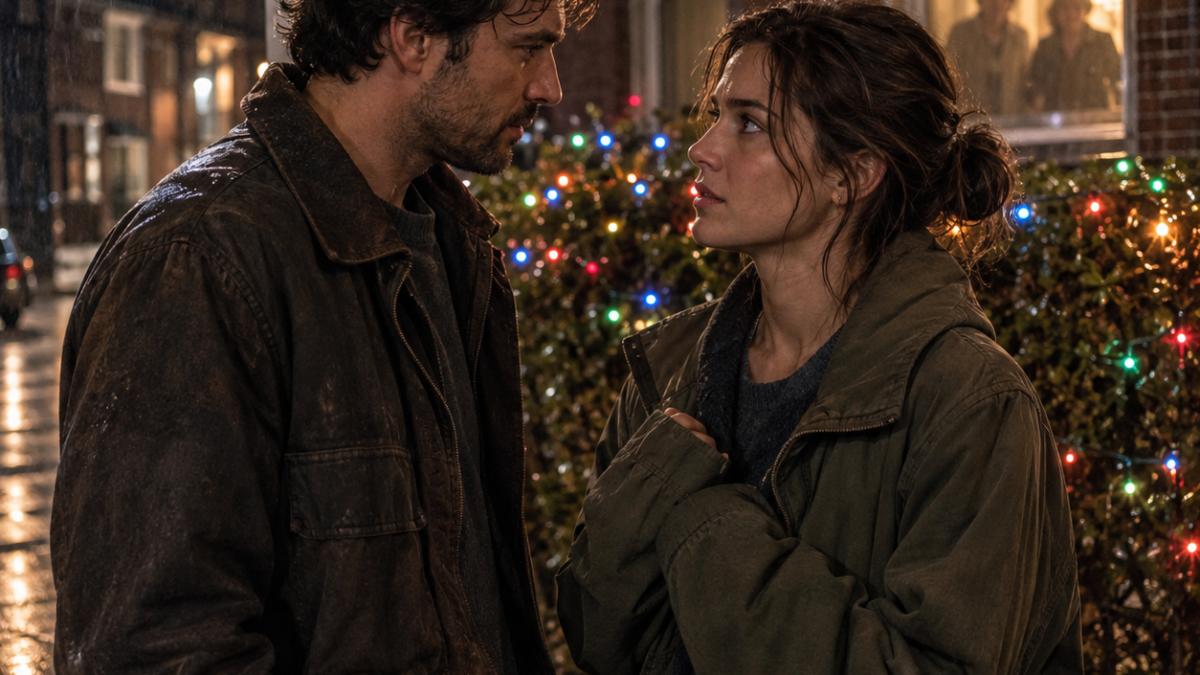
The rain had pinned us under my mother’s porch roof for ten minutes when Isabelle Navarro lifted my jacket off the railing, put it on, and said:
– “Let’s pretend it worked.”
She pulled the sleeves down over her hands and tucked her chin into the collar. Her expression stayed so level that I honestly could not tell whether she was joking. Behind us, through the front window, our mothers watched the porch with the careless innocence of two women who had rearranged a dining room table to stage this exact evening.
I had known Isabelle for about three hours, counting the pot roast. Everything I knew about her came from her mother’s stories and from the patience she had shown my mother’s questions, which was a patience I had never once managed myself. My mother, Bethany, had spent two weeks calling this dinner “just a little supper,” which in her vocabulary meant a roast, the good tablecloth, and exactly one extra guest.
I’m Damon Voss. I’m thirty-four and I run an auto shop off Roosevelt Boulevard with four employees who count on me to be where I say I’ll be. That job has made me comfortable saying no politely and early.
So I had walked in planning to be pleasant through dessert and decline a second date before the coffee cooled. Isabelle, it turned out, had walked in with the same plan.
She had answered my mother’s questions about her design work with real warmth all evening while steering every follow-up toward a new subject. I had admired the technique without wondering what it cost her.
– “Run that by me again,” I said.
She raised one sleeve-covered hand and counted on it.
– “My mother has a list on her refrigerator under a magnet shaped like a pineapple. It has a dentist, a neighbor’s cousin, and a man who restores pianos. If tonight worked, the list comes down. And I get a December where I decide what I do with my weekends.”
She said it lightly, but she watched my face the way people do when the joke is covering something they actually need.
– “I assume your mother has a list, too.”
I admitted that she kept a cousin of the church organist in reserve.
– “Then we both know what happens if we go back in there and say it was lovely and we’ll stay in touch.”
I did know, because I had watched my mother ignore the word no for thirty-four years, and she did it with such sincere affection that it never felt like winning. I leaned against the porch post and took my time, since a bad agreement made quickly is the only kind I have ever regretted.
– “Let me ask you straight. Do you want this, or do you just want out of the piano restorer?”
– “I’ve met the piano restorer,” she said. “He explained his sourdough starter to me for forty minutes. But yes, mostly I want my calendar back, and I’d rather lose it to you.”
– “When your mother asked you to drive me around to see the lights, you said I should pick my own evenings, and you said it so kindly that she thanked you.”
It was a more specific compliment than I had braced for, and it landed somewhere I had not left open. I had only said what I would have wanted someone to say for me. So I asked for terms, which is what I always do.
– “When does it end?”
– “New Year’s Day,” she said without hesitating, which told me she had worked this out before she ever touched the jacket. “We go to the gatherings our mothers already have planned. We arrive together and we let them reach their own conclusions.”
I told her nobody should invent a story about how we met and fell for each other.
– “Nobody invents anything,” she agreed. “We say we’re seeing each other, and everything past that stays private. Nothing promised beyond the gatherings.”
She finished the thought herself with a small shrug.
– “On the first of the year, we say it ran its course, and the two of them have the decency to leave us alone until spring.”
It was clean. It had an end date, and I could say yes to every line without feeling managed, which was exactly why I distrusted how much I liked it. She held out her hand from inside the sleeve of my jacket, the empty cuff flopping over her fingers, and I shook the cuff with great solemnity while we both tried not to laugh.
Going back inside to announce nothing turned out to be the whole strategy, because my mother and Rosa had arranged themselves on the sofa within the first second of the door opening. Rosa, Isabelle’s mother, took in the jacket and pressed both hands to her chest as if she had just watched a ship come in.
– “Damon, you let her keep your coat,” my mother said in the tone of a woman reading a headline aloud. “I said we were going to head out,” Isabelle said. “I said I was walking her to her car.”
Neither sentence contained a single claim, and neither of them needed one. Rosa was already saying that Saturday evening was her open house and the whole family would be there at six. My mother counted guests on her fingers and asked whether Isabelle liked cinnamon, and neither woman waited for an answer to anything.
I borrowed the big umbrella from my mother’s hall closet and walked Isabelle down the wet sidewalk to her little hatchback. She stood with her door open and the dome light on, still wearing my jacket, and looked back at the lit window where two silhouettes were failing to pretend they weren’t watching.
– “That went faster than I planned,” she said.
I told her we had agreed on everything except what any of it looked like when somebody was actually watching. She weighed that for a moment, and then she smiled in a way that did not fully convince either of us.
– “We’ll figure it out Saturday.”
She drove off with my jacket still on her shoulders, and I stood in the rain, holding my mother’s umbrella over nobody, with the unsettling sense that I had just signed a contract and skipped the one clause that mattered. Saturday evening, I picked Isabelle up at her mother’s brick rowhouse in South Philadelphia, where someone had stapled a string of colored lights along the gutter and plugged them into a window. She came down the steps with my jacket folded over her arm and handed it across the truck door like evidence.
– “I wore it to my studio twice,” she said. “It smells like a garage now, and by Thursday I’d stopped minding.”
We walked the half block to her mother’s cousin’s house, where Rosa’s open house was already spilling onto the sidewalk. And since we had agreed on a plan without agreeing on a performance, I asked what she thought a believable couple actually looked like.
– “Real couples stand within three feet of each other and argue about parking,” she said.
– “Real couples laugh at about half of each other’s jokes,” I said, “because laughing at all of them is how you know somebody is working.”
– “You’ve given this thought,” she said.
– “I’ve been to a lot of weddings,” I told her, “and neither of us promised the other a single gesture before we climbed the steps.”
Rosa opened the door in an apron with a flower on the sleeve, and my mother stood right behind her, holding a cinnamon cake like a trophy. Isabelle slid her hand into mine before either of them could speak, and her fingers were cold from the night air. I felt a small callous on the side of her middle finger, the kind a person gets from years of holding a pencil, and my hand closed around hers before I had made any decision about it.
It did not feel like acting. It felt the way a wrench feels when it fits the bolt on the first try, which is a comparison I kept to myself. Her fingers went still for half a second, which told me I was not the only one who had been surprised.
Rosa and my mother traded the kind of look that people save for a successful sale, and Rosa pulled us both inside by the sleeves. The house was packed with cousins and trays of food on every flat surface, and a poinsettia sat on the third stair like a guest who had gotten lost. Isabelle worked the room the way I would have expected, laughing in the right places and introducing me to a long line of relatives as simply Damon, with nothing attached.
I noticed that she never explained me or invented a backstory, and I understood it as the first term of our agreement being kept in a way I had not thought to ask for. In the hallway by the coat rack, with both mothers finally pulled into the kitchen, her thumb pressed twice against my knuckle. It was a clear signal that the audience had left and I could let go.
I held on for another five seconds, long enough that it was unmistakably my choice, and then I opened my hand. She looked down at her fingers and back up at me with an expression I had no name for.
– “That wasn’t in the terms,” she said.
– “Nobody was watching,” I said, and she nodded slowly as though I had confirmed something she had been trying not to wonder.
My mother found us by the dessert table an hour later with a paper plate in each hand and a question she had clearly been carrying for days. She wanted to know our plans for the coming week, specifically whether Damon would have any free evenings, because the church organist’s cousin had asked about him twice and she would hate to be rude. Isabelle opened her mouth, and I could see the pleasant, slippery answer she was about to give, the kind that would have left everyone satisfied and none of us bound to anything.
I answered first, and I kept it plain. I told my mother that I had a full week at the shop through the twenty-third, that I would see Isabelle when both our schedules allowed, and that I was not going to make plans for a woman who was standing right there and could make her own. My mother’s face did what it always does when she hears no, which is to fold briefly and recover.
– “I only ask because I care,” she said.
– “I know you do, Mom,” I told her, and I kissed her on the temple and added that I would tell her when there was something to tell.
She patted my cheek, announced that the cake needed cutting, and left us with the plates. Isabelle was watching me without any joke over her face, and she did not say anything about it. By ten, the rain had come back as a thin drizzle that smeared the Christmas lights into long colored streaks on the street.
Rosa waved from the doorway with both arms like she was landing a plane, and Isabelle and I walked down to her hatchback with my mother’s umbrella tilted between us. I had spent most of the evening practicing the first thing I knew how to do with her, which was to stay near and hold on and answer questions in a way that let her keep her calendar. That was the agreement, and it worked.
It also meant that nothing I had done tonight required me to want anything. I stopped beside her car door, and the sentence I had decided to say sounded blunter out loud than it had in my head.
– “I’d like to see you Thursday,” I said. “Not for our mothers and not as part of the deal. I’m telling you plainly because it isn’t in the terms, and you can say no without anything about the agreement changing.”
She had her keys in her hand, and she turned them over twice as she looked at me. The street light caught the rain on her eyelashes, and for once she did not reach for a joke.
– “Where?” she said.
I suggested somewhere in Center City on the grounds that nobody related to either of us ever went south of Walnut Street after dark.
– “Fine,” she said, “but I pick the movie.”
I told her that seemed like a risk I was cleared to take.
– “You might hate it.”
– “That’s the point of a risk,” I said, and she laughed, a short real laugh, and said, “Thursday.”
I watched her taillights turn the corner and stood a while longer with the umbrella over nobody again. For two evenings we had played a couple for a room full of people, and I had to admit it came easily, almost too easily. What I did not yet know was how either of us behaved when nobody needed to be convinced of anything, and Thursday was going to be the first time I would find out.
Thursday turned into a transmission job on a delivery van, so I rolled the bay doors down an hour late and scrubbed my hands with orange pumice until only a gray shadow remained in the creases of my knuckles. I reached the theater on Chestnut Street with six minutes to spare. Isabelle was waiting under the marquee in a green wool coat and a scarf the color of mustard, holding two tickets like a woman who had already won the argument.
– “It’s a restored French comedy from 1963,” she said. “It’s ninety-four minutes with subtitles, and you said you were cleared for risk.”
I told her I stood by every word, and she walked me into an auditorium holding nine people, three of whom appeared to be asleep before the previews ended. The film followed a man trying to get a stalled Citroën out of a wedding procession, and he diagnosed the engine wrong three times in a row while his relatives shouted advice from the back seat. I laughed out loud at the second wrong guess, because he had the right idea and the wrong part, and I have made that exact mistake in front of customers.
When I glanced over, Isabelle was watching me instead of the screen with the look of someone checking a measurement. She held the popcorn between us on the armrest, and our hands met inside the bag three separate times. Nobody in the other eight seats was looking, and neither of us pulled away or said a word about it.
By the closing credits, I was reasonably sure I had enjoyed myself more than I intended to admit. Out on the sidewalk, the cold had sharpened, and she stopped under a street light with her hands in her coat pockets.
– “You pick what happens next,” she said. “I chose the movie, and if I choose everything else too, I’m hosting you and you’re a guest.”
I took her to an all-night diner a few blocks north where the booths were red vinyl and the waitress called us both “hon.” We split a plate of fries and argued about the movie for twenty minutes.
– “A believable couple has to agree on something,” she said, “even if it is only the order they eat in.”
– “Couples who agree on everything are usually auditioning,” I said, “and the ones worth believing disagree comfortably.”
She told me the ending was a cheat, and I said the ending was the only honest part because the man never did fix the car.
– “You didn’t pretend to like it?” she said, as if that had surprised her.
– “Would you have believed me if I had?” I asked.
– “No,” she said, and she looked slightly annoyed to be telling me so. “That’s what I liked.”
She pulled a napkin from the dispenser and started sketching the diner’s neon sign, the one in the window that read “Eat” in letters crowded together like passengers on a late train. I asked what she was doing, and she said the E and the A were too close, and she could not unsee it now. Somewhere between the second sketch and the third, I told her about my shop, about the hand-painted sign my father had hung when he owned it, and about how I had never been able to bring myself to straighten the lopsided V.
She turned the napkin over and drew the V crooked on purpose, with a little more confidence than my father had managed, and slid it across the table to me. I folded it into my wallet without making a joke, which she noticed and also did not mention. Her phone buzzed against the table a little after midnight, and she read the screen with an expression I could not place.
– “My mother,” she said. “She wants to know if I got home safe, and she wants to know if you were a gentleman, in that order.”
She tilted the screen toward me the way you offer someone the last bite.
– “I can tell her we were practicing for Christmas Eve, if that’s easier. It would be a perfectly believable reason for us to be out.”
It was the easiest exit I was ever offered: a small, tidy lie that would have kept the night inside the agreement and left both of us safe from it.
– “Tell her we saw a bad movie and I liked it,” I said. “Tell her I was a gentleman about the fries.”
Isabelle typed it with her thumbs, and I could see the corner of her mouth working against a smile as she hit send. I had already paid, and the waitress was giving the counter a long look in our direction, but Isabelle made no move to stand.
– “You have to open the shop at seven,” she said, since I had mentioned it twice.
– “I do,” I said.
She picked up her coat, put it on slowly, and said:
– “Walk me past city hall. It’s out of the way, and I’d like to see the tree.”
It was a good deal out of the way, which we both knew. So I took the long route without comment. The big tree in the courtyard was lit white and gold against a sky the color of wet slate, and a few people were taking photographs of it in the cold.
She stood looking up at it with her chin in her scarf. I stood looking at her until she turned her head, and she did not look away. Her car was on the third level of a garage on Sansom, and we stopped beside it with the fluorescent lights humming overhead.
She was close enough that I could smell the cold on her coat, and I could see her deciding something about me, and then deciding to keep it to herself. I thought she might say something about the agreement, and I thought I might as well.
Neither of us did. She reached up and straightened my collar with one hand, which it did not need, and left her fingers on the edge of it for a moment longer than the job required.
– “Don’t tell me what it means,” she said quietly.
– “I wasn’t going to,” I said, and I meant it, although it took more effort than I had expected.
She got into her car, and I stood in the exhaust of her driving off with a napkin in my wallet and my pulse not quite where I had left it. Christmas Eve at my mother’s house was five days away, with the same long table, the same relatives, and the same two women who were counting every glance between us. I would walk in beside Isabelle, and someone would expect me to take her hand.
I drove home through empty streets, trying to work out whether I would hold it because the room wanted me to, or whether I could keep what had happened tonight from turning into a gesture for anyone else. I picked Isabelle up at six on Christmas Eve, and neither of us mentioned that she could have driven herself. She came down her mother’s steps in the green wool coat with a foil-covered tray of tamales, and I took the tray before she could offer it.
At my mother’s front door, I waited with the porch light on my shoulders and did not reach for her hand, because I wanted to see what she would do without a cue from me. She stood there with her breath showing, looked at my empty hand, and put her own in it.
– “You haven’t told anyone about the diner,” she said, low enough that the wreath could not hear.
– “I told my mother it was a bad movie, and that’s accurate,” I said. “That one isn’t for the room.”
She nodded as though I had confirmed a number she had already worked out, and I rang the bell with my free hand. The house smelled like ham, cinnamon, and the pine my mother insists on buying real, and she had added two folding chairs from the church basement to the long table to fit both families. Rosa claimed the tamales as a contribution to the meal, and my mother put them in the place of honor next to the ham.
So for an hour the two women passed dishes back and forth with the pleasure of people whose long-running plan has finally come to the table. I sat next to Isabelle with our knees touching under the tablecloth. It was no longer an accident that we kept ending up that close, and no one at the table needed us to be.
She laughed at about half my jokes, and I laughed at about half of hers, which still struck me as the mark of an honest couple. Twice her shoulder leaned into mine to reach for the salt, and I felt the lean after she had already straightened up. Rosa waited until the second helping of rice to ask, in the voice of a woman mentioning the weather:
– “You’ll both come on the sixth, of course. It’s Three Kings, and the whole family comes, and Bethany has already ordered the roscón, and is threatening to wear the paper crown.”
My mother put down her fork and said she had told the bakery six slices, and she gave me the hopeful look she has used on me since I was nine and wanted a bike. The table went quiet in a friendly way, and I watched the question travel down it toward Isabelle. She smiled, the easy smile that had carried her through my mother’s questions on the night we met.
– “It depends how the week shakes out, Mama. January always sneaks up on me, but I’d love to see everyone.”
It was a lovely answer that promised nothing, and Rosa received it as a yes.
– “I don’t know my January yet, Mrs. Navarro,” I said, keeping my voice mild. “The shop has a delivery contract that starts on the second, and I’m not going to promise a day that far out. I won’t say yes for Isabelle, either.”
My mother’s face did its brief fold and recovery, and Rosa said:
– “Well, that’s why we ask early,” a little too brightly, while a cousin at the far end asked someone to pass the potatoes with real gratitude.
Under the table, Isabelle’s knee moved away from mine by an inch, and I felt the loss of that inch more than I should have. I understood that I had made her answer look like a dodge, even though I had meant mine as the plain opposite of one. Nobody said anything else about it, and pie arrived, and the mothers argued amiably over whose recipe the crust had come from.
I found her afterward on the porch, the same one with the same railing and the same jacket hanging on a hook by the door out of old habit. There was no rain this time, only a clear cold and my mother’s colored lights blinking in the hedge. Isabelle had her arms folded over her coat and was looking at the street instead of me.
– “You made me sound like I was avoiding them,” she said without heat, and I told her that had not been my intention. “I know,” she said. “I said nothing nicely because if I said yes to the sixth, I’d be promising a version of us that’s supposed to be over by then. If I said no, my mother would take it as a death in the family.”
I told her I could not say yes for her, and I could not say yes for myself either, because I did not know whether the sixth was a day we would still be pretending. She looked at me for a long moment.
– “I noticed she said that you didn’t.”
I didn’t expect to notice it as much as I did. A car went by slowly with its radio playing carols, and the sound faded down the block. She unfolded her arms and pushed her hands into her pockets, which she does when she has decided to say something she has already rehearsed.
– “I want to see you again before New Year’s,” she said. “I don’t mean the thirty-first, because that one belongs to them. I mean an evening that’s ours, and I don’t want it to count as anything they can spend. It can’t be a data point or something somebody mentions over rice.”
It was a direct request, and I could tell it had cost her more than any clever line she had offered me all month. I said nothing about it would go anywhere near either family, and that I had no wish to put it in the terms or use it as an argument for or against anything.
– “Good,” she said. “Then you don’t have to pick anything.”
I told her the next invitation was hers, that she could name the night and I would move whatever I had to, and I saw her take that in and not know where to put it. She went back inside to help Rosa carry out the leftovers, and I stayed on the porch a minute longer with my hands in my jacket. She had asked for more time, and she had asked for it before the first of the year.
She had not said a word about the second. Isabelle named her night on the twenty-seventh with a text that reached me while I was under a pickup and said only that I should meet her at her studio at seven and bring nothing. The studio was a corner of a converted warehouse in Fishtown with a drafting table, a space heater, and a wall of printed proofs held up by binder clips.
She was finishing a label for a hot sauce company and made me judge three versions of the flame, which I did by pointing at the one that looked least like a flame. She picked it without comment, and we ate dumplings off the lid of the box while sitting on a stack of flat files.
Two nights later, I asked her to come by the shop after closing, since she had heard so much about it. She stood in the bay with her hands in her pockets and read the hand-painted sign above the office door, the way she would read a client’s work.
– “Don’t straighten the V,” she said.
I told her it was the one decision I had already made. Neither evening got a label from either of us, and nobody mentioned January, which should have felt like an omission and instead felt like the only sensible term we had ever reached. New Year’s Eve was at Rosa’s rowhouse, where the light stapled along the gutter had been joined by a paper banner and a cousin with a box of noise makers.
Both families were there, along with half the block, and the kitchen had been running on polvorones and ham sandwiches since four. I walked in beside Isabelle with a bottle of cider, and her hand found mine at the door without any cue from either of us. By ten-thirty, I had stopped keeping track of whose idea each touch was, which I understood was precisely the problem.
She leaned against my shoulder in the front room while a neighbor told a long story about a parade, and my mother watched from the doorway with her glass held at chin level. Nobody in that house needed us to be convincing anymore, and the only people still performing were me and Isabelle for each other without a script. The invitation arrived around eleven in the kitchen, where my mother and Rosa had cornered us by the stove with the ease of two women who had planned it.
Rosa said they would all watch the mummers on television together tomorrow, and the sixth was settled, and my mother added that the church supper in February had a family table that would seat the four of them nicely. She was already reaching for a pen on the counter to write our names on the back of an envelope.
– “Mom, don’t put us down for February,” I said. “I’m not going to plan Isabelle’s winter for her in a kitchen.”
I saw the slippery, pleasant answer begin to form on Isabelle’s face, the one that would have smoothed the whole room over, and I watched her decide against it.
– “He’s right, Mama,” she said, and she took the pen out of my mother’s fingers and set it on the counter. “Please don’t put us down for anything.”
Nobody said anything for a few seconds, and in the front room a cousin blew a noise maker twice and was shushed. Isabelle turned the pen end over end on the counter as she kept going.
– “We need to tell you how this started, because it’s gone on longer than it should have.”
I told them it had begun on my mother’s porch the night of the dinner and that it had been Isabelle’s idea and I had said yes. We had agreed to arrive together at the family gatherings through New Year’s Day so that neither of them would keep sending us out to meet other people.
– “The pineapple list,” Isabelle said to her mother. “The piano man and the dentist. I didn’t know how to say no to you, so I invented a way not to have to.”
Rosa pressed her lips together, and my mother lowered herself onto a stool with the slow care of someone whose knees had just announced themselves.
– “It was not a trial, and I was grateful for that in a way I could not have explained to anyone.”
Rosa said a list on a refrigerator was not a crime, and Isabelle said no, but it had been the reason, and her mother nodded without arguing. My mother said she would have liked to be asked instead of handled, and I told her she was right, and that I should have said so at the dinner. She studied me for a while with her hurt plain on her face, and then she stood, took a dish towel off the oven handle, and told me the ham still needed its foil, which is how my mother forgives.
Rosa said the roscón was already ordered and the sixth would not be cancelled over a misunderstanding, so anyone who wanted a slice could come and nobody would be counted. She said it to the pot on the stove, but Isabelle heard it and so did I.
At eleven-thirty, I was in the hallway by the coat rack doing the foil job with my sleeves pushed up when Isabelle appeared at my elbow in her green coat with my jacket over her arm. She had a look I had learned over the last month, which was the look of a woman who had rehearsed a sentence and was about to say it badly on purpose.
– “Leave with me before midnight,” she said. “I’m not asking as part of anything, and I’m not asking so anyone in this house will see us go. I just like to be somewhere else when it turns.”
Every term I had ever written for myself was in my head for about a second, and none of them would have fit the thing she had asked. I did not ask her whether this was a date, and I did not ask what she wanted it to be called, because I could see how much of the answer she did not have yet.
– “Let me get my keys,” I said.
My mother was standing at the end of the hall as we left, with a dish towel over her shoulder and an expression I could not read, and she raised one hand and let it drop, which I took as permission, and also as something more complicated. Isabelle handed me my jacket on the stoop, and I put it on while the whole block murmured behind its windows, waiting for the year to turn. The air was cold and clear, with a noise maker rattling somewhere down the street, and she stood on the step below me with her hands in her coat pockets, not looking at the door.
We had arrived together every time, and tonight the same two people were leaving together with nobody left to convince. I realized I did not know what she meant by it, and I suspected she did not know what I would take it to mean, and neither of us had a clause to hide behind. Out on the stoop, with the whole block waiting for the year to turn, I gave her the thing I would have wanted someone to give me.
– “Your car is three doors down, and mine is at the corner,” I said. “You can drive home with the radio on, and I’ll walk you to the door of the hatchback and say happy new year like a man who understands the agreement ended on the first. I won’t take your asking me to leave as a promise, and I don’t want you to feel I’m holding you to one.”
She looked at me for a moment, and I could see her turning the offer over for a catch.
– “You’re writing terms again,” she said.
I told her it was an exit sign, which is a different thing, and that the building code requires one in every room I work in. A cousin down the block set off a noise maker, and the sound bounced off the rowhouse bricks and came back thinner. She took her hands out of her pockets, and I understood it was going to be the unrehearsed version this time.
– “I’m not going home,” she said. “I practiced three ways of asking you in that hallway, and every one of them made it sound like part of a plan. I want to be with you at midnight, Damon, and there’s nobody here I need to convince.”
She did not smile when she said it and did not reach for a joke, and her voice dropped on my name in a way I had not heard from her before. I felt the last of my careful terms give way.
I had spent a month leaving every door open for her, and she had just walked through the one I had not known was there. I did not answer with a speech, because it seemed to me that the answer had to cost me something I could count.
– “The delivery contract starts on the second, which makes the tenth the first Saturday I can promise without lying to somebody,” I said. “I’ll ask Marcus to close the shop that afternoon, and he’s been asking for the swap since October. I’ll pick you up at your studio at seven and I’ll take you somewhere with a tablecloth and no relatives.”
She asked whether that was a date, and I said it was, with the word spelled out. I took the shop marker out of my jacket pocket and the folded napkin out of my wallet, and I wrote Saturday the 10th, 7:00 under her crooked V. She read it twice and then tucked the napkin into her own coat as if she were afraid the wind would take it.
We walked to the corner where my truck was parked, because it was away from the windows, and leaned against the tailgate with a foot of cold air between us that neither of us was working to close. Up and down the block, people had started counting from the front steps, and the numbers ran ragged and overlapped as they always do. When they reached one, a hundred noise makers went off and someone’s dog began to howl and a neighbor’s radio played something with a trumpet.
Isabelle was already looking at me when the noise started. I kissed her, or she kissed me, and I have never been able to settle which of us moved first. It was not a kiss that decided anything, because the napkin and the shop calendar had already decided it, and it felt more like signing my name under a thing I had finished writing.
We stayed out there until the street quieted and the block’s windows went dark one by one, and she kept her hand inside my jacket pocket for most of that time. She drove herself home in the end because that was how she wanted it. And I stood at the corner and watched her taillights until they turned.
The next morning I asked Marcus about the tenth, and he said he would have cleared his own calendar for it a week ago. We went to Three Kings on the sixth as ordinary guests, and nobody counted us. My mother wore the paper crown, and Rosa gave Isabelle the slice with the plastic baby in it, which I decided to treat as a coincidence.
On the tenth, I drove to Fishtown at five minutes to seven with my good shirt on and a pair of hands that had been scrubbed twice with orange pumice. Isabelle opened the studio door with her green coat already buttoned and her keys in her hand, and behind her the space heater was off and the proofs were lined up on the wall as if she had been done for a while. I had half expected she might still be sketching or still deciding, and she was neither.
Neither of us had told a single relative where we were going, which I counted as the first real term of the evening, and it was one nobody had to write down. There was a light drizzle on the street, and I held out my jacket by habit, and she shook her head.
– “I brought my own,” she said.
She locked the door, took my hand, and I said the only thing I could think of.
– “Nobody’s watching.”
– “I know,” she said, and she kept hold of it anyway.
My mother still tells people she planned the whole thing, and Rosa has never contradicted her, which I suspect is the secret of their friendship. I know what actually happened, which is that two stubborn people borrowed a pretense for a month and gave it back with the receipt. What I keep thinking about is how easy it would have been to let it run on, because nobody in either family would have objected.
We got to the real thing by deciding, one inconvenient time after another, to stop leaning on the fake one. So here is my question for you. If somebody offered you a pretend relationship with an end date, and you caught yourself no longer pretending, would you be the one to say it out loud first, or would you wait for the other person to say it?
I would like to hear what you would do in the comments. If this story gave you a good evening, a like and a subscribe would mean a lot.