I Refused a Young Founder’s Blank Check. At My Workshop, She Admitted, “Nobody’s Ever Told Me No.”
I Refused a Young Founder’s Blank Check. At My Workshop, She Admitted, “Nobody’s Ever Told Me No.”
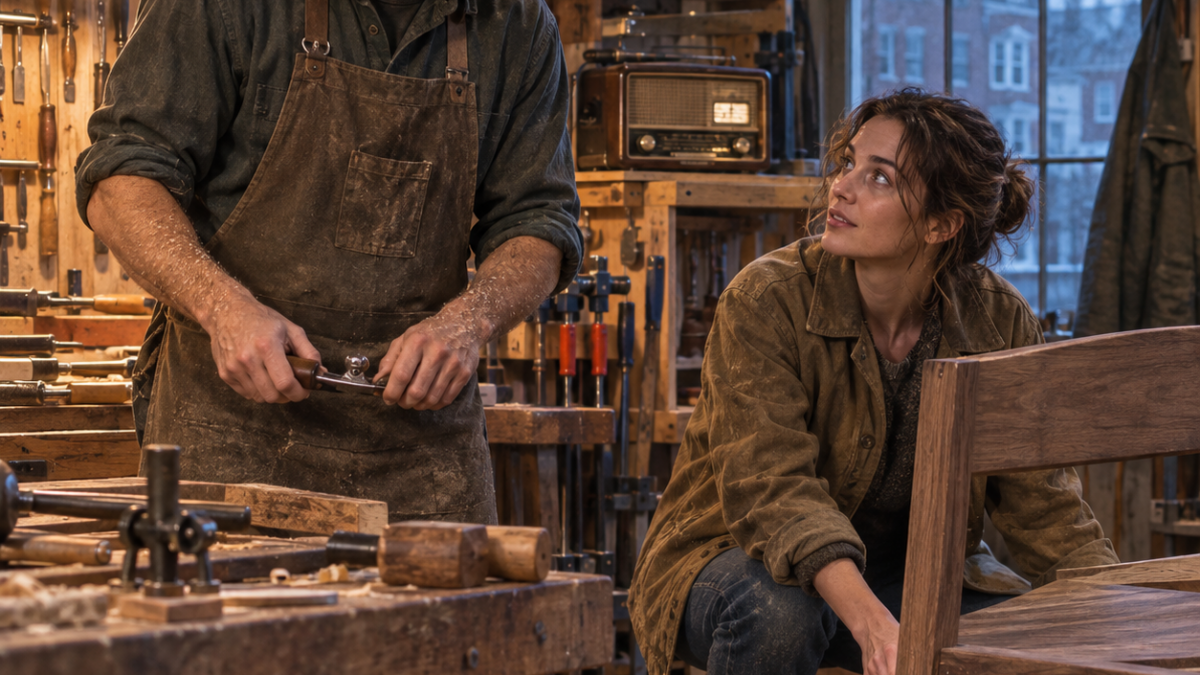
I was sweeping curls of white oak from under the bench and getting ready to lock up when the shop door opened and Francesca Bellini stepped inside by herself. The day before she had arrived with an assistant and a leather folder, but tonight she carried only her car keys, and she stopped in the middle of the sawdust as if she had forgotten where to put her hands. I leaned the broom against the bench and waited, because I had already learned that she filled silences with offers.
She did not offer anything this time. She took a breath and said:
– “Nobody’s ever told me no.”
It came out closer to an apology than a boast, and she looked almost as surprised to hear it as I was.
– “I’m Hugo Feldman. I’m thirty-eight, and I have built furniture by hand in this Providence shop for most of my adult life.”
Twenty-four hours earlier, she had set a signed check on my workbench with the amount left blank, and she had asked me to write any number I liked in exchange for exclusive rights to my whole line. I had slid the check back across the bench and told her the pieces were made one at a time, because that was the only way I knew how to stand behind them.
She had nodded, thanked me, and left without arguing, which I had taken for good manners. Now she was standing in the cold light of my work lamps, and I realized it had not been manners at all.
– “If you came to change my answer,” I said, “I should tell you that the number doesn’t matter either.”
– “I know it doesn’t,” she said, and she held up both hands to show me they were empty. “I didn’t bring a contract. I didn’t bring a new price. And I told my assistant to go home before I got in the car. Your answer is final, and I understand that.”
– “So, please don’t spend the next five minutes defending it.”
I told her I hadn’t been planning to defend it, and she laughed once, short and a little embarrassed. She said she had gone through an entire day of meetings with that no sitting in her head like a splinter.
And somewhere around the fourth meeting, she had stopped wondering what she had done wrong. She had started wondering what kind of man says it so calmly with nothing in his face that wanted her to feel small.
– “So I came to find out,” she said, “whether he’d talk to me when I had nothing left to offer him.”
I checked her pockets with my eyes slowly and on purpose, and she let me.
– “No pitch,” she said. “You can look again if you want.”
I told her I had looked the first time and had mostly found nerve, which was a different thing to be wary of. She was thirty and ran a company that was growing fast enough to be written about, and yet she stood there with her chin up and her shoulder slightly braced for the possibility that I would send her away. I would be lying if I said that did nothing to me.
It did a great deal, and that was exactly the trouble, because a woman like her could want almost anything, and I could not yet tell whether she wanted me, or only wanted to be the one person who had not said yes. Her eyes drifted past me toward the chair on the bench, and I moved half a step to the side without quite deciding to. It was not rude, but she noticed, and she did not pretend otherwise.
– “I’m not asking to see the shop,” she said. “I know that’s a separate question from whether you’ll talk to me.”
I told her that was fair, and that I was not ready to waver through my work as if the matter had been settled by a pleasant evening. The shop was the one place where I was always the one who got to say no, and I was not going to hand that over because she had been honest in the doorway. She took it without any visible damage, and I found I liked her better for that than I would have for a clever answer.
– “Then I’ll ask the other question,” she said. “Would you have a drink with me somewhere that isn’t here, with no clipboards and no one expecting anything?”
I heard how plainly she had asked it, with none of the speed she had used the day before, and I understood that she was giving me room to say no a second time. She started to suggest a restaurant downtown, caught herself in the middle of the street name, and said she could already tell I was going to hate a place with a reservation. I told her there was a bar on Wickenden Street where the bartender never asked anyone’s last name, and that I could be there Thursday at eight.
She asked whether Thursday worked for me or whether I was only being agreeable. I said I had checked my week in my head while she was talking, and Thursday was the first night I was not behind on an order.
That answer seemed to please her more than any gallantry would have. She went to the door, and with her hand on the frame, she turned back.
– “For the record, I’m not trying to win this,” she said. “I just wanted you to know your no hasn’t gone anywhere. It’s the reason I’m here.”
I said the yes was separate from the no, and that she should not mistake one for the other if she wanted either of them to mean anything. She nodded as if I had told her something she meant to remember, and the bell above the door rang once behind her. I stood listening to her heels cross the gravel lot and her car start, and I did not move until the headlights swung across the front windows and were gone.
When the sound of the engine had faded, I went back to the chair I had been fitting before she arrived. A walnut seat with a back slat I had been shaving for three days. The plane was where I had left it, and so was the shaving I had been in the middle of.
Yet the room felt wrong in a way I could not immediately name. For eleven years, the shop had been the one place where my refusal was enough, where I could shut a door, and every decision on the other side of it was mine. She had asked for nothing from it, and somehow it felt less like a wall than it had that morning.
I picked up the plane, ran it down the slat once, and stopped because I could not feel the grain through my hands the way I usually did. I told myself it was only the hour, and I swept up the rest of the oak, switched off the lamps, and locked the door twice. I did not tell myself the truth until I was standing in the parking lot with my keys in my hand and her words still going around in my head.
I had given a woman a personal yes without taking back a single syllable of my professional no, and I had no idea whether the two could live in the same room. All I knew was that on Thursday night in a bar with no reservations, one of us would have to find out whether we could sit across from each other without either of us being a reply to that blank check. On Thursday, I reached Wickenden Street ten minutes early, which I told myself was a habit and not nerves.
Francesca was already inside at a small table by the window, wearing jeans and a gray sweater with her hair pulled back. She had no leather folder and no phone on the table, and when I sat down, she looked at the two empty spots in front of us with something close to alarm.
– “I almost ordered for you,” she said. “I caught myself because I decided that was a terrible way to start.”
I told her I would take whatever pale ale they had, and she went to the bar herself and came back with two glasses. She insisted on paying for the first round, and I let her, since refusing would have turned it into another argument about who was in charge. I said the next one was mine, and she agreed without making anything of it.
I had expected a woman who ran a company to arrive with a plan, and instead I got someone who told stories with both hands. She described a delivery truck that had blocked her lane that afternoon, and the driver’s elaborate apology, and she acted out his shrug so well that the bartender glanced over. Without a proposal in front of her, she moved faster and laughed more easily, and her attention landed on whatever I said as though it were interesting rather than useful.
She asked about my day. I told her I had glued up a tabletop and eaten lunch standing at the bench, and she said that sounded like a good day, and she appeared to mean it. About halfway through the second beer, she pointed out that my answers had been getting longer.
– “You talk more when nobody’s trying to buy something,” she said.
I told her I talked exactly the same as always, and she said she had been taking notes and would let me know if the data changed. She noticed things about me that I had not planned to show her, and I was not sure how I felt about it. When she asked what I did on a night off, I said I fixed other people’s chairs for free, and I heard how much warmer my voice had gotten than it had been in the shop.
In the shop, I answered her like a man guarding a door. Here I was only a man at a table with a woman who listened with her whole face. I had come braced for her to be impressive, and she had spent forty minutes being curious instead, which was harder to defend against.
The first slip came when the bartender took our glasses. Francesca reached for her bag and said there was a place on Brook Street that served oysters until midnight, that it was two minutes away, and that she would call ahead so they could hold a table.
She had her phone halfway out before she stopped. She set it face down beside her glass and looked at me.
– “That was me deciding for you again,” she said. “I’d like to try that sentence over.”
I told her I had been wondering how long she would last, and that she had made it nearly an hour. She said I had clearly been timing her, and I admitted I had put a private bet on thirty minutes and lost. She laughed, and then she asked it properly as a question with an actual blank after it.
– “Would you like to stay and do something else, or would you like to go home?”
I said I wanted to stay, and that I did not need oysters for it because I would be happy to order fries at the bar and let her talk me through the rest of the delivery truck. The fries came with a second round, which I paid for, and somewhere in the middle of them the conversation left the blank check behind entirely. Francesca said she liked making decisions more than she probably should, and that her company had started because she once made a hard call in a bad month and happened to be right.
She said the speed was both the best and the worst thing about her, and that the people who complained about it usually just needed more time. I said I had noticed the speed, and she said I had also noticed the pitch, so we were even. She asked what happened to a piece after it left my shop, and I thought about that longer than she probably expected.
I told her about a dining table I had sold to a couple in Warwick eight years earlier. They sent me a photograph every Christmas with a different crowd around it, and one year they asked me to come refinish a scorch mark where someone had set down a hot pan. I had driven over with my sanding block, and they had fed me dinner at the same table with the mark still faintly visible under the new finish.
A piece that never gets used is only waiting. I said that one was doing its job. Francesca did not say anything clever.
She turned her glass a quarter inch on its coaster and said that thousands of her products went out every year, and she had never once been invited to eat dinner at any of them. Near eleven, she asked me directly if she could see me again. I took a moment because I wanted my answer to fit the week I really had and not the one I wished I had.
I told her I had a dresser due Monday and would be at the bench most evenings until nine, and that Saturday I would be finished by seven if she wanted to meet then. She nodded and said Saturday at seven was fine. She did not ask whether I could move something, and she did not suggest that a better night existed somewhere in her own schedule.
I had been prepared to defend that answer, and I felt oddly deflated and then oddly pleased when she simply accepted it. We walked out into a cold that came off the river and smelled of salt and old brick. She had parked three blocks down, and I went with her, partly because it was on my way and partly because I did not want to be the one who ended the evening first.
At her car, she turned around, and for a moment we were standing close enough that I could see her breath in the street light and the small crease between her eyebrows where she was deciding something. I thought about how little it would take.
She thought about it too, I believe, because she looked at my mouth and then at my face, and neither of us moved to turn that look into anything we would have to explain on Saturday. She let out a slow breath that was nearly a laugh.
– “Good night, Hugo,” she said, and I said good night to her.
She had her door open and one foot inside when she paused.
– “One more thing, and you don’t have to answer tonight,” she said. “Sometime I’d like to see you work. Not a date, not an event, just an ordinary day when you’re behind on something and I’m in your way.”
I told her I would think about it, and she nodded as if that were a perfectly good answer. Her taillights turned the corner onto Brook Street while I stood there with my hands in my pockets. I walked back toward my truck, knowing she had asked for something very different from another drink.
An ordinary Tuesday at my bench was a larger invitation than any date, and I could not yet tell whether I wanted to give it to her. I thought about her request for four days, and I spent Saturday evening with her in a noodle place on Hope Street without answering it. She did not bring it up again, which told me more about her than any answer I could have given.
On Tuesday morning, I called her at nine and said that if she still wanted to be in my way, she could come at two. I warned her that I was behind on a walnut chair and a dresser due Friday, and that I would be working the whole time she was there. She said that sounded perfect, and I believed her.
I did not sweep the floor. I did not hide the clamps hanging off every edge of the bench, and I left the radio on the classic rock station it had been tuned to since 2016. She arrived at ten to two in work boots and an old canvas coat, carrying two coffees.
She set mine on the shelf by the door instead of on the bench, so I knew she had been paying attention to where things belonged. She asked where she could stand, and I told her anywhere that wasn’t under the saw. She took the stool in the corner by the window, and her phone buzzed twice inside her coat pocket before she silenced it without looking.
I had expected her to drift along the wall of finished pieces, running a hand over them and doing the appraising I had been braced for all week. Instead, she watched me work, and she did it with an interest so plain that it made me clumsy for the first twenty minutes. I dropped a pencil.
I reached for a chisel that was not there, and at one point I planed a board in the wrong direction and had to flip it. She said nothing about any of it. When I finally forgot she was in the room, the shop settled into its usual rhythm of curls falling and wood talking back through the plane.
About an hour in, she got up and crouched beside the walnut chair, which sat on sawhorses, waiting for its back slat to be finished. She was not touching it. She was looking at the rear legs, and she asked why they flared outward so much more than the front ones did.
I heard myself answer in the voice I used on customers, saying the rake was standard for the pattern and gave the chair a stable base. She turned her head and looked at me, and her expression was patient, not offended.
– “I wasn’t asking for the spec sheet,” she said. “I wanted to know why you did it.”
My ears went warm. She was crouched in my sawdust with her coat sleeves pushed up, asking an honest question, and I had answered it as though she were about to put a bid on it. I put the plane down and told her the truth, which was that people lean back in chairs when they are tired.
The wider rear legs keep the whole thing from tipping when someone shifts his weight onto the back two feet. I had built it that way for years, after a customer’s father went over backward in a chair of mine and laughed about it for a week.
– “That’s the best thing anyone has ever told me about a chair,” she said.
I told her to sit in this one and see what it did for her. It was not finished and the seat was still rough in places, but I wanted to know what she felt rather than what she thought a home design founder should say. She lowered herself into it carefully and then paused, and I watched her figure out what to report.
She told me she was not a person who sat back, because she perched on the front of everything like she might need to leave. The front edge of the seat was pressing the backs of her knees when she did it.
Everything in me wanted to explain the geometry again, and I stopped myself. I knelt down, pressed my thumb behind her knee through her jeans, and found the line she meant, which was a quarter inch sharper than it should have been for anyone who sat the way she did.
– “I’m not telling you to change it,” she said quickly.
I told her I knew that, and that I was changing it anyway because I had decided to. I picked up the spokeshave and eased the front edge into a softer curve while she held very still on the seat. She did not offer any more opinions, and I was grateful and a little disappointed.
When I finished, I stood and held out a hand to help her up so she could test the new edge. She took it and rose, and then neither of us let go.
The radio had moved on to a song I knew, and there was walnut dust on her sleeve, and a pale streak of it along her jaw that I had been trying not to look at for an hour. I brushed it away with my thumb, and my thumb stayed there longer than the dust required.
– “You’re allowed to stop me,” she said, quietly enough that I barely heard it over the guitar.
I said I had no intention of stopping her. She kissed me then with one hand flat against my chest and the other still locked in mine, and it was nothing like the careful good night at her car. She tasted like the coffee she had carried in, and I felt her smile against my mouth when I stopped holding back and kissed her the way I had wanted to since Thursday.
I did not retreat behind the bench. I did not ask what it meant, and I did not make her prove anything first. For a few minutes, the only sound in the shop was the radio and the small noise she made when I pulled her closer.
Afterward, she sat on the arm of the stool in the corner with her hair coming loose, and I leaned against the bench with my hands in my back pockets because I did not trust them yet. She looked at the chair and then at me, and I could see her deciding whether to say something she had probably been rehearsing since the doorway.
– “Here’s what I can’t work out,” she said. “You told me about the Warwick table like it was the most precious thing in your life. And you took my opinion about a seat edge just now. But every time something I know touches your work, I watch you check whether I’m closing in. So what place does it have between us? Do I just never get to have a thought about it?”
I opened my mouth and found I did not have a neat answer. I told her she was right, that I had been listening for a pitch even when she made none, and that I had not decided how much of that was good judgment and how much was habit. I said I wanted to know her, and that part was not in doubt.
The part about her judgment touching my shop was the part I had not figured out. She nodded slowly like someone who had expected a cleaner response, and was not sorry I had not faked one. I did not take back the invitation, and she did not ask me to.
She left a little after five because she said she had a call she could not move, and she said it without apologizing for having one. At the door she pulled on her coat and gave me an odd, direct look.
– “You let me into yours?” she said. “Come see mine sometime. It’s not as interesting, but I’m in it a lot.”
She left before I could answer, and I stood by the chair with the spokeshave still in my hand, listening to her car back out of the gravel. I had opened my shop to her on an ordinary Tuesday, and she had changed the edge of a seat, and I was still standing. I could not tell yet whether that meant I was ready to follow her home.
It was one thing to let her into the room where I always got to say no, and quite another to walk into hers without hearing an offer in every kindness. Francesca called on Wednesday night, and instead of naming a restaurant, asked me to come to her place on Friday. She said she would order dinner from somewhere she trusted, and that she might be on her phone for part of the evening because a decision at work had not finished deciding itself.
She said all of it in one breath and then added that I could turn her down without it counting as a verdict. I told her I would be there at seven-thirty. Her house was a narrow brick rowhouse on the east side with a restored stoop, and she opened the door barefoot with her phone pinned against her shoulder.
Inside, a very good year was visible everywhere: in the tall windows, the kitchen rebuilt down to the studs, and the long table somebody had chosen with real care. Nothing in the room was mine, and she saw me notice.
– “I almost bought one of yours,” she said, covering the phone with her palm. “Then I realized it would just be a nicer way of buying you, so I didn’t.”
I told her that was the most considerate thing anyone had ever not done for me. The call that had been waiting for her turned out to be her head of operations, and she put him on speaker while she carried plates to the counter.
The frames on a sofa line due for the spring launch had cracked again in the second round of stress tests, and the supplier was promising a fix before the buyers arrived. Francesca asked two short questions, one about how many frames had failed and one about how many units were already contracted, and then she went quiet for about four seconds.
– “Pull the whole line from the launch,” she said. “Call the supplier first thing in the morning and tell the buyers today so they hear it from us. We’ll absorb the cost.”
She hung up and stood with both hands flat on the counter, and the corner of her mouth was turning up before she remembered I was there.
– “I should probably be more solemn about that,” she said. “But I love this part. I love being the one who gets to say stop.”
I enjoyed watching her far more than I expected to, and that was only half of what I felt. She had just given up a season of revenue in under two minutes without asking anyone’s permission, and she had done it for the same reason I would not sell my line, which was that she would not stand behind a thing that cracked. At the same time, I caught myself measuring where a man who answers in few words would fit beside that kind of speed.
I had spent the previous Tuesday easing a quarter inch off a seat edge, and she had spent her Friday evening moving a quarter of her year. We ate Portuguese takeout from Fox Point at the long table, and I got quieter with every bite, and she let it go for about ten minutes before she set down her fork.
– “If you want me to promise that work will never touch us, I can say the words,” she said. “I just don’t think I could keep it, and I’d rather not start by promising something I can’t deliver.”
I told her that wasn’t it. And then I told her what it was, because she had earned a plain answer.
– “For weeks, I had been hearing offers in things that were not offers,” I said. “And the reflex had followed me out of the shop and into your kitchen.”
She had told me about a delivery truck, and I had heard a pitch about logistics. She had admired a chair, and I had waited for the number.
– “I can’t date you by pretending I’m not a founder, Hugo,” she said, without any heat in it. “If I did, you’d be seeing someone I made up so you’d feel comfortable, and I’d be tired by Christmas.”
She said it plainly, the way she had said she was not trying to win, and I felt something in me rearrange itself to make room for it. What I understood, sitting there with cold rice on my plate, was that I had been spending her silence like it was free. She had been welcome near my work only as long as she said very little about it, and I had called that respect.
In truth, it had also been a way of keeping half of her outside my door while I took credit for letting the other half in. I had asked to see her real life and then looked away from the part of it that shaped her days, which was her judgment and the way she used it. So I did not leave, and I did not turn quiet and polite.
I asked her what pulling the line was going to cost her, and I asked it the way I would want to be asked about a chair, as a question and not a challenge. She looked at me for a moment, as if checking whether I meant it, and then she told me. The sofas were nearly a third of the spring category, she said, and about thirty people had spent most of the year on that launch.
She would tell them herself on Monday morning in the same room where she had thanked them in March. She said she would lie awake over it, and that lying awake was the part nobody saw when they talked about a founder’s confidence. I asked whether she would have called it differently if the cracks had shown up a month later, and she said probably not, but that she might have enjoyed it less.
I felt the comparison start up, my one bench against her warehouse, and I put it down because it had no business at that table. She was telling me the truth about her day, and the only thing it asked of me was attention.
We cleared the plates together, which turned out to be easy since she washed and I dried, and neither of us commented on who was doing which. At the door, she held my coat for a second longer than she needed to, and I could tell she was choosing her words before she let go of it.
– “The company’s turning five next Thursday,” she said. “We’re having a party at the showroom with the whole team and some vendors and a few people from the press. I would like you to come as the man I’m seeing. I wouldn’t be bringing a maker I hope to recruit, and I’ll say that to anyone who asks.”
She paused and pushed her hair back with the heel of her hand.
– “You can say no. I’d rather you say no than come to be polite.”
I told her I would think about it, and she nodded as though that were exactly the right answer. She kissed me once at the door, unhurried and warm, and then she let me walk out onto the stoop without another word. The street was quiet, and my breath showed in the light from her front window.
I understood what she had actually asked, even if she had phrased it as an invitation to a party. Standing beside her in that showroom would put me in front of her people, her buyers, and probably a few strangers who knew my chairs from a magazine and had opinions about what my work could become. It would also make us visible together in a room where my name might be mentioned the moment anyone noticed it.
I sat in my truck for a while without starting the engine, trying to work out whether I could stand in that room without either my work or the two of us ever being made to feel available for purchase. I called Francesca on Sunday afternoon after two days of staring at a drawer front and getting nowhere with it. She picked up on the second ring, and I skipped the greeting.
– “I’ll come Thursday,” I said. “But I want to tell you what it isn’t. It isn’t me changing my mind about the line, and if someone at that party asks, they’ll get the same answer you did.”
The keyboard noise on her end stopped, and she was quiet for a second.
– “I wouldn’t want you there on any other terms,” she said. “But I can’t promise to hide what I do for a living, and I won’t stand around managing what people think of you. Those people are mine. They’ll have opinions, and some of them will be about your chairs.”
I told her that was fair, and I noticed I was relieved she hadn’t offered to shield me from her world. A man who needs protecting from a room probably shouldn’t walk into it. She said she would meet me at the showroom door at six-thirty and asked whether I owned a jacket, and I told her I did, and that it had been to two funerals and a wedding.
The showroom on Westminster Street had a glass front, sofas arranged like small islands, and about ninety people holding drinks. Francesca was waiting by the door in a dark green dress, and she took my hand in front of half her staff without any ceremony at all. She walked me to the nearest cluster and said:
– “This is Hugo. I’m seeing him.”
Her head of operations, a broad, tired-looking man named Marcus, shook my hand and said:
– “I was the guy with the chair.”
I asked what chair, and he said she had told the whole leadership team about a quarter inch of walnut, and that none of them understood it. Francesca did not look at me when he said it, but her fingers tightened around mine. For the first hour, I met buyers, vendors, and two people from a design magazine, and every time, she used the same sentence and nothing more.
I was at the bar with a seltzer when a man in a good wool blazer stopped in front of me and read my name off nothing, because he already knew it. He introduced himself as Daniel Witcom, a buyer for a hotel group, and said he had seen my walnut side chairs in a magazine spread last spring. His company was outfitting forty rooms in Newport next year, and he turned to Francesca, who had come up beside me, and told her the two of us could do something remarkable together.
I felt the question land in the middle of the group like a dropped glass. Francesca set her drink on the bar, and her hand fell to her side, no longer touching my sleeve.
Her jaw tightened, and her mouth opened a fraction, and she closed it again. She looked at me and waited, and her silence was the loudest thing in that room.
– “I appreciate that,” I told Witcom, and I meant it. “I make every piece myself, one at a time, in a shop about ten minutes from here, and that’s the only way they get made. I’m not going to license them, and I’m not going to scale them up.”
He started to say that numbers could be flexible, and I said numbers weren’t the reason.
– “If you want a chair, come to the shop and put your name on the list,” I said. “It’s about seven months right now, same as for anyone else.”
He blinked at me and then laughed a little ruefully and said he supposed that was an answer. He gave me his card and said he would see about the list, and I thought he might actually do it. Francesca had not moved the whole time, and when I looked at her, her shoulders came down about an inch.
She stayed with me for a few minutes more and then excused herself because she owed her team a toast. She climbed onto the low platform at the front of the showroom and thanked them for five years, and she did it without a note. She told them about the sofa line she had pulled from the spring launch, and that she had told the buyers herself, and that she would rather be late with something good than on time with something cracked.
She said it the way she had said it to Marcus on speaker, with no hesitation and no apology, and a ripple of applause went through the room that sounded relieved. I watched her hold a hundred people’s attention with a sentence, and I felt no urge at all to measure myself against her. She was good at her work, and I was good at mine, and the room had room for both of us.
Afterward, we walked out onto the sidewalk where it was cold, and the street smelled like wet brick. She leaned on the door frame with her shoes in her hand and asked me how bad it had been.
– “You didn’t step in,” I said.
She told me she had wanted to, probably eleven times, and that she had counted them to keep from doing it.
– “I’m not thanking you for following my rules,” I said, because I knew that was not what had happened and she would know it too. “You did what you do, which is decide things. And you left one of them where it belonged.”
I told her I had been guarding the shop for so long that I had mistaken it for self-respect. It had become a way of deciding how much of her was allowed to come through the door, and I had been doing that to her without ever saying so. She looked at the pavement for a moment, and when she looked up, her eyes were bright and her mouth was crooked.
– “You said no in my showroom,” she said. “It sounded better there than I expected.”
I took her hand, and we stood there until a couple of her staff came out laughing and went the other way. I told her I had a pair of bar stools to finish, and that on Tuesday I would be at the bench from one o’clock on with nothing planned and nobody to impress.
– “Come if you want to be in my way,” I said.
She asked whether there was a no attached, and I said not this time. She did not ask to see the sketchbook, and she did not ask about the Newport buyer or what the shop could look like in five years. She asked what time she should come, and I said two, and she said she would bring coffee.
I told her to set mine on the shelf by the door the way she already knew to. I don’t know if what she felt at the start was wanting me or wanting the one man who had said no, and I don’t think she knew either. What I do know is that I went home with her taillights in my head and a hotel buyer’s card in my jacket, and I did not feel like anything I owned was for sale.
Tuesday, she was at the shop at ten to two with two coffees and boots that were already getting a little worn. If you were Hugo, how would you choose someone whose whole life is built on making decisions, without handing her the terms or taking them for yourself?
Tell me in the comments, because I really want to know. And if this story stayed with you, please like the video and subscribe so you won’t miss the next one.