My CEO’s Black Belt Son Forced Me to Spar—He Never Knew I Led a Navy SEAL Rescue Team
My CEO’s Black Belt Son Forced Me to Spar—He Never Knew I Led a Navy SEAL Rescue Team
You want to know what real violence looks like?
It doesn’t happen on a padded floor under fluorescent lights.
It doesn’t wait for a referee to wave his hand or tap a stopwatch.
I spent 12 years breathing in the dark, pulling hostages out of concrete basements God forgot about.
Now, I manage security for a tech billionaire and her 24-year-old son, a kid who bought a black belt with his trust fund, just told me to put on the gloves.
He thinks he’s going to teach the old man a lesson.
Let’s see.
The alarm goes off at 4:30 a.m.and my first instinct is to reach for a rifle that hasn’t been there in 3 years.
Instead, my hand finds the cold plastic of a digital clock.
I kill the noise before it can wake Toby. The house is quiet.
The kind of absolute suburban silence that used to keep me awake when I first got my discharge papers.
Now, I just endure it.
I sit on the edge of the mattress, feeling the familiar dull ache in my left knee and the phantom weight of body armor across my shoulders. I am 38 years old, a single father, and officially employed as the director of corporate risk for a logistics empire.
It’s a polite title.
Mostly, I make sure the CEO doesn’t get mobbed by paparazzi and that her servers don’t get compromised by rival firms.
It pays well.
It pays for Toby’s asthma medication, his school supplies, and the mortgage on a house that feels entirely too large for two people.
I walk down the hall.
Toby’s door is cracked open.
He’s six, entirely too small for his age, sprawled across his bed with one leg hanging off the edge, clutching a worn-out stuffed dog.
Looking at him is the only thing that makes the knot in my chest loosen.
He is my entire world, the only clean thing left in a life that spent a decade steeped in dirt, cordite, and blood. By 7:00 a.m., the The is packed, the kid is dropped off at his morning program, and I am pulling my nondescript black sedan into the underground garage of the glass-and-steel monolith downtown.
Lauren is already in her office.
She is a force of nature, a woman who built a billion-dollar supply chain company out of a laptop and sheer refusal to sleep. I respect her.
She’s demanding, ruthless in board meetings, but she pays her people on time and never asks me to carry her bags.
She treats me like a professional.
Her son, Preston, is another story. Preston is 24.
He has perfect teeth hair that always looks intentionally messy and an aggressive, desperate need to prove he isn’t just a beneficiary of his mother’s empire.
He wears tailored suits with sneakers, drinks green juice out of mason jars, and spends 4 hours a day at an elite mixed martial arts gym downtown.
He doesn’t just do jujitsu and Muay Thai.
He makes sure everyone in a 5-mile radius knows he does it.
He walks into rooms shoulders first, staring down the IT guys, the delivery drivers, the junior analysts. He is a predator in a fish tank, completely unaware that the ocean exists.
I sit in the corner of Lauren’s executive suite reviewing the perimeter security feeds on a tablet when Preston walks in.
He doesn’t knock.
He never knocks.
He’s wearing a fitted T-shirt that tightly hugs his shoulders, carrying a gym bag that costs more than my first car.
He drops it on one of the imported leather chairs.
“Mom, the retreat schedule is finalized,” he says, leaning over her desk.
Lauren doesn’t look up from her monitors.
“Did you clear the venue with Hayes?”
Preston throws a glance my way.
It’s the look a man gives a piece of furniture he stubbed his toe on.
“I don’t need the security guard to vet a private dojo, Mom.
It’s a closed event, executive team building.
I’m running the seminar.”
I keep my eyes on my tablet.
I don’t correct him on my title.
I don’t care what he calls me.
I spent my 20s in the Hindu Kush and the coastal regions of the Horn of Africa.
The opinions of a trust fund kid playing cage fighter do not register on my emotional radar.
It’s mandatory, by the way.
Preston adds a smirk, pulling at the corner of his mouth. Even for the security detail.
Good for morale.
Shows the grunts that the executives can sweat, too.
Lauren finally looks up, adjusting her glasses.
Hayes, does your team have an issue attending?
No, ma’am.
I say quietly.
We’ll be there.
Good.
Preston sneers.
He rolls his shoulders, cracking his neck loudly.
Make sure to bring gym clothes, Hayes. You look like you could use a little cardio.
Sitting in that chair all day is going to make you soft.
I look at him.
Really look at him. I see the slight forward roll of his shoulders, the way he balances his weight on his toes.
He’s athletic.
He’s probably fast.
But his eyes are completely empty of actual threat.
He’s a tourist in the violence business.
I’ll keep that in mind, Preston.
I say, my voice flat, completely devoid of the challenge he’s desperately trying to fish out of me.
He scoffs, grabs his bag, and walks out. Lauren sighs, rubbing her temples.
I apologize for him, Hayes.
He’s going through a phase.
He thinks martial arts is the answer to everything.
It’s a good hobby.
I reply, returning to my screen. It is a good hobby.
It keeps people fit. It teaches discipline.
But a hobby is all it is.
A game with rules, mats, tap outs, and water breaks.
I don’t play games anymore.
I left the teams because I was tired of burying my friends.
And because Toby needed a father who wasn’t constantly a missed phone call away from a flag-draped coffin.
I swore I would never raise my hands in anger again.
But sometimes, the world doesn’t care about the promises you make in the dark.
Friday afternoon.
The executive synergy event. The venue is a sprawling high-end martial arts academy in the expensive part of the city.
The mats are pristine. The walls are lined with heavy bags, and the air smells strongly of expensive disinfectant and eucalyptus.
The executive team, vice presidents, regional directors, and upper-level managers are standing around nervously in brand new athletic wear.
They look like they are waiting for a firing squad.
I am sitting on a wooden bench near the back wall. Beside me is Toby.
His school called at noon. The heating system broke, and they sent the kids home early.
I had no backup child care, no family in the city to call. Lauren, to her credit, had waved it off and told me to just bring him along.
Toby is wearing a yellow oversized hoodie, his little legs dangling off the bench, entirely engrossed in a cartoon playing on my phone. He has headphones on.
He is safe.
He is oblivious.
That is all that matters. I am wearing dark gray sweatpants and a plain black t-shirt.
I am barefooted, leaning against the cold cinder block wall, watching the room.
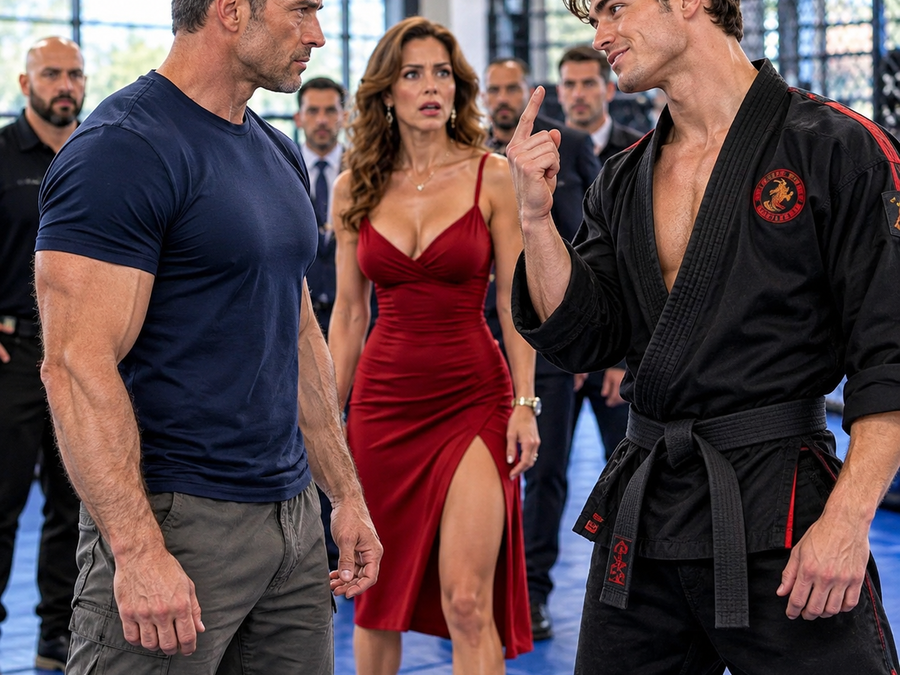
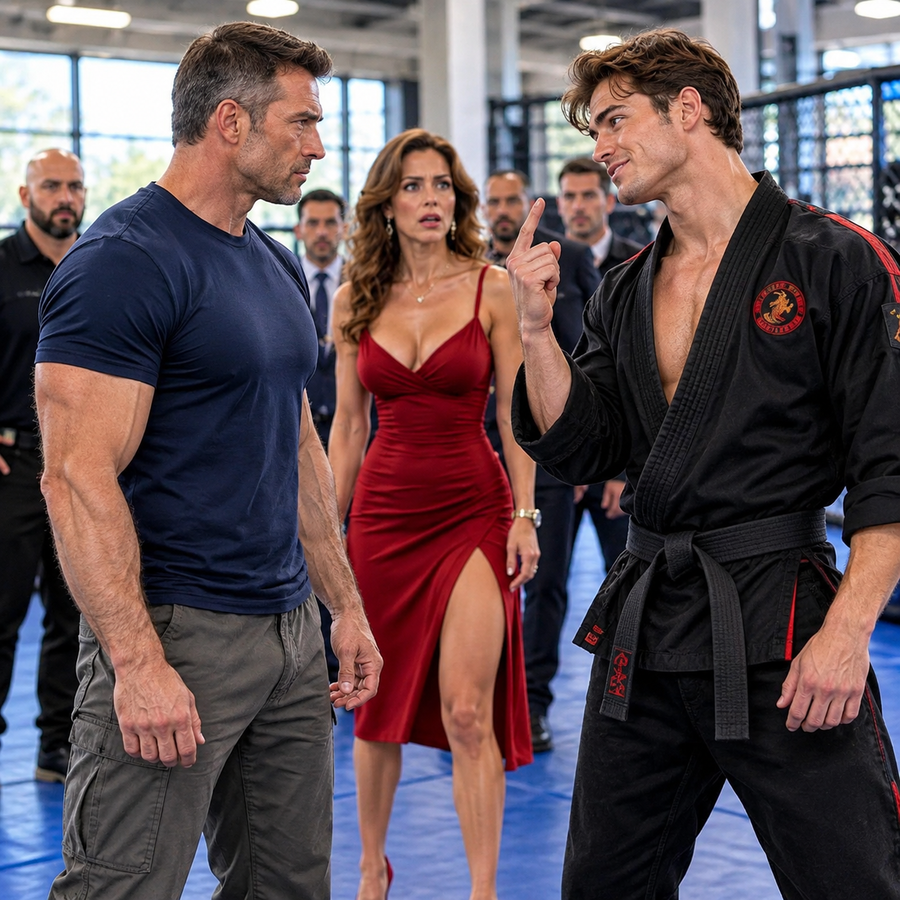
Preston steps onto the center of the mat. He is wearing a black gi, a customized belt tied perfectly around his waist, and an expression of profound unearned authority.
He claps his hands loudly.
The sharp crack echoes in the cavernous room, making a few of the accountants flinch.
“All right.
Gather around.”
Preston barks, pacing like a drill sergeant in a bad movie.
“Today is about getting out of your comfort zones.
Business is combat.
If you freeze in the boardroom, you die.
Today, we’re going to learn how not to freeze.”
It’s absolute garbage.
It’s corporate buzzword bingo wrapped in a thin layer of physical intimidation.
For the next hour, I watch a tragicomedy unfold. Preston pairs up the executives and teaches them basic self-defense techniques, wrist escapes, simple chokes, hip throws.
But, he isn’t teaching.
He’s performing.
Whenever an executive struggles, Preston steps in to demonstrate using way more force than necessary.
He dumps the chief financial officer, a 50-year-old man with bad knees, hard onto the mat.
He catches a junior marketing director in a guillotine choke, holding it just a second too long until the guy is red-faced and gasping.
Preston is getting off on it.
The power disparity.
The fact that none of these people whose paychecks depend on his mother can fight back or tell him to go to hell.
I stay on the bench.
I check my watch. 45 minutes left.
All right, let’s circle up, Preston announces, breathing a little heavy, wiping a bead of sweat from his forehead.
He scans the room. His eyes lock onto me in the back.
A slow, ugly smile spreads across his face.
“Hayes,” he calls out.
His voice carries over the quiet hum of the air conditioner.
“You’ve been sitting on the sidelines all day.
Get over here.”
Several heads turn.
I don’t move.
“I’m on duty, Preston, and I’m watching my son.
” Preston shakes his head, walking toward the edge of the mat.
“The perimeter is secure, Hayes.
We’re in a locked building, and your kid is busy.”
He gestures toward Toby, who hasn’t looked up from the screen.
“Come on, don’t be a coward.
Let’s show the team how a real physical confrontation works.”
“I’m going to pass,” I say, my voice remaining calm, perfectly level.
Preston stops 10 ft from me. The smirk vanishes, replaced by a flash of genuine anger.
He hates being told no.
He hates being dismissed.
“It wasn’t a request, Hayes.
My mother pays you to participate in company functions.
Get on the mat.”
Lauren steps forward from the group.
“Preston, leave him be.
He’s not required to participate.
” “No, Mom,” Preston snaps, not breaking eye contact with me.
“This guy sits around the office all day acting like he’s better than everyone else.
Never talks, never joins in.
I want to see what we’re paying for.
Or maybe he’s just scared he’ll embarrass himself in front of his kid.
The temperature in the room seems to drop 10°.
I look at Preston. Then I look down at Toby.
My son is still watching his screen, completely unaware of the tension, occasionally letting out a quiet giggle at whatever animated animal is dancing on the glass. If I walk away, Preston will escalate.
He’ll make it a point of pride to humiliate me in the office.
He’ll target my team.
He might even make a scene right here, right now, and wake Toby out of his quiet, happy little world.
I let out a slow, measured breath.
The kind of breath you take before you kick in a door in Fallujah when you don’t know what’s waiting on the other side.
I reach down and tap Toby’s knee.
He slides one headphone off. Yeah, Dad?
I’m going to go stretch my legs for a minute, buddy.
Stay right here.
Don’t move.
Okay, he says, immediately sliding the headphone back on.
I stand up.
I don’t look angry.
I don’t look pumped up.
I just walk toward the edge of the mat. The executives part like water, stepping back hastily as I pass.
Preston grins, backing up to the center of the mat, bouncing on his toes, shaking out his arms.
There we go. Finally.
Let’s do a little light sparring.
MMA rules. 3 minutes.
Unless you need a breather earlier. I step onto the tatami.
The texture beneath my bare feet is familiar, yet completely alien. The last time I was barefoot in a fight, I was slipping on blood on the deck of a hijacked cargo ship in the Gulf of Aden.
Light sparring, I repeat, my voice barely above a whisper. Yeah, old man, Preston says, raising his hands, tucking his chin.
Don’t worry.
I won’t hurt you too bad.
I don’t raise my hands.
I just stand there, arms relaxed at my sides, my weight perfectly distributed.
“Okay, Preston.
Show me.
” Preston doesn’t waste a second.
He wants a highlight reel. He wants to knock the quiet, graying security guard into next week and cement his alpha status in front of the entire C-suite.
He darts forward, feinting a jab to the head, and throws a vicious snapping low kick aimed right at my bad left knee.
It’s a solid technique, fast, but I’m not there.
I don’t leap out of the way.
I don’t scramble.
I just shift my hips backward, pivoting off my right foot.
Preston’s shin cuts through empty air, throwing him slightly off balance.
He recovers quickly, a flash of frustration crossing his face, and closes the distance. He throws a one-two combination, jab-cross, both aimed at my jaw.
I step inside the arc of his punches.
I don’t block.
Blocking is for boxing rings.
I just slip my head an inch to the right, feeling the breeze of his knuckles brush past my ear. He grunts, winding up for a massive right hook.
In the span of a second, the sterile dojo fades. The smell of eucalyptus is replaced by the phantom stench of sulfur and sweat.
The quiet gasps of the executives turn into the deafening roar of rotor wash.
Muscle memory is a terrifying thing. It bypasses the conscious brain.
It doesn’t think.
It executes.
As Preston’s right arm arcs toward me, completely exposing his ribs and his center of gravity, I move.
I don’t hit him.
Striking him would break his jaw, shatter orbital bones.
I promised myself no more blood. Instead, I slide my lead foot behind his ankle.
My left hand snakes out, gripping the thick fabric of his gi lapel right at the collarbone. My right hand cups his triceps.
I don’t pull him down.
I just redirect the massive kinetic energy he just voluntarily handed to me.
I twist my hips and drop my weight.
Preston leaves the floor. He goes completely airborne, his eyes going wide with sudden absolute panic.
The ceiling spins above him and then he hits the mat hard.
The impact sounds like a gunshot.
The breath is violently forced from his lungs in a wet hack.
He bounces once, gasping, trying to orient himself.
His gym-trained instincts kick in and he immediately tries to roll, trying to scramble up to his knees to shoot for a takedown.
He doesn’t make it.
Before his shoulders can even leave the mat, I am already there. I drop my right knee directly onto his floating rib.
Not enough to break it, but enough to pin him to the floor like a biological specimen. My left hand slides behind his neck, weaving through the collar of his gi.
My right hand feeds the opposite lapel across his throat.
It’s a cross choke, basic jiu-jitsu.
But I’m not applying it like a sport.
I’m applying it like a tourniquet.
I lock my wrists, drop my forehead to the mat next to his ear, and squeeze. Preston thrashes.
His legs kick wildly against the floor. He brings both his hands up, clawing frantically at my wrists, trying to break the grip.
But my forearms are like steel cables, locked into concrete.
10 years of hauling grown men in full battle rattle over brick walls means a 24-year-old’s panic doesn’t even register as resistance.
“Shh.”
I whisper.
My voice is completely calm, right in his ear.
“Stop moving.”
He doesn’t stop.
He bridges his hips, bucking violently, trying to throw me off. I ride the movement effortlessly, tightening the choke a millimeter with every exhale he makes.
I’m cutting off the carotid arteries.
I’m shutting down the blood flow to the brain.
It takes about 6 seconds if you do it right.
4 seconds in his thrashing turns into a desperate vibrating shudder. 5 seconds in his hands fall away from my wrists, slapping weakly against my back.
The universal sign for tap out, the gym rule, the safety net.
In a real fight, a tap means nothing.
In a real fight, you don’t stop until the threat is rendered entirely immobile.
My brain screams at me to finish it, to hold on until his body goes limp, until the threat is permanently neutralized.
The phantom echoes of the gunfire in my head grow louder. Clear the room, secure the target.
Then, through the haze, I hear a sound. A cartoon sound effect, a silly high-pitched boing from an iPad speaker.
Toby.
The sound cuts through the static in my brain like a scalpel. The darkness shatters.
I am not in Yemen.
I am not in a breached compound.
I am in a dojo in the suburbs, and I am strangling my boss’s son.
I release the grip instantly.
I stand up, stepping back, my breathing perfectly even.
My heart rate hasn’t broken 80 beats a minute.
Preston rolls onto his side, violently sucking in air, coughing and retching.
His face is a blotchy bruised red. He is clutching his throat, tears streaming down his face from the sheer physical trauma of oxygen deprivation.
He looks up at me, and the arrogance is entirely gone. In its place is raw, unadulterated terror.
He finally understands the ocean. The room is dead silent.
Nobody is breathing.
Even Lauren is frozen, staring at me with a mixture of shock and something bordering on fear. I look around the room.
I look at my hands.
They aren’t trembling.
They are perfectly steady.
I hate them for it.
I walk off the mat.
I don’t look back at Preston.
I walk straight to the bench where Toby is sitting.
He pulls one headphone off, looking up at me with bright, innocent eyes.
“Are you done stretching your legs, Dad?”
I force a soft smile, kneeling down to his eye level. I gently cup the side of his face.
His skin is warm.
He is real. Yeah, buddy.
I’m done.
Let’s go get some ice cream.
I pick up his small backpack, take his hand, and we walk out the glass doors into the afternoon sun.
I don’t look back.
I don’t need to.
They know exactly who I am now. Monday morning tastes like burnt coffee and impending unemployment.
I drop Toby off at the elementary school drop-off zone.
I watch him walk through the double glass doors, his backpack slightly too big bouncing against his shoulder blades. I wait until the heavy doors latch shut before I put the car in drive.
That is the rule.
You never leave until the asset is secured behind a hard physical barrier. The drive downtown is a blur of brake lights and gray overcast skies.
My knuckles are white on the steering wheel.
I am not angry about Friday.
I’m bracing for the impact.
When I step out of the elevator onto the executive floor of the logistics headquarters, the silence is immediate and absolute. Usually, this floor hums.
Keyboards clack. Phones ring.
Junior executives speedwalk down the carpeted hallways carrying iPads and anxiety. Today, the noise stops the second my boots hit the floor.
I walk past the glass-walled conference room.
The chief financial officer, the one Preston dumped on his bad knees last Friday, is standing by the espresso machine. He looks at me.
He doesn’t nod.
He doesn’t offer a polite corporate smile.
He simply sets his cup down and walks quickly the other way.
The receptionist, a bright 20-something named Keller who usually talks my ear off about her weekend plans, suddenly finds her monitor intensely fascinating as I pass her desk.
They don’t see the quiet security director anymore.
They see the violence. I sit at my desk in the corner.
The monitors are glowing. The perimeter feeds are nominal.
Delivery trucks are logging in at the loading docks.
Key card swipes at the server room are authorized. Everything is perfectly normal.
At 9:15 a.m.the intercom on my desk buzzes.
“Hayes.”
It’s Lauren.
Her voice is stripped of its usual polished corporate warmth.
“My office.
Now.”
I stand up. I adjust the cuffs of my suit jacket.
I walk the 50 ft to her suite, open the heavy oak door, and step inside. Lauren is not sitting behind her desk.
She is standing by the floor-to-ceiling window looking out at the city skyline.
The sky is the color of wet concrete.
She doesn’t turn around when the door clicks shut behind me.
“Preston isn’t coming in today.
” she says to the glass.
“He told me he tweaked his neck.
Said he needs to see a physical therapist.”
“I see.”
I reply. My voice is flat.
I’m giving her nothing to work with.
Lauren turns around.
She is a woman who commands boardrooms, who negotiates multi-million dollar shipping contracts with ruthless foreign syndicates, who fires vice presidents before her morning coffee.
But right now, she looks deeply, profoundly tired.
She walks over to her desk and picks up a Manila folder.
It’s thick.
“When I hired you, Hayes, I read your resume.”
she says, tossing the folder onto the polished mahogany.
“It said ‘Naval Service, Honorable Discharge, Security Consultant.’
I ran a standard background check. It came back clean.
No criminal record, good credit, solid references from a private corporate firm.”
She pauses, leaning her hands on the desk.
“But after Friday,” she continues, her eyes locking onto mine.
“I made a few phone calls.
I have friends in Washington. Friends who owe me favors for moving their hardware quietly across international borders.
I asked them to look deeper, to look past the standard H&R screening.”
I don’t move.
I don’t shift my weight.
I just look at the folder.
They couldn’t give me much.
Lauren says, her voice dropping an octave. Actually, they seemed angry that I was even asking.
But one of them told me off the record that my corporate risk manager didn’t just serve in the Navy.
He told me you spent 12 years in a Naval Special Warfare Development Group.
He told me you ran a specialized hostage rescue element.
He told me things that made my blood run completely cold.
The HVAC unit hums in the ceiling. Are you firing me, Lauren?
I ask. She lets out a sharp, humorless laugh.
Firing you, Hayes?
You nearly crushed my son’s windpipe in front of my entire executive staff.
You didn’t even look like you were trying.
You looked bored.
She runs a hand through her hair.
I should have fired you on Friday.
I should have called the police.
But you didn’t.
No, I didn’t.
Lauren walks around the desk, stopping a few feet from me. Because Preston is a fool.
Because I watched him push you and push you and push you. And I watched you try to walk away.
And because when I looked at my executives, the people he’s been bullying for 2 years, I saw absolute relief in their eyes.
You did what none of us had the spine to do.
I keep my face perfectly neutral.
I overreacted.
It won’t happen again.
I prefer to keep my private life private.
It’s too late for that, Lauren says sharply.
She crosses her arms. The veil is gone.
The office is terrified of you.
But that’s not why I called you in here.
She walks back to her desk and taps a button on her keyboard.
The large flat screen monitor mounted on the wall flickers to life. It displays a map of a sprawling industrial complex.
This is our primary sorting hub in the Pacific Northwest, she says.
Her tone instantly shifts from mother to CEO.
It handles 30% of our high value domestic freight, pharmaceuticals, microprocessors, proprietary tech for government contractors.
Last night at 2:00 a.m., the facility went entirely dark. I frown, stepping closer to the screen.
Dark how?
A power grid failure.
No, Lauren says tightly.
Dark as in the localized network was physically severed. The backup generators were manually disabled, and the local police department dispatched a cruiser for a welfare check on the guards an hour ago.
The cruiser never reported back.
My chest tightens.
The familiar cold calculus of tactical assessment begins to boot up in the back of my brain. Who was the client for the outbound freight last night?
Lauren looks at me. Defense contractors.
Next-generation drone optics. Small crates.
Extremely high value.
Easily moved.
It’s a hit, I say instantly.
Professional.
You don’t sever a localized network and intercept a police cruiser without a coordinated team.
They’re blindfolding the facility to buy time to strip the internal vault.
The local authorities are assembling a SWAT team, but they are 2 hours out, Lauren says, her voice tight with rising panic.
The nearest federal field office is even further.
The internal vault has a time lock, but if they have heavy thermite or breaching tools, they’ll be through it in 90 minutes.
If we lose that freight, Hayes, this company loses its government clearance.
We go under. I look at the map.
I look at the access roads.
I look at the sight lines.
I am no longer a corporate security guard.
I am a machine designed to solve violent geometry. I need you to fix this, Lauren says.
Her voice trembles just a fraction.
I don’t know how.
I don’t care what it costs, but you aren’t just a guard, Hayes.
I know what you are now.
Fix it. I look at her.
I think about Toby’s school fees.
I think about the mortgage. I think about the fact that I finally found a quiet place in the world and now the noise has found me again.
“I need a jet.”
I say.
“Wheels up in 20 minutes and I need absolute legal immunity from this company for whatever happens when I get there.”
Lauren doesn’t hesitate.
“Done.”
The corporate jet cuts through the cold upper atmosphere at 600 miles an hour.
I sit in the leather captain’s chair staring at the satellite schematics of the Pacific Northwest hub.
The facility is massive. A quarter mile of corrugated steel loading docks and security fencing.
It is surrounded by dense pine forests, geographically isolated, a perfect target.
There are no flight attendants. There is no in-flight service.
It’s just me, a secure satellite uplink, and a heavy canvas duffel bag sitting on the seat across from me.
I haven’t opened that bag in 3 years.
I reach over and unzip the heavy brass teeth.
The smell hits me first. Gun oil, canvas, the stale metallic scent of hardened steel.
Inside is the gear I brought home and swore I’d never put on again.
A lightweight plate carrier, a customized short-barreled rifle, three matte black spare magazines, a medical trauma kit, and a heavy forged steel combat knife worn smooth at the grip.
I strip off my suit jacket and my tie.
I leave them draped over the expensive leather seat.
I pull a dark tactical long-sleeve shirt over my head. I strap the plate carrier tight across my chest.
The weight of the ceramic plates settles over my lungs, heavy and familiar. It feels like a terrible suffocating embrace from an old friend.
My phone vibrates on the console.
It’s Lauren.
“We just intercepted police scanner traffic.”
She says, her voice brittle through the speaker.
“The local SWAT team hit a spike strip and a barricade on the only access road 5 miles out.
They’re pinned down by suppressing fire from the tree line.
The thieves are delaying them.
They set a blocking force, I say, sliding a magazine into the rifle and chambering a round with a sharp metallic clack. That means the main element is still inside the warehouse working on the vault.
How long until I’m overhead?
10 minutes, the pilot’s voice crackles over the intercom.
But sir, there’s no runway.
The nearest airfield is 40 miles south.
By the time we land and you drive up there, I’m not driving, I interrupt.
I grab a headset and plug it into the bulkhead console. Drop altitude to 5,000 ft.
Slow to stalling speed.
Pop the rear cargo hatch when we are directly over the tree line behind the facility.
Silence on the line.
Then Lauren’s voice, quiet and horrified.
Hayse, what are you doing? My job.
I strap a low-profile parachute rig over the plate carrier.
I check the release pins.
I check the altimeter.
My heart rate is steady, 60 beats a minute. The corporate world is a maze of politics, passive aggression, and fragile egos.
This world, the world of velocity, gravity, and violence is brutally honest. The cabin depressurizes with a hiss as the rear cargo door begins to lower.
The freezing howling wind of the Pacific Northwest night tears into the cabin.
I step to the edge of the ramp. The ground below is a black void of pine trees broken only by the faint emergency sodium lights of the massive logistics warehouse in the distance.
I step off the edge. The drop is violent and cold.
I pull the cord at 2,000 ft. The canopy deploys with a bone-jarring snap arresting my fall.
I steer the toggles, gliding silently in the darkness, aiming for the flat expanse of the warehouse roof. I hit the corrugated steel hard, rolling to absorb the impact, my rifle instantly coming up to my shoulder.
I ditch the chute, shoving it behind a massive HVAC unit. The roof is clear.
I move like a shadow toward the roof access hatch.
It’s locked from the inside.
I draw a suppressed pistol, angle the muzzle precisely over the locking mechanism, and fire twice.
The lock shatters with a quiet suppressed cough.
I pull the heavy hatch open and slip inside. I am on the steel catwalks overlooking the main sorting floor.
Below me, the warehouse is bathed in the eerie yellow glow of emergency lighting. Endless rows of conveyor belts and towering steel racks stretch out into the gloom.
And then, I see them.
There are six men. They are moving with terrifying efficiency.
They wear heavy tactical gear, night vision goggles pushed up on their helmets, carrying compact assault rifles.
They aren’t local thugs.
They are highly trained professionals.
Mercenaries. Two of them are standing guard by the main loading bay.
Four of them are clustered around the reinforced steel door of the internal vault.
A blinding shower of white-hot sparks is raining down from the door. Thermal breaching torches.
They are burning through the hinges.
They have maybe 10 minutes before they’re in.
I take a slow breath.
I picture Toby’s face.
I picture him sitting on the bench watching his cartoon. I hold that image in my mind, fold it up carefully, and lock it away in a heavy iron box in the back of my brain.
I cannot be a father right now.
I have to be the thing in the dark. I move down the steel stairs of the catwalk, my boots making absolutely no sound.
I don’t use the radio.
I don’t announce my presence.
I slip into the labyrinth of towering supply racks.
The smell of thermite is thick in the air. I flank the two guards at the loading bay.
They are checking their watches, looking outward toward the road, expecting the police.
They aren’t expecting the threat to come from inside the house.
I step out from behind a stack of wooden pallets 10 ft behind the closest guard. I raise the rifle.
I don’t hesitate.
I don’t feel anger.
I just solve the geometry. Two suppressed rounds to the back of the helmet.
The guard drops like a puppet with its strings cut, his rifle clattering against the concrete floor.
The second guard spins around, his eyes wide, raising his weapon. He opens his mouth to shout a warning.
I don’t give him the chance.
I close the distance in three massive strides, sweeping his rifle barrel aside with my left hand while driving the stock of my own weapon brutally into his sternum.
The air explodes from his lungs. As he doubles over, I drop him with a single precise strike to the base of his skull.
Two down, four at the vault. Suddenly, the blinding shower of sparks stops.
The heavy steel door of the vault groans and crashes outward onto the concrete floor. The breach is complete.
“We’re in.
” One of the mercenaries barks, his voice echoing in the massive space.
“Get the crates.
We have 5 minutes before the block force has to fall back.”
I step out from the shadows of the loading dock, moving methodically toward the vault.
I am totally exposed now, walking down the center aisle.
One of the men inside the vault turns around holding a reinforced black case.
He sees me. He sees the tactical gear, the plate carrier, the rifle leveled perfectly at his chest.
For a split second, there is total silence in the warehouse.
“Contact rear!”
He screams, dropping the case and raising his weapon.
The warehouse erupts. Muzzle flashes light up the dark like strobe lights.
The deafening roar of unsuppressed automatic gunfire shatters the quiet, the rounds tearing through cardboard and steel racks all around me.
I drop to a knee, seeking cover behind a heavy steel forklift, returning fire with measured terrifying precision.
I am not in an office anymore.
I’m home.
The heavy steel of the forklift shudders under the impact of high-velocity rounds.
Sparks rain down on my shoulders. The deafening echo of automatic fire in the enclosed warehouse is a physical weight pressing against my eardrums, rattling my teeth.
I don’t blindly return fire.
That is how you run out of ammunition and die in the dark. I wait.
I listen to the rhythm.
There are three rifles firing simultaneously, trying to suppress me, pinning me down behind the heavy machinery.
The fourth man is silent. He is moving.
He is flanking. I check the chamber of my rifle.
Full. I slide a smoke grenade from my plate carrier, pull the pin, and roll it to the left side of the forklift.
Thick, acrid gray smoke immediately billows outward, pooling across the cold concrete, obscuring the sightlines down the center aisle.
The incoming fire shifts instantly, the mercenaries dumping rounds blindly into the smoke cloud.
I don’t go left.
I go right. I break from cover, staying incredibly low, my boots eating the distance across the smooth floor.
I slide behind a towering rack of industrial hardware just as a burst of rounds chew through the cardboard boxes where I was a second ago.
I am parallel to the vault now.
“Where is he?”
A voice echoes from the center aisle. The panic is setting in.
They thought they were hitting a corporate warehouse guarded by minimum wage night watchmen.
They didn’t expect a ghost.
I move silently down the narrow corridor between two storage racks.
The lighting here is completely dead, shadowed by the towering shelves.
I hear boots scuffing the concrete just ahead of me.
The flanker. He is moving fast, his rifle raised, trying to get an angle on the forklift.
He passes the gap in the aisle, entirely focused on the smoke cloud.
I step out behind him.
I don’t shoot.
The muzzle flash would give away my new position to the remaining three. I step into his blind spot, my left hand snapping forward to cover his mouth and nose, violently snapping his head back.
My right hand drives the heavy steel combat knife upward, sliding cleanly under the back edge of his Kevlar helmet, severing the brain stem. He goes entirely limp.
I guide his heavy dead weight silently to the floor.
I wipe the blade on his tactical vest and slide it back into its sheath. Three left.
The smoke is beginning to thin.
I can hear the leader barking orders.
“Grab the primary case, leave the rest.
We are out of time.
Move.”
I step out from the aisle, raising my rifle.
The leader is sprinting toward the open loading dock doors, a heavy black Pelican case clutched in his left hand. The other two mercenaries are backing up, providing covering fire toward the thinning smoke.
I center my optic on the trailing guard.
I squeeze the trigger.
The rounds punch through the side of his rib cage, bypassing the heavy ceramic plates of his armor. He drops his rifle, collapsing to his knees with a wet gasp.
The second guard realizes the threat isn’t in front of them.
He spins wildly, his rifle sweeping toward my position in the aisle.
He is fast, operating on pure adrenaline. He pulls the trigger just as I fire.
His rounds slam into the steel racking inches from my face.
A jagged piece of spalled metal tears across my left bicep, slicing through the tactical shirt and biting deep into the muscle. The pain is instantaneous, a searing white-hot line of fire.
I don’t flinch.
I don’t break my stance.
My rounds catch him square in the chest. The ceramic plate of his armor stops the first bullet, but the kinetic impact shatters the plate.
The second and third rounds punch completely through.
He hits the concrete hard, sliding 3 ft before coming to a dead stop. I ignore the blood running down my left arm.
I track the leader.
He is 20 yd away, framed by the open loading dock doors.
Beyond him is the freezing black void of the pine forest. He knows he is the last one left.
He doesn’t look back.
He just runs.
I drop the rifle so it hangs by its sling across my chest. I draw my suppressed pistol.
I don’t aim for center mass.
He is wearing heavy armor.
I track the rhythmic pumping of his legs. I exhale half a breath, letting my lungs settle, letting the adrenaline slow time to a crawl.
I squeeze the trigger once. The round shatters his right femur.
He screams a raw, ragged sound, pitching forward violently. The heavy Pelican case flies from his grip, skidding across the concrete and slamming into a concrete pillar.
He hits the ground in a tangled heap of tactical gear and broken bone.
The silence that follows is absolute.
The ringing in my ears slowly fades, replaced by the low, steady hum of the warehouse’s emergency generators.
I walk slowly toward the open loading dock. My boots crunch on scattered brass casings and broken glass.
The leader is thrashing on the ground, clutching his shattered leg, his hands slick with his own blood. He stares up at me as I approach.
His night vision goggles are cracked, hanging off the side of his helmet. His face is pale, entirely drained of the professional detachment he had 5 minutes ago.
Who?
He gasps, his chest heaving. Who the hell are you?
I don’t answer him.
I stop beside the black Pelican case.
I kick it gently with my boot to ensure the latches are still secure.
It holds. I look down at the mercenary.
I pull a zip tie from my vest, toss it onto his chest.
“Turniquet your leg,” I tell him, my voice completely devoid of emotion, “or you’ll bleed out in 3 minutes.
The local SWAT team will be here in 4.”
I turn my back on him. I walk over to the breached vault, visually confirming the remaining crates are secure.
I tap the comms unit on my chest.
“Lauren.”
A second of static, then her voice, breathless and strained, “Hayes, are you is it done?”
“The package is secure.
The primary threat is neutralized.
Local law enforcement is about to breach the perimeter. Tell your pilot to prep the jet.
I’m leaving.”
“Understood.”
she says. A heavy, shuddering exhale comes through the earpiece.
“Thank you, Hayes.
Get out of there.”
I walk toward the rear emergency exit.
I don’t look back at the bodies.
I don’t look at the blood.
I compartmentalize it all, locking it away in the dark, and step out into the freezing forest night.
The bathroom mirror in my house is framed by cheap fluorescent lights.
It is 4:00 a.m.on Tuesday. I am standing over the porcelain sink.
My tactical gear is bundled in a heavy garbage bag on the floor, smelling of sweat, copper, and burned steel. I am holding a curved suture needle in my right hand.
I clench my jaw, staring into my own reflection, and drive the needle through the jagged skin of my left bicep.
The pain is a sharp electric jolt, but I keep my breathing steady. I tie off the knot, snip the black thread with a small pair of surgical scissors, and wipe away the blood with a sterile gauze pad.
Seven stitches.
It will scar, blending in perfectly with the jagged white lines that already cross my shoulders and ribs.
I wash my hands in the sink, watching the pink-tinged water swirl down the drain.
I look at my face in the mirror. There are dark, heavy bags under my eyes.
I look old.
I look like a man who has spent too much time operating in the shadows, trying to pretend he belongs in the light.
I dry my hands, pull on a clean gray T-shirt, and walk quietly down the hall.
Toby’s door is slightly open.
He is fast asleep, tangled in his blankets, his small chest rising and falling in a steady, peaceful rhythm. I stand in the doorway and wait for a long time.
This is why I do it. This is why I play the corporate game, why I endure the suffocating bureaucracy, why I put up with the fragile egos of trust fund kids.
I do it so Toby never has to know what the world actually looks like.
He gets to live in a reality where the monsters are just stories.
I close the door gently.
4 hours later, I am wearing a crisp charcoal gray suit. The sleeve is slightly tight over the bandage on my left arm, but the tailoring hides the bulk.
I drop Toby off at school.
I wait for the heavy glass doors to latch.
I drive downtown. The atmosphere on the executive floor is entirely different today.
On Monday, they looked at me with fear.
Today, they don’t look at me at all.
They look at their shoes.
They look at their monitors.
The rumor mill has clearly done its job. Someone, somewhere, whispered about a private jet, a breached warehouse, and a security director who completely vanished for 24 hours.
I sit at my desk.
I open the perimeter feeds.
The loading docks are quiet. The server room is secure.
At 9:30 a.m., the elevator doors chime.
Preston walks onto the floor.
He is not wearing a tailored suit. He is wearing a baggy sweatshirt and sweatpants.
He moves stiffly, his shoulders hunched. A thick white cervical collar is wrapped around his neck, restricting his movement.
His face is pale.
The arrogant, predatory energy entirely drained from his posture.
He doesn’t look at the junior analysts.
He doesn’t sneer at the IT guys.
He walks straight toward his mother’s office, but to get there, he has to walk past my desk.
I don’t look up from my monitors.
I just sit there, sipping a cup of lukewarm black coffee. Preston stops.
He stands a few feet from my desk.
The silence in the open-plan office becomes instantly suffocating.
Every single executive, every assistant, every receptionist freezes, waiting for the explosion.
I slowly turn my head.
I look at him. His eyes are bloodshot.
The bruising on his throat, just above the collar, is an ugly mottled purple.
He looks like a boy who finally touched a hot stove after being warned a hundred times not to. He swallows hard.
It clearly hurts.
“Hayes,” Preston says.
His voice is a raspy, broken whisper.
It completely lacks the booming, unearned confidence he carried into the dojo. I look at him.
I don’t offer him a smile.
I don’t offer him forgiveness.
I just wait.
I “I wanted to apologize,” he stammers.
His eyes darting to the floor before forcing themselves back up to meet mine.
“For Friday.
I was out of line.
I didn’t know.
” “You didn’t know what, Preston?”
I ask, my voice perfectly level, carrying across the dead quiet office.
He hesitates.
“I didn’t know who you were.”
I set my coffee cup down.
The ceramic clinks softly against the desk. I stand up.
I am only an inch taller than him, but right now, I might as well be ten feet tall.
I step closer to him. The office holds its collective breath.
“That’s the problem, Preston,” I say quietly, keeping my voice low enough that only he can hear the absolute zero in my tone.
You think respect is conditional.
You think you only have to be decent to people if they possess the capacity to break you in half.”
He flinches, a tiny, involuntary twitch of his shoulders.
“You didn’t respect the CFO when you dumped him on the mat.
You didn’t respect the marketing director when you choked him out.”
I continue, my eyes locked onto his.
“You were a bully because you thought you were safe.
But the world isn’t a dojo, Preston.
There are no referees.
There are no tap-outs.
And there is always, always someone quietly sitting in the back of the room who knows exactly how to stop your heart. Preston stares at me.
His hands are trembling slightly inside the pockets of his sweatshirt.
He finally understands the ocean.
“I’m sorry.”
He whispers again.
This time, it sounds real.
I look at him for a long moment.
I see a kid who played a dangerous game and survived.
I see a kid who will probably never put on a gi and act like a god again.
“Take the week off, Preston.”
I say, stepping back, instantly dropping the tactical intensity and putting the polished corporate mask back on.
“Rest your neck.
The retreat is over.”
I sit back down at my desk. I turn my eyes back to the security monitors.
Preston stands there for a few seconds, entirely lost, before turning and walking slowly into his mother’s office.
The heavy oak door clicks shut behind him. Slowly, the office begins to breathe again.
Keyboards start to clack. Phones begin to ring.
The corporate machine spins back to life.
My intercom buzzes.
It’s Lauren.
“Hayes.”
She says.
Her voice is crisp, professional, completely back in CEO mode.
“I received the preliminary reports from the Northwest hub.
The local authorities are taking credit for the intercept.
The freight was completely untouched.”
“Good to hear, ma’am.”
I reply, my eyes scanning the camera feeds.
“Your consulting fee has been wired to your account.
A substantial bonus has been included for working outside your standard hours.”
She pauses. The corporate mask slips just a fraction.
“Thank you.
Truly.”
“It’s just the job, Lauren.”
“Will I see you at the quarterly board meeting tomorrow?”
She asks.
I adjust the cuff of my suit jacket, feeling the slight pull of the fresh stitches in my arm. I look at the framed photo on my desk.
It’s Toby, smiling wildly, missing a front tooth, holding a massive ice cream cone.
“Yes, ma’am.”
I say, picking up my pen.
“I’ll be there.
I’ll make sure the perimeter is secure.”
I disconnect the line.
I look at the glowing monitors, watching the delivery trucks pull in and out of the loading base, watching the mundane, beautiful, boring machinery of the everyday world keep turning. I take a sip of my cold coffee.
It’s going to be a quiet week.
The real monsters rarely hide in the shadows.
They walk among us in tailored suits, mistaking quiet restraint for weakness, until the exact moment they push too far. Hayes learned the hard way that you can bury the past, but you can never truly kill it.