I Joked With My Neighbor, “Do You Want To Stay Tonight?” She Replied, “If There’s Room In Your Bed”

I Joked With My Neighbor, “Do You Want To Stay Tonight?” She Replied, “If There’s Room In Your Bed”
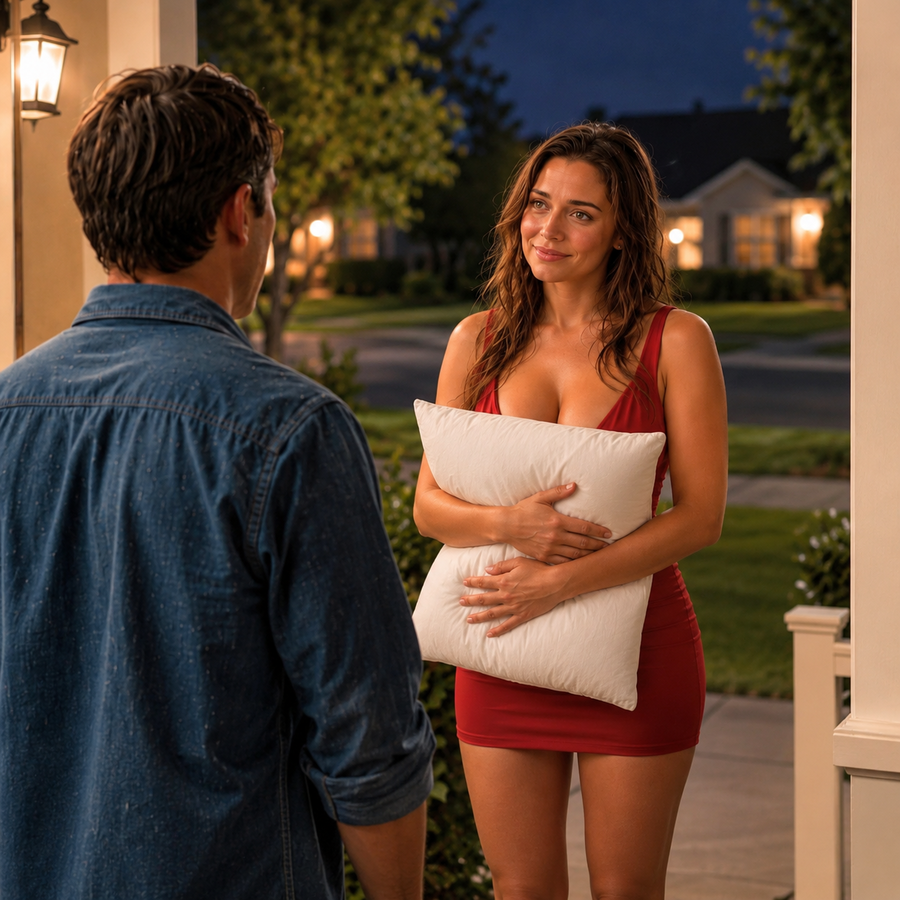
“Do you mind if I stay here tonight?”
“Depends.”
She said, leaning against my doorframe with a faint, reckless smirk.
“Is there room in your bed?”
I stood there holding a flickering beeswax candle, completely caught off guard. My brain stalled for 2 seconds flat before she broke into a laugh.
The kind of sudden, tired laugh that sounded like it had been dragged through gravel. She shook her head quickly, waving a hand in the dim hallway as if to erase the words from the air.
“Kidding.
I swear I’m kidding.”
She breathed, pulling her oversized sweater tighter around herself.
“The couch is fine.
A corner of the rug is fine.
Anywhere that isn’t across the hall.”
She wasn’t joking because she found the situation funny.
She was joking because if she didn’t say something ridiculous first, she looked like she might shatter right on my welcome mat.
The storm had rolled over the city just after 9:00, knocking out the power grid across our block with a violent crack of thunder that rattled the radiator pipes. Our building was an old brick walk-up on the corner of 4th and Elm, charming if you liked high ceilings and drafty sash windows, miserable if the neighborhood circuit breakers decided to give up the ghost.
I’d spent 40 minutes hunting down matches, lighting half-spent candles, and resigning myself to an evening of scraping bookbinding glue off my fingers in the dark.
Then came the knock, soft at first, then rapid and uneven, like someone trying very hard not to look desperate. When I pulled the door open, Maisie was standing under the pitch-black hallway ceiling.
She was clutching a flatbed pillow to her chest and holding a cheap plastic flashlight that was already blinking its dying amber wheeze. She was wearing a faded gray crew neck with frayed cuffs and flannel pajama pants that dragged slightly against the floorboards. Her dark hair was pulled into a messy knot that seemed to be held together purely by stubbornness.
She had moved into apartment 3B directly across from mine just 3 days ago.
I only knew her name because I’d held the heavy lobby door open while she wrestled a taped-up U-Haul box full of ceramic mugs and art supplies up three flights of stairs.
So, we had traded all of four sentences then. Her breathless thanks, my clumsy assurance that the stairs were terrible for everyone, and her quiet remark that she hoped the building had decent insulation because she was prone to dropping things.
Now, she was on my threshold, shivering slightly, looking small in a way that had nothing to do with her height.
“My apartment is pitch black,” she admitted, her voice dropping as she stepped inside without waiting for a formal invitation.
“Like, total void.
And the radiator in my living room keeps making this godawful groaning sound that makes me feel like I’m trapped in an abandoned meat locker.”
“The pipes get air pockets when the steam pressure drops,” I said, nudging the door shut with my foot until the deadbolt clicked.
The sound locked out the hollow howling of the wind in the stairwell.
“It’s harmless mostly.
Just noisy.”
“Right now, harmless sounds terrifying.”
She stopped in the center of the room and looked around. By candlelight, my place looked less like an apartment and more like an eccentric archive.
Stacks of cloth-bound novels and old trade paperbacks climbed from the hardwood floor like crooked mini skyscrapers. A pair of brass bone folders and an open jar of wheat paste sat beside a mug of cold coffee on the work table. The sofa itself was buried under a wool throw and three heavy volumes of an early 20th century encyclopedia.
I was supposed to be rebinding for an estate sale downtown.
“Give me 10 seconds,” I said, hurriedly gathering the encyclopedias into my arms.
I wasn’t exactly expecting company.
“Don’t move them on my account,” Mazie said, though she sank into the newly cleared corner of the cushions with an audible exhale, as if she’d been holding her breath since noon.
She hugged the pillow tight against her ribs. Her knuckles were white.
“Caleb, right?
You’re Caleb?”
“Yeah, Caleb.”
“Mazie.
” “Though you probably saw that on the junk mail piled by the lobby radiator.”
I figured. I set the heavy books on the floor by my desk and went to the tiny kitchen nook. The pilot light on the old gas stove was still burning, the single saving grace of an apartment built in 1928.
I struck another match, lit the front burner under an old tin kettle, and pulled two mismatched mugs from the open shelf.
“Chamomile or peppermint?”
I called over the low hiss of the blue flame.
“Whatever is hot and doesn’t require electricity,” she called back.
When I walked back into the living room, the candle on the side table cast long amber shadows across her face. Up close, without the hallway dark masking her features, the exhaustion was stark. Deep violet shadows bruised the skin beneath her eyes, and there was a brittle tightness around her jawline, like someone who had survived on black coffee and sheer willpower for weeks.
She accepted the mug with both hands, curling her fingers tightly around the warm ceramic.
“Thanks,” she whispered.
“Seriously, I know it’s weird.
Banging on a stranger’s door at midnight because the lights went out.
I’m an adult.
I should be able to sit in a dark room without having a mild breakdown.
“Darkness makes everything loud.”
I said, pulling my worn leather armchair closer and sitting down.
“Especially the things you’re trying not to hear.
” She looked up over the rim of her mug, her eyes catching the golden wick of the candle.
For a second, the witty defensive barrier she kept throwing up dropped completely, leaving something terribly raw and unguarded in its place.
“You have no idea.”
she murmured. We sat in silence while the rain beat against the windowpane, heavy and deliberate, blurring the streetlights below into smudges of orange on the wet pavement.
Her phone vibrated on the cushion beside her, a harsh, rhythmic buzz against the quiet.
Maisie didn’t pick it up.
She didn’t even look at the caller ID.
She reached out, turned the screen face down, and pressed her lips together until they formed a pale, thin line.
“Bad news?”
I asked gently, keeping any trace of pry out of my voice.
“Old news.”
she said, her tone dropping into a register that sounded flat and hollow.
“The kind that keeps ringing because it wants to make sure you haven’t forgotten how much it hurt.”
She stared down into the dark amber tea, watching the steam curl up toward the ceiling.
I didn’t push.
I’d spent enough years nursing my own quiet grief after my folks died to recognize the anatomy of a fresh scar.
When someone is bleeding that heavily on the inside, questions don’t comfort them.
Presence does.
“The couch isn’t bad once you get used to it.”
I said quietly, leaning back into the chair.
“The spring on the left side has an attitude, but it’s dry.
And the deadbolt on the door actually works.”
Maisie looked at me then, past the scattered books and the awkwardness of the midnight hour. A tiny, genuine softness touched the corner of her mouth, not the sharp smirk from the hallway, but something fragile and honest.
“Thanks, Caleb,” she said softly, “for the couch and for not asking why I looked like I was drowning before the rain even started.”
“Get some sleep, Mazie,” I replied, standing up to fetch a spare quilt from the hall closet.
“The storm usually blows out over the river by dawn.”
She nodded, pulling her knees up to her chest and tucking the quilt around her shoulders like a shield. Outside, the thunder rolled away into the distance, low and receding, while inside, the quiet between us stopped feeling like an intrusion and slowly began to feel like shelter. The smell of scorched butter was what woke me.
I pulled myself off the cot in my back workspace around 7:00, following the haze of smoke into the kitchen. Mazie was standing at my two-burner stove, wearing the gray crewneck and a pair of my thick woolen work socks, poking at a blackened disk in a cast-iron skillet with a metal spatula.
Her hair was piled high in another chaotic bun, and she looked thoroughly defeated by a carton of eggs.
“The power came back at 5:00,” she said without turning around, her voice thick with sleep and irritation.
“I thought I’d be neighborly, make breakfast to repay the shelter.
Instead, I’ve committed a felony against pancake mix.
” “You used the small skillet,” I said, leaning against the doorframe.
“It holds heat unevenly on the left burner.”
She looked down at the charred cake, then over at me with an apologetic wince.
“You could have warned me before I ruined four perfectly innocent cups of flour.”
I took the spatula from her hand, dumped the smoking batter into the compost bin under the sink, and set the skillet off the flame. We ended up splitting an old loaf of sourdough toasted until it was bearable, slathered in strawberry jam that was probably 3 months past its prime sitting side by side on my rug with our backs propped against the base of the sofa.
We ate in comfortable bleary-eyed silence. When she finished her tea, she dusted the crumbs from her lap, stood up, and looked down at me.
“Thanks for not letting me freeze across the hall, Caleb.”
“Door’s always unlocked if the grid goes down again.”
I told her. She had an apartment of her own, but somehow over the next 4 weeks, the space between 3A and 3B quietly evaporated. It started with practical things.
A blown fuse in her bathroom that needed replacing, a sticky deadbolt on her door that needed graphite, a heavy box of watercolor paper she couldn’t hoist onto her top shelf.
Then it became a bowl of beef stew I’d deliberately made too much of knocked across the hall under the pretense of clearing out my freezer.
By the second week of November, she had stopped knocking with excuses. She would simply appear around 6:00 in the evening with a bag of groceries, kick off her shoes by the entryway, and complain about the transit schedule while I peeled potatoes. One rainy Thursday, she arrived dragging a flat-pack flat file cabinet from an estate clearout down on South Main.
It was pressed particle board and bad intentions with instructions printed in three languages that barely made sense in any of them. We spent 2 hours on the hardwood floor with a pair of screwdrivers and a tube of wood glue.
Halfway through, she held up three zinc screws and a stray dowel pin between her fingers.
“We have parts left over.”
she said, looking suspiciously at the wobbling carcass of the cabinet.
“Those are optional.”
I lied, tightening a corner bracket until the wood groaned.
“Manufactured redundancy.
If this collapses on my sketches, I’m suing you for emotional damages.
” “The court will rule in favor of the cabinet,” I said.
“It put up a brave fight.”
She laughed. That sudden unguarded sound that had caught my attention the night of the blackout, and leaned her shoulder against mine. The contact was brief, casual, but it sent a quiet jolt straight through my ribs.
I stayed completely still, terrified that if I breathed too loud, the moment would dissolve. Her phone buzzed against the floorboards.
The laughter died instantly.
Maisie didn’t reach for the device, but her shoulders seized up, her jaw locking into that familiar brittle line.
The screen lit up in the dimming afternoon light, showing a name I hadn’t seen before, Julian.
It vibrated four times, stopped, and then started again. A voicemail notification popped up.
“You can take it,” I said quietly, setting my screwdriver down on a rag.
“I can finish the drawer slides.”
“There’s nothing to take,” she muttered.
She stared at the screen as if it were a venomous snake coiled between us.
“Five years, Caleb.
We shared a lease, a cat, a car, and every single holiday since I was 22. And then one Tuesday morning last August, I found an email confirmation for a weekend cabin rental upstate.
Not with me.”
The room grew very quiet, save for the rain clicking rhythmically against the glass.
“He told me it was a misunderstanding,” she continued, her voice low, drained of all inflection.
“Then he told me I was paranoid.
Then he told me she was the one he was supposed to be with all along. He kept the lease because his father co-signed it.
His friends stopped answering my texts because it was easier than picking sides.
So, I packed two suitcases into the back of a rented sedan and drove 300 miles until I ran out of gas money.”
She pulled her knees up to her chest, resting her chin on the faded denim.
“The worst part isn’t the lying.
It’s that he keeps calling to ask if I’m doing okay.
Like my survival is just a footnote on his conscience he needs to check off so he can sleep at night. I looked at the thin line of her shoulders, so fragile under the knit sweater, and felt an ache in my chest that had nothing to do with pity.
I knew what it felt like to have your entire world torn out from beneath your feet without warning.
I’d spent 2 years after my parents’ car accident staring at the walls of this very apartment convinced that loving anything was simply setting yourself up for an ambush.
“You don’t owe him an answer.”
I said gently.
“You don’t owe him absolution.
” “I know.”
she whispered.
“I just I keep waiting for the part where it stops feeling like a knife between my ribs.”
“It takes as long as it takes.”
I told her. I wanted to reach out.
I wanted to put my hand over hers, pull her against my shoulder that way wasn’t invisible, that she was the brightest thing that had walked into this dusty building in a decade.
But I held back.
When someone has been burned that badly, love offered too quickly doesn’t feel like a shelter.
It feels like another fire.
You don’t repair an 18th century binding by forcing the spine straight.
You humidify the paper, you set the weights, and you wait. A week later Mazie got a part-time gig at a florist shop five blocks north near the university quad.
Small transformations followed. A glass pickle jar filled with seeded eucalyptus and white ranunculus appeared on my kitchen sill. Fresh apples replaced the canned soup on my counter.
The dust in the apartment seemed lighter caught in the late afternoon sun that slanted through the clean panes she had wiped down when she couldn’t sleep.
The turning point came in the dead of December. It was nearly midnight and we were in my kitchen waiting for the kettle to boil after walking back from her shift through the slush. Her phone buzzed in her coat pocket.
Mazie froze.
For three rings, she just stood by the sink watching the reflection of the stove’s blue flame in the window.
Then, with a breath that sounded like diving into icy water, she pulled the phone out, slid her thumb across the glass, and held it to her ear.
“Julian,” she said.
Her voice was remarkably steady, stripped of all tears, cold as the frost outside. I stepped back into the doorway, keeping my eyes fixed on the linoleum floor to give her whatever privacy 40 square feet could afford.
“No,” she said into the receiver.
“You don’t get to ask how the weather is.
You don’t get to ask if I’ve found an apartment or if I’m eating.
You gave up the right to care about those things 4 months ago. No, listen to me. I spent 5 years apologizing for the spaces you refused to fill.
I am done apologizing for your mistakes.
Do not call this number again.”
She ended the call, tapped the screen twice to block the contact, and set the phone face down on the counter with a quiet, decisive tap. Her hands were shaking. She stood there for 5 seconds, her chest heaving, before she turned around.
When she saw me standing by the worktable, the armor cracked.
She didn’t say a word.
She just crossed the two paces between us, buried her face into the front of my flannel shirt, and let go. I wrapped my arms around her, pulling her close, holding her against the quiet hum of the old building. She wept against my chest, not the loud, frantic sobs of panic, but the long, shuddering breaths of someone finally setting down a weight they had carried until their bones creaked.
“I thought it would feel like winning,” she choked out against my collarbone.
“Why does it still hurt?”
“Because you were honest, Mazie,” I whispered, resting my chin lightly against the top of her hair, smelling the sweet, sharp scent of cedar and pine she’d carried from the flower shop.
And because ending a chapter doesn’t mean the book is over, it just means you finally get to turn the page.
Winter didn’t end with a dramatic thaw, it simply gave way week by week until the gray ice along the curb turned to slush and the city began to smell of wet asphalt and early earth.
By mid-April, apartment 3A had ceased to be a quiet tomb of dead authors.
The sill above my cast-iron sink was crowded with terracotta pots of sweet mint and lavender Maizie had rescued from the shop’s compost pile.
Two of her ink sketches, rude beautiful studies of the elm trees in the park, were taped directly to the plaster beside my drafting table.
Her presence wasn’t an invasion.
It had settled into the cracks of the room like morning light, slow and completely irreversible. We fell into a rhythm so natural it frightened me.
On weekends, she would sit cross-legged on my rug trimming the rough watercolor edges of her illustration prints while I sat at the bench with my bone folder and linen thread quietly sewing the signatures of a family Bible back into its calfskin spine. We could go 3 hours without exchanging 10 words, yet the silence felt crowded with understanding.
Then came a Friday evening when she walked in without her work apron.
She didn’t drop her keys on the counter.
She stood in the hall by the coat hooks, both hands shoved deep into the pockets of her canvas jacket, watching me clear off the dining table.
“Take a walk with me,” she said.
“It’s barely 45° out,” I pointed out, setting a glue pot down.
“Put on the heavy coat, bookbinder.”
Trust me. We walked north leaving the tight grid of the old neighborhood behind following the gravel pedestrian path that wound up toward the reservoir hill. It was the highest point on the east side of town, overlooking the low brick skyline and the river that curved like a dark ribbon through the scattered yellow lights below.
The wind was brisk, biting at our ears, but the sky was clear, scrubbed raw by an afternoon drizzle. Mazie sat on the damp wooden bench overlooking the valley. She pulled her knees up against her chest, just as she had on my couch 6 months earlier, and stared at the headlights crawling along the avenue beneath us.
“Can I ask you something?”
she said quietly.
“Always.”
“Why did you open the door that night?”
I looked down at the gravel between my boots.
“You knocked.”
“A lot of people knock,” she said, turning her head to look at me, her eyes dark and searching in the half-light.
“Most men would have given me a candle, locked the deadbolt, and gone back to bed.
Or worse.
” I shoved my hands into my pockets, feeling the familiar heavy ache behind my ribs.
“I knew what you looked like,” I said, “not just because I’d seen you in the hall.
After my parents died, I spent 3 years walking through this city feeling like a ghost. Like if I tripped into the river, no one would notice until the mail piled up too high. When you stood there in the hallway with that dying flashlight making stupid jokes about my bed, I recognized the look.
You weren’t afraid of the dark, Mazie.
You were afraid that if the lights went out, you would simply stop existing.”
She didn’t speak.
She just looked down, her lower lip trembling slightly before she caught it between her teeth. Then she reached into her inner coat pocket and pulled out a long white envelope folded twice across the middle.
She held it out toward me.
“My lease on 3B ends next week,” she said.
My stomach dropped so fast it felt like the ground had fallen away beneath the bench. I took the paper, unfolded it. It was a formal tenant agreement, pre-approved and signed by a rental agent for a bright, newly renovated one-bedroom over on Division Street, close to the park, close to her shop, clean and independent.
Everything an adult moving on with her life was supposed to want.
“You got it,” I said.
I tried to make the words sound light, encouraging, the way a supportive friend ought to sound. But my throat felt thick, lined with glass.
“Maisie, that’s that’s great.
And it has a southern exposure for your plants.”
She tilted her head, watching the strain in my jaw.
“You think I’m leaving?”
“I think you’ve spent six months fighting like hell to stand on your own two feet,” I answered honestly, looking straight into her eyes.
“And you did it.
You survived Julian, you built a life, and you don’t need anyone’s spare couch anymore.
I’m not going to be the person who holds you back because I got used to having fresh flowers on my windowsill.
” Maisie stared at me for a long, quiet moment.
Then she took the envelope from my hand, pinched the seam, and slowly, deliberately, tore it down the center.
“What are you doing?”
I choked out. She tore it again, folding the quarters into a small square, and shoved the useless scrap back into her pocket.
“When Julian took the apartment back home,” she said, her voice dropping into that calm, resolute cadence I had learned to respect, “I told myself I would never depend on another human being again.
I thought having a home meant having my name on a brass lease and a deadbolt only I had the key to. I thought independence was safety.
” She turned fully toward me on the bench, closing the distance between us until the cold air smelled faintly of her, sweet tea, turpentine, and rain.
“Then I lived across from you,” she whispered, “and I realized something.
A home isn’t an address on a piece of paper, Caleb.
A home is the place where somebody notices when your tea goes cold.
It’s the place where someone gives you room to bleed without asking when you’re going to finish bandaging yourself up.”
She reached out, slipping her fingers around my wrist, her touch warm against the cold wind.
“Do you remember what I said that night?”
she asked, a small, crooked smile tugging at the corner of her lips.
“In the hallway, when you were standing there with that ridiculous candle.
You asked if there was room in my bed.”
“I did,” she said softly, “and we both laughed because it was easier than crying.
But that wasn’t what I meant, Caleb.
I never actually gave a damn about the bed. I was terrified and I was drowning and I wanted to know, I needed to know if there was room in your life for somebody who was broken.
” My breath caught in my chest.
The wind off the river whipped a stray strand of dark hair across her cheek. I reached up with my gloved hand, gently brushing the hair behind her ear, letting my palm rest against the soft curve of her jaw.
“Is there?”
she whispered, searching my face.
“Is there still room?”
“Maisie,” I said, my voice barely louder than the rustle of the budding trees above us.
“There’s never going to be room for anyone else.”
She let out a breath that sounded half like a laugh and half like a sob. And then she leaned in, closing the last few inches between us. Her lips were cool from the spring air, but her mouth hunt was warm, soft, and completely sure.
It wasn’t the tentative, desperate cling of two people hiding from a storm.
It was the quiet, deliberate arrival of someone who had finally stopped running. I pulled her against me, wrapping my coat around her shoulders, feeling her fingers twist tightly into the wool of my jacket as the lights of the city hummed and blurred in the valley below. People write entire libraries of books trying to explain how love begins.
They look for grand speeches, brass bands, and fireworks in the dark.
They’re wrong.
Sometimes it begins with an old walk-up, a blown fuse, a stack of ruined pancakes, and a girl who was brave enough to knock on a stranger’s door when the lights went out.
We thought we were just surviving a midnight power outage. We had no idea we were unlocking the rest of our lives.
If Caleb and Maisie’s story brought a little light into your day, please take a moment to subscribe so we can share more quiet journeys like this together.
THE END.