I Checked a House for My Ex’s Sister. She Told the Owner, “Sold, the Keys Are for My Husband and Me”

I Checked a House for My Ex’s Sister. She Told the Owner, “Sold, the Keys Are for My Husband and Me”
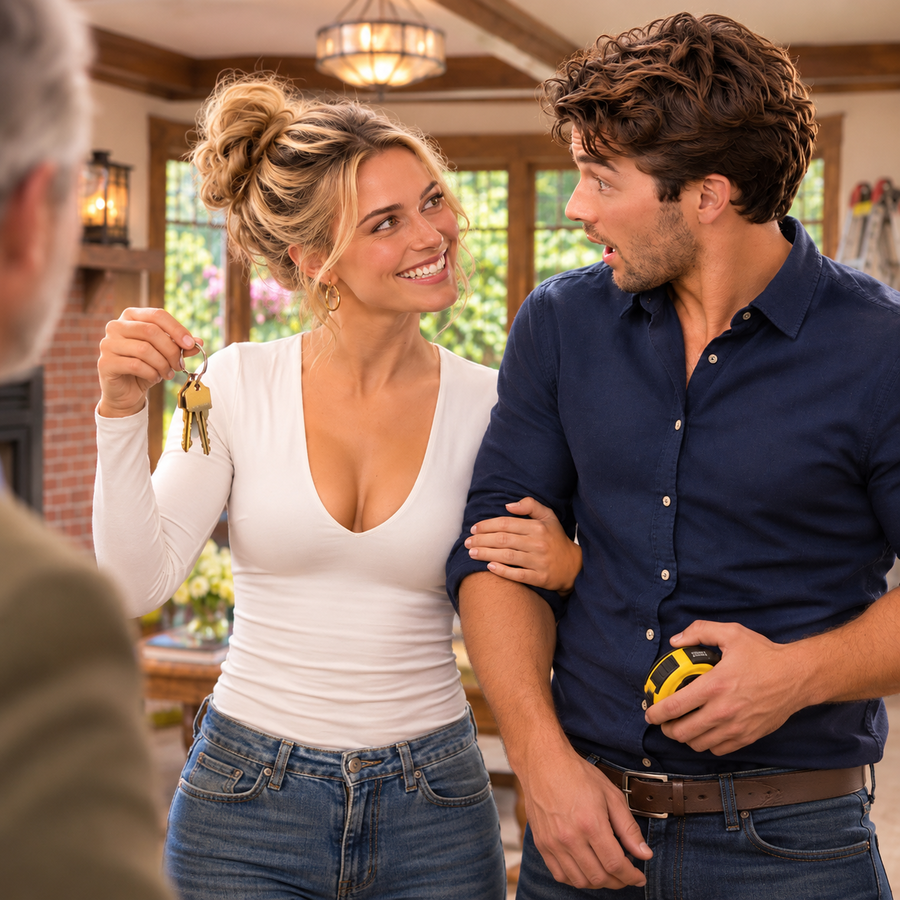
My ex-girlfriend’ little sister took me to an open house in an old white farmhouse outside Lexington, Kentucky.
I thought she just wanted me to check the rafters.
Then the realtor walked up, smiled, and asked, “So, are you two looking together?”
Before I could clear my throat, Lucy Foster slipped her arm through mine like she’d practiced it in a mirror and said, “Yes, my boyfriend and I love it.
” I choked on my lemonade so hard the realtor had to pat me on the back because Lucy was not my girlfriend.
Lucy Foster was the younger sister of the woman who broke my heart. My name is Graham Tucker.
I’m 32 and I restore old houses, farmhouses, Victorians, and barns people say should be torn down.
Three years ago, I dated Danielle Foster. She told me I spent too much time fixing old things instead of building something new, then moved to Chicago, married a banker, and sent me a polite text. Danielle wore heels and wanted a penthouse.
Lucy was 28, wore rubber boots, kept 40 beehives, and sold honey at the Saturday market under a yellow tent.
Whenever she saw me, she’d toss a little jar into my truck and say, “For your toast, Tucker.
You look like a man who eats sad toast.”
She wasn’t wrong.
So when she called asking if this farmhouse was about to collapse, I showed up. The place sat on eight rolling acres with peeling paint, a peach orchard, and a creaking porch swing.
It was falling apart, but Lucy looked at it like she’d just found home.
Then came the lie.
While I wiped lemonade off my shirt, the realtor, Bev, told us the 88-year-old seller, Mrs.Hollis, had turned down greedy developers because she’d only sell to a young couple who loved the house like she and her late husband Harold did.
The second Bev walked off, I whispered, “Lucy, what did you just do?
You panicked yourself a boyfriend?”
“I read the listing,” she whispered back, her face crimson.
“It said prefers a committed couple.
You’re the only man I know who understands a load-bearing wall, Graham.
Please. Just for this afternoon.
10 minutes later, we were sitting on the back porch swing with Mrs.Hollis herself. Tiny, sharp blue eyes rocking in her lavender cardigan. When she asked how we met, Lucy blurted out, he saved my bees.
It was true. Two summers ago, a swarm hit the market parking lot.
I walked right into 10,000 bees with a cardboard box to catch the queen, took 12 stings, and sat in my truck asking Lucy if she was all right. Mrs.Hollis smiled, remembering how Harold got stung on the nose the day they met in 1958.
Sunday supper, she ordered, 6 o’clock, fried chicken.
I want you two in my kitchen. That kicked off three days of boyfriend school.
Lucy sat cross-legged on my couch with a spiral notebook quizzing me on her favorite color, her middle name, and my hatred of cilantro.
But when I asked why she’d really brought me, she picked at the thread on her overalls and looked down.
Because when I pictured living in that house, Graham, I pictured you on the porch.
Sunday supper at Eleanor Hollis’s farmhouse felt less like an audition and more like stepping through a tear in time.
The kitchen smelled of lard, cast iron skillet chicken, and sweet peaches simmering down with cinnamon. Eleanor moved between the stove and the porcelain sink with the measured, stubborn rhythm of someone who had known those floorboards since Dwight Eisenhower was in office.
She didn’t use a timer.
She listened to the sizzle in the grease and watched the steam rise from the pot.
Lucy and I sat shoulder to shoulder on mismatched wooden chairs at a yellow Formica table that had witnessed 62 years of someone else’s marriage.
Every time Lucy shifted, her knee bumped against mine under the table, sending a sharp electric hum straight through my denim jeans. Neither of us pulled away. We were terrified that if we broke contact for even three seconds, the old woman would see right through the seams of our story.
Harold liked drumsticks, Mrs.Hollis said, sliding a heaping platter between us with hands spotted by age and garden soil.
Said a man who only eats white meat doesn’t have enough blood in him to work a farm.
Take two, Graham.
Yes, ma’am, I said.
We ate in a quiet that was thick with history. Halfway through the meal, while Mrs.Hollis was at the counter pouring sweet tea from a chipped glass pitcher, Lucy looked at me. Without breaking eye contact, she reached over with her thumb and wiped a stray biscuit crumb from the corner of my mouth.
It was completely instinctive.
She didn’t think about it.
Her thumb was warm, slightly rough from hauling hive frames, smelling faintly of clover and beeswax.
Then she realized what she’d just done.
Her hand froze in midair, hovering inches from my chin, and all the blood rushed straight into her cheeks. I stopped chewing. I looked at her thumb, then into her wide hazel eyes, and for a second, my heart pounded so hard in my ribs, I was sure it rattled the silver salt shakers.
From the counter, Mrs.Hollis turned around with the pitcher.
She didn’t say a single word.
She just set the tea down and smiled a quiet, knowing little smile into the rim of her glass.
Sun’s dipping, Mrs.Hollis announced as soon as the cobbler plates were scraped clean.
She pointed toward the back door with a wooden spoon.
I need two bushels of peaches picked for tomorrow’s church pies before dark.
You two get out to the orchard.
I’m going to rest my eyes in the parlor.
The orchard behind the house sloped down toward a shallow creek where wild mint grew thick in the gravel. In the late June heat, the air hung heavy with the smell of sun-baked grass and fermentation, ripe peaches that had dropped into the clover and split open.
The whole hillside was washed in that deep golden Kentucky twilight where every fence post casts an impossibly long blue shadow. Lucy carried one bushel basket. I carried the other She walked fast, her yellow rubber boots thudding softly against the turf, humming a tuneless little melody under her breath like she always did when she was nervous.
She stopped beneath a towering Alberta tree near the third row, craned her neck, and looked up into the canopy. High above her head, dangling just out of reach, was a peach the size of a softball, velvet skin streaked with crimson. She stood on her tiptoes.
Her fingers brushed the bottom leaf. She groaned, bent her knees, and jumped. Her fingers missed by 3 in.
Need a boost, Foster? I asked, setting my basket down in the clover.
I’m fine, Tucker, she grunted, pulling her bandana tighter around her unruly curls.
I lift 60-lb honey supers all morning. I can reach a piece of fruit. She jumped again.
Her boots landed in the soft dirt with an ungraceful thud, and the branch barely shook.
I didn’t ask a second time.
I stepped up behind her, placed my hands firmly around her waist and lifted. Lucy let out a startled little gasp that turned into a breathy laugh as her boots left the ground. She was lighter than I expected and solid and warm, her cotton shirt bunching under my calloused palms.
She reached up, twisted the peach free with a practiced flick of her wrist and held it high above her head like she’d just won an Olympic medal.
Got it, she cheered. I lowered her back down slowly.
My boots were planted in the weeds, but when her feet touched the earth, I didn’t take my hands off her hips, and Lucy didn’t step forward.
Instead, she turned around slowly within the small circle of my arms. We were standing so close I could see the flecks in her hazel eyes and the faint smudge of peach fuzz on her collarbone.
The sunset behind her cast an amber halo through her wild curls, setting every loose strand on fire. My hand stayed resting against the curve of her waist, thumb resting just above her belt loop. Graham, she whispered, her voice suddenly dropping an octave.
Yeah? Mrs.Hollis is in the parlor, she murmured, her eyes searching mine.
She can’t see us out here.
I know. Then why are your hands still on me?
My chest tightened.
Why haven’t you told me to let go?
A silence stretched between us, so still that the only sound in the entire county seemed to be the rustle of peach leaves and the steady thud of my own pulse. Lucy parted her lips slightly. She lifted her chin, rising just half an inch onto her toes, leaning into the space between us, and a honeybee dropped out of the foliage and landed directly on the bridge of my nose.
We both froze instantly.
Don’t move, Lucy whispered, her eyes widening.
Lucy, I muttered through clenched teeth, crossing my eyes, trying to look at the fuzzy yellow speck sitting between my eyebrows. There is a bee on my face. I know.
Don’t breathe through your nose.
It’s a worker.
She’s just investigating.
She’s investigating whether she wants to put a stinger in my sinus cavity.
Stay completely still, Graham. Lucy lifted her right hand with absolute steady grace.
She didn’t swat or flinch.
She simply brought the tip of her forefinger up to my face and rested it gently against my skin beside the bee. She clicked her tongue softly, making a tiny soothing hum in the back of her throat.
The worker bee crawled off my nose and onto Lucy’s knuckle, grooming its front legs in the evening light.
Lucy slowly drew her hand back, lifted it toward the sky, and watched the bee lift off, buzzing away toward the creek. Then Lucy looked back at me. Her mouth twitched.
A snort escaped her nose, and then she completely lost it. Just like Harold, how she gasped, clutching her stomach as she doubled over with laughter. You should have seen your eyes.
You looked like a terrified bulldog. Hey, that was a legitimate survival response.
I couldn’t help it.
The ridiculousness of the moment broke the dam and a deep helpless laugh tore out of my chest. She stumbled slightly in the dirt and when she grabbed my arm to steady herself, we both tumbled down into the high clover beneath the peach tree.
The bushel baskets tipped over, sending pale green and blushing peaches rolling out across the grass like scattered marbles. We sat there side by side, our shoulders pressed tight against each other, laughing until our ribs ached.
When the laughter finally faded into quiet gasps, Lucy didn’t pull away.
She leaned her head gently against my shoulder. Her hair brushed against my neck, smelling of sunshine and dried lavender.
And we sat together in the dampening grass, watching the sky turn from gold to bruised purple until the first whippoorwill started calling from the woods.
I didn’t kiss her that night, but God help me.
Looking down at the curve of her forehead against my worn denim jacket, I knew that walking away from her was no longer something I was capable of doing. The professional reality came crashing down three days later.
On Thursday morning, I returned to the farmhouse with my contractor’s kit, moisture meter, flashlight, level, and a yellow legal pad.
I spent four hours crawling through the darkest corners of the 88-year-old structure. I crawled under the wrap around porch into spider webs and damp dirt to inspect the foundation. I hauled my frame through the trap door into the stifling heat of the attic to inspect the roof trusses.
I pulled the cover off the electrical panel in the back pantry.
The news wasn’t just bad.
It was brutal. Lucy was waiting on the sagging front porch.
When I finally climbed down out of the crawl space, my knees caked in red Kentucky clay and my forearms covered in insulation itch. She was sitting on the wooden steps, holding two cold bottles of sweet tea, her eyes wide with hope.
Give it to me straight, Tucker, she said, trying to smile. Does she hold?
I didn’t answer right away.
I pulled off my leather gloves, sat down on the step beside her, and laid the yellow legal pad across my lap. The main floor joists are solid white oak.
They’ll outlive all of us, I started carefully.
The limestone foundation walls are true, but Lucy, the southern sill plate is completely rotten from decades of clogged gutters overflowing onto the siding. The wiring is old knob and tube with brittle cloth insulation from 1952.
It’s a miracle the kitchen hasn’t burned down.
And the shake roof under those asphalt shingles is spongier than wet cardboard.
The color drained out of Lucy’s face so fast it looked like she’d been struck.
She looked down at the paper, her fingers tightening around her tea bottle until her knuckles turned bone white. How much?
She whispered. I pointed to the figure circled at the bottom of the first column. If you hire a general contractor out of Lexington to pull permits and do the overhaul, $40,000 minimum before cosmetic work, before paint.
Lucy didn’t speak.
She just stared at the number. A tear welled in her lash line, caught the midday sun, and spilled down over the freckles on her cheek.
I can’t do that, she said, her voice small, cracking at the edges.
Graham, I’ve got $9,000 in my savings account.
That’s six years of hauling hives in the freezing rain, melting down beeswax in my kitchen, and selling honey $5 a jar at the Saturday curb.
I was going to use 8,000 for the down payment and pray the bank approved me on the rest.
I don’t have $40,000.
I’m a beekeeper.
She dropped her face into her hands, her shoulders shaking with silent, ragged sobs.
I ‘m an idiot.
I thought I could just build a life here, put my hives in the orchard, paint the trim, fix a few boards. I should have known. Lucy, I said gently, reaching out and pulling her eyes away from her face, look at the pad.
She blinked through her tears, sniffing. Why? It says 40.
Look at the second column. I tapped my pencil against the row of figures written below it.
Rented floor jacks to lift the sill, 400 bucks. Rough-sawn cedar timbers from my buddy Miller at the lumberyard, 800. Romex wire, modern breaker box, and conduit, 1,800.
Metal roofing panels, 6,000. Total materials, 11,200.
She stared at the numbers, her brow furrowing in confusion.
Okay, but who’s going to lift a house on jacks?
Who’s going to crawl under those sills and rewire 80-year-old walls?
I just sat there, looking at her. Her mouth fell slightly open.
Her breath hitched. Graham, no.
Absolutely not.
It’s what I do, Lucy.
No. She shook her head fiercely, pulling her hands back.
That is months of backbreaking labor.
That’s your entire summer.
You work 60 hours a week restoring Victorians in town for wealthy clients who pay you real money.
You can’t spend your weekends eating insulation and digging in dirt for free.
I don’t remember saying it was for free.
She glared at me through wet eyelashes.
I told you, I don’t have the cash to pay you.
Then pay me in honey. Graham, be serious.
She cried, her voice cracking.
That’s not a payment.
That’s an insult to your trade.
It’s not an insult to me, I said, my voice dropping low and steady.
I like weekends. Weekends without a project means sitting in an empty house listening to the refrigerator hum, wondering what Danielle is doing at some charity gala in Chicago.
I’d rather be here.
Why? She whispered, searching my eyes, desperate for an answer that made sense in her world. Why would you sacrifice your whole life for a girl who dragged you into a lie?
I reached out and tucked a wild blonde curl behind her ear. Because last week you told me that when you pictured living in this house you pictured me on the porch, I said softly.
And the second you said it, Lucy I couldn’t picture myself anywhere else.
She looked at me for a long breathless moment.
A fresh tear slid down her jawline, but this time she didn’t look away and she didn’t apologize.
Mrs.Hollis accepted Lucy’s formal offer the very next afternoon.
Bev, the realtor, called Lucy while we were standing outside my work truck at the lumberyard. According to Bev, the commercial developer from Cincinnati had raised his bid by another $15,000 in cash, promising to bulldoze the entire parcel and break ground on an executive subdivision within 90 days. Mrs.Hollis had told him to take his checkbook and go back up north.
I’ve made my peace, the old woman had told Bev over the phone.
That developer only sees timber and subdivision lots. That little bee girl looks at this house and sees a home.
And that young carpenter looks at her like she hung the moon.
A house knows when it’s loved, Beverly.
Tell them the papers are drawn. The closing was set for late August, giving Lucy time to finalize her agricultural small business loan. But Mrs.Hollis gave us written permission to begin structural repairs immediately.
That summer in Bourbon County became the sweatiest, loudest, most exhausting season of my 32 years, and the only time in my adult life I woke up on a Saturday morning actually eager to climb out of bed. Every Saturday at 6:00 in the morning, my beat-up Ford truck rattled down the Hollis gravel driveway, loaded with framing lumber, circular saws, and toolboxes.
And every Saturday at 6:05, Lucy’s rusted yellow pickup would pull in right behind me, the truck bed rattling with bee smokers, hive tools, and a Coleman cooler filled with sandwiches and sweet tea.
We tore out the southern sill plate first. It was miserable, terrifying work.
We set hydraulic 20-ton bottle jacks on concrete footers beneath the foundation beams and slowly pumped the handles, lifting the southern wall of the two-story house an eighth of an inch at a time. The old timbers groaned and popped, settling into the lift like an old man cracking his joints.
Lucy stood beside me in the mud, holding the work light, her jaw set tight, never complaining once about the spiders, the sawdust, or the blistering humidity. By mid-July, we had stabilized the foundation and moved inside to gut the moldering drywall in the kitchen.
That was where the great kitchen island war began. It ruins the historic footprint, Lucy, I argued, standing in the middle of the bare studs with a chalk line in my hand.
In 1910, Kentucky farmhouses had open hearth or work table floor plans. You put an 8-ft fixed island right here in the center, and you choke off the traffic flow between the pantry and the back door.
Lucy stood with her hands planted firmly on the hips of her denim overalls. A streak of gray sheetrock dust smeared across her cheek.
Graham Tucker, I don’t give a damn about the traffic flow of 1910.
She shot back, waving a putty knife at me.
Mrs.Hollis didn’t have 40 hives producing 1,200 lb of clover honey every July.
I need 6 ft of butcher block to sterilize jars, run the centrifugal extractor, and cap honeycomb.
If I don’t have an island, I’m jarring honey on the floor, and bees don’t like floor honey.
A work table would move.
I don’t want a table that wobbles.
I want an island. She stepped up to me, tapping the blunt end of the putty knife against the center of my chest, a solid, unmovable giant island built by the best carpenter in Lexington. I looked down at her.
Her face was flushed, her curls escaping from under a blue her eyes sparkling with stubborn, joyful fire. You fight dirty, Foster, I muttered. I fight to win, Tucker.
She won. Of course she won.
The following Tuesday I drove two hours out to an old tobacco barn being dismantled in Mercer County and bought three 4-in thick planks of reclaimed heart pine that had cured in the rafters for a century.
I spent three late nights in my shop planing them down by hand, cutting mortise and tenon joints just to make sure her island wouldn’t wobble even if a freight train ran through the kitchen.
Most Saturdays Mrs.Hollis watched our progress from the safety of her porch rocking chair. She brought out pitchers of ice water, shelled green beans into her lap, and referred to us exclusively as the carpenter and the bee girl.
Whenever we started bickering about trim profiles or outlet locations, she’d just chuckle and rock back and forth, remarking to the air that Harold had been just as pigheaded about the barn doors back in ’61.
One scorching Saturday afternoon in late July, the heat index hit 100°. We called a truce at noon and walked out to the ancient black walnut tree near the driveway, collapsing into the deep pool of shade on the grass. Lucy pulled two ham and biscuit sandwiches and two icy lemonades from her cooler.
We sat leaning back against the rough trunk, our legs stretched out in the weeds, our clothes soaked through with sweat. Hold still, Lucy said suddenly, dropping her sandwich into the wax paper.
She scooted closer to me, reaching out and grabbing my left hand. What? I asked.
You’ve got a cedar splinter under your thumb.
It’s huge.
You’ve been ignoring it all morning.
Before I could pull away, she reached into the small pocket of her overalls and pulled out a clean pair of hive tweezers. She took my thumb between her fingers, holding it firmly.
Her touch was gentle, deliberate. Her face tilted down so close I could feel the warmth her breath against my knuckles.
Don’t flinch, she murmured, carefully working the tip of the metal tweezers into the skin.
Carpenters don’t flinch, I lied.
She pulled the 3/4 in sliver of cedar out cleanly, wiped away the drop of blood with her bandana, and then, without looking up, kept hold of my hand. She rubbed her thumb slowly over the rough, scarred calluses across my palm.
What is it, Lucy? I asked softly. She stared down at our joined hands.
The playful, stubborn light that had danced in her eyes all morning suddenly faded, replaced by something quiet and vulnerable. Danielle called me last night, she said. My stomach gave a small involuntary twist.
She did? Lucy nodded slowly.
She asked how the house hunting was going. She told me she and Robert just bought a condo in the Gold Coast in Chicago. 42nd floor, floor-to-ceiling glass, concierge service, everything clean, shiny, and brand new.
She swallowed hard, her voice tightening. Danielle was always the pretty one, Graham, the neat one.
Mom always said Danielle was built for silk and city lights, and I was just the wild child who came inside with dirt in my fingernails and burrs in my hair. Growing up, every boy who ever came to our house was looking at Danielle.
Even when she wasn’t trying, she just took up all the air in the room.
Lucy looked up at me then, her hazel eyes glistening with an insecurity she’d carried for decades.
Sometimes I look at you working on this house, and I think about how you loved her for three years. She had the perfect hair, the perfect clothes, the ambition.
And here I am, covered in drywall dust, smelling like bee smoke and sweat, making you rebuild a rotting porch. I just wonder if if you look at me and just see her scruffy little sister.
My heart ached with such sudden, sharp force that I dropped my sandwich into the grass. I turned fully toward her, reached out with both hands, and framed her dust-streaked face.
Listen to me, I said, making sure my voice was steady, fierce, and undeniable.
Danielle looked at an old, beautiful thing and only saw what it wasn’t.
She looked at a life with me and saw something that wasn’t fast enough, shiny enough, or wealthy enough.
She wanted a showroom, Lucy.
She didn’t want a home.
I brushed a smudge of sawdust from her cheekbone with my thumb. You look at a rotting porch and see a place to watch the sunset. You look at eight overgrown acres and see a sanctuary for 40,000 bees.
You’re not Danielle’s shadow, Lucy.
You never were. You are dirt, sunshine, honey, and backbone.
You are the only person I have ever known who sees something broken and understands that it just needs someone who loves it enough to stay. Lucy stared at me. Her lower lip trembled, and a single tear cut a clean path through the dust on her cheek.
She didn’t speak.
She just leaned forward, closing the space between us and pressed her forehead against the hollow of my neck. I wrapped my arms around her, pulling her small, strong frame tight against my chest, breathing in the scent of her hair, the cedar shavings, and the sweet summer earth. We stayed like that under the walnut tree for a long time, the cicadas screaming in the high branches above us, while the house behind us waited to be brought back to life.
The Kentucky heat broke in early August with a violent squall rolling off the Ohio River Valley. I was 20 ft up on the farmhouse roof, nailing down plywood, when the wind struck like a freight train, dropping the temperature 20° in seconds.
Down below, Lucy yelled over the gale, pointing at our exposed rafters and the four nucleus hives we’d set near the orchard fence.
We scrambled through blinding sheets of rain. For 20 breathless minutes, we fought the wind to lash a 50-ft blue tarp over the open roof beams, then charged into the pasture to cinch ratchet straps and creek stones over the trembling bee boxes.
Soaked to the bone and caked in red clay, we bolted into the dry warmth of Harold’s old red barn and slammed the heavy oak door shut against the storm.
Lucy slid down the wooden wall into the hay, gasping for air. At first, I thought she was crying, but when she lifted her face, she was wheezing with laughter.
Did you see your hat? she choked out, pointing at my bare head.
The wind took it right off your ears and slapped it against the tractor like a wet possum. A bark of laughter tore out of my chest. Wrapped together in a scratchy wool saddle blanket, we sat in the straw laughing until our ribs ached.
When the storm cleared an hour later, the sun dropped below the clouds, flooding the sky with fiery orange and gold. We climbed the hemlock ladder into the hay loft where the open double doors framed the mist rising off the glowing valley. Lucy sat on a bale of Timothy hay, sawdust caught in her damp curls, a streak of yellow primer still tracing her jawline.
Bev called before the storm hit, Lucy said quietly, looking out across the peach trees. The loan cleared.
The clear-to-close came through. We signed the deed next Friday.
My chest tightened with a strange, hollow ache.
That’s everything you worked for, Lucy.
Yeah, she murmured, picking at a strand of straw. It means we can stop pretending. Bev gets her commission, the deed is in my name alone, and nobody needs us to be a couple anymore.
Is that what you want, Graham? To stop pretending.
I looked at her freckled nose, her stubborn chin, and the hazel eyes that had quietly undone every defense I’d built up over the past three years.
No, I said softly. I stopped pretending a long time ago. I stopped under the peach tree.
Hell, maybe I stopped two years ago when you tossed honey into my truck and told me I ate sad toast.
You’re nothing like Danielle, Lucy.
You’re the only person who ever looked at an old, broken thing and saw something worth pouring your life into.
Tears spilled over her lashes, tracing clean paths through the dust on her cheeks.
I brought you to that open house because I’ve been in love with you since the day you caught my queen bee, Graham.
I sat in your truck while you iced 12 stings, and all you cared about was if my hands were shaking.
I told myself it was wrong because you were Danielle’s ex, but it feels like the only right thing I’ve ever done.
No bees this time, Foster, I whispered, reaching up to cup her cheek. No bees, Tucker. She laughed through her tears.
I leaned in and kissed her. Her mouth was soft, tasting of rain and sweet tea.
She wrapped her arms around my neck, pulling me tight with an urgency that told me she’d been holding this back just as long as I had, while the sky outside deepened into violet.
When we finally broke apart, she rested her forehead against mine, whispering, No more pretending. Is that carpenter kissing my bee girl up in the straw?
A sharp voice cracked from below. We peered over the loft edge to see Mrs.Hollis standing at the foot of the ladder in her yellow overshoes, leaning on her walnut cane with a flashlight swinging from her wrist.
I’m 88, she called up with a grin.
I’ve seen plenty of kissing.
Carry on, but shut the loft door before the raccoons get into the seed oats. The next morning at 7:00, my cell phone rattled across the nightstand.
Graham, I can’t do it, Lucy whispered, her voice taut with panic.
I have to tell Mrs.Hollis the truth. She chose me over that developer because she believed we were a real couple.
If I sign those papers on Friday knowing this sale started with a scam, my whole life here is built on a lie.
You’re a carpenter.
You know you can’t build a house on rotted sills.
I couldn’t argue with that.
Her stubborn honesty was the very thing that made me love her.
I’ll pick you up in 20 minutes, I told her.
That afternoon, we found Mrs.Hollis sitting in her white rocker on the porch, a blue enamel basin in her lap, rhythmically shelling purple hull peas. Lucy walked up the steps, folded her hands tightly and laid out the entire truth.
She confessed the panic over the listing, the pretend boyfriend, boyfriend school on my couch, and how she’d lied to Bev from the start.
Graham only went along with it to help me. Lucy choked out, tears running freely.
If you want to cancel the sale, I understand.
I just couldn’t live under your roof knowing I stole it with a lie.
Silence settled over the porch. The rhythmic ping of peas hitting the basin stopped.
Then Mrs.Hollis set the bowl down with a dull clunk and began to chuckle. The chuckle grew into a full-bellied laugh that bounced off the porch rafters. Lucy blinked, stunned.
You you aren’t angry?
Child, I knew you two were faking within 5 minutes, Mrs.Hollis said, wiping her eyes with a lace handkerchief.
You held his arm like a scorching casserole dish, and Graham choked on Bev’s lemonade so hard he nearly turned blue.
Real couples don’t look that terrified.
Then why did you pick us? Lucy asked.
Mrs.Hollis’s face softened with deep, gentle wisdom.
Because in the summer of 1958, Harold and I were a fake couple, too.
We drove to Tennessee for his sister’s wedding, and motels wouldn’t rent two rooms to an unmarried boy and girl.
Harold bought a 10 cent brass ring at the five and dime and told the clerk we were newlyweds. By Sunday evening, neither of us wanted to take the ring off.
She reached out, taking Lucy’s trembling hand.
I didn’t choose you because you were already a settled couple.
I chose you because I could see what you were going to become.
You weren’t pretending to love each other, honey.
You were just pretending you didn’t.
Lucy broke down, dropping to her knees and burying her face in Eleanor ‘s cardigan as the old woman hugged her tight.
Over Lucy’s shoulder, Mrs.Hollis pointed a stern finger at me.
Now, carpenter, don’t you dare take two years like Harold did.
I’m 88.
I don’t have that kind of patience.
Don’t worry, Mrs.Hollis, I said softly.
I know how to build things to last. The house signed the deed alone, her name, her six years of market savings, one $5 jar at a time. When Beverly handed over the brass keys, Lucy held them in her palm like solid gold.
That afternoon, we moved all 40 of her beehives to the Clover border along the peach orchard. Over the next two months, I finished the porch and Lucy painted the kitchen cabinets butter yellow. And yes, she got her island, eight solid feet of century-old reclaimed barn wood that I planed and joined by hand.
Danielle called in mid-October. Lucy put the call on speaker while we were kneeling on the second floor landing, sanding the stair risers. Mom told me about you and Graham, Danielle said quietly.
Lucy held her breath, braced for tension, but Danielle’s voice was genuinely soft.
Honestly, Luce, I’m happy for you.
Graham was always better at loving old things than shiny new ones, and you were always the one who wanted something built to last. Take care of each other.
When the line clicked off, Lucy buried her face in my neck and cried soft relieved tears. The last shadow from the past was finally gone.
Mrs.Hollis moved into a quiet senior apartment in town, but she never missed Sunday supper on the farm. One year after that frantic open house, on a warm evening in June, I asked Lucy to meet me on the porch swing at sunset.
That swing was the one piece of lumber I hadn’t replaced.
I’d only cleaned, sanded, and oiled the aged white oak, preserving the faded letters Harold had carved into the armrest 66 years earlier, HNL 1958.
Lucy walked out onto the porch in a yellow sundress, barefoot, her curly hair tumbling down over her shoulder. Mrs.Hollis was perched in her rocking chair at the far end of the porch, pretending to read a magazine that she was holding completely upside down.
Look at the armrest, Lucy, I whispered. She looked down and let out a sharp gasp.
Freshly carved right underneath Harold and Eleanor’s initials were two new letters, G and L, and right below them, in small, steady chisel marks, Will you?
I dropped down onto one knee on the porch boards I’d nailed myself and pulled a small velvet box from my pocket.
Lucy Margaret Foster, I said, my voice thick with emotion. A year ago, you told a realtor I was your boyfriend. It was the best lie anyone ever told about me.
I want to make it true forever. I want to build a life here and get stung by your bees for the rest of my days.
Will you marry me? Tears spilled over her lashes.
She couldn’t speak.
She just nodded frantically, throwing her arms around my neck. Yes, Graham, yes, yes, yes. I slid the ring onto her finger and pulled her in, kissing her while the old swing chains creaked in rhythm.
Across the porch, Mrs.Hollis tossed her magazine aside and clapped her spotted hands. Thank goodness.
Harold took two years, but I’m 89 now.
I don’t have that kind of time.
We were married that October in the peach orchard beneath gold leaves and humming hives. Lucy wore an antique white gown and her bright yellow rubber boots.
Mrs.Hollis walked her down the aisle, leaning on her walnut cane, giving a toast about Harold that didn’t leave a dry eye in Bourbon County.
Our wedding favors were tiny jars of raw honey labeled Lucy’s Bees.
Sweeter together, and Bev the realtor told every guest who’d listen.
I knew it the second he choked on my lemonade. Now, every Sunday, Lucy and I sit on that porch swing, watching the sun slip behind the hills while the bees quiet down for the night. Lucy traces the letters carved into the wood, H and L 1958, G and L.
THE END.