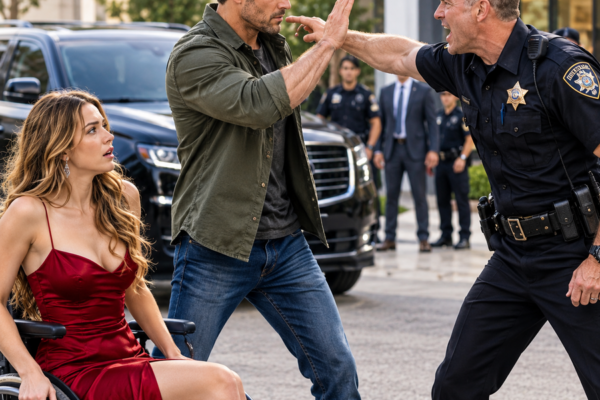
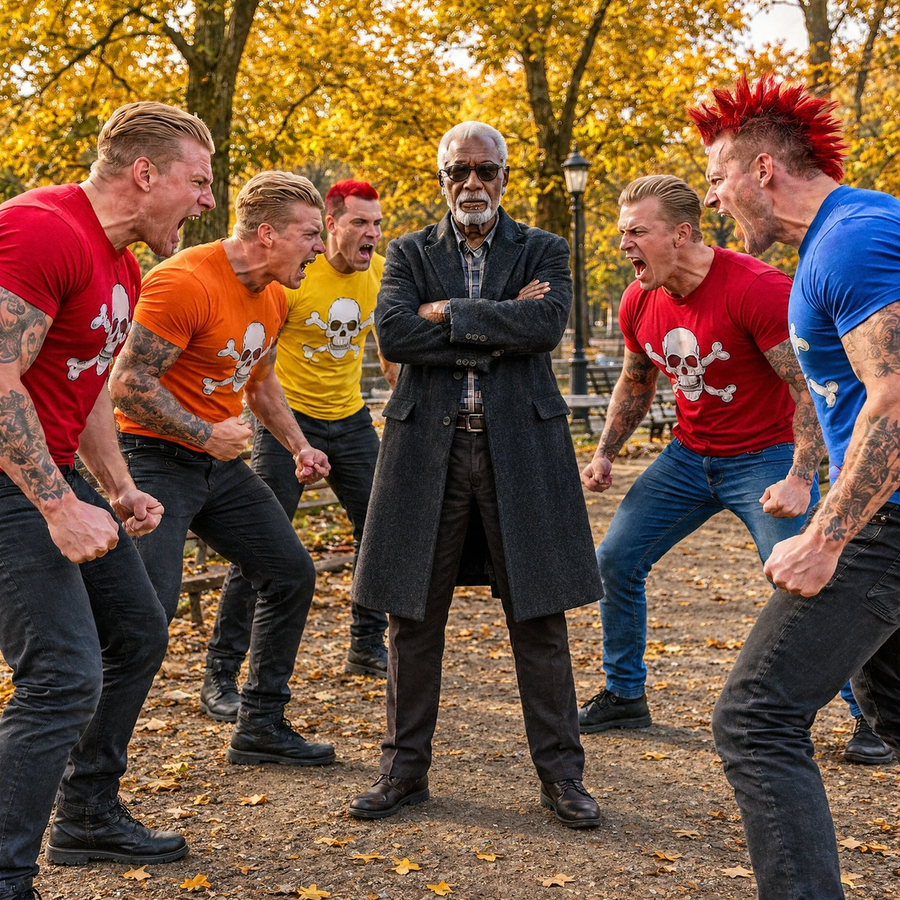
5 Bullies Circled an Elderly Black Man in the Park — Not Knowing, He Was a MMA Champion

5 Bullies Circled an Elderly Black Man in the Park — Not Knowing, He Was a MMA Champion
Get off my park, old man.
I’m just feeding the duck, son.
Don’t call me son.
Cody angrily grabbed Bernard’s collar and yanked him half up.
Who the hell are you to think you’re my father, you limping fool?
Let go of my shirt, please.
Cody kicked the cane out from under Bernard’s arm.
His bad knee buckled hard against the concrete. Cody let him drop and turned to his boys.
You’re stinking up my park, old man.
Let me fix your other knee so you can crawl home.
Please don’t say that.
Teach him a lesson. This stinking dares to talk back to me.
They closed the circle. Bernard pushed himself up slowly, every joint protesting.
He looked at Cody. You sure about that, son? Cody had no idea who the man he had just attacked really was.
That morning had started like every other morning for the past 3 years. Bernard laced his shoes at 6:15 in the two-bedroom apartment above the corner deli on Route 33. The apartment smelled like old wood and coffee grounds.
Coffee first, then the framed photograph on the fridge. Loretta on a beach the summer of their 15th anniversary, laughing at something he could no longer remember. He kissed his finger and touched the glass.
Same order, same silence, same fresh cup of coffee going cold while he stared. 40 years married, 3 years alone.
The knee was bad this morning. He rubbed linamament into it, wrapped it in an elastic sleeve, and took the wooden cane from the hook by the door.
The cane had been his father’s.
Riverbend, Ohio, population 8,000 and change. Two churches, one high school, one grocery store that used to be a Woolworth. The park sat at the end of Elm Street, where the river curved past the water tower.
Bernard’s building was three blocks away.
He knew every crack in the sidewalk between his door and his bench. Mrs.Atkins waved from her porch.
She’d known Loretta from choir for 30 years.
Diego from the bike shop nodded on his way to open the store. Sheila at Corner Perk had his black coffee ready when he walked past.
No charge the way she’d done every day since Loretta’s funeral.
Feeding the babies again, Bernie. Every day, Sheila, give him one for me.
The bench sat between two oak trees 10 ft from the duck pond. Loretta had picked it out on their first spring in town.
You could see the water from there, and it caught the morning sun. Bernard broke stale sourdough into the paper bag on his lap. The ducks knew him.
So did the geese. So did the one gray heron that stalked the shallows every Tuesday. What Cody Wilson could not see standing over Bernard with a curled lip that afternoon was any of that.
He couldn’t see the photograph on the fridge.
He couldn’t see the welterweight belt at the bottom of a cardboard box in Bernard’s closet.
He couldn’t see the 12-year career fighting for regional promoters up and down the Midwest.
Pay-per-view undercards, gymnasium prelims, smoky VFW halls in Toledo and Akran. One televised main event on ESPN 2 that Loretta had watched from the front row in a green dress.
He couldn’t see how many mornings Bernard had come home from a fight with a face that scared her.
He couldn’t see how many times he’d made her laugh again before breakfast.
Cody couldn’t see any of that because Cody wasn’t looking.
Cody Wilson was 28 unemployed since spring.
He’d moved back into his father’s house after 2 years of failing to make the family restaurant chain work in Columbus.
The last family dinner had ended with his father calling him soft, unfocused, and a disappointment to the Wilson name.
Cody’s older brother had nodded through the whole speech.
Their mother had said nothing. Cody needed to feel hard. He needed to feel like a Wilson.
He had four buddies who felt the same, more or less. Ryan, whose father owned the auto shop. Dylan, whose father owned nothing but a temper.
Micah, who was going to community college on his mother’s savings, Tanner, who wasn’t going anywhere.
They met at Riverbend Park every afternoon because it was free and they had nowhere else to be.
They’d been watching Bernard for 2 weeks.
Cody had picked him for reasons that felt like strategy, but were mostly hunger. Bernard was old. Bernard was alone.
Bernard walked with a cane and fed ducks and never once looked up when Cody’s crew slouched past his bench.
Bernard was in Cody’s math easy.
Or so Cody thought. The cane on the concrete that Tuesday afternoon was the loudest sound the park had heard in years.
By nightfall, everyone in Riverbend would know why. Two weeks earlier, Bernard had come to the park to feed the ducks.
Cody Wilson had come to look for someone to hurt. It was the first time the two of them had ever spoken.
Bernard sat on his bench, paper bag on his lap, Cain leaning against his good knee. The heron was already at the shallows. The malards were fighting over crust.
Cody and his four buddies came up the gravel path in a loose knot, laughing too loud, hands in pockets. Cody stopped 10 ft from the bench. Look at this.
Nature Channel special. Old man versus wet birds. The crew snorted.
Dylan spat on the grass. Bernard did not look up.
He tore another piece of sourdough.
Hey, I’m talking to you.
I heard you.
You always feed rats at this bench because I’ve been coming here 2 weeks.
Every day you’re on that bench.
Same bench. Same rats. Bernard broke another crust.
It’s my bench.
Your bench? Cody walked in a slow half circle around it, boots crunching gravel. This whole park was built by the Wilson Foundation.
Whole east side of Riverbend was Wilson land before you were born. You know that.
I know. Then get off Wilson property.
Bernard finally looked up. His eyes were quiet the way still water is quiet before a stone drops in it.
He looked at Cody without expression.
Cody didn’t like it.
I’m not property.
Neither is this bench. Ryan shifted uncomfortably. Micah looked at his phone.
Only Dylan was still smirking. Cody felt the air go slack around him. He did the thing he always did when he felt himself losing a moment.
He kicked the paper bag. Bread scattered across the gravel. The ducks scattered, too.
See you tomorrow, uncle. Bring more bread. My rats got to eat.
Cody’s crew laughed.
They kept walking. Bernard stayed on the bench.
He picked up one piece of bread from the gravel, brushed it off, and finished feeding the ducks who dared come back. That night, in the small kitchen above the deli, Bernard opened a drawer he had not touched in 20 years. He took out a small black notebook.
On the first fresh page, he wrote, “Cody Wilson, Tuesday, first contact.
” The next day was Wednesday.
Cody came alone.
He sat down on Bernard’s bench before Bernard arrived.
When Bernard walked up with his cane and his paper bag, Cody was already there, legs stretched out, arms across the back. Morning, uncle.
Bench seemed empty. Bernard nodded once.
He walked 10 ft down the path to another bench and sat. Cody laughed. Oh, you can move.
I thought you were stuck to that other one. Bernard opened his paper bag. The ducks came to him.
They didn’t care which bench.
Thursday, Cody brought Dylan.
They stood behind Bernard’s bench and dropped cigarette butts into his coffee cup on the armrest.
Friday, Cody kicked at the ducks. They scattered, squawking. Bernard sat still and watched them come back.
Cody kept kicking until they would not come back.
Saturday, Cody wasn’t there.
Sunday, Cody wasn’t there.
Monday morning at 6:30, Bernard walked to his bench and found a dead duck on the seat, neck broken, freshly done. He stood for a long time looking at it. Then he put it in his paper bag with the bread, carried it home, and buried it in a coffee can behind the deli.
He said a short prayer over it. He was not a church-going man anymore.
Loretta had been, and some habit stayed. That evening, he made a phone call he had not made in almost 30 years.
Terrence, Bernie, that you?
It’s me, man.
I ain’t heard your voice since that thing in Louisville.
99 something like that. You okay?
I got a situation. Terrence Boyd was 3 years older than Bernard.
Ran a small gym above a laundromat in Cleveland. He listened for 20 minutes without saying much.
When Bernard finished, Terrence said, “How many are there?”
Five mostly. One does the talking.
He carrying not that I’ve seen.
You still got the notebook? Started a new one.
Good. Every incident, every witness, every phone that films it, you write it down.
And you don’t touch a hair on his head unless he touches you first.
You hear me, Bernie? I hear you. Because they will spin it.
Old black man, group of white kids, small town. They will spin it fast and they will spin it hard.
I know.
I’ll be down Saturday.
Bring my camera. Bring the good one. Always the good one.
Bernard hung up. He wrote in the notebook called Terrence.
He’s coming.
The next Tuesday, Cody stood in front of his father’s bookshelf and stared at a framed photograph of his grandfather.
First Wilson’s grill, 1962.
His father was in the frame, too, 12 years old in a bow tie. His father had told him at Sunday dinner that the Riverbend restaurant was closing at the end of the quarter unless the numbers turned.
He had said it looking at Cody’s brother, not at Cody.
Cody was going to fix that. He was going to make the Wilson name mean something again. He would do it by clearing the east side for the redevelopment his father had been chasing for 18 months.
Three parcels stood in the way. Two were old apartments above dead retail. One was a two-bedroom above the corner deli on Route 33, held free and clear by a widowerower who had refused three cash offers.
The widowerower had a name. Cody had looked it up. Bernard Ingram, retired, 68.
No children, no lawyer, no mortgage, no visible income above social security, no family within 400 miles, no union pension, no community board seat. Easy.
Cody stared at his grandfather’s photograph and made himself a promise.
He would break this old man’s spirit or he would break the old man himself.
Either way, the bench and the deli and the three parcels would come loose. Either way, his father would look up at Sunday dinner and see him. He did not tell Ryan.
Ryan would not get it. The next day, Cody saw Bernard writing in a small black notebook after their exchange. He understood correctly that the old man was documenting him.
“What is that?
You writing a diary about me, uncle?”
“Notes for the police report.
” Cody laughed too loud.
His crew laughed with him. That night, Cody did the math.
Notes weren’t enough.
He needed something on camera, something the old man could not talk his way out of. He needed the old man to swing first.
He put a plan together. It took him 4 days. He picked the time 3:00 Tuesday when the jogger women were on their route.
He picked the angles, three phones, three positions, one crew member holding a coffee cup he would throw. He picked the crew member who would fall. Tanner would fall.
Tanner had the least to lose. Tanner would fall and Micah would scream. And by the time the ambulance came, the internet would already have picked its side.
Meanwhile, Bernard drove to Cleveland on a Saturday morning and spent 6 hours at Terren’s gym above the laundromat.
They did not spar. They talked.
They walked the floor. Terrence had photographs on the wall.
Bernard among them, 30 lbs heavier, glove raised in a red trunks knight from a long time ago. Terrence showed him a small body camera clipped inside a coat button.
He showed him an audio recorder that looked like a pen. He showed him the app that would stream anything the body camera saw to a cloud folder. He walked Bernard through three drills.
How to protect the recorder. How to keep the audio pen clean. How to make a controlled fall look natural to any camera that might catch it.
How to say the words, “I am asking you to leave.”
in a voice that would carry to a jury.
“You’re not fighting them,” Terrence said.
“You’re recording them.”
And when they cross the line, you protect yourself. Not one inch more.
Not one inch more. Say it again. Not one inch more.
Because if you cross that line, Bernie, they’ll bury you, and I am too tired to dig you back up.”
Bernard drove home that night with the camera in his coat pocket and the audio pen clipped to his notebook. The next Tuesday was the Tuesday that would break the internet.
Cody was ready. So was Bernard, but only one of them knew what ready meant. That Tuesday morning, Bernard did not go to the park at his usual hour.
He sat at his kitchen table until 9. He unwrapped the small body camera and clipped it inside the second button of his coat, angle facing up and out. He clipped the audio pen inside his notebook cover.
He tested both on his phone twice, then again. Terrence knocked at 10.
He had driven down from Cleveland at first light. He carried a duffel bag with a second phone, a folding tripod, and the coffee thermos Bernard had left at his gym in 1998. You ready, Bernie?
I am. You remember what we said?
Not one inch more. Say it again. Not one inch more.
Terrence set up the second phone on the tripod inside the deli window angled across the street. If a phone in the park failed, this one would not. He also handed Bernard a card folded twice.
Woman I know. Civil rights lawyer out of Columbus.
Real one.
She’s expecting your call by end of business either way.
Thank you.
Don’t thank me.
Live through today. Bernard drank the last of his coffee. He looked at the photograph on the fridge, kissed his finger, and touched the glass.
Bernard drank the last of his coffee. He rinsed the cup in the sink the way Loretta had taught him.
hot water first, then cold. He dried it with the checkered towel and set it upside down on the rack.
He put on the coat. He checked the camera button twice.
He checked the audio pen three times.
He picked up the cane, his father’s cane, the one that had crossed three state lines and two decades of ring walks.
He walked out the front door. Terrence watched him from the deli window. He did not wave.
He did not need to. They had been in corners together before.
They knew what a walk to the ring looked like. Bernard walked to the park at his usual afternoon hour.
Cain in his right hand, camera in his coat. The sun was behind the water tower. The ducks were at the pond.
The bench was empty. Cody was not. Cody was on the bench when Bernard arrived, legs stretched out, a paper coffee cup in his hand.
His four friends fanned along the treeine, hands in pockets, phones half- raised. Tanner stood near a low iron railing, the one Cody had told him to stand near. Ryan had a paper cup of his own, coffee, held out awkwardly.
Dylan was at the picnic table 20 ft back with his phone up. Micah was on the path blocking the exit. Renard walked up slowly, cane clicking.
He noted every position without looking. He stopped six feet from the bench. Get off my park, old man.
I’m just feeding the ducks, son.
Don’t call me son.
Cody stood angry and grabbed Bernard’s collar.
He yanked him half up.
Who the hell are you to think you’re my father, you limping fool.
Let go of my shirt, please.
Cody kicked the cane out from under Bernard’s arm.
Bernard’s bad knee buckled hard against the concrete.
You’re stinking up my park, old man.
Let me fix your other knee so you can crawl home.
Please don’t say that.
Cody let him drop and turned to his boys. Teach him a lesson. This stinking dares to talk back to me.
The circle closed. Bernard pushed himself up slowly, every joint protesting. He looked at Cody.
You sure about that, son? Cody swung wide, fast, aimed at the jaw.
Bernard’s left hand came up like it remembered everything, like muscle had its own calendar, and the appointment was 20 years overdue.
He caught Cody’s wrist midair, redirected the punch past his own shoulder, and pivoted on his good knee.
Cody stumbled forward.
Ryan lunged from the right coffee cup falling hand, reaching for Bernard’s throat.
Bernard did not strike him.
He caught Ryan’s wrist, dropped his weight, and used Ryan’s own momentum to pull him past.
Ryan’s face met the arm of the bench.
He went down without a sound. His coffee cup rolled under the bench lid, popping off brown liquid pooling on the concrete.
Bernard’s knee screamed.
He ignored it. He had been ignoring that knee since 1999. Micah came next from the front, both hands.
Bernard sidstepped, slipped one hand under Micah’s elbow, and drove him gently but firmly into the wet grass.
He held him there for 3 seconds. Then he let go. Stay down.
Micah stayed. Dylan lunged from behind. Bernard felt him coming.
You learn to feel these things when you have done this for a living and simply pivoted. Dylan overran the bench and hit the iron railing chest first.
Tanner had been waiting for his queue. His cue was a punch that never came.
Confused, he started his fall anyway, a theatrical stumble toward the concrete coffee cup already flying. Bernard caught him by the collar midfall.
He sat Tanner down carefully on his back on the grass.
“You drop this,” Bernard said.
He placed the coffee cup upright next to him. His voice had not changed, not once.
Same volume, same tone, same sun cadence he used for every sentence since the first day on that bench. Now only Cody was standing.
Cody had his wrist still trapped in Bernard’s left hand.
Bernard had not let go the entire time. He had not thrown a single strike.
He had not even raised his voice. Cody looked at his crew on the ground. He looked at the phone still filming.
He looked at the jogger 50 ft off at the deli window where a second phone caught a different angle.
He looked at Bernard’s eyes which were quiet the way still water is quiet.
Bernard let his wrist go. Go home, son. Cody went.
He ran. Actually ran. Boots skidding on gravel.
jacket flapping past the picnic table, past the swings, past Micah still lying face down in the grass. His crew got up in stages behind him.
Ryan holding his nose, Dylan bent over the railing. Tanner staring at the sky.
They did not follow Cody. They did not know where to follow him, too. Bernard sat down on the bench.
He picked up his cane. His lip was bleeding.
His knee was swelling to twice its size. His hands were shaking.
the way hands shake when they have not done that kind of work in 20 years. He wiped the blood off his mouth.
He looked at the ducks that had scattered to the far side of the pond. You can come back now. The jogger got there before the ambulance.
Her name was Amelia. She was 29, a parallegal at a firm in Columbus.
She had been recording since Bernard set his coffee down that afternoon. She sat on the bench next to him. She did not stop filming.
You okay, sir?
I’ve been worse.
Ambulance is coming. Thank you.
I got all of it. Every angle. Sound, too.
Terrence has it, too. And the deli window.
Amelia laughed once, short and surprised. Sir, this is going everywhere.
She was right about that. By 8:00 that evening, the first clip had 2 million views. By 10, 4 million.
By midnight, the world had picked its favorite 30 seconds.
Bernard’s calm face saying, “Go home, son.”
Looped, slowed, set to music printed on shirts by morning. The hashtag was up before 3:00 a.m.# Bernard Ingram # Riverbend Park #not1in more. That was the good part.
The bad part started at breakfast. By 8 the next morning, three Ohio news outlets had picked up the story with a different framing.
Retired man attacks group of local youths in Riverbend Park. No mention that Bernard was black.
No mention that Bernard had said please more than once. No mention that Cody had grabbed his collar first. By 9, a Columbus Talk radio host was calling it senseless.
A local paper editorial went up at 10:00.
The headline read, “Where does vigilante justice end it?”
At noon, a process server knocked on Bernard’s door.
Terrence answered, “Bernard Ingram, not right now.
I have a civil complaint.”
He handed over a manila envelope. Terrence closed the door.
Inside, Bernard sat at the kitchen table with an ice pack on his knee. He opened the envelope.
He read the first page. Then, he read it again. Cody Wilson and his four friends were suing him for aggravated assault.
Ryan claimed a broken nose. Dylan claimed a concussion.
Micah claimed emotional distress. Tanner claimed a coffee cup burn and a torn ligament. Cody claimed he was the victim of an unprovoked attack by a former professional fighter who had lured him into a public confrontation.
$12 million, punitive damages. Bernard put the papers down.
He looked at Terrence.
Well, he said, “That was fast.”
Terrence sat down across from him.
“Told you they would spin it.
You didn’t tell me they would sue me for 12 million.”
I underestimated them.
“Yeah.”
Outside, a car door slammed, then another, then a news van.
The next 72 hours were the worst Bernard had lived through since Loretta’s funeral.
The news van parked outside the deli on Wednesday morning. Two more arrived by noon.
A reporter from Columbus stood on the sidewalk and did her standup with Bernard’s window in the background.
A retired Riverbend man is at the center of a growing controversy tonight. Cell phone video shows him confronting a group of young men at the park. Confronting, not defending.
Bernard heard the words from his kitchen. Terrence shut the window. By Wednesday evening, the narrative had calcified.
Talk radio said, “Senior citizen assaults five youths.”
A cable segment ran the clip backward.
It started from Ryan’s bloody nose.
It cut before Cody’s collar grab.
The internet had split. Half the comment said hero.
Half said criminal. The louder half was winning. Thursday morning.
Sheila at Corner Perk did not have his coffee ready. She was behind the counter when Bernard walked in.
She looked at him then at the floor.
Bernie, I can’t.
Can’t.
What?
I’m getting calls, people saying they’ll boycott.
Three stars on Google this morning. Three.
You’ve known me 15 years, Sheila.
I know. She did not pour the coffee. Bernard stood there.
Then he left. The bell on the door did not ring.
Sheila had removed it. Thursday afternoon, Bernard tried to walk to the park.
A woman he did not know stopped him on the sidewalk. You should be in jail. He turned around.
That evening, someone threw an egg at his apartment window.
It hit the glass 3 ft from Loretta’s photograph.
Terrence cleaned it off without saying a word.
Bernard sat at the kitchen table and wrote in the notebook, “Egg window.
8:14 p.m.No plate number.”
Friday morning, Mrs.Atkins did not wave from her porch. She was inside, curtains drawn.
Diego from the bike shop was open, but would not look up when Bernard walked past. The sidewalk that had greeted him every morning for 20 years was now a gauntlet of turned backs and closed doors. Bernard kept walking.
He had been walking into hostile rooms his entire career. A sidewalk was nothing. Friday, a second editorial ran in the Columbus Dispatch.
A law professor was quoted calling Bernard’s response disproportionate force by a trained combatant.
The quote did not mention Cody’s collar grab.
It did not mention the cane. It did not mention two weeks of escalation. The lawsuit gained weight.
Cody’s father, Richard Wilson, had hired a Columbus firm for personal injury.
The firm had connections to two local judges. They filed a motion barring Bernard from the park, the bench, and the threeb block radius. The judge signed it Friday evening.
Bernard was banned from the only place in Riverbend that still felt like home.
“Terance called the Columbus lawyer.
Her name was Dana Price.”
She picked up on the first ring.
“I’ve been watching the coverage,” she said.
“Then you know, I know the framing is bad.
I know the lawsuit is garbage.
I know the injunction won’t survive appeal, but you need to win in public before you win in court.”
How? Evidence.
Every recording, every notebook entry, every time stamp, and the thing they don’t know you have, what thing?
The thing they never bothered to look for.
The week between Saturday and Thursday was the longest week of Bernard’s life.
Sunday, he stayed inside. Terrence cooked.
They ate scrambled eggs in silence. The phone rang four times.
Bernard did not answer. Two were reporters. One was Diego from the bike shop.
One was Mrs.Atkins. Monday, Bernard tried to walk to the grocery store. A pickup truck slowed next to him on Route 33.
The driver, a man he had never met, rolled down the window. You the guy from the video? Depends on which video.
The one where you attacked those kids. Bernard kept walking.
The truck kept pace. My nephew is friends with one of those boys.
You broke his nose.
Your nephew’s friend grabbed my collar first.
That ain’t what the news said.
The news is wrong. The truck accelerated. Bernard walked home the long way through the alley behind the bike shop so no one else would stop him.
Tuesday, Dana called. She had received a cease and desist letter from Holtz firm demanding that all body camera and audio recordings be destroyed as illegally obtained surveillance.
Can they do that? Bernard asked.
No. Ohio is a one party consent state.
You were the party. You consented. Good.
But they’re going to argue it in front of a sympathetic judge if they can.
We need to get ahead of this. How far ahead?
Thursday ahead. Wednesday night.
Bernard could not sleep. He sat at the kitchen table at 2 in the morning with the notebook open. He read every entry from the first page.
43 encounters, 14 days.
He had written them in the same handwriting he used to write Loretta’s grocery lists.
He closed the notebook. He looked at the fridge.
“I’m tired, baby,” he said.
“But I’m not done.”
Terrence found him asleep at the table Thursday morning. Notebook under his arm, coffee cold.
“Wake up, Bernie.
We got a meeting to win.”
Bernard put on the coat. He checked the camera button. He clipped the audio pen.
Let’s go.
Dana flew to Riverbend on Saturday.
She sat at Bernard’s kitchen table with Terrence and a legal pad.
She watched the body camera footage. She watched the deli window footage.
She watched Amelia’s jogger footage.
Then she said, “I need the notebook.”
Bernard gave it to her. 43 entries, dates, times, witnesses, license plates, weather, every encounter in steady handwriting that did not waver from first page to last. Dana looked at Terrence.
Your friend is meticulous. He was a fighter. Fighter study tape.
Dana looked at Bernard.
There’s a town council meeting Thursday.
Open session. Public comments.
I want to present all of it.
That’s not a courtroom.
No, it’s better.
It’s a room full of voters.
And if they don’t listen, then we take the same evidence to court.
But I think they’ll listen.
Why? Dana turned her laptop toward Bernard.
On the screen was a screenshot from Cody’s phone, a group chat with five names, messages dated, timestamped, and explicit.
Micah’s mother found this on his phone last night.
She called me directly. She is very angry. Bernard read the first message, then the second, then he sat back.
The messages laid it out, every detail.
The plan to provoke Bernard, the assigned camera angles, Tanner’s staged fall, the coffee cup, the choreography.
Cody had written it all down in a chat called Operation Bench Press. Operation bench press. Bernard looked at Terrence.
Terrence looked at Dana. They wrote it down, Terrence said. They always write it down, Dana said.
They always think the chat is private. Bernard closed the laptop.
He looked at the photograph on the fridge. Thursday, he said.
Thursday. Outside, the news van was still parked. Inside, the evidence was stacked.
And in a group chat on five phones, the confession was already written in their own words, in their own time.
They just didn’t know it yet.
Thursday night, Riverbend Town Hall, room 4B. The room held 200 chairs and everyone was taken. Another 60 people stood along the walls.
Two cameras from Columbus station set up in the back. Amelia sat in the third row with her phone already recording. Bernard walked in with Terrence on one side and Dana Price on the other.
He wore the same coat. The body camera button was still clipped inside it.
Cody Wilson sat in the front row with his father, Richard. Richard wore a suit. Cody wore a collared shirt.
someone had ironed for him. Their lawyer, a man named Hol from the Columbus firm, sat one seat over with a leather folder. The room went quiet when Bernard entered.
Not silent quiet, the hum of 200 people deciding what they thought. Council Chair Margaret Stokes called the session to order at 7 sharp.
We have one item on the public comment agenda tonight. The incident at Riverbend Park on Tuesday the 14th.
We will hear from both parties. Mr.Holt, you have 10 minutes.
Holt stood. He was polished.
He was smooth. He told the room that five young men had been attacked without provocation by a man with professional combat training. He showed the edited clip.
Ryan’s bloody nose.
Dylan bent over the railing. He used the word ambush. He used the word predator.
He said Bernard had lured these young men to the park. He called it a violent assault disguised as self-defense.
He sat down to light applause from the Wilson side of the room. Dana stood. Council members, my name is Dana Price.
I represent Bernard Ingram. I have three things to show you tonight.
They will take less than 9 minutes. She held up a USB drive.
The tech volunteer plugged it into the projector.
First, the body camera footage from Mr.Ingram’s coat.
The room watched. The footage started with Bernard walking to the bench.
It showed Cody already there. It showed the collar grab.
It showed the cane kicked.
It showed Bernard’s knee hitting concrete.
It showed every word Cody said in order in real time. The room was no longer quiet. It was loud.
Second, the audio from Mr.Ingram’s pen recorder.
She played 30 seconds.
Cody’s voice was clear.
This stinking dares to talk back to me. The room flinched.
A one in the fourth row put her hand over her mouth. Third.
Dana clicked to the next slide. The room saw a screenshot of a group chat.
Five names. A thread titled Operation Bench Press.
These messages were recovered from one participant’s phone by his mother.
They are dated. They are timestamped. They describe in detail a plan to provoke Mr.Ingram into a physical confrontation.
She read three messages aloud. Just three. That was enough.
Message one, Cody to group. Tuesday, 3 p.m.I grab his collar. Tanner falls.
Dylan and Micah film. Make sure he swings first. Message two, Cody to group.
If he doesn’t swing, we escalate.
Kick the cane. Call him names.
Whatever it takes. Message three, Cody to group.
Dad’s lawyer is on standby.
We sue the same day. The room broke open.
People stood. Voices overlapped.
Margaret Stokes hit the gavl four times before it got quiet again. Dana waited, then she spoke.
Mr.Ingram did not swing first. Mr.Ingram did not ambush anyone.
Mr.Ingram is a 68-year-old widowerower who feeds ducks in a park he has visited every day for 20 years. He was targeted, harassed for 2 weeks, physically assaulted, and then sued for defending himself. She turned to look at Cody.
The question is not what Mr.Ingram did.
The question is why five young men planned in writing to destroy a man’s life.
And the answer is in the messages.
Cody’s face had gone white.
His father was staring straight ahead. Hol stood. Council chair.
These messages have not been authenticated. Dana cut him.
They were submitted to the Riverbend Police Department this morning by the mother of one of the participants. She authenticated them herself.
The police are reviewing them now. Holt sat down. Margaret Stokes looked at Cody Wilson, then at Richard Wilson, then at the room.
I think we’ve heard enough for the public comment session.
I am recommending that this council refer the matter to the county prosecutor for independent review. I am also recommending that the emergency injunction barring Mr.Ingram from the park be reviewed immediately. Applause.
Real applause. Not one side of the room. Both.
Bernard did not clap. He did not smile. He sat with his hands on his cane and looked at the floor.
Terrence put a hand on his shoulder.
Amelia’s footage of that moment, Bernard sitting still while the room erupted, got 11 million views in 48 hours.
It was the second most replayed moment of the entire story. The most replayed moment was still coming. After the meeting, a reporter from a Columbus station stopped Dana in the hallway.
Ms.Price, your client. Is he really a former professional fighter?
Dana smiled. You should look that up. By Friday morning, someone did.
A sports blogger in Akran found the record. Bernard Ingram, welterweight, 12 years on the regional circuit.
31 wins, six losses, 22 by submission. One ESPN 2 main event 1998 against a man named Carl Driscoll in Toledo. The internet did what the internet does.
By noon, the ESPN 2 footage was on every platform. Bernard at 40 gloves up in red trunks Loretta in the front row in a green dress. The clip of him finishing Driscoll with an armbar in the third round was watched 9 million times by Saturday.
Someone found an interview from after the fight. Bernard, 40 years old, ice on his knuckles, looking into the camera. I fight clean because my wife is watching.
Loretta was in the background, green dress, arms crossed, smiling like she already knew. That clip alone got 20 million views.
People cried in the comments.
They said, “Protect this man at all costs.”
They said, “He fought for her then and he fought for her now.”
They were not wrong. # Bernard Ingram trended nationally.
#not1in more went global. A retired MMA analyst posted a breakdown of the park footage frame by frame. He pointed out every technique Bernard had used.
The wrist redirect on Cody, the hip drop on Ryan, the elbow guide on Micah, the collar catch on Tanner. Four controlled takedowns in under 90 seconds.
No strikes, no blood drawn by Bernard’s hands.
The analyst’s conclusion was one sentence.
This man could have ended all five of them. He chose not to. That is mastery.
The video of the analysis got 12 million views on its own. And in Riverbend, Ohio, a 68-year-old widowerower sat at his kitchen table.
He looked at the photograph on the fridge. Loretta laughing. He did not say anything.
He did not need to. She already knew.
The consequences came in stages like dominoes someone had spent months lining up. Monday morning, the county prosecutor announced a formal investigation. the charges, fraudulent civil complaint, conspiracy to commit assault, and filing a false police report.
The civil suit against Bernard was withdrawn by Holt’s firm before lunch.
By 2:00, Holt’s firm had dropped Cody Wilson as a client entirely.
Ryan turned first. His father, the auto shop owner, drove him to the police station on Monday afternoon. Ryan gave a full statement.
He confirmed the group chat. He confirmed the plan. He confirmed that Cody had written every step and assigned every role.
He said he had not wanted to do it. He said he had done it anyway.
Dylan turned second. No father drove him.
He walked in alone on Tuesday morning and asked for the detective by name.
Micah’s mother had already done the work.
Micah was cooperating from the start. His mother sat next to him in every interview. She did not let him look away from the questions.
Tanner was the last. He showed up Wednesday with a public defender and a bruise on his cheek he would not explain. He confirmed that his fall had been staged.
He confirmed that the coffee cup had been thrown on Q. He confirmed that Cody had rehearsed the scene with him three times in a parking lot behind the gas station on Route 33.
Four confessions, four signed statements, four young men pointing at the same name.
Cody Wilson was arrested on Thursday morning at his father’s house.
The charge sheet ran two pages. Conspiracy, filing a false report, assault by means of a dangerous weapon, the cane kick.
Under Ohio law, Bernard’s disability made the cane an extension of his mobility.
Richard Wilson held a press conference that afternoon. He stood at a podium outside the family restaurant. He said his son had made mistakes.
He said the family was cooperating fully. He did not mention the redevelopment plan.
He did not mention the three parcels. He did not mention the cash offers Bernard had refused.
A reporter asked about them anyway.
Mr.Wilson, is it true your family made three separate offers to purchase Mr.Ingram’s property?
Richard Wilson ended the press conference. By Friday, the Riverbend City Council had frozen the Wilson redevelopment application pending an ethics review.
The family restaurant on Main Street lost its weekend reservations. Not all of them enough.
The Columbus Dispatch ran a correction on page one.
The headline read, “Park incident, what the first reports got wrong.
” The law professor, who had used the phrase disproportionate force, issued a one paragraph statement.
He said he had been quoted without full context. He did not apologize. The news cycle turned like a wheel.
The same outlets that had called Bernard a predator now called him a hero.
A cable morning show ran a 5-minute segment, The Man Who Wouldn’t Swing First.
They played the body camera footage in full. Unedited.
For the first time on national television, the comment section exploded. Dana got calls from three other civil rights firms offering to partner. She got calls from two documentary producers.
She got a call from a congressional staffer who wanted to talk about elder abuse legislation. Bernard got letters, real ones, on paper in envelopes with stamps.
A retired Marine in Virginia who had been jumped at a bus stop. A grandmother in Detroit whose landlord had tried to force her out.
a former boxer in Mississippi who had been arrested for defending himself at a gas station. They all said the same thing in different words. I thought I was alone.
Bernard read every letter. He answered none.
He kept them all in a shoe box under the bed next to Loretta’s shoes.
The newspaper’s reporter, a man named Gillis, was placed on leave pending an internal review.
He had written his story using only the Wilson family’s press release as a source.
He had not contacted Bernard. He had not contacted Dana Price.
He had not watched the body camera footage which had been publicly available for 3 days before his article ran. Sheila at Corner Perk called Bernard on Saturday morning. Bernie.
Sheila.
I’m sorry.
Bernard was quiet for a moment.
I know your coffee’s on me for a long time.
I’ll be in Monday.
I’ll have it ready.
He hung up and sat at the kitchen table.
Terrence was in the other room on the phone with the gym telling someone he’d be back next week.
Bernard looked at Loretta’s photograph.
He did not cry. He had done his crying 20 years ago in locker rooms and parking lots where no one could see.
He had learned a long time ago that tears were private and strength was what you showed the world when you were out of tears.
“We did it, baby,” he said to the glass.
The following Tuesday, Bernard walked to the park for the first time in 3 weeks. Dana had gotten the injunction lifted on Monday. The bench was there, the ducks were there, the heron was in the shallows.
Someone had left flowers on the bench, yellow ones, no card. Bernard sat down. He opened his paper bag.
He tore the bread into pieces and dropped them one by one into the water. Mrs.Atkins walked past. She stopped.
“Welcome back, Bernie.”
“Thank you, ma’am.”
Loretta would be proud. Bernard nodded. He did not trust his voice.
Later that afternoon, the city council passed a resolution. The bench between the two oak trees at the duck pond would be formally dedicated. A small brass plaque would read in memory of Loretta Ingram.
She loved this place.
Bernard’s name was not on the plaque.
He had asked them to leave it off. It was always her bench, he said. 3 months later, Terrence Boyd opened the second floor of his Cleveland gym to a new program.
He called it Elder Shield. Free classes for adults over 60. Not fighting classes, evidence classes, how to use a body camera, how to keep a log, how to record without escalating, how to protect yourself within the law, and not one inch beyond it.
Bernard drove up for the launch. He sat in a folding chair in the back and watched Terrence teach 12 people how to clip a camera inside a coat button. One of them was 81.
She took notes in a spiral notebook, the same kind Bernard used.
Amelia the jogger became the program’s legal liaison.
She had quit the Columbus firm the month before and joined Dana Price’s practice.
She was the one who suggested the website. She was the one who posted the curriculum.
She was the one who answered the phone when a senior center in Dayton called then then one in Cincinnati. Then one in Atlanta.
By spring, Elder Shield had chapters in nine cities.
Dana Price took Bernard’s civil counters suit to trial.
The jury found Cody Wilson and his four co-fendants liable for defamation, intentional infliction of emotional distress, and conspiracy to file a fraudulent claim. The damages were not 12 million.
They were enough.
Enough for Bernard to keep his apartment, repair the deli building’s roof, and put the rest into a fund that Loretta would have liked.
Cody Wilson was sentenced separately in criminal court. community service, probation, a restraining order that covered the park, the deli, and every block in between. His father sold the restaurant on Main Street 6 weeks later.
The sign came down on a Tuesday. Ryan took a plea deal and enrolled in a mediation training program.
His father drove him to every session. Dylan moved to Pennsylvania.
No forwarding address. Micah finished community college. his mother made sure.
Tanner got a job at a warehouse outside Columbus. He wrote Bernard a letter that summer, one page. Bernard read it at the kitchen table.
He did not write back. But he kept the letter in the drawer with the notebook. The MMA community found Bernard.
Invitations came, podcasts, interviews. A gym in Akran offered him a paid position as a senior adviser. He turned them all down except one.
a video call with a high school in Toledo. A 16-year-old asked him what it felt like to fight five people at 68.
Bernard thought about it. Then he said it felt like Tuesday.
The kid laughed. The teacher laughed.
Bernard did not laugh. He meant it.
The following fall, Riverbend Park hosted its first annual standup day. Terrence came down. Dana came.
Amelia came with her daughter. Sheila catered the coffee.
Mrs.Atkins brought a sheetcake that said Loretta’s bench in yellow frosting.
Bernard sat on the bench. The brass plaque was new.
He ran his thumb across the letters. He did not read them out loud.
The ducks came to him. They always came to him. If this story reminded you of someone you know, a grandfather, a neighbor, a quiet man on a bench.
THE END.